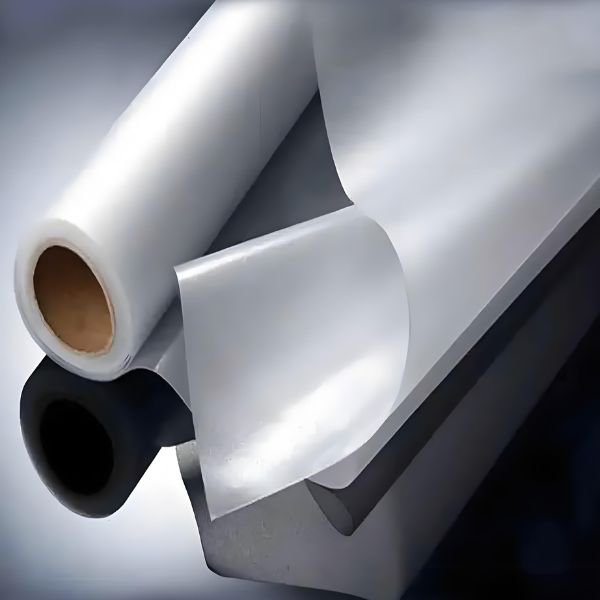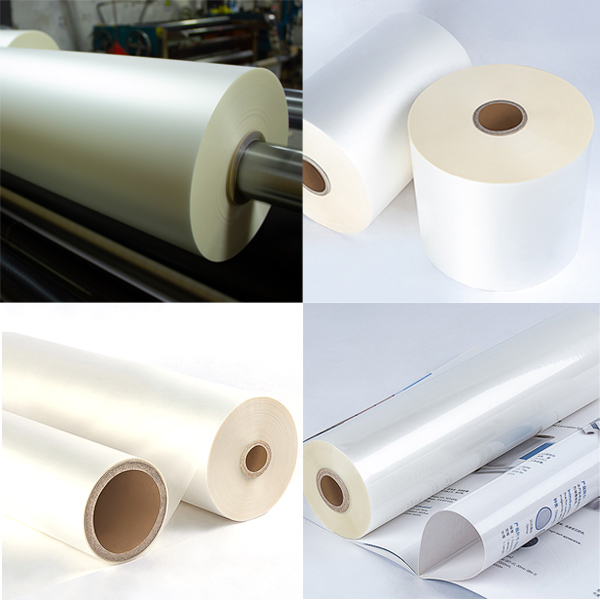
Choose matte BOPP when cost efficiency, low density, moisture resistance, and reliable performance in everyday dry-food packaging or paper lamination are the main priorities. Choose matte PET when higher heat resistance, tensile modulus, dimensional stability, or durable performance in demanding labels, graphics, and premium laminates is more important. Neither material is universally better. The correct decision depends on the exact film grade, thickness, matte surface, treatment side, laminate structure, converting temperature, packed product, and target market.
Both films can create a low-gloss, anti-glare appearance. However, that similar surface does not make them interchangeable. A 20 µm matte BOPP web should not be replaced with a 20 µm matte PET web only because the rolls look alike. Weight per square metre, stiffness, shrinkage, ink and adhesive compatibility, roll tension, and finished-pack behavior may all change.
If your project starts with a general-purpose packaging or laminating application, review matte BOPP film for printing and lamination. If the project requires a firmer web or more demanding thermal and dimensional performance, compare it with matte PET film for high-stability applications. Then qualify the selected grade on the actual converting and packing line.
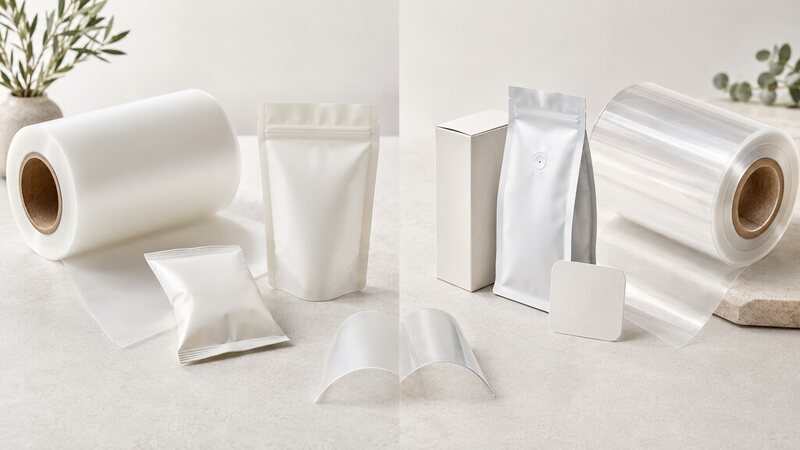
Quick Selection: Which Film Should You Shortlist?
| Your main requirement | Shortlist first | Reason |
| Economical matte outer web for snacks, dry food, overwrap, labels, or general paper lamination | Matte BOPP | Lower base-polymer density usually gives better area yield per kilogram, with useful stiffness and moisture resistance. |
| Higher process temperature or tighter dimensional control during printing, lamination, coating, or service | Matte PET | Polyester typically provides higher modulus, heat resistance, and dimensional stability at a comparable gauge. |
| PP-oriented laminate development | Matte BOPP | A polypropylene outer web may fit a PP-family design more logically, but the complete pack still needs a destination-specific recyclability assessment. |
| Durable label, control-panel overlay, screen-protection layer, or industrial graphic | Matte PET | Higher stability and durability are often more important than lowest material cost. |
| Premium pouch with no unusual heat or durability demand | Test both | Approve the appearance, hand feel, scuff behavior, structure, and total converted cost rather than selecting from the polymer name alone. |
This table is a screening tool, not a purchase specification. Some coated or coextruded specialty grades can reverse a typical trend. Always compare current technical data sheets under the same units and test conditions.
What Are Matte BOPP and Matte PET Films?
Matte BOPP is an oriented polypropylene film with a low-gloss surface
BOPP means biaxially oriented polypropylene. A matte grade may use a coextruded matte skin, a surface formulation, or a coating to scatter light and reduce gloss. It is commonly supplied with one matte face and one treated face for printing, adhesive lamination, or another converting step. Typical packaging roles include reverse-printed outer webs, label films, overlamination, and printed-paper protection.
Matte PET is an oriented polyester film with a low-gloss surface
PET film used in flexible packaging is usually biaxially oriented polyester, also called BOPET. Matte effects can be built into the film or applied through a specialized surface. PET is known for tensile strength, modulus, heat resistance, and dimensional stability. Matte grades are used in premium printed laminates, durable labels, book covers, electronic overlays, control panels, and anti-glare protective applications.
In most flexible packages, both materials serve as the outer web
The matte web normally provides appearance, print support, print protection, and stiffness. It does not automatically provide the package’s heat seal or complete shelf-life barrier. PE, CPP, metallized film, foil, coated film, or another functional web may be added according to the product. The matte plastic packaging materials guide covers the broader finish options; this page focuses only on choosing between the two oriented base films.
Matte BOPP vs Matte PET: Technical Comparison
| Decision factor | Matte BOPP: typical trend | Matte PET: typical trend | What the buyer should verify |
| Base polymer | Polypropylene | Polyethylene terephthalate | Exact grade construction, coating, additives, and intended surface function |
| Density and yield | Lower density; generally more square metres per kilogram at equal gauge | Higher density; generally fewer square metres per kilogram at equal gauge | Actual grade density, thickness tolerance, usable roll length, and price per square metre |
| Stiffness and modulus | Useful packaging stiffness, especially at common BOPP gauges | Usually higher modulus and dimensional stability at comparable thickness | MD/TD tensile data, modulus, web handling, and finished-pack feel |
| Heat resistance and shrinkage | More sensitive to elevated converting or service temperatures | Usually better thermal and dimensional stability | Shrinkage at an agreed time and temperature, maximum process temperature, and real-line trial |
| Water-vapor barrier | Generally the stronger uncoated base-film trend | Usually more moderate without a barrier coating or added web | WVTR of the complete laminate at stated temperature and humidity |
| Oxygen and aroma barrier | Moderate; should not be treated as high barrier by default | Generally better than standard BOPP, but still may not meet long shelf-life targets alone | OTR of the complete structure at stated conditions, plus product shelf-life trial |
| Printing and lamination | Good with the correct treated face, ink, adhesive, and tension | Good print registration and stability, especially in demanding multi-pass conversion | Side map, treatment level, ink system, bond strength, cure, and residual solvent where applicable |
| Heat sealing | Standard matte grades are not automatically sealable; dedicated sealable grades exist | Standard matte grades are not automatically sealable; coated sealable grades exist | Seal face, seal-initiation temperature, seal window, hot tack, and seal strength |
| Scuff and surface durability | Depends strongly on matte skin or coating; dark print can show rub marks | Often chosen for durable uses, but the matte surface still needs rub and scratch approval | Printed rub test, abrasion test, transport simulation, and approved visual limit |
| Typical commercial position | Cost-efficient general packaging and lamination option | Higher-performance option where heat, stability, or durability justifies the cost | Total converted cost, reject rate, line speed, downgauging potential, and supplier MOQ |
The general differences between oriented film families are summarized in the BOPP vs BOPET vs CPP vs PE packaging film guide. For this C1 decision, the matte surface must be evaluated as an additional functional layer because it can change friction, optical appearance, ink adhesion, and scuff response.
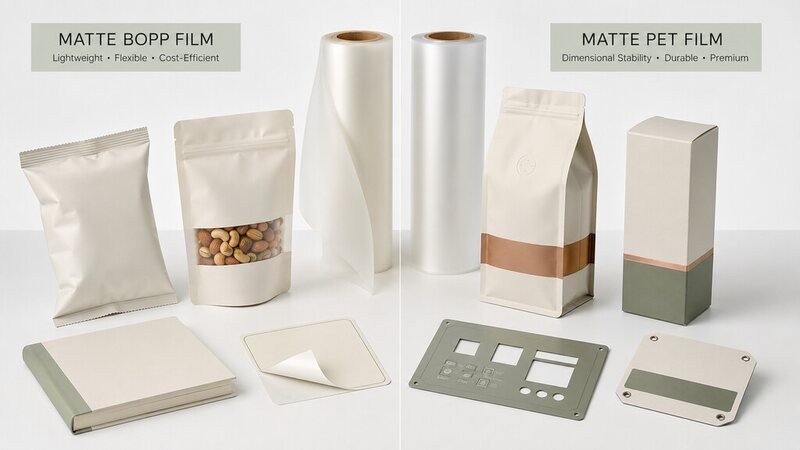
How Each Property Changes the Buying Decision
Stiffness and dimensional stability
Matte PET normally has a higher tensile modulus at a comparable thickness. This can help registration during printing, reduce web growth under tension, and keep a durable label or graphic overlay flatter in service. Matte BOPP still provides useful stiffness for pouches, flow wrap, labels, and paper lamination, but it may need different tension settings and may move more when heat and tension act together.
Do not specify stiffness only as “hard” or “soft.” Ask for thickness, modulus in both machine and transverse directions, tensile strength, elongation, and shrinkage. Then assess the finished laminate. A soft PE sealant or thick adhesive layer can change the hand feel even when the same outer web is used.
Heat resistance and process window
Matte PET is usually the safer starting point when the web will see higher drying temperatures, demanding coating conditions, hot filling, elevated service temperature, or a process where registration loss from shrinkage would be costly. That does not mean every matte PET grade is suitable for retort, oven use, or sterilization. Those conditions require a purpose-designed complete structure and validation.
For ordinary snack laminates and paper applications, matte BOPP may operate well within the converter’s established temperature and tension window. A trial should record dryer temperature, web temperature, nip conditions, line speed, tension, curl, shrinkage, and appearance instead of relying only on the set-point shown on the machine.
Moisture, oxygen, aroma, and light barrier
Uncoated BOPP typically offers a useful water-vapor-barrier advantage, which is valuable for crackers, cereal, dry snacks, and moisture-sensitive powders. PET often provides a better oxygen-barrier trend than standard BOPP. Neither should be described as a universal high-barrier solution. Metallization, transparent barrier coating, aluminum foil, or another web may still be needed.
Compare OTR and WVTR for the proposed complete laminate, not just the matte base film. Require the test temperature, humidity, units, sample thickness, and whether the specimen was printed, laminated, cured, flexed, or unflexed. Finished seals, folds, valves, zippers, and pinholes can control actual package performance.
Printing, treatment, and lamination bond
Some grades are printed on the treated glossy face and viewed through or beneath the matte outer surface. Other grades are surface printed or coated on the matte face. The purchase order must identify the outside face, print face, adhesive face, treatment type, minimum treatment at delivery, and unwind direction. “One side treated” is not enough for a converter to set up the roll correctly.
Run ink-adhesion and lamination-bond trials with the actual ink, primer, adhesive, coating weight, cure schedule, and line speed. A dyne value is a useful incoming check, but it does not by itself prove long-term ink or adhesive adhesion.
Sealing performance
In many pouches, the matte BOPP or matte PET layer is the non-sealing outer web. PE or CPP provides the product-side seal. If the film must seal to itself, form a lap seal, or laminate directly to paper through heat and pressure, request a purpose-designed heat-sealable or thermal-lamination grade. Confirm which face seals and whether the quoted thickness includes the adhesive or seal coating.
Yield and total converted cost
Comparing price per kilogram alone can distort the decision because polypropylene is less dense than polyester. Film grammage can be estimated as density in g/cm³ multiplied by thickness in µm. Using illustrative base-polymer densities of 0.91 for PP and 1.39 for PET, a 20 µm web would weigh about 18.2 g/m² for BOPP and 27.8 g/m² for PET.
| Illustrative 20 µm web | Approximate grammage | Approximate area per kilogram | Important limitation |
| Matte BOPP using 0.91 g/cm³ | 18.2 g/m² | 54.9 m²/kg | Actual matte skins, voiding, coatings, and density change the result |
| Matte PET using 1.39 g/cm³ | 27.8 g/m² | 36.0 m²/kg | Higher modulus may allow a different functional gauge, so equal thickness is not always equal performance |
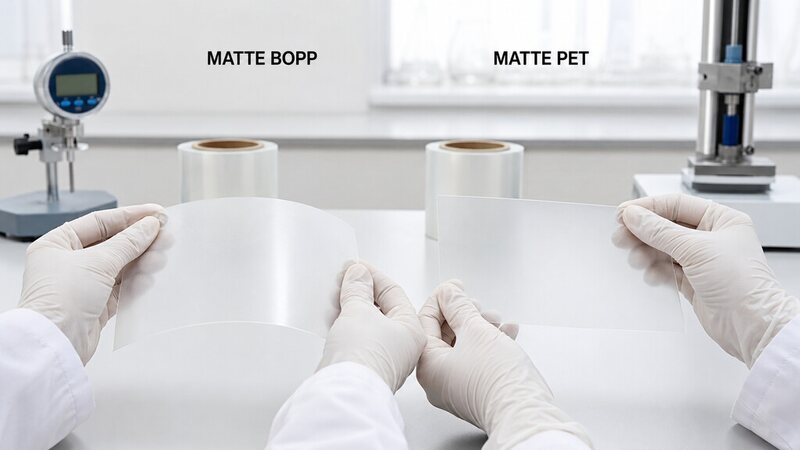
Application Comparison by End Use
| Application | Matte BOPP position | Matte PET position | Selection trigger |
| Dry snacks, biscuits, cereal, and confectionery | Often the first cost-efficient outer-web trial | Useful when extra stability, premium hand feel, or a PET-based barrier structure is already specified | Moisture risk, line speed, pack stiffness, target structure, and cost per pack |
| Coffee, tea, pet food, and aroma-sensitive dry products | Can be used with a separate barrier web and sealant | Common strong outer web in PET-based high-barrier laminates | OTR, WVTR, light barrier, valve or zipper, drop test, and shelf life |
| Cosmetic and personal-care sachets or pouches | Good general matte appearance at controlled cost | Good when heat, chemical exposure, or dimensional stability is more demanding | Formula compatibility, scuff resistance, heat exposure, and brand appearance |
| Book covers, cartons, brochures, and printed paper | Widely used for economical matte lamination | Selected for greater durability or thermal stability | Wet, dry, or thermal lamination method; curl; adhesive; rub; and post-finishing |
| Pressure-sensitive labels | Suitable for many food, beverage, household, and promotional labels | Preferred for durable, chemical-resistant, or dimensionally demanding labels | Container, adhesive, exposure, print method, die cutting, and dispensing speed |
| Electronics, HMI overlays, and control-panel graphics | Use only when the specific grade meets service requirements | Usually the stronger starting candidate | Heat, dimensional stability, scratch, chemicals, embossing, switches, and service life |
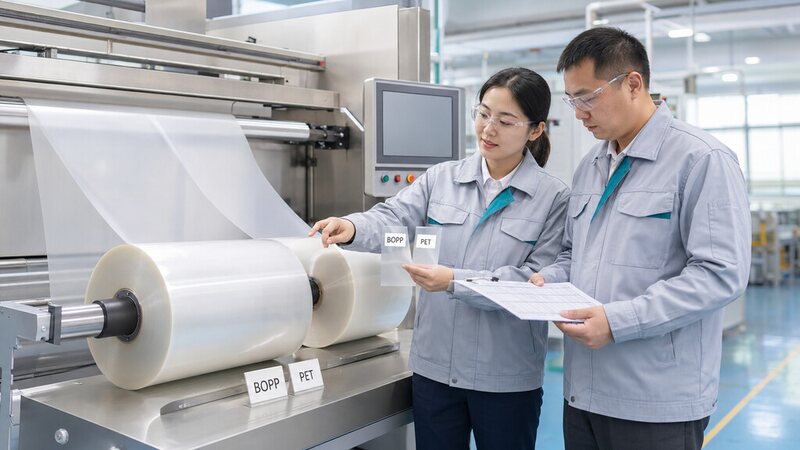
Practical Starting Structures
Structures below are starting points for discussion. They are written from the outside to the product-contact side. The converter must confirm food-contact status, adhesive, gauge, barrier, sealant, and process compatibility.
| Starting structure | Typical use | Why it may fit | What must be tested |
| 15–20 µm matte BOPP / 25–40 µm CPP | Pillow packs, biscuits, confectionery, and light dry snacks | Cost-efficient matte outer web with a PP sealant and useful stiffness | COF, seal initiation, hot tack, moisture barrier, pack speed, and surface scuff |
| 18–20 µm matte BOPP / 50–70 µm PE | Stand-up pouches for nuts, cereal, dried fruit, and dry mixes | Matte appearance, moisture resistance, and a flexible PE sealing layer | Oxygen target, puncture, zipper, drop test, seal contamination, and total gauge |
| 12–15 µm matte PET / 50–80 µm PE | Premium pouches requiring a stable print web | High print stability with a broad, flexible PE sealing layer | Required barrier, adhesive bond, curl, seal performance, and pack stiffness |
| 12–15 µm matte PET / 12 µm metallized PET / 50–80 µm PE | Coffee, pet food, supplements, or aroma-sensitive dry products | Stable outer web plus a separate high-barrier layer and robust sealant | OTR, WVTR, metal adhesion, flex cracking, valve or zipper, and shelf life |
| Matte BOPP or matte PET / thermal adhesive layer | Book covers, cartons, menus, brochures, and printed paper | Ready-to-laminate surface when the grade is built for heat-and-pressure bonding | Whether thickness includes adhesive, activation temperature, line speed, curl, bond, and post-finishing |
For a real food-application example, see matte BOPP film for premium snack packaging. For multilayer terminology and the difference between an internal coextruded film and a laminated package, use the BOPP film structure and laminate guide.
Where Matte BOPP Usually Works Well
- Dry-food packaging where moisture resistance, high area yield, and controlled material cost are priorities.
- Snack, bakery, confectionery, label, overwrap, and general flexible-packaging outer webs.
- Book covers, cartons, brochures, and printed paper when a qualified wet, dry, or thermal-lamination grade is used.
- PP-oriented structures where a polypropylene outer layer supports the project’s material strategy.
- Projects already running standard BOPP successfully and seeking a low-gloss surface without a major process redesign.
Where Matte PET Usually Works Well
- Premium printed laminates that need a firmer web and stable registration through demanding conversion.
- Coffee, pet food, cosmetics, and specialty pouches built around a PET-based outer or barrier structure.
- Durable labels, nameplates, graphic overlays, membrane-switch layers, screen protection, and electronics applications.
- Processes or service conditions where higher heat resistance and lower dimensional movement are valuable.
- Applications where a higher material cost is justified by stability, durability, reduced waste, or a validated lower gauge.
Where Either Film Is Unsuitable or Needs Caution
- Direct sealing without a sealable grade:Standard matte outer webs should not be assumed to seal to themselves. Specify the seal layer and seal face.
- Retort, sterilization, oven, or demanding hot-fill:A base polymer comparison is not enough. Use a process-specific complete laminate and validate seals, bond, migration, shrinkage, and appearance.
- High-barrier shelf life based only on the matte web:Measure the full structure. Add an appropriate barrier layer when product modeling requires it.
- Sharp, heavy, or liquid contents:Puncture, flex cracking, drop strength, sealant toughness, and leak integrity may control the structure more than the outer film.
- Dark solid-color artwork:Matte surfaces may reveal rub marks, pressure gloss, fingerprints, or gloss variation. Approve printed and transported samples under retail lighting.
- Outdoor exposure:Do not assume weatherability or UV resistance. Specify a suitable coating and run accelerated and real-exposure tests.
- Unverified material substitution:Never replace equal gauge for equal gauge without recalculating yield and retesting tension, registration, lamination, sealing, and finished-pack performance.
- Unsupported environmental claims:Evaluate the whole printed and laminated article under a recognized protocol for the destination market.
A Six-Step Material Selection Process
| Step | Action | Decision output |
| 1. Define the film’s role | State whether it is an outer print web, overlaminate, label face, paper-lamination film, protective layer, or another function. | A clear side map and functional specification |
| 2. Define the end-use stress | Record product, pack weight, shelf life, temperature, humidity, chemicals, light, handling, and distribution route. | Required mechanical, thermal, barrier, and surface limits |
| 3. Screen the polymer | Start with BOPP for yield, moisture resistance, and everyday packaging; start with PET for heat, stability, and durable uses. | One lead material and one backup candidate |
| 4. Specify the exact grade | Confirm thickness, matte level, haze, gloss, treatment, COF, coating, sealability, roll geometry, and regulatory status. | Comparable supplier data sheets and samples |
| 5. Convert and test | Print, laminate, cure, slit, make pouches or labels, and run the intended packing or application process. | Recorded settings, waste, speed, quality results, and failure observations |
| 6. Approve the finished article | Run barrier, seal, drop, scuff, storage, transport, and shelf-life tests as applicable. | Signed specification, approved sample, and incoming QC limits |
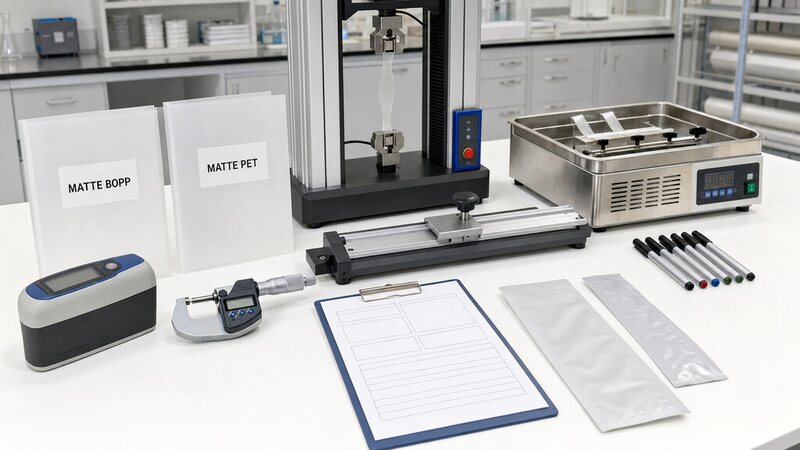
Trial and Quality-Control Plan
Ask suppliers to report test methods and conditions, not only typical values. The current edition of an agreed standard should be written into the specification. For gauge selection and yield planning, the BOPP film thickness guide for packaging buyers provides additional context.
| Test or check | Why it matters | Common method or evidence |
| Thickness and profile | Controls yield, stiffness, winding, and consistency | Calibrated thickness measurement across the web; report average and tolerance |
| Haze, gloss, and visual standard | Defines the matte appearance and batch consistency | ASTM D1003 for haze; ASTM D2457 or agreed geometry for gloss; approved physical sample |
| Tensile strength, elongation, and modulus | Supports web handling and stiffness comparison | ASTM D882 or agreed equivalent in MD and TD |
| Thermal shrinkage | Predicts dimensional movement under heat | Agreed oven time and temperature; report MD and TD |
| Surface energy and treatment age | Supports ink and adhesive wetting | Dyne test or specified instrumental method at production and receipt |
| Coefficient of friction | Affects feeding, tracking, forming, and stacking | ASTM D1894 or agreed equivalent, with face-to-face combination stated |
| Ink adhesion and rub | Prevents print loss and visible scuffing | Approved tape, rub, abrasion, and transport simulation procedures |
| Lamination bond | Detects weak adhesion, tunneling, and delamination risk | Peel strength after the full cure, with failure mode recorded |
| OTR and WVTR | Supports shelf-life design | ASTM D3985 for oxygen and ASTM F1249 for water vapor, or agreed equivalents, on the complete laminate |
| Seal window and seal strength | Defines packing-line reliability | Laboratory seals across temperature, pressure, and dwell; ASTM F88 or agreed seal test |
| Roll inspection | Prevents telescoping, wrinkles, gauge bands, and unwind problems | Width, diameter, core, winding, splice map, edge, and packaging inspection |
| Production trial | Confirms real compatibility | Documented print, lamination, slitting, pouching, labeling, or packing trial at target speed |
What to Confirm with a Supplier or Manufacturer
A useful quotation should identify who makes the base film, who applies the matte surface or coating, who slits the roll, and who owns test and complaint responsibility. A qualified flexible packaging film manufacturer and export supplier should be able to connect the offered grade, production batch, technical documents, samples, and roll label.
- Application:packed product or protected substrate, package or label format, dimensions, filling weight, service conditions, and target shelf life.
- Film role:outer print web, label face, overlaminate, thermal lamination film, protective layer, or other function.
- Grade construction:base polymer, coextruded matte skin or coating, one-side or two-side matte, and any seal or adhesive layer.
- Optics:target haze, gloss test angle, transparency, color, contact clarity, and acceptable batch variation.
- Surface map:outside face, print face, adhesive face, treatment type, dyne level at manufacture and delivery, and permitted re-treatment.
- Mechanical and thermal data:thickness and tolerance, density, tensile strength, elongation, modulus, shrinkage conditions, and maximum recommended process temperature.
- Runnability:static and dynamic COF by surface combination, slip, antiblock, static control, intended machine, and target line speed.
- Barrier and sealing:OTR, WVTR, sealable face, seal window, hot tack, seal strength, and whether values refer to the film or full laminate.
- Roll specification:slit width and tolerance, length or net weight, maximum diameter, core, winding direction, splice limit, edge quality, and pallet protection.
- Compliance:destination-market food-contact or chemical documentation, declarations for additives and coatings, and lot-specific certificate needs.
- Quality system:batch traceability, retention samples, certificate of analysis, change-notification process, claim procedure, and agreed acceptance limits.
- Commercial information:sample size, trial MOQ, production MOQ by width and grade, lead time, annual capacity, quantity tolerance, Incoterm, destination port, and payment terms.
RFQ Template for Comparing Both Films
Application: [product, package/label format, size, filling weight, shelf life, destination market]
Film role: [outer print web / label face / paper lamination / protective layer]
Current structure: [layers from outside to inside, individual gauges, adhesive, print location]
Comparison request: Please propose one matte BOPP grade and one matte PET grade, with the reason for each recommendation.
Performance: [matte level, haze/gloss, stiffness, maximum process temperature, shrinkage, COF, scuff, OTR/WVTR, seal requirements]
Process: [printing, lamination, coating, slitting, pouching/labeling/packing equipment, target speed]
Roll: [width, tolerance, length/weight, outside diameter, core, unwind direction, splice limit]
Compliance and logistics: [documents, sample quantity, trial order, annual demand, Incoterm, port]
Ask the supplier to mark differences line by line. A useful response explains why the recommended gauges may differ, which data is typical rather than guaranteed, and which properties must be confirmed on the finished laminate.
Frequently Asked Purchasing Questions
Is matte BOPP cheaper than matte PET?
It is often the lower-cost option, and its lower density usually provides more area per kilogram at equal thickness. The correct comparison is price per usable square metre or finished pack, including waste and line performance. A stable PET grade can be commercially sensible if it reduces rejects or allows a validated lower gauge.
Which film is stiffer?
Matte PET generally has the higher tensile modulus at a comparable thickness. Finished stiffness also depends on gauge, orientation, matte layer, adhesive, other laminate webs, pouch geometry, and conditioning.
Which film has better heat resistance?
Matte PET normally offers better thermal and dimensional stability. Do not translate that trend into automatic approval for retort, sterilization, oven, or hot-fill use. Obtain grade-specific limits and test the complete structure.
Which film gives the better moisture barrier?
Standard BOPP generally has the better water-vapor-barrier trend. Shelf life must still be designed from the measured WVTR of the full printed and laminated structure, including seals and package features.
Which film gives the better oxygen barrier?
Standard PET generally has a better oxygen-barrier trend than standard BOPP. Many coffee, nut, pet-food, and aroma-sensitive products still require metallization, a transparent barrier coating, foil, or another dedicated barrier web.
Can matte BOPP and matte PET be heat sealed directly?
Not unless the selected grade has a suitable sealable skin or coating. Most flexible packages use these films as outer webs and use PE, CPP, or another material as the sealant. Confirm the sealable face and operating window.
Can I replace matte BOPP with matte PET at the same thickness?
Do not make a direct equal-gauge substitution. Recalculate roll yield and weight, then retest tension, registration, drying, lamination, curl, slitting, sealing, surface appearance, and finished performance.
Which film is better for snack packaging?
Matte BOPP is often the first trial for dry snacks because of yield, moisture resistance, stiffness, and cost. Matte PET can be selected when the overall laminate is PET-based or needs more print and thermal stability. Barrier and sealant layers must be selected separately.
Which film is better for coffee or pet-food pouches?
Matte PET is a common outer-web candidate in demanding high-barrier structures, while matte BOPP can also work with a qualified barrier and sealant combination. The deciding evidence is the complete laminate’s barrier, drop performance, flex durability, valve or zipper compatibility, and shelf-life result.
Which film is better for books and cartons?
Matte BOPP is widely used for economical paper lamination. Matte PET is useful when more heat resistance, dimensional stability, or durability is needed. Confirm whether you require a bare film for wet or dry lamination or a thermal film already coated with adhesive.
Which film is better for durable labels and electronics?
Matte PET is normally the stronger starting candidate because of stability and durability. Chemical resistance, UV exposure, embossing, switch life, adhesive, die cutting, print method, and service temperature still require application-specific approval.
Does a higher haze value always mean a better matte finish?
No. Haze, surface gloss, contact clarity, texture, color shift, and printed appearance describe different effects. Approve numeric limits together with a signed physical sample viewed under controlled lighting.
How much sample material is needed?
Request enough for laboratory checks and a meaningful production trial. A small sheet can confirm appearance, but it cannot prove web handling, static, COF, winding, printing stability, or packing speed. State the minimum roll width, diameter, and length required by the actual line.
What documents should accompany the order?
At minimum, request the current technical data sheet, safety information where applicable, grade-specific regulatory statement, certificate of analysis or agreed batch data, roll labels, packing list, and traceability information. Add ink, adhesive, coating, and food-contact documentation according to the final structure and destination market.
Request a Grade Comparison and Trial Sample
Send us your application, current laminate, maximum process temperature, target matte appearance, film thickness, roll width, treatment side, annual volume, and destination market.
CloudFilm will compare a suitable matte BOPP grade with a matte PET alternative, explain the technical and cost trade-offs, prepare sample options, and quote the roll specification needed for your trial.
CTA: Request A Matte BOPP Vs Matte PET Film Comparison And Sample