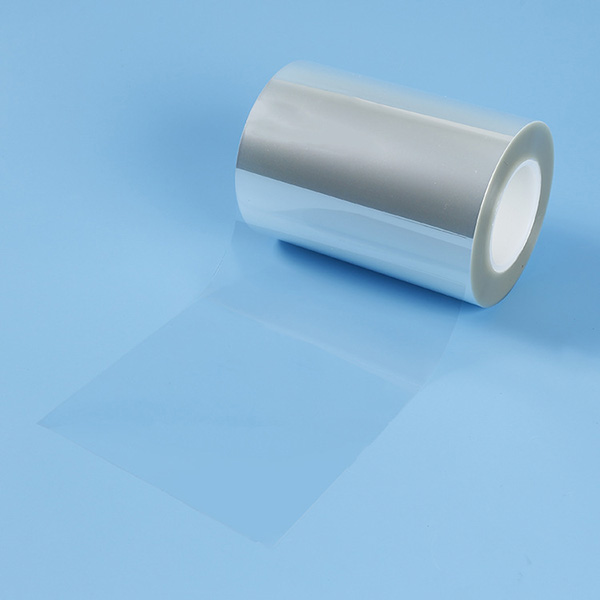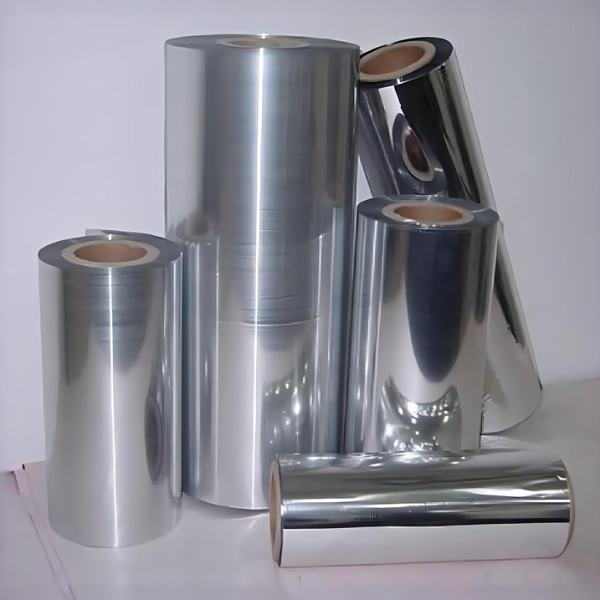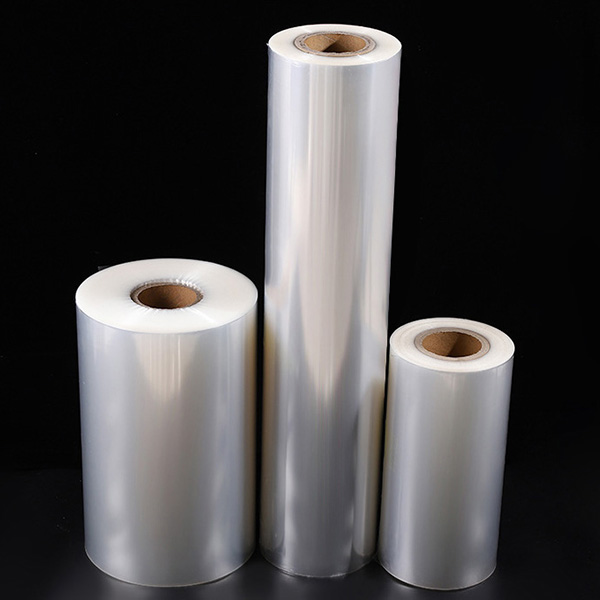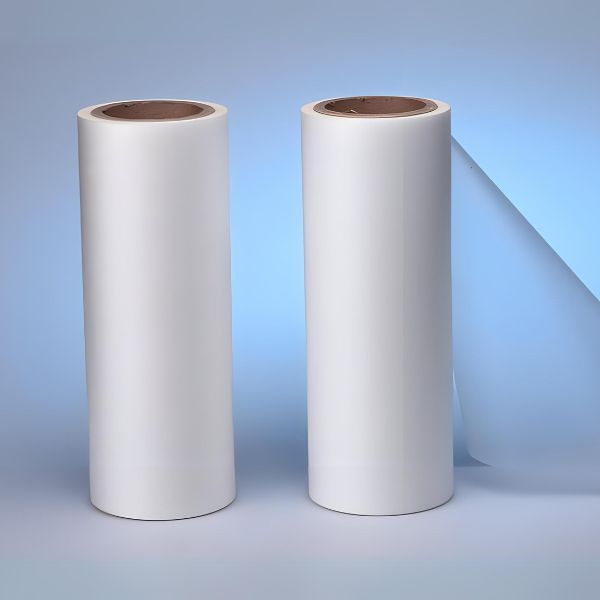
Matte BOPP film is a practical choice for premium dry-snack packaging when it is used as the outer appearance and print web of a properly designed laminate. It creates a low-gloss, anti-glare surface, adds useful stiffness, and protects reverse-printed graphics. It normally should not be treated as the only barrier or sealing layer. Pair it with PE, CPP, metallized PP film, or another inner web according to the snack’s moisture, oxygen, light, grease, puncture, and sealing risks.
For many stand-up pouches containing nuts, granola, cereal, or dried fruit, 18–20 µm matte BOPP laminated to 50–70 µm PE is a sensible trial structure. For lightweight pillow packs and flow wrap, 15–20 µm matte BOPP laminated to a suitable CPP sealant may provide better stiffness-to-yield balance. These are starting points, not universal specifications. The final construction must be verified against the product, target shelf life, filling line, storage climate, and transport route.
Buyers can review available matte BOPP film rolls for printing and lamination, then use the selection process below to prepare a technically complete trial request.
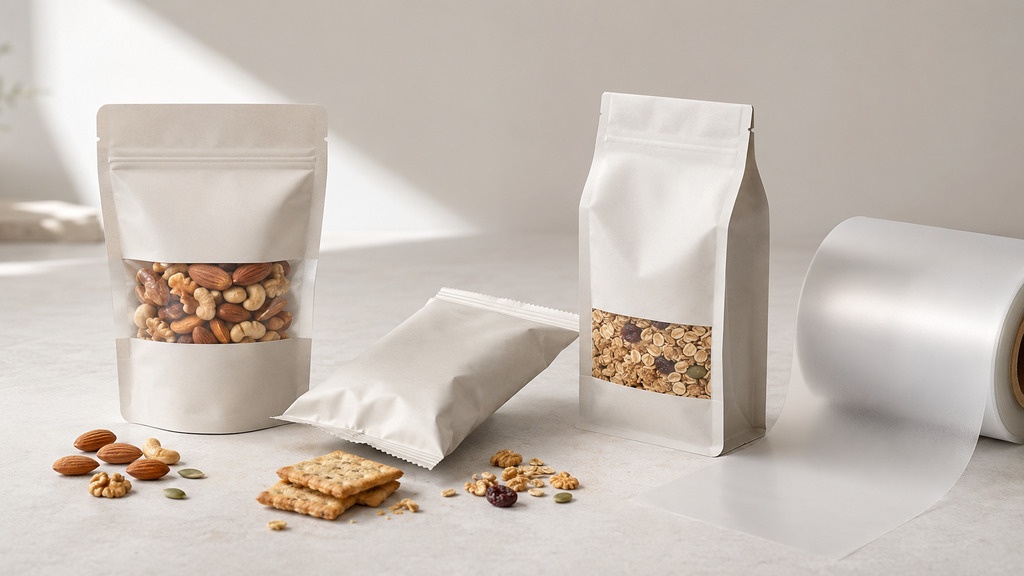
What Role Does Matte BOPP Play in a Snack Package?
The outer web carries appearance, print protection, and stiffness
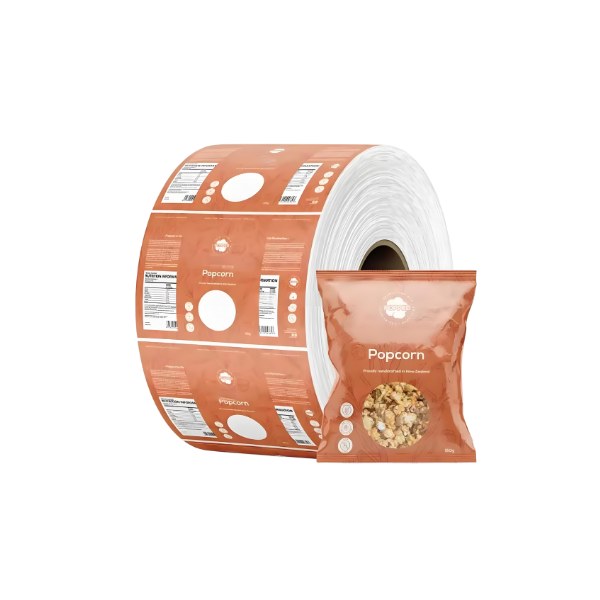
In a common reverse-printed laminate, the matte surface faces the shopper. The opposite treated surface receives ink and adhesive, so the printed design is protected between layers. This arrangement reduces ink scuffing during distribution and keeps the low-gloss surface visible. Side identity is grade-specific, however. Some films are treated on one side, others on both sides, and certain specialty grades are printable or sealable on a different face. The supplier’s side map must match the converter’s unwind direction.
The oriented polypropylene web also contributes stiffness, dimensional control, and moisture resistance. That helps a pouch stand neatly and helps roll stock track through printing, laminating, slitting, and packing equipment. It does not automatically provide a wide heat-seal window, high oxygen barrier, or strong puncture resistance.
The complete laminate—not the matte finish—controls shelf life
A matte finish is primarily an appearance and surface-function decision. Crisp snacks still need moisture protection. Nuts and seeds may also need oxygen, aroma, and light protection because their oils can oxidize. The inner web must seal reliably even when crumbs, seasoning, or fine powder reach the seal area.
Before choosing a structure, define the deterioration mode that ends shelf life: loss of crispness, rancid flavor, aroma loss, color change, seal leakage, puncture, or another failure. The broader snack packaging film guide explains these material families; this page concentrates on building them around a matte BOPP outer web.
Which Snack Applications Are a Good Fit?
The material is most useful for ambient, dry products that need a calm, natural, craft, wellness, or premium shelf appearance. It can be supplied as printed roll stock for VFFS or HFFS equipment, or converted into premade formats such as stand-up pouches and flat-bottom pouches.
| Snack category | Useful pack format | Practical starting structure | Main risk to verify |
| Roasted nuts and seeds | Zipper stand-up or flat-bottom pouch | 18–20 µm matte BOPP / 50–70 µm PE; add a barrier web when needed | Oxygen, light, oily-product interaction, seal contamination, and long export storage |
| Granola, cereal, and trail mix | Stand-up pouch or pillow pack | Matte BOPP / PE or matte BOPP / CPP | Moisture pickup, sharp inclusions, zipper area strength, and drop resistance |
| Baked crisps, crackers, and cookies | HFFS pillow or flow wrap | 15–20 µm matte BOPP / CPP, or matte BOPP / VMCPP for higher barrier | Moisture barrier, crushing, COF, sealing speed, and pack tightness |
| Chocolate and confectionery snacks | Pillow pack, sachet, or premade pouch | Matte BOPP / CPP; use a barrier layer for aroma- or light-sensitive formulas | Fat and aroma protection, seal initiation, hot-weather transport, and scuff appearance |
| Protein powder and dry snack mixes | Three-side-seal or zipper pouch | Matte BOPP / PE, with metallized or other barrier web if justified | Fine-powder seal contamination, puncture, aroma retention, and repeated opening |
A “premium” pack does not need a heavy structure by definition. A small single-serve cracker pack may need high yield and stable machine speed more than a thick hand feel. A 750 g nut pouch, by contrast, may need a thicker sealant, stronger zipper area, and better drop resistance. Pack weight, dimensions, headspace, and distribution method should drive the structure.
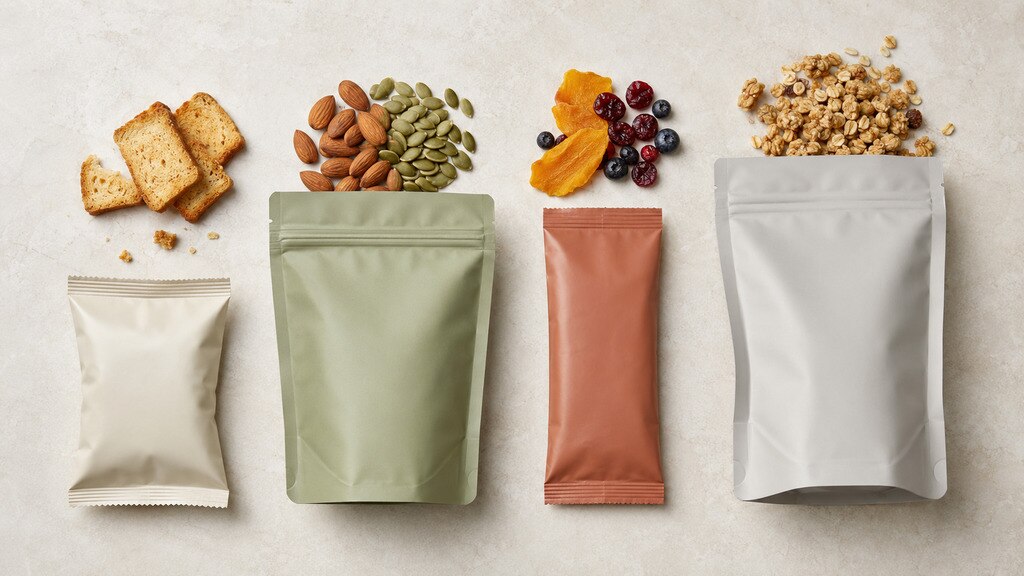
Recommended Laminate Structures and How to Choose
In the table below, structures are listed from the outside of the package to the product-contact side. Thickness ranges are trial ranges for common snack projects. They are not replacements for a converter’s approved specification or a shelf-life study.
| Starting structure | Where it fits | Why buyers select it | What needs confirmation |
| 18–20 µm matte BOPP / 50–70 µm PE | Nuts, granola, dried fruit, cereal, and many premade dry-food pouches | Low-gloss outer surface, flexible inner seal, moisture resistance, and useful puncture tolerance | Required oxygen barrier, PE seal window, drop performance, zipper compatibility, and total gauge |
| 15–20 µm matte BOPP / 20–40 µm CPP | Biscuits, confectionery, light snacks, pillow packs, and flow wrap | PP-family construction, good stiffness, clear sealant options, and efficient high-speed converting | COF, hot tack, seal initiation temperature, pack speed, and stiffness at the selected gauge |
| 18–20 µm matte BOPP / 15–20 µm metallized BOPP / 30–60 µm PE or CPP | Oily nuts, seasoned crisps, and light- or aroma-sensitive snacks | Matte shelf appearance plus stronger moisture, oxygen, aroma, and light protection | Measured OTR and WVTR, metal adhesion, flex damage, adhesive compatibility, and opacity |
| 18–20 µm matte BOPP / 20–30 µm VMCPP | High-barrier snack flow wrap and PP-oriented laminate development | VMCPP combines a metallized barrier function with a sealable inner web | Seal performance, metal pick-off, machine temperature, and recyclability assessment in the destination market |
| Matte BOPP / 7–9 µm aluminum foil / 50–70 µm PE | Very light- or oxygen-sensitive dry products where maximum protection is prioritized | Very strong light and gas barrier when the foil remains intact | Flex cracking, pinholes, drop resistance, laminate stiffness, cost, and end-of-life limitations |
For a detailed two-layer option, see the BOPP/PE laminated film guide. If the inner web must provide a broad seal window for high-speed packs, compare a suitable clear CPP film. When the product needs greater light and gas protection, a metallized BOPP film can be evaluated as an added barrier web rather than assuming the matte outer layer can carry the full barrier duty.
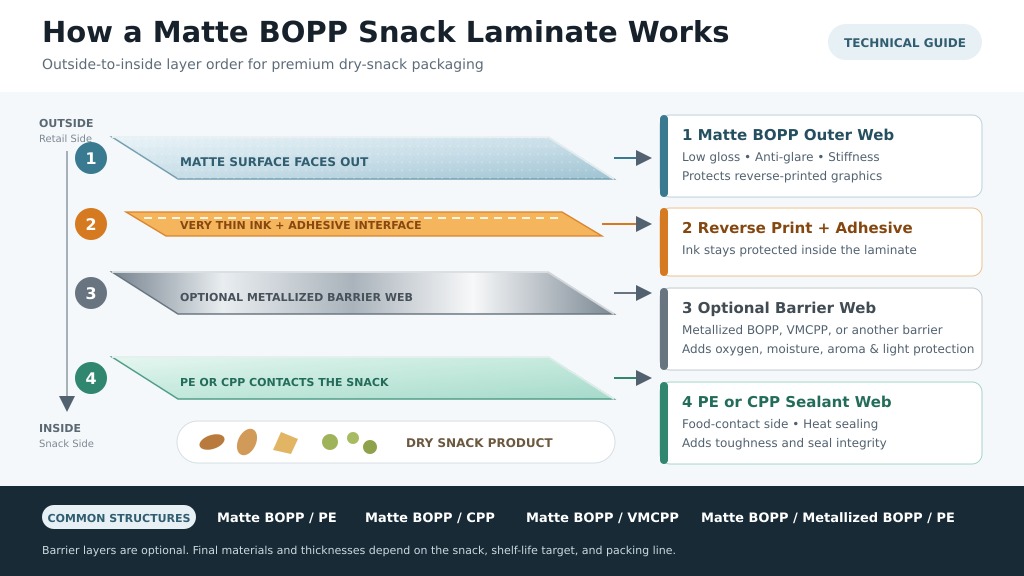
Select Barrier by Product Risk, Not by Appearance
Moisture barrier protects crispness
Crackers, cereal, puffed snacks, and granola often fail when they absorb moisture and lose texture. Ask for the WVTR of the complete laminate at a stated test temperature and relative humidity. A value for one base film does not describe the printed, laminated, creased, and sealed package. Finished-pack seal integrity can matter as much as the flat-web result.
Oxygen, aroma, and light matter for high-fat snacks
Nuts, seeds, chocolate inclusions, and heavily seasoned snacks may oxidize or lose aroma before they become soft. If the target shelf life or export route is demanding, request OTR data for the proposed laminate and compare a metallized or other high-barrier structure. An opaque barrier may protect the product but removes product visibility, so the artwork and window strategy must be decided early.
Grease and flavor systems affect material compatibility
The product-contact web, inks, adhesive, zipper, and sealant formulation must be compatible with oil, salt, spices, flavor compounds, and any processing aids in the food. A standard dry cracker and a strongly flavored, high-fat nut mix may need different adhesive and barrier decisions even when both use the same outer finish.
Shelf-life evidence should include finished packs
Use flat-film data to screen options, then run real or accelerated storage trials on filled, sealed packs. Inspect texture, flavor, odor, color, seal integrity, delamination, scuffing, and barrier change after flexing. Record the filling date, storage conditions, machine settings, and laminate lot so a failure can be traced.
Printing, Lamination, and Machine Runnability
Confirm the print side and the lamination side
Do not write only “one side matte” on a purchase order. State which face will be outside, which face will receive ink, which face will receive adhesive, and the required treatment level at conversion. Surface treatment can decay during storage. A converter may need to re-treat the web before printing or laminating, subject to the grade and supplier’s guidance. The technical background in corona treatment on plastic film can help purchasing and production teams use the same terminology.
Control COF, slip, tension, and static
A matte surface may interact differently with rollers, forming collars, guides, and finished packs than a glossy film. Excessive friction can cause poor feeding, wrinkles, or unstable pack length. Very low friction can cause slipping and stacking problems. Ask for static and dynamic COF by side, the test method, conditioning, and acceptable range. Then confirm performance on the actual line speed because laboratory values do not represent every machine contact.
The seal normally comes from the inner web
Standard matte film should not be assumed to seal to itself. The PE, CPP, VMCPP, or another engineered inner layer provides the primary seal in most laminates. If a mono-web or overlap-seal design is required, specify a dedicated heat-sealable BOPP grade and confirm the sealable face, seal-initiation temperature, hot tack, seal strength, pressure, dwell time, and operating window.
Roll geometry must match the converter and packing line
Confirm slit width and tolerance, roll length or net weight, maximum outside diameter, 3-inch or 6-inch core, core material, unwind direction, print repeat, splice count and marking, winding hardness, pallet pattern, and moisture protection. A correct resin and thickness can still cause downtime if the roll is wound poorly or supplied in the wrong direction.

Where This Material Works Well
- Dry, ambient snacks that benefit from a low-gloss, anti-glare, natural, craft, wellness, or premium appearance.
- Reverse-printed laminates where graphics need protection beneath an outer web.
- Pillow packs, flow wrap, stand-up pouches, three-side-seal pouches, and flat-bottom pouches when the complete structure is matched to the machine.
- Nuts, seeds, granola, cereals, biscuits, crackers, confectionery, dried fruit, and dry mixes with an appropriate barrier and sealant layer.
- Projects that need customized slit widths, roll diameters, cores, treatment sides, and COF for an existing converting line.
- PP-oriented laminate development where the full package is assessed against a recognized design-for-recycling protocol and local collection system.
Where It Is Unsuitable or Needs Caution
- As a universal single web:Standard matte film alone may not provide the required heat seal, oxygen barrier, puncture resistance, or aroma protection.
- Retort, sterilization, or demanding hot-fill:Do not assume a standard grade will retain dimensions, appearance, bond strength, or seals at elevated temperature. Use a process-specific laminate and validate it.
- Liquids, wet foods, or frozen products:It may still serve as an outer web in a qualified structure, but the sealant, adhesive, low-temperature toughness, and moisture exposure need separate testing.
- Sharp or heavy contents:Granola clusters, shells, hard candy edges, and large pack weights may require a tougher or thicker inner web and drop testing.
- Very high-barrier products:The outer finish does not replace metallization, foil, coating, or another engineered barrier when the shelf-life model requires one.
- Direct heat sealing with a standard grade:Select a sealable grade or a separate sealant layer instead of raising jaw temperature until the oriented web distorts.
- Unqualified recycling claims:BOPP is polypropylene, but a printed, adhesive-laminated, metallized, zippered, or mixed-polymer package must be assessed as a complete pack in the destination market.
- Appearance-critical dark artwork:Matte surfaces can show scuffs, pressure marks, gloss variation, or fingerprints differently. Approve printed and rubbed samples under retail lighting.
A Practical Trial and Quality-Control Plan
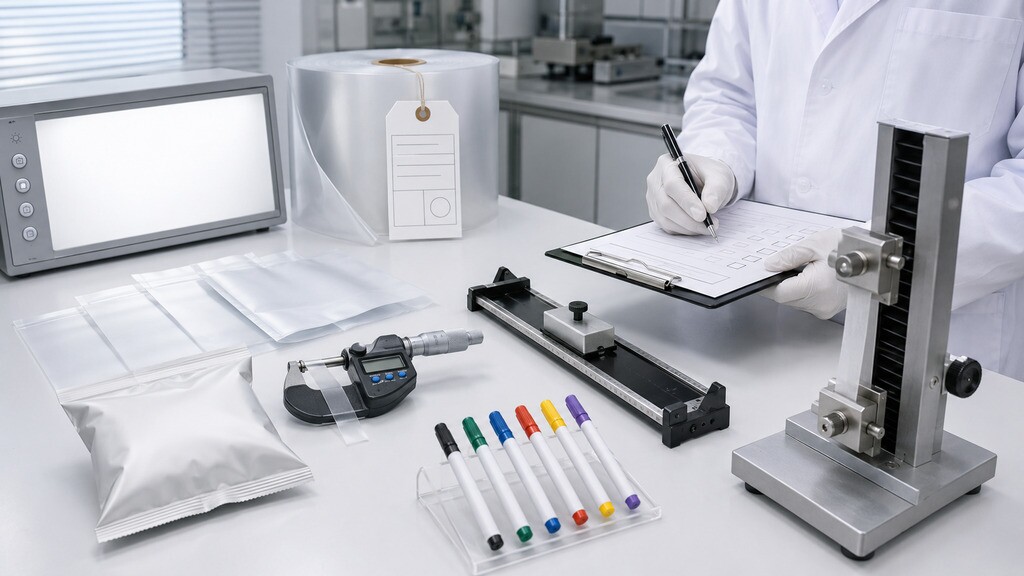
Approve the film in stages. A small roll that prints well is useful evidence, but it is not the same as a filled-pack shelf-life approval. The flexible packaging quality control guide provides a broader inspection framework.
| Stage | What to check | Decision question |
| 1. Incoming film | Thickness profile, width, roll condition, side identification, dyne level, haze or gloss target, COF, splices, and winding | Does the delivered roll match the written specification and approved sample? |
| 2. Printing | Ink wetting, adhesion, color density, registration, trapping, rub resistance, and matte/gloss appearance | Are graphics stable on the intended treated side at production speed? |
| 3. Lamination and curing | Adhesive coating, bond strength, bubbles, tunneling, curl, odor, cure time, and residual solvent where relevant | Does the laminate remain flat, clean, and bonded after the full cure? |
| 4. Slitting and pouch making | Tracking, edge quality, web tension, static, zipper position, gusset geometry, seals, and surface scuffing | Can the converter make repeatable rolls or pouches without excessive waste? |
| 5. Filling-line trial | Forming, draw-down, registration, jaw release, seal contamination, pack speed, leaks, and finished appearance | Does the package run at the required speed with an acceptable operating window? |
| 6. Distribution and shelf life | Drop, compression, vibration, flexing, storage climate, texture, flavor, aroma, seals, barrier, and scuff appearance | Does the filled pack protect the snack through the declared shelf life and route? |
What to Confirm with a Supplier or Manufacturer
A useful B2B quotation is built from measurable requirements. Whether you buy from a film manufacturer, an export supplier, a converter, or a regional distributor, ask who controls extrusion, treatment, slitting, lamination, testing, and batch traceability. A partner presented as a flexible packaging film manufacturer in China should be able to explain the production route and provide documents that correspond to the actual grade offered.
- Snack and pack:product name, ingredients that affect packaging, filling weight, pack dimensions, headspace, and pouch or roll-stock format.
- Shelf-life conditions:target months, filling atmosphere, storage temperature and humidity, retail light, export route, and expected handling.
- Layer structure:every web from outside to inside, individual gauge, total gauge, adhesive system, print location, and product-contact layer.
- Matte grade:one-side or two-side matte, surface gloss and haze targets, visual tolerance, scuff requirement, and approved appearance sample.
- Surface treatment:treated face, dyne target at manufacture and at delivery, test method, aging expectation, and whether re-treatment is permitted.
- Mechanical data:tensile properties, elongation, shrinkage, modulus or stiffness, puncture performance where relevant, and thickness tolerance.
- Runnability:static and dynamic COF by face, antiblock and slip behavior, intended line type, speed, forming geometry, and known machine limits.
- Seal requirements:sealant material, sealing window, hot tack, seal strength, contamination tolerance, zipper or valve compatibility, and leak-test method.
- Barrier evidence:OTR and WVTR of the proposed complete laminate, test conditions, light barrier where required, and any flexed-sample data.
- Roll specification:slit width and tolerance, length or weight, maximum outer diameter, core size, unwind direction, splices, winding hardness, pallet, and export packing.
- Compliance:food-contact statement and supporting documentation for the destination market, plus declarations for inks, adhesives, and the contact web when applicable.
- Commercial terms:trial quantity, MOQ by grade and width, price basis, quantity tolerance, sample lead time, production lead time, Incoterm, destination port, and claim procedure.
RFQ Template for Faster Quotations
Product: [snack type, ingredients, oil/aroma sensitivity]
Pack: [format, dimensions, filling weight, zipper/tear notch, clear window]
Current or proposed structure: [outside-to-inside layers and gauge]
Performance: [target shelf life, OTR/WVTR or barrier goal, seal strength, scuff requirement]
Process: [printing method, lamination method, VFFS/HFFS/pouch filling line, speed, seal range]
Roll: [width, outer diameter, core, unwind direction, maximum splices]
Compliance and logistics: [destination market, documents, trial quantity, annual demand, Incoterm, port]
Attach the current technical data sheet, a failed pack if there is one, machine photos, and a short video of the problem. This gives the supplier enough evidence to recommend a grade instead of guessing from the words “premium matte film.”
Frequently Asked Purchasing Questions
Is matte BOPP suitable for food packaging?
It can be used in food-packaging structures when the specific grade and the complete package meet the regulatory requirements of the destination market. Ask for a food-contact statement and supporting documents tied to the supplied grade. Also verify the inks, adhesive, sealant, and any zipper or coating.
Can it be used as a single layer for snack packs?
Only when a purpose-designed grade provides every required function, including sealing and barrier, and the filled pack passes trials. Standard matte BOPP is more commonly used as an outer web in a laminate.
Which side should be printed?
Print the surface identified and treated for the selected ink system. In many one-side-matte grades, the opposite smoother treated face is reverse printed and laminated, leaving the matte face outside. Do not assume this arrangement; obtain a roll-side diagram.
What thickness should a buyer start with?
For many premium snack laminates, 18–20 µm is a useful outer-web trial range. Thinner grades may improve yield for small high-speed packs. Thicker grades may improve stiffness or handling for larger formats. Test the total laminate, not the outer gauge alone.
Should I choose PE or CPP as the inner layer?
PE is often selected for flexible pouches, toughness, and a practical seal layer. CPP is common in pillow packs and PP-family laminates where clarity, stiffness balance, and sealing performance suit the machine. The decision depends on seal range, hot tack, COF, pack format, barrier plan, and local end-of-life goal.
Does the matte outer web provide enough barrier for nuts?
Not automatically. Nuts can be sensitive to oxygen, light, and aroma loss. Use shelf-life requirements and measured OTR/WVTR to decide whether a metallized, foil, coated, or other barrier web is necessary.
Can the structure run on VFFS and HFFS machines?
Yes, when roll geometry, stiffness, COF, tension, registration, sealant, and sealing window match the equipment. A line trial at the intended speed is essential because the matte surface changes web-to-machine contact.
How can scuffing or uneven matte appearance be reduced?
Set measurable gloss and haze targets, approve a production-representative sample, control winding pressure and roller cleanliness, protect rolls during transport, and run rub tests on printed laminates. Dark solid colors and large unprinted areas should be reviewed under the intended store lighting.
How long does corona treatment remain usable?
Treatment level can decline with time and storage conditions. Ask for the minimum dyne level at delivery, not only at manufacture, and test before conversion. Confirm whether re-treatment is allowed for the grade and process.
Is a PP-based laminate automatically recyclable?
No. Material family is only one factor. Adhesives, inks, metallization, coatings, zippers, labels, total composition, collection, sorting, and local recycling capability all matter. Evaluate the complete pack under the current protocol used in the sales market before making a claim.
What samples should be approved before a bulk order?
Approve a base-film roll sample, printed and laminated proof, converted pouch or roll-stock sample, and filled-pack line trial. Keep signed reference samples and written acceptance limits for appearance, dimensions, COF, treatment, bond, seals, barrier, and roll quality.
What information is most important for an accurate quote?
Send the snack, pack size, structure and gauges, barrier or shelf-life target, print and lamination method, machine type, roll dimensions, treatment side, compliance market, order quantity, Incoterm, and destination port. If the structure is unknown, share the current pack and the failure you want to solve.
Build the Trial Around the Snack, Not the Finish
A matte surface can strengthen premium positioning, but the successful package is the one that protects flavor and texture, seals within a stable operating window, survives distribution, and arrives with consistent roll quality. Start with the product risk, choose the sealant and barrier system, then specify the matte outer web and machine settings.
Send us your snack type, current structure, target shelf life, pack dimensions, machine details, roll specification, destination market, and expected order volume.
CloudFilm can review the information, suggest a trial structure, and prepare sample options. Request a technical recommendation and quotation.