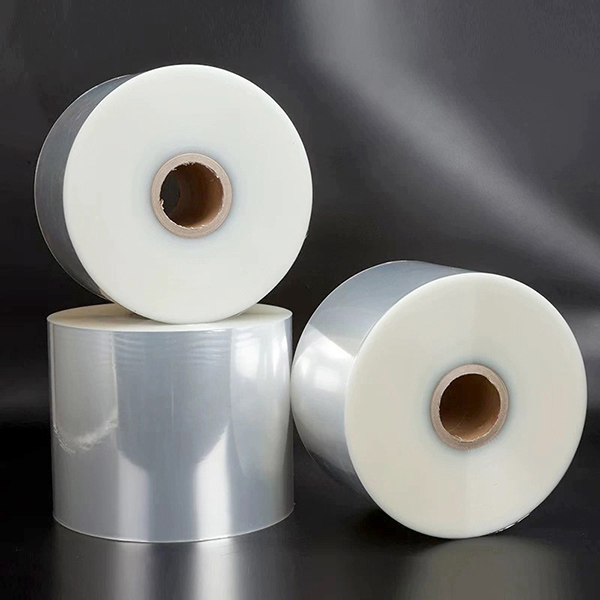
OPP film blocking means unwanted adhesion between film surfaces that should separate. When delivered rolls unwind poorly or empty bags resist opening, first establish whether the difficulty is adhesion, sliding friction, electrostatic attraction, or a combination. Each calls for different evidence and corrective action.
Start by isolating the affected stock, identifying the surfaces in contact, and retaining untouched samples. Then compare affected and satisfactory material under the same documented conditions. A hand-opening demonstration is useful evidence, but it cannot establish a laboratory blocking result or identify the cause alone.
This guide focuses on problems discovered after delivery or storage. For the wider material background, see our guide to BOPP properties. The investigation below applies to the actual film grade and package structure, rather than assuming every product sold as OPP behaves alike.
Identify What “Sticking” Actually Means
Operators often describe several different problems as sticky film. Ask them to demonstrate the first point of resistance: lifting one layer away, starting sideways movement, continuing to slide, or opening a bag on the machine. Record the action before changing settings.
Resistance when separating contacting layers
True blocking concerns adhesion between contacting film surfaces. It can develop during processing or storage, and temperature and pressure can influence it. Difficulty separating layers is the relevant symptom; how easily the already separated sheets slide is a different observation.
Look for whether resistance extends across the contact area or occurs in patches. Record visible transfer, surface marking, stretching, or tearing during separation. These observations describe the failure but do not prove which material, process stage, or storage condition caused it.
Resistance when sliding surfaces
Friction concerns resistance to starting or continuing movement along another surface. Film may separate easily yet drag against another sheet or machine component. Conversely, acceptable sliding behavior does not demonstrate that stored contacting layers will always release readily.
Ask whether the problem occurs against film, metal, or another machine surface. A film-to-film result does not automatically explain drag over a different contact material. Keep bag-opening observations separate from web transport observations, even when both occur on the same line.
Cling that may involve electrostatic charge
Electrostatic attraction can contribute to sheets following one another, handling difficulty, or material clinging to surrounding surfaces. Appearance alone cannot distinguish charge from adhesion. Qualified personnel should assess charge with suitable equipment and a documented setup when the observed behavior makes it a plausible contributor.
A change after controlled ionization can support further investigation of static effects. It does not establish that every part of the complaint is electrostatic or that material formulation is satisfactory. More than one mechanism can be present in the same sample.
Use the following observations to choose a check, not to declare a cause.
| First observed difficulty | Useful next check | What it does not establish |
| Contacting layers resist lifting apart | Preserve the interface and assess existing blocking | Which process or storage stage caused it |
| Separated film drags during sliding | Compare friction against the actual contact surface | Whether stored layers will separate readily |
| Sheets follow one another or cling to equipment | Assess electrostatic conditions with a suitable instrument | That static is the only mechanism |
| Resistance occurs only on the unwinder | Have trained personnel check brakes, guides and roll condition | That the film grade is defective |
If loose layers separate normally but the roll resists only on the machine, investigate mechanical resistance before changing the formulation. A controlled comparison with a satisfactory roll can help, provided setup differences are documented. Equipment checks belong with trained personnel under the site’s procedures.
Identify the Two Surfaces That Were Touching
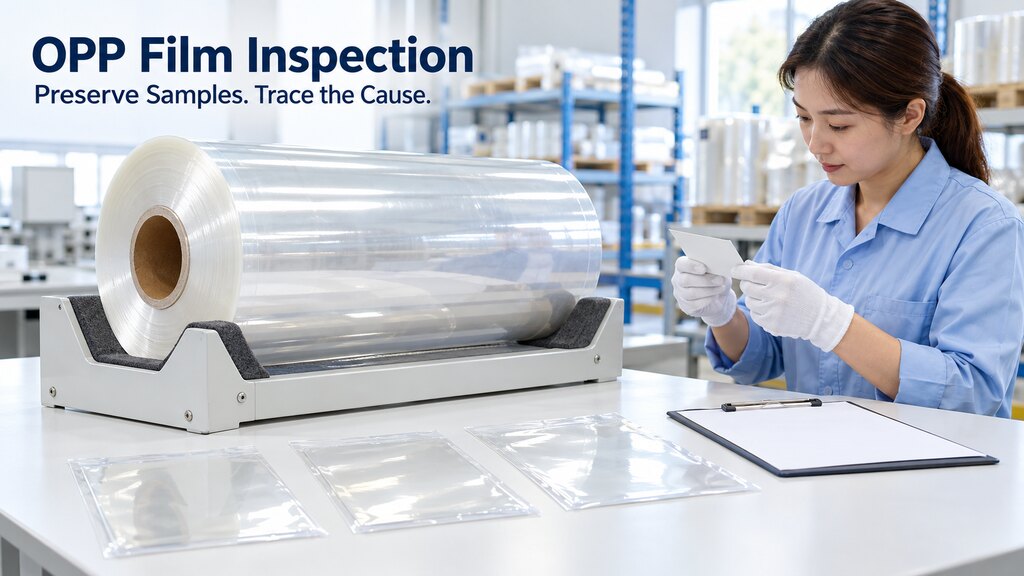
“OPP against OPP” is often too vague for a useful complaint. Record the grade, construction, treatment side, coating, printing location, and sealing side wherever available. Transparency and gloss cannot reliably identify which functional surface faces the other film.
Distinguish a film skin from a laminate layer
An oriented film can have different functional skins on its two faces. A finished laminate can also combine separate webs with different functions. Our BOPP film structure guide explains this distinction, which matters when assigning the correct contact pair.
For a conventional BOPP/CPP bag with CPP as its inner sealant, the surfaces inside the empty bag are CPP against CPP. Calling the package an OPP bag does not make its opening problem an OPP-to-OPP interface problem.
The contact between adjacent wound layers may be different again. Map the exposed outside and inside surfaces in the supplied roll orientation. The comparison between mono-web BOPP and BOPP/CPP laminates helps clarify which web provides the sealing face.
Label sides before cutting samples
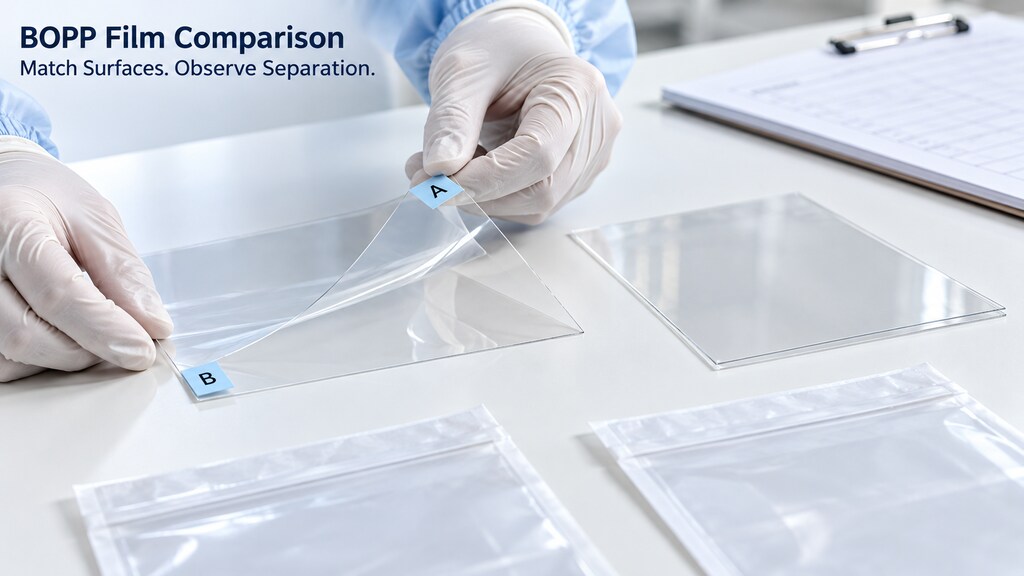
Use a simple identification system, such as side A and side B, tied to the supplier’s construction drawing. Mark only outside the test area. Photograph the unwind direction and sample location so that the laboratory can reconstruct the interface without relying on memory.
For heat sealable BOPP film, confirm whether the supplied grade seals on one face or both. Do not infer this from the product family name. Test the contact pair involved in the complaint, rather than whichever two faces are easiest to assemble.
Reconstruct the Timeline and Preserve Evidence
The first observed failure is not necessarily when the problem developed. Build a timeline covering manufacture, converting, dispatch, receipt, storage, unpacking, and first use. Record unknowns explicitly; an assumed transport temperature is weaker evidence than a logger record.
Record the distribution of the problem
Identify affected lot, roll, pallet, or carton numbers and the quantity checked. Note whether the symptom appears throughout a roll, near one edge, at particular depths, or only in selected packs. Compare actual observations with the supplied identification records.
Separate “all stock is affected” from “all samples examined so far are affected.” Document the sampling coverage. A pattern concentrated in one carton or location may guide investigation, but it does not assign responsibility by itself.
Record measured warehouse conditions where available, storage duration, stacking arrangement, packaging damage, and exposure to unusual heat. Ask the supplier for grade-specific storage instructions. There is no single temperature or humidity recommendation that establishes suitability for every OPP construction.
Time matters because some films use migratory slip additives whose surface concentration changes after manufacture. Ask which system the actual grade uses and when its properties are evaluated. Other grades use different systems; do not assume that all BOPP becomes progressively more slippery.
Keep untouched material as well as opened examples
Retain an unopened unit or undisturbed roll section when practicable. Repeatedly opening, rubbing, or rewinding the only available specimen changes the evidence. Ask the receiving laboratory how to preserve contact before preparing blocking specimens or inserting separators.
Keep demonstrated samples separately from untouched material, with clear labels. Include a satisfactory reference from the same specification if available. Record its age and storage history, since a newly produced reference and an older complaint sample may not provide a controlled comparison.
Photograph packaging, labels, sample location, and the opening sequence. A short video should show the starting condition and the same handling action for both materials. Retain the original files and record who handled each sample and when.
Make a Controlled Comparison Before Changing the Material
The following is a suggested investigation workflow, not a standardized test protocol. Agree the details with the supplier or laboratory before using results for acceptance. Its purpose is to reduce competing explanations and select the next measurement.
Prepare comparable sample groups
Compare affected stock with satisfactory stock of the same intended construction and grade. Confirm BOPP film thickness, side pairing, converting status, and sample age. Differences should be recorded rather than silently treated as equivalent.
Create separate groups for the condition as received and any planned conditioning. Preserve an untouched reserve. Decide sample locations, repeat measurements, and reporting of inconsistent results in advance. Agree suitable quantities with the laboratory instead of relying on one convenient specimen.
Include the supplier’s retained material when available, but establish what it represents. A loose sheet stored separately has a different contact history from the interior of a delivered reel. Record that difference before treating the retain as evidence that the entire shipment was satisfactory.
If the retain opens normally while delivered material does not, investigate the histories that diverged. The comparison can narrow the questions about converting, packing, transport, and storage. It cannot identify the responsible stage without additional evidence.
Change one variable at a time
Keep the opening action, contact pair, operator technique, and observation method consistent for the initial comparison. If storage exposure is suspected, design a separate comparison in which the selected exposure changes while other controllable factors remain matched.
Record contact time, applied load or pressure arrangement, temperature, humidity, specimen geometry, and any recovery time before evaluation. Distinguish measured values from nominal equipment settings. These details determine whether another party can repeat the comparison and understand its limitations.
Do not invent an elevated-temperature treatment and describe the entire procedure as an ASTM test. Custom conditioning can support a specific investigation, but the exposure conditions and the subsequent measurement method must be reported separately, including any deviations from the agreed standard.
Choose an endpoint that answers the complaint
For manual opening, describe the agreed observation: release without damage, visible transfer, incomplete opening, or another defined outcome. If force is measured, specify the fixture and method. A subjective handling rating and an instrument reading are different kinds of evidence.
A controlled machine trial can then assess practical consequences such as missed bag openings or interruptions. Record machine settings, operating duration, material quantity, and the observed failures. Separate the material comparison from unrelated adjustments that could mask or create a difference.
Select Tests That Match the Suspected Mechanism
The right test answers a defined question. A certificate showing one acceptable property cannot settle every complaint described as sticking. When comparing reports, review the method and specimen details alongside the result; our packaging film parameters guide provides broader specification context.
Blocking load measures existing adhesion
ASTM D3354 uses a parallel-plate method to quantify blocking already present between film layers. Its stated scope does not measure susceptibility to future blocking. Therefore, a satisfactory result on fresh film cannot, by itself, establish performance after an unspecified storage history.
Discuss specimen preservation and the method’s applicability with the laboratory before separating the film. Where the complaint involves aged samples, report their history. Where an agreed aging exposure precedes measurement, identify that exposure separately instead of implying that D3354 defines it.
Friction testing measures starting and sliding resistance
ASTM D1894 addresses static and kinetic coefficients of friction. Here, “static” means the resistance associated with starting movement, not electrical charge. Specify the tested faces and contact material so that the result addresses the interface causing difficulty.
Film age, surface condition, and test timing can affect friction results. Use the same agreed method for comparative work. ASTM D1894 and ISO 8295 results are not directly interchangeable; a shared property name does not make unlike test reports comparable.
Request the method edition, conditioning details, and individual results or reported variability, rather than just a pass label. A lower COF is not a universal objective: the acceptable range must fit the intended process and the agreed material specification.
Electrostatic checks need their own measurements
Electrical charge requires an appropriate assessment separate from blocking load and COF. Have trained personnel document instrument type, measurement position, distance, grounding arrangement, and relevant environmental conditions. Follow the equipment instructions so that before-and-after readings are meaningful.
Record any ionization trial separately from an additive trial. If static control improves opening but separation damage remains, investigate the remaining symptom. A fieldmeter reading also differs from a surface-resistivity or charge-decay test; these measurements answer different questions about electrical behavior.

Match Corrective Action to the Finding
Keep proposed changes provisional until a comparison supports them. A change that improves hand opening may affect another required property. Validate the relevant appearance, converting, sealing, and handling requirements before extending a change to commercial stock.
When adhesion is the main finding
Review the actual surface combination and its contact history with the supplier. Examine documented heat exposure and compression, then discuss whether the grade and surface design suit those conditions. Avoid assigning the complaint to “too little antiblock” without supporting material and process evidence.
Where evidence points toward winding or compression, involve the converter in reviewing the relevant records. Our film slitting guide provides context for winding control. Any revised setting should be evaluated on representative material rather than applied across every roll without review.
If ink, coating, adhesive, or other visible transfer accompanies the problem, document the location and ask the responsible converter to investigate the affected surface. Do not assume that every case involving printed or laminated film has the same cause.
When friction or electrostatic attraction dominates
For friction-related drag, compare the relevant surface pair and investigate differences in grade, age, processing, or contact conditions. For charge-related cling, review the static-control arrangement with qualified personnel. Evaluate improvements against the same original symptom and baseline.
Avoid rubbing powders, oils, or other improvised materials onto packaging film to make it open. Do not add lubricants or introduce new additives without approval. Such changes also compromise the original sample and can create a different surface from the one supplied.
Keep additive functions distinct
Antiblock additives are used to reduce unwanted contact adhesion; particulate types can create microscopic separation between surfaces. Slip additives target sliding behavior. Antistatic additives address charge accumulation or dissipation. These functions can interact, but the terms do not describe interchangeable remedies.
Ask for the intended performance of a proposed grade change, not an unsupported additive dosage. The supplier should identify what will be evaluated and which other requirements need confirmation. A revised formulation is a candidate solution until comparative trials support its use.
Turn the Complaint into an Agreed Acceptance Plan
A useful supplier complaint combines traceable samples with a precise account of the failure. Send the agreed specification, delivery identifiers, affected quantity, contact-surface map, timeline, and comparison evidence. State the business impact without presenting an unverified cause as a settled conclusion.
For example, distinguish “selected bags could not be opened using the agreed operation” from “the film contains insufficient antiblock.” The first describes an observed failure. The second is a formulation conclusion that requires separate support.
Agree how the disputed stock will be evaluated
Set out who will sample, which units will be represented, and where testing will occur. Agree the method, contact pair, conditioning, timing, and reporting format. Specify how results near an acceptance boundary or inconsistent between laboratories will be handled.
Use numerical limits only when they are agreed for the actual grade and application. There is no universal blocking-load or COF limit that settles all OPP packaging complaints. Where no suitable limit exists, develop criteria from representative trials and documented performance needs.
Maintain separate decisions for immediate stock disposition and longer-term corrective action. The parties may agree a hold, restricted trial, replacement, or another documented arrangement. A promising sample-level result should not automatically release an entire shipment.
Define what evidence closes the issue
Before evaluating a revised supply, record the required outcome and the relevant period after production or conditioning. If the original problem appeared after storage, an immediate opening check alone may not address the same use condition.
Keep the approved reference sample, test report, and agreed operating conditions linked to the purchase specification. Record who authorizes release and how later discrepancies will be reviewed. The flexible packaging quality control guide places this documentation within the wider inspection process.

Frequently Asked Questions
- Can the sound made during unwinding identify blocking?
Sound can help document where behavior changes, but it is not a measurement of blocking load. Record it with the unwind sequence and visible effects. Use the relevant separation assessment before assigning a mechanism or acceptance decision.
- Does an absent temperature logger prove transport conditions were acceptable?
No. Missing data leaves that part of the history uncertain. Record available dispatch, receipt, and storage evidence, identify the gap, and agree how it affects the investigation. Neither party should replace an unknown condition with an assumed measurement.
- Is it useful to send only the visibly damaged sample?
It documents the consequence, but it may no longer represent the original contact condition. Ask the laboratory what additional undisturbed material it needs. Keep the damaged example clearly identified so it is not mistaken for an untouched test specimen.
- Should a complaint sample be cleaned before shipment to the supplier?
Preserve it as found unless the receiving laboratory requests a documented preparation step. Cleaning can remove evidence or change the surface. If a cleaned comparison is needed, prepare it separately and keep an untouched counterpart.
Discuss Your OPP Film Opening Problem
Contact CloudFilm with the film grade or laminate structure, lot identification, storage timeline, and a short description of the opening failure. Include the actual contacting surfaces and any comparison results so the discussion can focus on the relevant specification, sample review, and next checks.