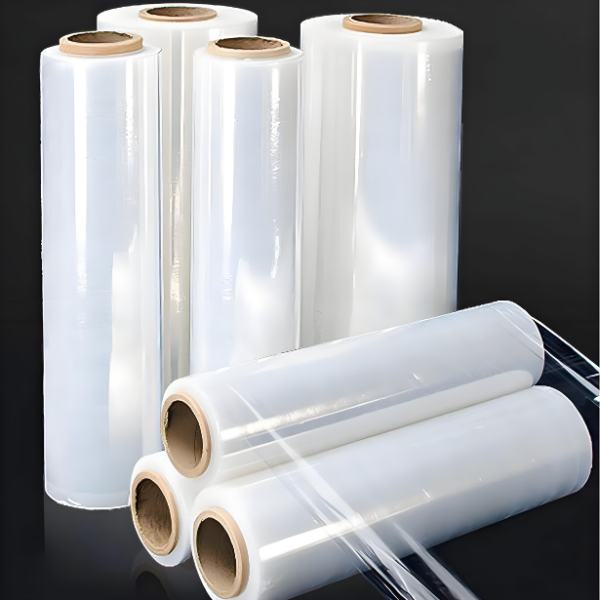
To buy the right LLDPE film, define the packaging job before asking for a resin name: identify the packed product, load, failure mode, converting process, sealing conditions, required surface treatment, roll dimensions and acceptance tests. Then compare candidate films by thickness consistency, tensile and elongation in both directions, puncture or impact resistance, tear behavior, seal performance, coefficient of friction, optical appearance and roll quality. A supplier’s “LLDPE film” label alone is not a complete specification.
This guide is for packaging buyers, distributors, bag makers, laminators and process engineers who need to turn an application into an RFQ that a film manufacturer can quote and test. If you already know the target construction and dimensions, review CloudFilm’s custom LLDPE film rolls and specifications. If you are still comparing polyethylene families, begin with the PE film types, properties and uses guide.
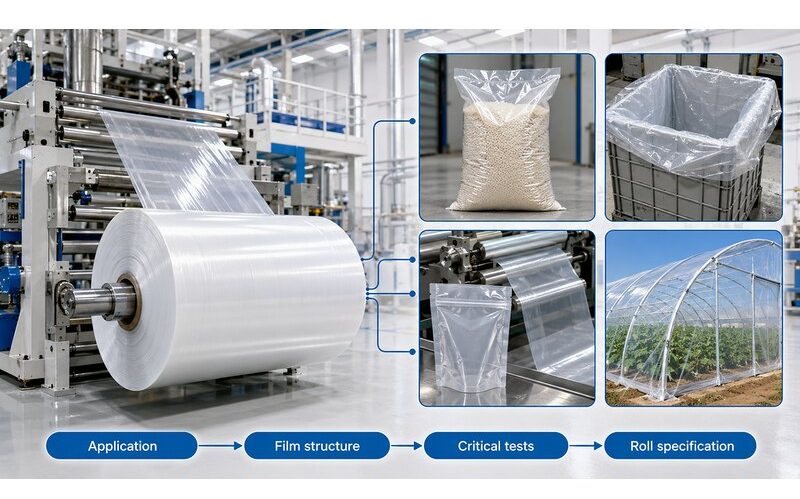
What LLDPE Film Is—and What It Is Not
LLDPE means linear low-density polyethylene. It is produced by copolymerizing ethylene with a controlled amount of an alpha-olefin comonomer. Compared with the highly branched molecular structure associated with conventional LDPE, LLDPE has a more linear backbone with short-chain branching. In film applications, that molecular design is commonly selected for toughness, elongation, puncture resistance and sealability.
Those general characteristics do not make every LLDPE film interchangeable. Resin density, melt index, comonomer type and distribution, catalyst technology, extrusion method, layer design, blend ratio, additives, orientation during processing and film thickness all influence final performance. A film sold as “100% LLDPE,” an LDPE/LLDPE blend and a coextruded film with an LLDPE-rich seal layer can behave very differently on the same packaging line.
Useful strengths
- Good toughness and extensibility for packs exposed to handling, corners or movement.
- Useful heat-seal behavior for bags, liners and sealant layers when the grade and process window are matched.
- Moisture resistance and chemical resistance suitable for many general packaging duties.
- Compatibility with blown-film, cast-film, monolayer, blended and coextruded structures.
Important limitations
- LLDPE is not, by itself, a high oxygen-barrier material. Shelf-life requirements may need another barrier layer or coating.
- “Stronger” is application-specific. A high tensile result does not automatically predict puncture, tear propagation, seal integrity or filled-pack survival.
- Surface treatment can decay with storage. Printing, coating and lamination require a defined treated side, test method and acceptance point.
- Slip, antiblock, antistatic, UV and processing additives can solve one problem while changing sealing, friction, optics or downstream adhesion.
For the broader relationship among LDPE, LLDPE, HDPE and other PE films, use CloudFilm’s polyethylene film classification guide. This page stays focused on writing and validating an LLDPE purchase specification.
Start with the Packaging Job, Not the Resin Name
The fastest route to a useful quotation is a one-page application brief. It should describe what the film must do, what currently fails and how success will be measured. A request such as “quote 50-micron LLDPE” leaves the supplier guessing about the bag geometry, load, sealing line, friction, treatment and roll build. A request such as “inner liner for an angular dry ingredient, bottom sealed at the customer’s existing jaw settings, with no puncture after the agreed filled-pack drop test” gives the supplier a testable target.
| Buyer question | Information to provide | Why it changes the film choice |
| What is packed? | Product, weight, particle shape, moisture or oil, temperature at filling, and any regulatory contact requirement | Sharp particles, hot fill, oils and food contact each create different material and compliance needs. |
| How does the pack fail? | Puncture, split seal, tear propagation, blocking, slipping, print/lamination failure, haze or roll defects | The primary failure mode determines which property and test deserve priority. |
| How is it converted? | Blown or cast film preference, bag-making process, lamination or printing process, machine speed and web path | Gauge profile, flatness, stiffness, friction and surface treatment affect machine stability. |
| How is it sealed? | Jaw type, dwell, pressure, line speed, seal geometry, contamination risk and current temperature range | Seal initiation, hot tack and final seal strength depend on the full sealing process, not resin name alone. |
| How is it shipped and used? | Stacking, palletization, drop exposure, cold conditions, outdoor exposure and expected storage time | Distribution hazards and aging can dominate the final pack result. |
Translate the dominant failure mode into a critical-to-quality property
Do not create a specification with twenty equal-priority values. Choose two or three critical-to-quality properties and treat the rest as control values. If puncture causes field losses, prioritize an agreed puncture or dart-impact test and a filled-pack simulation. If seals open while hot, prioritize hot tack and the actual packaging-line window. If the web wanders, measure gauge profile, roll build and friction before assuming the resin is wrong.
Choose the Film Architecture
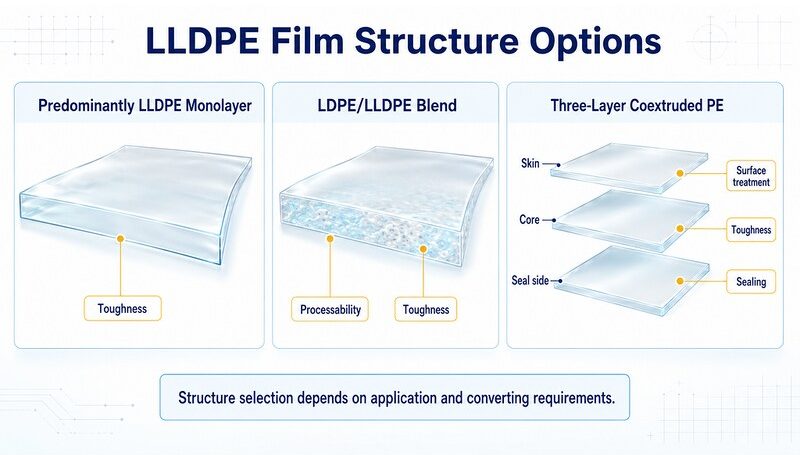
“LLDPE film” can describe a monolayer film, a blend or one or more functional layers in a coextruded structure. The best option is the simplest architecture that meets the pack, converting and compliance requirements with a stable manufacturing window.
| Film option | Why buyers consider it | What to verify | Typical decision risk |
| Predominantly or fully LLDPE monolayer | Direct route to toughness, stretch and sealability for suitable bags, liners and general film uses | Processability, bubble stability or cast behavior, optics, blocking, friction and seal window | Assuming the resin label guarantees all converting properties |
| LDPE/LLDPE blend | Can balance processing, melt strength, optics, stiffness, seal behavior and toughness | Actual blend intent, lot consistency, performance after downgauging and additive package | Judging the blend as inferior without testing the finished film |
| Three-layer or multilayer PE film | Allows each layer to perform a job: skin handling, core mechanics and seal-side function | Layer functions, total thickness, recyclability claim basis, treatment side and interlayer consistency | Comparing only total gauge while ignoring layer distribution |
| LLDPE-rich sealant in a laminate | Provides the sealing and product-contact side beneath a print, stiffness or barrier web | Lamination bond, seal-through-contamination behavior, COF, additive migration and barrier contribution of the full structure | Expecting the LLDPE layer alone to supply oxygen or aroma barrier |
Where optical uniformity, rapid quenching or balanced directional properties matter, film process can be as important as resin choice. CloudFilm’s cast film vs blown film comparison explains the process-level trade-offs. For applications that need functional skins and a mechanical core, review three-layer PE film options.
Build the Specification in Five Layers
A purchase specification should be short enough to use and precise enough to audit. Organize it into five layers: application, construction, dimensions, performance and logistics. Mark every item as required, target, reporting-only or supplier-proposed. This prevents a provisional development value from becoming an accidental contractual limit.
1. Application and construction
- End use, packed product, net weight, bag or web geometry and contact side.
- Monolayer, blend or coextruded structure; whether the film is standalone or a laminate sealant.
- Required additives and the problem each additive must solve. Avoid requesting “all additives” without a functional reason.
- Color, opacity or transparency, surface finish and odor expectations.
2. Dimensions and tolerances
| Item | Specify | Buyer note |
| Thickness | Nominal gauge, individual-point tolerance, average roll tolerance and agreed measurement method | Average thickness alone can hide weak lanes that puncture or seal inconsistently. |
| Width | Finished width, slit tolerance and edge quality | Define whether width is layflat, tube, single-wound sheet or slit web. |
| Length or roll weight | Net film length/weight and tolerance | State which measure controls invoicing and acceptance. |
| Core and roll | Core ID, core length, maximum OD, maximum roll weight, winding direction and splice rule | Roll geometry must fit the unwind, lifting method and storage rack. |
| Packaging | Pallet pattern, edge protection, moisture protection, labels and traceability fields | Export handling can damage acceptable film if roll protection is underspecified. |
3. Mechanical performance
Request results in machine direction (MD) and transverse direction (TD) where the method requires direction. Tensile strength, yield behavior, elongation and secant modulus describe different parts of the stress–strain response; they should not be collapsed into one “strength” number. Tear initiation, tear propagation, dart impact and puncture also represent different failure mechanisms. Select the tests that reproduce the pack hazard rather than collecting every available data point.
4. Converting and surface performance
| Property | Define or test | Common purchasing trap |
| Heat sealing | Seal curve across agreed temperature, dwell and pressure; hot tack if the seal carries load before cooling | Quoting a single “sealing temperature” without the machine conditions |
| Coefficient of friction | Static/dynamic COF, tested side-to-side combination, conditioning and target at receipt/use | Ignoring additive migration and aging |
| Corona treatment | Treated side map, target surface energy, test method and time of acceptance | Assuming treatment at extrusion will remain unchanged through storage |
| Optics | Haze, gloss, clarity or color only when they matter to the package | Rejecting a tough industrial liner for an irrelevant cosmetic target |
| Blocking and winding | Unwind force, telescoping, wrinkles, gauge bands, edge alignment and splice limits | Testing resin properties while accepting unusable rolls |
When printing, coating or laminating is involved, use the corona treatment guide for plastic film to define treatment side, measurement and storage controls.
5. Compliance, documentation and logistics
State the destination market, packed product and applicable contact conditions. Ask for the documents relevant to that exact grade and use; do not treat a general company certificate as proof that every film is suitable for every contact condition. Also define COA fields, lot identification, retention sample, change-notification expectations, pallet marking, Incoterm, port and required shipping documents.
How to Read CloudFilm’s Current LLDPE Product Data
The table below transcribes the typical values and dimensional range currently shown on CloudFilm’s LLDPE product page. They are useful as a starting reference, not as universal LLDPE limits or an automatic guarantee for every customized film. Confirm the exact grade, thickness, production route, test conditioning, tolerance and batch-specific acceptance criteria before purchase.
| Current product-page item | Published value | Procurement interpretation |
| Density | 0.918 g/cm³ · ASTM D792 | Useful for yield calculations and resin positioning; verify the finished-film or resin basis used. |
| Yield tensile strength | MD 9.3 MPa · TD 10 MPa · ASTM D882 | Compare both directions and use the same specimen and conditioning protocol. |
| Break tensile strength | MD 45 MPa · TD 36 MPa · ASTM D882 | High break strength does not replace puncture, tear or seal testing. |
| Elongation at break | MD 550% · TD 910% · ASTM D882 | Directional elongation is informative, but filled-pack deformation must still be tested. |
| 1% secant modulus | MD 180 MPa · TD 210 MPa · ASTM D882 | Relates to early-stage stiffness; verify whether the required web handling needs a range or target. |
| Gloss / haze | 45° gloss 51 · ASTM D2457; haze 18% · ASTM D1003 | Use optical limits only if appearance is critical and compare at the same thickness. |
| Thickness range | 15–100 μm | Current published range. Applications outside it require a capability check or another PE construction. |
| Width range | 300–2000 mm | Confirm finished width, slit tolerance and whether the web is sheet, tube or layflat. |
| Roll diameter | 240–400 mm | Confirm maximum OD against the unwind and roll-weight limit. |
| Core / treatment | 3 or 6 inch core · one-side corona | Specify core tolerance, winding direction and which physical side is treated. |
| Published MOQ | 1000 kg | Confirm MOQ for the exact customized specification, trial quantity and shipment combination. |
Buyer rule: Never paste typical values into a contract without confirming whether they are targets, minimums, maximums or reporting-only values. A valid acceptance specification also needs tolerances, sampling frequency, test method/version, conditioning and an agreed action when a result is out of range.
For estimating square-meter yield or comparing quotes with different density and thickness assumptions, use CloudFilm’s flexible film density and yield formulas.
Match Tests to the Application
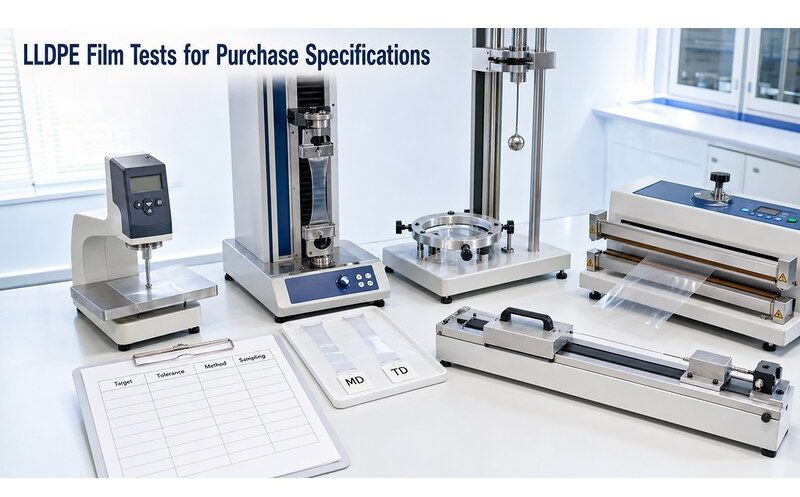
A laboratory result is valuable only when the method, specimen and failure criterion are clear. Ask the supplier to identify whether data are typical resin values, typical finished-film values or guaranteed shipment limits. When comparing suppliers, test samples at the same nominal thickness and conditioning. If the films have different gauges, also compare yield, total package cost and filled-pack performance—not only the highest number on a data sheet.
| Packaging risk | Useful evidence | Application confirmation |
| Sharp product or corner puncture | Puncture energy/force or dart impact using an agreed method; gauge profile | Filled-pack handling, compression and drop sequence with the actual product |
| Bag tears during filling or lifting | Tear test in MD/TD, tensile/elongation and seal-area inspection | Actual bag geometry, lifting points and line speed |
| Seal opens while hot | Hot-tack curve and seal-strength curve across a defined window | Run at production speed with actual jaw geometry and contamination level |
| Web blocks or slips | Static/dynamic COF, blocking tendency, additive and aging review | Unwind, web transport, stacking and bag opening on the production line |
| Printing or lamination delaminates | Surface-energy check, treated-side verification and bond/ink adhesion test | Run with the actual ink, adhesive, cure time and storage condition |
| Roll will not run consistently | Thickness profile, width, flatness, edge, winding hardness, telescoping and splice audit | Full-speed unwind trial on the intended equipment |
CloudFilm’s flexible packaging quality control guide provides a broader incoming, in-process and final-inspection framework. Use it to decide who measures each property and how results are recorded.
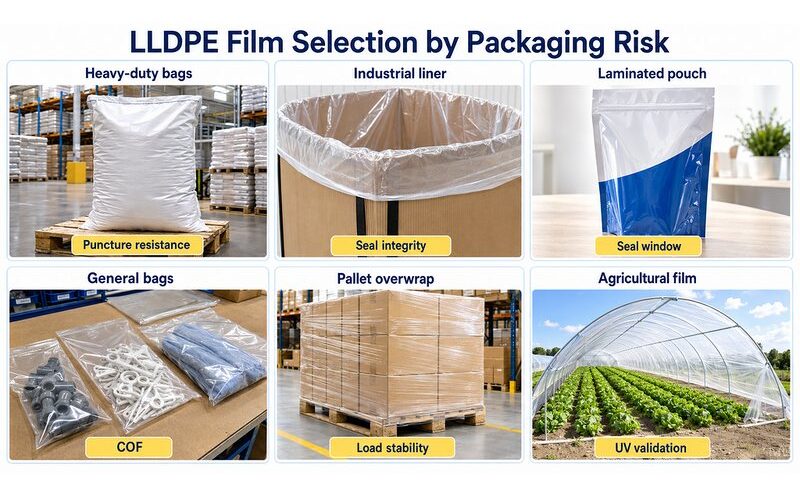
Application Selection Matrix
| Application | Primary buying priorities | Questions before quoting | Do not assume |
| Heavy-duty bags and shipping sacks | Puncture, impact, tear control, seal integrity, gauge profile and filled-pack survival | Load, product shape, bag dimensions, drop/stacking hazards, filling temperature and seal process | That a thicker film always gives the best cost per successful pack |
| Industrial liners | Toughness, dimensions, fold/gusset design, seal quality, cleanliness and roll/bag handling | Container geometry, liner fit, sharp points, insertion method and closure method | That one standard liner gauge fits all containers and payloads |
| Laminate sealant layer | Seal initiation, hot tack, final seal, COF, lamination bond and product compatibility | Outer web, adhesive, cure, pack speed, jaw conditions, contamination and shelf-life target | That LLDPE alone supplies the laminate’s oxygen barrier |
| General bags and pouches | Bag opening, seal consistency, clarity/appearance, stiffness balance and runnability | Bag machine, printing, zipper/fitment, stack behavior and end-use load | That the lowest COF or highest clarity is automatically best |
| Stretch, overwrap or load containment | Stretch behavior, holding force, puncture, cling/slip balance and unwind stability | Manual or machine use, pre-stretch, load profile, edges, storage and transport route | That generic film data predicts load stability without a pallet trial |
| Agricultural or outdoor film | Mechanical durability, UV package, optical/thermal function, aging and installation behavior | Crop/use, geography, exposure period, climate, thickness and disposal route | That “UV stabilized” is meaningful without a defined exposure target and validation |
If the requirement is a general sheet, tube or liner roll rather than a specialized film, compare the available custom PE roll formats. For a procurement-focused overview of packaging formats, see the packaging PE film selection guide.
Run a Trial That Can Produce a Decision
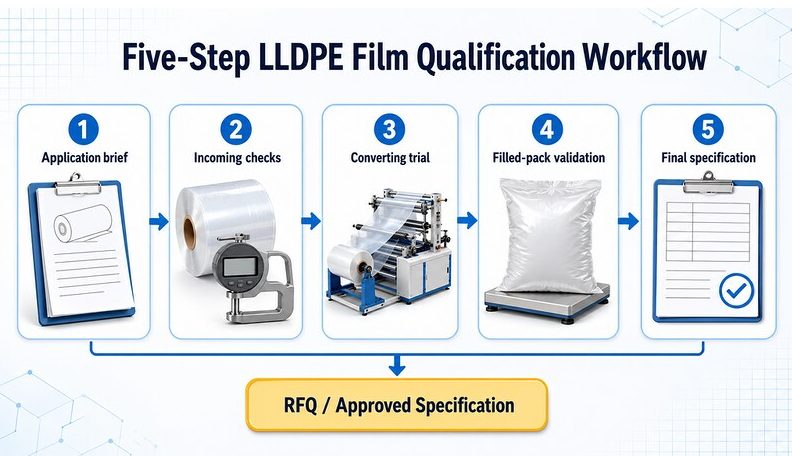
A sample request is not yet a trial plan. Before the roll arrives, record the incumbent film, candidate code, nominal dimensions, machine, line conditions, test sequence and pass/fail criteria. Change one major variable at a time where practical. Keep samples from the start, middle and end of the roll, and record any adjustment made by the operator.
- Desk review:Compare the application brief, technical data, compliance documents, roll format and supplier-declared differences from the incumbent.
- Incoming check:Verify labels, lot traceability, packaging damage, roll dimensions, thickness profile, treated side and any agreed laboratory controls.
- Conversion trial:Start at a safe baseline, then test the intended production window for unwind, web tracking, bag opening, sealing, printing or lamination.
- Pack validation:Use the real product or a justified simulant. Evaluate seal integrity, puncture, drops, compression, storage and transport hazards relevant to the application.
- Commercial decision:Compare good-pack yield, film use per pack, downtime, waste, complaint risk, lead time and landed cost. Approve the exact specification—not merely the supplier name.
Downgauging needs a controlled comparison
A thinner LLDPE film may reduce material per pack, but only if gauge profile, seals, puncture performance and line stability remain acceptable. Compare films at equal pack function, not equal price per kilogram. Record film weight per thousand packs, rejected packs, line speed, changeover loss and distribution results. If the thinner film needs slower operation or produces more failures, the apparent material saving can disappear.
RFQ Checklist for LLDPE Film
Send the following information in the first inquiry. If a field is unknown, state “supplier to recommend” and provide the application facts that support the recommendation.
| RFQ field | Buyer input |
| Application | End use, packed product, net weight, contact conditions and destination market |
| Current material | Existing film structure/grade, thickness, supplier data sheet or a representative sample |
| Problem or target | Failure to solve, cost/yield target, line-speed target or performance improvement |
| Film format | Single-wound sheet, centerfold, tube, layflat, gusseted tube, bags or laminate sealant web |
| Dimensions | Thickness, width/layflat, length or net weight, core ID, maximum OD and roll weight |
| Converting | Blown/cast preference, printing, lamination, bag making, sealing equipment and production speed |
| Surface/additives | Treated side, target surface energy, slip/COF, antiblock, antistatic, UV, color or other functional need |
| Acceptance | Critical properties, test methods, tolerances, sampling and trial pass/fail criteria |
| Compliance | Relevant food/contact or other regulatory requirement and required document set |
| Commercial | Trial quantity, annual demand, delivery destination, Incoterm, preferred shipment and target timing |
Common Buying Mistakes
Buying by thickness and price per kilogram only
Two films at the same nominal gauge can have different profiles, yield, sealing and roll quality. Compare cost per accepted pack or square meter at the required function. Include waste, downtime and complaint exposure.
Treating “LLDPE” as one universal grade
Ask what performance the proposed resin, blend and layer design are intended to deliver. A supplier may recommend a blend or multilayer route because it offers a more stable process window—not because it is substituting an inferior material.
Approving a laboratory sample without a production trial
Hand samples cannot demonstrate roll build, full-speed web handling, additive aging or actual seals. Use laboratory screening to eliminate weak candidates, then qualify the preferred option on the intended equipment.
Leaving the treated side and winding direction ambiguous
Define a side map from the operator’s viewpoint and include unwind direction. A correctly treated film can still fail if the converter prints or laminates the wrong face.
Requiring certificates without connecting them to the grade
Specify the exact declaration or report needed for the destination market and packed product. Confirm grade identity, intended use and document validity instead of collecting unrelated certificates.
Frequently Asked Questions
Is 100% LLDPE film always better than an LDPE/LLDPE blend?
No. A blend may improve process stability, optics, stiffness balance, seal behavior or bubble performance while retaining the toughness needed by the pack. Compare the finished films using the same gauge, line and acceptance tests.
What thickness of LLDPE film should I buy?
There is no universal thickness. Start from load, product shape, bag geometry, distribution hazards, sealing and converting. Screen candidate gauges in a controlled trial. CloudFilm’s current product page lists 15–100 μm as its published reference range; confirm the exact customized capability.
Which LLDPE film property best predicts puncture resistance?
No single tensile value reliably predicts every puncture event. Use an agreed puncture or dart-impact method, check thickness profile, and validate with the actual product, bag geometry and handling sequence.
Does LLDPE film provide oxygen barrier?
LLDPE provides useful moisture resistance for many uses, but it is not normally selected as a high oxygen-barrier layer. Oxygen-sensitive products may need EVOH, polyamide, coated film, metallized film, foil or another validated barrier structure.
Should I specify a heat-sealing temperature?
Specify a tested sealing window with jaw type, dwell, pressure and line speed, not one isolated temperature. Include hot tack when the seal carries load before it cools and final seal strength after defined conditioning.
How should corona treatment be specified?
Define the treated side, surface-energy target, test method, conditioning and time of measurement. Also define winding direction so the converter can identify the treated face. Retest after storage when printing or lamination performance is critical.
What should I request with an LLDPE film sample?
Request the candidate code, construction, nominal dimensions, production lot, TDS, relevant compliance documents, treated-side identification, roll format and declared differences from your current film. Send a written trial plan and return measured results.
How do I compare two LLDPE quotations fairly?
Normalize thickness, density, width, length or net weight, roll format, packaging, Incoterm and tolerances. Then compare yield, accepted packs, waste, line speed, lead time, complaint risk and landed cost—not only price per kilogram.