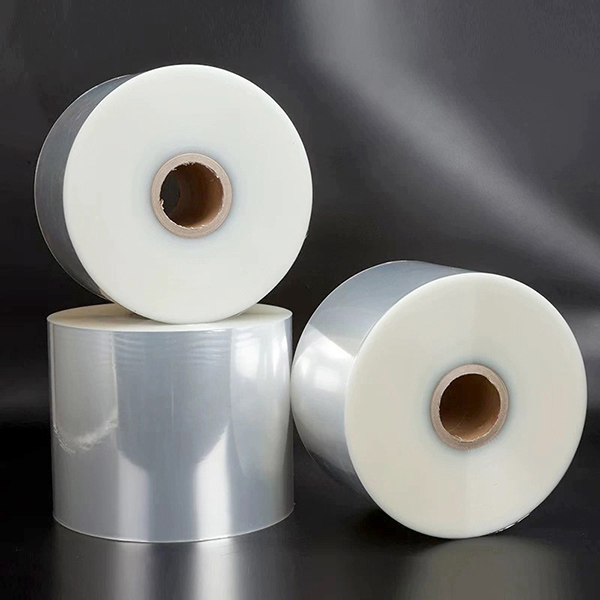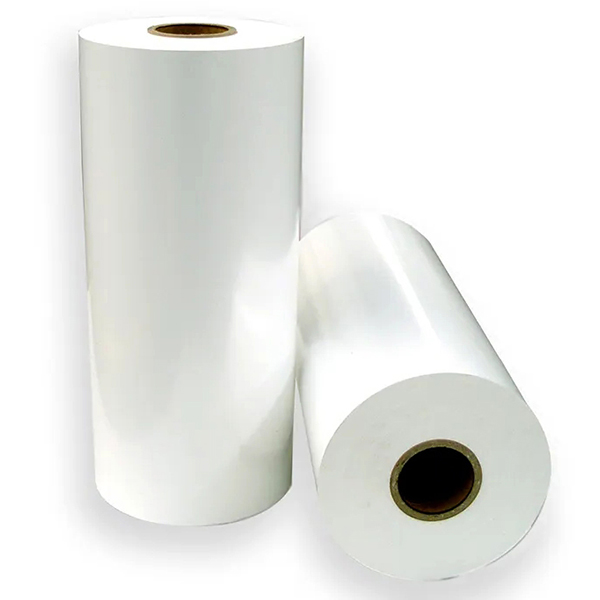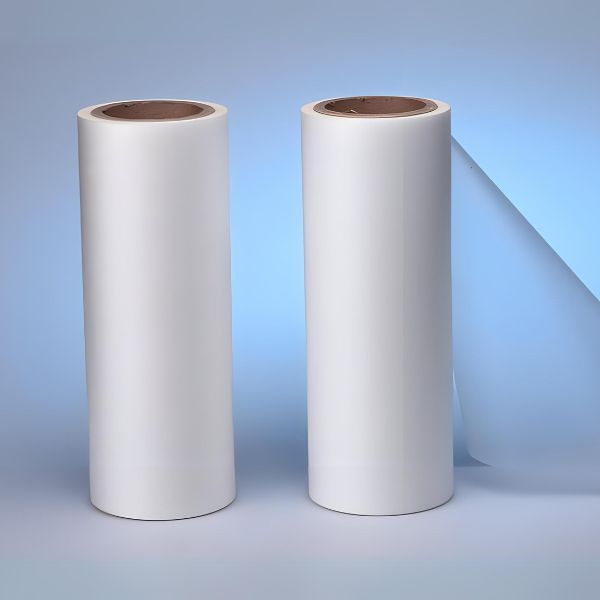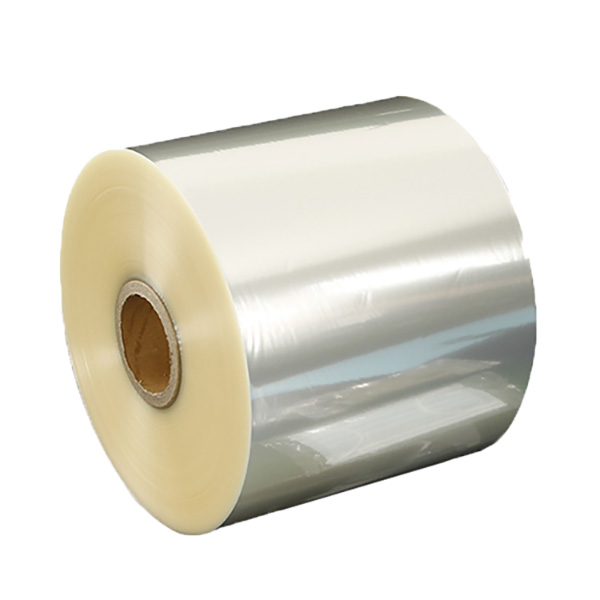
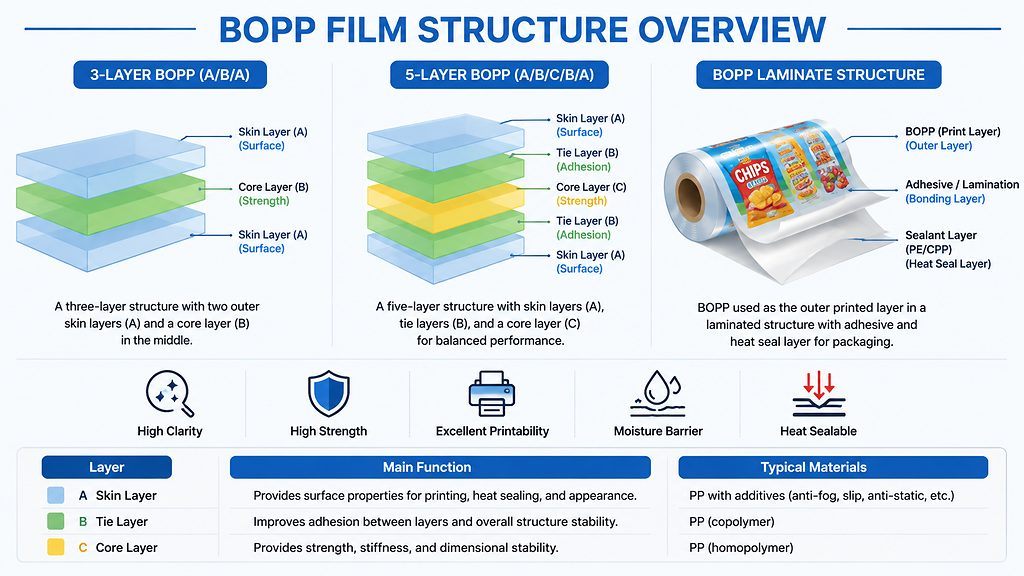
BOPP film structure can mean two different things. The first is the internal construction of the film itself, such as a single-layer, three-layer, or five-layer coextruded film. The second is the finished packaging laminate, such as BOPP/PE or BOPP/CPP, in which BOPP is combined with another web to add sealing, barrier, or mechanical performance.
Understanding this distinction helps packaging buyers, converters, brand owners, and engineers avoid vague specifications. It also makes it easier to compare grades in the BOPP Film Series and communicate the correct print side, seal side, surface treatment, thickness, and roll requirements to a manufacturer.
Direct answer: Most general-purpose BOPP packaging films are either monolayer or coextruded multilayer films. Three-layer constructions such as A/B/A or A/B/C are common, while five-layer constructions provide more freedom to separate surface, optical, sealing, and processing functions. A finished flexible package may then laminate the BOPP web to PE, CPP, metallized film, paper, or another substrate.
What Is BOPP Film?
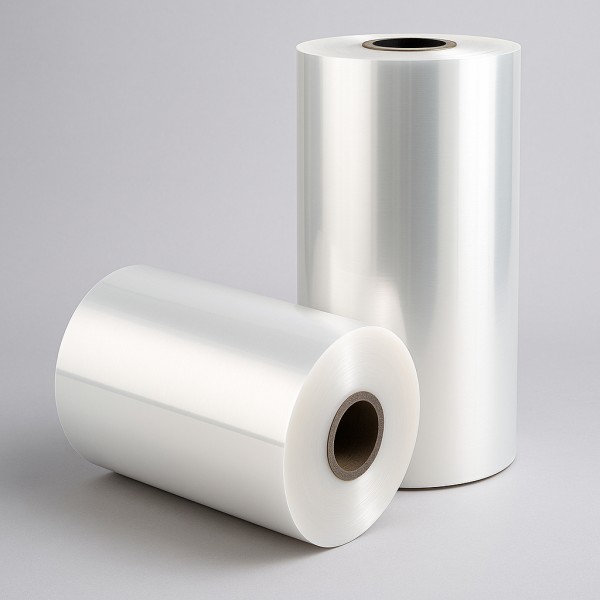
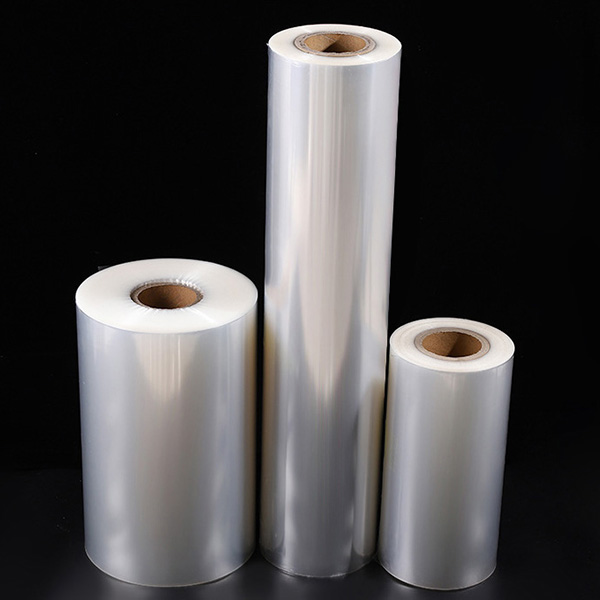
BOPP stands for biaxially oriented polypropylene. Polypropylene resin is melted and formed into a thick cast sheet, then stretched in the machine direction and the transverse direction under controlled temperature. The orientation aligns the polymer structure and produces a film with a useful combination of tensile strength, stiffness, clarity, gloss, dimensional stability, and moisture resistance.
The exact property balance depends on resin selection, stretching ratios, heat setting, layer design, additives, coating, and surface treatment. For a broader performance overview, see BOPP film properties, benefits and uses.
BOPP is not automatically heat sealable, printable, anti-fog, metallizable, matte, or high barrier. These functions must be engineered into the grade through skin-layer formulation, corona or flame treatment, coating, metallization, cavitation, or lamination.
BOPP Film Structure Versus Packaging Laminate Structure
A coextruded BOPP film is produced as one integrated web. Its layers leave the die together and are stretched as a unit. A packaging laminate is different: two or more already-formed webs are bonded later by adhesive, extrusion lamination, or another converting process.
| Term | What It Describes | Typical Example | Main Purpose |
| BOPP layer structure | Layers inside one BOPP web | A/B/A or A/B/C | Divide surface and core functions |
| BOPP laminate structure | BOPP bonded to another film or substrate | BOPP/PE or BOPP/CPP | Combine printing, sealing, barrier, and toughness |
| Coated or metallized BOPP | A BOPP base web with a functional surface layer | Acrylic-coated BOPP or metallized BOPP | Add sealability, barrier, appearance, or protection |
A specification that says only “three-layer BOPP” does not tell the buyer whether the film is printable, sealable, matte, anti-fog, or suitable for metallization. Likewise, a notation such as BOPP/PE does not reveal the thickness, adhesive system, print location, barrier target, or seal requirements. Both levels of structure must be defined.
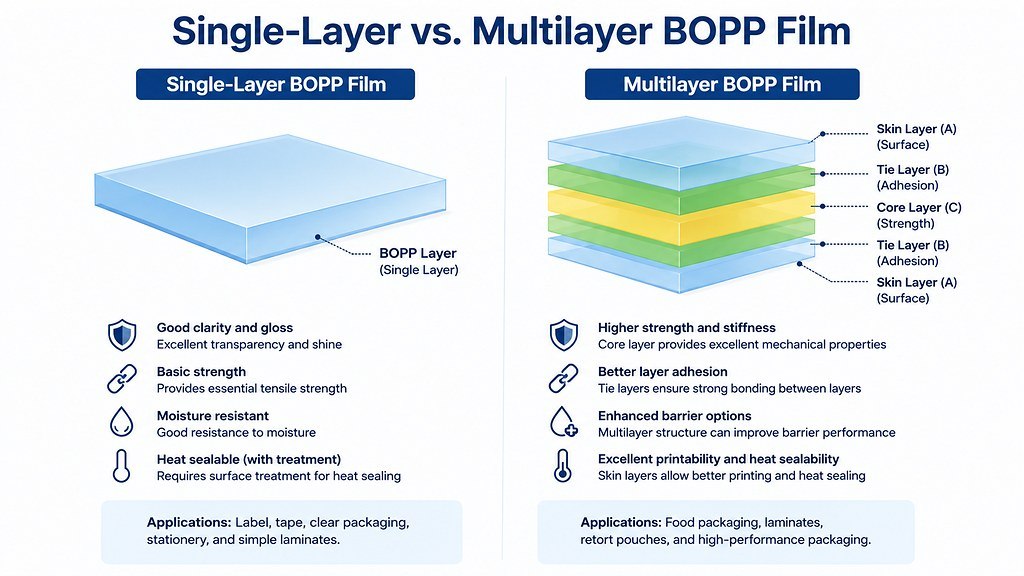
Single-Layer BOPP Film
A monolayer BOPP film uses one main formulation across the film thickness. It can be suitable when the application primarily needs clarity, stiffness, release, tape backing, simple overwrap, or another focused function. It may also be coated or treated after orientation.
The limitation is formulation compromise. Additives that improve slip, antiblock, opacity, sealing, or surface behavior can also affect optics, printing, winding, or mechanical properties. Multilayer coextrusion allows many of these functions to be moved into thin skin layers while the main core remains optimized for strength, stiffness, and yield.
Three-Layer BOPP Film Structure: A/B/A and A/B/C
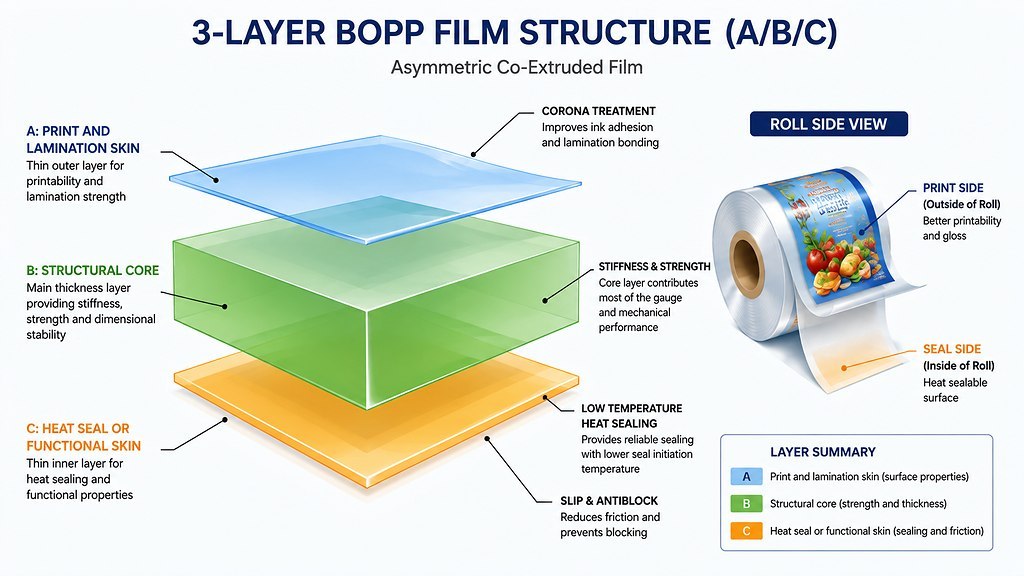
Three-layer BOPP is widely used because it offers a practical balance between performance and manufacturing efficiency. The core usually represents most of the total thickness, while the two thinner outer skins control the surfaces that contact ink, adhesive, sealing jaws, product, or downstream coatings.
A/B/A Structure
In an A/B/A design, the two outer skin layers use the same or closely related formulation. This symmetric construction can be useful when both sides need similar slip, antiblock, sealing, or optical behavior. Symmetry can also simplify film design and help maintain balanced handling.
A/B/C Structure
In an A/B/C design, the two surfaces have different jobs. One skin may be optimized for printing or lamination, while the opposite skin may be heat sealable, metallizable, anti-fog, matte, or engineered for controlled coefficient of friction. This asymmetric design is common when a converter needs a clearly defined outer side and inner side.
Typical Functions of Each Layer
- Outer print or lamination skin: controlled surface chemistry, corona treatment, clarity, gloss, and ink or adhesive anchorage.
- Core layer: stiffness, tensile strength, thickness contribution, yield, opacity or cavitation when required, and overall dimensional behavior.
- Inner seal or functional skin: heat-sealing resin, slip and antiblock package, anti-fog function, metallization receptivity, or another application-specific surface.
For reverse-printed flexible packaging, a dedicated BOPP Printing Film can provide the treated and optically controlled outer web. When the BOPP itself must close the pack, a Heat Sealable BOPP Film is normally required rather than a standard non-sealable printing grade.
Five-Layer BOPP Film Structure
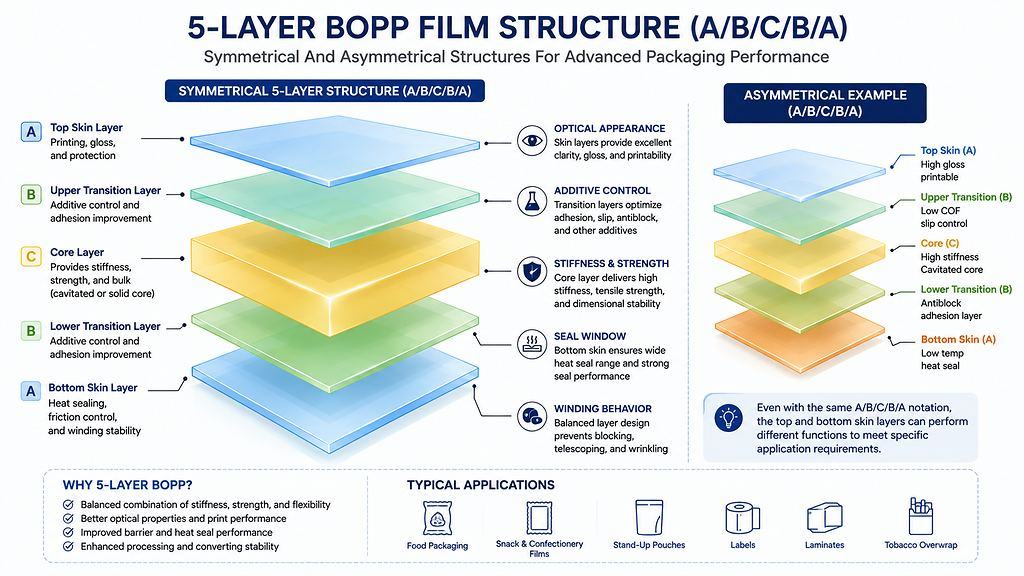
Five-layer BOPP provides additional design freedom. A common conceptual arrangement is A/B/C/B/A, but the letters do not have a universal industry meaning. One manufacturer may use A for a print skin and another may use A for a seal skin. The technical data sheet and side identification are therefore more important than the letter sequence alone.
The extra layers can be used to split additive packages, isolate a special core, improve surface uniformity, manage opacity, reduce the amount of an expensive functional resin, or create different behavior on the two sides. Unlike a barrier coextrusion containing chemically incompatible polymers, a five-layer BOPP structure does not automatically mean that the two intermediate layers are adhesive tie layers. They may simply be transition or functional polypropylene-based layers.
Why Use Five Layers Instead of Three?
- More precise separation of printing, sealing, optical, mechanical, and winding functions.
- Better control of additive migration and surface performance.
- Opportunity to place costly specialty materials only where they are needed.
- Greater flexibility for matte, pearlized, white, cavitated, metallizable, coated, label, or high-speed packaging grades.
- Potentially more stable processing windows when surface and core demands conflict.
The benefit is not simply “more layers are better.” A well-designed three-layer film may outperform a poorly specified five-layer film. The correct choice depends on the package, process, shelf-life target, equipment, and total cost.
Printability and Lamination Bond
Polypropylene has naturally low surface energy, so the printing or lamination side normally requires controlled surface treatment. Corona treatment is common, but the buyer should specify the treated side and target treatment level, then verify it before use because treatment can decline during storage. Ink, adhesive, primer, and press conditions must also be compatible with the selected film.
Heat Sealability
Heat-sealable skins use a resin system with a lower sealing range than the structural PP core. Important data include seal initiation temperature, seal strength, hot tack, contamination tolerance, dwell time, pressure, and sealing range. A film that seals in a laboratory may still fail on a fast packing line if hot tack or jaw release is insufficient.
Slip, Antiblock and Coefficient of Friction
Slip additives help the web move through rollers and forming collars. Antiblock particles prevent adjacent layers from sticking in the roll. Too little slip can cause drag and unstable feeding; too much can reduce print or lamination adhesion and may create telescoping or winding issues. The target coefficient of friction should match the machine and package format.
Optics, Matte Finish and Cavitation
Clear BOPP emphasizes transparency and gloss. A matte skin creates a low-glare appearance, while cavitated or pearlized structures use microscopic voids to produce opacity, lower density, and a distinctive visual effect. Buyers seeking a non-gloss finish can compare a dedicated BOPP Matte Film with coated soft-touch grades rather than assuming every matte-looking film has the same surface durability or tactile feel.
Moisture, Oxygen and Light Barrier
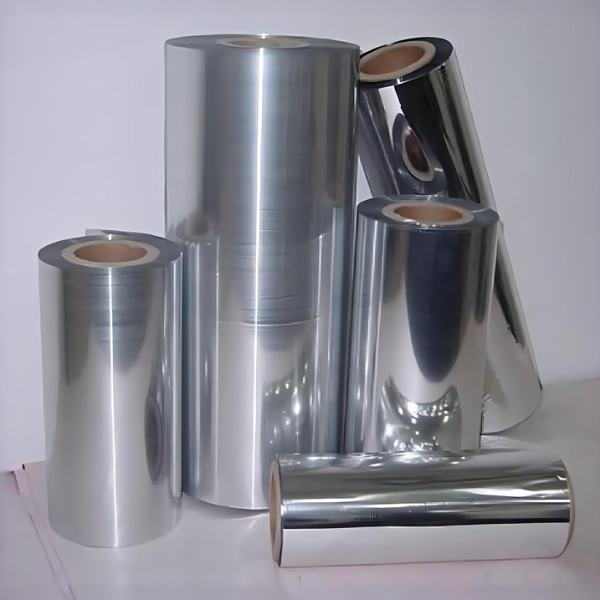
Standard BOPP is a useful moisture barrier but is not usually selected as a high oxygen barrier by itself. Metallization or barrier coating can substantially improve oxygen, aroma, and light protection. A Metallized BOPP Film may serve as a barrier and decorative layer in snack, confectionery, and other dry-food structures, provided the design also meets flex-crack, seal, and product-compatibility requirements.
Anti-Fog and Specialty Surfaces
Condensation inside fresh-food packs can obscure the product even when the base film is highly transparent. A purpose-designed Anti Fog BOPP Film uses a functional surface to spread condensed moisture into a more uniform layer instead of visible droplets. Other specialty skins and coatings can add acrylic sealing, anti-scratch behavior, release, label performance, or premium tactile effects.
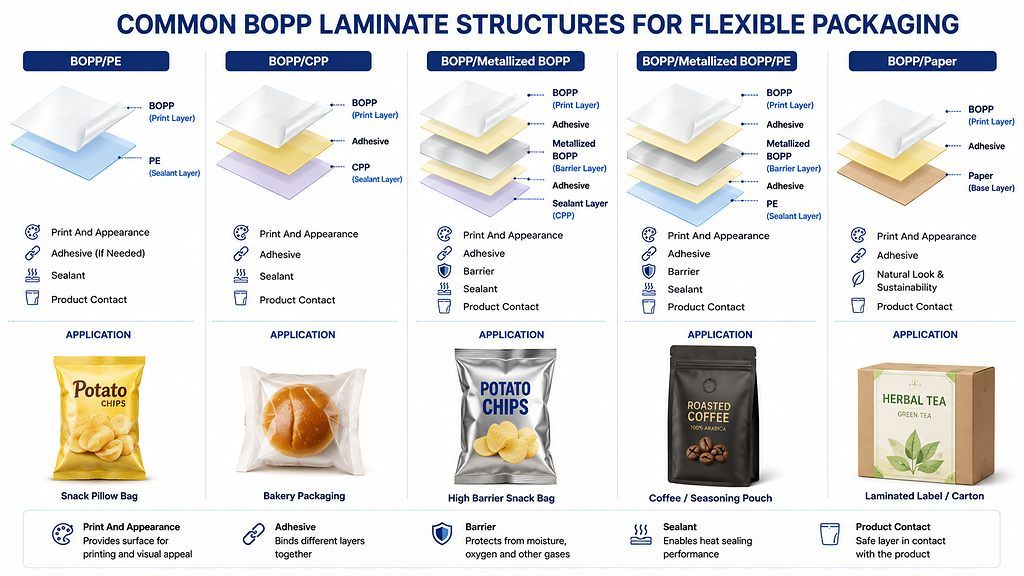
Common BOPP Laminate Structures
Once the correct BOPP web is selected, it may be laminated to another material. The outer BOPP usually provides printing, gloss, stiffness, and moisture resistance, while the inner web provides sealing, puncture resistance, heat resistance, or additional barrier.
| Structure | Typical Role of BOPP | Role of Other Layer | Common Uses |
| BOPP/PE | Printed outer layer, stiffness, appearance | Flexible low-temperature sealant and product-contact layer | Snacks, powders, noodles, frozen foods, daily chemicals |
| BOPP/CPP | Print layer and crisp appearance | PP sealant with good clarity and heat resistance | Pillow packs, confectionery, bakery, general food packaging |
| BOPP/Metallized BOPP | Printed outer web | Barrier, light protection, metallic appearance | Chips, biscuits, candy and dry foods |
| BOPP/Metallized BOPP/PE or CPP | Print and mechanical surface | Barrier middle web plus sealant inner web | Products requiring stronger aroma, oxygen, or light protection |
| BOPP/Paper or Board Laminate | Protective gloss or matte surface | Print body, stiffness, or structural substrate | Labels, cartons, book covers and decorative applications |
For a more focused explanation of layer order, thickness notation, sealing, and sourcing, review the BOPP/PE laminated film guide. The correct laminate should be selected from the product, filling method, pack shape, storage conditions, shelf life, and recycling strategy—not from a familiar structure name alone.
How to Choose the Right BOPP Structure
Start with the packed product and the packaging line, not with a layer count. The same nominal thickness can behave very differently depending on skin formulation, orientation, coefficient of friction, heat-seal system, treatment, and winding quality.
1. Define the Product and Shelf-Life Risks
Identify sensitivity to moisture, oxygen, aroma loss, light, grease, puncture, and temperature. Dry snacks may prioritize moisture and aroma protection; fresh produce may need clarity, controlled perforation, and anti-fog behavior; powdered products may require strong seals and contamination tolerance.
2. Define the Converting Process
State whether the film will be surface printed, reverse printed, laminated, metallized, coated, made into labels, used as tape backing, or run as an unsupported wrapper. Confirm the printing method, ink system, adhesive type, curing conditions, and whether one or both sides require treatment.
3. Define the Packing Machine
Provide the machine type, maximum speed, forming method, seal-jaw style, sealing temperature, dwell time, roll direction, unwind position, core size, maximum roll diameter, and required coefficient of friction. A structure that performs well on one machine may need adjustment on another.
4. Select Film Thickness and Layer Function
Do not select thickness only from a competitor sample. Calculate stiffness, yield, pack size, filling weight, abuse resistance, and line tension. A high-yield 12 Micron BOPP Film may be suitable for many snack and confectionery structures, while heavier gauges may be required for labels, overwrap, large packs, or demanding handling.
5. Compare BOPP With Other Films
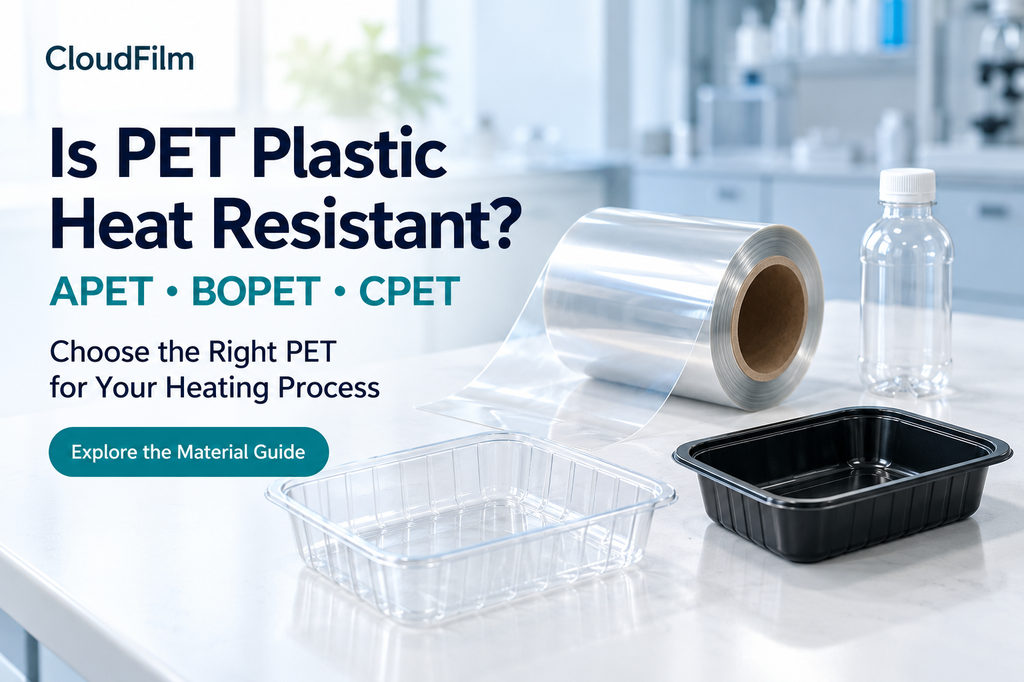
BOPP may not be the best outer web for every package. PET generally offers higher temperature resistance and dimensional stability, CPP offers softness and direct sealing, PE offers flexibility and low-temperature sealing, and BOPA offers puncture resistance. The BOPP vs BOPET vs CPP vs PE packaging film guide helps clarify these trade-offs.
6. Validate With Samples and Line Trials
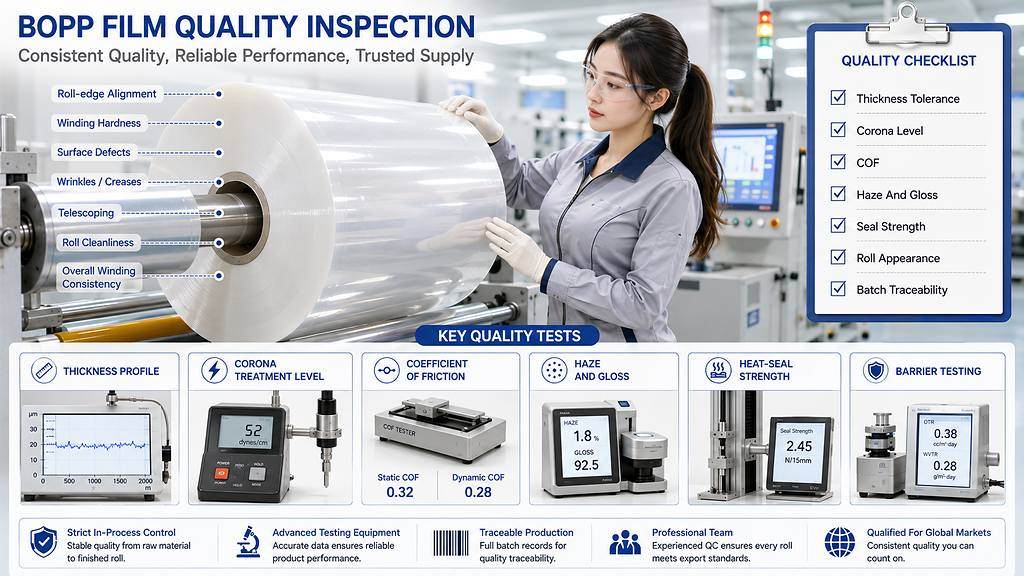
Request representative A4 sheets for preliminary checks and short rolls for realistic converting and packing trials. Record print adhesion, bond strength, seal curves, hot tack, coefficient of friction, haze, gloss, barrier, roll appearance, and machine efficiency. Approve a written specification and control sample before mass production.
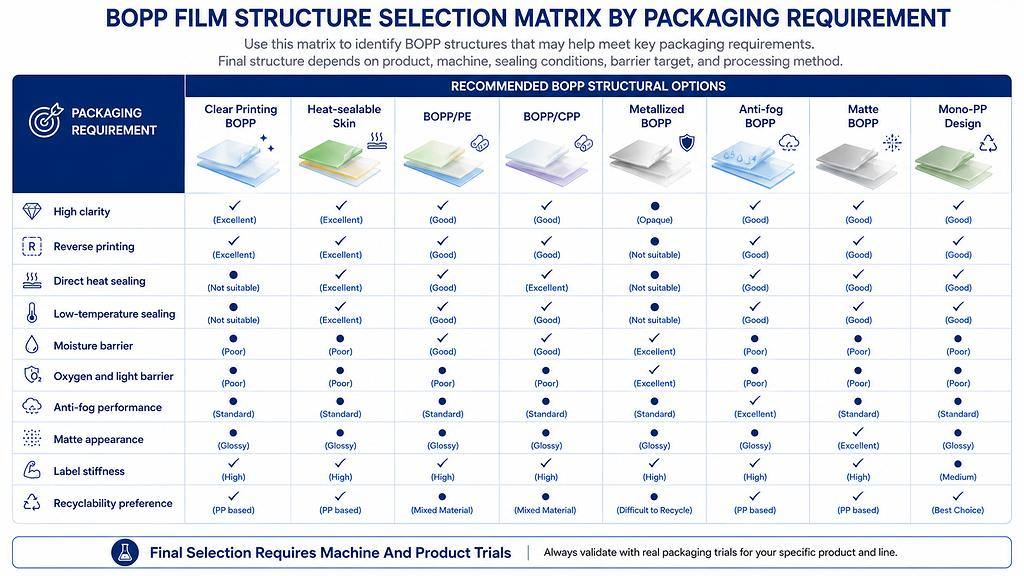
BOPP Structure Selection by Application
| Application | Possible Starting Structure | Critical Checks |
| Dry snacks and confectionery | Printed BOPP/CPP, BOPP/PE, or BOPP/metallized BOPP | Moisture barrier, aroma, seal integrity, hot tack, machine speed |
| Bakery and fresh produce | Heat-sealable BOPP or anti-fog BOPP; sometimes BOPP/CPP | Clarity, fog control, perforation, seal range, product respiration |
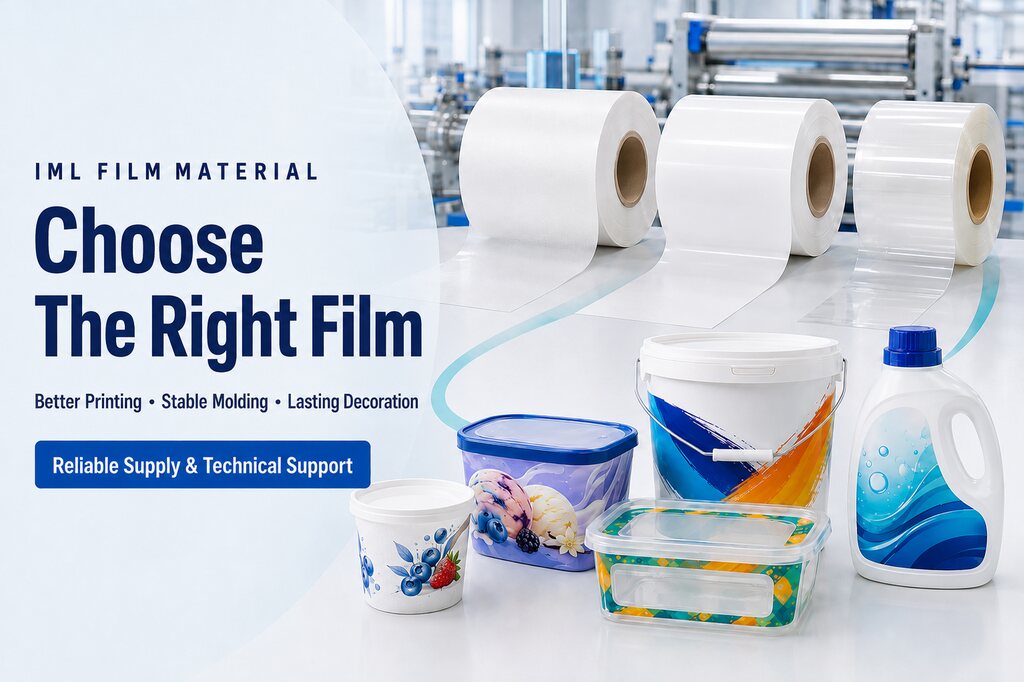
| Labels and in-mold labels | Specialized clear, white, cavitated, or IML BOPP | Printability, die cutting, static, stiffness, mold behavior, surface finish |
| Tape backing | High-strength BOPP tape film | Tensile profile, elongation, coating anchorage, winding |
| Carton, book and decorative lamination | Gloss, matte, thermal, or coated BOPP | Bond, scratch resistance, curl, appearance, downstream finishing |
| High-barrier dry food | Printed BOPP plus metallized or coated barrier web and sealant | OTR, WVTR, light barrier, flex resistance, seal and migration compliance |
Additional end-use examples are covered in BOPP film uses in the packaging industry. These examples are starting points, not universal specifications; product formulation and line conditions still determine the final design.
How to Work With a BOPP Film Manufacturer and Supplier
Adding supplier and manufacturer considerations is useful because a technically correct structure can still create losses if roll quality, treatment, winding, documentation, or delivery is inconsistent. The commercial section should remain practical and directly connected to the buyer’s risk rather than repeating promotional claims.
Information to Send With an Inquiry
- Application, packed product, filling weight, pack dimensions, and target shelf life.
- Existing structure and total thickness, including each layer when known.
- Required BOPP type, thickness, width, treatment side, seal side, and roll direction.
- Printing, lamination, metallization, coating, or label-converting process.
- Core size, roll diameter, roll length or weight, splice policy, and pallet requirements.
- Required optical, mechanical, sealing, coefficient-of-friction, barrier, and food-contact data.
- Annual demand, trial quantity, destination, Incoterm, and requested documentation.
What a Reliable Supplier Should Control
A capable BOPP film manufacturer and supplier should provide consistent gauge, stable treatment, controlled surface properties, clean winding, traceable production lots, suitable export packaging, and technical communication before and after trials. It should also explain which values are typical and which are guaranteed in the agreed specification.
Buyers comparing sources in a major production market can use the overview of BOPP film manufacturers in China as a preliminary reference, then qualify the actual supplier through samples, audits, documentation review, and repeat-order consistency.
Sustainability and Structure Simplification
A BOPP-based laminate is not automatically recyclable in every market. Compatibility depends on the other layers, coatings, adhesives, inks, labels, collection systems, and local rules. Where practical, a mono-PP structure using BOPP with a PP sealant can simplify the material family, but performance and recycling claims must still be validated. See the discussion of BOPP recycling challenges and solutions for design considerations.
Common Specification Mistakes to Avoid
- Assuming A/B/A or A/B/C has the same meaning for every producer.
- Ordering “printable BOPP” without stating the treated side, treatment target, ink, or adhesive system.
- Ordering “heat-sealable BOPP” without confirming seal initiation temperature, hot tack, seal strength, and machine speed.
- Using BOPP/PE or BOPP/CPP notation without individual layer thicknesses and print orientation.
- Choosing only by price per kilogram instead of yield, waste, downtime, and packed-unit cost.
- Approving a hand sample without testing the production-width roll on the real converting and packaging line.
- Ignoring roll direction, core, maximum diameter, splice location, pallet layout, and storage conditions.
- Claiming barrier, food contact, or recyclability without data for the final structure and target market.
Frequently Asked Questions About BOPP Film Structure
1. What is the basic structure of BOPP film?
BOPP is an oriented polypropylene web that may be monolayer or coextruded with several layers. In multilayer film, a thick structural core is combined with thinner skins that control printing, sealing, optics, friction, coating, or other surface functions.
2. Is BOPP film always three layers?
No. BOPP can be single-layer, three-layer, five-layer, or another engineered construction. Three-layer film is common, but the final design depends on the production line and product grade.
3. What do A, B, and C mean in BOPP structure?
They are layer identifiers, not universal material codes. A/B/A normally indicates similar outer skins around a core, while A/B/C indicates different surfaces. The supplier must define the function and formulation of each side.
4. What is the core layer of BOPP film?
The core normally provides most of the thickness, stiffness, tensile performance, yield, and dimensional behavior. It may also be clear, white, cavitated, or modified for a special optical or mechanical result.
5. What are BOPP skin layers?
Skin layers are thin outer layers engineered for surface functions such as printability, lamination bond, heat sealing, slip, antiblock, matte appearance, metallization, or anti-fog performance.
6. Is five-layer BOPP better than three-layer BOPP?
Not automatically. Five layers allow more formulation freedom, but a well-designed three-layer film can be the most efficient choice. Performance should be judged against the application and specification.
7. Are the intermediate layers in five-layer BOPP always tie layers?
No. In many BOPP designs they are polypropylene-based functional or transition layers. They are not necessarily adhesive tie layers used to bond incompatible polymers.
8. Which side of BOPP should be printed?
Print the side specified and treated for the selected ink system. The roll label, supplier certificate, and side-marking method should identify it. Treatment should be checked before production.
9. Can standard BOPP film be heat sealed?
Standard homopolymer BOPP may not provide a useful direct seal. Direct-seal applications normally require a heat-sealable skin or coating designed for the machine and seal range.
10. What is BOPP/PE structure?
It is usually a laminate with BOPP as the printed outer layer and PE as the inner sealant and product-contact layer. The individual thicknesses and PE formulation must be specified.
11. Is BOPP a good oxygen barrier?
Standard BOPP is not normally considered a high oxygen barrier. Metallization, coating, or an additional barrier layer may be needed for oxygen-sensitive products.
12. Is BOPP a good moisture barrier?
BOPP generally provides useful resistance to water vapor and is widely used for dry-food packaging. The required WVTR should still be confirmed for the film thickness and finished laminate.
13. What thickness is common for BOPP packaging film?
Many packaging grades are supplied in thin gauges such as roughly 12 to 30 microns, but labels, tapes, overwraps, specialty films, and decorative laminates can use other thicknesses. Application trials should determine the final gauge.
14. What is corona-treated BOPP?
It is BOPP whose surface has been activated to improve wetting and adhesion for ink, adhesive, or coating. Treatment level, treated side, storage time, and downstream chemistry all matter.
15. Can BOPP be metallized?
Yes, selected grades are designed with a metallization-receptive surface. Metallized BOPP is used for improved light, oxygen, aroma, and moisture protection as well as metallic appearance.
16. Can BOPP be used in a mono-material PP package?
Yes, BOPP can be combined with a PP-based sealant such as CPP in a predominantly PP structure. The full pack, including adhesive, ink, coating, valve, and zipper, must be reviewed against the relevant recycling guidance.
17. What information is needed for a BOPP quotation?
Provide the application, film type, thickness, width, treatment and seal sides, roll dimensions, printing or lamination process, target properties, quantity, destination, and sample or testing requirements.
18. How should a new BOPP structure be approved?
Use technical data review, laboratory tests, converting trials, packing-line trials, packed-product evaluation, and an agreed written specification. Keep an approved control sample when practical.
19. How do I select a BOPP manufacturer or supplier?
Evaluate technical support, consistency, traceability, test capability, roll quality, export packaging, documentation, lead time, communication, and performance over repeat orders—not only the initial unit price.
20. What is BOPP/CPP structure?
It combines a BOPP print or appearance web with a cast polypropylene sealant web. It is common in food packaging that benefits from a PP-based structure, clarity, and reliable sealing.
Conclusion
BOPP film structure begins with the internal design of one oriented web and continues into the complete packaging laminate. Three-layer and five-layer constructions allow the core and surfaces to perform different jobs, while laminates such as BOPP/PE, BOPP/CPP, and BOPP/metallized structures combine printing, sealing, barrier, and mechanical functions.
The most reliable selection process is to define the product, shelf-life risk, converting method, packing machine, and commercial requirements before choosing a layer count. Clear specifications and production trials are more valuable than a generic structure name.
CloudFilm supplies BOPP packaging films and related flexible-packaging structures for printing, lamination, sealing, metallization, labels, food packaging, and industrial use. Share your current structure, application, roll specification, and test targets through the CloudFilm contact page to receive a technically matched recommendation and quotation.