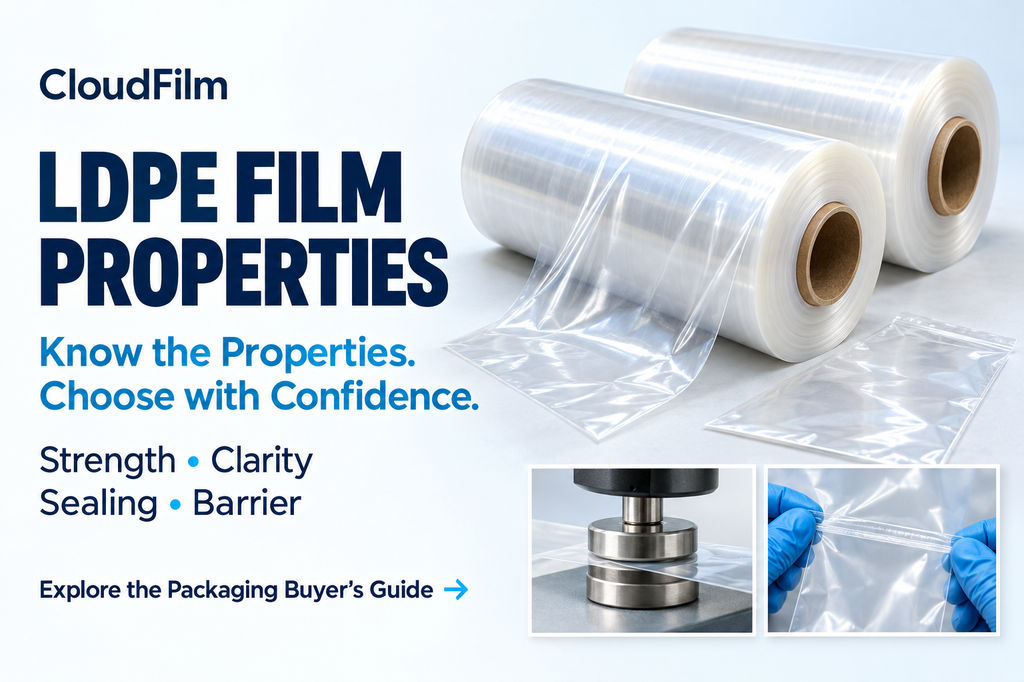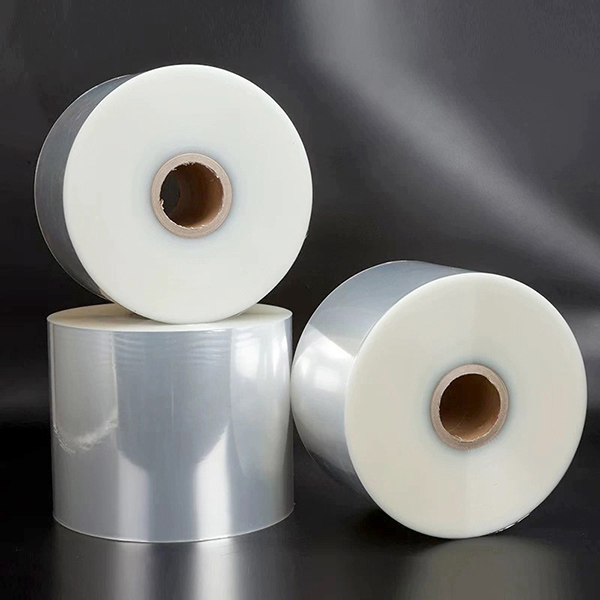
Choose poly wrapping film around the complete mailing job: the publication and inserts, the wrapping machine, the address method, and the delivery route. Approve the material only after representative packs run reliably and remain readable and intact through the agreed handling checks.
A clear roll that looks suitable on a sample table may still feed unevenly, seal inconsistently, obscure an address, or perform poorly with a heavier insert combination. A useful specification connects each requirement to an observable result instead of relying on a generic material name.
This guide is for printers, mailing houses, fulfilment businesses, and publishers buying film for an existing wrapping operation. It explains how to define the job, compare candidate films, organize a meaningful machine trial, and turn the results into repeatable purchasing requirements.

What Poly Wrapping Means for Publications
In publication mailing, poly wrapping usually means enclosing magazines, catalogues, brochures, or mixed promotional inserts in a plastic film wrapper. The operation may include gathering items, forming the wrap, sealing or closing it, applying an address, and sorting the completed packs.
Buying the film is different from buying a complete mailing service. A film supplier needs the machine and material requirements; a mailing contractor also manages publication assembly, address data, and dispatch. Establish who owns each responsibility before requesting a quotation.
Heat sealing joins suitable film surfaces. Heat shrinking contracts a suitable film around a product. A wrapper can be heat sealed without passing through a shrink tunnel. Do not specify shrink performance unless the actual process requires it.
Pallet stretch wrap serves another purpose: securing loads through stretching and tension. The shrink wrap and stretch wrap comparison explains those categories. Neither name, by itself, identifies the right film for a magazine mailing line.
Publication overwrap is also different from film laminated onto a printed cover. Overwrap encloses the assembled mail pack; cover lamination bonds to the printed surface. Their purchasing specifications and equipment requirements should remain separate.
Define the Mail Pack Before Choosing the Film
Start with the assembled pack, including every insert. Record finished length, width, thickness, weight, and the orientation in which the pack enters the wrapper. Measure real production pieces rather than relying only on the nominal page size.
Check the thinnest and thickest versions of the mailing. A catalogue alone, a catalogue with a reply envelope, and a catalogue with a promotional sample can behave differently even when the outer dimensions appear similar.
Include the sequence of different pack types in the trial. Equipment may have separate limits for maximum product thickness and changes between successive products. Ask the machine supplier which limits apply to the installed configuration, including its feeders and positioning controls.
Check edges and loose components
Staples, stiff corners, folded inserts, and small loose items deserve particular attention. Identify where they contact the film and whether movement inside the wrapper can create rubbing or concentrated stress during handling.
Decide how closely the wrapper should fit. Excess loose film may interfere with presentation or handling, while an unnecessarily tight wrap may distort the contents or load the seals. Agree on an acceptable finished sample instead of using “tight wrap” as the entire requirement.
Confirm the closing and opening design
Identify the required seal or closure positions and whether an opening feature is needed. Any perforation or tear feature should be assessed on the finished pack because it deliberately changes the wrapper’s resistance to opening.
Keep one approved pack for each important publication configuration. These physical references help procurement, operators, and the film supplier discuss the same result when a later batch behaves differently.

Select a Film Construction That Matches the Process
Polyethylene mailing film is a relevant starting point for many publication wrapping projects. However, PE covers different resin combinations and film constructions. The material family does not define the finished film’s stiffness, friction, sealing behavior, or performance at a particular thickness.
When evaluating LDPE film, request the proposed grade’s data and intended use. If the supplier recommends a blend or coextruded construction, ask which job requirements it addresses and which properties must be verified on your equipment.
Some wrapping systems also accept polypropylene films. That does not mean ordinary BOPP, a heat-sealable BOPP grade, and PE can be exchanged without adjustment. Obtain the equipment supplier’s material guidance and confirm the actual sealing surfaces.
If heat-sealable BOPP film is being considered, verify the sealable side or sides and the proposed closure geometry. Its suitability must be demonstrated with the publication pack and installed equipment; optical appearance alone is insufficient.
Avoid selecting a thicker film automatically whenever a pack fails. A problem caused by seal placement, a damaged guide, or incompatible friction may remain after thickness increases. First identify where the failure begins and compare the candidate with satisfactory material under equivalent conditions.
Specify the Roll the Machine Will Actually Use
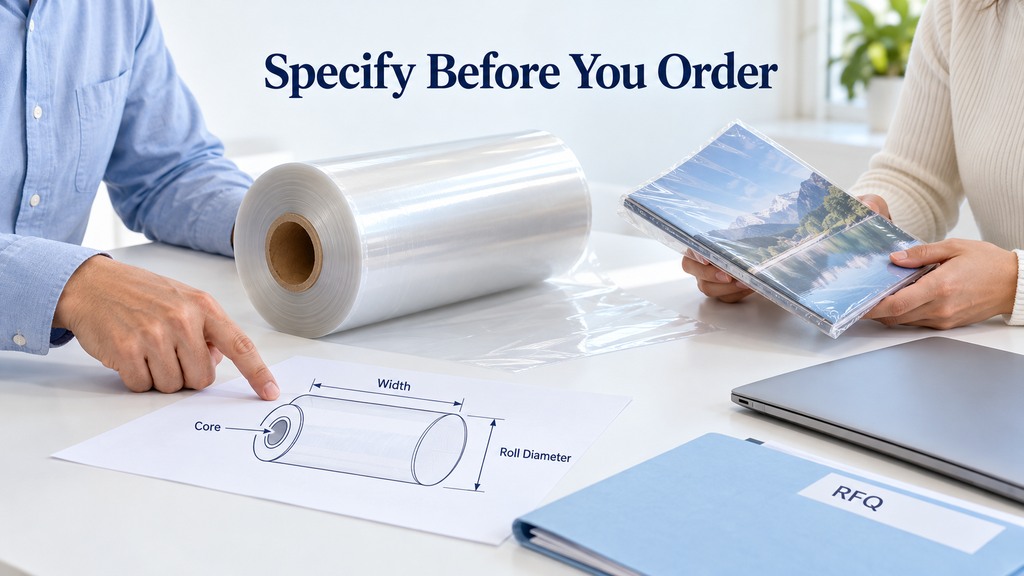
Confirm whether the equipment requires a single flat web, centerfold film, or another supply format. Film width has different meanings for flat, folded, and tubular materials. Use a dimensioned sketch so the buyer, converter, and machine operator interpret the quotation consistently.
For a flat web formed around a publication, the necessary width depends on the pack cross-section, the forming arrangement, and the closure allowance. Do not order solely from the publication’s face width or use a universal allowance that ignores the machine.
Agree on these roll details before comparing prices:
- Nominal thickness, permitted variation, and the measurement method.
- Film width and whether it is measured open, folded, or laid flat.
- Core internal diameter, core length, and compatibility with the shaft.
- Maximum roll diameter and weight permitted by the unwinder.
- Winding direction and the side facing the product or printer.
- Roll length or net film weight, with the core excluded where appropriate.
- Permitted splice count, splice identification, and handling instructions.
- Packaging, roll identification, and protection against edge damage.
The transparent polythene roll guide provides useful background on supply formats. For a mailing project, translate that background into a roll drawing and a machine-specific order specification.
Roll quality is part of the specification. Ask operators to check alignment, damaged edges, core condition, and visible unevenness before installation. Record whether problems occur near the outside of a roll, after a splice, or as the remaining diameter decreases.
Control Friction and Separation Without Guessing
Film must move predictably through the actual contact points on the line. Excessive resistance can disturb feeding, but very low friction is not automatically better: the machine still needs to grip, guide, position, and transport the web and wrapped product.
Coefficient of friction, or COF, describes resistance between contacting surfaces. Ask whether a reported value is static or kinetic, which surfaces were tested, and what conditioning and test procedure were used. Film-to-film and film-to-machine contact are different comparisons.
ASTM D1894 is a recognized method for measuring friction properties of plastic film and sheeting. A result from that method does not establish one universal acceptable COF for every wrapper. Set the purchasing range using the equipment requirements and successful trials.
CloudFilm’s LDPE film properties guide explains why test conditions matter. In the mailing trial, record the actual symptom: difficult unwinding, sliding resistance, inconsistent positioning, or unwanted attraction between film and contents.
Blocking concerns surfaces sticking together; friction concerns sliding; static electricity can produce attraction and handling difficulties. These effects can appear together, but they are not interchangeable diagnoses. Avoid requesting “more slip” before establishing which behavior is causing the stoppage.
Include expected storage and conditioning conditions in the comparison. Ask the supplier whether material age or storage affects the proposed grade’s surface behavior. Retain both satisfactory and affected samples with their batch references when investigating a change.
Establish a Usable Sealing Window
A seal must be formed consistently under the operating conditions of the installed machine. Record the sealing arrangement, temperature settings where applicable, dwell or contact time, pressure settings, and the support available while the newly formed seal moves away.
A laboratory seal-initiation figure is not a universal production setting. Heat transfer depends on the equipment and film combination. Begin within the material and machine suppliers’ recommended conditions, then adjust through an agreed trial plan.
Check both longitudinal and transverse closures where the pack uses them. A satisfactory seal in one position does not prove that another jaw, contact geometry, or film overlap will produce the same result.
Separate cooled strength from immediate performance
ASTM F88/F88M addresses seal strength in flexible barrier materials. ASTM F1921/F1921M addresses hot tack, the strength of heat seals while still hot. These measurements answer different questions and should not be presented as interchangeable acceptance evidence.
For production approval, observe whether seals remain closed immediately after formation and after the agreed conditioning period. Record the failure mode as well as any force measurement. Film tearing beside the seal and separation through the seal interface are different observations.
If failures increase with speed, investigate available contact time, actual heat transfer, seal loading, alignment, and support. Do not respond only by raising temperature, which may introduce distortion or other damage.
The objective is a repeatable operating window, not one perfect pack produced at a carefully chosen setting. Compare realistic changes in publication thickness, routine restarts, and normal running conditions before declaring the material acceptable.
Keep the Cover Visible and the Address Readable
Define what must be seen through the film. A visually attractive magazine cover and an address read by a machine impose different checks. Clarity, folds, reflections, print placement, and movement of the contents can all affect the finished result.
When considering clear poly film, assess it over the actual publication and address area. Inspect the finished wrap rather than judging only an unprinted film sample held against a light.
Decide whether the address is printed directly onto the film, printed on an inserted carrier, or applied as a label. Each route needs its own checks for position, visibility, attachment or print adhesion, and readability after handling.
For printed film, agree on the artwork repeat, web direction, registration marks, and any white address area. Obtain the printer’s requirements for the specific film surface and ink system. A surface-treatment figure alone does not demonstrate durable ink adhesion.
Test addresses and codes using representative production equipment and lighting. Ensure seams, loose folds, graphics, and variable insert positions do not obscure the required information. Use fictional address data in sample packs and demonstration photographs.
Confirm Mailing Requirements for the Destination
Confirm the destination country, postal operator, mailing service, and mailpiece category before approving the packaging. Material approval, machine performance, and acceptance of the completed mailpiece are separate matters.
For U.S. projects, the mailing partner should review the applicable current DMM requirements and the exact film’s listing where required. The official USPS polywrap resources provide a starting point for checking film qualifications and relevant test procedures.
A film’s listing or test record must not be treated as blanket approval of every finished pack. Publication dimensions, construction, closure, and address presentation still need to meet the requirements applicable to the mailing.
For other destinations, request the corresponding operator’s instructions rather than transferring U.S. criteria. Keep the mailing partner’s acceptance requirements with the job specification so a packaging change triggers the right review.
Run a Controlled Machine Trial
Use the current satisfactory film as a reference whenever possible. Identify both materials by grade, batch, thickness, and roll dimensions. Confirm that the trial samples represent the construction and surface treatment intended for commercial supply.
Before testing a new film, verify that the reference material runs normally. A worn sealing surface, incorrect guide position, or damaged feed component can make a material comparison misleading. Record relevant maintenance and setup conditions.
Prepare representative pack combinations
Include the smallest and largest practical formats, thin and thick versions, and important insert combinations. Select the cases most likely to challenge feeding, sealing, or readability rather than testing only the easiest publication.
Agree on the trial quantity and duration before starting. They should be sufficient to observe stable operation, routine restarts, and relevant roll changes. There is no universal number of successful packs that validates every mailing line.
Change variables in a controlled sequence
Begin with the documented reference setup, subject to the candidate film’s recommended operating conditions. Change one relevant factor at a time where practical. Otherwise, record the combined change clearly so the result remains interpretable.
Use a trial record that connects the observed outcome to the actual setup:
| Check | Record during the trial | Agree before approval |
| Feeding and positioning | Web tracking, pack alignment, interruptions, and the location of each event | Acceptable interruption and reject limits for the job |
| Sealing | Settings, closure location, appearance, and immediate or conditioned failure | Required checks, methods, and acceptance criteria |
| Pack protection | Edge damage, punctures, loose inserts, and damage after agreed handling | Representative handling conditions and allowable defects |
| Address performance | Print or label condition, folds, code readability, and read failures | The mailing partner’s relevant readability requirements |
| Material consumption | Film issued, usable material returned, waste, and accepted pack count | A consistent basis for comparing candidates |
Keep sample packs from the beginning, stable running, and the end of the trial. Record where each came from. An isolated attractive pack cannot explain intermittent failures or demonstrate that the full run met the agreed criteria.
Use the flexible packaging quality control guide to organize traceability and acceptance records. Release the specification only when operations, purchasing, and the responsible mailing contact agree on the evidence and any remaining restrictions.
Investigate Failures Before Changing the Material
Describe the failure precisely before asking for a replacement grade. “The film is poor” provides little direction. “The transverse seal opens after the thicker insert pack leaves the sealing station” identifies a location, timing, and condition that can be investigated.
| Observed problem | Useful checks before changing the film |
| The web moves sideways or wrinkles | Roll alignment, edge damage, guides, web tension, thickness uniformity, and which roll diameter triggers the issue |
| Packs open after sealing | Actual closure geometry, contact conditions, loading before cooling, contamination, and the observed failure mode |
| Film separates poorly from the roll | Surface adhesion, storage history, winding condition, static effects, and comparison with retained reference stock |
| Corners puncture the wrapper | The precise contact point, sharp inserts, pack movement, fit, and representative handling |
| Addresses become unreadable | Film folds, glare, print adhesion, label position, ink transfer, and movement of the address carrier |
These checks identify possible contributors; they do not prove a root cause. Where a packaging machine requires intervention, follow its operating and maintenance instructions.
If a thinner candidate performs poorly, compare it at a suitable documented setup before rejecting the entire material family. Conversely, do not accept an apparently improved pack if the change requires unstable settings or substantially increases stoppages.
Compare Cost per Accepted Mailing Pack
Price per kilogram is useful for purchasing film, but it does not show the complete cost of producing usable mail packs. A cheaper roll can become expensive if it increases waste, slows the line, or creates rework.
Calculate film cost per thousand accepted packs as the film consumed for the run multiplied by its purchase price per kilogram, divided by accepted pack count, then multiplied by 1,000. State how setup waste, recovered film, and rejected packs are accounted for.
For illustration only, suppose one candidate consumes 12 kilograms at 3.00 currency units per kilogram to produce 10,000 accepted packs. Its film cost is 3.60 currency units per thousand accepted packs.
A second candidate consuming 10 kilograms at 3.40 currency units per kilogram for the same accepted output costs 3.40 per thousand. Its kilogram price is higher, but its film cost per accepted pack is lower.
These figures are arithmetic examples, not product claims or quotations.
Then compare machine time, labor, setup, waste disposal, and rework using the same production boundary. Avoid counting the same loss twice. For variable mailing campaigns, calculate important pack configurations separately rather than hiding a difficult configuration inside an overall average.
Assess Recycled Content and Material Reduction Separately
Recycled content, reduced film weight, and recyclability describe different things. Record which objective the project is pursuing and what evidence is required.
A recycled-content percentage does not establish how the finished wrapper will be collected or processed after use.
If PCR is requested, specify post-consumer content clearly and obtain the supplier’s evidence for the agreed grade and claim. Evaluate the production sample for the same sealing, handling, appearance, and address requirements as any other candidate.
For recyclability, examine the whole wrapper, including inks, coatings, labels, and attachments, against the relevant destination’s collection and recycling arrangements. Avoid an unconditional claim that every PE wrapper is recyclable everywhere.
For downgauging, compare accepted packs, protection, and actual consumption. A lower nominal thickness is useful only if the completed mailing still performs as required. Test changes in dimensions and fit separately from changes in thickness so the source of any saving remains clear.

Send an RFQ That Suppliers Can Compare
Provide a concise job brief with publication formats, insert combinations, machine make and model, current film specification, address method, destination, trial quantity, and expected repeat demand. Include photographs or drawings that show the current seal arrangement and any known failure.
Separate mandatory requirements from preferences. Identify which dimensions are equipment limits, which properties are acceptance criteria, and which features remain open to recommendation. The packaging film parameters guide can help organize comparable technical data.
Request the proposed grade identification, test methods, relevant tolerances, roll configuration, sample availability, quotation basis, and change-notification process. Require written agreement before an approved construction, surface treatment, or other critical feature is substituted.
For a PE-based project, CloudFilm’s PE roll page is a practical starting point for discussing material and roll requirements. Share the existing sample and machine information so suitability can be assessed before any application-specific supply commitment.
Frequently Asked Questions
- Should the film and wrapping service be purchased from the same business?
Not necessarily. A mailing house may buy roll film directly, while a publisher may purchase a complete wrapping and dispatch service. Assign responsibility for film approval, production rejects, address performance, and postal acceptance so problems do not fall between suppliers.
- Can one approved roll specification cover several magazine formats?
Possibly, if the equipment accommodates them and trials cover the relevant combinations. Confirm whether a common width creates excessive waste or unsuitable pack fit. Record which formats are covered by the approval rather than extending it automatically to every future mailing.
- Is an A4 sheet sample sufficient to approve a mailing film?
A sheet can help assess appearance, feel, printing, and selected laboratory properties. It cannot demonstrate full-roll unwinding, tracking, splice handling, or sustained machine performance. Use a representative trial roll for those checks before approving routine production.
- Does passing a seal-strength test prove the wrapper is waterproof?
No. Seal strength measures a particular mechanical property under defined conditions. It does not establish the absence of holes, channels, perforations, or other entry paths. Specify and test the actual level of moisture protection needed for the mailing route.
- When should an approved film be requalified?
Review qualification after a relevant change in construction, thickness, additives, treatment, printing, roll format, equipment, inserts, or mailing requirements. The extent of retesting should match the risk introduced by the change and be agreed before production resumes.
- What should happen when an incoming batch behaves differently?
Identify and separate affected rolls, record batch numbers and storage history, retain samples, and compare with approved material under documented conditions. Share specific observations with the supplier. Avoid changing several settings or mixing unidentified rolls before the evidence is preserved.