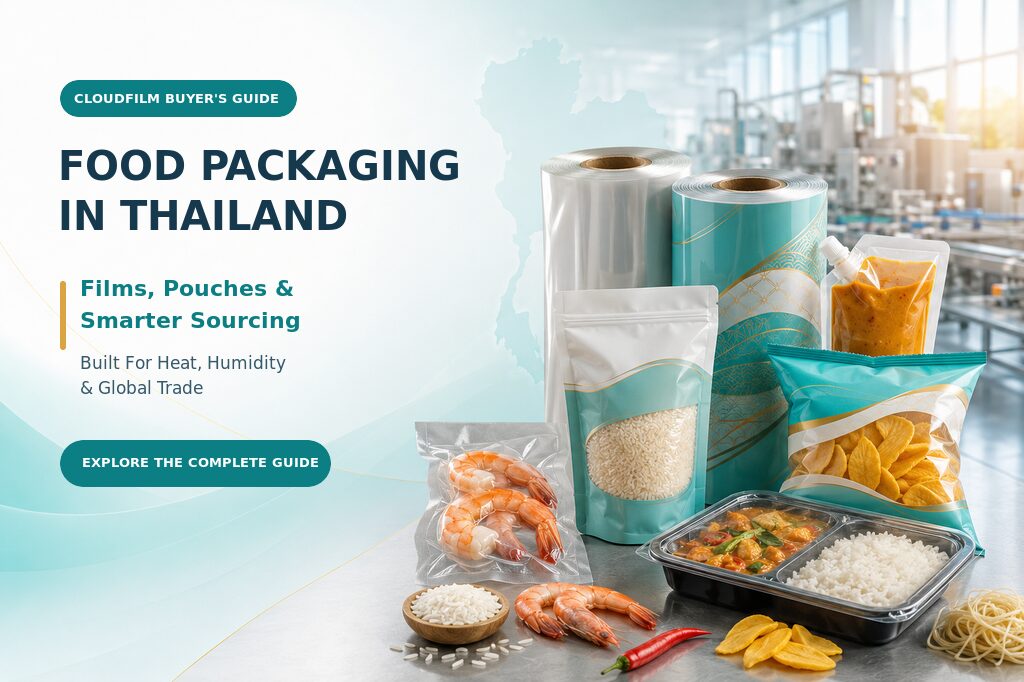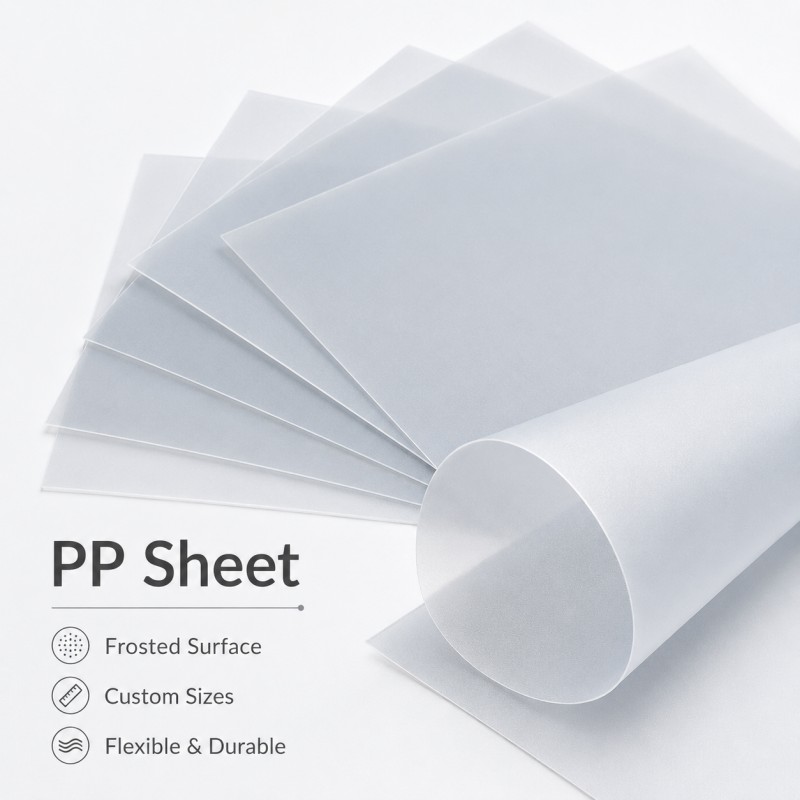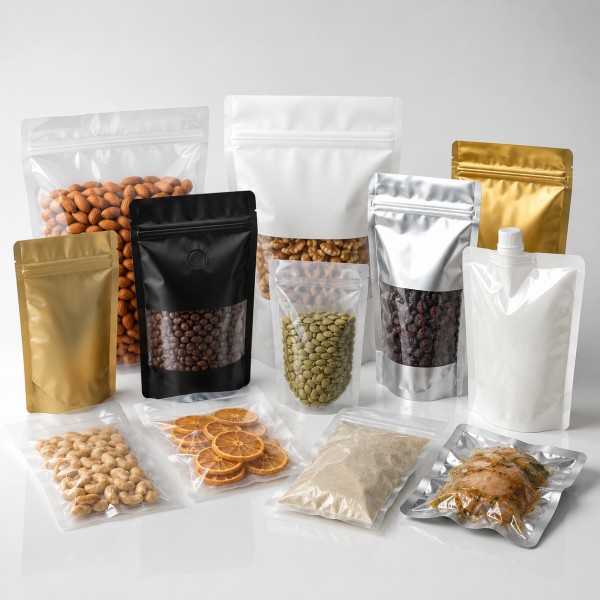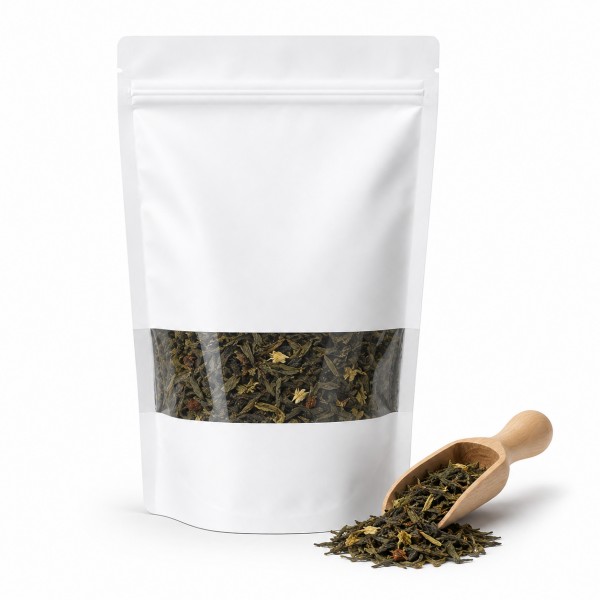
CPP material is one of the most widely used polypropylene-based materials in modern flexible packaging. For packaging buyers, converters, food brands, and industrial product manufacturers, CPP film is valued because it combines clarity, softness, heat-seal performance, moisture resistance, and good converting stability.
In many flexible packaging structures, CPP is not always the most visible layer, but it is often one of the most important layers. It may work as the inner sealing layer in laminated film, the transparent body of a single-layer bag, the anti-fog surface for chilled food, the retort-resistant layer in high-temperature pouches, or the metallic barrier layer in snack and dry food packaging.
If you are sourcing packaging film rolls, choosing the right CPP material can directly affect sealing strength, machine speed, product appearance, shelf life, leakage rate, and final packaging cost. This guide explains what CPP material is, where it is used, how it compares with BOPP, PET, and PE, and what information buyers should prepare before contacting a CPP film manufacturer or supplier.
What Is CPP Material?
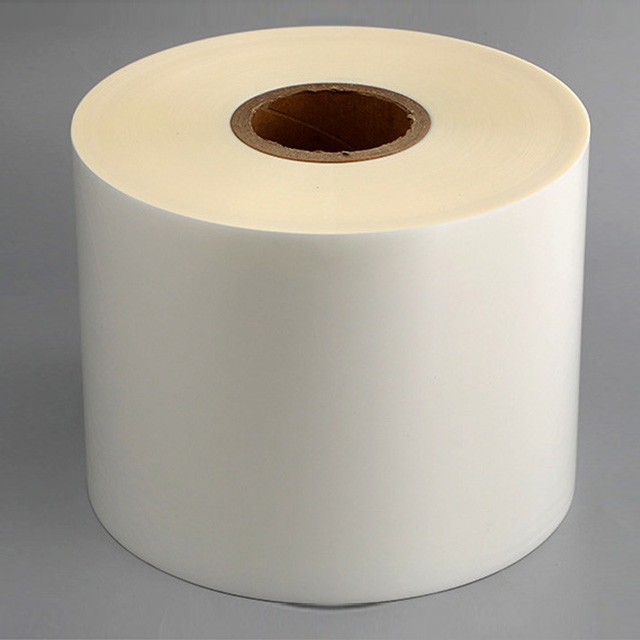
CPP means cast polypropylene. It is a polypropylene film produced by a cast extrusion process. During production, molten polypropylene resin is extruded through a flat die and rapidly cooled on a chill roll. This process gives CPP film a softer, more flexible, and more heat-sealable structure compared with oriented polypropylene films.
CPP belongs to the PP material family. However, it is different from BOPP, which is biaxially oriented polypropylene. BOPP is stretched in both machine and transverse directions, so it usually has higher stiffness, better tensile strength, and excellent printability. CPP is not biaxially oriented, so it has a softer hand feel, better heat-sealing behavior, and stronger impact resistance in many packaging applications.
Because of these characteristics, CPP is widely used as a sealing layer in laminated structures such as BOPP/CPP, PET/CPP, PET/AL/RCPP, and PET/NY/RCPP. It can also be used as a single-layer film for transparent bags, textile packaging, stationery packaging, tissue overwrap, and some fresh produce applications.
For buyers who want a broader overview of CPP film types, CloudFilm’s CPP Film page provides a useful product category reference.
Why CPP Material Is Important In Flexible Packaging
The inner layer of a flexible package must do more than simply close the bag. It must seal reliably at the correct temperature, resist contamination during filling, protect the product from moisture, survive transportation pressure, and remain compatible with printing, lamination, slitting, and pouch-making processes.
CPP material is often chosen because it offers a good balance between performance and cost. It can provide strong heat seals, smooth processing, good transparency, and moisture protection without making the structure too rigid or difficult to convert.
In food packaging, CPP helps create secure seals for snacks, confectionery, bakery products, frozen foods, sauces, and ready meals. In industrial packaging, CPP can protect stationery, textiles, electronics, powders, and other products from dust, moisture, and surface damage. In laminated packaging, CPP is frequently selected when the pack requires a reliable sealing layer but also needs outer layers such as BOPP, PET, nylon, or aluminum foil for stiffness, printability, barrier, or retort performance.
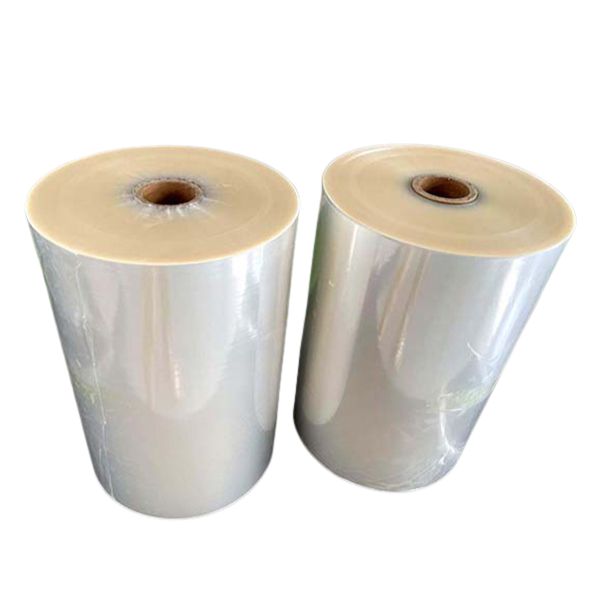
If your project involves rollstock for automated packing machines, you can also review CloudFilm’s Packaging Film Roll solutions for common roll structures and specification ranges.
Main Properties Of CPP Film
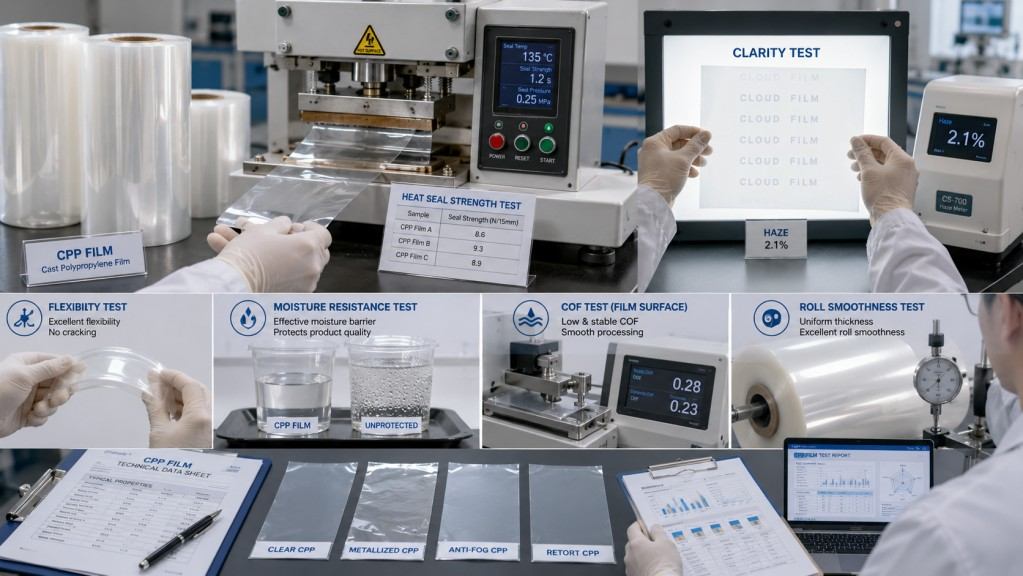
1. Good Heat-Seal Performance
One of the biggest advantages of CPP film is its heat-sealing ability. CPP can form strong seals on high-speed packaging lines when the correct grade, thickness, sealing temperature, pressure, and dwell time are selected.
This is why CPP is commonly used as the inner layer of laminated food packaging film. In structures such as BOPP/CPP or PET/CPP, the outer layer provides printability and stiffness, while the CPP layer provides the seal.
2. High Clarity And Gloss
Clear CPP material can offer excellent transparency, allowing consumers to see the product inside. This is important for snacks, bakery items, textiles, stationery, gift packaging, and retail display products.
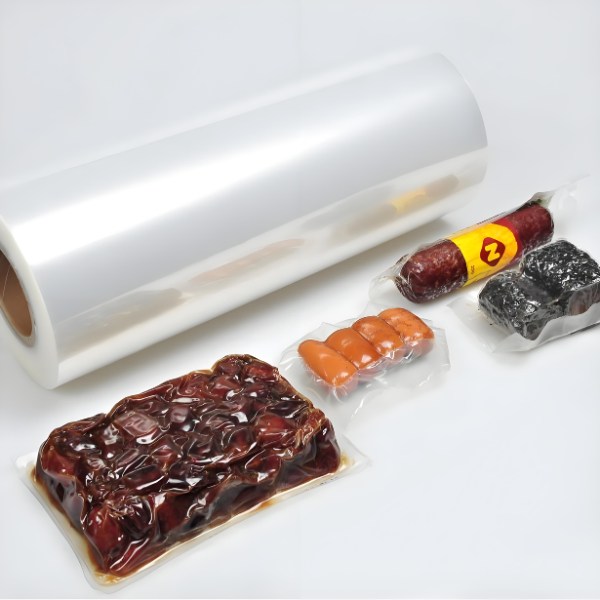
For applications where clarity is especially important, CloudFilm’s Clear CPP Film is designed for flow-wrap packs, pillow packs, transparent bags, and laminated structures such as BOPP/CPP and PET/CPP.
3. Soft Hand Feel And Good Flexibility
Compared with many oriented films, CPP feels softer and more flexible. This makes it useful for products that need a smooth touch, low noise, or better resistance to sharp product corners. Textile bags, tissue packaging, garment packaging, and certain daily-use products often benefit from this softer film behavior.
4. Good Moisture Resistance
CPP provides good resistance to water vapor, helping protect products that are sensitive to moisture. For dry foods, powders, stationery, tissue, and personal-care items, moisture resistance can help maintain product quality during storage and transport.
5. Good Impact Resistance
Because CPP is a cast and non-oriented film, it can absorb impact better than some stiff films. This helps reduce pinholes, cracks, and seal failures when products are filled, transported, or handled roughly.
6. Compatibility With Lamination
CPP works well with other films in multi-layer packaging structures. It can be laminated with BOPP, PET, nylon, aluminum foil, metallized film, or high-barrier layers depending on the final packaging requirements.
For example, PET CPP laminated film combines the stiffness and printability of PET with the heat-sealing performance of CPP. This structure is widely used for food, medical, dry product, and technical packaging.
Common Types Of CPP Material
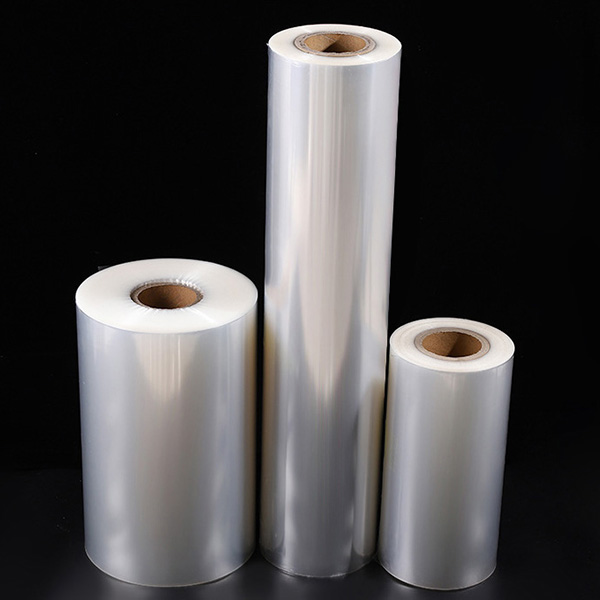
Clear CPP Film
Clear CPP film is used when visibility, seal strength, and a clean retail appearance are important. It is suitable for flow-wrap packaging, pillow bags, transparent garment bags, stationery bags, and laminated packaging structures.
Clear CPP is often selected for products where buyers want to show the contents clearly while still protecting them from dust, moisture, and handling damage.
Metallized CPP Film
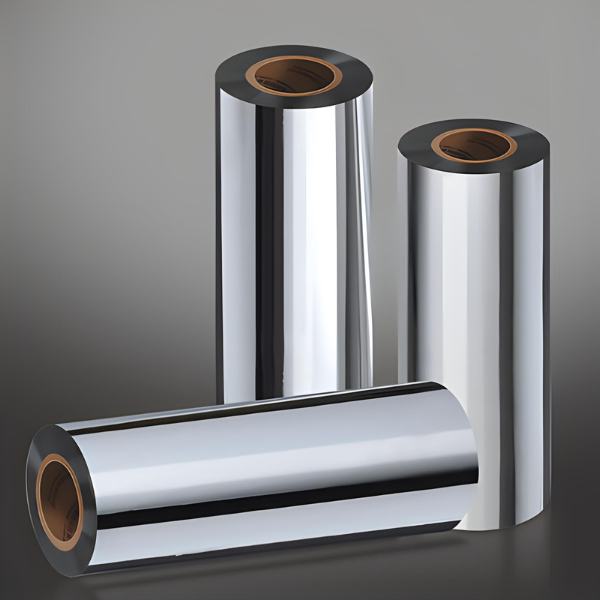
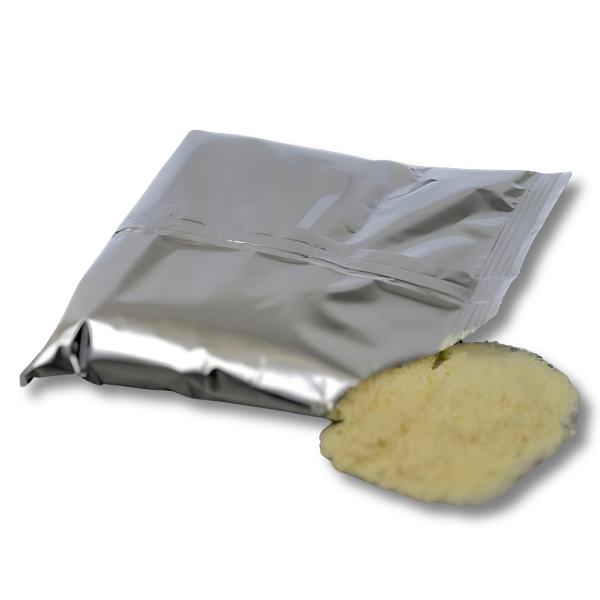
Metallized CPP, also called VMCPP, is CPP film coated with a thin aluminum layer by vacuum metallizing. This gives the film a metallic appearance and improves barrier performance against moisture, oxygen, and light.
It is commonly used in snacks, coffee, tea, dry foods, and technical packaging. CloudFilm’s Metallized CPP Film can be used when buyers need both a strong heat-sealable layer and better barrier performance.
CPP Anti Fog Film
CPP anti-fog film is designed for chilled food, fresh produce, salads, fruit, vegetables, bakery products, and tray lidding applications. The anti-fog treatment helps reduce condensation droplets on the film surface, keeping the package clearer in cold cabinets.
For fresh food brands, visibility is not only a technical issue but also a sales issue. If consumers cannot see the product clearly, the package may look less fresh. CloudFilm’s CPP Anti Fog Film is suitable for produce bags, pillow packs, tray lidding film, frozen food overwrap, and chilled ready-meal packaging.
CPP Anti Static Film
CPP anti-static film is used when static electricity can cause dust attraction, powder adhesion, poor filling accuracy, or damage to electronic components. It can be suitable for electronics, semiconductor parts, pharmaceutical powders, cosmetic powders, food additives, and laboratory products.
For sensitive industrial or powder packaging, anti-static performance can improve cleanliness, packing efficiency, and product protection.
CPP Tissue Film
CPP tissue film is designed for tissue overwrap, napkin packaging, toilet paper packaging, and other soft paper product applications. It normally requires good clarity, soft touch, low noise, smooth machinability, and stable sealing.
Retort CPP Film
Retort CPP, also called RCPP, is engineered for high-temperature sterilization packaging. It is commonly used as the inner sealing layer in retort pouches for ready meals, soups, sauces, wet pet food, and some medical or diagnostic packaging.
CloudFilm’s Retort CPP Film is designed for demanding retort conditions where seal integrity, heat resistance, and dimensional stability are critical.
CPP Material Vs BOPP, PET, And PE
CPP Vs BOPP
CPP and BOPP are both polypropylene-based films, but their functions are different. BOPP is stiffer, stronger in tensile direction, and more commonly used as a printing layer. CPP is softer, more flexible, and more commonly used as a sealing layer.
In a BOPP/CPP laminate, BOPP usually acts as the outer print layer, while CPP acts as the inner sealant layer. If your project requires printed snack film, candy packaging, or bakery flow-wrap film, this structure may be a practical choice.
For related polypropylene packaging options, buyers can compare CPP with CloudFilm’s BOPP Film category.
CPP Vs PET
PET film offers excellent stiffness, dimensional stability, heat resistance, and printability. CPP offers better heat-seal performance and a softer inner layer. In PET/CPP packaging, PET works as the outer layer, while CPP works as the inner sealing layer.
This structure can be used for dry foods, sauces, retort packaging, medical device pouches, and industrial product packaging when stronger mechanical performance is required.
CPP Vs PE
PE film is very common in flexible packaging because of its sealing performance, toughness, and cost efficiency. CPP is often clearer and glossier than many PE films, and it can offer good heat resistance in selected grades. PE, however, may be preferred for certain recyclable mono-PE structures, heavy-duty bags, stretch film, shrink film, and soft pouch applications.
If your packaging project may require PE-based structures, you can compare CPP options with CloudFilm’s PE Film portfolio.
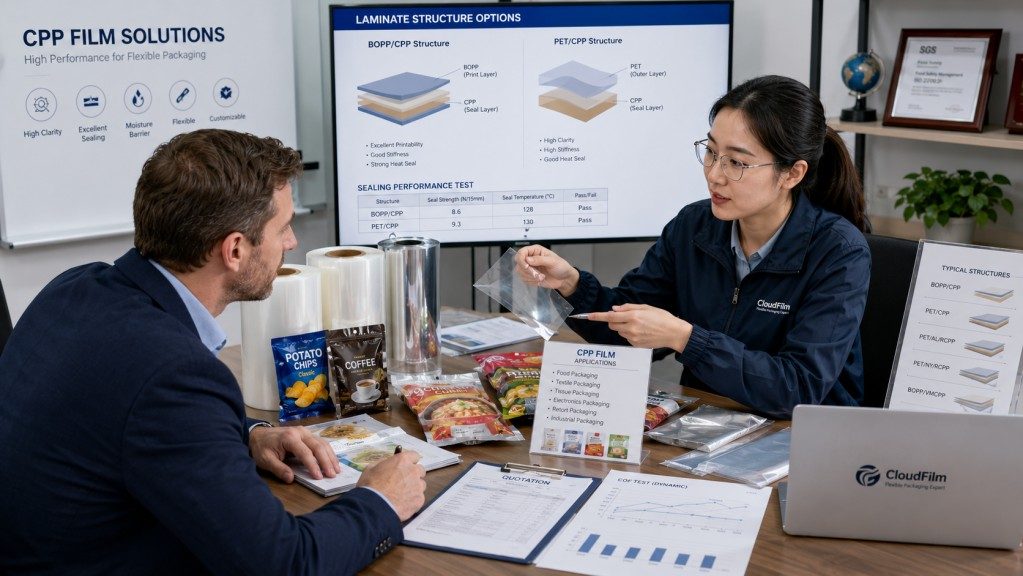
Typical CPP Film Structures
CPP material can be used alone or as part of laminated structures. The right structure depends on the product, shelf-life target, filling process, sealing equipment, storage condition, and branding requirement.
Common structures include:
BOPP/CPP – Used for snacks, candies, biscuits, bakery products, and lightweight pillow packs. BOPP provides printability and stiffness; CPP provides sealing.
PET/CPP – Used for food, powder, sauce, medical, and technical packaging. PET provides strength, dimensional stability, and printability; CPP provides heat sealing.
PET/AL/RCPP – Used for high-barrier retort pouches, ready meals, sauces, wet pet food, and long-shelf-life packaging. Aluminum foil provides strong barrier; RCPP provides retort sealing performance.
PET/NY/RCPP – Used for transparent retort pouches or high-strength hot-fill packs. Nylon improves puncture resistance and flexibility; RCPP provides the inner seal.
BOPP/VMCPP – Used for snacks, dry foods, tea, coffee, and products that need metallic appearance and better barrier performance.
Mono-PP Structures – In some projects, CPP can be used with other PP-based layers to support polypropylene-rich packaging designs. This depends on local recycling systems and the final application.
When choosing a structure, buyers should avoid selecting film only by thickness. A 40-micron film from one structure may perform very differently from a 40-micron film from another structure. Material type, layer ratio, sealing temperature, COF, corona treatment, barrier target, and lamination quality all matter.
Main Applications Of CPP Material
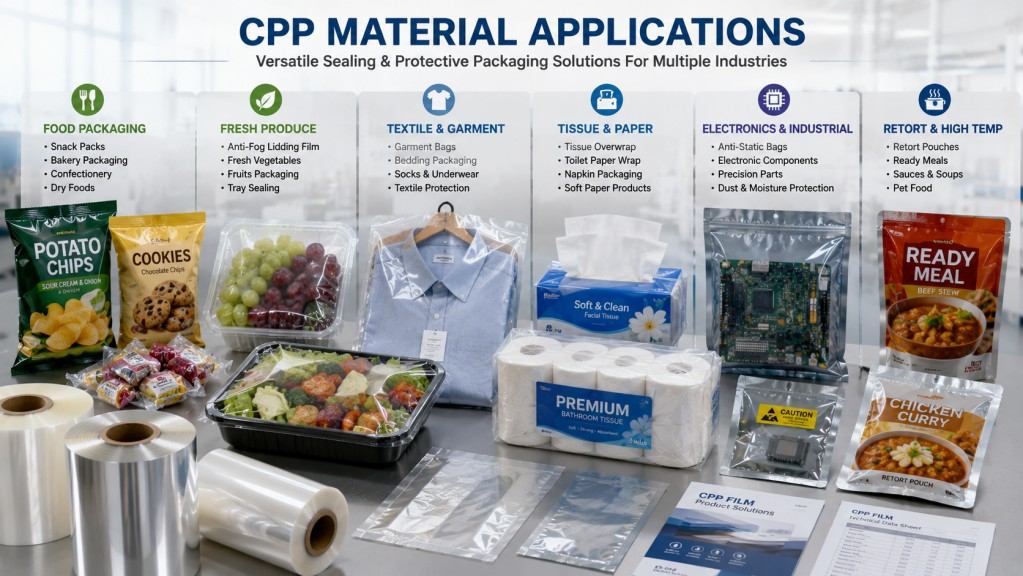
Food Packaging
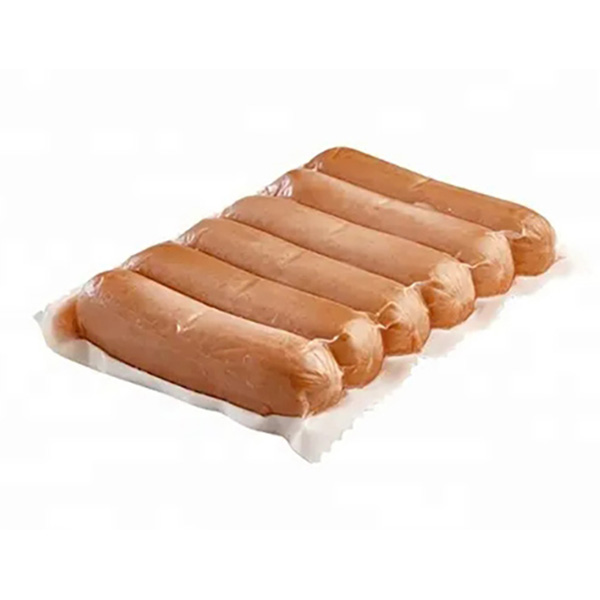
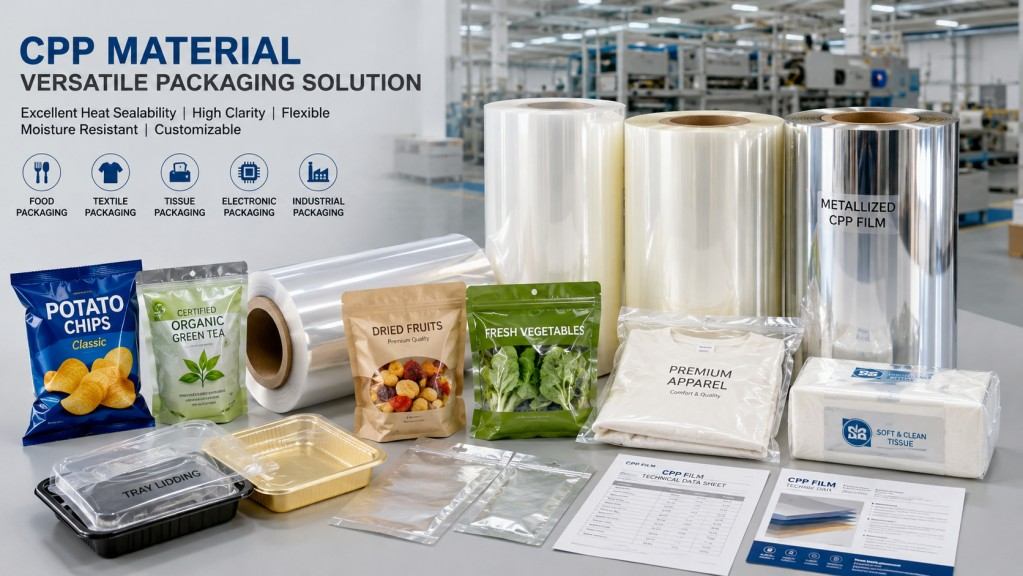
CPP material is widely used in food packaging because it can provide good sealing, clarity, moisture resistance, and flexible converting performance. Common applications include snacks, candies, bread, biscuits, frozen foods, chilled meals, sauces, condiments, dry fruits, nuts, tea, coffee, and pet food.
For food brands that need custom flexible packaging materials, CloudFilm’s Food Packaging Film page offers broader material options for freshness protection, shelf life, and packaging efficiency.
Fresh Produce And Chilled Food
CPP anti-fog film can be used for fresh vegetables, fruit, salads, sandwiches, bakery products, chilled ready meals, and tray lidding. Clear visibility is especially important in refrigerated display cabinets, where fogging can make the product look less attractive.
Textile And Garment Packaging
CPP film is used for transparent bags for clothes, underwear, bedding, carpets, socks, and other textile products. The film offers good clarity, softness, and sealing performance while protecting products from dust and moisture.
Tissue And Paper Product Packaging
CPP tissue film is suitable for facial tissues, toilet paper, napkins, and soft paper packaging. The film can offer soft hand feel, low noise, good gloss, and stable machinability on overwrapping lines.
Electronics And Industrial Packaging
CPP anti-static film can be used for electronic components, circuit boards, semiconductors, precision parts, powders, and dust-sensitive products. Anti-static properties help reduce dust attraction and lower the risk of static-related problems during packing and storage.
Medical And Retort Packaging
Retort CPP can be used in high-temperature sterilization packaging for ready meals, medical devices, diagnostic kits, and wet pet food. In these applications, the film must maintain seal strength and package integrity after heating, pressure, cooling, and handling.
How To Choose The Right CPP Material
Define The Product First
The first step is to define what will be packed. Dry snacks, frozen food, fresh vegetables, powder, liquid sauce, garments, tissues, and electronic parts all need different CPP grades.
A film that works well for biscuit packaging may not be suitable for retort pouches. A film that performs well on a tissue overwrap line may not be the best choice for chilled salad lidding. The product decides the film.
Confirm The Packaging Machine
Packaging machine type has a strong influence on film selection. VFFS, HFFS, flow-wrap, tray lidding, pouch-making, and overwrapping machines may require different sealing windows, friction levels, roll diameters, winding tensions, and film stiffness.
Before requesting a quotation, buyers should prepare machine type, speed, forming style, sealing jaw temperature, sealing pressure, and any previous film problems.
Decide The Structure
If the pack only needs transparency and simple sealing, clear CPP may be enough. If the pack needs printing, stiffness, or higher barrier, a laminated structure such as BOPP/CPP or PET/CPP may be more suitable. If the product needs retort sterilization, RCPP-based structures should be considered.
Check Barrier Requirements
CPP has good moisture resistance, but it may need to be combined with metallized film, PET, aluminum foil, EVOH, or other barrier materials for products sensitive to oxygen, aroma loss, light, or long storage.
Consider Appearance
Packaging appearance affects brand perception. Clear CPP is useful when product visibility is important. Metallized CPP is useful when a premium metallic look or better light barrier is required. Matte or printed outer layers can also be added through laminated structures.
Request Samples And Test On Your Line
Film selection should always be confirmed by testing. Buyers should check sealing strength, leakage rate, cutting behavior, roll unwinding, static level, clarity, pouch flatness, and finished pack appearance.
A professional CPP film supplier should be able to provide samples, technical data, recommended structures, and trial support based on your product and equipment.
What Information Should You Send To A CPP Film Manufacturer?
To receive an accurate recommendation and quotation, prepare the following details:
Your product name and packaging application.
Your desired film structure, if known.
Required thickness, width, roll length, core size, and roll diameter.
Packaging machine type and packing speed.
Required sealing temperature range or current sealing settings.
Printing, lamination, anti-fog, anti-static, metallized, or retort requirements.
Target shelf life and storage conditions.
Food-contact or regulatory documentation requirements.
Trial quantity, monthly quantity, and destination port or country.
If you do not know the exact structure, you can send your current film sample, packaging photos, machine photos, or product details. A reliable CPP film manufacturer can help reverse-check the structure or recommend a suitable alternative.
Why Work With A CPP Film Supplier From China?
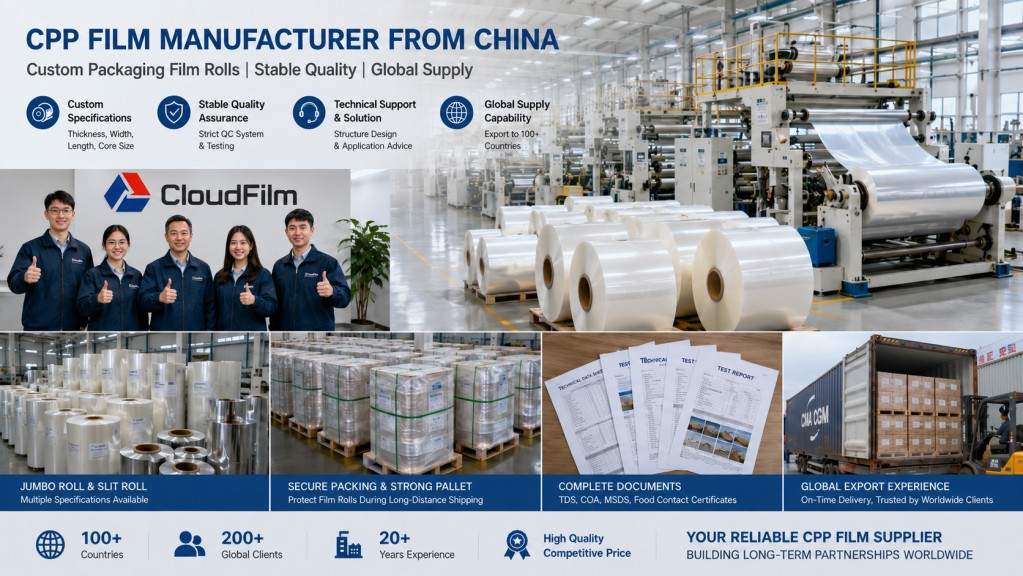
China has a mature flexible packaging supply chain, including resin sourcing, extrusion, metallizing, coating, printing, lamination, slitting, pouch-making, and export logistics. For international buyers, working with an experienced CPP film supplier from China can help reduce sourcing complexity and improve cost control.
However, the supplier should not only offer low prices. A strong CPP material supplier should understand applications, sealing performance, roll quality, documentation, packaging machine compatibility, and shipment details.
CloudFilm Packaging supplies CPP film, PP film, PE film, BOPP film, PET-based laminated film, and custom packaging film rolls for international customers. For buyers who need different film materials from one source, this can reduce communication time and make structure selection easier.
A good supplier should help you answer practical questions: Which CPP grade should be used? What thickness is suitable? Can the film run on existing equipment? Is anti-fog treatment needed? Should the structure be BOPP/CPP or PET/CPP? Is retort CPP required? Can the roll width and diameter match your machine?
This is where supplier experience becomes valuable.
FAQ About CPP Material
1. What does CPP material mean?
CPP means cast polypropylene. It is a polypropylene film made by cast extrusion. In packaging, CPP is widely used as a heat-sealable film or inner sealing layer in laminated structures.
2. Is CPP the same as PP?
CPP is one type of PP material. PP is the general polymer family, while CPP is a cast polypropylene film made from PP resin.
3. What is CPP film used for?
CPP film is used for food packaging, textile bags, stationery bags, tissue overwrap, electronics packaging, anti-fog produce packaging, metallized snack packaging, and retort pouches.
4. Is CPP film heat sealable?
Yes. Heat-seal performance is one of the main reasons CPP is used in flexible packaging. It is commonly used as the sealing layer in BOPP/CPP and PET/CPP laminates.
5. What is the difference between CPP and BOPP?
BOPP is biaxially oriented and usually stiffer with better tensile strength and printability. CPP is cast and non-oriented, making it softer, more flexible, and better suited for heat sealing.
6. Can CPP film be used for food packaging?
Yes. Food-grade CPP film can be used for direct or indirect food packaging when the correct grade, ink, adhesive, and process are selected.
7. Is CPP material transparent?
Clear CPP film can be highly transparent and glossy, making it suitable for retail display packaging and transparent bags.
8. What is metallized CPP film?
Metallized CPP, or VMCPP, is CPP film coated with a thin aluminum layer. It offers metallic appearance, better barrier performance, and heat-seal properties.
9. What is CPP anti-fog film?
CPP anti-fog film is treated to reduce fogging caused by condensation. It is used for fresh produce, salads, chilled meals, tray lidding, and refrigerated display packaging.
10. What is retort CPP film?
Retort CPP is a heat-resistant CPP grade designed for high-temperature sterilization packaging such as ready-meal pouches, sauces, wet pet food, and some medical pouches.
11. What are common CPP laminate structures?
Common structures include BOPP/CPP, PET/CPP, BOPP/VMCPP, PET/AL/RCPP, and PET/NY/RCPP.
12. What thickness is CPP film?
CPP film thickness varies by application. Common packaging grades may range from thin sealing layers to thicker functional films. The final thickness should be selected based on product weight, sealing strength, machine type, and structure.
13. Can CPP film be printed?
CPP can be printed in certain applications, but in many laminated structures, printing is usually done on BOPP or PET outer layers, while CPP works as the inner sealing layer.
14. Can CPP material be laminated with PET?
Yes. PET/CPP is a common laminated film structure. PET provides stiffness and printability, while CPP provides heat sealing.
15. Can CPP material be used for frozen food packaging?
Yes, selected CPP grades can be used for frozen food packaging, especially when low-temperature impact resistance and sealing performance are considered.
16. Can CPP film be used for powder packaging?
Yes. CPP and PET/CPP structures can be used for powder packaging. For powder products affected by static, anti-static CPP may be considered.
17. Is CPP recyclable?
CPP is polypropylene-based. Its recyclability depends on local recycling systems and whether the final packaging is mono-material or multi-material laminated packaging.
18. How do I choose between CPP and PE?
Choose CPP when you need high clarity, gloss, PP-based sealing, and good heat resistance in selected grades. Choose PE when you need PE-based structures, soft toughness, shrink/stretch behavior, or mono-PE packaging targets.
19. What should I provide to get a CPP film quotation?
You should provide product application, structure, thickness, width, roll size, machine type, printing or lamination needs, sealing requirements, quantity, and destination country or port.
20. How can I find a reliable CPP film supplier?
Choose a supplier that understands film structures, sealing performance, roll quality, application requirements, documentation, and export logistics. A reliable supplier should provide technical advice, samples, stable production, and clear communication.
Conclusion
CPP material is a practical and versatile packaging film that plays an important role in flexible packaging. It can provide strong heat sealing, good clarity, soft hand feel, moisture resistance, and stable converting performance. Depending on the grade, CPP can be used for transparent bags, laminated food packaging, metallized barrier packaging, anti-fog fresh produce packaging, anti-static industrial packaging, tissue overwrap, and retort pouches.
For packaging buyers, the key is not only to ask for CPP film by name. The better approach is to define your product, packaging machine, structure, thickness, sealing conditions, barrier target, and final application. This allows the CPP film manufacturer to recommend the right grade and avoid costly trial errors.
Whether you need clear CPP, metallized CPP, CPP anti-fog film, CPP anti-static film, tissue CPP, retort CPP, BOPP/CPP, or PET/CPP laminated film, a reliable supplier can help you match the material to your product and production line.
CloudFilm Packaging supports international buyers with custom CPP film rolls, laminated packaging film structures, technical consultation, sample support, and export supply service. If you are developing a new packaging project or improving an existing film structure, sharing your product details and machine requirements is the first step toward a better packaging solution.