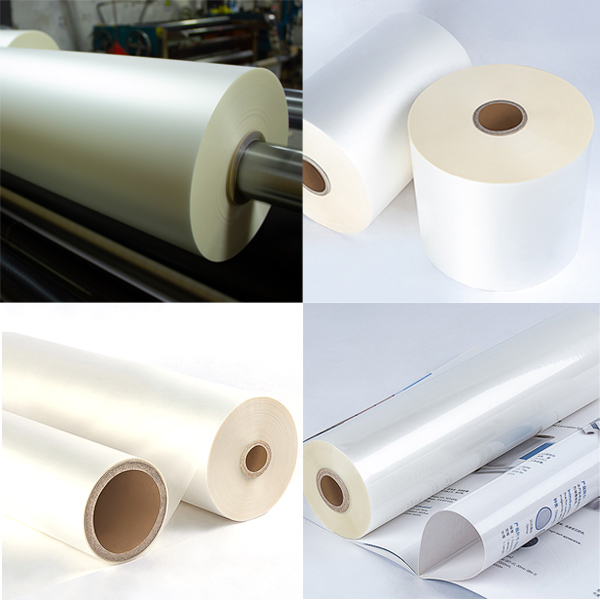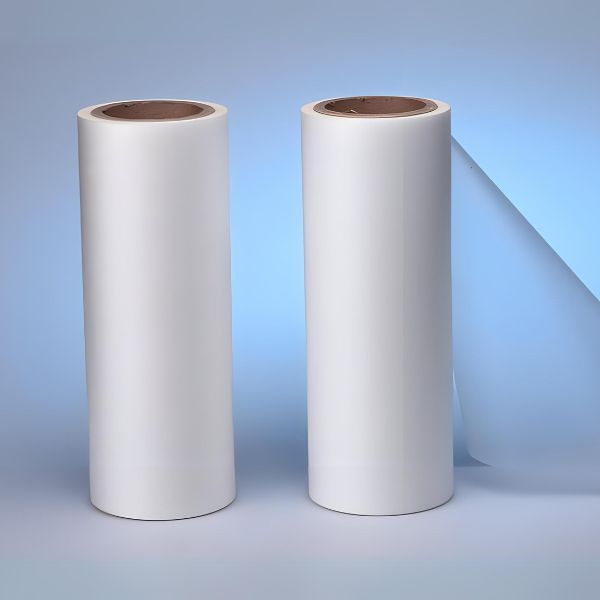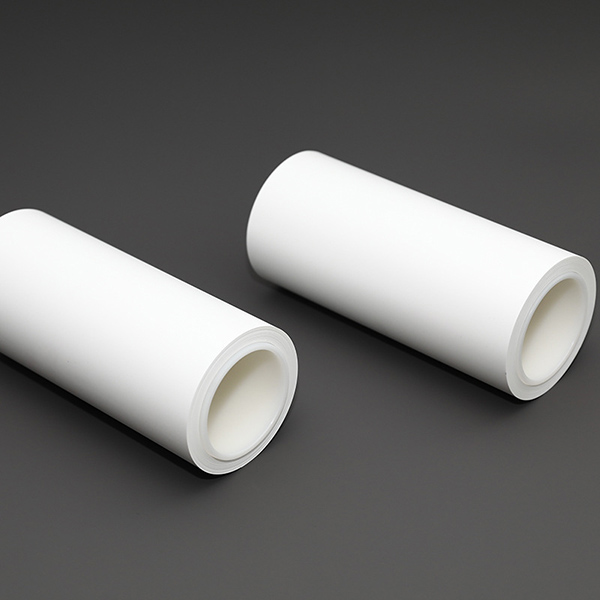
A matte pouch may look simple from the outside, yet the low-gloss surface can be created in several different ways. Two of the most common are a matte overprint varnish applied during printing and a matte film used as the outer web or laminating layer.
The distinction matters because the two routes can behave differently during abrasion, chemical exposure, lamination, printing, pouch making, filling, transport, and repeated consumer handling. It also affects how a buyer should specify the package, approve samples, compare quotations, and investigate a quality complaint.
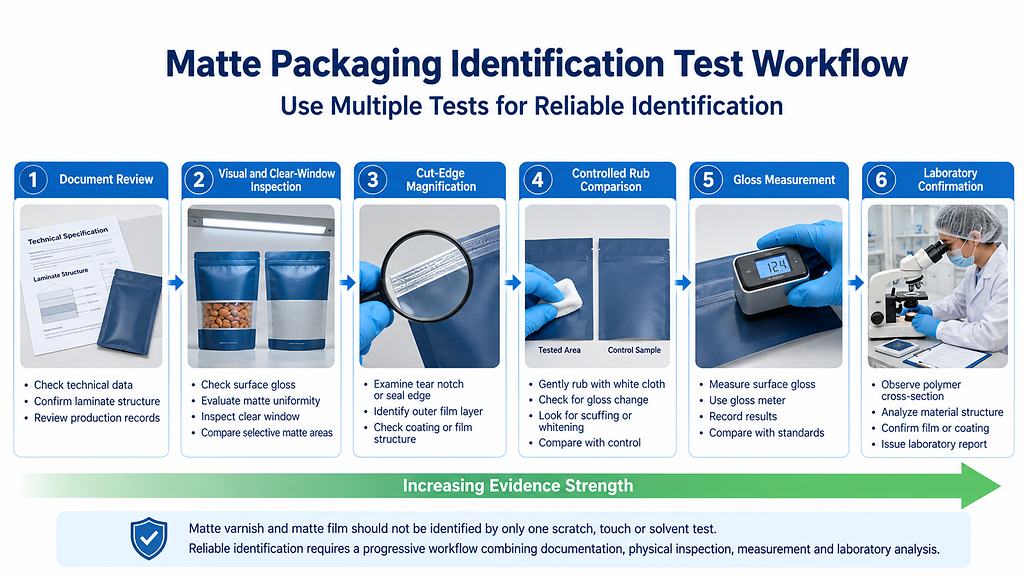
The fastest reliable answer is not a single scratch or solvent trick. It is a combination of the packaging structure record, visual clues, edge inspection, controlled rub testing, gloss measurement, and confirmation from the converter or film supplier.
Quick Answer
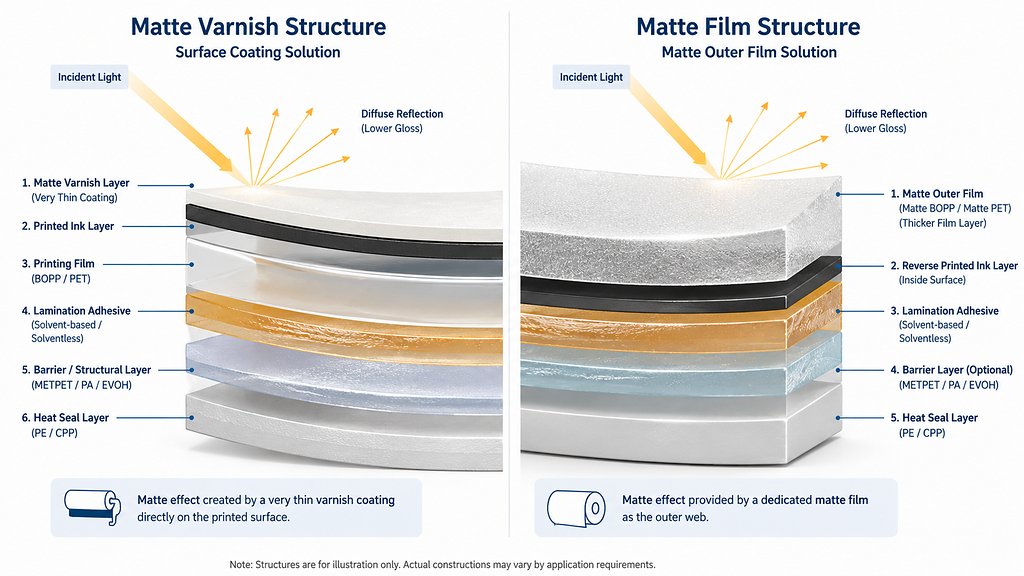
A matte varnish is a thin coating printed or coated onto a substrate to reduce surface gloss. A matte film is a separate plastic web, or a film with an engineered matte surface, that forms part of the package structure. A varnish is easier to apply selectively, while a matte film generally provides a more continuous physical surface. However, modern high-performance varnishes can be highly scratch- and chemical-resistant, and some matte films use coated surfaces, so no single field test is conclusive.
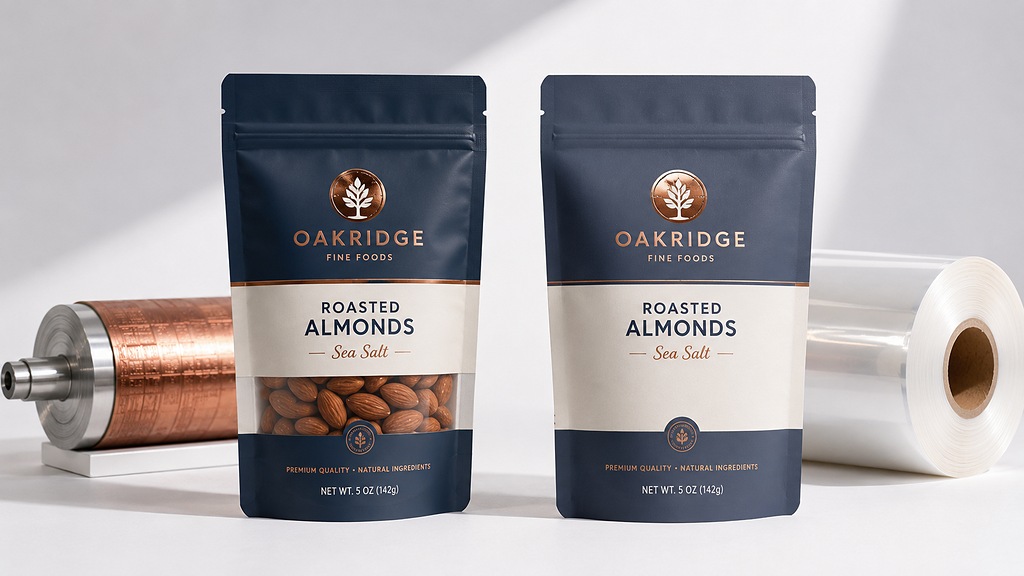
What Creates a Matte Finish on Flexible Packaging?
Matte Varnish or Matte Overprint Varnish
A matte varnish is a transparent or translucent surface coating formulated to scatter reflected light and lower gloss. Depending on the printing and converting system, the coating may be water-based, solvent-based, or UV-curable. It can be applied over printed graphics by gravure, flexography, offset, or another suitable coating process.
The coating may cover the whole printed surface or only selected areas. This makes it practical for spot-matte designs, matte-and-gloss contrast, clear windows, variable tactile zones, and registered decorative effects. The final result depends on the varnish chemistry, coat weight, anilox or cylinder specification, drying or curing, substrate surface energy, ink system, and storage conditions.
A matte varnish should not be described simply as “matte ink.” Ink provides color and graphics; an overprint varnish is normally a separate protective or decorative layer applied above the printed image, although some printing systems may combine effect coatings with other functional layers.
Matte Film
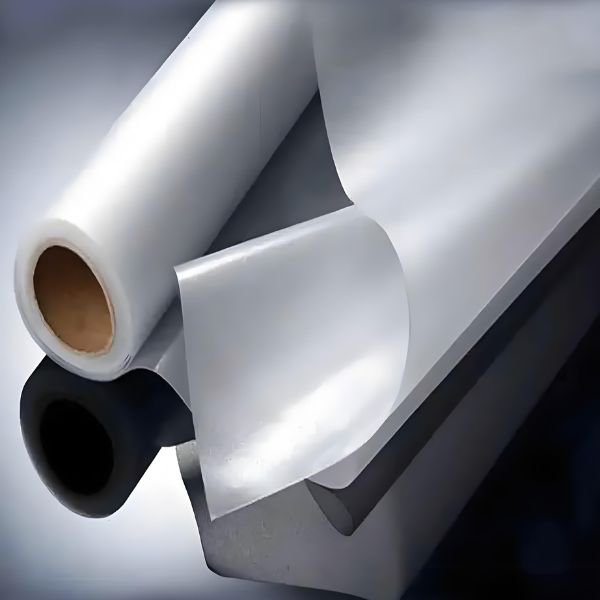
A matte film is a plastic film engineered to provide a low-gloss surface. It may be a coextruded film with a matte skin layer, a film made with a matte formulation, or a base film carrying a specialty matte coating. In flexible packaging, the matte web is commonly used as the outside print or lamination layer.
One widely used option is BOPP matte film, which can provide a paper-like or satin appearance, useful stiffness, and a moisture-resistant polypropylene outer web. Matte PET film is another option when higher stiffness, dimensional stability, or heat resistance is important.
A matte film may be reverse printed and laminated so the printed ink is protected inside the structure. It may also be supplied as a thermal laminating film for paper, paperboard, labels, or selected printed substrates. The exact construction must be confirmed because “matte film” is a finish category, not one universal material specification. For a wider overview of finishing routes, applications, and material choices, see the matte lamination guide.
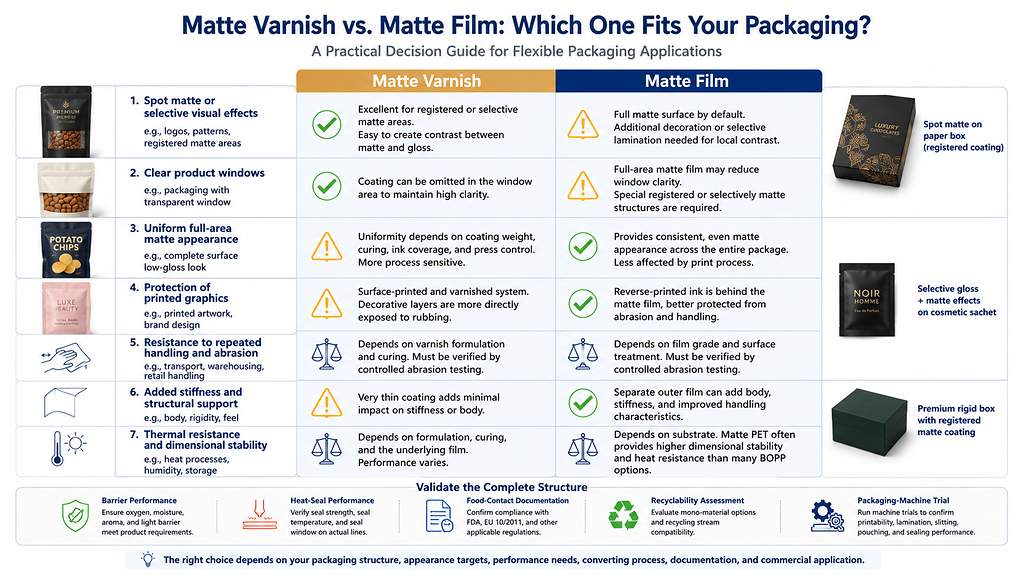
Matte Varnish vs Matte Film: The Main Differences
| Evaluation Point | Matte Varnish | Matte Film |
| How the finish is created | A thin coating is applied to the surface | A separate film web or engineered matte film surface is used |
| Selective design | Well suited to spot matte, gloss contrast, and registered effects | Usually used for a continuous matte area; selective windows need a specific construction |
| Added structure | Adds a very thin surface layer | Adds or defines a film layer within the laminate |
| Surface uniformity | Depends strongly on coating weight, curing, ink coverage, and press control | Often highly uniform when the film grade and lamination are stable |
| Abrasion behavior | May polish, scuff, or wear if the formulation or cure is unsuitable; high-performance grades can be very resistant | The matte layer usually remains physically present, but it can still scratch, polish, or mark |
| Chemical resistance | Highly formulation-dependent | Depends on the matte surface chemistry, base polymer, printing, and laminate |
| Clear windows | Easier to leave selected areas uncoated | A full matte web can reduce window clarity unless the window is separately designed |
| Printing route | Commonly surface printed or coated over print | Often reverse printed and laminated, but other constructions are possible |
| Cost drivers | Coating, press pass, drying or curing, waste, and registration | Film price, lamination adhesive, converting, yield, and added thickness |
| Best specification method | Varnish type, coat weight, gloss, cure, rub resistance, and compatibility | Polymer, grade, thickness, matte side, treatment side, gloss, haze, COF, and lamination function |
How to Identify Whether a Package Uses Matte Varnish or Matte Film
A useful identification process moves from non-destructive evidence to controlled testing. Do not begin by aggressively scratching a saleable pack or wiping it with an unknown solvent.
- Check the Packaging Specification and Purchase Record
The most reliable evidence is the approved structure, artwork specification, bill of materials, converter declaration, or technical data sheet. Look for terms such as matte OPV, matte lacquer, spot matte, surface coating, matte BOPP, matte PET, matte thermal film, or matte outer web.
Also check whether the pack is surface printed or reverse printed. Reverse-printed graphics protected under an outer film strongly suggest a laminated construction, although a matte coating may still be applied over that film.
- Inspect a Cut Edge, Tear Notch, Seal Flap, or Scrap Sample
Under magnification, an additional outer film web may sometimes be visible as a distinct layer at a cut edge or tear notch. A varnish is normally too thin to appear as a clearly separate film layer to the naked eye.
This observation is only a clue. Most commercial pouches are already multilayer laminates, and the matte outer film may be difficult to distinguish from the other webs without a known reference sample or microscopy.
- Look for Selective Matte and Clear Areas
A sharp transition between matte and gloss that follows the printed artwork is often produced by a registered coating. Spot-matte logos, gloss text on a matte field, or a clear product window surrounded by matte graphics are strong clues that a selective varnish or coating process was used.
A full-area matte film normally creates a continuous low-gloss surface. When a clear window is required, the converter may use a separate window construction, a selectively coated clear film, or another registered design. The production route should be confirmed rather than inferred from appearance alone. The practical design trade-offs are explained further in the clear window pouches guide.
- Perform a Controlled Dry Rub or Scuff Comparison
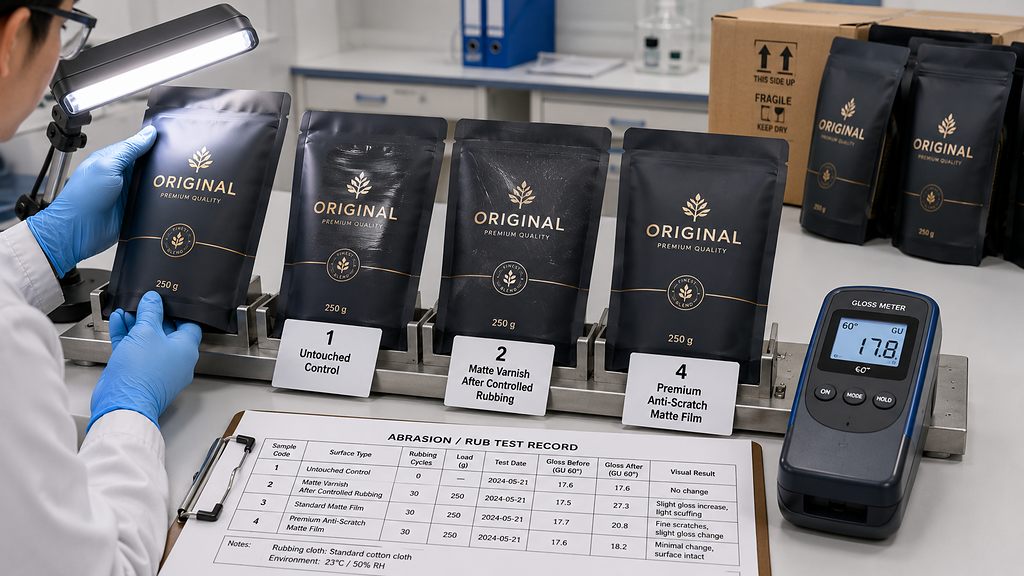
Use a hidden area or retained sample. Rub the same number of cycles with the same material, pressure, direction, and contact area. Compare gloss, color transfer, whitening, scratches, and surface polishing against an untouched control.
A weak or poorly cured varnish may wear, polish, or transfer more readily. A matte film usually remains as a physical web, but its surface can still scratch or become shinier where the microscopic texture is flattened. Therefore, “it did not rub off” does not prove that the finish is a film.
- Use Adhesive Tape Only as a Comparative Adhesion Check
A tape pull may reveal weak adhesion between a coating, ink, or film surface, but it is not a universal identification test. Results vary with tape type, peel angle, dwell time, substrate, curing, and surface treatment.
If the tape removes a surface layer, the result shows an adhesion problem. It does not automatically identify that layer as matte varnish, because inks, primers, coatings, metallization, or poorly bonded laminate surfaces can also fail.
- Measure Gloss Instead of Relying Only on Touch
A gloss meter gives repeatable numerical data when the same instrument geometry, backing, sample orientation, conditioning, and measurement area are used. Plastic films can be evaluated using methods designed for film gloss, while coatings are commonly evaluated using coating gloss methods.
Gloss data alone will not reveal the chemistry, but it can show whether the matte effect is uniform and whether rubbing, heat, chemicals, or handling changed the surface. For transparent or partly transparent samples, use the same backing and setup for every comparison.
- Treat Solvent Resistance as a Controlled Laboratory Test
Some simple demonstrations use ethyl acetate or another solvent to wipe the surface. A low-resistance coating may soften, dissolve, smear, or change gloss. However, modern matte coatings can be formulated for strong chemical resistance, and the same solvent may attack ink, primer, adhesive, sealant, or the package contents.
Solvents are flammable and require suitable ventilation, protective equipment, and a documented test method. They should be used only by trained personnel on scrap or retained samples. A solvent response is supporting evidence, not a definitive identification result.
- Escalate High-Value Disputes to the Converter or a Laboratory
For a large order, recurring defect, or supplier dispute, request the approved structure and batch records first. If the documentation is incomplete, a packaging laboratory can examine a cross-section and use appropriate material-analysis methods to determine whether a distinct film web or surface coating is present.
The final conclusion should combine structure evidence, microscopy or laboratory analysis, printing records, and performance tests. This is more reliable than relying on a single scratch, smell, or touch impression.
Why One-Test Rules Often Give the Wrong Answer
The original surface may not be a basic coating or a basic uncoated film. Packaging suppliers can use high-resistance matte varnishes, soft-touch coatings, anti-scratch topcoats, coated matte films, coextruded matte layers, and combinations of these technologies.
A well-formulated matte coating may resist rubbing and chemicals much better than a low-cost coating. Conversely, a matte film may show scratches, pressure marks, gloss change, or white stress marks even though the film layer remains intact.
Printing sequence also matters. A pouch can use reverse printing beneath a matte film, surface printing protected by a varnish, or a laminated structure that receives an additional matte coating after lamination. The finished package may therefore contain both a matte film and a coating.
For these reasons, the best answer is a confidence-based conclusion: confirmed by documents, strongly indicated by physical evidence, or still uncertain and requiring supplier confirmation.
Performance Differences That Matter in Real Packaging
Appearance and Surface Consistency
Matte film often provides a uniform finish across a large area because the surface is created under controlled film-manufacturing conditions. Matte varnish can also be uniform, but its final gloss depends more directly on press settings, coat weight, drying or curing, ink coverage, and the substrate.
For a broader comparison of finish routes and visual effects, see the matte plastic packaging materials and buying guide.
Scuff, Scratch, and Repeated Handling
A film outer web provides a continuous physical layer that can protect reverse-printed graphics. This is often useful for coffee bags, pet-food pouches, detergent refills, frozen-food packaging, and other packs exposed to distribution abrasion.
A properly selected varnish can also deliver strong rub and scratch resistance. Performance must be specified and tested rather than assumed from the words “varnish” or “film.” Dark solid colors are especially useful for approval trials because scuffs, polishing, and fingerprints are more visible.
Clear Windows and Spot Effects
Registered matte varnish is often the more flexible route when artwork requires a transparent window, high-gloss logo, metallic detail, or precise matte-and-gloss contrast. A full matte film can reduce window clarity because its haze and surface texture scatter light.
A converter can still design a matte-film pouch with a clear window, but the structure and registration method must be planned at the artwork and material-selection stage.
Barrier, Sealing, and Shelf Life
Neither “matte varnish” nor “matte film” defines the complete barrier performance of a package. Oxygen, moisture, aroma, light, grease, and puncture protection depend on the total laminate structure, thickness, coatings, adhesives, seals, and package integrity.
The matte outer layer is normally not the heat-seal layer. Seal initiation temperature, hot tack, seal strength, contamination tolerance, and filling-line performance must be specified for the inner sealant web.
Stiffness, Yield, and Package Feel
Adding a separate matte film can change total thickness, stiffness, dead fold, flex-crack behavior, pouch opening, and material yield. BOPP is commonly selected when buyers want low density, stiffness, moisture resistance, and balanced cost. PET is commonly selected when higher modulus, heat resistance, and dimensional stability are more important.
A varnish adds much less structural thickness, so it can preserve the base laminate’s flexibility. Its effect on friction, blocking, winding, and pouch machinability still needs to be evaluated.
Cost and Production Complexity
Matte varnish may reduce the need for an added lamination film in some structures, but it requires compatible coating equipment, drying or curing capacity, registration control, and process validation. Matte film adds material and lamination cost, yet it can simplify visual consistency and protect reverse printing.
The lowest unit price is not always the lowest total cost. Include printing waste, lamination yield, curing time, rejected gloss variation, scuff claims, line speed, and commercial order volume when comparing the two routes.
Which Matte Solution Should You Choose?
Choose Matte Varnish When:
- The design needs spot matte, gloss contrast, or an uncoated clear window.
- The existing substrate already provides the required mechanical and barrier performance.
- Added film thickness or stiffness is undesirable.
- The printer has a proven varnish, drying or curing system, and stable registration control.
- The agreed rub, chemical, heat, coefficient-of-friction, and food-packaging requirements can be met by the coating.
Choose Matte Film When:
- A continuous, uniform matte appearance is required across most of the package.
- Reverse-printed graphics need protection beneath the outer web.
- The package will experience repeated handling, transport abrasion, or retail shelf contact.
- The structure benefits from the stiffness, dimensional stability, moisture resistance, or heat performance of the selected base film.
- The converter wants a repeatable film grade with defined thickness, gloss, haze, treatment, and winding properties.
Choose a Premium Tactile Film When:
A normal matte finish reduces glare, while a tactile finish adds a velvet-like or peach-skin feel. Buyers developing luxury cartons, labels, coffee packs, cosmetics, or gift packaging can compare soft touch BOPP film with standard matte BOPP before approving the final hand feel and scratch performance.
Choose Thermal Matte Film for Printed Paper or Board When:
For book covers, brochures, paperboard cartons, menus, and related printed materials, a pre-coated BOPP thermal lamination film can be bonded using heat and pressure. The thermal lamination process guide explains the importance of film grade, ink condition, temperature, pressure, speed, and cooling.
What Buyers Should Specify to a Matte Film Supplier or Packaging Converter
Do not purchase only by the phrase “matte pouch.” Send a structured specification so the manufacturer can match the finish to the real package and filling line.
- End Use and Product Risk
State the packed product, net weight, pack format, shelf-life target, filling temperature, storage climate, distribution route, and consumer-use pattern.
- Complete Laminate Structure
Provide every known layer, thickness, printing position, adhesive type, barrier requirement, and sealant. Mark which side must face outward and which side will be printed, laminated, coated, or heat sealed.
- Matte Route
Specify full-area matte varnish, spot matte varnish, matte BOPP outer web, matte PET outer web, matte thermal film, soft-touch film, or another defined finish. Do not leave the production route open unless alternative quotations are requested.
- Optical Targets
Agree on gloss measurement geometry, target range, haze or transparency needs, color tolerance, metallic appearance, window clarity, and the lighting conditions used for visual approval.
- Surface and Converting Performance
Define rub or scuff resistance, scratch resistance, coefficient of friction, blocking, ink or coating adhesion, corona treatment, lamination bond, heat resistance, chemical exposure, and any downstream hot stamping, coding, zipper insertion, laser scoring, or pouch-making requirement.
- Roll and Commercial Details
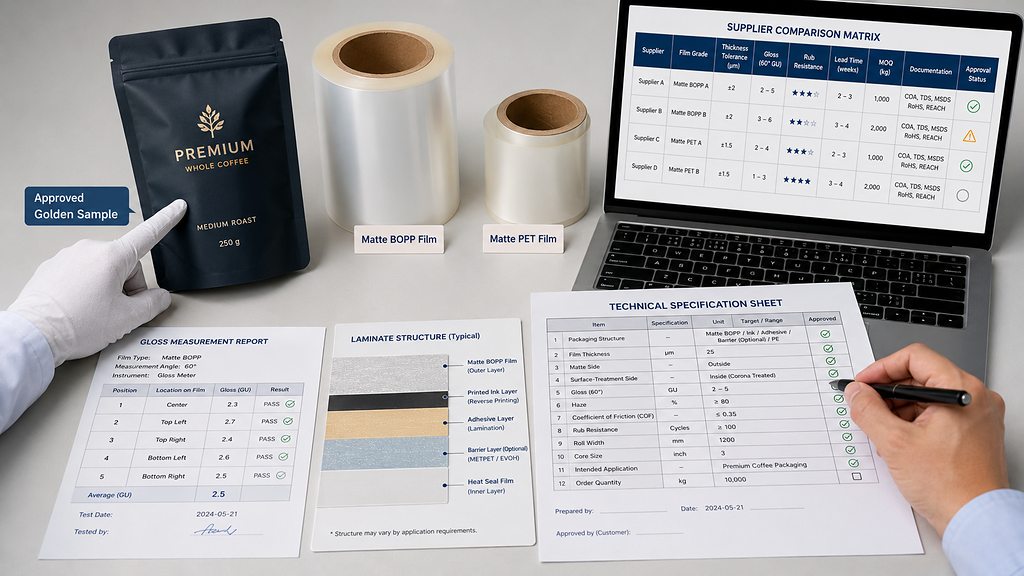
State thickness, width, tolerance, core size, maximum roll diameter, winding direction, splice allowance, quantity, annual demand, destination, and required documentation. A qualified film manufacturer or supplier should identify which properties are typical and which will be guaranteed in the purchase specification.
Buyers benchmarking supply options can also review the BOPP film manufacturers in China overview, then qualify the selected producer against the exact matte grade and application rather than company size alone.
A Practical Quality-Control Plan for Matte Packaging
Approve a Golden Sample
Keep a signed physical standard from the approved production trial. Record the film grade, varnish code, structure, printing sequence, gloss values, color data, and test conditions. Photographs alone cannot reproduce gloss and touch accurately.
Measure More Than One Location
Check the center, edges, seal areas, dark solid colors, light colors, and any transition between matte and gloss. Registered coating should also be checked for positional accuracy against artwork.
Use Agreed Comparative Tests
The buyer and supplier should agree on the rub material, load, cycle count, test area, conditioning, and acceptance criteria. The same principle applies to chemical resistance, heat resistance, blocking, tape adhesion, and coefficient of friction.
Test After Converting and Filling
A film or coating that performs well as a flat print may behave differently after lamination, curing, slitting, pouch making, zipper insertion, filling, sealing, sterilization, freezing, or transport. Final approval should use the real structure and representative production conditions.
Control Batch Traceability
Record raw-material lots, ink and varnish batches, adhesive batch, film roll numbers, press settings, curing conditions, and inspection results. Traceability makes it much easier to separate a material problem from a printing, lamination, storage, or handling problem.
Food Contact, Sustainability, and Recyclability Considerations
A matte appearance does not automatically make a package suitable for food contact. The entire finished structure, including film, ink, coating, adhesive, additives, set-off risk, and intended food-contact conditions, must comply with the applicable market requirements.
For mono-material projects, confirm that the matte film, coating, ink, adhesive, zipper, and other components are compatible with the intended recycling stream and local collection system. A thin varnish is not automatically the more recyclable option, and a matte film is not automatically the less recyclable option. The answer depends on the complete package design and the relevant recycling guidance.
Ask the supplier for current declarations, technical data, and application limits. Claims should relate to the exact product grade and finished structure, not only to the generic polymer name.
Frequently Asked Questions
- What is the simplest difference between matte varnish and matte film?
Matte varnish is a coated finish applied to a surface. Matte film is a film web or engineered film surface incorporated into the packaging structure. The first is primarily a coating process; the second is primarily a material and lamination choice.
- Can I identify the finish only by touching the pouch?
Not reliably. A varnish can feel smooth, dry, rubbery, or paper-like, while a film can feel satin, rough, silky, or soft-touch. Formulation, surface texture, additives, and storage conditions can make the hand feel overlap.
- Does a scratch test prove that the surface is matte varnish?
No. A weak varnish may scratch or polish, but a matte film can also scratch, whiten, or become glossier under abrasion. Use a controlled comparison and combine the result with structure records and edge inspection.
- Is an ethyl acetate wipe a reliable identification test?
It is only a supporting laboratory check. Some coatings may soften or change gloss, while resistant coatings may show little change. The solvent may also affect ink, adhesive, primer, or sealant. Use trained personnel, proper safety controls, and a retained sample.
- Is matte film always more scratch-resistant than matte varnish?
No. A standard film may scratch more easily than a premium anti-scratch varnish, and a low-cost varnish may wear faster than a well-designed film. Specify and test the required performance instead of ranking technologies by name alone.
- Which option gives the most uniform low-gloss appearance?
A stable matte film grade often provides excellent full-area uniformity. A well-controlled varnish can also be uniform, but the result is more sensitive to coat weight, cure, ink coverage, and press settings.
- Which option is better for a clear product window?
Registered matte varnish is often easier because the window can be left uncoated. A full matte film may reduce clarity unless the package uses a dedicated clear-window or selectively matte construction.
- Which option is better for reverse-printed graphics?
Matte film is commonly used as the outer web with ink printed on its inner side and protected by lamination. This is a practical route for graphics that must resist scuffing. Other structures are possible, so the print position should be confirmed.
- Does the matte finish improve oxygen or moisture barrier?
Not by itself. Barrier performance comes from the complete structure. A BOPP outer web can contribute moisture resistance, while PET can contribute strength and dimensional stability, but oxygen and moisture targets must be verified for the full laminate.
- Does matte film provide the heat seal?
Usually not when it is used as the outer web. The inner PE, CPP, or another sealant layer normally forms the seal. Some specialty matte films are heat sealable, so the exact grade and sealing side must be identified.
- What is the difference between matte BOPP and matte PET?
Matte BOPP is generally lower in density, flexible, moisture-resistant, and cost-effective for many packaging and lamination applications. Matte PET is generally stiffer, more dimensionally stable, and more heat-resistant. The best choice depends on structure, process, and end use.
- Is soft-touch film the same as normal matte film?
No. Normal matte film mainly reduces gloss. Soft-touch film adds a distinctive velvet-like tactile effect. It should be approved by physical sample because touch cannot be evaluated accurately from photographs.
- Can a package contain both matte film and matte varnish?
Yes. A converter may use a matte outer film and then add a selective coating, tactile effect, anti-scratch layer, or registered gloss detail. This is another reason that a single rub test cannot identify the full structure.
- Which option is less expensive?
The answer depends on order volume, press configuration, coating pass, drying or curing, film price, lamination cost, waste, and performance requirements. Compare total converted cost and expected rejection risk, not only raw-material price.
- Which option is more recyclable?
Neither is universally better. Recyclability depends on the complete package, polymer combination, coating and ink compatibility, adhesive, components, and local recycling infrastructure. Evaluate the exact structure against applicable design guidance.
- What should I request from a supplier before ordering?
Request the exact grade, structure, thickness, matte and treatment sides, gloss and haze data, COF, rub or scratch performance, food-contact documents when relevant, roll specification, sample, and recommended processing conditions.
- How should I approve a matte packaging sample?
Approve a physical golden sample under controlled lighting, record gloss values, inspect dark and light artwork areas, perform agreed rub and converting tests, and run the actual pouch-making and filling process before mass production.
- Can a manufacturer reproduce my existing matte pouch without a data sheet?
A qualified manufacturer can examine the pouch, measure thickness and gloss, study the structure, and propose trial materials. However, reverse engineering has limits. A production trial and written acceptance specification are still necessary before a commercial order.
Conclusion
Matte varnish and matte film can create a similar premium, low-gloss appearance, but they are not interchangeable production routes. Varnish offers strong design flexibility for spot effects and clear windows. Matte film offers a defined film web that can support uniform appearance, reverse-print protection, stiffness, and repeatable converting performance.
The correct way to identify an existing package is to combine documents, visual clues, edge inspection, controlled rub testing, gloss measurement, and supplier confirmation. The correct way to buy a new package is to specify the complete laminate, finish route, optical targets, surface performance, sealing requirements, compliance documents, and real machine conditions.
CloudFilm supports converters, brand owners, and distributors with matte BOPP, matte PET, thermal lamination, soft-touch, and custom flexible-packaging structures. Learn more about CloudFilm as a flexible packaging film manufacturer or contact the technical sales team with your current structure, sample photos, roll requirements, and end-use conditions.