When a buyer searches for “packaging aluminium,” the intended phrase is usually “aluminium packaging.” The search can refer to household foil, food trays, pharmaceutical blister materials, cans, lidding, or flexible laminates. For packaging engineers and commercial buyers, however, the most important distinction is often between solid aluminium foil, aluminium-coated plastic film, and transparent high-barrier film. These materials may look similar in a quotation, yet they behave very differently during printing, lamination, sealing, filling, distribution, and recycling.
This guide focuses on flexible packaging because it is where material selection is most complex. It explains the main aluminium-based options, common laminate structures, performance trade-offs, application examples, purchasing specifications, and the questions to ask an aluminium packaging manufacturer or supplier. Buyers who already know that they require a foil-based laminate can review flexible packaging aluminium foil as a practical starting point for structure development.
What Does Aluminium Packaging Mean?
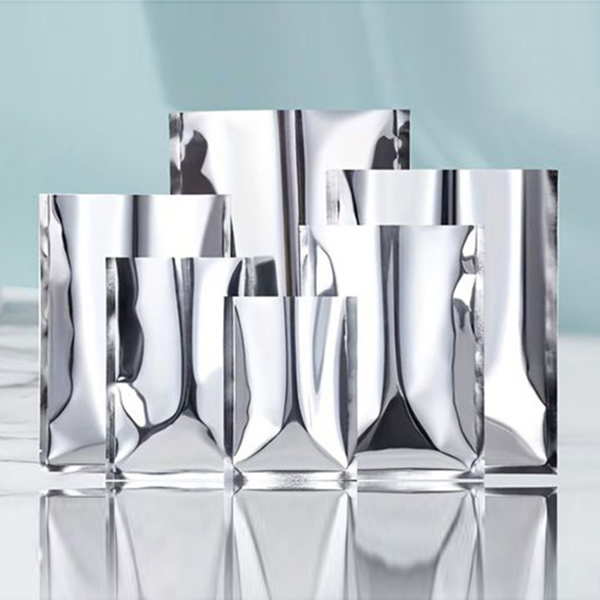
Aluminium packaging is a broad category rather than one product. It includes packages made entirely from aluminium, packages containing a solid foil layer, and plastic films carrying a microscopic aluminium coating. The material may provide barrier protection, rigidity, decoration, heat resistance, tamper evidence, or a combination of these functions.
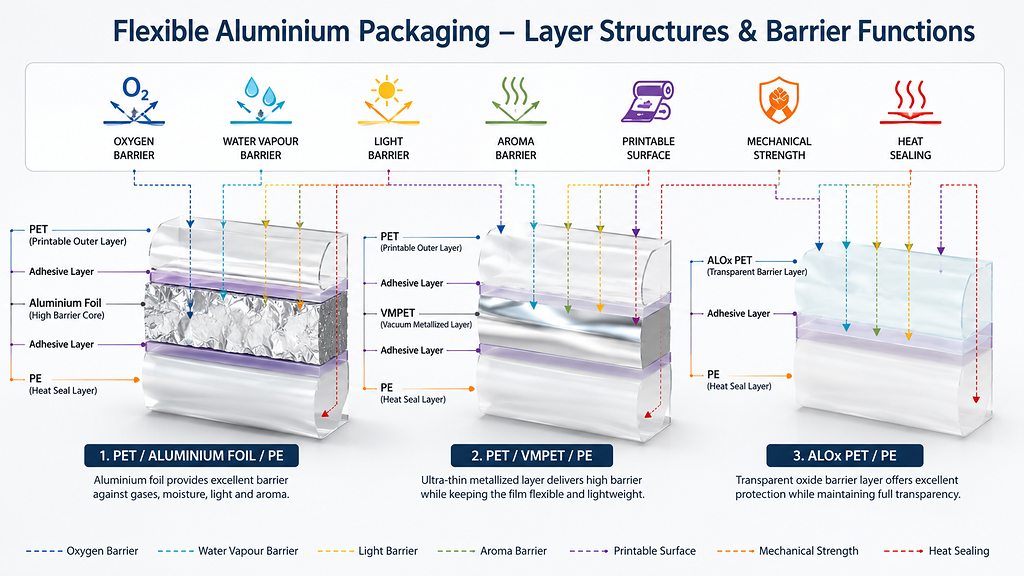
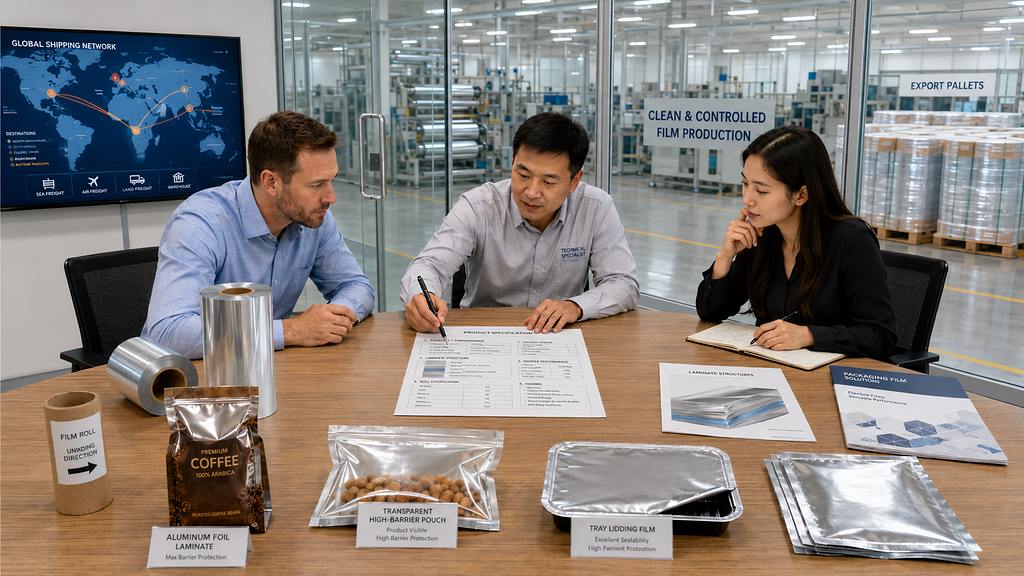
In flexible packaging, aluminium is rarely expected to perform every job alone. A final laminate normally divides the work among several layers: an outer web for printing and mechanical strength, a barrier layer for oxygen, moisture, aroma, and light protection, an adhesive or tie layer, and an inner sealant layer that contacts the product and closes the package. Understanding this layered system prevents a common sourcing mistake: buying a “high-barrier film” without confirming whether it can actually seal to the chosen pouch, tray, cup, or packing machine.
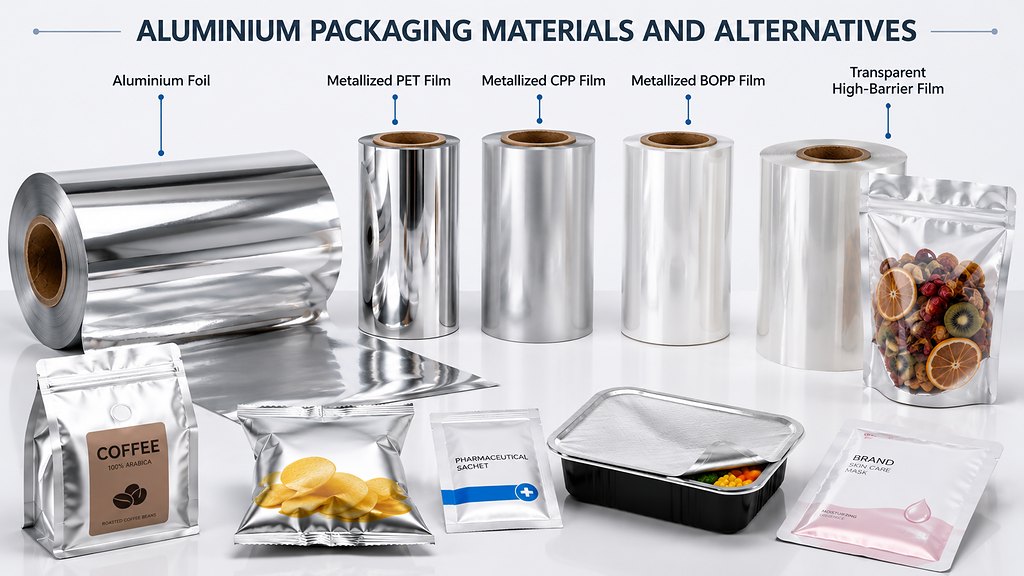
The four principal categories are:
- Solid aluminium packaging, such as trays, cans, tubes, lids, and formed containers. These formats use aluminium as the structural body and are normally supplied by specialist metal-packaging producers.
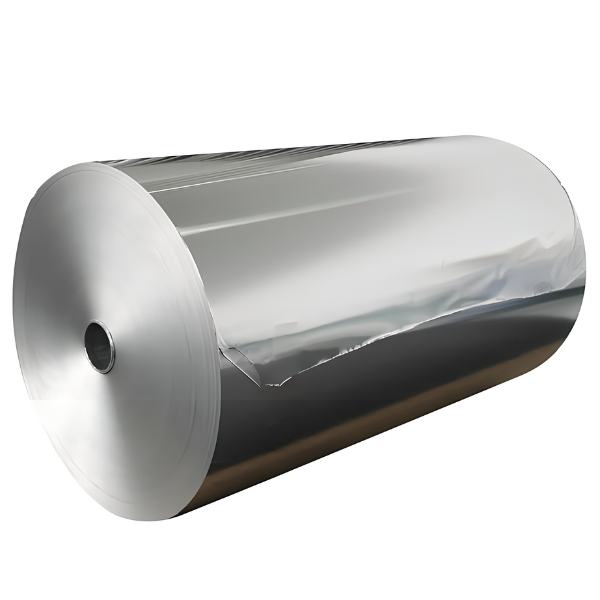
- Aluminium foil and foil laminates. Thin foil is combined with PET, BOPP, paper, PE, CPP, nylon, coatings, or lacquers. This category is used when very strong protection against oxygen, moisture, aroma loss, and light is needed. For direct food-contact and converting projects, food-grade aluminium foil is selected according to alloy, temper, thickness, surface condition, and compliance requirements.
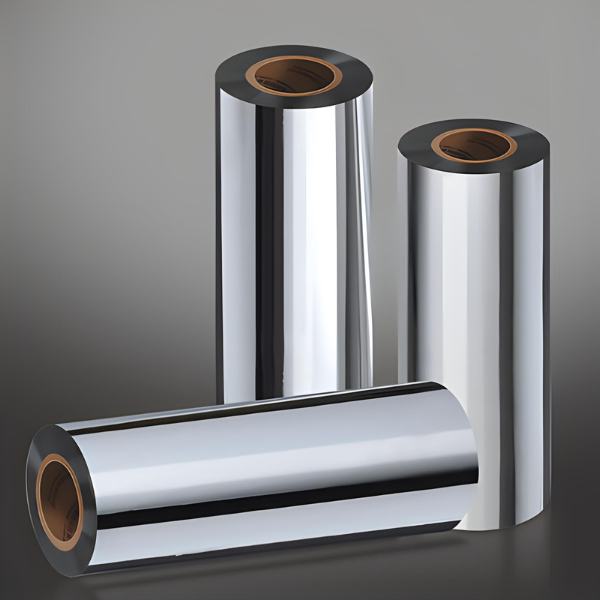
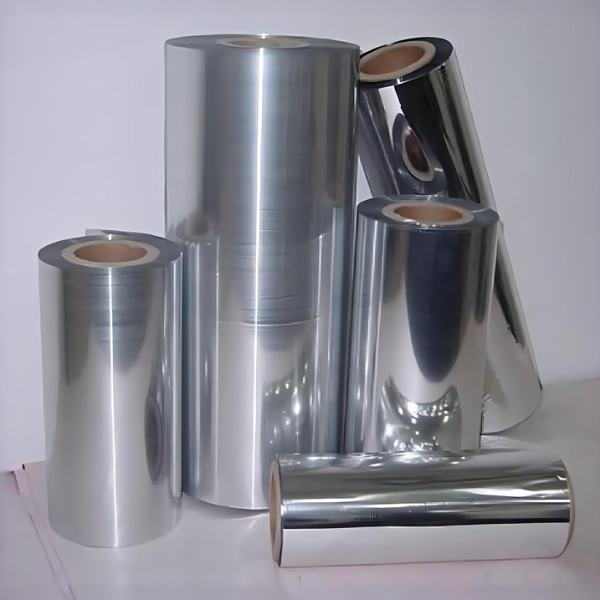
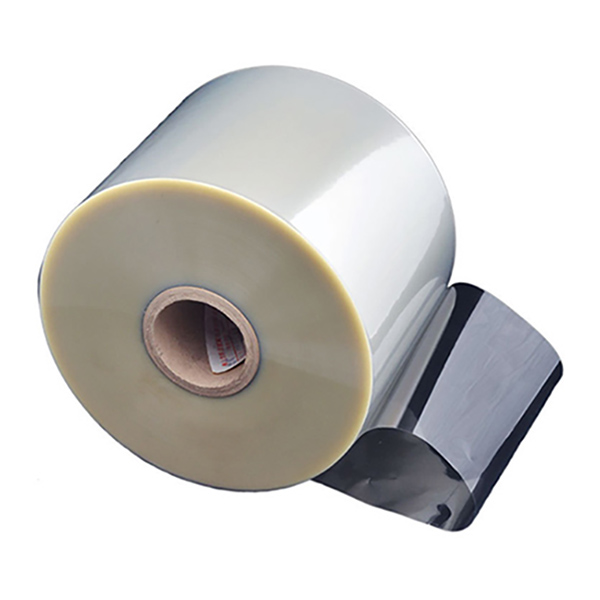
- Metallized plastic films. PET, BOPP, CPP, or PE-based film is coated with an extremely thin aluminium layer under vacuum. The result remains flexible and lightweight while gaining metallic appearance and improved barrier performance. A buyer comparing substrate options can review the metallized films range before choosing a specific grade.
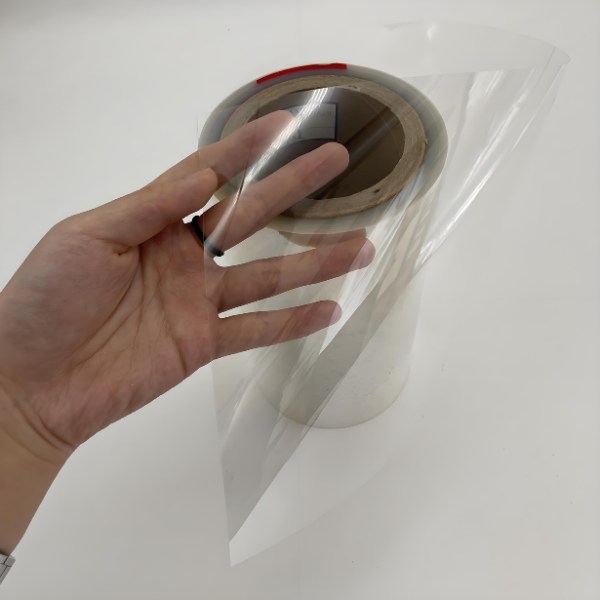
- Transparent high-barrier alternatives. Materials such as aluminium-oxide-coated PET use a clear inorganic coating instead of an opaque metallic layer. They are useful when the product must remain visible or when metal-containing packaging creates a process limitation.
How Aluminium-Based Packaging Protects Products
The value of aluminium in packaging comes from barrier performance. Oxygen can accelerate oxidation, rancidity, colour loss, vitamin degradation, and flavour change. Water vapour can soften crisp products, cause powders to cake, or dry out moisture-sensitive goods. Light can damage oils, pigments, active ingredients, and aroma compounds. Aluminium foil blocks light and, when defect-free and properly laminated, can provide extremely strong gas and moisture protection.
Real packages are more complicated than ideal laboratory samples. Very thin foil can develop pinholes, and a laminate can be damaged by sharp product edges, repeated flexing, aggressive forming, poor winding, or rough logistics. Metallized films do not contain a continuous thick metal sheet; their barrier depends on substrate quality, coating uniformity, optical density, surface treatment, lamination quality, and the absence of scratches or cracks. Transparent coated films also need careful handling because abrasion or severe flexing can damage the barrier coating.
Barrier values should therefore be treated as system data, not as a material slogan. The buyer should specify the target oxygen transmission rate and water-vapour transmission rate, the test temperature and humidity, the expected shelf life, package size, seal area, filling conditions, and distribution route. The converted package should then be validated after printing, lamination, curing, slitting, pouch making, filling, and transport simulation whenever the product risk justifies it.
Sealing is a separate function.
Bare foil, VMPET, and most ALOx PET grades are not normally the final heat-seal surface. They are laminated to PE, CPP, ionomer, easy-peel sealant, or another purpose-designed inner layer. The correct sealant depends on the container material, sealing temperature, dwell time, pressure, contamination level, hot-tack demand, opening behaviour, and whether the package will be boiled, pasteurised, frozen, retorted, or stored at ambient temperature.
Aluminium Foil vs Metallized Film vs Transparent Barrier Film
No material is automatically best. The correct option is the one that reaches the required shelf life and processing performance with acceptable cost, machinability, appearance, and environmental impact. The following comparison is a practical screening tool; final selection should be based on measured data from the exact structure.
| Selection Factor | Aluminium Foil Laminate | Metallized Film Laminate | Transparent Barrier Laminate |
| Typical barrier level | Very high when foil integrity is maintained | Moderate to high, depending on substrate and coating | Moderate to high, depending on coating and laminate |
| Appearance | Opaque metallic; may be hidden by printing | Metallic and reflective | Clear, allowing product visibility |
| Light protection | Excellent | Strong to excellent | Limited unless combined with UV or light-barrier features |
| Flex-crack sensitivity | Can be vulnerable in thin or heavily flexed structures | Usually more flexible than foil but coating can crack or scratch | Coating requires careful handling and conversion |
| Heat sealing | Requires a sealant coating or laminated seal layer | Depends on base film; VMPET usually needs a sealant layer, VMCPP may seal | Usually requires PE, CPP, or another sealant |
| Product visibility | No | No or very limited | Yes |
| Microwave suitability | Generally unsuitable unless specially engineered and validated | Generally unsuitable because it contains metal | Potentially suitable when the complete structure is designed and validated for microwave use |
| Common uses | Coffee, powders, pharma, sensitive foods, technical products | Snacks, biscuits, coffee, tea, pet food, cosmetics | Premium visible food, meat, dried fruit, medical and technical packs |
For a deeper materials comparison, the article film and foil in flexible packaging explains how these layers cooperate in commercial laminate structures.
Common Flexible Packaging Structures
PET / AL / PE
This is a classic high-barrier laminate. PET provides printability, stiffness, and dimensional stability; aluminium foil provides the main barrier and light block; PE provides product contact and heat sealing. Depending on the product, the inner layer can be modified for stronger seals, chemical resistance, easy peel, or low-temperature performance.
PET / VMPET / PE
This structure is lighter and often more flexible than a foil laminate. The outer PET carries the reverse print, the aluminized PET film supplies metallic appearance and barrier, and PE supplies the seal. It is widely considered for coffee, tea, powdered drinks, dry foods, pet food, and technical products when the barrier target does not require solid foil.
BOPP / VMCPP
This two-layer structure is common in high-speed snack and biscuit packaging. BOPP contributes stiffness, gloss, printability, and machine handling, while VMCPP contributes sealing, flexibility, and improved barrier. It can be economical and efficient, but its oxygen and moisture protection must be matched to the product and shelf-life target. For an outer web with moisture barrier and metallic appearance, metallized BOPP film can also be used in alternative laminate designs.
ALOx PET / PE or ALOx PET / CPP
A clear barrier structure can be selected when consumers need to see the product or when an opaque metallic look is undesirable. ALOx PET film provides the transparent barrier web, while PE or CPP provides sealing. This structure may be used for dried fruit, meat, cheese, snacks, medical products, and premium technical packaging, subject to barrier validation after conversion.
Paper / AL / PE
Paper creates a natural tactile and printable outer surface, foil supplies barrier and light protection, and PE provides sealing. It is used for sachets, wrapped products, powders, and selected pharmaceutical or food applications. Although the paper appearance can support a natural brand image, the bonded multi-material structure needs a realistic end-of-life assessment.
Lacquered or coated foil lidding
For cups, tubs, bottles, and trays, aluminium foil may be coated with a heat-seal lacquer matched to PP, PE, PET, PS, PVC, or another container surface. Peel strength, seal initiation temperature, sealing window, contamination resistance, puncture behaviour, and opening force must be tested on the actual container. Buyers developing tray or cup seals can first review what lidding film is and how it is selected before defining the foil or film specification.
Where Aluminium Packaging Is Commonly Used
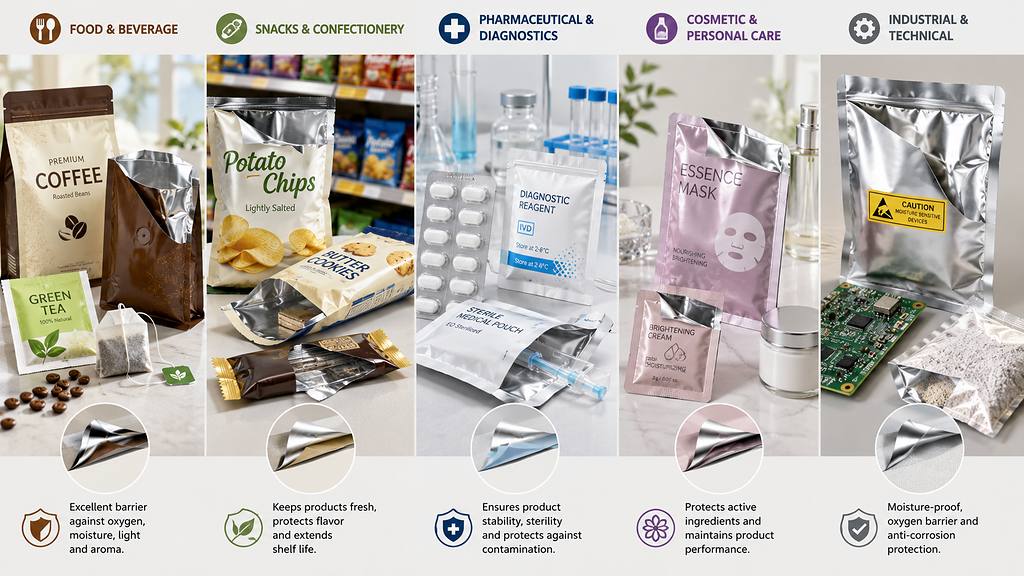
Coffee, tea, cocoa, and aromatic powders
These products are sensitive to oxygen, moisture, aroma loss, and sometimes light. Foil laminates are selected for demanding shelf-life targets, while VMPET structures may provide a lighter and more cost-efficient option. Degassing valves, zipper areas, gussets, and seal contamination must be considered because the best barrier web cannot compensate for a leaking valve or weak seal.
Snacks, biscuits, confectionery, and instant foods
Metallized BOPP and VMCPP are widely considered for pillow packs and flow-wrap applications because they combine shelf impact, moisture protection, machinability, and sealing. Product fat content, crispness target, pack size, line speed, and nitrogen flushing determine whether a two-layer structure is sufficient or a stronger laminate is needed.
Milk powder, nutrition, ingredients, and dry mixes
Powders can be highly sensitive to moisture and oxidation. A foil laminate may be selected for long shelf life and strong light protection, while VMPET or transparent barrier film may be suitable for less demanding products. Large packs also require puncture strength, drop resistance, and dependable seals because the weight of the contents places more stress on the laminate.
Pharmaceutical, diagnostic, and medical packaging
Foil appears in blister lidding, sachets, strip packs, device pouches, and diagnostic consumables. The structure may need barrier, sterilisation resistance, clean opening, puncturability, tamper evidence, or compatibility with automated equipment. Medical and pharmaceutical projects require a controlled specification, documented change management, and application-specific regulatory review rather than a generic food-packaging grade.
Cosmetics and personal care
Mask sachets, sample packs, creams, oils, and active formulations may need light and oxygen protection. Metallized PET or foil can create a premium appearance, while the sealant must resist the product formulation. Migration, aroma interaction, laminate bond strength, and long-term chemical compatibility should be evaluated.
Electronics, chemicals, and industrial products
Sensitive components, powders, resins, and corrosion-prone parts may use foil or metallized laminates for moisture and light control. Static protection, chemical resistance, puncture strength, clean-room requirements, and export logistics can be more important than retail appearance. The broader high-barrier film portfolio helps buyers compare foil, metallized, coated, and co-extruded options for these demanding uses.
How to Select the Right Material
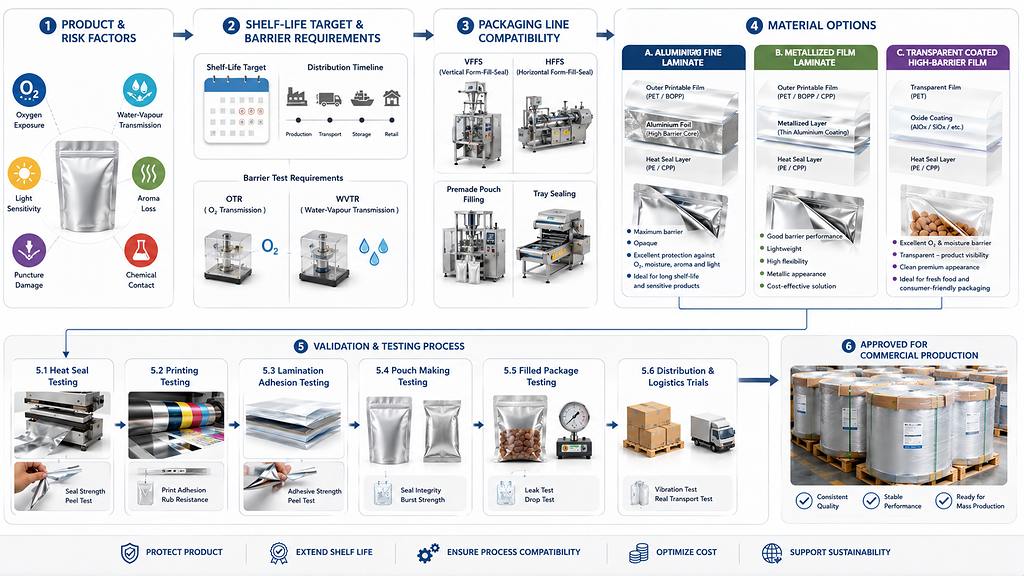
Material selection should start with the packaged product, not with a familiar structure copied from another application. Two products that appear similar can require different barriers because of fat content, moisture activity, oxygen sensitivity, aroma intensity, filling temperature, expected shelf life, or distribution climate.
- Define the product risk.
List what can damage the product: oxygen, moisture gain, moisture loss, light, aroma loss, grease, chemicals, microorganisms, puncture, or physical deformation. Identify the failure that would end shelf life first.
- Set measurable targets.
State the required shelf life and target barrier values under defined test conditions. Include package dimensions and product weight because total ingress depends on the complete exposed area, seals, valves, closures, and defects—not only the transmission value printed on a film data sheet.
- Confirm the packing process.
Specify VFFS, HFFS, flow wrap, premade pouch filling, thermoforming, tray sealing, blister sealing, or another process. Provide line speed, sealing temperature, dwell time, pressure, jaw type, forming geometry, tension, and any known issues such as wrinkles, curling, static, poor hot tack, or seal contamination.
- Decide whether the package must be opaque, metallic, or clear.
Foil gives complete opacity and excellent light protection. Metallized film provides a metallic effect with less aluminium and greater flexibility. Transparent barriers preserve product visibility but may need additional light protection. The desired shelf appearance should never override the barrier and sealing requirements.
- Check downstream restrictions.
Metal-containing structures can affect microwave heating, metal detection, x-ray inspection settings, induction processes, and some recycling routes. Confirm the customer’s filling, inspection, distribution, and consumer-use conditions before approving the structure.
- Compare total converted cost.
A lower price per kilogram does not necessarily mean a lower packaging cost. Yield per square metre, laminate thickness, scrap rate, printing efficiency, adhesive consumption, curing time, line speed, rejects, freight, and product waste all influence the final economic result.
Manufacturing and Converting Points Buyers Should Control
Foil alloy, temper, thickness, and surface condition
Foil performance is influenced by alloy, temper, thickness tolerance, pinhole level, rolling oil residue, wettability, cleanliness, and surface treatment. The correct specification depends on whether the foil will be printed, lacquered, laminated, embossed, formed, or used as lidding. Buyers should not approve a quotation based only on nominal thickness.
Metallized-film optical density and coating uniformity
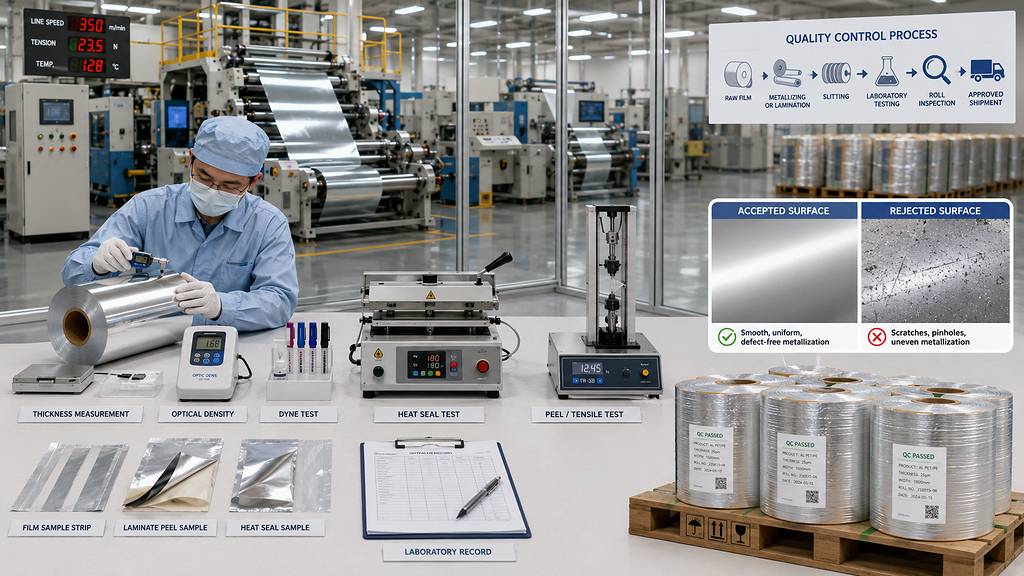
For metallized film, the aluminium deposition must be uniform across the web and along the roll. Optical density is often used as a practical process indicator, but it should be linked to actual oxygen and moisture barrier results. Adhesion of the metal layer, treatment level, roll hardness, wrinkles, blocking, and surface scratches also affect converting performance.
Adhesive selection and curing
The adhesive system must match the substrates, product, filling conditions, and thermal process. Incomplete cure can cause odour, migration concerns, weak bonds, tunnelling, delamination, or poor heat resistance. Solvent-based, solvent-free, water-based, and extrusion-lamination processes each have different controls. A supplier should state the recommended cure time and testing schedule rather than shipping freshly laminated rolls directly to high-risk filling.
Printing and ink protection
Reverse printing protects graphics inside the laminate, while surface printing may require protective varnish. Metallic substrates change colour appearance because white ink, transparent colours, and the reflective background interact. Artwork proofs should reflect the actual material rather than a paper simulation.
Slitting, winding, and roll geometry
Poor winding can create telescoping, wrinkles, gauge bands, blocking, loose edges, or excessive roll hardness. The buyer should define roll width, tolerance, maximum outside diameter, core size, winding direction, splice policy, roll weight, pallet configuration, and traceability labels. These details are essential for stable automated production.
Finished-package testing
A sound qualification plan can include thickness, bond strength, seal strength, hot tack, coefficient of friction, barrier, pinhole inspection, dye penetration, burst, drop, compression, puncture, migration, odour, retort or pasteurisation resistance, and transport trials. Not every test is needed for every package, but the plan should address the actual failure risks.
Sustainability and Material Reduction
Aluminium can protect products extremely well, and preventing food, pharmaceutical, or high-value product waste may be a major environmental benefit. At the same time, a laminate that permanently bonds foil, plastic, paper, inks, and adhesive can be difficult to recycle in many collection systems. A credible sustainability discussion must therefore consider product protection, material quantity, manufacturing loss, transport, consumer use, collection infrastructure, and actual end-of-life routes.
The first design question should be whether the package needs solid foil. If a validated metallized film reaches the required shelf life, material use and package weight may be reduced. If product visibility is valuable, a transparent coated barrier may be considered. If the market prioritises mechanical recycling, a mono-PE or mono-PP structure with an appropriate barrier technology may be investigated. The article on mono-material flexible packaging explains why recyclability claims must be connected to the complete structure and local collection system.
Co-extruded barrier layers can also provide a metal-free route for selected products. For example, EVOH co-extruded film may be incorporated into PE- or PP-rich structures where oxygen protection, transparency, and sealing are required. EVOH performance is sensitive to humidity and structure design, so it should not be presented as a universal foil replacement. The practical goal is not to eliminate aluminium at any cost; it is to use the minimum structure that reliably protects the product through its full life cycle.
How to Choose an Aluminium Packaging Manufacturer or Supplier
A qualified supplier should be able to move beyond a simple price per kilogram. The team should understand barrier targets, laminate design, printing, adhesives, sealing, roll conversion, filling equipment, compliance documentation, sampling, and export logistics. For international sourcing, communication quality and change control are as important as nominal material data.
Send a complete request for quotation.
Include the product name, ingredients or chemical characteristics, pack format, finished dimensions, current structure, target structure, total thickness, barrier requirements, printing colours, sealing substrate, filling temperature, heat process, line type, roll specification, annual volume, destination, and regulatory market. Photos, drawings, used samples, and machine data reduce assumptions and shorten development time.
Request evidence that matches the supplied grade.
Ask for a technical data sheet, relevant compliance declarations, barrier results, recommended processing conditions, change-control policy, traceability approach, and representative samples. Confirm whether the values are typical or guaranteed and whether they were measured on the base film, the laminate, or a finished package.
Evaluate consistency, not only the first sample.
A sample can prove basic compatibility, but commercial success requires repeatable thickness, treatment, coating, barrier, slitting, winding, and packaging. Agree on approval criteria and retain reference samples from qualified lots. During scale-up, compare trial rolls with production rolls under the same machine settings.
Buyers comparing China-based partners can use the packaging films manufacturer and supplier guide to structure their due-diligence questions. CloudFilm supports converters, brand owners, distributors, and packers with custom roll stock and related barrier materials. A project can begin with an existing laminate, a filled package, a target shelf life, or a machine specification; the material proposal should then be verified through sampling and line trials.
Frequently Asked Questions
- Is aluminium packaging the same as aluminium foil packaging?
No. Aluminium packaging is the broader category. It includes rigid aluminium containers, cans, trays, tubes, foil laminates, lacquered foil lidding, and plastic films coated with aluminium. Aluminium foil packaging specifically contains a solid foil layer or foil-based component.
- Is metallized film the same as aluminium foil?
No. Metallized film is a plastic substrate carrying an extremely thin aluminium coating. Foil is a separately rolled metal sheet. Metallized film is usually lighter and more flexible, while intact foil generally provides stronger barrier and complete light blocking.
- Which is better: aluminium foil or VMPET?
The answer depends on the product. Foil is preferred when the highest opaque barrier is essential. VMPET may be better when lower weight, flexibility, metallic appearance, yield, and cost are priorities and its measured barrier is sufficient for the required shelf life.
- Can aluminium foil be heat sealed directly?
Bare foil does not normally provide the desired seal by itself. It is commonly coated with a heat-seal lacquer or laminated to PE, CPP, ionomer, or another sealant selected for the container or opposing web.
- Can VMPET be used as the inner heat-seal layer?
Standard VMPET is usually a barrier layer rather than the final sealant. It is commonly laminated to PE or CPP. Metallized CPP can sometimes combine barrier contribution and heat sealing, subject to the grade and application.
- Is aluminium packaging microwave safe?
Metal-containing flexible packaging is generally not suitable for conventional microwave use unless the complete package has been specifically engineered, tested, and approved for that application. A transparent metal-free barrier structure may be more appropriate.
- What transparent material can replace aluminium foil?
Potential options include ALOx-coated PET, silicon-oxide-coated films, PVDC-coated films, EVOH co-extruded structures, and other high-barrier laminates. None is a universal replacement; performance depends on humidity, flexing, sealing, thermal treatment, and shelf-life requirements.
- What are common aluminium foil laminate structures?
Common examples include PET/AL/PE, PET/AL/CPP, paper/AL/PE, PA/AL/PE, and lacquered foil lidding. The exact outer and inner layers should be selected for printing, strength, chemical resistance, heat sealing, and processing conditions.
- How thick should aluminium foil be for packaging?
There is no universal thickness. The correct value depends on the required barrier, pinhole risk, forming depth, flexing, package size, product sharpness, and converting process. Thickness should be approved together with alloy, temper, pinhole limits, and final laminate testing.
- Can aluminium foil packaging be punctured?
Yes, thin foil and foil laminates can be designed to be pierceable, but puncture force depends on foil thickness, supporting layers, adhesives, coating, seal area, and the geometry of the needle or probe. Diagnostic and lidding projects should test the actual assembled structure.
- Is aluminium packaging suitable for food contact?
It can be, provided the exact foil, coatings, inks, adhesives, and sealant layers comply with the applicable market requirements and are suitable for the food and conditions of use. A generic statement about aluminium alone is not sufficient for a multi-layer package.
- Can aluminium packaging be printed?
Yes. Foil and metallized films can be surface printed or reverse printed within a laminate, depending on treatment and ink system. Metallic backgrounds affect colour appearance, so white ink strategy, proofing, adhesion, and abrasion resistance should be controlled.
- Is aluminium flexible packaging recyclable?
Recyclability depends on the complete construction and local infrastructure. Clean mono-aluminium items may have established recycling routes, while thin foil bonded to plastic or paper can be difficult to separate. Claims should be based on the marketed package and destination system.
- What is the usual MOQ for custom aluminium packaging?
MOQ varies by material, alloy, thickness, coating, print design, laminate structure, roll width, and converting process. Standard unprinted foil or film may allow a lower quantity than custom printed, lacquered, laminated, or pouch-converted material. Suppliers need a complete specification before confirming MOQ.
- What information is required for an accurate quotation?
Provide the intended product, structure or current sample, thickness, width, roll length or finished size, seal substrate, barrier target, print colours, application temperature, machine type, monthly or annual volume, compliance market, delivery destination, and expected trade term.
Conclusion
The phrase “packaging aluminium” can lead to many different products, but flexible-packaging buyers usually need to choose among solid foil laminates, metallized plastic films, and transparent high-barrier alternatives. The decision should be based on the packaged product, shelf-life target, barrier measurements, light protection, seal system, line conditions, package format, consumer use, and end-of-life route.
A reliable aluminium packaging supplier or manufacturer should translate those requirements into a complete structure rather than offering one material in isolation. CloudFilm’s flexible packaging solutions cover foil, metallized films, transparent barrier films, sealant layers, printed roll stock, and finished pouches. Share your existing specification, package sample, machine conditions, and annual demand to receive a technically matched proposal for testing and commercial production.