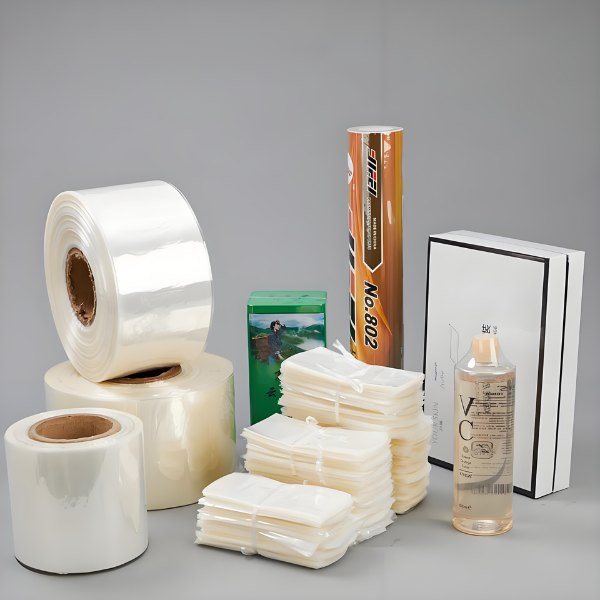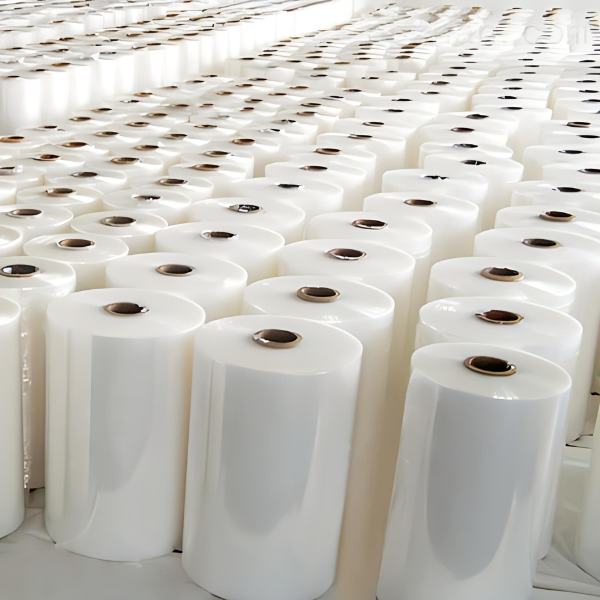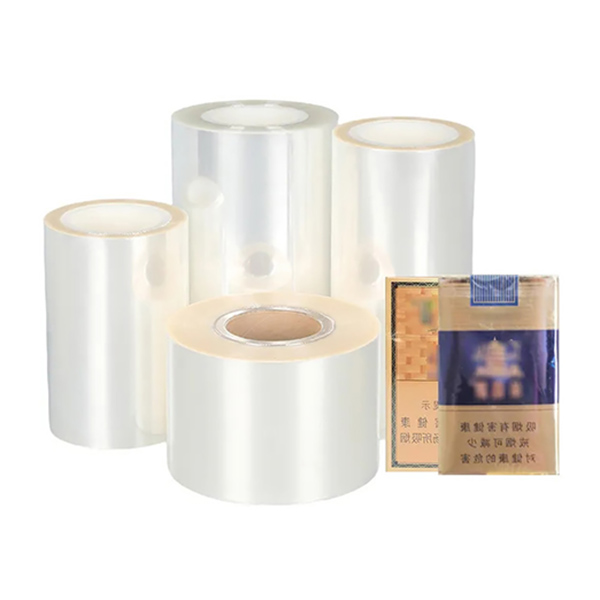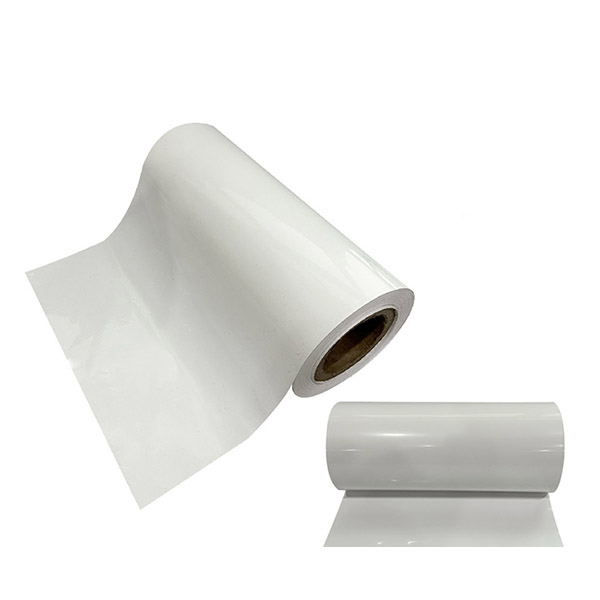
PVC shrink film density is an essential number for converters, label printers, packaging buyers and distributors. It connects film thickness with square-meter yield, roll weight, freight cost and the amount of material consumed by each package.
Quick Answer: What Is the Density of PVC Shrink Film?
Commercial PVC shrink film commonly has a density of approximately 1.33–1.40 g/cm³. Many rigid calendered or cast shrink-film grades use a typical value near 1.35 g/cm³ or 1.38 g/cm³.
The exact value depends on the PVC resin, stabilizers, modifiers, plasticizer level, pigments, processing route and target shrink performance. Always use the density stated on the supplier’s technical data sheet when calculating a purchase order.
Density is not the same as thickness, shrinkage or roll hardness. It describes mass per unit volume. A denser film weighs more than a lower-density film when both films have the same thickness, width and length.
For a complete product overview, review CloudFilm’s PVC shrink film specifications and available roll formats.
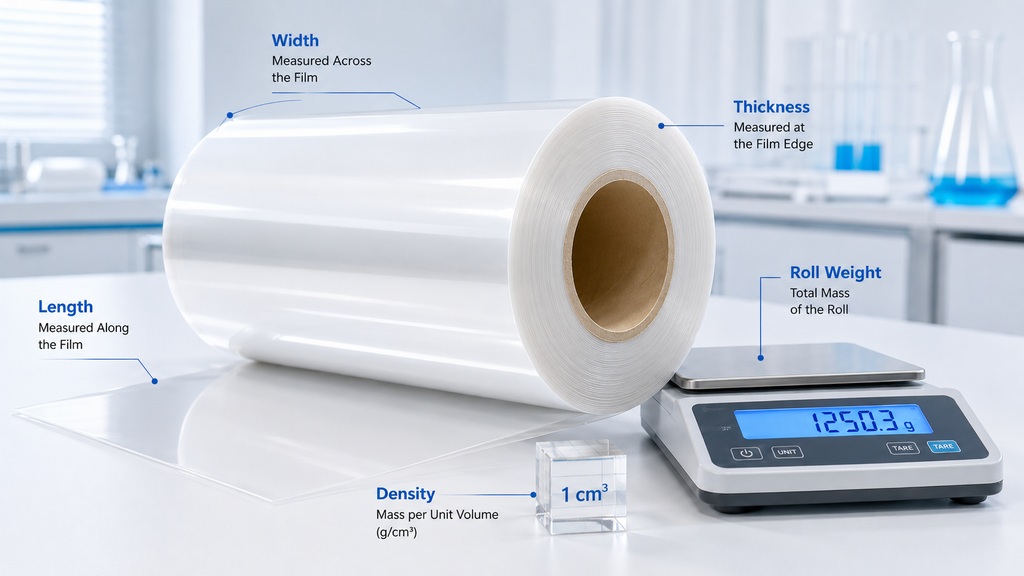
What Does PVC Shrink Film Density Mean?
Density is the mass contained in a specific volume. For packaging film, it is normally expressed in grams per cubic centimeter, written as g/cm³, or kilograms per cubic meter, written as kg/m³.
A density of 1.35 g/cm³ equals 1,350 kg/m³. This means PVC shrink film is significantly denser than common POF and PE shrink films, which usually remain below 1.00 g/cm³.
The higher density does not automatically mean better packaging performance. It mainly changes material yield and weight. Clarity, shrink ratio, shrink force, sealing behavior and printing performance must be evaluated separately.
Buyers often compare quotations only by price per kilogram. This can be misleading because two materials with different densities provide different square-meter yields at the same thickness.
A practical comparison should therefore consider price per kilogram, density, thickness, usable yield, machine efficiency and the finished packaging result.
Typical PVC Shrink Film Density Range
For preliminary calculations, 1.35 g/cm³ is a practical reference value for many PVC shrink-film grades. Some technical data sheets state 1.34, 1.35 or 1.38 g/cm³, while specially formulated films may fall outside those values.
The safest purchasing practice is to request the exact density, test method and tolerance from the PVC shrink film manufacturer. Density should appear beside thickness, shrinkage, tensile properties, haze, gloss and storage conditions.
Do not confuse finished-film density with the apparent bulk density of PVC resin powder. Resin bulk density describes how loosely powder occupies a container. Finished-film density describes the compacted, processed film itself.
The broader flexible film density formulas, tables and yield guide explains how density is used across PE, PP, PET, PA and other packaging films.
Why Can PVC Shrink Film Density Vary?
PVC Resin Grade
Different molecular-weight grades and polymerization characteristics influence processing behavior. The final film formulation is selected for calendering, casting, blowing, printing or sleeve conversion requirements.
Plasticizers And Flexibility Modifiers
Plasticizers can make PVC softer and more flexible. Their type and concentration may change density, shrink behavior, low-temperature flexibility and resistance to brittleness.
Stabilizers And Processing Aids
Heat stabilizers, lubricants, impact modifiers and processing aids protect the material and improve film production. Each ingredient changes the total formulation and can slightly alter finished-film density.
Pigments And Fillers
Clear film, tinted film, opaque film and printed film may have different effective densities. Mineral fillers or high pigment loading can increase mass without increasing usable area.
Manufacturing Method
Calendered, cast and blown PVC shrink films can use different formulations and orientation conditions. Processing also affects thickness uniformity, shrink direction, flatness and roll consistency.
Test Conditions
Density results can differ slightly because of test method, sample conditioning, temperature and measurement equipment. Ask whether the value follows ASTM D1505, ASTM D792 or another recognized method.
How Density Affects Film Yield And Cost
Yield describes the area produced by one kilogram of film. At the same thickness, a lower-density material provides more square meters per kilogram than a higher-density material.
PVC shrink film therefore provides fewer square meters per kilogram than POF or PE shrink film at an identical nominal thickness. This is important when comparing material prices or estimating packaging consumption.
The lower quotation per kilogram is not always the lower cost per square meter. Buyers should convert each offer into comparable area, roll or package-level costs.
Density also affects roll weight. Heavy rolls may require stronger shafts, safer handling procedures, appropriate pallets and carefully planned container loading.
PVC Shrink Film Density Formulas
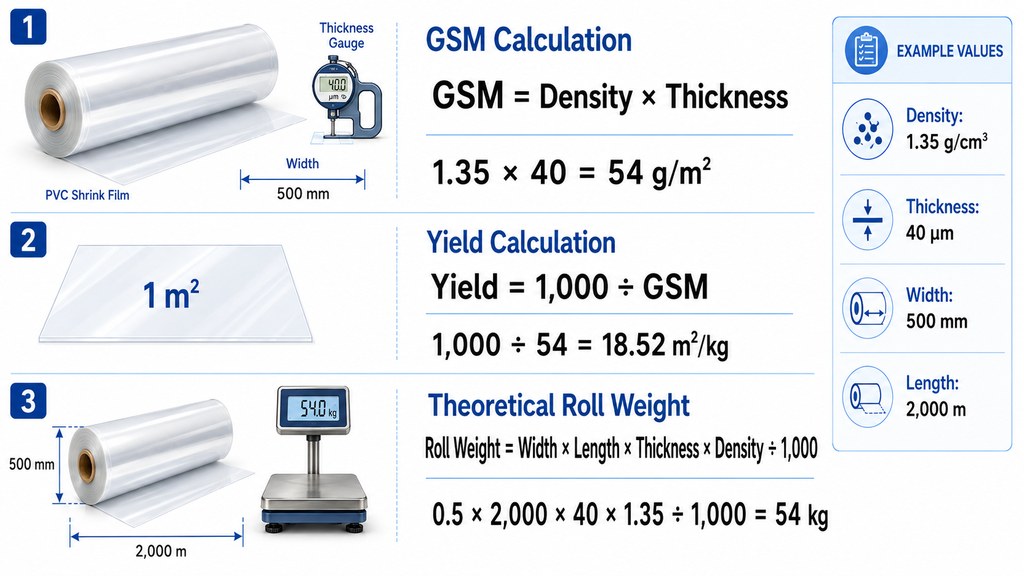
- Grammage Or GSM
GSM (g/m²) = Density (g/cm³) × Thickness (µm)
For a 40-micron PVC shrink film with a density of 1.35 g/cm³:
GSM = 1.35 × 40 = 54 g/m²
- Area Yield
Yield (m²/kg) = 1000 ÷ GSM
For the same 40-micron film:
Yield = 1000 ÷ 54 = 18.52 m²/kg
- Roll Weight
Roll Weight (kg) = Width (m) × Length (m) × Thickness (µm) × Density (g/cm³) ÷ 1000
For 500 mm × 2,000 m × 40 µm film at 1.35 g/cm³:
Roll Weight = 0.5 × 2,000 × 40 × 1.35 ÷ 1000 = 54 kg
The result is the theoretical net film weight. Add core weight, packaging materials and normal production tolerance when calculating gross shipping weight.
PVC Shrink Film Yield Table
The following table uses a reference density of 1.35 g/cm³. It is suitable for preliminary estimation, not final production settlement.
| Thickness | Theoretical GSM | Theoretical Yield |
| 30 µm | 40.50 g/m² | 24.69 m²/kg |
| 35 µm | 47.25 g/m² | 21.16 m²/kg |
| 40 µm | 54.00 g/m² | 18.52 m²/kg |
| 45 µm | 60.75 g/m² | 16.46 m²/kg |
| 50 µm | 67.50 g/m² | 14.81 m²/kg |
| 60 µm | 81.00 g/m² | 12.35 m²/kg |
| 70 µm | 94.50 g/m² | 10.58 m²/kg |
Actual roll yield can differ because of thickness tolerance, density tolerance, edge trimming, splices and unusable start or end film. Commercial settlement terms should be agreed before production.
Important Width Rule For Center-Folded Film
A common calculation error occurs when center-folded film is quoted by layflat width. A 500 mm center-folded roll contains two 500 mm layers, so its developed web width is approximately 1,000 mm.
When estimating net film weight, use the full developed width unless the supplier’s specification defines width differently. Single-wound film normally uses its actual flat web width.
Tubular film may also require circumference-based calculation. Confirm whether the stated dimension means layflat width, total open width, slit width or sleeve circumference.
Example Roll Weight Calculations
Example A: Single-Wound PVC Shrink Film
Specification: 500 mm width, 2,000 m length, 40 µm thickness and 1.35 g/cm³ density.
Theoretical net weight: 54 kg.
Example B: Center-Folded PVC Shrink Film
Specification: 500 mm layflat width, 2,000 m length, 40 µm thickness and 1.35 g/cm³ density.
Use 1.0 m developed width. Theoretical net weight: 108 kg.
Example C: Printed Shrink Sleeve Film
Specification: 600 mm width, 1,500 m length, 45 µm thickness and 1.38 g/cm³ density.
Theoretical net weight: 55.89 kg, before adding ink, adhesive, core and packing weight.
These examples show why the exact width definition and density must be confirmed before comparing quotations.
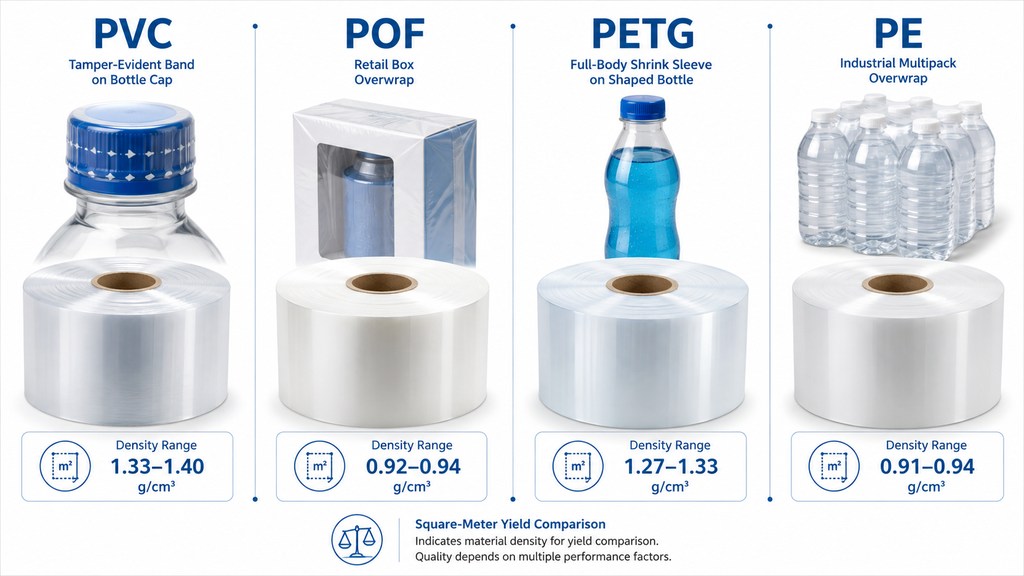
PVC Density Compared With Other Shrink Films
Approximate density values help buyers understand yield differences. They do not replace a complete performance evaluation.
| Material | Approximate Density | Typical Positioning |
| PVC shrink film | 1.33–1.40 g/cm³ | Economical sleeves, bands and selected non-food overwraps |
| PETG shrink film | Around 1.27–1.33 g/cm³ | High-shrink sleeves for shaped containers |
| POF shrink film | Around 0.92–0.94 g/cm³ | Clear retail and food-related overwrap |
| PE shrink film | Around 0.91–0.94 g/cm³ | Heavy bundling and transport packaging |
POF usually provides more area per kilogram and good toughness for retail packaging. Buyers evaluating this route can review CloudFilm’s POF shrink film range.
PETG is widely considered for high-shrink sleeve labels and complex container shapes. See the available PETG shrink film options for this application.
For a direct material comparison, read the POF vs PVC shrink film comparison and the PVC vs PETG shrink film buyer guide.
Does Higher Density Improve Shrink Performance?
Not necessarily. Density and shrink performance are different properties. Shrink ratio depends mainly on molecular orientation, formulation, manufacturing conditions and the temperature-time profile inside the shrink tunnel.
A film with higher density can still shrink poorly if its orientation is unsuitable or if the tunnel settings are incorrect. A lower-density film can provide excellent appearance when its grade matches the product and equipment.
Buyers should evaluate transverse-direction shrinkage, machine-direction shrinkage, shrink force, shrink curve, sealing window, haze, gloss, tensile strength and elongation.
For sleeves, controlled shrinkage is especially important. Excessive force can distort lightweight containers. Insufficient shrinkage can produce wrinkles, loose areas or poor contour definition.
How Density Influences Packaging Operations
Roll Handling
High-density film creates heavier rolls at the same dimensions. Verify maximum roll weight, shaft capacity, lifting equipment and operator handling procedures.
Freight And Warehousing
Denser film increases pallet weight and may reduce the number of rolls that fit within a shipping weight limit. However, roll diameter and pallet volume can remain efficient.
Machine Setup
Density does not directly determine shrink-tunnel temperature. Film formulation and shrink curve are more important. Always conduct a machine trial before approving mass production.
Cost Control
Use cost per square meter, cost per sleeve or cost per finished pack. These measures are more useful than price per kilogram alone.
Quality Control
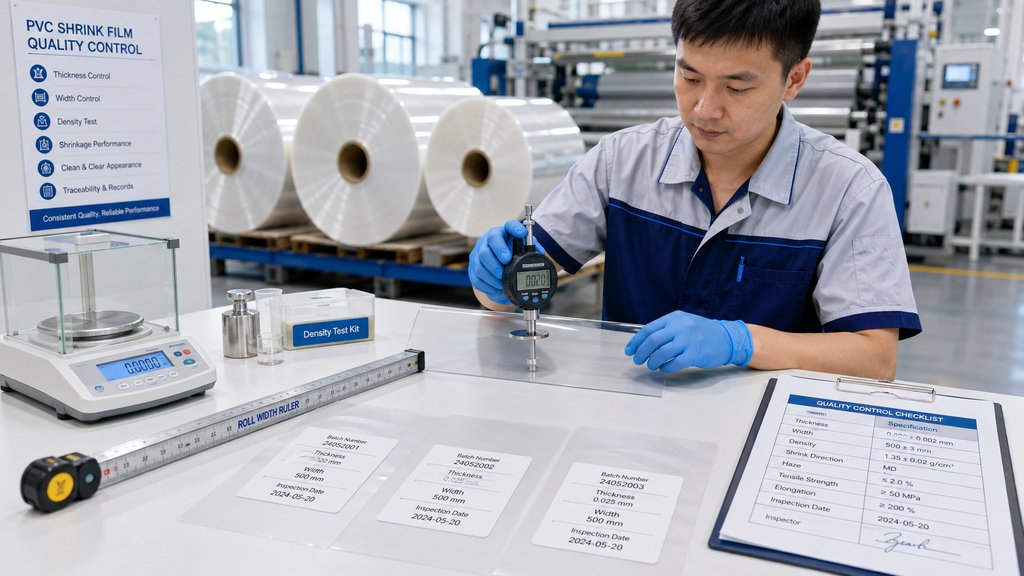
A stable supplier should control thickness profile, roll winding, shrink ratio, surface appearance, splices and dimensional tolerance. Density is only one part of the inspection plan.
Common PVC Shrink Film Applications
PVC shrink film is used for bottle labels, neck bands, tamper-evident seals, cosmetic containers, stationery, printed boxes, promotional packs and selected general consumer products.
Application suitability depends on local regulations, product sensitivity, recycling requirements and heat exposure. For food-contact or sustainability-sensitive projects, buyers often evaluate POF, PE or PETG alternatives.
The Shrink Film Collection provides a broader view of materials for retail wrapping, sleeve labels, bundling and industrial protection.
The heat shrink film packaging guide also explains how material selection changes with packaging format and end use.

How To Select A PVC Shrink Film Manufacturer Or Supplier
A dependable supplier should provide more than a price. The technical discussion should cover density, thickness tolerance, shrink direction, shrink curve, roll format, printing requirements, tunnel conditions and packing method.
Ask the manufacturer to confirm whether the film is cast, calendered or blown. Confirm whether it is single-wound, center-folded, tubular, preformed or supplied as printed sleeve rollstock.
Request a technical data sheet and a sample for machine testing. When possible, compare the sample’s measured net weight with the theoretical weight calculated from width, length, thickness and density.
International buyers should also review export packing, pallet dimensions, core size, roll orientation, labeling, batch traceability, lead time and shipping documents.
CloudFilm’s PVC shrink film manufacturers in China overview highlights practical supplier-selection factors for sleeve and packaging projects.
Buyers comparing several material families can also consult top shrink film manufacturers in China for a broader sourcing perspective.
Information To Include In A Quotation Request
A clear inquiry helps the supplier recommend the correct grade and calculate roll weight accurately.
Provide the application, product shape, required thickness, film format, width definition, roll length, core diameter, shrink direction, shrink percentage, printing requirements and estimated order quantity.
Also provide your current material, machine model, maximum roll weight, sealing method, shrink-tunnel type, operating temperature and any defects you want to solve.
For export orders, state the destination port, trade term, pallet restrictions, documentation requirements and target delivery date.
When exact specifications are unavailable, send photographs, current film labels, roll dimensions and a sample. A qualified manufacturer can then propose a test plan rather than guessing.
Storage And Handling Considerations
PVC shrink film is sensitive to elevated temperatures. Store rolls in a cool, dry, shaded area and follow the temperature and shelf-life limits stated on the supplier’s technical data sheet.
Avoid direct sunlight, hot containers, heaters and prolonged pressure on unsupported roll edges. Keep original packaging closed until the film is ready for converting or packing.
Allow cold rolls to reach the production-room temperature before opening the package. This helps reduce condensation, blocking and surface problems.
Use older batches first and maintain batch records. Inspect roll shape, edge alignment and surface condition before loading the film onto the machine.
Practical Buying Conclusion
PVC shrink film density is usually around 1.33–1.40 g/cm³, with 1.35 or 1.38 g/cm³ commonly used as representative values. The correct figure must come from the actual film grade.
Use density to calculate GSM, square-meter yield and theoretical roll weight. Then compare materials by cost per usable area, cost per finished package and performance on your equipment.
Density should never be the only selection criterion. Shrink curve, shrink force, thickness uniformity, printing performance, clarity, storage stability and regulatory suitability remain equally important.
To receive a practical recommendation, send CloudFilm your application, film format, width, thickness, roll length, machine conditions and order quantity through the Contact CloudFilm page.

PVC Shrink Film Density FAQs
- What is the standard density of PVC shrink film?
There is no single universal value. Many commercial grades are approximately 1.33–1.40 g/cm³, while 1.35 or 1.38 g/cm³ frequently appears as a typical technical-data value.
- Is specific gravity the same as density?
For practical film calculations, specific gravity and density in g/cm³ have the same numerical value when referenced to water under standard conditions. Technical documents may use either term.
- Why is PVC shrink film denser than POF film?
PVC’s polymer chemistry and formulation produce a higher mass per unit volume. POF commonly uses lower-density polyolefin resins, so it offers more square meters per kilogram at the same thickness.
- Does density determine shrink percentage?
No. Shrink percentage depends mainly on molecular orientation, formulation and heat exposure. Density is useful for weight and yield calculations, but it cannot predict the complete shrink curve.
- How do I calculate PVC film GSM?
Multiply density in g/cm³ by thickness in microns. A 40 µm film with 1.35 g/cm³ density has a theoretical grammage of 54 g/m².
- How do I calculate square meters per kilogram?
Divide 1,000 by the film’s GSM. A 54 g/m² film provides approximately 18.52 m²/kg before production losses and tolerances.
- How do I calculate roll weight?
Multiply width in meters, length in meters, thickness in microns and density in g/cm³, then divide by 1,000. Add core and packaging weight for gross shipment calculations.
- Should I use layflat width for center-folded film?
Use the full developed web width unless the specification states another convention. A 500 mm center-folded layflat commonly represents approximately 1,000 mm of total film width.
- Why does actual roll weight differ from the formula?
Thickness variation, density tolerance, edge trimming, splice sections, length tolerance, ink, adhesive, core weight and packaging materials can all create differences.
- Can I compare PVC and POF prices by kilogram?
A kilogram-only comparison is incomplete. Convert both offers into cost per square meter or cost per finished package, then include sealing efficiency, rejects and machine productivity.
- Does printed PVC film have a different density?
The base film density may remain similar, but ink, coating and adhesive increase effective roll weight. Printed-roll calculations should include the complete converted structure.
- Which test methods are used for PVC film density?
Common methods include ASTM D1505 and ASTM D792. The supplier should identify the method, conditioning procedure and reported tolerance on the technical data sheet.
- Is PVC resin bulk density useful for roll calculations?
No. Apparent bulk density describes loose resin powder. Roll calculations require the density of the finished, compacted shrink film.
- Can density identify recycled content?
Density alone cannot reliably confirm recycled content. Formulation changes, fillers and pigments can produce similar results. Use traceability documents and suitable analytical testing.
- Is higher-density PVC film stronger?
Not automatically. Strength depends on formulation, orientation, thickness and testing direction. Review tensile strength, elongation, impact resistance and shrink force instead of assuming density equals strength.
- What density should I enter in an initial calculator?
Use 1.35 g/cm³ as a reasonable preliminary estimate when no TDS is available. Replace it with the supplier’s confirmed value before ordering or settling production weight.
- What information should I request from a supplier?
Request density, thickness and tolerance, shrinkage in both directions, shrink curve, tensile properties, haze, gloss, width tolerance, roll format, core size, storage guidance and compliance documents.
- Can CloudFilm customize PVC shrink film rolls?
CloudFilm can discuss customized thickness, width, roll length, roll format, shrink performance and export packing. Final availability depends on the application, required quantity and technical confirmation.