Branding and packaging work together when customers recognize a product range, distinguish individual products, and receive packaging suited to what is inside. For flexible packaging, that requires decisions about graphics, materials, pack dimensions, printing, and replenishment across the whole range.
Start by separating three things: brand elements that should remain recognizable, product information that must change, and packaging specifications that can be shared only after validation. This makes expansion easier without assuming every product needs an identical pouch.
Consider a hypothetical snack brand selling nuts, dried fruit, and a seasonal mix in different pack sizes. The examples below illustrate planning decisions; they are not a CloudFilm customer case or a recommendation for a particular laminate.
In this guide, a SKU means a separately managed product variant, such as a flavor or pack size. A packaging family is the group of packs that follows shared brand rules while retaining the specifications each SKU requires.
Build the Product and Packaging Brief First
Before commissioning artwork, list every SKU that will launch together and the additions already under consideration. A design that works for one pouch may become awkward when a second size needs longer product names, different information, or another closure.
Give each SKU its own row in a working brief. Record confirmed information separately from assumptions. Mark an unknown barrier requirement as awaiting assessment, rather than copying the specification from a neighboring product to complete the table.
Use the following template once for each SKU. The decision column shows why the information matters; the final column is for the brand owner and supplier to complete together.
| Field | Decision supported | Your SKU entry |
| Product and variant | Distinguish recipes, flavors, and intended uses | To complete |
| Net content and filled volume | Establish useful capacity and pack dimensions | To complete |
| Shelf life and distribution | Define protection and validation needs | To complete |
| Filling equipment and process | Select premade pouch or rollstock requirements | To complete |
| Market and approved product information | Allocate space for the correct text and identifiers | To complete |
| Launch quantity and replenishment | Compare production and stockholding options | To complete |
| Brand elements and finish | Identify shared appearance requirements | To complete |
| Specification and artwork references | Keep purchasing and approval records aligned | To complete |
Separate product needs from visual preferences
A clear window, matte surface, or larger front panel is a design preference until its suitability has been checked. Record these preferences beside the product requirements so the supplier can explain where a choice affects structure, printing, or pack construction.
For the snack example, ask whether each product is sensitive to moisture, oxygen, light, handling damage, or aroma loss. The answer depends on the actual recipe, processing, distribution, and shelf-life objective. Product names alone cannot establish a complete specification.
Discuss whether the launch uses existing equipment, a contract packer, or a new filling route. A supplier cannot confirm roll dimensions or pouch construction reliably from the front-view artwork alone. Obtain equipment requirements before treating a pack size as final.

Set Brand Rules and Product Differences
Create a short specification for the appearance of the range. It should describe the recognizable features buyers should see across all packs, the areas reserved for product differences, and the conditions under which a designer may adjust the layout.
Keep the number of fixed rules manageable. A consistent logo area and information hierarchy may provide continuity while allowing different pack proportions. Requiring every element to occupy identical millimeter coordinates can create problems when the usable print area changes.
Define the shared visual structure
Decide where the brand appears, how product names are presented, which type styles are used, and how the main product image relates to the text. Describe relative alignment and spacing rather than simply enlarging the smallest artwork file for every size.
Treat finish as a deliberate part of the range. If one SKU uses a metallic effect and another uses a transparent window, state which surrounding features preserve the family resemblance. Review the packs together before accepting either design in isolation.
Make variants easy to distinguish
Give flavor names, product categories, and net contents clear positions. Color can help distinguish variants, but pair it with readable wording. This is especially useful when a pack is viewed as a small online image or under different retail lighting.
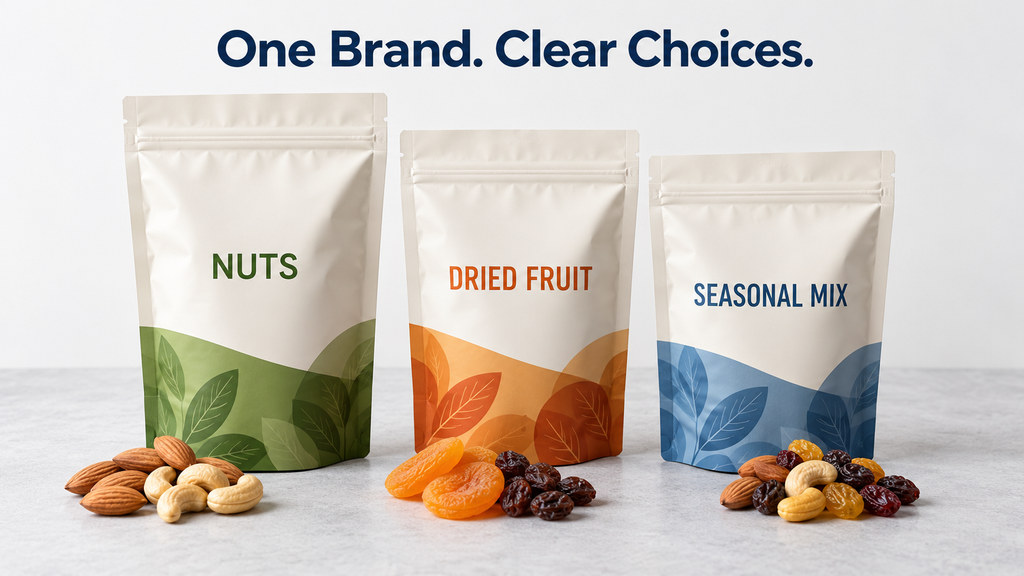
For the hypothetical range, nuts, dried fruit, and seasonal mix can use the same brand position and typography, with distinct product names and illustration areas. The seasonal pack should still identify its contents clearly instead of relying only on decorative artwork.
Include side and back panels in the rules. Reserve space for variable information, coding, and identifiers, and check whether folds, seals, or accessories interrupt those areas. A consistent front panel does not resolve a poorly planned back panel.
Separate appearance from product identification
Have the product-data owner confirm the identifier assigned to each saleable item. The GS1 GTIN Management Standard governs relevant identification decisions; for example, changing the declared net content printed on a pack requires a new GTIN under that standard.
Do not assume every artwork refresh creates a new retail GTIN. Check the applicable rule and packaging level. Keep the internal SKU, artwork revision, and trade-item identifier as distinct fields so a graphics update cannot silently overwrite product records.
Decide Which Packaging Specifications Can Be Shared
Standardization should follow compatibility. Compare product protection, useful capacity, filling conditions, handling, and opening requirements before proposing a common structure or pouch size. A shared specification is valuable when it serves the relevant products and remains practical to purchase.
Start with protection and sealing requirements
Request a justified barrier and seal specification for each product group. If measured oxygen or moisture transmission values are used, record the test conditions and construction being measured. A value detached from those conditions is an unreliable basis for comparing materials.
A common laminate may be considered when the products’ requirements are compatible, but it still needs appropriate product and packing validation. Conversely, different laminates can belong to the same brand family if their appearance and production expectations are managed clearly.
For nuts, dried fruit, and mixed snacks, examine the actual contents rather than assuming one category has a universal barrier requirement. CloudFilm’s snack packaging guide provides the material and application background for that discussion.
Check capacity with the real product
Net weight does not determine pouch volume by itself. Products differ in shape, settling, and bulk density. Trial-fill the candidate pack and inspect headspace, closure access, shelf presentation, and the area needed for a reliable top seal.
For a larger pack, confirm whether the gusset, zipper, seal design, and handling performance remain suitable. Scaling the printed drawing is not a substitute for checking the filled package. Record the tested dimensions and the product used in the trial.
Group SKUs by their packing route
Separate ready-made pouch projects from form-fill-seal rollstock projects. For stand up pouches, discuss finished dimensions, openings, closures, and filling access. For printed roll stock, confirm web layout, repeat, winding direction, and machine requirements.
Identical artwork does not establish whether two SKUs can run in one production arrangement. Ask the converter which dimensions, structures, finishes, and production steps must match. Record any common specification as conditional until the responsible teams have approved it.
| Decision | Evidence to request | Result to record |
| Shared film structure | Product requirements and relevant validation | Approved products and limits |
| Shared pouch dimensions | Filled samples and filling checks | Qualified dimensions by SKU |
| Shared appearance | Finished samples reviewed together | Common rules and accepted differences |
| Combined production | Converter’s job and quantity conditions | Eligible versions and minimums |
Approve Appearance on the Actual Packaging
A screen image is useful for layout discussions, but it cannot establish how every finished pack will look. Substrate, ink system, white backing, and surface finish can affect color appearance. Review the proposed construction as part of the brand decision.
Specify the result and its conditions
Provide the color reference and explain which areas are critical to brand recognition. Ask the printer to identify achievable targets on the chosen construction. Where numerical tolerances are agreed, also record the measurement method, backing, and viewing conditions.
On metallized materials, a consistent white-ink layer can provide a base for printed colors. Changing that layer can change the appearance of overprinted colors. Review the white coverage and intended metallic areas explicitly rather than treating them as an invisible production detail.
Compare filled or suitably representative packs when contents are visible through transparent areas. The product behind a window can alter the overall impression even when the printed artwork is unchanged. Confirm the window’s position against folds, graphics, and the actual fill level.
Compare the family and the individual SKU
Place samples together under agreed lighting and compare logo visibility, variant recognition, finish, and product-name readability. Then inspect each pack independently. A range can look coordinated as a group while one SKU has text or layout problems of its own.
If the proposed matte treatment changes, consult the distinction between matte film and matte varnish. Approve the intended finished appearance and relevant performance instead of using the word matte as the entire specification.
Document accepted differences. For example, the family may retain its logo and layout across two approved finishes. Describe that decision in the brand rules so future reviewers do not reject an intentional difference or accept an unintended one.
Keep approved physical samples with their structure and artwork references. A photograph is useful for communication, but it should not replace the agreed reference for color or finish. Record approval dates and identify which sample supersedes an earlier version.
Plan Printing and Purchasing by SKU
Prepare a quantity forecast for each SKU, not only a total for the brand. Record the launch order, expected replenishment, demand uncertainty, and any date after which packaging becomes unusable for that promotion or version.
Two ranges with the same total volume can require different purchasing plans. One may have a dominant repeat seller; the other may spread demand across many trial products. Ask for quotations that reflect the actual mix and ordering pattern.
Clarify what the minimum order covers
Ask whether the minimum applies to each artwork, structure, size, production batch, or combination of these. Confirm whether different versions can be grouped and what restrictions apply. A low total minimum does not automatically permit unlimited designs in arbitrary quantities.
Request a clear split of recurring packaging cost, setup or tooling charges, sample work, and delivery conditions where applicable. Confirm ownership and reuse conditions for production tooling. Avoid comparing quotations that assume different specifications or different numbers of printed versions.
Choose a printing route for the actual order pattern
Digital production can support short runs and multiple artwork versions, making it worth evaluating for launches and seasonal ranges. It still has substrate, finishing, converting, and commercial constraints. A printer must confirm feasibility for the proposed pack.
CloudFilm’s digital flexible packaging guide explains that route in more detail. Compare it with suitable conventional printing options using the actual structure, version count, quantities, color requirements, and repeat-order expectations rather than a universal volume threshold.
For a core SKU, evaluate repeatability and replenishment alongside unit price. For a trial SKU, pay attention to how much unused printed packaging remains if demand is weak or the recipe changes. Request commercial comparisons using the same planning period.
Control slow-moving versions
Review packaging stock by artwork revision as well as SKU. Packaging with a superseded product statement or expired promotion may no longer serve the intended sale, even when the film and pouch remain physically sound.
Ask whether staged deliveries or other stock arrangements are available, then confirm ownership, storage, remaining quantities, and responsibilities in writing. Do not assume the supplier will hold printed inventory or absorb obsolete material without an agreement.
Control New Variants and Packaging Changes
A new SKU should enter the family through a documented change request. Identify what changes in the contents, pack size, market, equipment, artwork, or purchasing plan. Then decide which existing approvals remain applicable and which need to be repeated.
Keep specifications and artwork connected
Use a record containing the SKU, specification reference, artwork revision, identifier, approval status, and effective production date or order. Put the same references on the purchase instruction and approval record so the supplier knows which combination is authorized.
Give files unambiguous revision names and record the approver. A filename such as final-new-final does not communicate which version was released. Keep superseded files separately and prevent them from being mistaken for production-ready artwork.
Match the review to the change
A flavor addition may require new product information and another assessment of compatibility. A size change can affect filling, dimensions, layout, and identification. A material change can affect both appearance and function. Define the review scope from the change itself.
Use a family-level review for brand recognition and variant differentiation, and a SKU-level review for correct information, construction, and performance. Both should be complete before release; visual similarity does not establish technical approval.
For detailed checks, use CloudFilm’s flexible packaging quality control guide. Record the applicable checks against each SKU rather than assuming a test or approval for one product covers every member of the range.
Plan the changeover
Agree how existing printed stock and the new version will be separated. Specify the order or batch from which the new version applies, who updates product images and records, and how warehouse and packing teams will distinguish the two.
Review the first production delivery against the released documents and samples. Record issues by SKU and revision. Feed confirmed corrections into the shared rules so a problem found on one pack can be checked across the other affected packs.
Image 3 Placeholder | 1024 × 576 px
Editorial block — replace with the image before publishing.
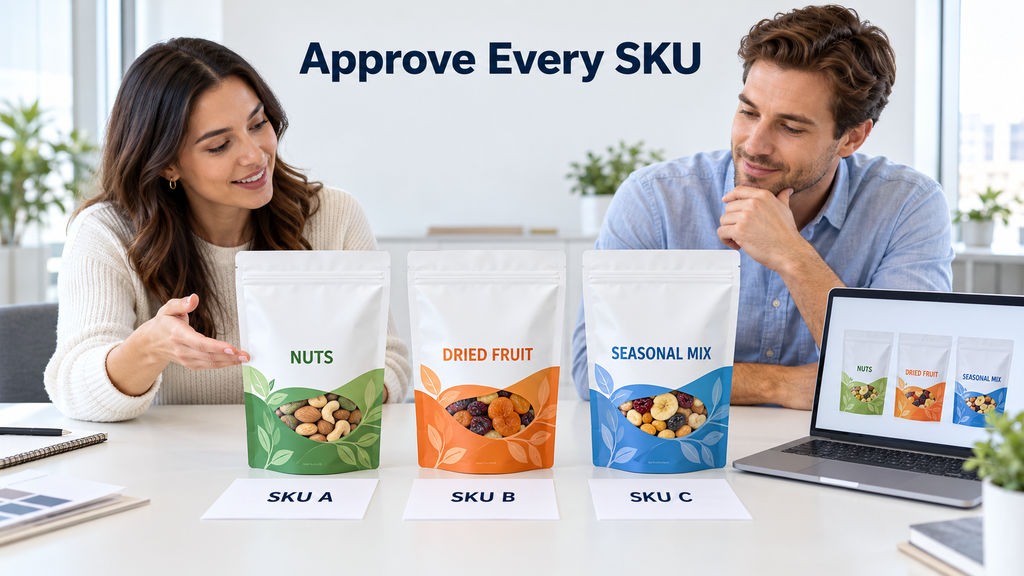
Purpose: Show individual SKU approval within one coordinated packaging project.
ALT: Packaging Team Reviewing Individual SKU Samples And Artwork Versions
Work Through a Packaging Family Example
Return to the hypothetical nuts, dried fruit, and seasonal mix range. The team starts with separate briefs and keeps material choices open. It agrees on a shared brand position, readable product-name area, and consistent layout logic across the front panels.
The seasonal mix receives its own variant name and artwork reference. Its decorative theme occupies a defined area, leaving the product description and net content easy to find. The same principle is tested on the smallest pack before larger artwork is approved.
Next, the supplier reviews protection requirements and packing conditions. The team considers sharing a structure only where that review supports it. Candidate pouch sizes are trial-filled, and any unsuitable size is changed without abandoning the visual rules for the range.
The team then compares actual samples side by side. A finish difference is either accepted and documented or revised before release. Each SKU retains a separate approval record, even when several samples are evaluated in the same meeting.
Finally, purchasing separates the repeat sellers from the seasonal order and requests quotations on that basis. The outcome is a defined packaging family with recorded exceptions, quantities, and approvals. No saving, shelf-life improvement, or production result is assumed without evidence.
Questions Buyers Ask About Packaging Families
1 Can one master artwork file cover the whole range
A master layout can guide the range, but each production version needs the correct dimensions, product information, identifiers, and approval reference. Maintain a version list so changes to the shared layout are deliberately applied to the affected SKUs.
2 Should every SKU use the same pouch supplier
It can simplify coordination, but evaluate actual capability, service, and supply requirements. If more than one supplier is used, provide controlled references and clarify which team maintains the shared specifications and approves differences between finished packs.
3 Can an existing approval cover another pack size
Only use it for aspects that remain applicable and have been confirmed. A different size can change layout, capacity, handling, and packing behavior. Record which evidence carries over and which checks must be completed for the new size.
4 What should a brand send for the first discussion
Send the SKU brief, available product or packaging samples, filling requirements, current artwork, quantities by version, and launch priorities. Clearly mark assumptions and unresolved choices. This supports a useful proposal without presenting an untested design as a finished specification.
Discuss Your Product Range With CloudFilm
Share your product list, current packs, intended sizes, filling method, and quantities by SKU with CloudFilm. Identify the brand features you want to retain and the problems you want to solve. These inputs provide a starting point for reviewing films, finished pouches, and printed rollstock.