Introduction: Why POF vs PVC Shrink Film Matters
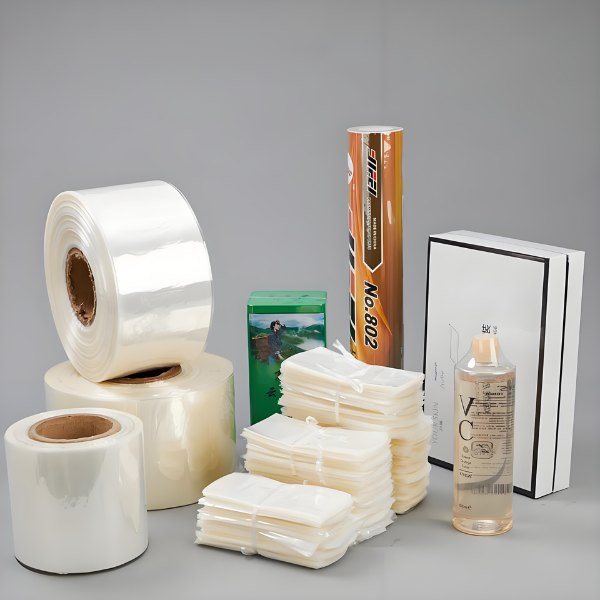
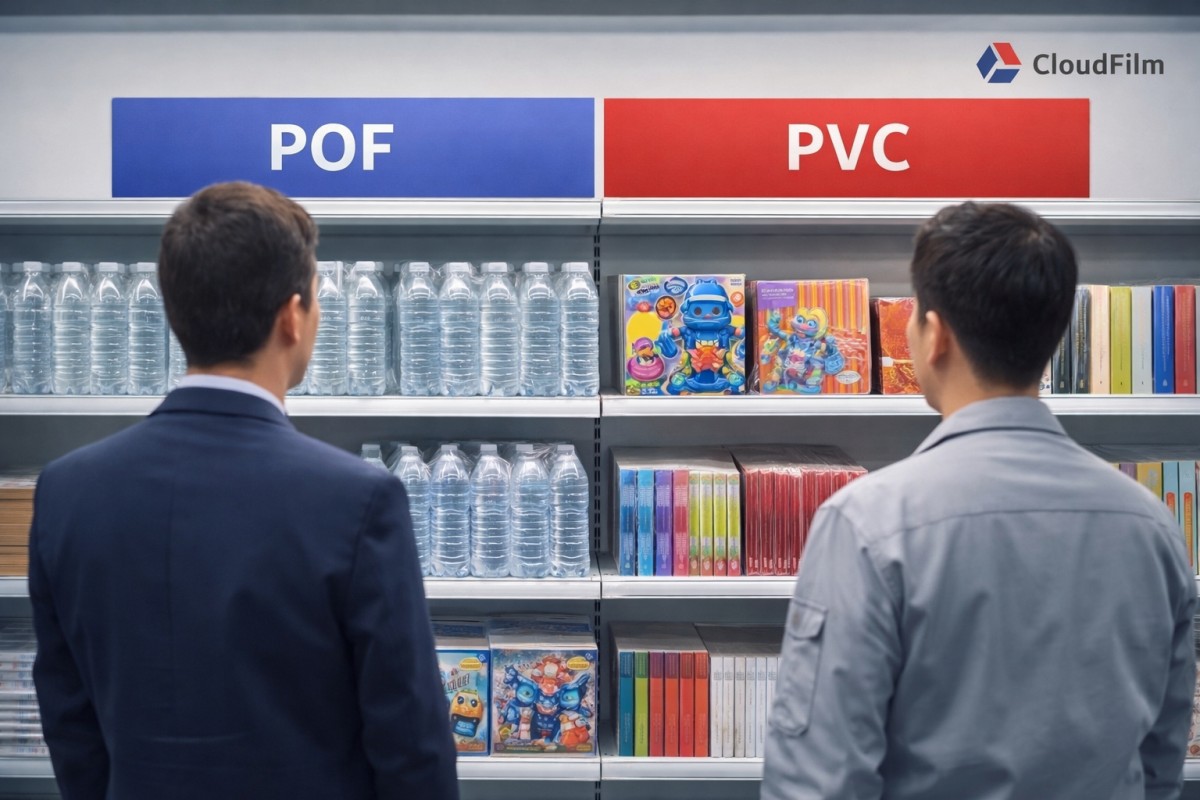
Are you hesitating between different shrink films when you look at bottled water multipacks, toy boxes, books, cosmetics or pizza cartons on the shelf? It is easy to assume they all use the same film, but in reality POF and PVC behave very differently once they enter your shrink tunnel.
As a purchasing manager, packaging engineer or brand owner, you know that shrink packaging is not just a “transparent outer coat.” It directly affects:
- Product protection and tamper evidence
- On-shelf appearance and brand image
- Line efficiency, rework rate and operator safety
- Compliance with food-contact and environmental regulations
A poor shrink film choice can trigger torn packs, cloudy or yellowed wraps, smoke and odor inside the workshop, or even regulatory risks in export markets.
This guide takes POF (polyolefin) and PVC (polyvinyl chloride) shrink films as the two core “players” and compares them in a structured, decision-oriented way. You will see how they differ in safety, eco-profile, clarity, shrink performance, cost and application scenarios.
By the end, you should be able to quickly decide which film to use for each product, and what to discuss with CloudFilm’s engineers when you request samples or quotes.
If you already know that you need food-grade, export-friendly shrink wrap, you can go straight to CloudFilm’s POF shrink film page and share your pack size, machine type and target market to get a tailored proposal.
Meet The Materials: What Are POF And PVC Shrink Films?
What Is POF Shrink Film?
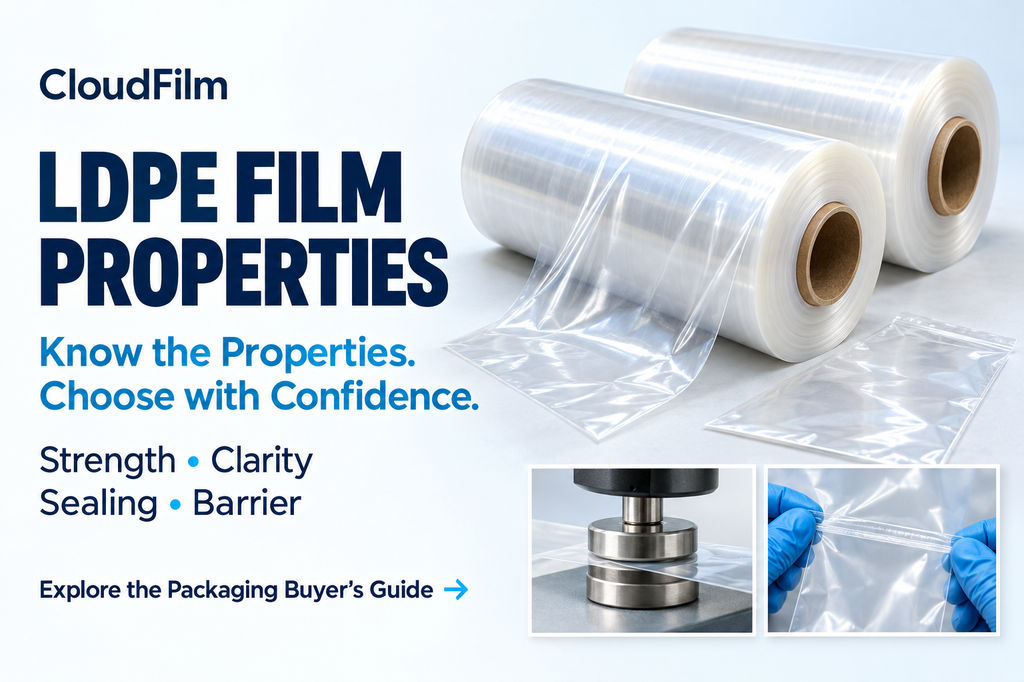
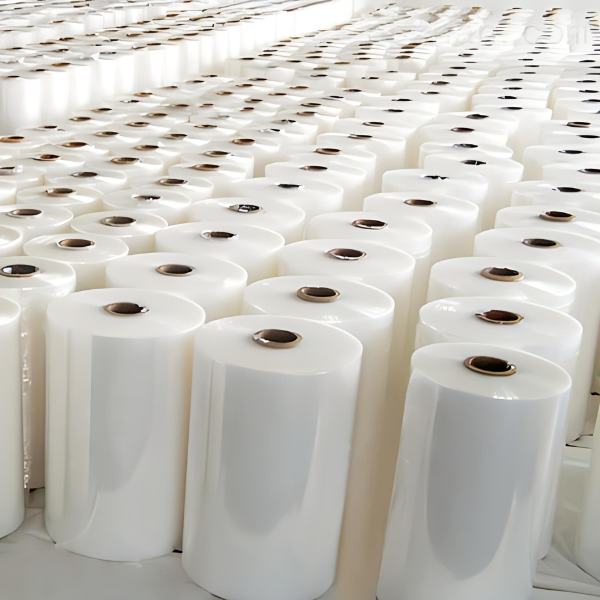
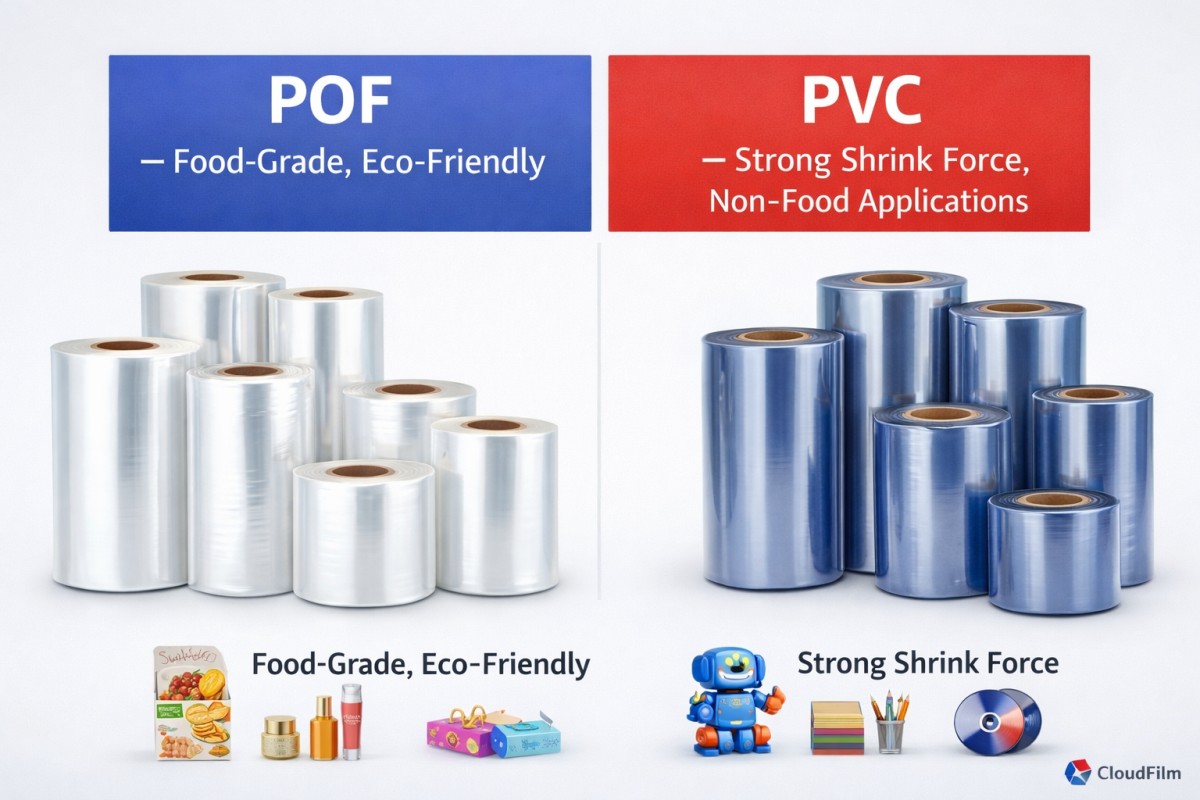
POF (polyolefin) shrink film is usually made from polyethylene and polypropylene-based copolymers. It is a soft, tough and low-odor film that maintains flexibility even at low temperatures.
Key characteristics of quality POF shrink film include:
- Food-grade and non-toxic – No harmful plasticizers or heavy metals, suitable for direct and indirect food contact under major regulations (FDA, EU, GB, etc.).
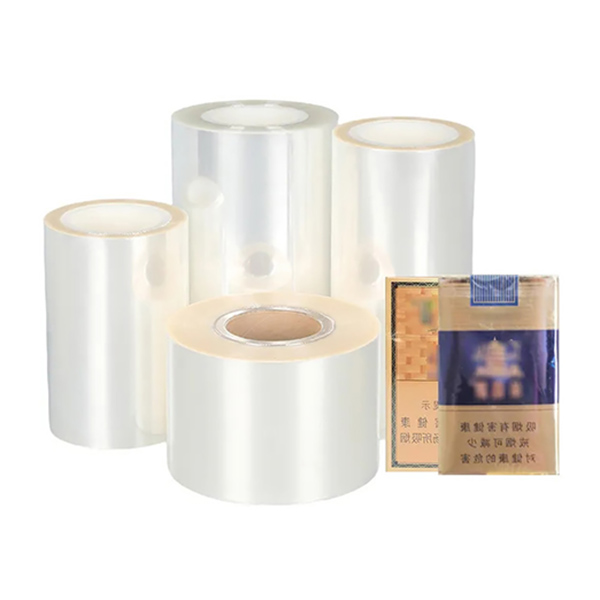
- High clarity and good gloss – Products remain clearly visible, which is important for premium snacks, cosmetics, books and gift sets.
- Excellent toughness and puncture resistance – Better protection for irregular or sharp-edged products to avoid “dog ears” and tearing during shrink and transport.
- Wide processing window – Lower seal and shrink temperatures help reduce energy consumption and smoke inside the tunnel.
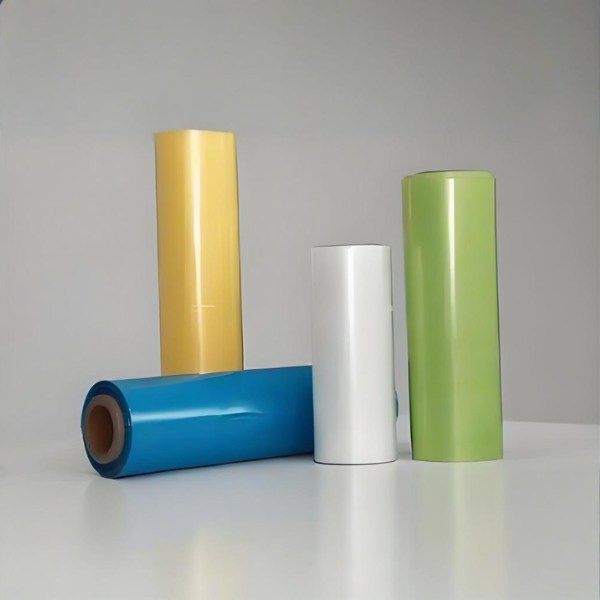
CloudFilm integrates POF shrink film into its PE film family and shrink film portfolio, offering rolls for L-bar sealers, side-seal machines and high-speed automatic tunnels. You can choose center-folded or single-wound rolls, plain or perforated films, and custom thickness according to your product weight and line speed.
For food, cosmetics, household items and electronic accessories that require both safety and attractive presentation, CloudFilm’s POF shrink film is usually the first recommendation.
What Is PVC Shrink Film?
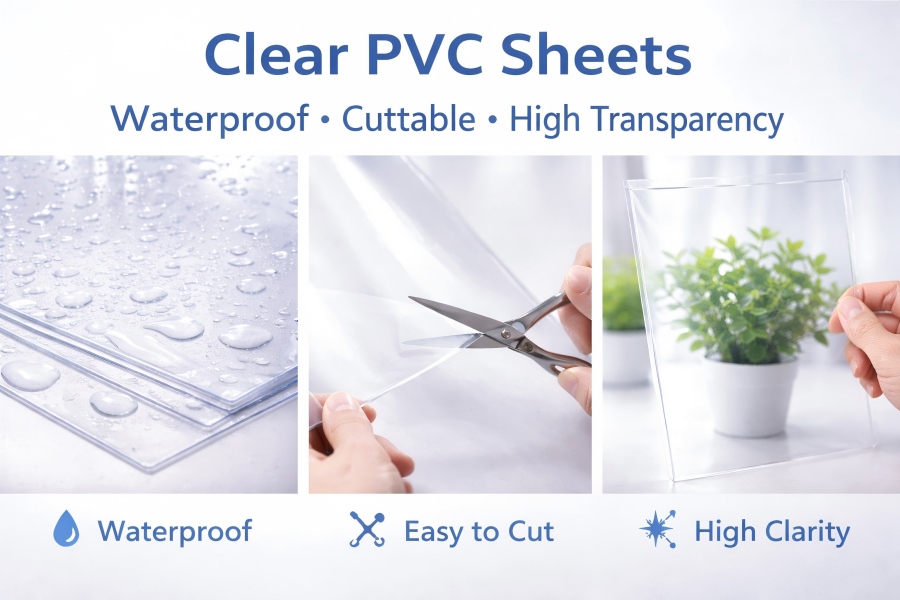
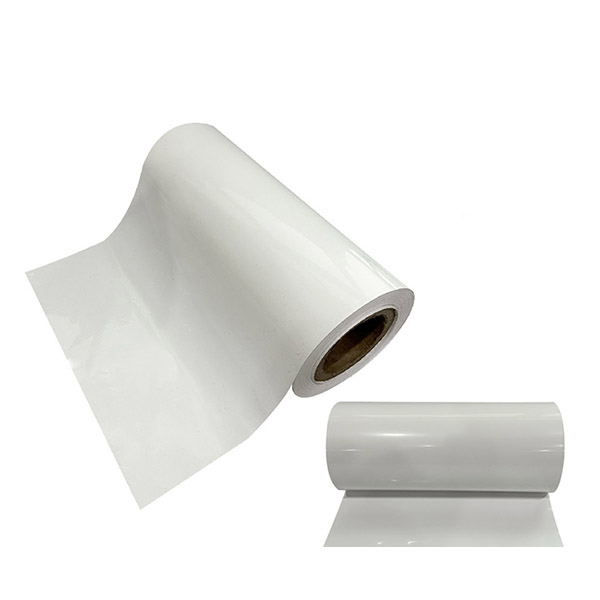
PVC (polyvinyl chloride) is one of the world’s major general-purpose plastics and has been used in shrink packaging for many years. PVC shrink film is known for:
- Strong shrink force
- High surface gloss
- Relatively low material cost
However, in order to make PVC flexible enough for shrink wrapping, plasticizers must be added, and these additives can migrate under certain conditions. When PVC is incinerated or improperly recycled, it may also release substances such as hydrogen chloride and dioxins, which place pressure on the environment.
For these reasons, many regulations and brand owner policies are gradually restricting the use of PVC in food, pharmaceutical and children’s products. CloudFilm’s PVC shrink film is therefore positioned mainly for non-food, low-risk packaging such as toys, stationery, multimedia discs and certain promotional bundles, where strong shrink force and low price are still attractive.
In projects that involve food contact, export to markets with strict environmental rules, or long-term brand sustainability goals, CloudFilm generally recommends upgrading from PVC to POF or PE shrink film instead of continuing with PVC.
Head-to-Head Battle — A Comprehensive Comparison of POF and PVC
To give you a more intuitive view of the differences, let’s lay out this showdown in a table:
| Comparison Dimension | POF Shrink Film | PVC Shrink Film |
|---|---|---|
| Safety | High. Non-toxic and odorless, complies with food contact standards like FDA, EU. | Low. Contains plasticizers that may leach, non-compliant with many food/pharma packaging standards. |
| Eco-Friendliness | High. Recyclable, produces only water and CO2 when incinerated, no toxic gases. | Low. Difficult to recycle, releases toxic gases like dioxins when incinerated, restricted in many countries. |
| Physical Properties | High toughness, puncture-resistant. Less prone to tearing, remains flexible in cold. | Brittle, easy to tear. Becomes hard and cracks in low temperatures. |
| Shrink Performance | Moderate shrink rate (approx. 60-80%), shrinks evenly, less likely to distort products. | Strong shrink force (approx. 40-60%), but uneven shrinking can distort products. |
| Clarity & Gloss | High clarity, good gloss, showcases products clearly. | Very high gloss, has a “shiny” appearance, but slightly lower clarity than POF… |
| Sealing & Processing | Excellent. Seals at low temperatures, strong seal, produces minimal smoke and odor. | Fair. Requires higher sealing temperatures, produces irritating smoke and a scorched smell. |
| Operating Temperature | Wide range. Can shrink at lower temperatures, highly adaptable. | Narrow range. Requires higher and precise temperature control. |
| Cost | Higher. Raw material and processing costs are higher than PVC. | Lower. Price is one of its main advantages. |
In CloudFilm’s daily technical support work, POF shrink film is the default option for food, cosmetics and export packaging, while PVC is used only in a limited number of special, non-food projects where cost or shrink force is the overriding priority.
Selection Guide — When Should You Use POF Or PVC?
After comparing the properties, you still have to answer one core question internally: for my specific products, which film should I actually buy?
Five Scenarios Where POF Shrink Film Is Strongly Recommended
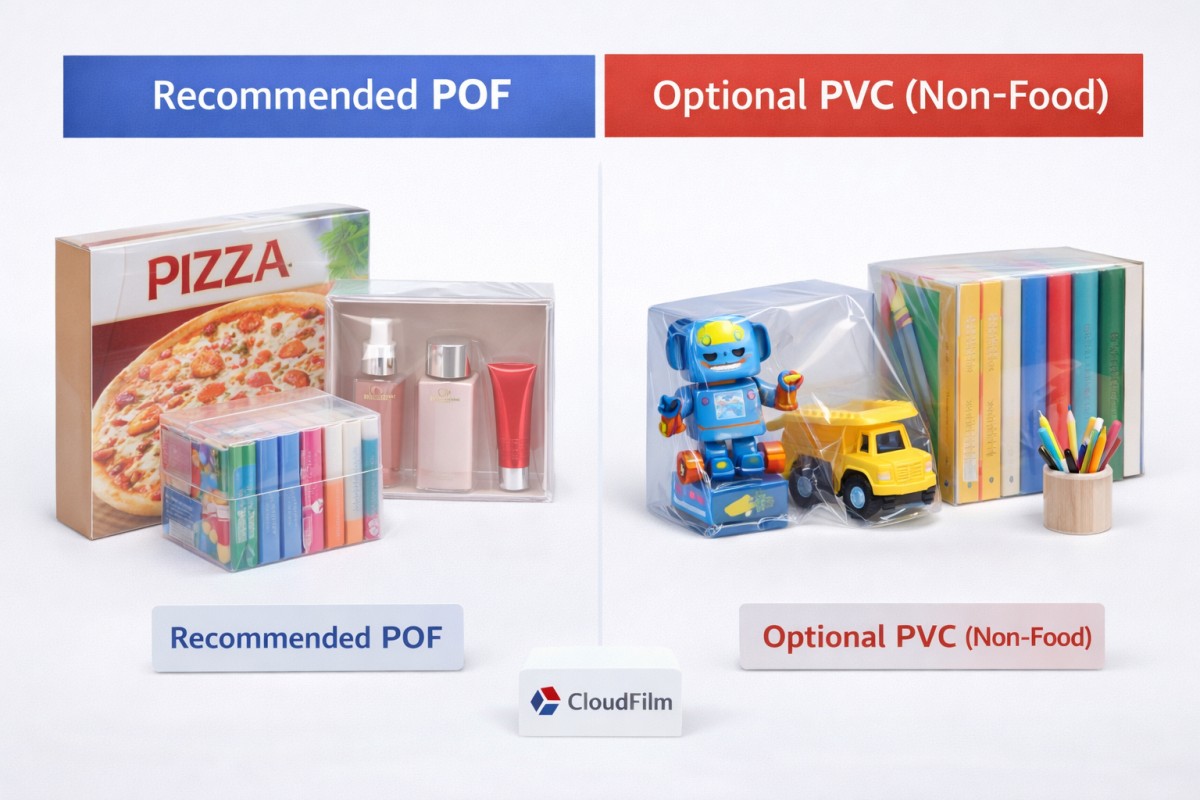
- Food, pharmaceuticals and cosmetics
Whenever your pack touches food, health products or skincare items, safety and regulatory compliance must come first. POF’s food-grade, low-odor nature and good global acceptance make it the safer default choice. - Irregular shapes and sharp edges
Multi-pack toys, tools, gift sets with corners and protrusions, or products stacked in steps all put stress on the film. POF’s higher toughness and puncture resistance greatly reduce tear risk and customer complaints. - High-end brand image and clear presentation
If you rely on clear graphics and fine details to convince buyers—premium snacks, books, collectibles, electronic accessories—POF’s clarity and even shrink give a “clean,” premium look. - Focus on workshop environment and operator health
POF runs at lower temperature with less smoke, helping you keep a cleaner tunnel and better operator experience during long shifts. - Export business or sustainability-driven markets
Brands selling to the EU, US, Japan and other regions with strong environmental expectations are already moving away from PVC. Choosing POF helps you align with retailer requirements and sustainability goals.
In these situations, CloudFilm’s POF shrink film and overall shrink film collection give you a safe, future-proof base material to build on.
Two Scenarios Where PVC Shrink Film Might Still Be Considered
- Ultra cost-sensitive, non-food products
For low-value items sold in very competitive markets—certain stationery, budget toys, simple promotional gifts—PVC’s low unit price can still be attractive, provided there is no food contact and no stringent eco-requirements. - Very strong shrink force for specific industrial tasks
In some purely industrial projects, where a strong “grip” is needed on rigid objects (e.g., certain printed boxes for warehousing, non-food multi-packs), PVC’s shrink force can be useful if your line is well tuned.
Even in these cases, CloudFilm will usually compare PVC with alternatives such as PE shrink film and POF shrink film, to see whether you can achieve similar load stability and appearance while using more sustainable materials.
How To Switch From PVC To POF With CloudFilm
Many buyers are not just choosing between POF and PVC for new lines; they are actively planning a step-by-step migration from PVC shrink film to POF shrink film to meet retailer audits and sustainability targets.
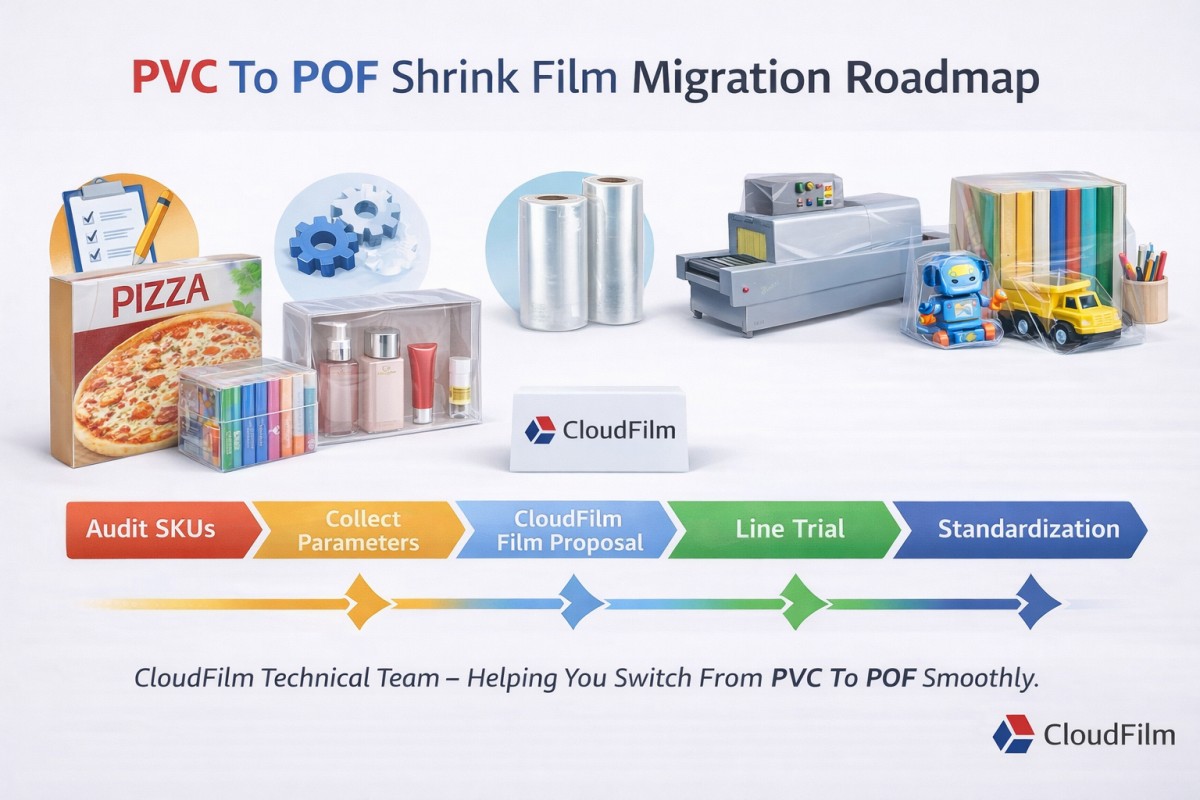
CloudFilm typically helps customers follow this roadmap:
- Audit your current products and markets
List which SKUs use PVC, which are food or non-food, and which are exported. This clarifies where regulatory and brand risks are highest. - Collect packaging and machine parameters
Prepare basic data: pack dimensions, film width and thickness currently used, shrink tunnel temperature profile, line speed and defect types (e.g., “dog ears,” tears, yellowing). - Initial film proposal from CloudFilm
Based on your data, CloudFilm’s engineers will recommend 1–2 POF structures (and, if needed, PE shrink film or PETG shrink film for sleeve labels) and advise which SKUs can be switched first with minimal change to equipment. - Sample trial and fine-tuning
You run small-batch trials, record shrink appearance, seal strength and machine settings, and share feedback. CloudFilm adjusts film thickness, slip and perforation accordingly. - Roll-out and documentation
Once stable, you can document POF as the new standard film in your specifications and supplier lists, with PVC kept only for a small number of strictly non-food projects if necessary.
By working this way, many CloudFilm customers have successfully reduced or fully eliminated PVC shrink film from their portfolios, without sacrificing appearance or line efficiency—and in some cases even lowering their total cost of ownership.
Industry Trends and CloudFilm’s Professional Advice
Globally, shrink film usage is being reshaped by three forces:
- Regulation – More regions restrict PVC, especially in food and pharma packaging.
- Brand and retailer policies – Major retailers and brand owners increasingly specify “PVC-free” or “preferred polyolefin shrink film.”
- Consumer expectations – End users pay attention not only to the product, but also to whether the packaging is “safe,” “recyclable” and “environmentally responsible.”
Against this backdrop, CloudFilm’s position is clear:
- In the vast majority of cases, POF or PE shrink film should be prioritized over PVC.
- PVC shrink film should be treated as a niche material for specific, non-food, cost-driven projects after other options have been seriously evaluated.
CloudFilm has built a complete shrink film family—including POF shrink film, PE shrink film and PETG shrink film for sleeve labels—to cover different application levels from primary food packaging to secondary transport packaging and bottle labels.
If you share your product type, line speed and target markets, CloudFilm can quickly shortlist 1–2 shrink film options and send samples, helping you move toward a safer and more sustainable packaging portfolio without trial-and-error on your own.
FAQs About POF vs PVC Shrink Film
FAQ 1: Is POF Shrink Film Safe For Direct Food Contact?
Yes, high-quality POF shrink film from reputable manufacturers is designed as a food-grade, non-toxic material and can be used for direct or indirect food contact when it complies with relevant regulations (such as FDA, EU and GB standards).
CloudFilm’s POF shrink filmis explicitly positioned for food packaging, snacks, bakery products and frozen foods that need both safety and good presentation.
FAQ 2: Can I Run POF On The Same Machine That Currently Uses PVC?
In many cases, yes. Most L-sealers, side-seal machines and shrink tunnels that run PVC can also run POF, but you typically need to adjust sealing temperature, tunnel temperature and conveyor speed. POF often works at slightly lower temperatures with longer dwell time to get a smooth finish.
CloudFilm’s technical team can review your current PVC settings and recommend starting parameters for POF trials, helping you minimize adjustment time and scrap.
FAQ 3: How Do I Choose The Right Shrink Film Thickness?
Typical POF shrink film thicknesses range from about 12–30 µm; thicker grades are used for heavier or sharper products, while thinner grades suit light, smooth packs. PE shrink film for trays and multipacks is usually thicker (25–60 µm) to stabilize loads.
As a rule of thumb:
- Small, light retail packs → thinner POF
- Heavy or sharp-edged boxes → thicker POF
- Beverage trays or secondary transport packs → CloudFilm PE shrink film is often more suitable.
CloudFilm can recommend a thickness after you share product weight, transport conditions and drop-test requirements.
FAQ 4: How Does POF Compare To PE Shrink Film?
POF and PE are both polyolefin-based but serve different roles:
- POF shrink film – Mainly used for primary retail packaging where clarity, tight fit and shelf appeal matter most.
- PE shrink film – Typically thicker, used for secondary packaging such as bottled water trays, beverage multipacks and pallet unitization.
If your main goal is to improve the look of individual retail packs, POF is usually best. If your priority is stabilizing heavy loads for transport, CloudFilm’s PE shrink film is designed specifically for that job.
FAQ 5: What If I Need Shrink Sleeve Labels Instead Of Overwrap?
For full-body or partial shrink sleeve labels on beverage and cosmetic bottles, PETG shrink film is often more suitable than POF or PVC because of its very high shrink ratio and excellent printability. CloudFilm supplies PETG shrink film for this purpose, giving you strong design flexibility and a premium label appearance.
FAQ 6: How Can I Get A Quotation Or Sample From CloudFilm?
To speed up the process, prepare the following information:
Product type and approximate pack size
Whether it is food or non-food
Current film type, thickness and width (if any)
Machine type (manual L-sealer, semi-automatic or fully automatic tunnel)
Target market / export countries
You can then send this information via the Get A Quote form on the relevant product pages such as POF shrink film or PE shrink film, and CloudFilm’s sales and engineering team will respond with a tailored film recommendation, sample plan and quotation.