Retort pouches can deliver long shelf life, low transport weight, efficient storage, and strong product protection. However, they are not a universal replacement for cans, jars, trays, or ordinary flexible bags. Their multilayer construction, high-temperature sterilization process, and demanding seal requirements create disadvantages that buyers must understand before approving a structure or placing a production order.
This guide focuses on the practical weaknesses of retort pouches: what can go wrong, why it happens, which risks can be engineered out, and which limitations remain inherent to the format. Readers who need a broader introduction can first review the complete guide to retort pouch advantages and disadvantages. For material definitions and common laminate structures, see what a retort pouch is and how it works.
The central point is simple: most retort pouch failures are not caused by one film alone. They normally result from a mismatch among the food, pouch structure, adhesive, ink system, sealing conditions, retort cycle, filling line, and distribution environment. A good decision therefore requires system-level validation rather than choosing a pouch only by thickness or unit price.
Quick Answer: What Are the Main Disadvantages of Retort Pouches?
The main disadvantages are difficult recycling, higher development and validation costs, vulnerability to puncture and flex cracking, seal failure risk, delamination risk, dependence on precise process control, limited compatibility with some heating methods, and more demanding supplier qualification. Aluminum-foil structures also block product visibility and can interfere with metal detection, while transparent structures may require more careful barrier design.
| Disadvantage | Why It Matters | Can It Be Reduced? |
| Difficult recycling | Most high-performance structures combine different polymers, adhesives, inks, and sometimes foil. | Partly, through simplified or mono-material-compatible designs. |
| Higher project cost | Trials, tooling, printing cylinders, validation, and retort testing increase launch cost. | Yes, through staged sampling and clear specifications. |
| Puncture and flex-crack risk | Sharp food pieces, handling, folding, or transport can damage a flexible laminate. | Yes, with nylon, better pouch design, and transport controls. |
| Seal failure and leakage | Contamination, weak seals, channel leaks, or poor cooling can destroy commercial sterility. | Yes, but only with controlled sealing and retort conditions. |
| Delamination and odor risk | Heat, moisture, fat, acid, adhesive choice, and incomplete curing can attack the laminate. | Usually, through compatible materials and full cure time. |
| Barrier trade-offs | Foil gives excellent barrier but removes transparency; clear barrier structures require careful selection. | Partly, depending on shelf life and product sensitivity. |
| Process sensitivity | A pouch may pass room-temperature tests but fail after sterilization or distribution. | Yes, through full-process validation. |
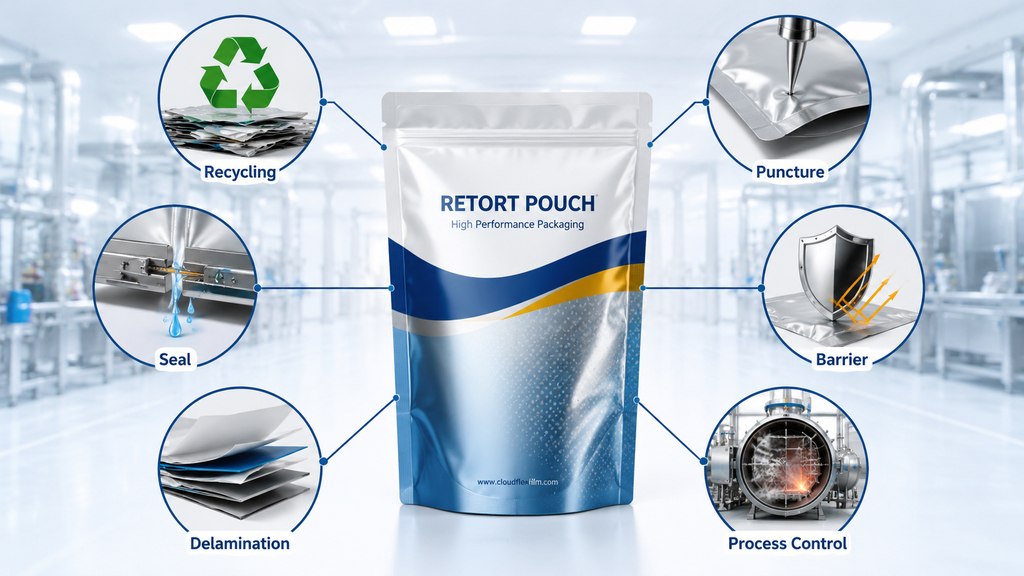
Why Retort Pouches Are More Demanding Than Ordinary Flexible Packaging
A normal snack bag may only need to survive printing, lamination, filling, sealing, transport, and ambient storage. A retort pouch must survive all of those steps plus sterilization under elevated temperature and pressure, followed by cooling. During this cycle, each layer expands, softens, contracts, absorbs stress, and interacts with moisture, oil, salt, acid, or other product components.
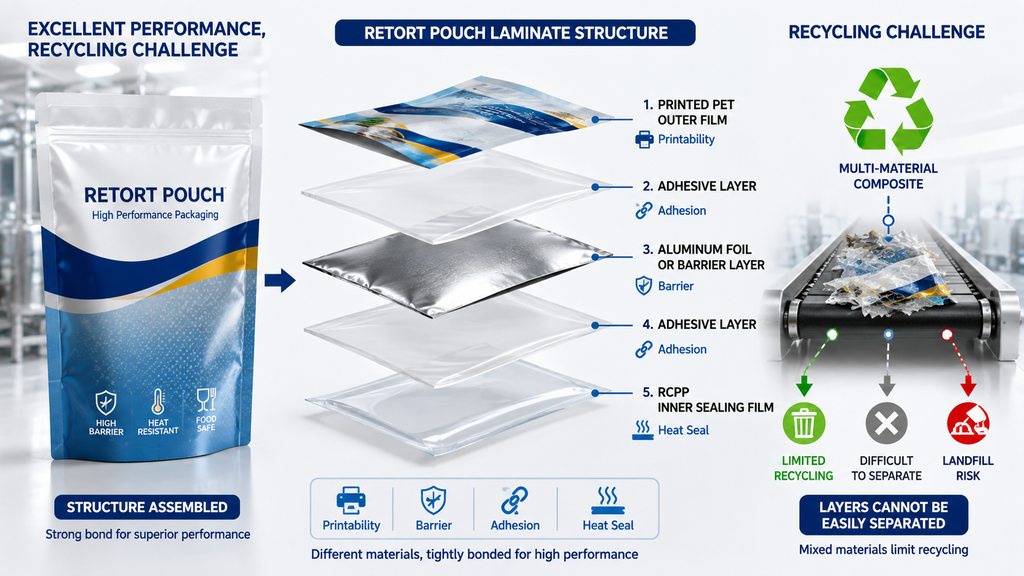
The pouch is therefore a coordinated laminate rather than a simple bag. The outer web provides printability and dimensional stability. A middle layer may provide oxygen, moisture, aroma, light, or puncture protection. The inner sealant must contact the product, form a strong hermetic seal, and retain that strength after retort. Adhesive and ink systems must remain stable between the layers. Even a high-quality base film can fail if another part of the structure is unsuitable.
This explains why custom retort pouches should be specified from the product and process backward. The correct structure for smooth soup may be different from the structure for bone-in meat, oily pet food, acidic sauce, seafood, or medical products.
1. Multilayer Structures Are Difficult to Recycle
Why recycling is challenging
Many retort pouches use combinations such as PET/aluminum foil/RCPP, PET/nylon/RCPP, or four-layer structures that add both nylon and foil. These materials perform different jobs, but they are bonded together and cannot normally be separated by conventional household recycling systems. Printing inks, primers, adhesives, zippers, spouts, and residual food can further complicate collection and reprocessing.
The problem is not that flexible packaging uses a large amount of material. In fact, a pouch can use much less material than a rigid container. The problem is end-of-life compatibility. A lightweight package may reduce transport emissions but still be difficult to recycle in the market where it is sold. Buyers should therefore avoid making broad environmental claims based only on low weight.
How buyers can reduce the limitation
Start by identifying the real barrier and retort requirements. Some products need foil-level protection; others do not. Simplifying a four-layer structure to a qualified three-layer structure may reduce material complexity. For products with moderate shelf-life targets, a polypropylene-rich or other recycling-compatible design may be possible, but it must still pass heat, seal, barrier, migration, and shelf-life testing. A useful starting point is CloudFilm’s discussion of recyclable, compostable, and mono-material packaging options, while recognizing that full-retort performance remains one of the most demanding applications for simplified structures.
2. Development, Printing, and Validation Costs Can Be High
The unit price is only one part of the project cost
Retort pouches often cost more to develop than simple two-layer bags. A new project may require pouch drawings, printing cylinders or plates, color proofs, laminate trials, adhesive curing time, sample pouch conversion, filling tests, sterilization tests, seal-strength checks, leakage checks, sensory review, shelf-life studies, and transport testing. The total launch cost can be significant even when the eventual unit price is competitive.
Small buyers may also face minimum order quantities for custom printing, special films, foil widths, adhesives, or pouch conversion. A supplier that accepts a low trial quantity may still need to charge setup costs. Comparing quotations only by price per thousand pouches can hide these project-level expenses.
A better commercial approach
Use a staged approval process. Begin with unprinted stock samples or laboratory laminates. Confirm pouch size, seal position, filling behavior, and retort survival. Then approve graphics and move to a printed pilot run. This sequence costs less than discovering a structural problem after full printing. Buyers should request a clear separation of one-time costs, sample costs, mass-production price, tooling ownership, and repeat-order conditions.
3. Flexible Pouches Are More Vulnerable to Puncture and Flex Cracking
Where damage occurs
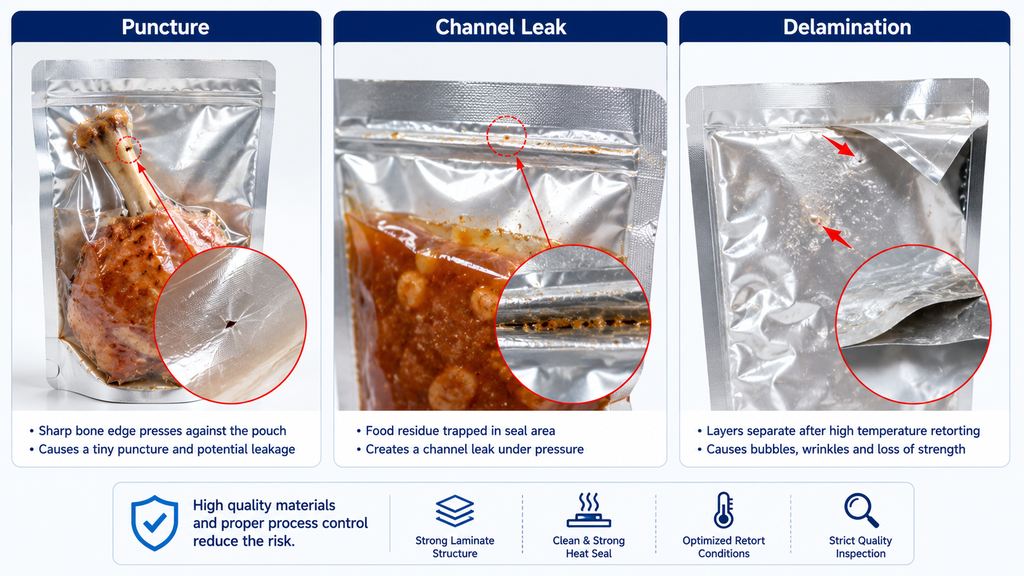
A metal can protects the product with a rigid wall. A flexible pouch depends on the mechanical strength of thin films. Sharp bones, shell edges, frozen corners, hard inclusions, pouch folds, carton staples, rough conveyor guides, and repeated vibration can create pinholes or cracks. Damage may be microscopic and still compromise oxygen barrier or seal integrity.
Foil structures deserve special attention because aluminum foil provides outstanding barrier but can lose barrier when sharply creased or flexed. Transparent structures without foil may tolerate folding differently, but they still need sufficient puncture and abuse resistance. Distribution by parcel, mixed pallet, or long export route can expose the pack to more handling than a controlled domestic supply chain.
How nylon and pouch design help
For products with sharp or dense contents, BOPA film can add puncture resistance, toughness, and flex-crack resistance. The relationship between nylon and the seal layer is explained in BOPA film for retort pouch structures. However, material selection alone is not enough. Rounded pouch corners, adequate headspace, controlled fill weight, correct carton dimensions, separators, and drop-test validation all contribute to protection.
4. Seal Failure Can Cause Leakage and Loss of Commercial Sterility
Why the seal is the critical control point
The pouch body can have excellent barrier, yet the package still fails if the seal is weak, contaminated, wrinkled, too narrow, overheated, underheated, or unevenly compressed. Liquid, oil, sauce, powder, fibers, or food particles in the seal area can create channels. Incorrect jaw alignment or worn sealing surfaces can produce local weak points.
Retort adds another stress. Internal pressure rises during heating, and the pouch may expand before pressure is balanced. During cooling, rapid pressure changes can stress the seal again. A seal that looks acceptable before sterilization may lose strength after exposure to heat, moisture, and pressure. The inner layer must therefore be a true retort grade, not ordinary CPP selected only because it seals well at room temperature.
Material and process controls
A dedicated retortable CPP film should provide an appropriate sealing window, hot-tack behavior, food-contact suitability, and post-retort seal strength for the intended cycle. On the line, processors should control sealing temperature, pressure, dwell time, seal width, cooling, pouch presentation, and seal-area cleanliness. Finished packs should be checked for visual defects, seal strength, leaks, burst performance where applicable, and stability after retort.
5. Delamination, Curl, Blistering, and Odor Can Appear After Retort
Heat and product chemistry attack the complete laminate
Delamination occurs when bonded layers lose adhesion. Possible causes include an unsuitable adhesive, low coating weight, poor surface treatment, moisture, incomplete curing, retained solvent, excessive retort conditions, or chemical attack from the packed product. Oils, acids, salts, spices, and flavor compounds may behave differently during high-temperature processing than during ambient testing.
Visual defects can include bubbles, whitening, tunneling, edge lift, curl, or uneven surface appearance. Some failures occur immediately after retort; others appear during aging. Odor or flavor concerns may result from retained solvent, ink or adhesive incompatibility, insufficient cure, or inappropriate material selection. These issues require investigation of the full laminate and process, not a conclusion that all retort pouches are unsafe.
Why curing time cannot be rushed
The laminate should receive the adhesive manufacturer’s required curing conditions before pouch making, filling, or retort testing. Accelerating shipment before full cure may create a false economy: the material reaches the customer sooner but has not developed its intended bond strength or chemical resistance. Buyers should ask when lamination occurred, when conversion is planned, and when the material is genuinely ready for sterilization trials.
6. Barrier Performance Depends on the Exact Structure
A retort pouch is not automatically high barrier
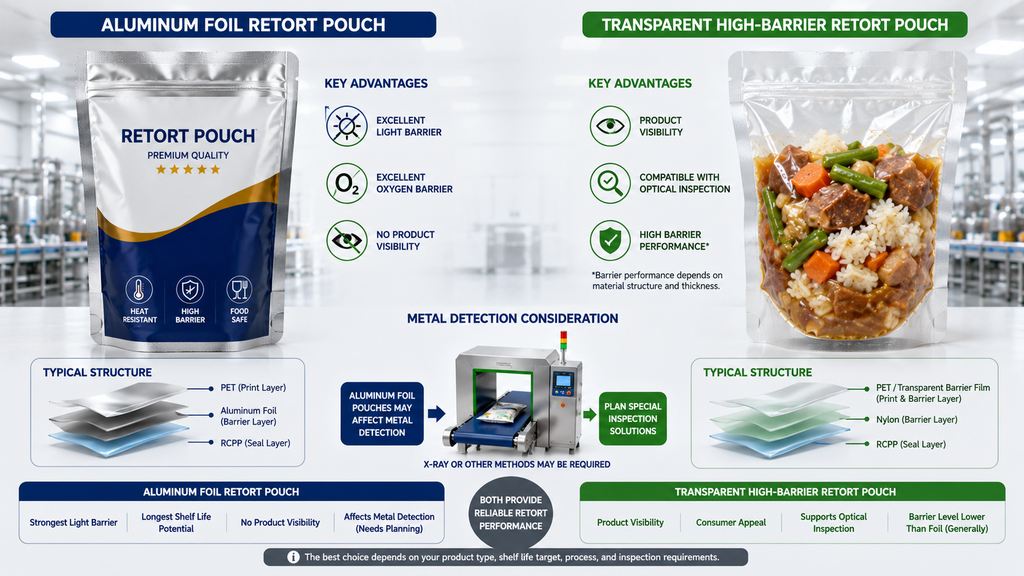
The term “retort pouch” describes process resistance, not one guaranteed oxygen or moisture transmission rate. A transparent PET/nylon/RCPP pouch and a PET/foil/RCPP pouch may both survive sterilization, but their light and gas barriers can be very different. Shelf life also depends on food formulation, residual oxygen, fill temperature, seal integrity, package size, storage temperature, and distribution conditions.
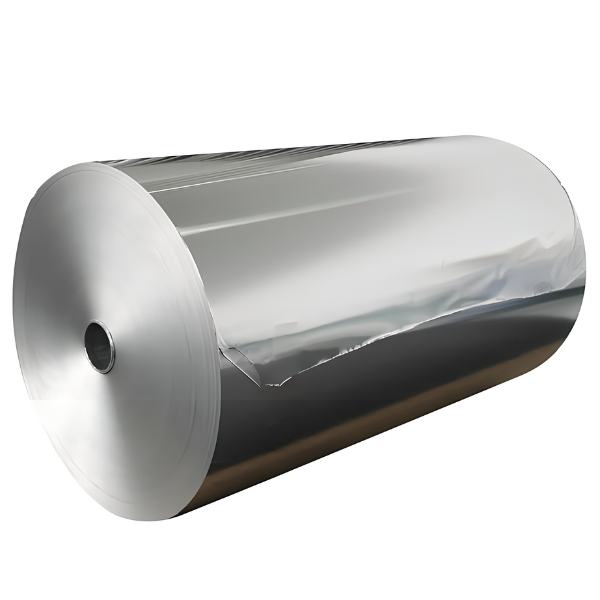
Foil normally provides very strong oxygen, moisture, aroma, and light protection when it remains intact. CloudFilm’s flexible packaging aluminum foil can form part of high-barrier retort structures, but foil introduces opacity, flex-crack sensitivity, and metal-detection limitations. Transparent barrier materials may support product visibility and metal detection, but the structure must be validated against the target shelf life.
Do not approve by structure name alone
Two suppliers may both quote “PET/AL/RCPP” while using different film thicknesses, foil gauges, adhesives, treatment levels, sealing grades, and quality controls. The buyer should request a layer-by-layer specification and relevant performance data. Where transparent barrier is required, materials such as ALOx PET film may be considered as part of a properly engineered laminate, but the completed pouch—not only the base film—must pass retort and shelf-life validation.
7. Foil Retort Pouches Limit Product Visibility and Metal Detection
Opacity can be a commercial disadvantage
Many food brands want consumers to see the product. Aluminum foil blocks visibility completely, so the package must rely on graphics, photography, or a serving suggestion. This may be acceptable for military meals, pet food, tuna, sauces, or shelf-stable ingredients, but it can be a disadvantage for premium products sold on visual freshness.
Metal detection needs special planning
A foil-containing pouch can interfere with conventional metal detection because the package itself contains metal. Processors may need alternative inspection technology, a different detection setup, or a transparent non-foil structure. The correct decision depends on the hazard-control plan, product conductivity, pack size, and equipment. Packaging should therefore be selected together with the food-safety inspection strategy rather than afterward.
8. Microwave and Consumer Heating Options Are Limited by Structure
Not every retort pouch is microwaveable
A retort pouch can be shelf stable without being suitable for microwave heating. Foil-containing structures should not be placed in a microwave unless the complete package is specifically designed and validated for that use. Even transparent pouches may require venting instructions, tear-open guidance, controlled heating time, or transfer of the food to another container.
Consumer convenience claims should match the actual package. “Ready to eat,” “boil in pouch,” “microwaveable,” and “hot water reheatable” are different functions. Each requires the correct materials, ink resistance, pouch geometry, opening feature, and instructions. A package that survives industrial retort is not automatically optimized for consumer reheating.
9. Retort Processing Is Less Forgiving Than Ambient Packing
Temperature alone does not define the cycle
Buyers often specify only a maximum temperature, such as 121°C. That information is incomplete. The packaging supplier also needs the heating medium, pressure profile, holding time, come-up time, cooling method, counterpressure, pouch orientation, product viscosity, fill weight, headspace, and retort equipment type. A short cycle at one pressure profile may stress the pouch differently from a long cycle at the same temperature.
Under-processing creates a food-safety risk; over-processing can damage food quality and packaging. The sterilization schedule must be established and validated by qualified process specialists. The packaging manufacturer supports material selection and pack testing, but should not replace the authority responsible for the thermal process.
Cooling is part of the packaging challenge
A pouch may survive heating and still fail during cooling. If external pressure drops too quickly while the pouch remains hot, internal pressure can stress the seals or distort the pack. Water quality, cooling rate, pouch support, and handling immediately after retort can also affect appearance and integrity.
10. Filling Lines and Pouch Handling Require Tight Control
Flexible packs behave differently from rigid containers
Pouches can slip, curl, cling, wrinkle, or misalign on filling and sealing equipment. Their coefficient of friction, stiffness, pouch opening behavior, static level, and dimensions must fit the machine. A structure that is mechanically excellent may still run poorly if the pouch mouth does not open consistently or if the web curls after lamination.
Hot, oily, or particulate products increase seal contamination risk. Heavy fills increase load on the bottom and side seals. Spouted retort pouches add fitment sealing and cap-torque variables. These issues can reduce line speed and yield during early production unless the pouch and equipment are developed together.
Pilot trials should use realistic conditions
A meaningful trial uses the intended product or a representative simulant, normal fill temperature, target fill weight, production sealing equipment, actual retort cycle, and planned secondary packaging. Hand-sealed empty pouches can screen materials, but they cannot prove full commercial performance.
11. Product Compatibility Must Be Confirmed
Food composition changes packaging stress
Retort products vary widely. Acidic tomato sauce, oily curry, salty seafood, alcohol-containing formulations, sulfur-containing foods, pet food, and medical liquids may interact differently with films, adhesives, inks, coatings, and foil. Product compatibility should be evaluated after sterilization and during aging, not only through short room-temperature contact.
The supplier should receive enough information to recommend a structure without requiring the buyer to disclose a complete proprietary recipe. Useful inputs include product category, approximate pH range where relevant, oil or alcohol content, presence of bones or sharp particles, filling temperature, retort schedule, desired shelf life, and target markets. All food-contact materials must be selected and documented for the applicable requirements in those markets.
12. Sustainability Claims Require Careful Trade-Off Analysis
Lightweight does not automatically mean recyclable
Retort pouches can reduce packaging weight, warehouse space, and freight compared with many rigid formats. They can also support efficient heat transfer because of their thin profile. These are meaningful advantages. However, they do not remove the recycling challenge of multilayer laminates. Sustainability comparisons should consider material weight, food waste prevention, transport, sterilization energy, shelf life, collection systems, and end-of-life outcomes together.
A pouch that protects food for a long shelf life may prevent significant product waste. Conversely, an unnecessarily complex laminate may use more barrier than the application needs. The practical goal is not the fewest layers at any cost; it is the simplest structure that safely meets process, shelf-life, distribution, and regulatory requirements.
Retort Pouches Compared With Cans and Glass Jars
| Decision Factor | Retort Pouch | Metal Can | Glass Jar |
| Transport weight | Low | Medium | High |
| Storage efficiency before filling | Excellent | Moderate | Poor |
| Puncture resistance | Lower; structure dependent | High | High, but breakable |
| Recycling infrastructure | Often limited for multilayers | Generally established | Generally established |
| Product visibility | Possible with clear structures | No | Yes |
| Light barrier | Excellent with foil; lower for clear structures | Excellent | Limited unless colored or sleeved |
| Metal detection | Simple for non-foil; special planning for foil | Special planning required | Generally compatible |
| Heating and retort efficiency | Fast heat transfer due to thin profile | Slower than pouch in many cases | Slower and sensitive to thermal shock |
| Opening and portability | Light and convenient; opening feature must be designed | Rigid and durable; opener or easy-open end may be needed | Resealable but heavy and breakable |
| Development sensitivity | High: laminate, sealing, retort, and handling must align | Mature but requires can and seam control | Mature but requires closure and breakage control |
The “best” format depends on product, factory, distribution, consumer use, and local recovery systems. Retort pouches are particularly attractive when low weight, compact logistics, fast heat transfer, and graphic area matter. Cans or jars may remain preferable when rigid protection, established recycling, or consumer habits outweigh those benefits.
Which Disadvantages Can Be Solved—and Which Cannot?
Risks that can usually be reduced
- Seal leakage can be reduced through retort-grade sealant, clean seals, suitable sealing settings, and post-retort verification.
- Puncture risk can be reduced through nylon, adequate thickness, rounded pouch design, controlled filling, and stronger secondary packaging.
- Delamination can be reduced through compatible films, inks, adhesives, coating weight, treatment, full curing, and realistic product testing.
- Poor machinability can be reduced by matching pouch stiffness, COF, dimensions, and opening behavior to the filling line.
- Excess cost can be reduced by staged trials, standardized sizes, sensible printing choices, and early specification alignment.
Limitations that may remain
- A conventional multilayer high-barrier pouch may still be difficult to recycle in many markets.
- A foil pouch will remain opaque and will require special planning for metal detection.
- A flexible pouch will not provide the same rigid-wall protection as a can.
- Full commercial validation will remain more important than a simple film data sheet.
How to Reduce Retort Pouch Risks Before Mass Production
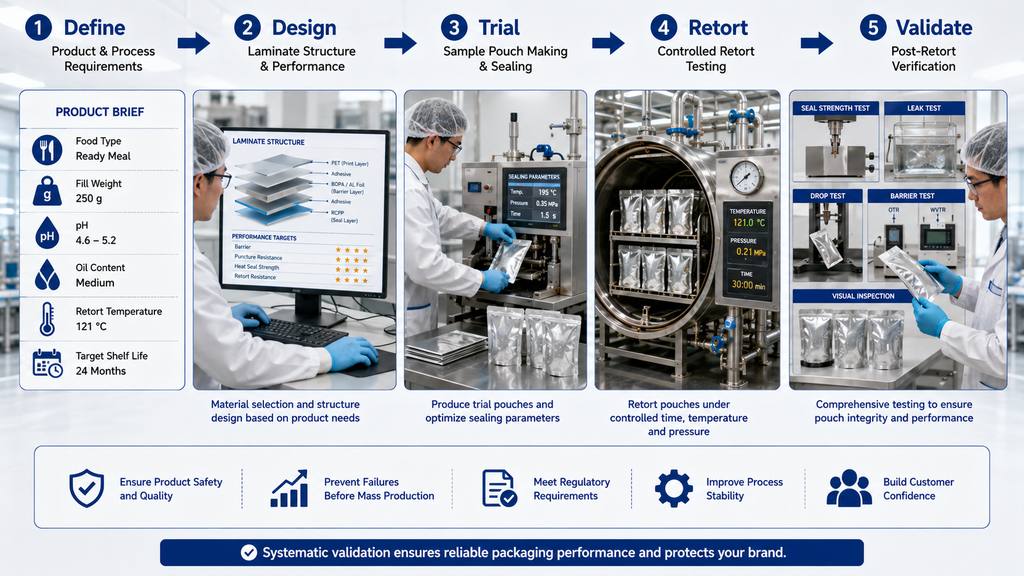
Step 1: Define the product and process
Provide product type, pouch size, target fill weight, filling temperature, expected shelf life, retort temperature, time, pressure profile, cooling method, storage conditions, distribution route, and consumer heating method. State whether the product contains oil, acid, alcohol, bones, shells, or sharp particles.
Step 2: Select the structure by function
Assign each layer a reason to exist: print and heat resistance, puncture strength, oxygen barrier, moisture barrier, light barrier, or sealing. Avoid copying a competitor’s structure without knowing its exact process. A PET/CPP laminate, for example, can be suitable for some applications, while high-barrier or full-retort projects may require additional layers. CloudFilm’s PET/CPP laminated film page explains how PET and CPP perform different roles in a laminate.
Step 3: Test material, pouch, and process together
Conduct pre-retort and post-retort seal tests, leakage checks, visual inspection, bond-strength checks, dimensional review, and handling tests. For critical products, add drop, compression, vibration, aging, barrier, sensory, and shelf-life evaluation. Record the exact machine and retort settings used for approved samples.
Step 4: Approve a controlled specification
The purchase specification should define structure, layer thicknesses or total thickness, pouch dimensions, seal width, printing standard, treatment, roll or pouch orientation, applicable test methods, acceptance criteria, packing method, and document requirements. The approved sample should be linked to a production batch and revision.
Step 5: Monitor mass production and incoming quality
A robust flexible packaging quality control plan should address raw materials, printing, lamination, curing, pouch making, dimensions, appearance, seal strength, bond strength, leak performance, traceability, and shipment protection. Buyers should also define how deviations are reported and how retained samples are stored.
How to Choose a Retort Pouch Manufacturer or Supplier
Look beyond the pouch quotation
A capable retort pouch manufacturer should understand film production, printing, lamination, adhesive curing, pouch conversion, seal behavior, retort conditions, and export handling. A supplier should be able to explain why a proposed structure fits the product rather than offering the same laminate for every application. Clear technical questions are a positive sign, not an inconvenience.
For international sourcing, evaluate traceability, sample support, response speed, document control, batch consistency, change notification, complaint handling, and packaging for shipment. CloudFilm is positioned as a retort pouch and retort packaging film manufacturer and supplier for food, pet food, and technical applications. Buyers comparing sourcing options may also consult the packaging films manufacturers in China supplier guide to understand broader supplier-selection criteria.
Information to request before approval
- Recommended laminate structure and the function of each layer.
- Retort temperature range and any limits on time, pressure, or cooling.
- Typical seal-strength and bond-strength information before and after retort.
- Food-contact and quality documents available for the target market.
- Sample type, trial quantity, MOQ, tooling cost, lead time, and repeat-order conditions.
- Change-control policy for resin, film, adhesive, ink, or production process.
- Packing method and protection against bending, compression, moisture, and transport damage.

When Retort Pouches May Be the Wrong Choice
Retort pouches may not be the best format when the product has extremely sharp components that cannot be controlled, when the market requires a widely recycled rigid package, when consumers strongly prefer a resealable jar, when the factory cannot control pouch sealing and retort pressure, or when the inspection system is incompatible with the selected barrier structure. They may also be unsuitable when the expected order quantity cannot economically support the required validation and custom conversion.
In these situations, the correct response is not to force the pouch format. Compare cans, trays, glass, semi-rigid cups, or another flexible structure. The package should follow the product and process—not the other way around.
Final Decision: Are the Disadvantages Acceptable?
Retort pouches have real disadvantages, but many are manageable engineering and process risks rather than automatic reasons to reject the format. Recycling limitations, opacity of foil, and lower rigid protection are inherent trade-offs. Seal leakage, delamination, puncture, odor, and poor machinability are often preventable when the structure, converting process, filling line, retort cycle, and distribution system are developed together.
For buyers, the safest approach is to define requirements clearly, test in stages, approve a controlled specification, and select a manufacturer or supplier that can discuss both benefits and limitations. A successful retort pouch is not merely a bag that survives one hot-water test. It is a validated packaging system that protects the product through production, sterilization, transport, storage, opening, and use.
Frequently Asked Questions
- What is the biggest disadvantage of retort pouches?
The most persistent disadvantage is the recycling difficulty of conventional multilayer laminates. From a production perspective, the biggest risk is often seal or laminate failure caused by a mismatch among materials, filling conditions, sealing settings, and the retort cycle.
- Are retort pouches recyclable?
Some simplified or recycling-compatible designs are being developed, but many high-barrier retort pouches combine different polymers, adhesives, inks, and foil, so they are not accepted by ordinary recycling systems. Local collection and processing rules must be checked.
- Are retort pouches more expensive than cans?
The answer depends on volume, size, printing, logistics, equipment, and validation. Pouches may reduce freight and storage costs, but custom development, printing setup, pouch conversion, and process testing can make the initial project cost higher.
- Why do retort pouches delaminate?
Common causes include incompatible adhesive, insufficient coating weight, incomplete curing, poor surface treatment, retained solvent, excessive process conditions, moisture, and chemical attack from oil, acid, salt, spices, or other product components.
- Why do retort pouch seals fail after sterilization?
The sealant may be unsuitable, the seal area may be contaminated, sealing temperature or pressure may be incorrect, the seal may be wrinkled, or the retort pressure and cooling profile may overstress the pack. Post-retort seal strength is more relevant than room-temperature appearance alone.
- Can retort pouches be punctured easily?
They are more vulnerable than rigid cans, but puncture resistance can be improved with nylon layers, suitable thickness, rounded corners, controlled product placement, stronger cartons, and realistic drop and transport tests.
- Is an aluminum-foil retort pouch always better?
No. Foil normally provides excellent light and gas barrier, but it is opaque, can be sensitive to flex cracking, and requires special planning for metal detection. A transparent high-barrier structure may be better when visibility or inspection compatibility is important.
- Can all retort pouches be microwaved?
No. Foil structures are generally not suitable for conventional microwave heating unless the complete package is specifically designed and validated for it. Transparent structures also require verified materials, venting, opening, and heating instructions.
- What is the best retort pouch structure for bone-in meat?
A nylon-containing structure is often considered because BOPA adds puncture resistance and toughness. The final structure depends on bone sharpness, fill weight, shelf-life target, barrier requirement, retort cycle, pouch size, and transport conditions.
- Does a thicker pouch always perform better?
No. Total thickness alone does not reveal layer functions, sealant grade, adhesive compatibility, foil gauge, barrier performance, or post-retort strength. A well-designed thinner structure can outperform a poorly designed thicker one.
- What tests should be completed before mass production?
Typical checks include dimensions, visual quality, seal strength, bond strength, leak testing, post-retort appearance, drop or handling tests, and verification under the actual retort cycle. Barrier, sensory, migration, aging, and shelf-life tests may also be required.
- What information should a buyer send to the supplier?
Send the product type, pouch format, size, fill weight, filling temperature, retort temperature and time, pressure and cooling details, target shelf life, storage and transport conditions, sharp or oily ingredients, printing needs, order quantity, and target market.
- Can a mono-material retort pouch solve the recycling problem?
It can improve compatibility with some recycling streams, but full-retort performance is technically demanding. The design must still meet seal, barrier, heat resistance, food-contact, machinability, and shelf-life requirements. Market acceptance also depends on local recycling infrastructure.
- How should I compare retort pouch manufacturers and suppliers?
Compare technical understanding, sample and trial support, traceability, documentation, batch consistency, change control, export packing, complaint handling, and the ability to explain the proposed structure. The lowest quoted unit price does not necessarily produce the lowest total project risk.