
Understanding Shrink Poly Film: Types, Uses & FAQs
When people search for “shrink poly”, “shrink poly film” or “shrink wrap film”, they are usually looking for a clear, heat-shrinkable plastic film that can tightly wrap products, protect them in transport, and improve shelf appearance. In practice, “shrink poly” is not a strict technical term, but an umbrella phrase that covers several shrinkable polymer films, mainly POF (polyolefin) shrink film, PE shrink film, PVC shrink film and PETG shrink sleeve film.
As a flexible packaging film manufacturer and exporter, CloudFilm sees shrink poly every day in food, beverage, cosmetics, printing, logistics and many other industries. This guide is written for purchasing managers, packaging engineers, importers, converters and brand owners who:
- Want a simple but professional explanation of what shrink poly is
- Need to understand the differences between POF, PE, PVC and PETG shrink films
- Are comparing shrink poly to other solutions like stretch film, carton packaging or traditional BOPP overwrap
- Hope to work directly with a manufacturer / supplier to optimize cost, performance and sustainability
In this article, you will learn:
- What shrink poly film is and how it works
- The main types of shrink poly and where each one is used
- Key technical parameters and how to select the right film
- Typical applications and advantages
- A practical selection checklist for new projects
- An extended FAQ section that anticipates the questions buyers and engineers often ask
Throughout the article, we will also highlight where CloudFilm’s shrink film product family can support your projects as a dedicated manufacturer and supplier.
What Is Shrink Poly?
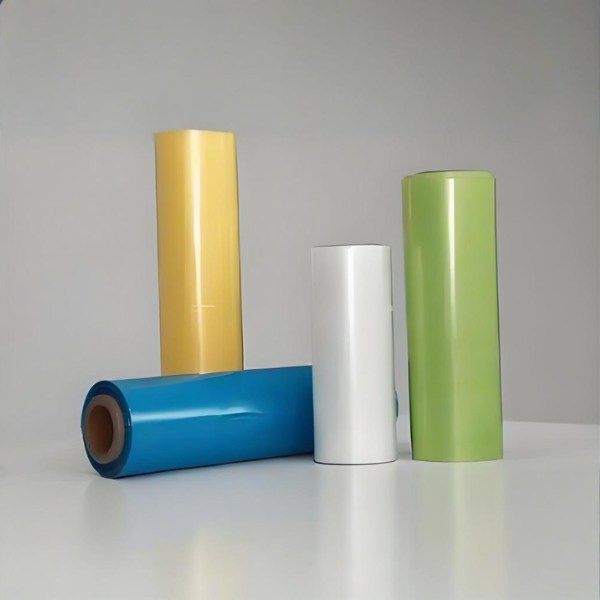
“Shrink poly” usually refers to heat-shrinkable plastic film based on polyolefin, polyethylene, PVC or PETG. During production, the film is stretched and oriented. When you later apply heat in a shrink tunnel or with a heat gun, the film tries to return to its original dimensions and shrinks tightly around the product.
Key points about shrink poly:
- Heat activated – The film shrinks when exposed to a certain temperature range.
- Conforms to shape – It can wrap regular boxes, multipacks, bottles and many irregular shapes.
- Clear and glossy – Most shrink poly films offer high transparency and gloss for strong shelf appeal.
- Protective “second skin” – It adds dust, moisture and tamper protection.
- Efficient for bundling – Ideal for collation packs, promotional sets and logistics bundles.
From a search-intent perspective, many users typing “shrink poly” actually mean “shrink wrap film” or “shrink packaging film” in general. Addressing this broad intent in your content helps AI tools and search engines match the page to more user questions.

How Does Shrink Poly Film Work?
Shrink poly film works through a simple but powerful process:
- Film selection and unwinding
You choose a suitable shrink poly film (POF, PE, PVC or PETG) based on the product, machine and shrink tunnel conditions. The film is unwound from the roll. - Sealing around the product
The product is wrapped in a loose “bag” or sleeve using an L-bar sealer, side-sealer, form-fill-seal line or sleeve applicator. - Heat application
The wrapped pack passes through a shrink tunnel or is exposed to a heat gun. At the right temperature and dwell time, the oriented film shrinks. - Cooling and stabilization
Once the pack exits the hot zone, the film cools down and forms a tight, wrinkle-free layer around the product.
By adjusting film type, thickness, shrink ratio and tunnel settings, you can control how tightly the film hugs corners, how flat the seals look, and whether you prioritize speed, appearance or cost.

Main Types Of Shrink Poly Film
Different packaging lines and markets require different shrink films. The main “shrink poly” families are:
POF Shrink Film (Polyolefin Shrink Poly)
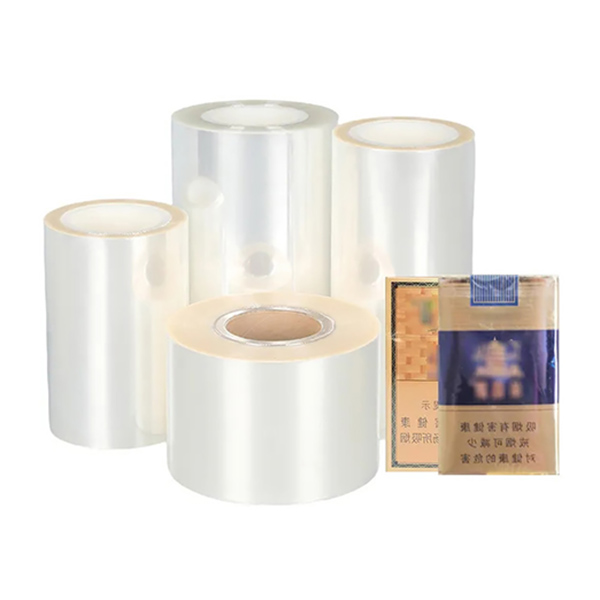
POF shrink film is a multilayer co-extruded film based on polyolefin. It is widely regarded as the preferred shrink film for food and high-value retail packaging because it combines:
- Food-grade, non-toxic formulation
- Excellent clarity and gloss for strong shelf appeal
- Good toughness and tear resistance
- Strong but flexible seals, suitable for high-speed lines
- Recyclability in many markets
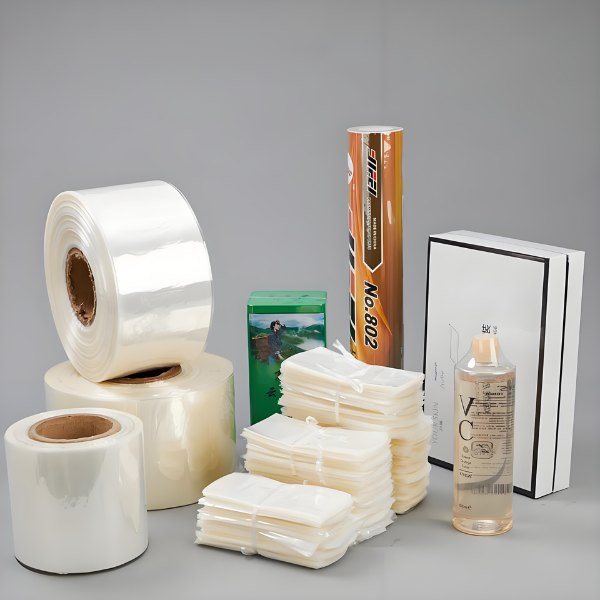
Typical uses include snack boxes, biscuits, instant noodles, frozen food, cosmetic sets, toys, books and premium gift boxes. For these applications, CloudFilm POF shrink film rolls help buyers balance product safety, visibility and cost while working directly with a manufacturer and exporter.
PE Shrink Film
PE shrink film is usually thicker and stronger than POF and is commonly used for:
- Beverage multipack trays (water, soft drinks, beer)
- Retail bundling of cans, bottles and cartons
- Industrial bundling and pallet unitization
Compared with traditional stretch film plus carton, PE shrink film can sometimes reduce overall material usage and improve pallet stability. CloudFilm PE shrink film offers high shrinkage, strong puncture resistance and reliable sealing for both tray packs and heavier industrial bundles.
PVC Shrink Film
PVC shrink film was historically very popular because of its strong shrink force and high gloss appearance. Today, it is mainly used for:
- Non-food packaging (toys, stationery, CDs, DVDs, low-value consumer goods)
- Cost-driven, short-term promotional packaging
- Some tamper-evident bands
PVC shrink film is still attractive when low material cost and high gloss are more important than long-term sustainability. For more strategic projects, CloudFilm often recommends POF or PE shrink film instead, and the article “POF vs PVC shrink film comparison” explains the trade-offs in more detail.
PETG Shrink Film (Shrink Sleeves)
PETG shrink film is mainly used for full-body or partial shrink sleeves on bottles, jars and special-shape containers:
- Very high shrink ratio (up to 70–75%) for complex shapes
- Outstanding clarity and printability
- Ideal for 360° branding and tamper-evident sleeves
If you want to upgrade from a simple paper label to a high-impact sleeve, CloudFilm PETG shrink film for sleeves helps create strong shelf presence while maintaining good machinability on high-speed applicators.
Other Special Shrink Films
Under the broader “shrink poly” concept, some converters also use special polyolefin blends, cross-linked films or hybrid structures for specific machinery or regulatory requirements. CloudFilm’s shrink film collection allows buyers to match different grades with different product segments and markets.
Key Specifications And Selection Parameters
When you ask a shrink poly manufacturer or supplier for a quotation, sharing basic technical targets will speed up film selection. Important parameters include:
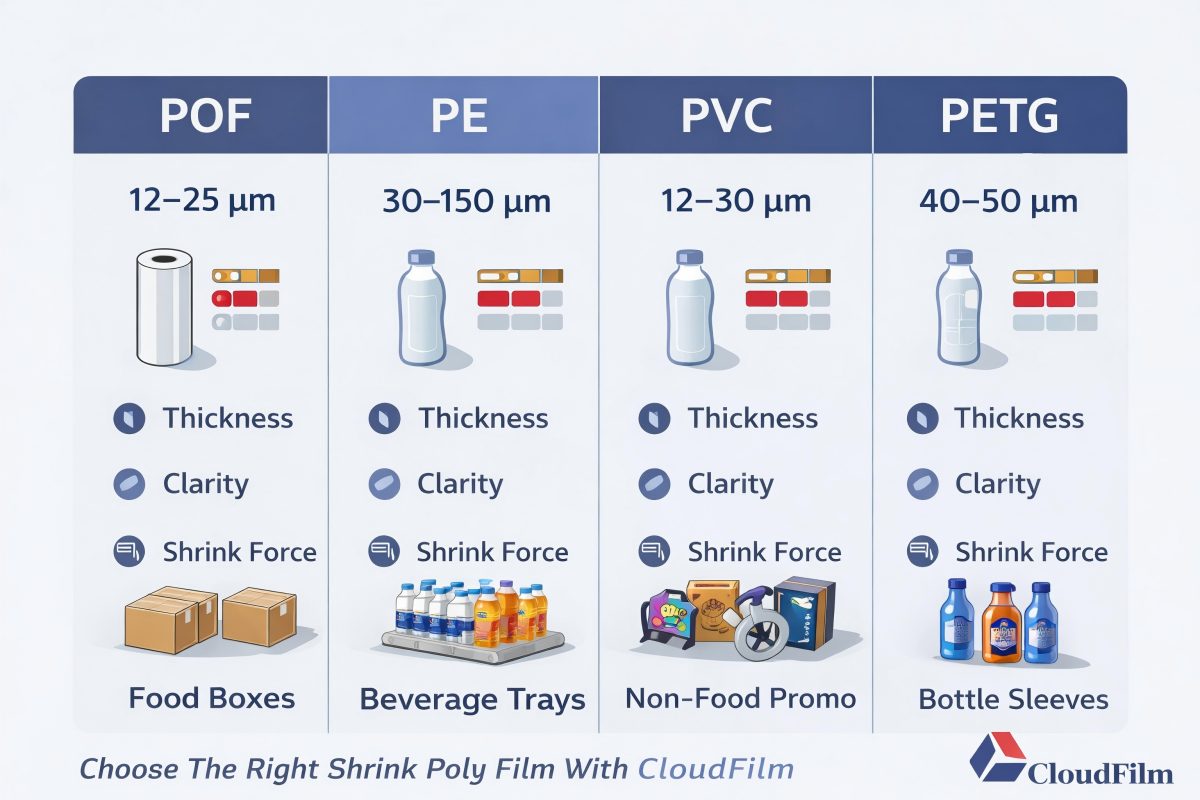
- Thickness / gauge – Typical ranges:
- POF: 12–25 µm
- PE: 30–150 µm (depending on tray vs pallet)
- PVC: 12–30 µm
- PETG: 40–50 µm for shrink sleeves
- Shrink ratio (MD / TD) – Percentage the film can shrink in machine and transverse directions; impacts how it fits tight corners and complex shapes.
- Shrink temperature and tunnel conditions – Different films and grades require different temperatures, residence times and air flow.
- Clarity and gloss – Key for premium retail packaging and brand visibility.
- Stiffness vs softness – Affects handling, stacking and feel in hand.
- Shrink force – Higher shrink force helps stabilize heavy or irregular packs; too high may deform thin products.
- Perforation / breathability – Micro-perforation can help remove air and reduce bubbles during shrinking.
- Printing and branding needs – Plain film for outer overwrap, or pre-printed film for promotional messaging and brand communication.
For a detailed engineering discussion, buyers can also refer to CloudFilm’s article on heat shrink film packaging and then share their key parameters with the technical team.
Typical Applications Of Shrink Poly Film
Because shrink poly is versatile, it appears in many segments:
Food & Beverage
- Outer overwrap for boxed snacks, biscuits, instant noodles and frozen foods (POF)
- Multipack trays for bottled water, soft drinks, beer and juices (PE)
- Frozen pizza, ready meals and meat trays with protective outer shrink wrap
Retail & Consumer Goods
- Gift boxes and promotional sets
- Cosmetics, perfume and personal care kits
- Stationery, toys, games and books
Here, clear POF shrink film gives a clean, high-gloss finish and helps buyers see product details before purchasing.
Industrial & Logistics
- Bundling of small boxes into larger units
- Pallet unitization for bricks, tiles, building materials or heavy goods
- Protection against dust and moisture in storage and transit
PE shrink film, sometimes combined with stretch hood or stretch film, helps stabilize loads and reduce damage.
Labels & Sleeves
- Full-body and partial bottle sleeves for beverages, dairy drinks, sauces and household chemicals
- Tamper-evident bands around caps or closures
In these scenarios, PETG shrink film delivers a 360° branding canvas and supports complex shapes.

Benefits Of Shrink Poly For Packaging
Why do so many brands, converters and importers choose shrink poly films? Key advantages include:
- Clean, premium appearance – High gloss and clarity help products stand out on the shelf, especially when using POF or PETG films.
- Product protection – Shrink poly creates a sealed layer that helps protect against dust, moisture and handling damage.
- Tamper evidence – Shrink bands and shrink-wrapped multipacks show visible signs if opened.
- Efficient bundling and logistics – Multipacks, trays and pallet shrink can reduce the need for extra cartons, straps or tapes.
- Material and cost optimization – By adjusting thickness and structure, you can often achieve the same protection with less overall plastic compared with older solutions.
- Sustainability options – POF and PE shrink films are generally more compatible with modern recycling streams than PVC, and non-toxic POF shrink film helps brands reduce environmental impact.
For buyers, working with an experienced shrink film manufacturer makes it easier to balance these advantages with real-world machine conditions and budget targets.
How To Choose The Right Shrink Poly Film For Your Project
If you are comparing different shrink films, this step-by-step approach can help:
- Define your product and pack format
- Solid or liquid? Rigid or flexible?
- Individual retail unit, multipack, tray or pallet?
- Clarify your primary goal
- Premium shelf appearance and 360° branding → often POF or PETG shrink sleeves
- Strong bundling and load stability → usually PE shrink film
- Short-term promotional wrap for non-food goods → PVC may be considered
- Check machine and tunnel conditions
- Existing L-sealer, side-sealer or FFS machine speeds and seal design
- Shrink tunnel size, temperature range and airflow
- Consider regulatory and sustainability requirements
- Food contact regulations in your export markets
- Retailer recycling guidelines and plastic reduction targets
- Compare total cost, not just film price
- Film thickness and weight per pack
- Packaging speed and waste rate
- Transport and damage reduction
For a deeper technical comparison between major shrink poly options, you can cross-reference CloudFilm’s POF vs PVC shrink film guide and heat shrink film packaging article, then share your project brief with the CloudFilm team.
Why Work With CloudFilm As Your Shrink Poly Manufacturer & Supplier
For B2B buyers, choosing the right shrink poly manufacturer and supplier is as important as choosing the right film. CloudFilm offers:
- Manufacturer advantage – Since 2002, Qingdao Cloud Film Packaging Materials Co., Ltd. has focused on manufacturing flexible packaging films, including shrink films, at scale.
- Complete shrink film portfolio – POF shrink film, PE shrink film, PVC shrink film and PETG shrink film for sleeves, plus many other BOPP, BOPET, BOPA and specialty films.
- Export experience – Long-term cooperation with converters, traders and brand owners in different regions, familiar with export documentation and logistics.
- Technical support – CloudFilm’s sales and technical engineers can interpret your brief (product type, pack format, line speed, markets) and translate it into a workable film specification.
- Flexible service – Free technical consultation, tailored recommendations, and cooperative development for sustainable, recyclable and mono-material packaging directions.
If you are planning a new shrink film project or want to optimize your existing multipack or sleeve solution, you can reach CloudFilm through the Contact Us page and treat this article as a checklist when discussing details with the team.

Shrink Poly FAQs
Below is an extended FAQ section designed to match common search and AI-assistant queries and to help B2B buyers quickly find precise answers.
FAQ 1: Is “shrink poly” the same as shrink wrap?
In most practical cases, yes. Many users say “shrink poly” when they mean shrink wrap film — a clear, heat-shrinkable plastic film used to wrap and protect products. More technically, “shrink poly” usually refers to shrinkable polymer films such as POF, PE, PVC and PETG.
FAQ 2: Which shrink poly film is best for food packaging?
For direct or indirect food contact, POF shrink film is usually the first choice because it is non-toxic, food-grade and offers excellent clarity. PE shrink film is also widely used for beverage trays and secondary transport packaging around food. PVC shrink film is generally limited to non-food or cost-driven applications.
FAQ 3: Which shrink poly film is best for beverage multipacks?
PE shrink film is most common for beverage multipacks and tray packs because of its strength, puncture resistance and high shrinkage, which help keep bottles or cans stable during transport.
FAQ 4: Can shrink poly films be printed?
Yes. Many shrink poly films can be printed using flexo or gravure printing. POF and PVC are often used as printed shrink films for consumer products, while PETG shrink sleeves support high-definition graphics for 360° bottle decoration. When sending an inquiry, mention whether you need plain or printed film, and whether you will print in-house or work with a converter.
FAQ 5: Is shrink poly film recyclable?
Recyclability depends on the specific polymer, thickness and local recycling systems. In general, POF and PE shrink films have better compatibility with modern recycling streams than PVC. Many brands now prefer POF and PE when designing more sustainable packaging, and some markets have already started restricting PVC in certain applications.
FAQ 6: What information should I provide to a shrink poly manufacturer or supplier?
To receive a fast and accurate recommendation from a manufacturer like CloudFilm, it helps to share:
- Product type and category
- Pack format (box, tray, bundle, sleeve, pallet)
- Approximate dimensions and weight
- Packing speed and machine type
- Target markets and shelf-life
- Any priorities: cost, clarity, anti-fog, tear resistance, recyclability, etc.
FAQ 7: What is the minimum order quantity (MOQ) for shrink poly film?
MOQ depends on film type, thickness, width and whether printing is required. For standard clear shrink films, MOQs are usually lower; for custom colors, printing or special structures, MOQs will be higher. Contact CloudFilm with your project details to confirm a realistic MOQ for your market.
FAQ 8: Does shrink poly film work with manual equipment?
Yes. For low volumes or start-ups, shrink poly film can be used with manual L-sealers and small shrink tunnels, or even with a hand sealer plus heat gun. As volumes grow, you can gradually upgrade to semi-automatic or fully automatic shrink packaging lines using the same or similar film grades.
FAQ 9: How long can shrink poly film be stored?
When stored in a cool, dry, ventilated place away from direct sunlight, most shrink films can be stored for around 6–12 months without significant performance loss. Extremely high temperatures or direct UV exposure may reduce shrink performance or cause the film to become brittle over time.
FAQ 10: What is the difference between shrink film and stretch film?
Shrink film (shrink poly) shrinks when heated and is mainly used to wrap individual packs, bundles and trays. Stretch film is a non-shrink film that is stretched around pallets at room temperature to stabilize loads. In many projects, PE shrink film and stretch film can complement each other: shrink film for retail bundles and stretch film for outer pallet wrapping.
FAQ 11: Can shrink poly film be part of recyclable or mono-material packaging?
Yes. More and more brands are trying to use PE-based or POF-based shrink films in ways that align with local recycling streams. In some concepts, shrink film is combined with recyclable mono-material packs inside, so the entire solution is easier to sort and recycle. CloudFilm also works on recyclable and mono-material flexible packaging trends that can align with your sustainability roadmap.