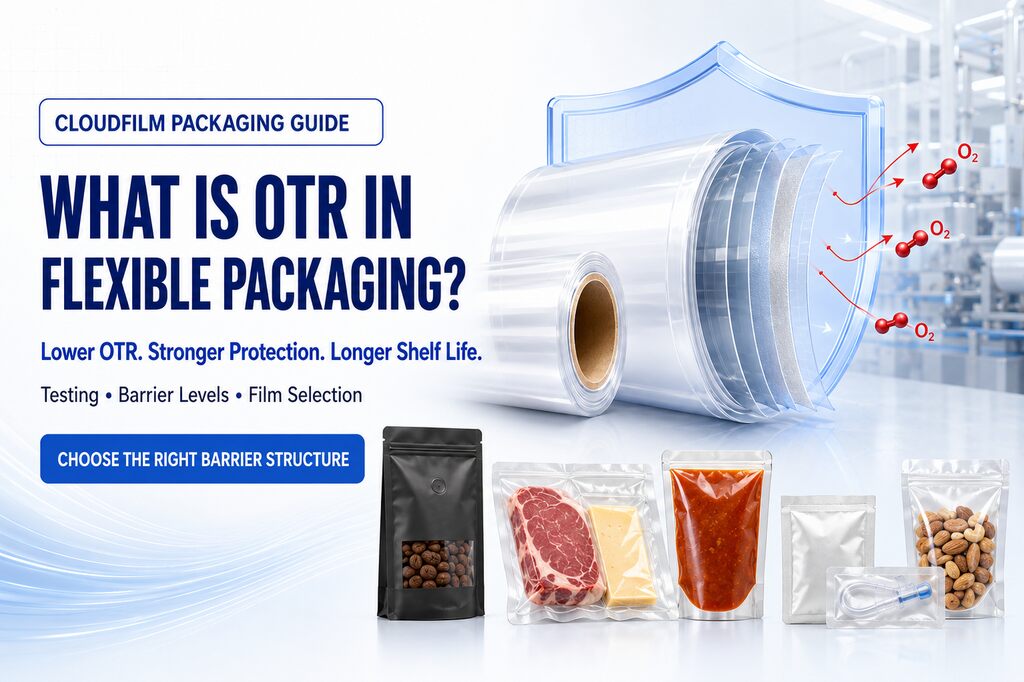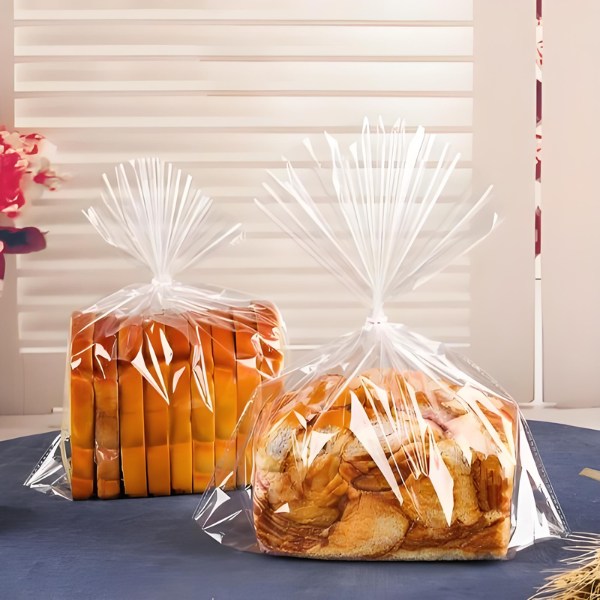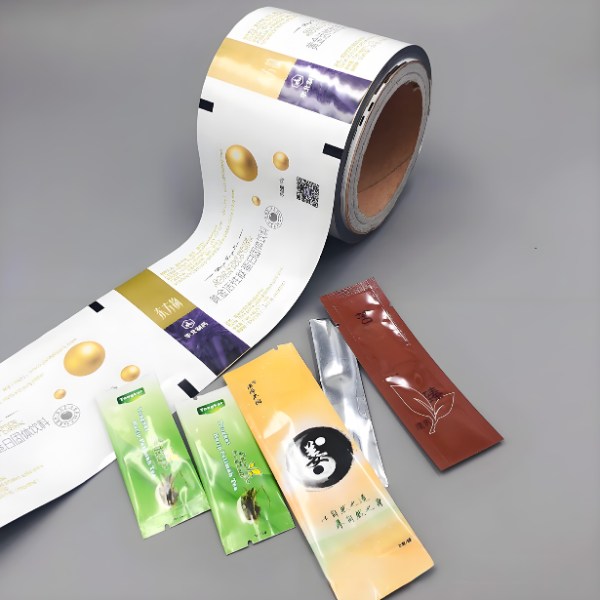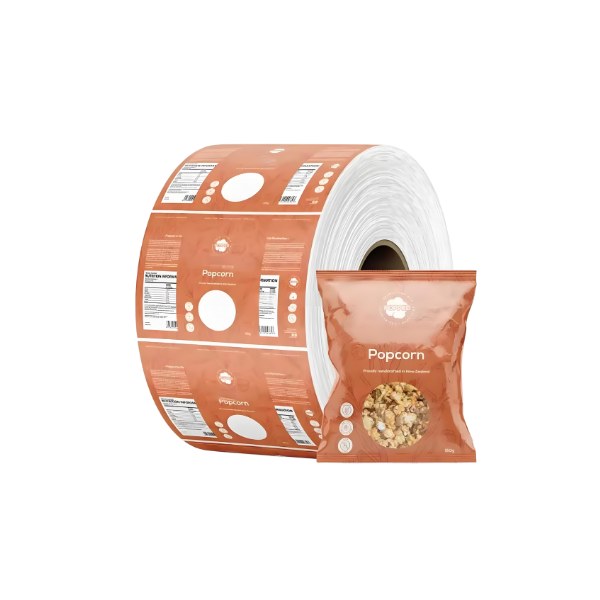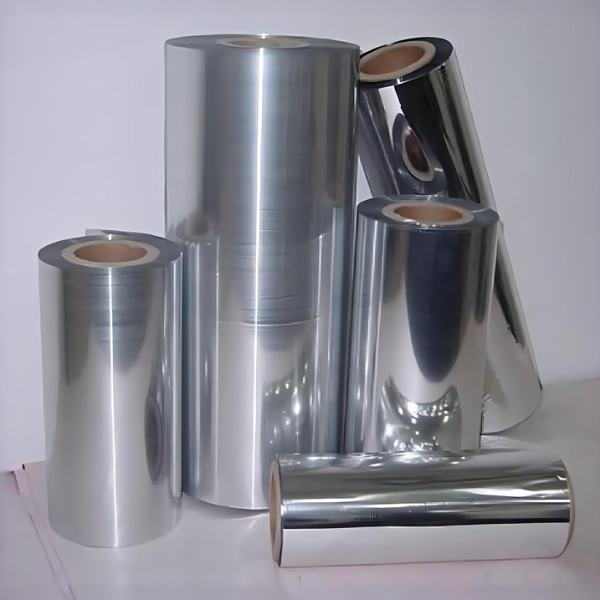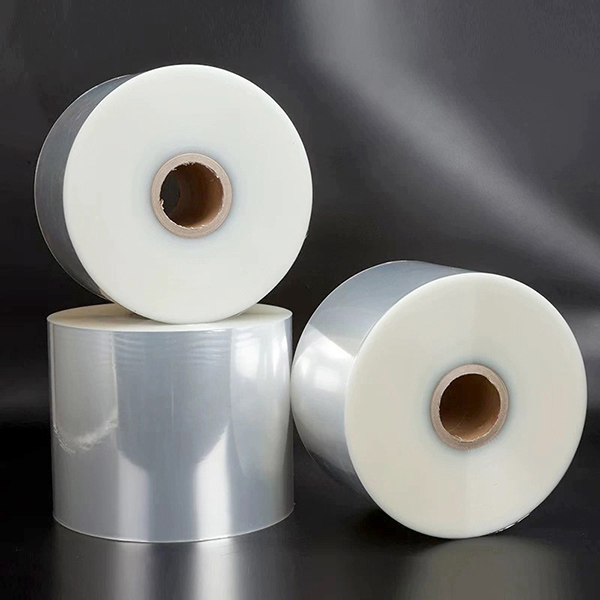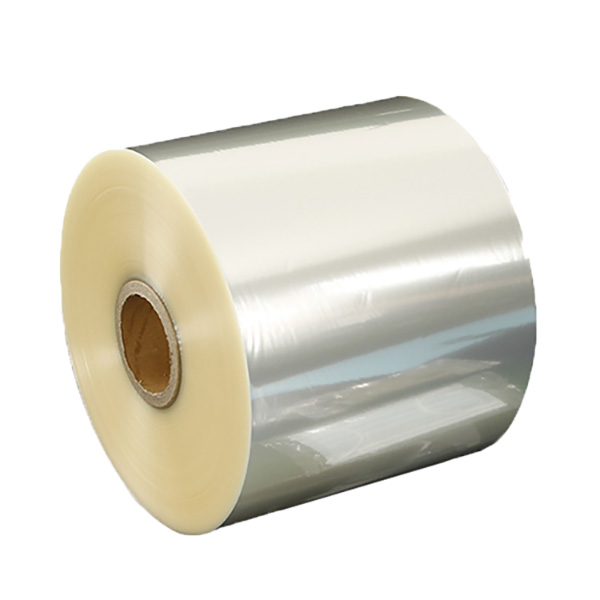
For buyers, converters, and packaging engineers, heat sealing is often the final step that decides whether a package looks clean, runs smoothly, and protects the product during storage and transport. Even when the film quality is good, a wrong sealing temperature can create weak seals, distorted edges, wrinkles, film sticking, or unstable performance on high-speed packaging lines.
This guide explains how to choose the right heat sealing temperature for heat sealable BOPP film, how to test the sealing window, and how to solve common sealing problems. It is written for packaging buyers, film converters, food brands, and production teams that need practical information before sampling, trial production, or bulk purchasing.
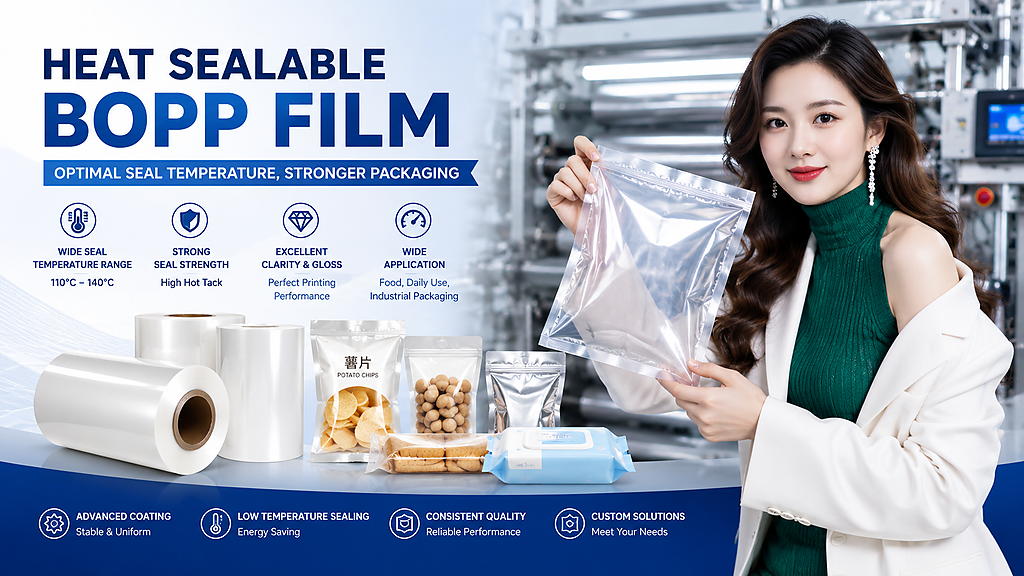
Quick Answer: What Is The Typical Heat Sealing Temperature?
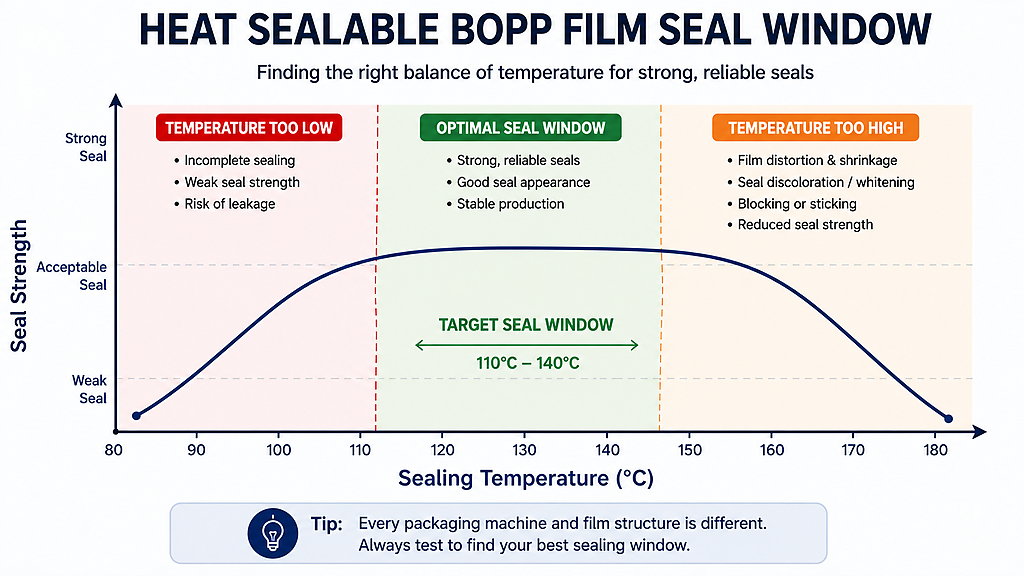
For most heat sealable BOPP film grades, a practical starting range is usually around 110°C to 140°C. Some lines may run slightly lower or higher depending on film structure, thickness, sealant formulation, machine speed, jaw design, pressure, and dwell time. The final setting should always be confirmed by real machine testing instead of using one fixed number for every pack.
The important point is that the operator is not trying to melt the whole BOPP film. Standard BOPP has good clarity, stiffness, and dimensional stability, but it does not automatically create a reliable heat seal. A dedicated sealable grade has a lower-temperature seal layer on one side or both sides. During sealing, that layer softens, flows, and bonds to the opposite seal layer under heat and pressure.
If you are still choosing the film grade, start with CloudFilm’s heat sealable BOPP film product page and then confirm the exact sealing conditions with sample rolls on your own machine.
Why Temperature Alone Does Not Decide Seal Strength
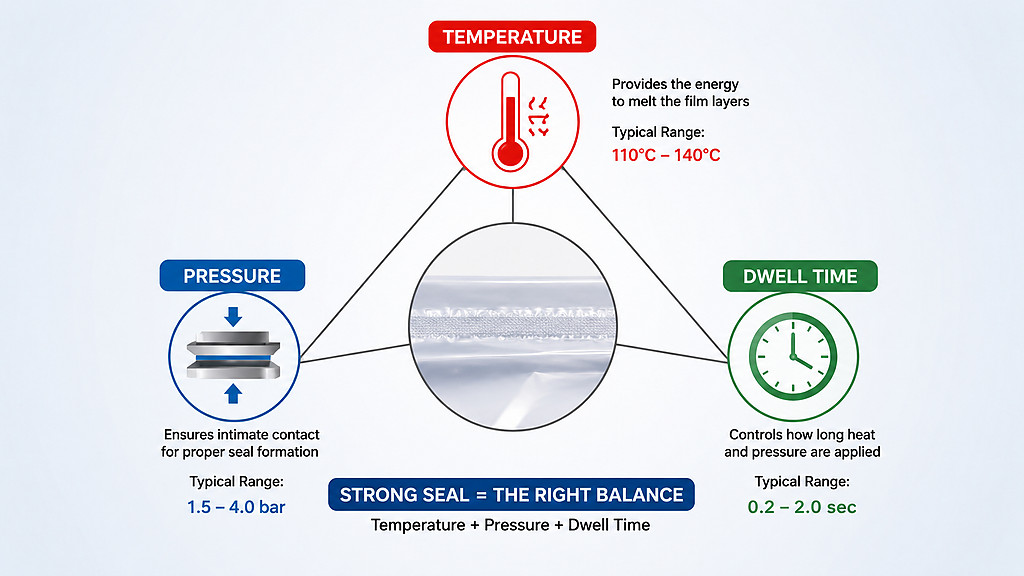
Temperature activates the sealant layer
Temperature is the first number most buyers ask about, but it is only one part of the heat sealing process. If the jaw temperature is too low, the sealant layer will not activate enough and the seal may open during packing, handling, or shelf display. If the temperature is too high, the film may shrink, wrinkle, whiten, distort, or stick to the sealing jaw.
A good temperature setting should create a clean seal without damaging the surrounding film. For many packaging operations, the best temperature is not the highest temperature that seals. It is the lowest stable temperature that gives enough seal strength at the required line speed.
Pressure brings the two seal layers into full contact
Even when the temperature is correct, poor pressure can create channels, leaks, or partial sealing. Pressure forces the two sealable surfaces into close contact and helps the softened seal layer spread across the sealing area. If the pressure is too low, the seal may look closed but still fail during a peel test or drop test. If the pressure is too high, the jaw may crush the film, squeeze the molten layer out of the seal area, or leave a brittle seal.
Dwell time controls how long heat stays at the interface
Dwell time is the time that the film stays under heat and pressure. On high-speed HFFS, VFFS, and overwrap machines, dwell time can be very short. A film that seals well in a laboratory at slow speed may not seal well on a fast machine if the sealant layer cannot activate quickly enough. This is why low-temperature or fast-sealing grades are valuable for automatic lines.
How To Find The Best Sealing Window
A sealing window is the useful temperature range where the film gives strong, clean, repeatable seals without causing film damage. Instead of looking for one exact temperature, the better approach is to find the whole working range.
Start with a conservative temperature, then increase the sealing jaw temperature in small steps. At each setting, keep pressure and dwell time unchanged. Make several sample seals, then test seal strength, appearance, opening behavior, and leakage resistance. When the seal begins to hold consistently, note the lower limit. Continue raising the temperature until you begin to see distortion, sticking, whitening, excessive shrinkage, or brittle seals. The best production setting normally sits inside this stable area, not at the edge.
For serious qualification, test the film under the real conditions of your packaging line. A laboratory heat sealer is useful for comparison, but actual machine speed, product loading, dust, oil, humidity, film tension, jaw shape, and knife temperature can change the result. If the pack will be shipped through hot or cold environments, run additional storage and transport simulations before approving bulk production.
Recommended Starting Points For Different Packaging Lines
Different packaging machines need different sealing behavior. A snack pillow pack on a horizontal wrapper, a noodle pack on a vertical machine, and a tissue overwrap pack may all use heat sealable BOPP, but the practical settings can be different.
For horizontal flow wrapping, the film usually needs good hot tack, stable slip, and a clean fin seal or lap seal. Line speed can be high, so the sealable layer must activate quickly. For vertical form-fill-seal packaging, the back seal and end seals must resist product weight and drop impact, especially for granular, powder, or noodle products. For overwrap packaging, seal appearance and low distortion are often important because the final pack is viewed directly by consumers.
When your project is based on food, snacks, bakery, candy, tissue, masks, straws, or daily-use products, it is helpful to check both film and machine requirements together. For a broader material view, you can compare related structures in the BOPP Vs BOPET Vs CPP Vs PE Packaging Film Guide.
| Packaging Line | Practical Focus | Sealing Advice |
| HFFS Flow Wrap | Fast fin seal and end seal | Choose fast-sealing BOPP with stable COF and test at real speed. |
| VFFS Packaging | Seal strength under product weight | Confirm back seal strength, end seal integrity, and drop resistance. |
| Overwrap | Neat appearance and low distortion | Use a stable seal window and avoid excessive jaw temperature. |
| Tissue And Straw Packs | Clean seals and smooth running | Check slip, static control, roll profile, and seal consistency. |
| Printed Packaging | Ink and lamination compatibility | Keep the seal area clean and confirm the correct sealing side. |
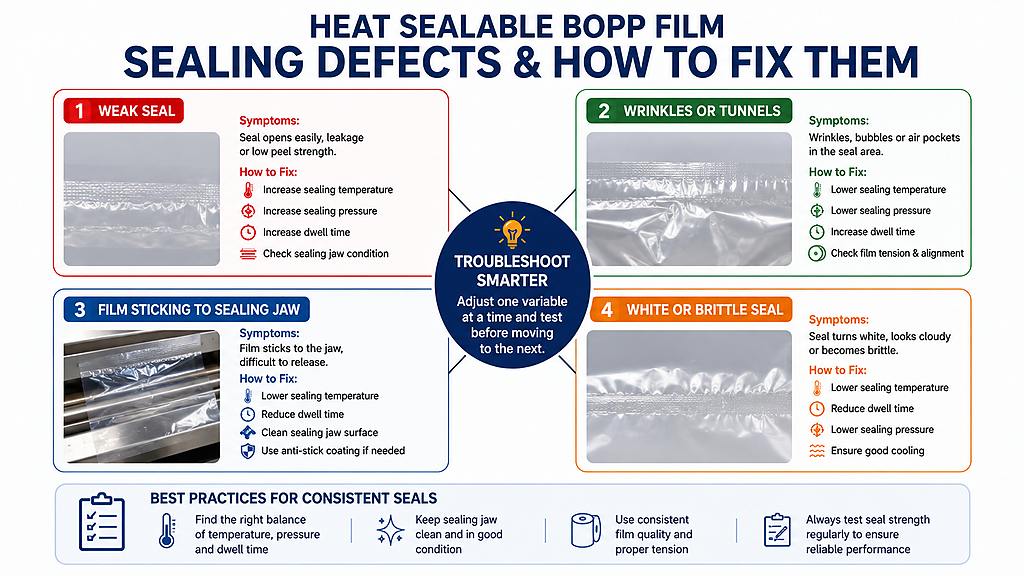
Common Heat Sealing Problems And How To Fix Them
Weak seal or seal opening
A weak seal usually means that the seal layer did not receive enough effective heat, pressure, or dwell time. Increase temperature gradually, then check pressure and dwell time. Also confirm that the film is being sealed on the correct side. For one-side heat sealable BOPP, sealing the wrong surface may give almost no bond.
If the seal is weak only in some positions, inspect jaw flatness, temperature uniformity, film tension, roll profile, and product contamination in the seal area. Powder, oil, crumbs, or moisture can prevent the two seal surfaces from bonding completely.
Film sticks to the sealing jaw
Sticking can happen when the temperature is too high, the dwell time is too long, the jaw surface is damaged, or the film grade is not suitable for the machine. First reduce the temperature step by step while checking seal strength. Then inspect the jaw surface, release coating, pressure, and cooling. If sticking continues, ask your film supplier whether a different sealant formulation or lower sealing initiation temperature is available.
Wrinkles, tunnels, or distorted edges
Wrinkles near the seal can come from excessive heat, uneven tension, poor roll profile, film shrinkage, or mechanical alignment problems. Reduce the sealing temperature if the wrinkle appears only in the seal zone. If the wrinkle appears before sealing, check the unwinding tension, forming shoulder, guide rollers, and web tracking.
A stable film roll is also important. Gauge variation, poor winding, or uneven roll hardness can cause tension changes that appear as sealing defects on the machine. For roll-stock projects, the packaging film roll specification should include width tolerance, roll outside diameter, core size, roll weight, winding direction, and packing requirements.
White, brittle, or burned seal
A white or brittle seal normally means the film has been overheated or crushed. Lower the jaw temperature, reduce pressure, or shorten dwell time. Also make sure that the sealing jaw is not dirty or misaligned. A brittle seal may look strong in a simple pull test but can fail during vibration, bending, or cold-chain handling.
Poor sealing after printing or lamination
When BOPP is used in printed packaging, the sealing area must be designed carefully. Ink, varnish, adhesive, or coating should not enter the seal area unless it has been tested and approved. If the pack uses reverse printing, lamination, or surface printing, the converter should confirm which side is printed, which side is sealed, and whether a sealable coating or sealant web is needed.
For packaging structures where BOPP acts as the print layer, BOPP printing film can be combined with a suitable sealing layer, such as heat sealable BOPP, CPP, or PE, depending on the product requirements.
Heat Sealable BOPP Vs CPP And PE Sealant Films
Heat sealable BOPP is often selected when buyers need a clear, glossy, stiff, printable, and lightweight polypropylene-based film. It is widely used for snack packs, bakery packs, confectionery, tissue overwrap, masks, straws, and general consumer packaging.
CPP and PE sealant films usually provide easier sealing and higher seal strength, especially when the package needs more softness, puncture resistance, or strong seal performance under contamination. However, they may not provide the same stiffness, gloss, and crisp pack appearance as BOPP. The right material depends on product weight, machine speed, packaging format, barrier needs, appearance, and cost target.
For many dry food and daily-use packaging projects, heat sealable BOPP can work as a single-web solution or as part of a simple laminated structure. For heavier products, oily products, high-barrier packs, or demanding pouch applications, the buyer may need a stronger sealant layer or a laminated structure. If the product is fresh produce or chilled food where visibility is critical, Anti Fog BOPP Film may be a better option because it combines clarity, anti-fog function, and heat-sealable grades for flow-wrap or lidding use.
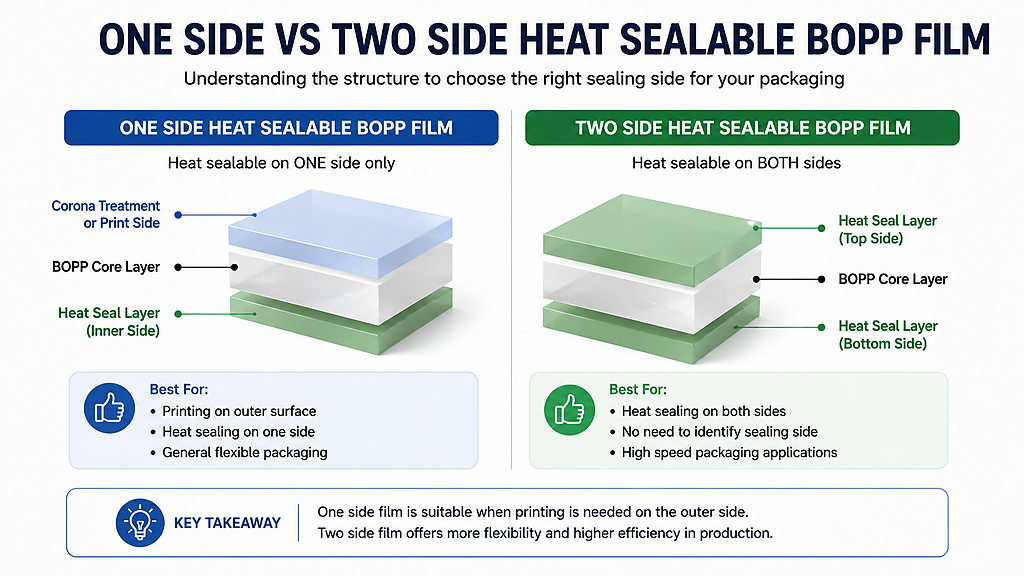
One-Side Or Two-Side Heat Sealable BOPP: How To Choose
Choose one-side heat sealable BOPP when one surface needs printing or lamination
One-side heat sealable BOPP is common when the outside surface needs corona treatment for printing or lamination, while the inside surface needs to seal. This structure helps buyers control ink adhesion, lamination bond, and seal position. It is often used when the package has a clear outer display surface and a defined inner sealing side.
Choose two-side heat sealable BOPP for overwraps and flexible sealing direction
Two-side heat sealable BOPP is useful when both surfaces may need to seal, such as overwraps, certain pillow packs, or automatic wrapping applications where the film path and contact direction require more flexibility. It can reduce the risk of wrong-side sealing, but the converter still needs to confirm friction, blocking, and winding behavior.
Before confirming the structure, share your packaging drawing, film path, printing plan, and sealing jaw position with the manufacturer. This avoids a common mistake: ordering a film that has the right thickness but the wrong sealable side.
How To Choose The Right Grade For Food Packaging
For food packaging, sealing temperature is not the only selection point. The film also needs suitable clarity, odor performance, food-contact documentation, roll cleanliness, COF, thickness tolerance, and packing protection. For snacks and bakery products, moisture resistance and crisp appearance can be important. For candy and confectionery, gloss and seal appearance may matter more. For noodles or powder products, end-seal strength and contamination resistance should be checked carefully.
A project may also need printed roll stock, laminated roll stock, or pre-made pouches. If the final structure must protect aroma, oil, oxygen, or moisture-sensitive food, the buyer should ask whether metallized BOPP, PET, CPP, PE, EVOH, or other high-barrier structures are more suitable. A single heat sealable film is not always the best answer for every product.
For application planning, CloudFilm’s food packaging film page can help buyers connect material selection with snack, bakery, frozen food, fresh food, and ready-to-eat packaging requirements. If your line is a horizontal wrapper, the Flow Packaging Film Supplier For Food Packaging Lines article gives additional points about machine trials, roll quality, and sealing performance.
What Buyers Should Send To A Manufacturer Or Supplier
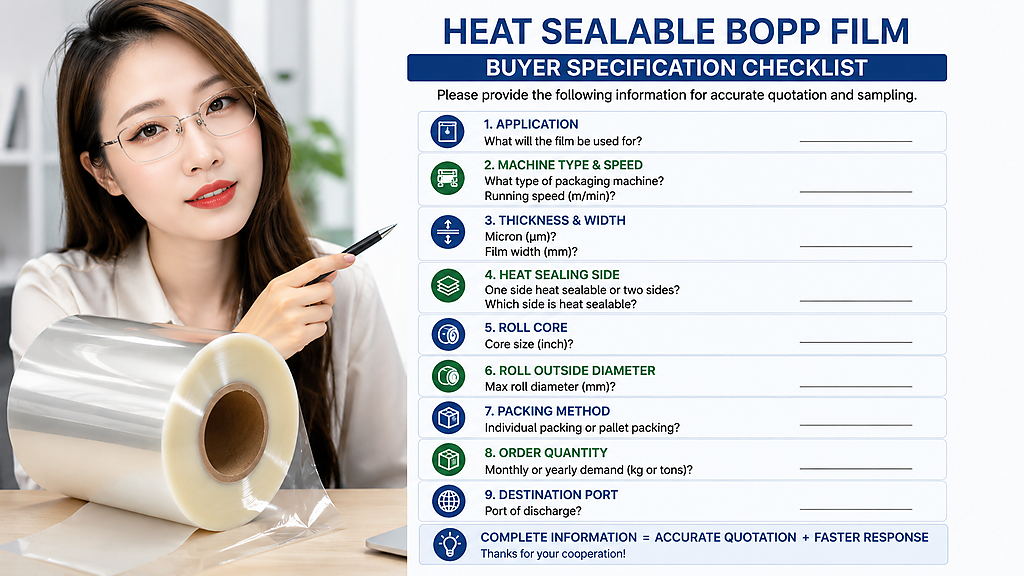
A reliable manufacturer or supplier can recommend a better film when the inquiry includes enough technical information. Instead of only asking for a price per kilogram, send the application and machine data first. This helps reduce wrong samples, slow communication, and costly production trials.
Useful information includes the product to be packed, packaging format, machine type, line speed, target thickness, film width, roll length or roll weight, sealing side, printing method, lamination structure, required barrier, core size, roll outside diameter, winding direction, estimated order quantity, and destination port. If you have a previous film sample or technical datasheet, share it for comparison.
For buyers who are still comparing BOPP grades, CloudFilm’s BOPP Film Series gives a wider view of transparent, matte, metallized, thermal lamination, anti-fog, coated, and heat sealable grades. The BOPP film properties guide is also useful when you need to explain clarity, stiffness, moisture resistance, and film selection to your purchasing or production team.
Sample Testing Checklist Before Bulk Orders
Before placing a bulk order, test the film on the real packaging machine whenever possible. Use the actual product, actual speed, actual jaw settings, and actual packing environment. If the film will be printed or laminated later, test the complete structure rather than only the base film.
Check the following points during trial production:
- Seal strength at the lower, middle, and upper part of the sealing window.
- Hot tack immediately after sealing, especially on fast machines.
- Seal appearance, including wrinkles, whitening, bubbles, and edge distortion.
- COF and film feeding stability from the beginning to the end of the roll.
- Static level, roll profile, telescoping, blocking, and dust.
- Leakage resistance, drop resistance, and shelf-life performance.
- Printing, lamination, and food-contact documentation where required.
A good trial should produce clear results. If the machine runs well at only one narrow temperature, the production risk is higher. If the film runs well across a wider range, the line will be more stable when speed, room temperature, product loading, or operator settings change.
FAQ About Heat Sealable BOPP Film Sealing Temperature
1. What temperature should I use to heat seal BOPP film?
A common starting range for heat sealable BOPP film is around 110°C to 140°C, but the exact setting depends on film grade, thickness, machine speed, pressure, dwell time, and sealing jaw design. Always confirm by real machine testing.
2. Can standard BOPP film be heat sealed?
Standard BOPP film may soften or distort under heat, but it normally does not create a reliable commercial heat seal. For direct sealing, choose a heat sealable BOPP grade with a dedicated seal layer.
3. Why does my datasheet temperature not work on my machine?
Datasheet values are usually measured under controlled laboratory conditions. Your machine may have different jaw design, speed, pressure, dwell time, temperature calibration, and product contamination. Use the datasheet as a starting point, then build your own production window.
4. Is lower sealing temperature always better?
Not always. Lower temperature is useful for high-speed packaging and lower distortion, but the seal must still meet strength and leakage requirements. The best setting is the lowest stable setting that passes your tests.
5. How can I improve a weak seal?
Increase temperature gradually, then check pressure, dwell time, sealing side, jaw flatness, and contamination in the seal area. If the seal is still weak, the film may not be the correct grade for your machine or product.
6. What is hot tack?
Hot tack is the ability of the seal to hold while it is still hot and not fully cooled. It is very important for fast packaging lines because the package may be pulled, filled, or dropped immediately after sealing.
7. Does film thickness affect sealing temperature?
Yes. Thicker films may need more heat or dwell time because heat needs more time to reach the seal interface. However, the sealant formulation is often more important than thickness alone.
8. What is the difference between one-side and two-side heat sealable BOPP?
One-side heat sealable BOPP has one printable or treatable side and one sealable side. Two-side heat sealable BOPP can seal on both surfaces and is useful for overwraps and certain automatic wrapping applications.
9. Can heat sealable BOPP film be printed?
Yes, if the surface is properly treated for printing. The buyer must confirm the printable side and the sealable side before production. Ink or coating should not contaminate the seal area unless tested.
10. Can heat sealable BOPP seal through powder, oil, or crumbs?
Light contamination may sometimes be tolerated, but powder, oil, crumbs, and moisture usually reduce seal strength. If contamination is unavoidable, test the film under real filling conditions or consider another sealant structure.
11. Is heat sealable BOPP suitable for high-speed packaging machines?
Yes, if the grade has a suitable low sealing initiation temperature, good hot tack, stable COF, and good roll quality. Always test at the real production speed before approving a bulk order.
12. Is heat sealable BOPP suitable for frozen food?
It may be suitable for some frozen or chilled dry applications, but the final decision depends on impact resistance, seal strength at low temperature, barrier requirement, and product type. For heavy frozen products, a laminated structure may be safer.
13. How do I know which side is the sealing side?
Check the supplier label, roll direction, corona treatment information, and technical datasheet. During testing, make small seal samples from each side and compare the bond. Mark the correct side before machine trials.
14. Why does the film wrinkle near the seal?
Common reasons include excessive temperature, uneven tension, poor roll profile, incorrect forming, jaw misalignment, or film shrinkage. Reduce heat first if the wrinkle appears only in the sealing area.
15. What documents should food packaging buyers request?
Depending on the market, buyers may request a technical datasheet, food-contact declaration, migration test report, specification sheet, COA, SDS if needed, and packing information. Requirements should be confirmed according to the target country and final application.
16. What is the best way to request a quotation?
Send your product, packaging format, machine type, target thickness, width, sealing side, roll size, printing or lamination needs, order quantity, and destination port. The more complete the information, the faster the supplier can recommend the right grade.
Conclusion
Heat sealable BOPP film sealing temperature is not a single fixed number. It is a working window built from temperature, pressure, dwell time, film structure, machine condition, and product requirements. Most projects should begin with a typical range, then use real machine testing to find the lowest stable temperature that gives strong seals and clean package appearance.
For buyers, the safest approach is to choose the right sealable structure first, then test samples under real production conditions. For suppliers and converters, clear communication about machine type, line speed, film side, roll size, and final application can prevent sealing failures before mass production starts.
If you need heat sealable BOPP film for snacks, bakery, tissue, masks, straws, overwraps, or other flexible packaging projects, prepare your application details and request samples before confirming the bulk order. A well-tested sealing window will help your packaging line run faster, cleaner, and more consistently.