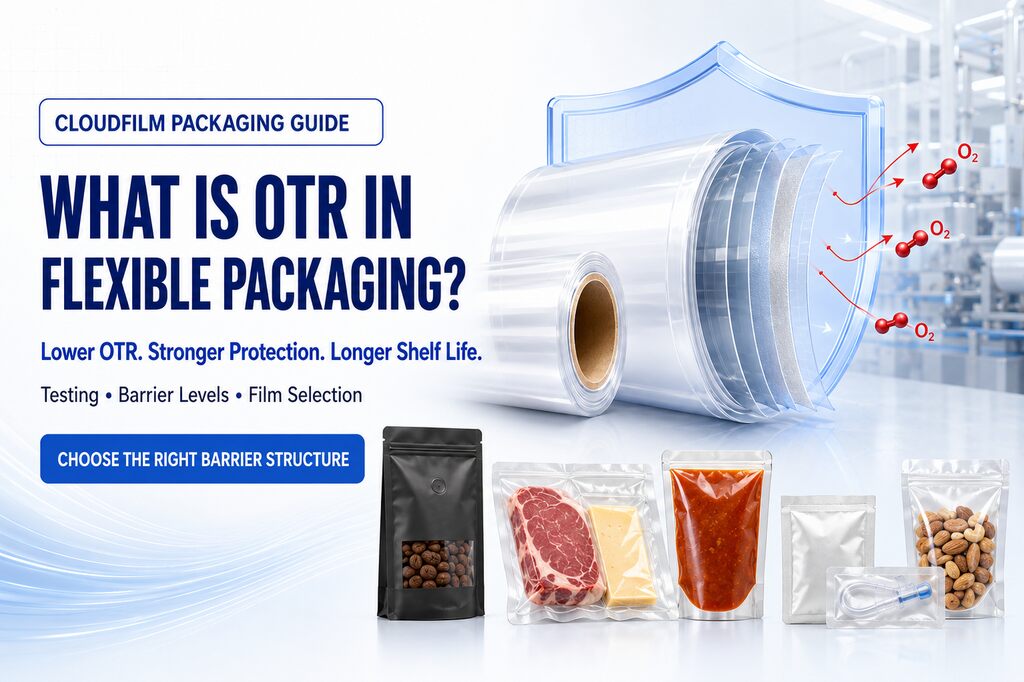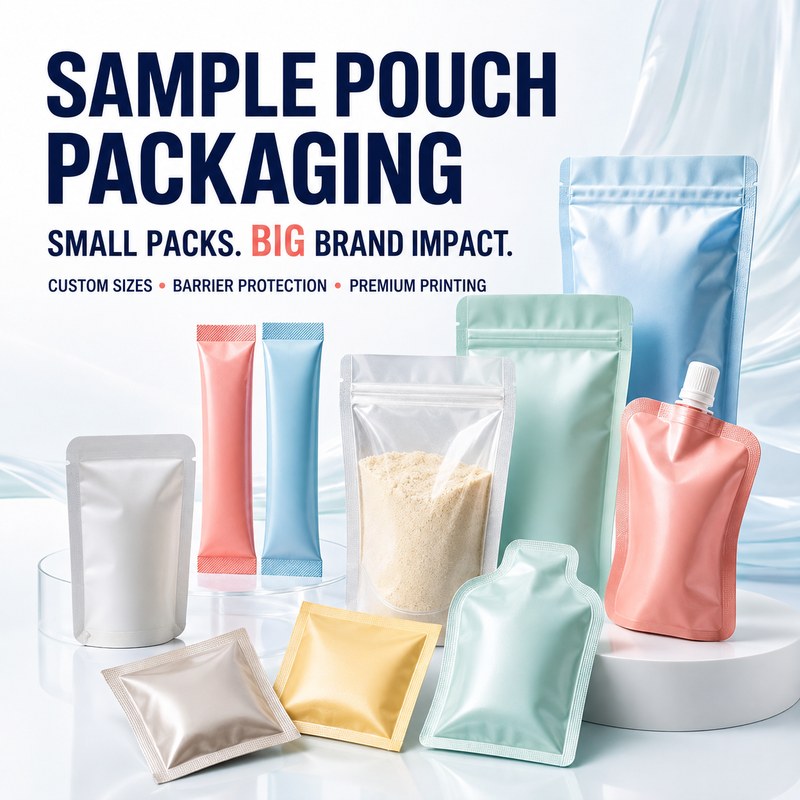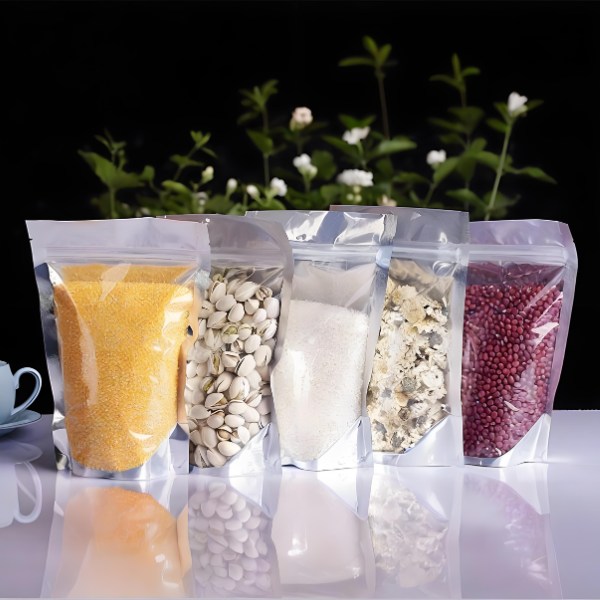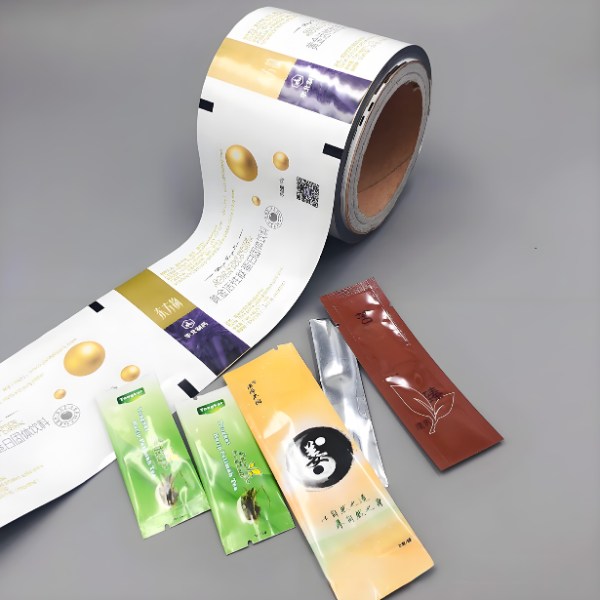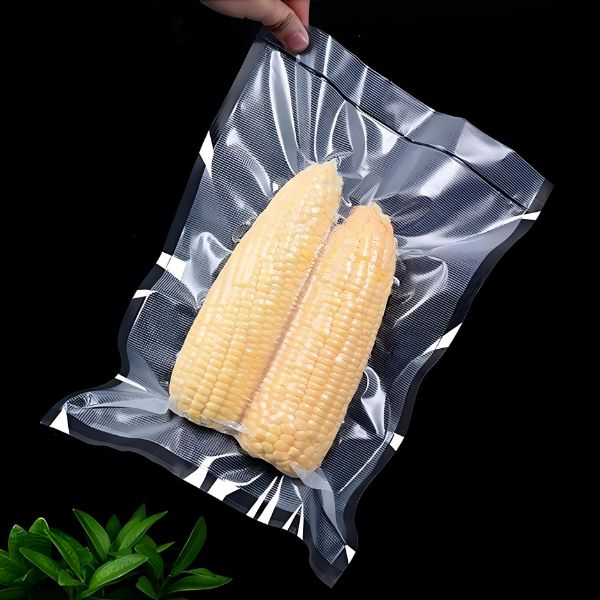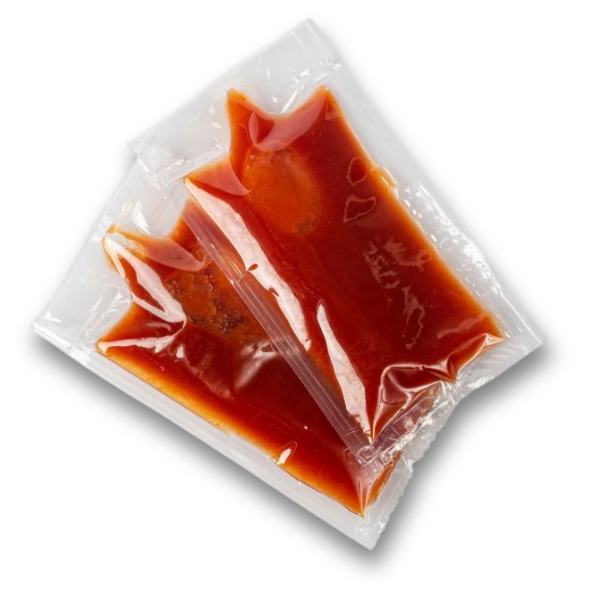
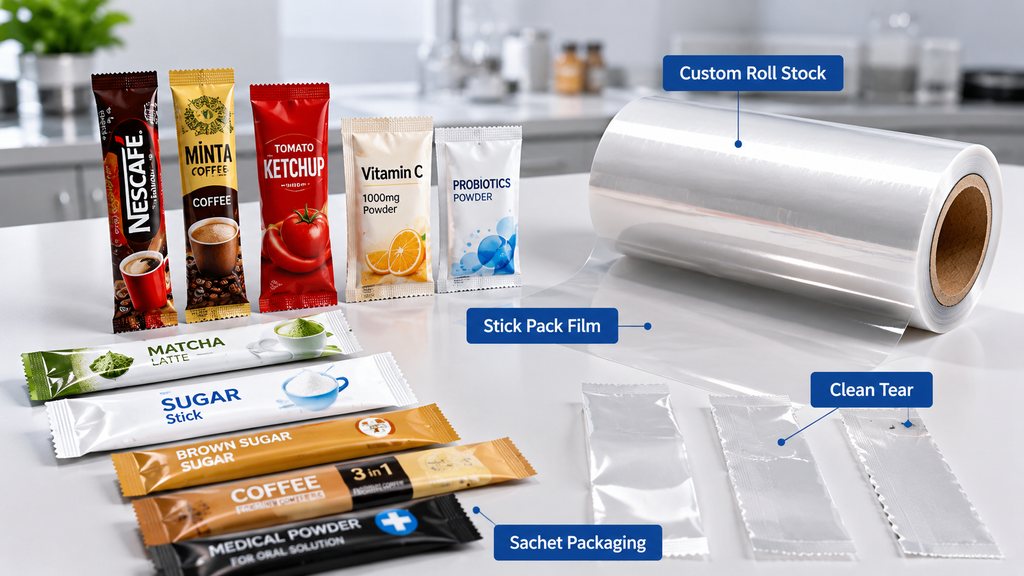
Stick packs and sachets are designed for speed, portion control, and convenience. They are used for instant coffee, drink powder, protein powder, seasoning, sugar, salt, ketchup, sauces, oral-care samples, shampoo samples, wet wipes, pharmaceutical powders, diagnostic products, and many other single-serve products. In this type of packaging, the first consumer action is very simple: open the pack by hand.
If the film is difficult to tear, the whole package feels cheap and frustrating. If the tear runs in the wrong direction, powder may spill, liquid may leak, and the user experience becomes messy. If the film tears too easily during filling, sealing, transport, or display, the brand may face higher rejects, complaints, and product loss. This is why easy tear film is not only a small opening feature. For stick packs and sachets, it is part of the complete packaging performance.
For converters, brand owners, contract packers, and packaging procurement teams, the best easy tear film should balance four requirements: clean opening, reliable sealing, suitable barrier, and smooth running on packing machines. A good film supplier should understand the product inside the pack, the forming and sealing process, the tear direction, the desired opening force, and the final market where the pack will be used.
Why Easy Tear Film Matters For Single-Serve Packaging
Stick packs and sachets are often opened in quick-use situations. A consumer may be holding a bottle of water, cooking in a kitchen, preparing medicine, feeding a pet, or using a sample product in a hotel bathroom. The package must be easy to open without scissors, knives, or excessive force.
For powdered products, the opening must be clean enough to pour the contents into a cup, bottle, bowl, or mixing container. For liquids and pastes, the tear should create a controlled opening without splashing. For pharmaceutical and nutraceutical products, the pack must protect the product first, then open in a predictable way when needed.
An ordinary film may have good seal strength and barrier, but it may stretch, deform, or tear irregularly. Easy tear film is engineered so that the tear can start from a notch, laser score, cut line, or film structure and then propagate more easily across the pack. The goal is not simply to make the film weak. The goal is to make the opening area easy to tear while keeping the rest of the package strong enough for filling, sealing, storage, and shipping.
For B2B projects, this difference is important. A film that tears well in a hand sample may still fail on a high-speed stick pack machine if the coefficient of friction, heat sealing window, roll tension, stiffness, and laminate bonding are not matched to the line. That is why easy tear performance should always be discussed together with machinability and seal integrity.
What Makes A Film Easy To Tear?
Easy tear performance usually comes from a combination of material selection, orientation, film structure, notch design, and converting process. The film does not need to be fragile. In fact, high-quality easy tear film must remain strong in the roll and finished pack, but it should open smoothly when the consumer starts tearing from the designed area.
Controlled Tear Propagation
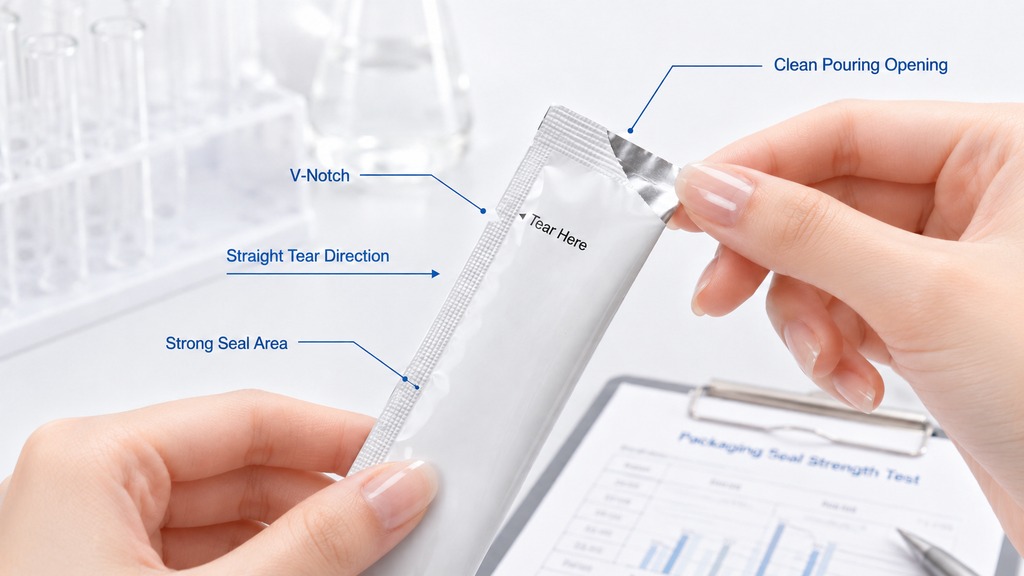
Controlled tear propagation means the tear follows a predictable path after it starts. In stick packs and sachets, this is usually achieved through a side notch, V-cut, straight cut, laser score, or directional tear layer. The ideal result is a straight and clean opening across the top corner or side edge.
Balanced Mechanical Strength
A good easy tear film should resist accidental rupture during filling, sealing, packing, carton loading, and transport. The film should not split on the roll, tear during tension changes, or break when the machine pulls it through forming shoulders and sealing jaws. The easy-open function should appear mainly at the designed opening point.
Suitable Tear Direction
Some projects need machine direction tear, while others need transverse direction tear. Stick pack opening direction depends on the pack design, printing layout, notch position, and consumer habit. Before mass production, the buyer and supplier should confirm whether the film needs straight-line tear across the width, tear along the length, or easy tearing in multiple directions.
Stable Heat Sealing Window
The film still needs to seal well. If the sealing layer is too weak, the sachet may leak. If the seal is too strong or the sealing area becomes too stiff, the consumer may struggle to open the pack. The supplier should recommend a sealant layer that matches the product, machine speed, sealing temperature, and required seal strength.
Common Materials Used In Easy Tear Stick Pack Film
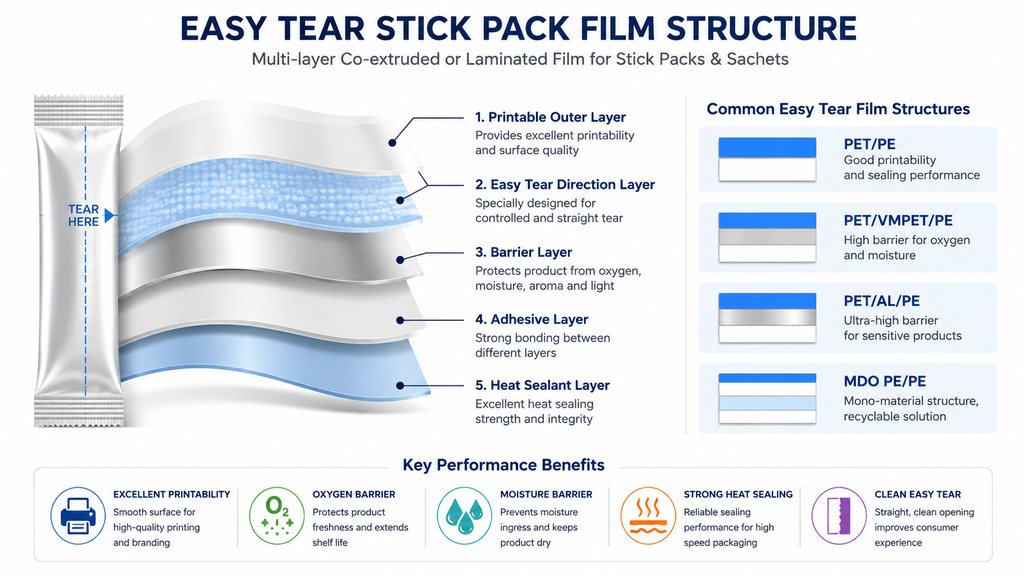
Stick pack and sachet films are usually laminated structures. Each layer has a function. The outer layer may provide printability, stiffness, heat resistance, and tear behavior. The middle layer may provide oxygen, moisture, light, or aroma barrier. The inner layer provides heat sealing and direct product contact performance.
For many projects, buyers start with Easy Tear Film when they need a general easy-open packaging material that can be customized in PE, PP, PET, or laminated structures. For projects requiring higher clarity, strength, and premium printing, PET Easy Tear Film is often considered because PET provides excellent dimensional stability and a smooth printing surface.
PET-Based Easy Tear Laminates
PET is widely used as an outer layer for stick packs and sachets because it offers clarity, stiffness, tensile strength, heat resistance, and printability. When an easy tear PET layer is combined with a suitable sealant, it can support clean opening while still giving the pack a premium appearance. PET-based structures are common for coffee powder, instant beverage powder, nutritional powder, medical powder, and personal-care sachets.
BOPP Or PP-Based Easy Tear Laminates
BOPP and PP-based structures can be useful where stiffness, clarity, cost efficiency, and good machinability are needed. PP-based easy tear options may also fit some snack, seasoning, soup powder, or dry food sachets. The structure should be tested carefully because PP film stiffness and tear behavior can vary depending on orientation and laminate design.
PE-Based Easy Tear And Mono-PE Structures
PE is flexible and sealable, which makes it important for the inner layer of many stick pack and sachet films. For recyclable-oriented packaging, PE-based designs are receiving more attention. MDO PE Film can help create higher stiffness and better printability in PE-rich structures, while still supporting a mono-PE packaging direction when combined with compatible PE sealant layers.
High-Barrier Laminates
Many stick packs need strong barrier because the product is sensitive to moisture, oxygen, aroma loss, oil, or light. Coffee powder, probiotics, vitamins, electrolytes, protein powder, pharmaceutical powders, and sauces may require high-barrier structures. In such cases, the easy tear layer must be combined with the correct barrier layer and sealant layer.
Typical Easy Tear Film Structures For Stick Packs And Sachets
There is no single universal structure for every product. The correct structure depends on the product type, shelf-life target, filling process, storage condition, and market requirement. However, several structure directions are common in B2B flexible packaging projects.
PET / PE
This structure is often used when the product needs good printing, stiffness, clean appearance, and reliable heat sealing. PET works as the printable outer web, while PE provides sealability. For dry powders, samples, and light products, this can be a practical starting point.
PET / VMPET / PE
This structure adds a metallized PET barrier layer for better oxygen, moisture, light, and aroma protection. It is commonly considered for coffee powder, dry beverage mixes, seasoning, and products that need improved shelf life and strong shelf appearance.
PET / AL / PE
Aluminum foil laminates provide strong barrier and are often used for highly sensitive powders, pharmaceuticals, nutraceuticals, diagnostic products, and long shelf-life food ingredients. The challenge is to keep the pack easy to open while protecting the foil layer from cracking or uncontrolled tearing.
BOPP / PE Or BOPP / CPP
These structures can be used for some snack, candy, granule, or dry food sachets where high clarity, stiffness, and cost control are important. The final choice depends on sealing temperature, packing speed, and the required tear direction.
MDO PE / PE
For buyers moving toward recyclable packaging, MDO PE / PE is an important structure family. It can offer a PE-based material direction with improved stiffness and printability. For easy tear applications, the film design must be tested carefully because PE-rich structures can be more stretchable than conventional PET-based laminates.
Applications: Which Products Need Easy Tear Stick Packs And Sachets?
Easy tear film is especially valuable when the pack is small, single-use, and opened directly by the consumer. The less space the pack has, the more important the opening design becomes. A large pouch can include a zipper, corner cut, or tear notch with more tolerance. A small sachet has very little area for error.
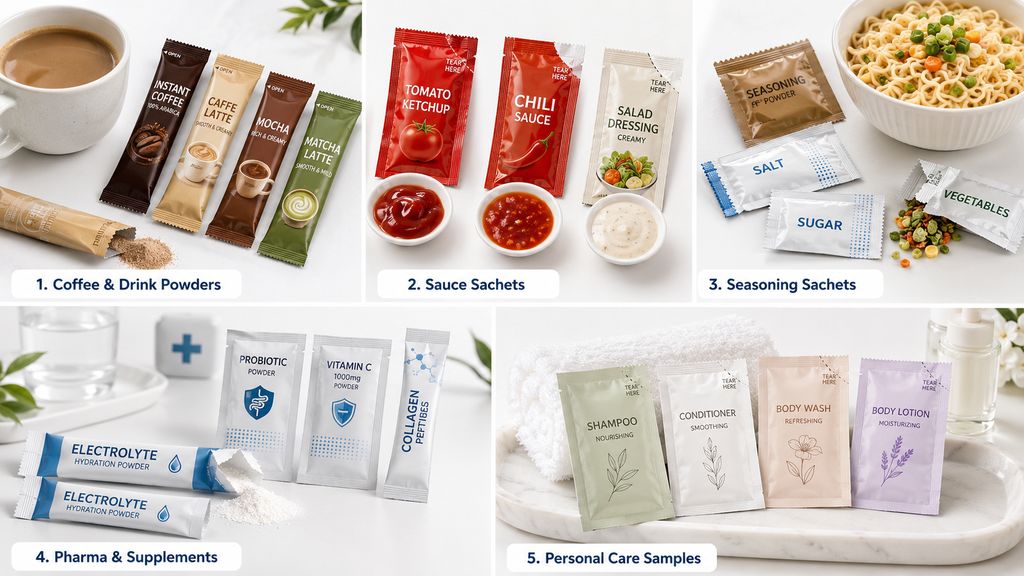
Instant Coffee, Drink Powder, And Nutritional Powder
Coffee, milk powder, electrolyte powder, collagen powder, protein powder, and meal replacement powder require clean pouring. A bad tear can make the powder cling to the opening or spill onto the table. The film should open across the top or side without creating a narrow, blocked, or irregular opening.
Condiments, Sauces, And Pastes
Ketchup, chili sauce, mayonnaise, salad dressing, soy sauce, honey, and other liquid or semi-liquid products need a controlled opening. The seal must resist pressure during transport, but the tear should still be easy for the user. Oil resistance, sealing reliability, and barrier performance may become important depending on the formula.
Seasoning, Sugar, Salt, And Granules
Seasoning sachets are common in instant noodles, ready meals, snacks, and foodservice packs. The film must be easy to open quickly and cleanly, especially in kitchens and food preparation environments. Static control, powder release, and seal contamination resistance may also need attention.
Pharmaceutical, Nutraceutical, And Healthcare Products
Powder medicine, oral rehydration salts, probiotics, diagnostic powder packs, and healthcare supplements often need strong protection and predictable opening. In these markets, the supplier may also need to support documentation, traceability, and strict quality consistency from batch to batch.
Cosmetic, Personal Care, And Hotel Samples
Shampoo sachets, cream samples, facial cleanser sachets, wet wipe packs, and lotion samples need a pleasant consumer experience. Easy tear opening helps the user open the pack without sharp tools, while the film structure must protect fragrance, moisture, and texture.
Easy Tear Film For High-Speed Stick Pack Machines
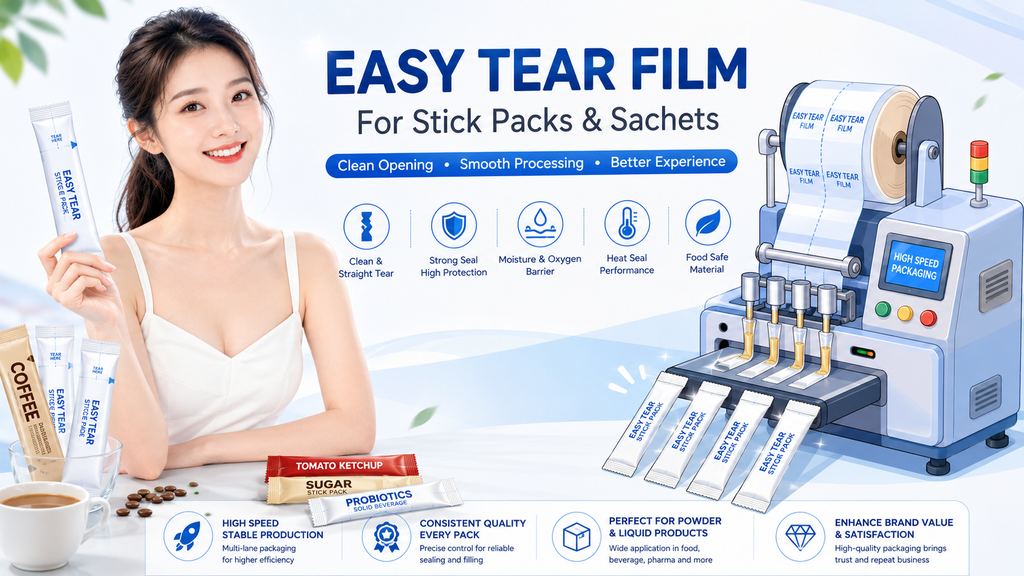
A stick pack film is not selected only by hand feel. It must also run well on the packing line. Many stick packs are produced on vertical form-fill-seal machines that form multiple narrow lanes at the same time. This creates special demands for roll flatness, tension stability, coefficient of friction, sealing consistency, and slitting accuracy.
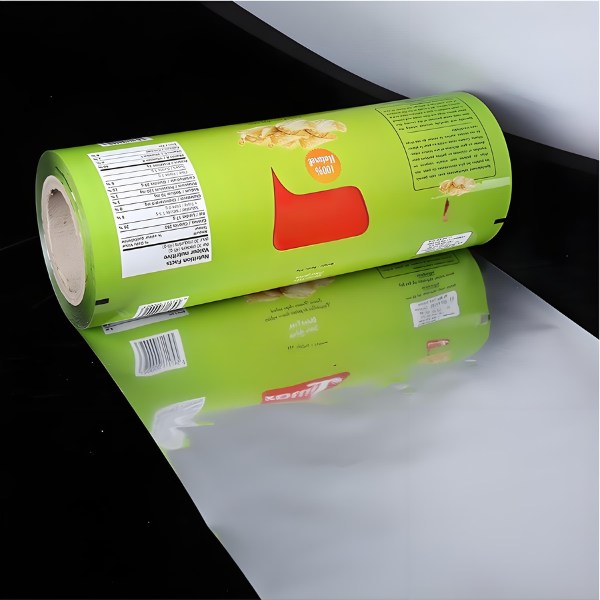
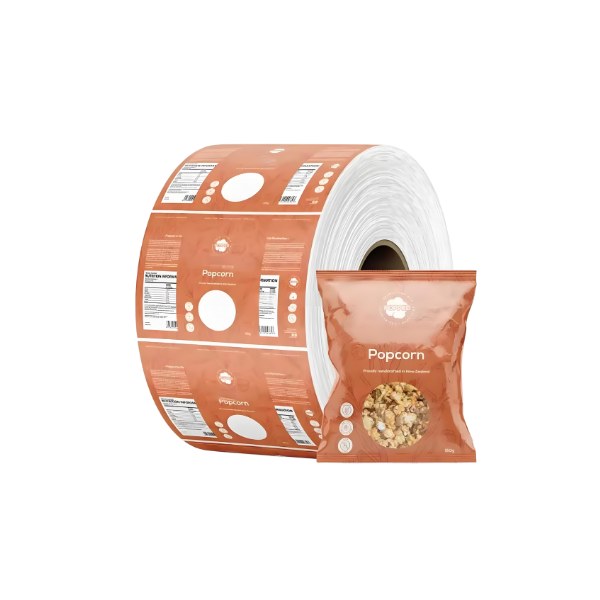
Roll Stock is often the practical supply format for stick packs and sachets because it allows converters and co-packers to form, fill, and seal packs continuously on VFFS, HFFS, or flow-wrap lines. When easy tear function is added to roll stock, the supplier should control not only the laminate structure but also the roll width, core size, winding direction, splice quality, roll diameter, and packaging method.
Roll Flatness And Tension Control
If the film roll has wrinkles, telescoping, blocking, or uneven winding, the machine may experience tracking issues. On multi-lane stick pack lines, even small variations can affect registration, seal position, cutting accuracy, and final pack appearance.
Sealing Temperature And Dwell Time
The easy tear film must seal within the machine’s available temperature range. If the sealing window is too narrow, operators may need to raise temperature and risk film shrinkage, distortion, ink damage, or seal brittleness. A well-designed sealant layer helps maintain production stability.
Print Registration And Eye Mark Accuracy
Printed stick packs need accurate registration so that the tear notch, design elements, product information, and cutting position align correctly. The film should offer good dimensional stability through printing, lamination, slitting, and packing.
Cutting And Notch Quality
The tear function often starts at the notch or cut. If the notch is too shallow, consumers may struggle to start the tear. If it is too deep, the pack may tear during production or transport. The notch location must also avoid weakening the seal area in a way that creates leakage.
Easy Tear Vs Easy Peel: Do Not Confuse The Two
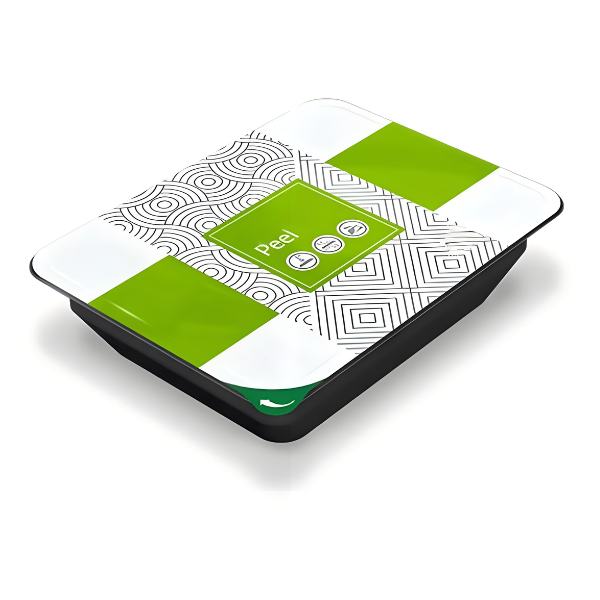
Easy tear and easy peel are related to easy opening, but they are not the same packaging function. Easy tear means the flexible pack itself can be torn open by hand, usually from a notch or designed tear area. Easy peel means a lidding film can be peeled away from a tray, cup, or container while maintaining a controlled peel strength.
For stick packs and sachets, easy tear is usually the correct direction because the consumer needs to tear the bag open. For cups, trays, thermoformed packs, dairy products, and ready meal lids, Easy Peel Film may be the better solution because the opening action is peeling, not tearing.
This difference matters during inquiry. If a buyer only says “easy open film,” the supplier should ask whether the pack is a pouch, sachet, stick pack, tray lid, cup lid, or thermoforming pack. A wrong assumption can lead to a film that opens in the wrong way, seals incorrectly, or fails the customer’s machine trial.
Barrier, Shelf Life, And Product Protection
Easy opening should never be designed separately from product protection. Stick packs and sachets are often used for moisture-sensitive and oxygen-sensitive products. Many powders absorb moisture quickly, clump during storage, or lose flavor and active ingredients when exposed to oxygen. Some liquids and sauces require aroma protection, oil resistance, or light barrier.
For stronger protection, buyers can consider structures using metallized films, aluminum foil, EVOH, ALOx, or other high-barrier layers. For co-extruded high-barrier applications, high-barrier co-extruded film can support oxygen and moisture protection in demanding food, pharmaceutical, and sauce packaging projects.
A practical structure decision should answer several questions. Is the product dry, oily, acidic, fragrant, or hygroscopic? Is the target shelf life three months, six months, one year, or longer? Will the product be sold in hot, humid, chilled, frozen, or ambient conditions? Does the market require transparent packaging, metallized appearance, or full light blocking?
The higher the barrier requirement, the more carefully the easy tear design must be tested. For example, foil and metallized layers can provide strong protection, but the tear line must be controlled so that the pack opens cleanly without excessive force or sharp fragments. The laminate bond must also remain stable under storage and transport conditions.
Recyclable Easy Tear Film For Stick Packs And Sachets
Many brands are looking for recyclable or mono-material stick pack and sachet solutions. This is more challenging than conventional multi-material packaging because easy tear, stiffness, barrier, and sealing must be balanced within a narrower material family.
In recyclable-oriented projects, mono-material flexible packaging may use PE-rich or PP-rich structures to improve material compatibility. For finished flexible formats, recyclable mono-material pouches can also help brands develop a broader packaging portfolio beyond stick packs.
For easy tear stick packs, recyclable design should be evaluated case by case. Mono-PE structures can be flexible and sealable, but they may need special orientation, structure design, or easy tear technology to avoid stretching instead of tearing. Mono-PP structures can provide stiffness and clarity, but sealing range and product compatibility must be confirmed. When high barrier is required, a barrier layer may be needed, and the structure should be checked against the target market’s recycling guidelines.
A responsible manufacturer should not promise recyclability only by looking at one film layer. The total laminate structure, ink coverage, adhesives, barrier layer, sealing layer, local collection system, and certification requirements all matter. Buyers should confirm both packaging performance and recyclability claims before commercial launch.
How To Choose An Easy Tear Film Supplier Or Manufacturer
For stick packs and sachets, choosing the right easy tear film supplier is not only about the lowest price. It is about whether the supplier can help you reduce machine trial risk, packaging failures, consumer complaints, and repeat development work.
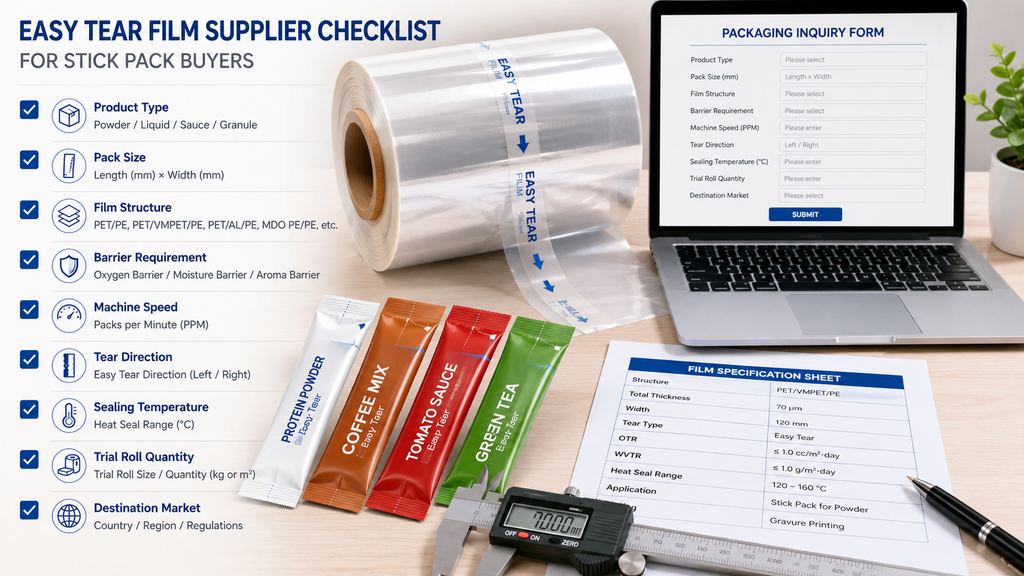
Share The Product Information
Tell the supplier what product will be packed: powder, granules, liquid, paste, oil-based sauce, medical powder, supplement, or cosmetic sample. The product determines the required barrier, sealant, film stiffness, and contamination resistance.
Confirm The Packaging Format
State whether the pack is a stick pack, four-side seal sachet, three-side seal sachet, pillow pack, flow pack, or small pouch. The film width, roll direction, notch position, and sealing jaw design will depend on the format.
Provide Machine Details
Share the machine type, number of lanes, running speed, sealing temperature range, filling temperature, pack dimensions, roll core size, maximum roll diameter, and winding direction. These details help the supplier recommend a film that can run smoothly, not just look good in a lab sample.
Define Opening Performance
Explain where the consumer will tear the pack and how the opening should look. For powders, a wider opening may be needed for pouring. For liquids, a smaller controlled opening may be better. For children, seniors, or outdoor use, the opening force should be comfortable and predictable.
Request Samples And Trial Rolls
A4 sheets can help check appearance, hand feel, and basic tear direction. Trial rolls are more useful for machine evaluation because they show real sealing, cutting, feeding, and registration behavior. For serious projects, pilot production is usually the best way to confirm performance.
Common Problems And How To Solve Them
Even when a film is called easy tear film, problems can still happen if the structure, notch, machine, and product are not aligned. The most common issues are poor tear initiation, crooked tearing, accidental tearing, leakage, sealing failure, powder contamination in the seal, and poor machine running.
The Pack Is Difficult To Start Tearing
This may happen when the notch is too shallow, the film is too tough in the opening direction, or the seal area is too thick. Solutions may include adjusting notch depth, changing the tear layer, adding laser scoring, or modifying the pack design.
The Tear Runs Crooked
Crooked tearing may come from poor directional tear control, uneven laminate tension, incorrect notch position, or a mismatch between the film orientation and pack layout. The supplier should review the machine direction, transverse direction, and artwork orientation before changing the film.
The Film Tears During Production
If the film breaks during running, the easy tear function may be too aggressive, the film tension may be too high, or the slit edge may be damaged. The solution may involve stronger outer layers, better roll winding, cleaner slitting, lower tension, or different notch timing.
The Sachet Leaks After Sealing
Leakage may be caused by seal contamination, insufficient sealing temperature, too short dwell time, poor sealant selection, or excessive product pressure. In powder filling, fine particles can enter the seal area. A sealant layer with better hot tack and contamination resistance may be required.
The Opening Looks Messy
A messy opening may not always be a film failure. It can also be related to user opening direction, notch placement, pack shape, or excessive seal width. The best solution is to test several notch positions and tear directions before mass production.
FAQ About Easy Tear Film For Stick Packs And Sachets
1. What is easy tear film for stick packs and sachets?
Easy tear film is a flexible packaging film designed to open by hand more easily and cleanly than ordinary film. In stick packs and sachets, it is used to create a convenient opening from a notch, cut line, laser score, or directional tear structure.
2. Is easy tear film the same as easy peel film?
No. Easy tear film is torn open from the flexible pack itself. Easy peel film is peeled away from a tray, cup, or container. Stick packs and sachets usually need easy tear film, while tray lids usually need easy peel film.
3. Which products commonly use easy tear sachets?
Common products include coffee powder, drink powder, protein powder, probiotics, seasoning, sugar, salt, ketchup, sauces, shampoo samples, cosmetic samples, pharmaceutical powders, and nutraceutical stick packs.
4. Can easy tear film be used for liquid sachets?
Yes, but the structure must provide reliable sealing, puncture resistance, oil or chemical resistance when needed, and a controlled opening shape. Liquids and sauces usually need more careful testing than dry powders.
5. Can easy tear film be high barrier?
Yes. Easy tear function can be combined with barrier layers such as metallized film, aluminum foil, EVOH, ALOx, or other barrier materials. The correct structure depends on the product and shelf-life target.
6. What is the best film structure for coffee stick packs?
Coffee often needs aroma, oxygen, moisture, and light protection. Common options may include PET/VMPET/PE or PET/AL/PE, but the final structure should be chosen based on shelf life, filling process, appearance, and cost target.
7. What is the best film structure for powder sachets?
For simple dry powders, PET/PE may be enough. For moisture-sensitive or oxygen-sensitive powders, a metallized, foil, or EVOH-containing structure may be needed.
8. Can easy tear film be printed?
Yes. Many easy tear films are supplied as printed roll stock. Reverse printing on PET or BOPP outer layers is common for stick packs and sachets because it protects the ink inside the laminate.
9. Does easy tear film require a notch?
In most stick packs and sachets, a notch is recommended because it gives the consumer a clear starting point. Some materials can tear easily from an edge, but a notch improves consistency.
10. Can laser scoring be used with easy tear film?
Yes. Laser scoring can help create a controlled tear line, especially when the laminate structure is strong. However, laser scoring must be tested carefully so it does not weaken the pack too much or damage barrier performance.
11. Can recyclable easy tear film be made?
Yes, but it requires careful structure design. Mono-PE or mono-PP structures may be possible, but the supplier must balance recyclability, stiffness, sealing, tear behavior, and barrier requirements.
12. What information should I provide for a quotation?
Provide product type, pack size, film width, thickness target, structure if known, barrier requirement, printing design, sealing machine, running speed, roll core size, quantity, destination port or country, and whether samples or trial rolls are needed.
13. How can I test easy tear performance?
You can test hand opening, tear direction, opening force, powder pouring, liquid squeezing, seal strength, drop resistance, aging after storage, and machine running behavior. A full trial should include both consumer opening tests and packing line tests.
14. Why does my sachet tear crookedly?
Crooked tearing may be caused by film orientation, notch position, laminate imbalance, excessive seal width, wrong opening direction, or poor slit edge quality. The supplier should review the full pack layout before recommending changes.
15. Can easy tear film be used on high-speed multi-lane machines?
Yes, but the film must have stable thickness, good roll flatness, suitable COF, accurate slitting, correct winding direction, and a sealing layer matched to the machine speed and temperature range.
16. What is the difference between a sample sheet and a trial roll?
A sample sheet is useful for basic evaluation, while a trial roll is necessary for checking real machine performance. For stick packs and sachets, trial rolls are strongly recommended before commercial orders.
17. Can easy tear film be used for pharmaceutical packaging?
Yes, but the film must meet the required protection, sealing, cleanliness, documentation, and quality consistency standards for the target market. Pharmaceutical projects usually need stricter validation than ordinary food packaging.
18. How do I choose a reliable easy tear film manufacturer?
Choose a manufacturer or supplier that can discuss structure design, barrier needs, tear direction, machine parameters, samples, trial rolls, quality control, documentation, and long-term supply. A good partner should solve the total packaging problem, not only sell film rolls.
Conclusion: Make Small Packs Easier To Open And Safer To Run
Easy tear film plays a critical role in stick packs and sachets because it directly affects consumer convenience, product protection, and production efficiency. A well-designed film should open cleanly by hand, protect the product during shelf life, seal reliably on the machine, and support the brand’s packaging goals.
For buyers, the best way to start is to define the product, pack format, machine details, tear direction, barrier requirement, and sample plan. From there, an experienced easy tear film supplier can recommend a suitable structure, provide samples, support machine trials, and help move the project toward stable mass production.
If you are developing stick packs or sachets for powders, condiments, sauces, pharmaceuticals, supplements, or personal-care products, CloudFilm can help you evaluate easy tear film options, custom roll stock specifications, high-barrier structures, and recyclable-oriented packaging directions for your project.