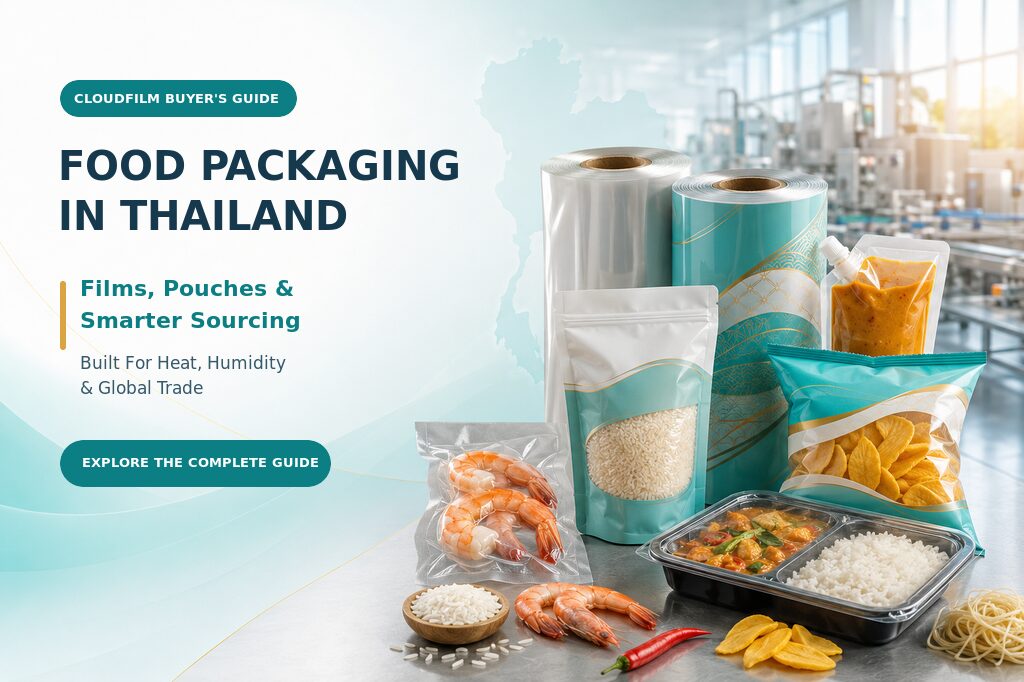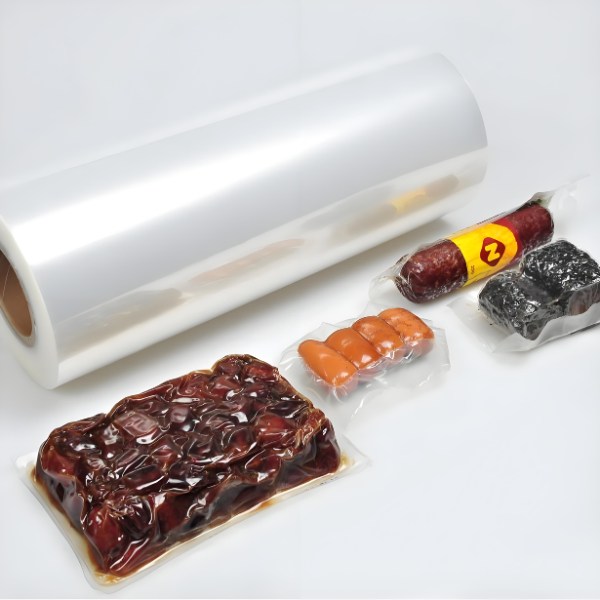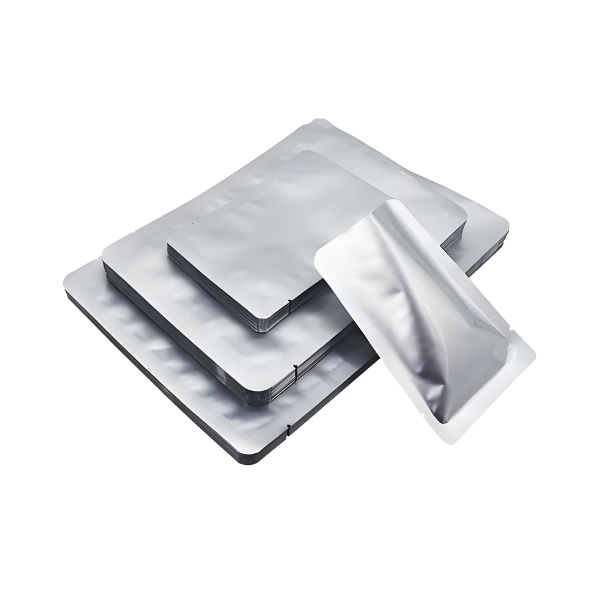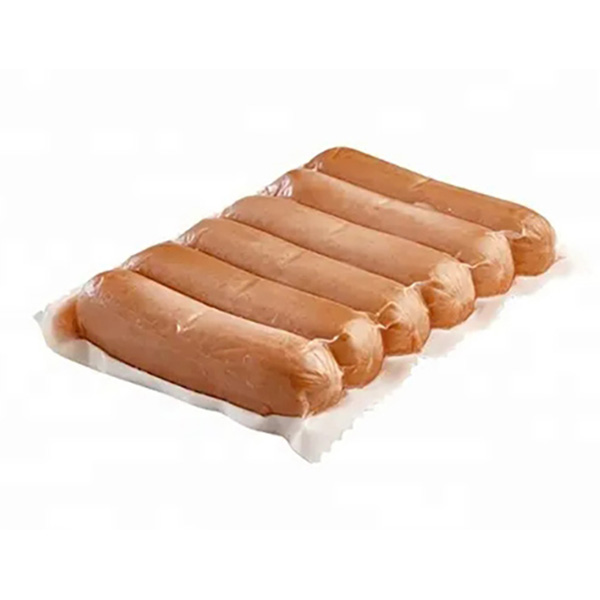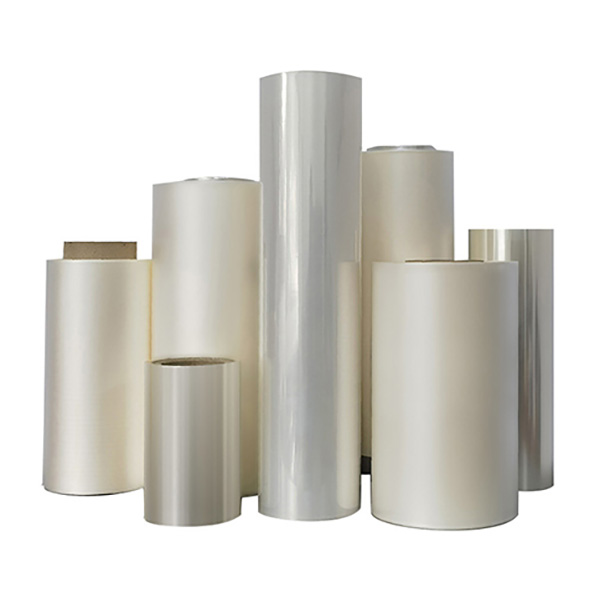
Retort pouches are widely used for ready meals, sauces, soups, seafood, meat products, wet pet food, baby food, and other products that need long shelf life after heat sterilization. Compared with rigid cans and glass jars, retort pouches are lighter, easier to transport, more convenient to open, and more flexible for modern retail packaging.
However, a retort pouch is not just a simple plastic bag. It is a carefully engineered laminate structure. Each layer has a specific job: printing appearance, mechanical strength, barrier protection, heat resistance, seal integrity, and food contact safety. Among these layers, BOPA film is often selected when the packaging needs excellent puncture resistance, toughness, flexibility, and strong performance after high-temperature processing.
For brand owners, food factories, packaging converters, and procurement teams, understanding how BOPA film works in retort pouches can help reduce packaging failures, improve shelf life, and choose a more reliable supplier or manufacturer.
What Is BOPA Film?
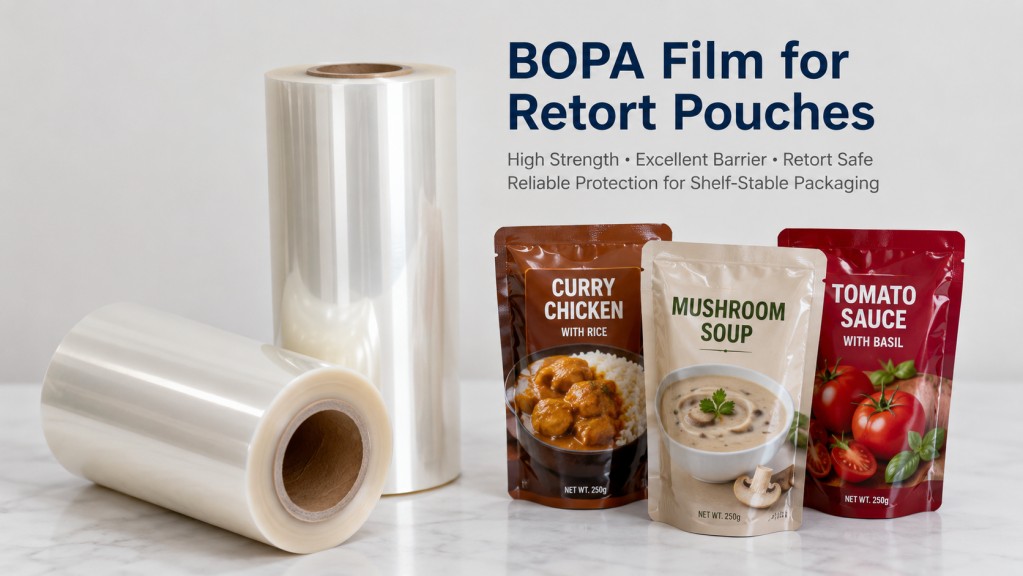
BOPA film means Biaxially Oriented Polyamide Film. It is also commonly called nylon film or BOPA nylon film in the flexible packaging industry. During production, polyamide material is stretched in both machine and transverse directions. This biaxial orientation improves strength, puncture resistance, dimensional stability, and barrier performance.
In retort pouch packaging, BOPA film is not normally used alone. It is usually laminated with other materials such as PET, aluminum foil, CPP, RCPP, PE, or high-barrier layers. The final structure depends on the product, retort temperature, shelf-life requirement, filling process, and desired appearance.
If you need a general introduction to BOPA material, you can also read CloudFilm’s BOPA film product page for available film solutions and typical packaging applications.
Why BOPA Film Is Used In Retort Pouches
Retort packaging must survive heat, pressure, moisture, filling stress, handling, transportation, and shelf display. A weak pouch structure can lead to delamination, pinholes, leakage, seal failure, deformation, or shorter shelf life.
BOPA film is useful in retort pouches because it brings several important advantages.
First, BOPA film provides high puncture resistance. This is important for products with bones, sharp edges, hard particles, seafood shells, frozen ingredients, rice grains, vegetables, or dense wet pet food. During filling, sterilization, cooling, and transportation, the pouch may face pressure from inside and outside. A strong nylon layer helps reduce the risk of puncture damage.
Second, BOPA film provides excellent toughness and flexibility. Retort pouches need to bend, expand, shrink, and recover during processing. BOPA helps the laminate absorb stress and remain stable.
Third, BOPA film offers good oxygen barrier performance compared with many general packaging films. In many food applications, oxygen control is important for flavor, color, aroma, oil stability, and shelf life.
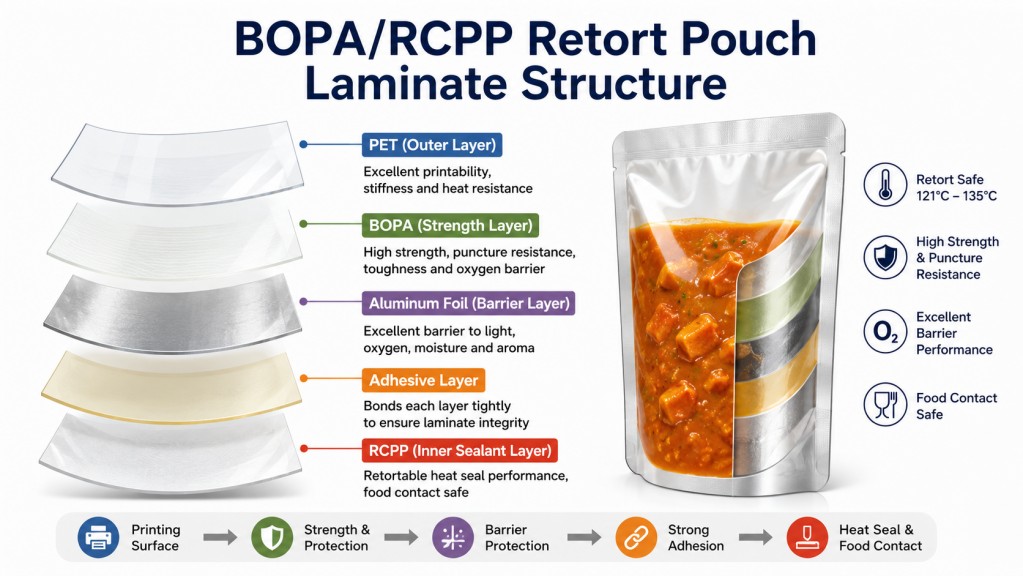
Fourth, BOPA film performs well in laminated structures for high-temperature food packaging when it is combined with a suitable retort-grade sealing layer such as RCPP. For this reason, it is widely used in structures such as PET/BOPA/RCPP, PET/NY/RCPP, BOPA/RCPP, and other custom high-barrier laminates.
For more background about BOPA uses and material selection, you can refer to CloudFilm’s guide on BOPA film applications and future trends.
Common BOPA Film Retort Pouch Structures
A retort pouch structure should be designed according to the product and sterilization conditions. There is no single “best” structure for all products. However, several common structures are widely used in the market.
| Structure | Typical Use | Main Benefit |
|---|---|---|
| BOPA/RCPP | Transparent retort pouches, lightweight applications | Good toughness, sealing, and clarity |
| PET/BOPA/RCPP | Ready meals, sauces, soups, seafood, pet food | Better stiffness, printability, puncture resistance, and sealing |
| PET/AL/RCPP | Long shelf-life food, high barrier products | Excellent light, oxygen, and moisture barrier |
| PET/BOPA/AL/RCPP | Heavy-duty retort pouches, high-value food | Strong mechanical support and high barrier protection |
| BOPA/AL/RCPP | High-barrier retort applications | Strong toughness with aluminum barrier |
| PET/BOPA/CPP | Boil or semi-retort applications | Balanced strength and heat-seal performance |
In many retort pouch structures, RCPP works as the inner heat-sealing layer. It contacts the product directly and must maintain seal strength after sterilization. CloudFilm supplies retortable CPP film for high-temperature retort pouches and other steam-sterilization packaging.
BOPA Film And RCPP: A Strong Combination For Retort Packaging
BOPA and RCPP often work together in retort pouch structures. BOPA provides toughness, puncture resistance, and mechanical support, while RCPP provides heat sealing and food contact performance.
During retort sterilization, the pouch goes through heating, pressure, and cooling. The sealing layer must resist hot water or steam, while the structural layers must resist distortion and delamination. If the inner layer is not suitable for retort conditions, the pouch can leak. If the outer or middle layer is not strong enough, the pouch can deform or break.
That is why a retort pouch manufacturer or film supplier must not only provide the film, but also understand the total laminate structure. The adhesive system, ink system, film surface treatment, lamination process, curing time, pouch-making process, and final sterilization conditions all affect the final result.
For buyers who need a complete pouch instead of roll film, CloudFilm also supplies retort pouches for ready meals, pet food, seafood, soups, sauces, and medical packaging applications.
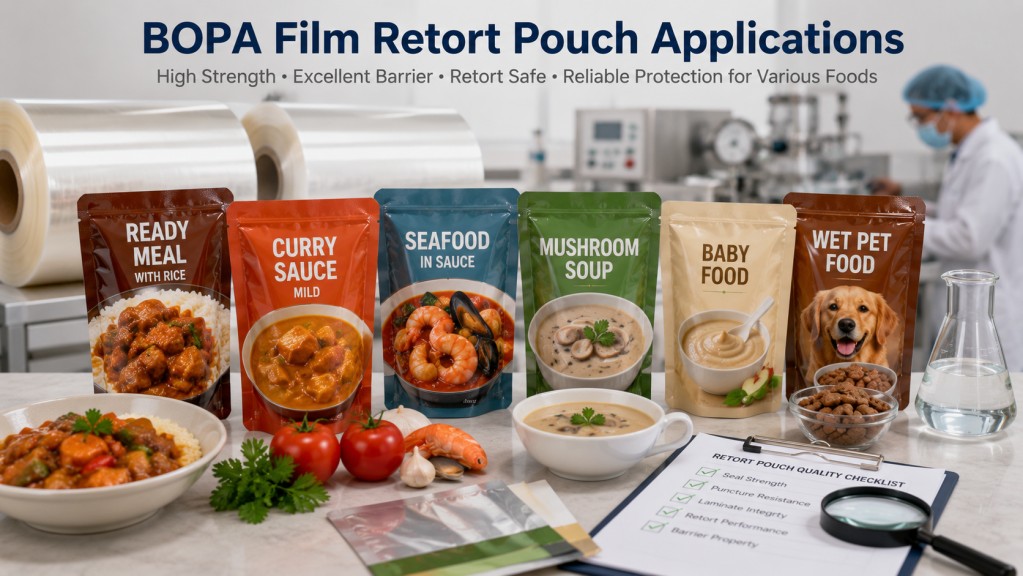
Main Applications Of BOPA Film For Retort Pouches
BOPA film for retort pouches is used across many food and non-food markets. The following applications are especially common.
Ready-To-Eat Meals
Ready meals often contain rice, meat, vegetables, sauces, oil, and seasonings. These ingredients create a demanding packaging environment. The pouch must resist heat, pressure, and product stress while keeping the food stable during shelf life.
PET/BOPA/RCPP or PET/AL/RCPP structures are often considered depending on whether the product needs transparent packaging or high light barrier protection.
Soups, Sauces And Liquid Foods
Liquid foods put pressure on seals and corners. They can also be oily, acidic, or salty. BOPA helps improve pouch toughness and reduces the risk of flex cracking or puncture during filling and transportation.
For tomato sauce, curry sauce, soup base, broth, chili sauce, and other liquid foods, pouch structure should be selected carefully based on acidity, oil content, filling temperature, and target shelf life.
Wet Pet Food
Wet pet food often requires strong pouches because the product can be heavy, oily, and dense. Some pet food contains chunks, bones, or hard particles. BOPA film helps improve puncture resistance and drop resistance, especially for larger pouches.
For pet food brands that need custom pouch formats, CloudFilm’s flexible packaging solutions can support structure design, roll film, and pouch packaging options.
Seafood And Meat Products
Seafood and meat products often need oxygen control, puncture resistance, and strong seal performance. Fish bones, shells, meat edges, and frozen product corners can damage weak films. BOPA film is a practical layer for improving mechanical protection.
Baby Food And Medical Nutrition
Baby food and medical nutrition packaging require careful material selection, stable processing, and reliable sealing. Depending on the product and regulation requirements, a transparent or aluminum-containing retort structure may be selected.
Industrial And Special Applications
Although food is the most common market, some chemical, pharmaceutical, and industrial products may also use retortable or heat-resistant pouch structures. In these cases, chemical resistance, seal strength, and barrier needs must be reviewed before final structure confirmation.
How To Choose The Right BOPA Film Thickness
BOPA film thickness should be selected based on product weight, pouch size, sterilization process, filling speed, puncture risk, and target shelf life. In many flexible packaging applications, BOPA is used in thicknesses around 10–25 microns, but the final choice depends on actual project conditions.
A small sauce pouch may not need the same BOPA thickness as a large wet pet food pouch. A transparent pouch may need a different structure from an aluminum foil pouch. A product with sharp bones or shells may need stronger mechanical protection than a smooth soup pouch.
When discussing BOPA film thickness with a supplier, buyers should prepare the following information:
- Product type and ingredients
- Filling weight per pouch
- Pouch size and pouch format
- Retort temperature and time
- Filling temperature
- Target shelf life
- Required barrier level
- Whether the pouch should be transparent or opaque
- Printing requirements
- Packing machine type
- Expected order quantity
With this information, a professional BOPA film manufacturer or retort pouch supplier can recommend a more accurate structure instead of only quoting a basic film grade.
For buyers comparing different packaging films, CloudFilm’s BOPA film usage and benefits article can help explain how BOPA works with PE, CPP, PET, and other materials.
Transparent Retort Pouches Vs Aluminum Foil Retort Pouches
One common question is whether a retort pouch should be transparent or aluminum-based.
Transparent retort pouches often use structures such as BOPA/RCPP, PET/BOPA/RCPP, or PET/CPP. Their main advantage is product visibility. Consumers can see the food inside, which can be useful for seafood, rice, vegetables, sauces, and premium ready meals. Transparent packaging also gives a clean and modern appearance.
However, transparent structures may not provide the same light and oxygen barrier as aluminum foil laminates. For products that are very sensitive to light, oxygen, aroma loss, or long-term storage, aluminum foil structures may be preferred.
Aluminum foil retort pouches, such as PET/AL/RCPP or PET/BOPA/AL/RCPP, provide stronger light and gas barrier performance. They are widely used for long shelf-life ready meals, wet pet food, high-fat foods, and products that need better protection from oxidation.
The right choice depends on the product. If product visibility is important and the shelf-life requirement is moderate, a transparent BOPA-based structure may be suitable. If maximum barrier protection is more important, an aluminum-containing structure may be safer.
For broader barrier material options, you can review CloudFilm’s high barrier films page.
Key Performance Requirements For BOPA Retort Pouch Film
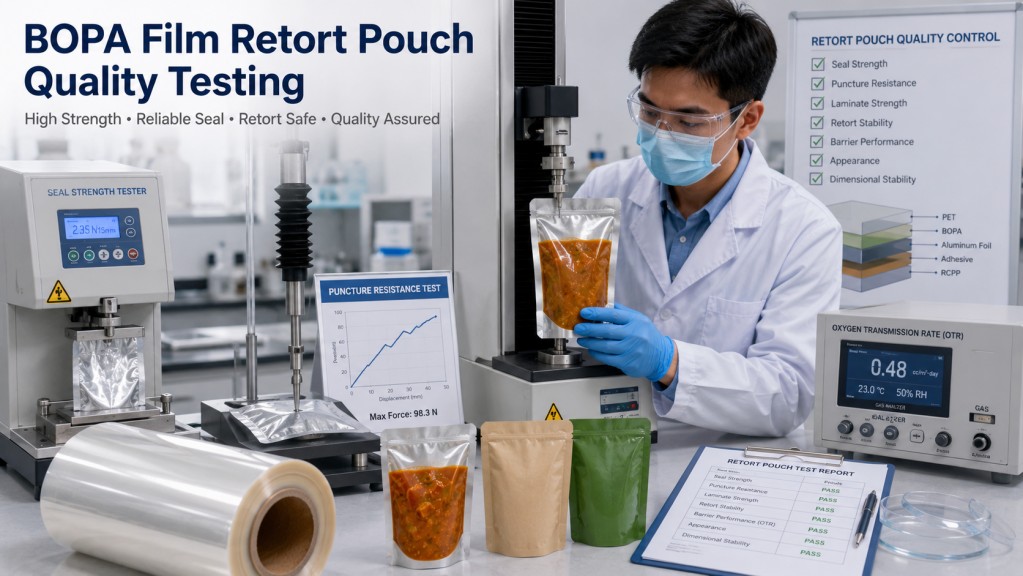
A good BOPA retort pouch film should not only look good before lamination. It must perform well through the full packaging process.
1. Heat Resistance
The material must remain stable during retort sterilization. The exact temperature and time depend on the product and process. Common retort conditions include 121°C and higher-temperature processes up to around 135°C, depending on the structure and material grade.
2. Puncture Resistance
Puncture resistance is one of the main reasons buyers choose BOPA film. It helps protect the pouch from hard contents, sharp edges, transportation impact, and pouch handling.
3. Lamination Strength
BOPA film must bond well with adhesives and other layers. Poor lamination can cause delamination after retort processing, especially under heat, moisture, and pressure.
4. Dimensional Stability
The pouch should remain flat and attractive after sterilization. Excessive shrinkage, curling, or deformation can reduce shelf appeal and create problems in secondary packaging.
5. Seal Integrity
Although BOPA is not normally the sealing layer, it supports the whole laminate. The inner RCPP or CPP layer must create strong seals, while the total structure must resist retort pressure.
6. Food Contact Safety
All materials in the final structure should meet the required food-contact standards for the target market. This should be confirmed before commercial production.
Common Problems In Retort Pouches And How BOPA Helps
Retort pouches can fail for many reasons. Choosing the right BOPA film and laminate structure can reduce several common risks.
Pouch Puncture
Puncture can happen during filling, vacuum packing, sterilization, boxing, or transportation. BOPA adds toughness and helps improve the pouch’s ability to resist sharp or hard product contents.
Delamination
Delamination may occur when film layers separate after retort processing. This can be related to adhesive selection, surface treatment, curing, moisture, temperature, or product chemistry. BOPA must be matched with the correct adhesive and lamination process.
Seal Failure
Seal failure is usually related to the sealing layer, contamination in the seal area, sealing temperature, pressure, dwell time, or pouch design. BOPA supports structure strength, but RCPP or CPP selection is still critical.
Poor Shelf Appearance
Wrinkles, curling, and deformation can make a pouch look low quality. Proper material selection and processing control help improve pouch flatness after retort.
Short Shelf Life
If the barrier level is not enough, oxygen, moisture, or aroma loss can affect the product. BOPA improves oxygen barrier compared with many general packaging films, but some products may still need aluminum foil, EVOH, PVDC, or other high-barrier materials.
How To Work With A BOPA Film Supplier Or Retort Pouch Manufacturer
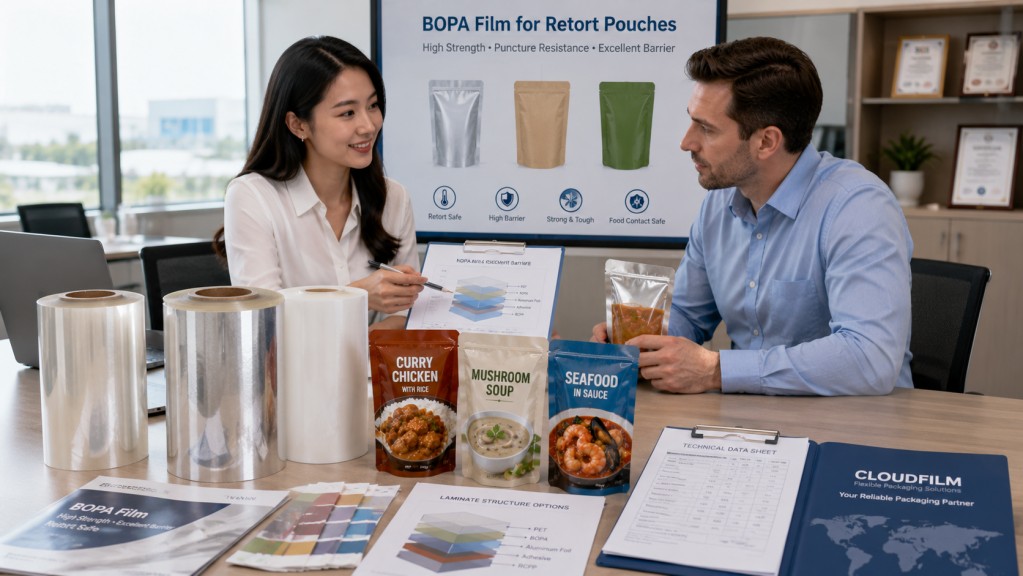
A professional supplier should not only ask for thickness and width. For retort packaging, the supplier should understand the real application.
Before asking for a quotation, it is better to prepare a simple technical brief. This can include product type, pouch size, filling weight, retort conditions, shelf-life target, packaging format, printing needs, and annual demand.
A reliable BOPA film supplier should be able to discuss:
- Film grade and thickness
- Surface treatment
- Lamination structure
- Compatible sealing layer
- Retort temperature range
- Barrier requirements
- Pouch-making performance
- Sampling plan
- MOQ and lead time
- Export packing and shipping
For example, if you only say “we need BOPA film for retort pouches,” the supplier may not know whether you need transparent pouch film, aluminum foil retort structure, roll stock for lamination, or finished pouches. But if you provide full product details, the supplier can recommend a more practical solution.
CloudFilm works as a flexible packaging film manufacturer and supplier for BOPA film, CPP film, retort CPP film, PET/CPP laminated film, retort pouches, and other high-performance packaging materials. If your project involves both film selection and pouch structure, you can also consider CloudFilm’s PET/CPP laminated packaging film for related retort, food, pharmaceutical, and industrial applications.
What Information Should Buyers Provide For A Quote?
To get an accurate quote for BOPA film for retort pouches, buyers should provide more than just “price per kilogram.” Retort pouch projects are technical, and the final price depends on film type, structure, thickness, width, order quantity, printing, lamination, pouch format, and testing requirements.
Here is a useful checklist:
- Product to be packed
- Liquid, solid, powder, paste, or mixed contents
- Product weight per pouch
- Pouch style: flat pouch, stand-up pouch, three-side seal pouch, shaped pouch, or roll stock
- Required structure, if known
- Required film width and roll length
- Retort temperature and time
- Shelf-life target
- Transparent or opaque appearance
- Printing colors and artwork
- Food-contact requirements
- Annual or monthly demand
- Destination country and port
The more complete the information, the more accurate the quotation and technical recommendation will be.
Why Choose CloudFilm For BOPA Retort Pouch Film
CloudFilm supplies flexible packaging films and custom pouch solutions for international buyers, converters, and food packaging companies. For BOPA film used in retort pouches, CloudFilm can help buyers review the packaging application and select a suitable starting structure.
Depending on your project, CloudFilm can support BOPA film, RCPP film, CPP film, PET/CPP laminated film, high-barrier structures, and finished retort pouches. This makes it easier for buyers to discuss film performance, structure design, sampling, and bulk production with one packaging partner.
If you are developing a new retort pouch project, improving an existing structure, or looking for a BOPA film manufacturer in China, you can contact CloudFilm through the contact us page.
FAQ About BOPA Film For Retort Pouches
1. What is BOPA film for retort pouches?
BOPA film for retort pouches is a biaxially oriented nylon film used as a strength, puncture-resistant, and barrier layer in laminated retort packaging. It is usually combined with RCPP, CPP, PET, aluminum foil, or other materials.
2. Can BOPA film be used alone for retort pouches?
Usually no. BOPA film is normally laminated with other films. It provides strength and barrier support, while RCPP or CPP provides heat sealing and food contact performance.
3. What is the common structure of BOPA retort pouches?
Common structures include BOPA/RCPP, PET/BOPA/RCPP, PET/NY/RCPP, BOPA/AL/RCPP, and PET/BOPA/AL/RCPP. The final structure depends on product type, retort temperature, barrier needs, and shelf-life target.
4. Is BOPA film suitable for 121°C retort sterilization?
Yes, BOPA film can be used in suitable laminated structures for 121°C retort applications. The full laminate, adhesive, ink, and sealing layer must also be suitable for the sterilization process.
5. Can BOPA film be used for 135°C retort pouches?
It may be used in certain high-temperature retort structures, but the complete material system must be carefully selected and tested. Buyers should confirm temperature, time, product type, and pouch format with the supplier.
6. Why is RCPP used with BOPA film?
RCPP is used as the inner heat-sealing layer in retort pouches. It provides seal strength and retort resistance, while BOPA provides toughness and puncture resistance.
7. Is BOPA film better than PET for retort pouches?
BOPA and PET have different functions. PET offers stiffness, heat resistance, and printability. BOPA offers better toughness and puncture resistance. Many retort structures use both PET and BOPA together.
8. Is BOPA film transparent?
Yes, BOPA film is generally transparent. This makes it suitable for transparent retort pouches when product visibility is needed.
9. Does BOPA film provide oxygen barrier?
Yes, BOPA film provides good oxygen barrier performance compared with many general flexible packaging films. However, for very high barrier needs, aluminum foil, EVOH, PVDC, or other barrier layers may also be required.
10. What products are suitable for BOPA retort pouches?
Typical products include ready meals, sauces, soups, seafood, meat products, wet pet food, baby food, and other heat-sterilized products.
11. What thickness of BOPA film is used for retort pouches?
Common BOPA film thickness depends on the product and structure. Many packaging applications use BOPA in the range of about 10–25 microns, but heavy-duty products may require customized structures.
12. Can BOPA film be printed?
BOPA film can be used in printed laminated structures, but printing is usually done on the appropriate outer layer or treated surface depending on the structure design.
13. What causes delamination after retort?
Delamination can be caused by unsuitable adhesive, poor curing, weak surface treatment, excessive retort conditions, moisture, product chemistry, or incorrect lamination process.
14. How can buyers test BOPA retort pouch film?
Buyers can test seal strength, puncture resistance, lamination strength, oxygen barrier, heat resistance, drop performance, retort stability, and final shelf-life performance.
15. How do I choose a BOPA film supplier?
Choose a supplier that understands retort pouch structures, not just film thickness. A good supplier should discuss application, structure, retort conditions, sealing layer, testing, MOQ, lead time, and export support.
Conclusion
BOPA film is an important material for retort pouches because it improves toughness, puncture resistance, flexibility, and barrier performance in demanding packaging structures. When laminated with RCPP, CPP, PET, aluminum foil, or other high-barrier materials, it can support reliable retort packaging for ready meals, sauces, soups, seafood, meat products, wet pet food, and many other applications.
For buyers, the key is not only choosing a film name. The real goal is to build the right total structure for the product, filling process, sterilization conditions, shelf life, and market requirements.
If you are looking for BOPA film for retort pouches, retort CPP film, high-barrier laminated roll stock, or finished retort pouches, CloudFilm can help you review your packaging needs and develop a practical solution for testing and bulk production.