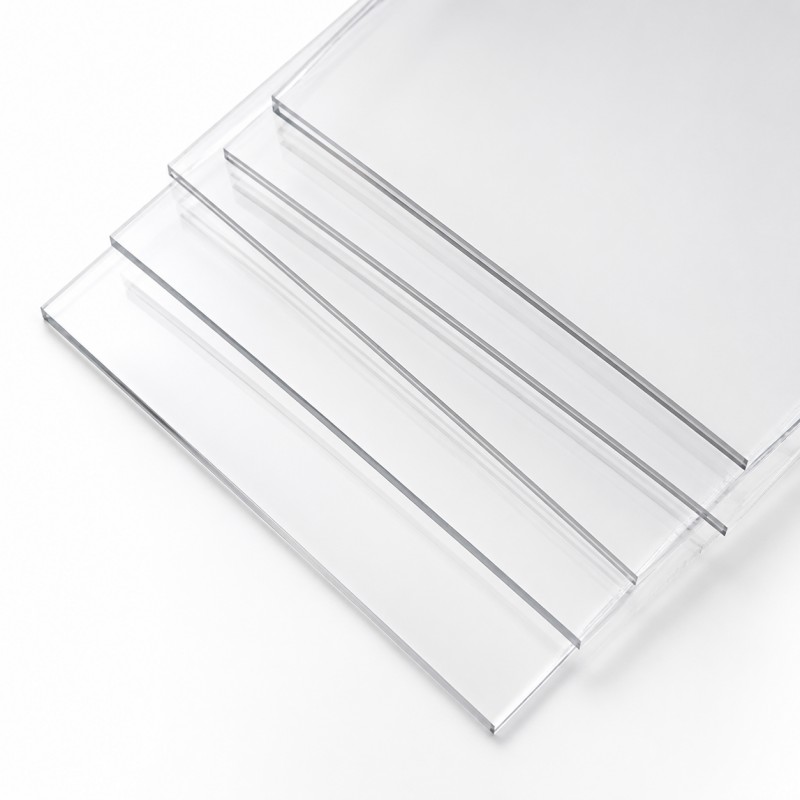
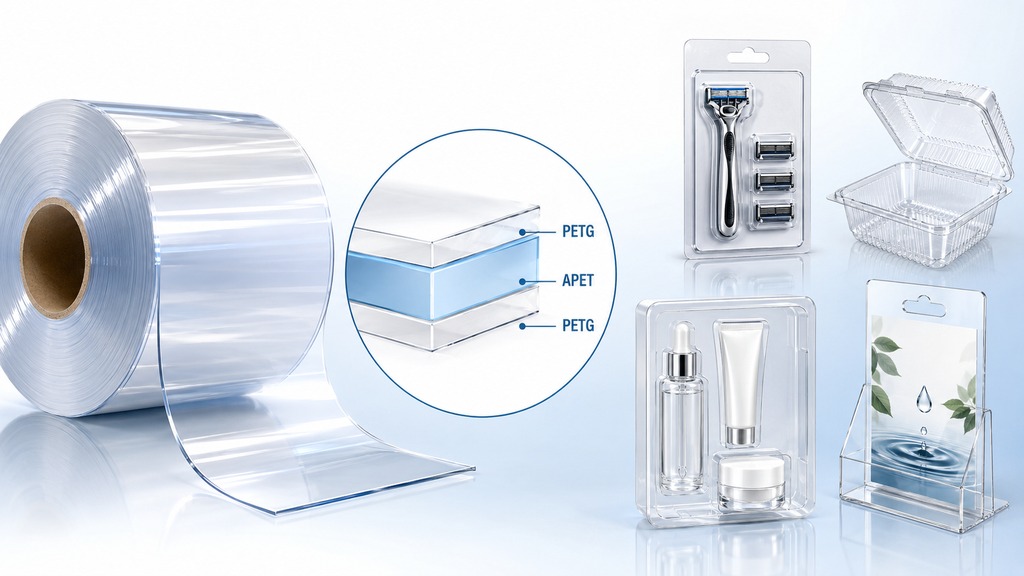
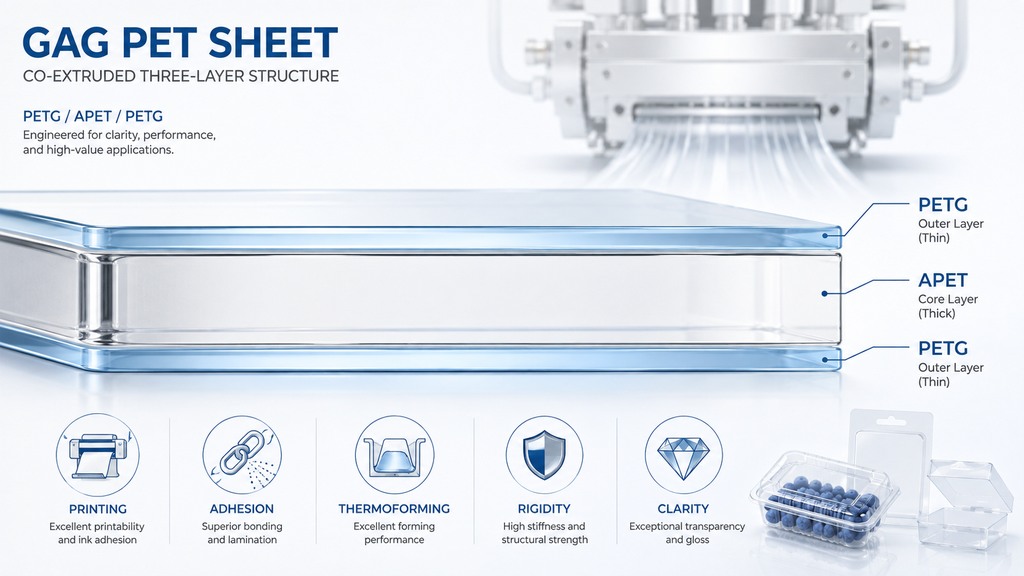
GAG PET sheet is a rigid, transparent, three-layer polyester sheet made with a PETG surface layer, an APET core, and another PETG surface layer. The name “GAG” comes directly from this PETG/APET/PETG construction.
The structure is designed to combine PETG’s processing advantages with APET’s stiffness and economic efficiency. It is commonly supplied in rolls or cut sheets for thermoforming, blister packaging, clamshells, display packaging, folding boxes, trays, and printed plastic components.
For packaging buyers, the important point is that GAG is not simply another name for PETG. It is a co-extruded PET structure whose performance depends on layer design, raw-material quality, thickness consistency, surface condition, and the final forming or converting process.
Buyers who already know their thickness, width, forming depth, sealing method, and end-use conditions can review CloudFilm’s GAG PET sheet product page before requesting samples or a quotation.
What Does GAG Mean in PET Sheet?
The letters describe the three material layers:
- G:PETG outer layer
- A:APET middle layer
- G:PETG outer layer
PETG is a glycol-modified copolyester. It is valued for clarity, toughness, printability, adhesion, and thermoforming behavior. APET is amorphous polyethylene terephthalate, generally selected for clarity, rigidity, dimensional stability, and cost-efficient rigid packaging.
During production, the three molten material streams are combined through a multilayer co-extrusion die. They become one integrated sheet rather than three separately laminated films. Proper layer bonding is essential because the finished material must remain stable during heating, forming, cutting, printing, and handling.
The PETG skins are normally much thinner than the APET core. However, the exact layer ratio should not be assumed. It can vary by supplier, grade, thickness, target performance, and cost requirement.
How the PETG/APET/PETG Structure Works
Each layer performs a different function. The APET core forms most of the sheet thickness. It contributes body, stiffness, shape retention, and a cost base that is usually lower than using PETG throughout the entire structure.
The PETG surfaces modify how the sheet behaves during fabrication. They can improve surface adhesion, printing response, bonding, bending, and thermoforming compared with an unmodified APET surface.
This combination allows converters to use a PET-based sheet with balanced properties. It can provide a premium transparent appearance and practical processing performance without requiring a full-thickness PETG construction.
The structure should still be evaluated as a complete material. A thin PETG skin cannot compensate for poor core resin, unstable gauge, contamination, weak layer distribution, excessive internal stress, or unsuitable forming conditions.
Key Benefits of GAG PET Sheet
High Transparency and Product Visibility
Clear GAG sheet can provide strong visual presentation for retail products. This makes it suitable for packaging where consumers need to inspect food, cosmetics, electronics, stationery, toys, hardware, or medical components before purchase.
Optical quality depends on resin clarity, extrusion control, contamination management, cooling, surface protection, and handling. Buyers should therefore request actual samples instead of relying only on a generic transparency statement.
Balanced Rigidity and Toughness
The APET core contributes rigidity, while the PETG surfaces can support toughness and resistance to cracking during fabrication. The balance is useful for formed packs that must hold their shape while surviving trimming, transport, display, and consumer handling.
The correct thickness remains important. A material can have good resin properties but still fail if the sheet is too thin for the cavity depth, product weight, stacking load, or distribution conditions.
Reliable Thermoforming Performance
GAG sheet is widely selected for vacuum forming and pressure forming. A stable grade can reproduce edges, corners, ribs, and cavities while maintaining acceptable wall distribution.
Actual forming behavior depends on heater settings, heating time, mold temperature, draw ratio, plug design, vacuum level, cooling, and line speed. Machine trials remain necessary when changing suppliers, thicknesses, or mold geometry.
Improved Printing and Bonding Surface
PETG surfaces can be easier to print, decorate, glue, or bond than standard APET surfaces. This is useful for display sheets, transparent folding boxes, printed inserts, and components requiring adhesive assembly.
Ink, adhesive, primer, and sealing compatibility must still be confirmed. Surface energy, additive package, treatment, storage time, and cleanliness all affect the final bond.
Cost Control Compared with Full PETG Sheet
A full PETG sheet uses PETG across its entire thickness. GAG places PETG mainly on the surfaces and uses APET as the central structural layer. This can deliver useful PETG-like surface behavior with more controlled material cost.
The lowest price is not automatically the lowest total cost. A slightly cheaper sheet may create more scrap, uneven forming, weak printing, edge cracking, blocking, or unstable winding. Buyers should compare processing yield and finished-pack performance.
GAG Sheet vs APET, PETG, and PVC Sheet
GAG is often compared with APET, PETG, and PVC because all four can appear in clear rigid packaging. The correct selection depends on the converting method, performance requirement, target market, and total project economics.
| Material | Basic Structure | Main Strengths | Typical Selection Reason |
| GAG PET | PETG/APET/PETG co-extrusion | Balanced clarity, forming, bonding, rigidity, and cost | PETG-like surface performance with an APET core |
| APET | Amorphous PET sheet | Clarity, rigidity, tray forming, PET-family material | Cost-efficient thermoformed trays and blisters |
| PETG | Glycol-modified copolyester sheet | Toughness, fabrication, printability, bonding, deep forming | Demanding forming or display applications |
| PVC | Rigid polyvinyl chloride sheet | Established processing, sealing options, broad availability | Existing PVC packaging systems and equipment |
For a deeper material comparison, review the APET vs PET film guide and the PET vs PETG comparison.
GAG should not be selected only because it sits between APET and PETG in price. The decision should begin with the finished component, forming geometry, print or bonding requirements, compliance needs, and the customer’s recycling or material policy.
Common Applications of GAG PET Sheet
Blister Packaging
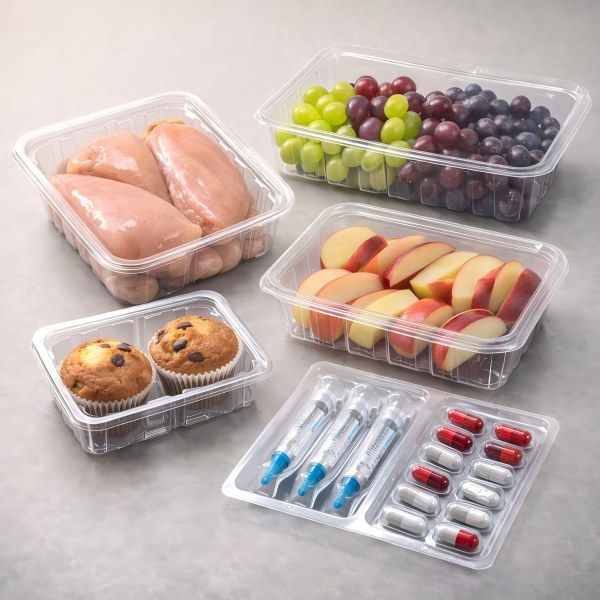
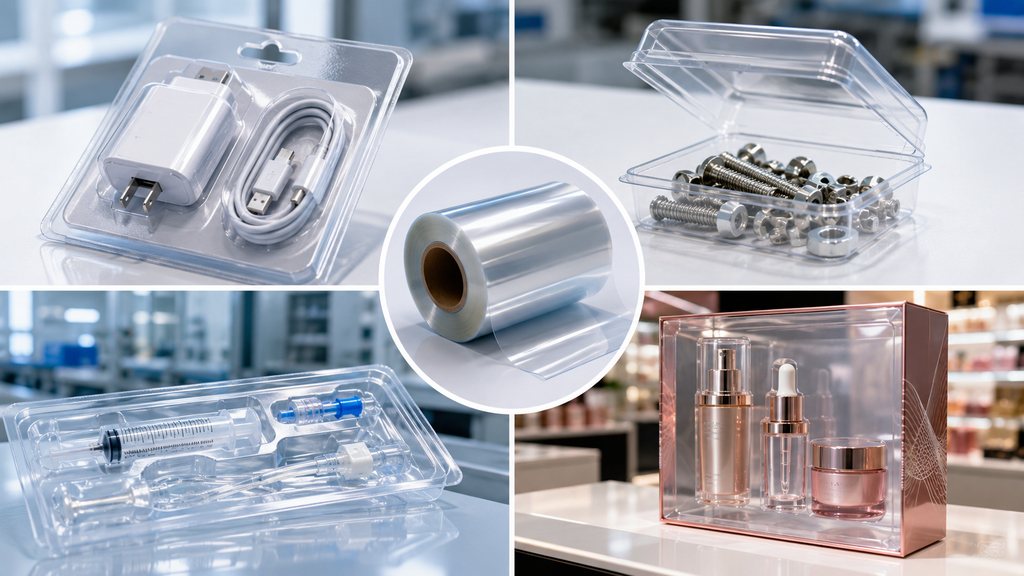
GAG sheet can be thermoformed into clear blisters for electronics, hardware, stationery, cosmetics, toys, personal-care products, and consumer goods. The transparent cavity protects the item while maintaining strong shelf visibility.
Clamshell Packaging
Hinged clamshells require forming consistency, hinge durability, edge quality, and reliable closure. Material thickness and design should be matched to the product weight, hanging method, tamper requirement, and expected handling.
Thermoformed Trays
GAG can be used for clear trays, inserts, and organizers. Food-contact projects require an appropriate grade and supporting declarations. Buyers comparing tray materials may also review CloudFilm’s APET film and food packaging trays.
Transparent Folding Boxes
PETG outer surfaces can support scoring, folding, printing, and adhesive assembly. Transparent boxes are frequently used for cosmetics, gifts, electronics, confectionery, stationery, and premium retail products.
Printed Displays and POP Components
Clear or colored GAG sheets can be printed, die-cut, bent, and assembled into display cards, shelf components, signs, protective panels, and point-of-purchase structures.
Medical and Technical Packaging
Certain grades may be considered for medical-device trays, technical component trays, and protective covers. Qualification should address cleanliness, aging, sterilization exposure, impact requirements, sealing, and regulatory documentation.
How GAG Sheet Is Thermoformed and Converted
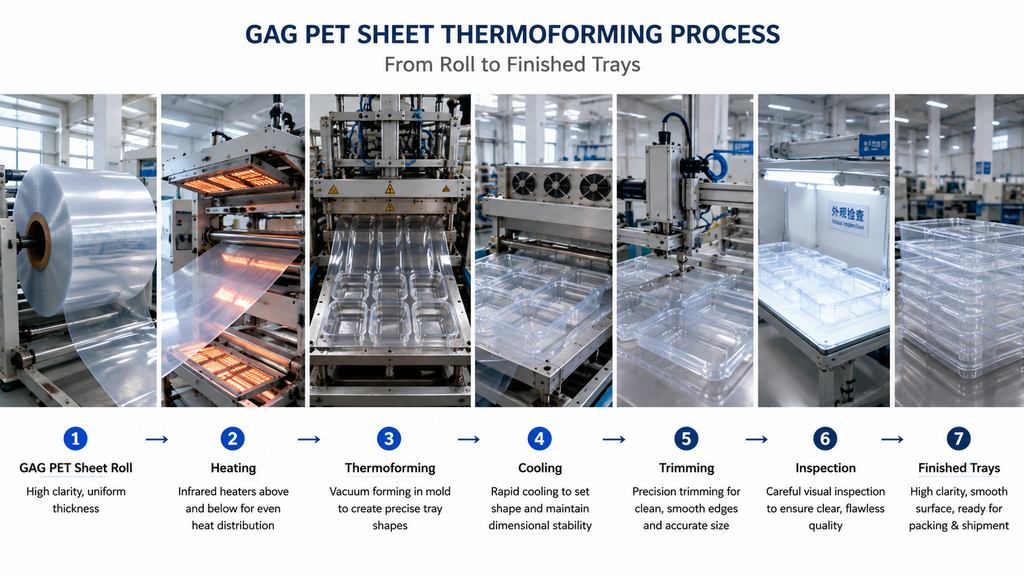
The process normally begins with sheet unwinding or sheet loading. The material enters a controlled heating zone, softens, and is formed against a mold by vacuum, pressure, mechanical assistance, or a combination of methods.
After forming, the part is cooled, released, trimmed, inspected, and packed. Additional operations may include printing, die-cutting, creasing, folding, gluing, welding, punching, or protective-film removal.
Uniform heating is critical. Uneven heating can create thin corners, webbing, distortion, haziness, weak details, or unstable shrinkage. Heater zoning should match the mold design and sheet width.
The draw ratio must also be considered. Deep cavities place greater stress on the sheet and increase the risk of uneven wall thickness. Plug assistance or material redistribution may be needed for demanding geometries.
Some GAG grades may process without pre-drying under suitable storage and line conditions. However, moisture history, resin formulation, sheet thickness, storage environment, and equipment design can change the result. Follow the supplier’s processing guidance and confirm performance through trials.
Important Specifications for GAG PET Sheet
A professional quotation should be based on measurable specifications rather than a product name alone. “GAG sheet” does not define the exact thickness, width, layer ratio, surface, color, compliance, or packing method.
Thickness
Thickness influences rigidity, forming depth, unit weight, yield, packaging strength, and cost. Buyers should provide the target thickness and tolerance. A reference sample or drawing is helpful when the current specification is uncertain.
Width or Sheet Size
Roll width should match the forming line and mold layout. Cut-sheet dimensions should match the feeding, printing, die-cutting, or fabrication process. Excess width creates trim waste and unnecessary freight cost.
Roll or Cut-Sheet Format
Roll stock supports continuous thermoforming lines. Cut sheets suit sheet-fed forming, printing, display fabrication, prototyping, and smaller production runs. Core size, roll diameter, roll weight, and splice requirements should be stated.
Color and Optical Appearance
Clear is the most common option, but white, black, tinted, matte, or special visual effects may be possible. Define haze, gloss, color consistency, and acceptable surface defects when appearance is critical.
Surface Treatment and Protection
Projects may require corona treatment, primer, masking film, anti-static performance, anti-fog behavior, scratch control, or another functional surface. Each treatment should be linked to a specific converting or end-use requirement.
Layer Ratio and Material Declaration
When the PETG skin ratio matters, request a declared construction or agreed performance specification. Do not assume that every GAG supplier uses the same PETG percentage or resin grade.
Compliance Documentation
Food, medical, electronics, and export projects may require food-contact declarations, restricted-substance documents, safety data, test reports, traceability, or destination-specific compliance. Documentation should be confirmed before the purchase order.
Buyers who also need general-purpose rigid polyester formats can compare PET film sheet in rolls and cut sheets.
How to Evaluate a GAG PET Sheet Manufacturer and Supplier
Including “manufacturer” and “supplier” language is appropriate for this topic because many readers are packaging buyers, converters, importers, distributors, and product developers. However, these terms should appear naturally and support practical purchasing decisions.
A capable GAG PET sheet manufacturer should control resin feeding, layer distribution, melt filtration, die uniformity, cooling, thickness, winding, surface protection, and contamination. The supplier should also understand how those controls affect the customer’s forming and fabrication process.
Ask whether the supplier can provide a technical data sheet, certificate of analysis, food-contact documents when applicable, sample sheets, trial rolls, roll labels, batch traceability, inspection records, and export packing details.
Evaluate communication quality as carefully as price. A reliable supplier should ask about your machine, mold, forming depth, trimming method, printing system, adhesive, sealing process, annual volume, destination, and current material problems.
A quotation is more useful when it includes thickness, width, format, roll weight, core, packing, quantity basis, Incoterm, lead time, payment terms, sample policy, and specification validity.
CloudFilm supports international converters and packaging buyers with material selection, samples, technical documentation, and customized supply. Learn more about the CloudFilm packaging materials manufacturer before discussing a GAG project.
Quality Checks Buyers Should Request
Quality control should reflect the intended use. A decorative display sheet and a deep-draw technical tray do not require exactly the same inspection plan.
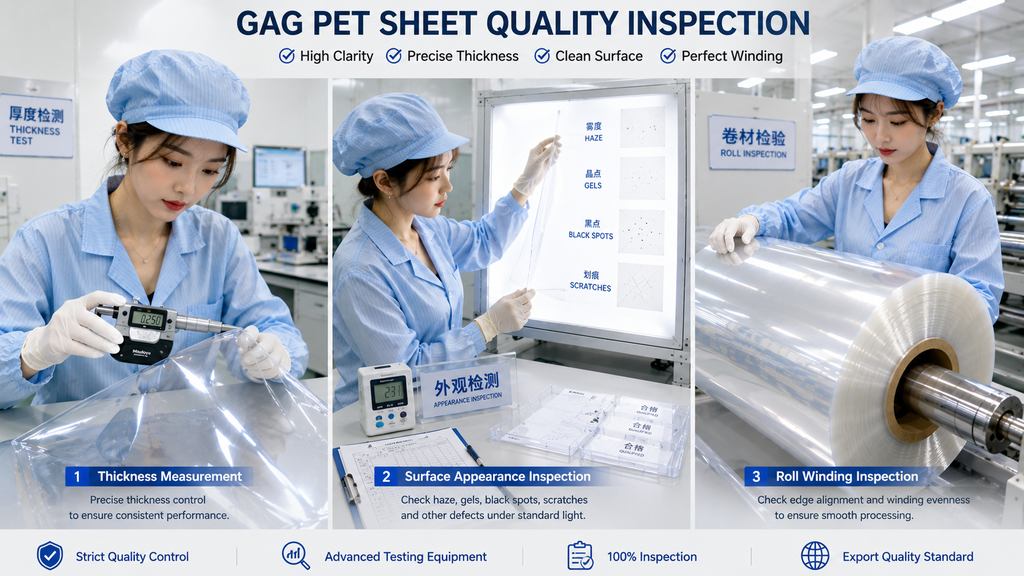
Typical checks may include thickness and width, roll weight, surface appearance, haze, light transmission, color, impact behavior, tensile properties, forming response, shrinkage, adhesion, printability, cutting quality, and layer integrity.
Roll inspection should also cover winding hardness, telescoping, edge alignment, blocking, wrinkles, contamination, scratches, protective-film condition, core damage, splice quantity, and label accuracy.
For cut sheets, inspect dimensional accuracy, squareness, edge quality, masking condition, flatness, surface marks, and packing protection. Finished pallets should prevent moisture, dust, crushing, and movement during export transport.
Sustainability and Recyclability Considerations
GAG belongs to the PET material family because both PETG and APET are polyester materials. That does not mean every finished GAG package will automatically be accepted in every local recycling stream.
Recyclability depends on the complete package, including color, labels, inks, adhesives, coatings, closures, contamination, collection systems, sorting technology, and regional recycling rules.
Clear, well-designed PET packaging may have better sorting potential than dark or heavily decorated structures. Buyers should review current local design-for-recycling guidance for the destination market before making environmental claims.
Recycled content may be technically possible in certain PET sheet structures, but the location, percentage, optical impact, food-contact status, traceability, and regulatory suitability must be defined. Do not substitute recycled resin without validating performance and compliance.
Information to Send When Requesting a Quote
A complete inquiry allows the supplier to recommend a suitable grade and prepare a meaningful quotation. Send the following information whenever possible:
- Application and packed product
- Required thickness and tolerance
- Roll width or cut-sheet dimensions
- Roll length, roll weight, or sheet quantity
- Core size and maximum roll diameter
- Clear, colored, matte, or special appearance
- Thermoforming method and forming depth
- Printing, gluing, sealing, or welding process
- Surface treatment or functional requirements
- Food-contact, medical, or restricted-substance documents
- Current material and problems to solve
- Trial quantity and annual demand
- Delivery destination and preferred trade term
- Required packing and pallet limits
A drawing, current sample, forming photograph, or short machine video can prevent misunderstandings. It also helps the supplier identify whether the project needs GAG, APET, full PETG, or another rigid sheet.
FAQs About GAG PET Sheet
- What is GAG PET sheet?
GAG PET sheet is a three-layer co-extruded rigid polyester sheet. It normally has PETG on both outer surfaces and APET in the central core.
- What does GAG stand for?
The first and third “G” indicate PETG surface layers. The “A” indicates the APET core layer.
- Is GAG sheet the same as PETG sheet?
No. Full PETG sheet uses PETG throughout its thickness. GAG uses PETG mainly on the surfaces and APET in the core.
- Why is APET used in the middle?
APET provides stiffness, dimensional stability, clarity, and a cost-efficient core. It allows the structure to use PETG where its surface and processing properties are most valuable.
- Can GAG PET sheet be thermoformed?
Yes. It is widely used for vacuum forming and pressure forming. Final conditions should be optimized for the grade, thickness, mold, draw ratio, and equipment.
- Does GAG sheet require pre-drying?
The answer is grade- and process-dependent. Some materials may run without pre-drying under controlled conditions, while moisture-sensitive situations may require drying. Follow the supplier’s guidance and conduct a line trial.
- Can GAG sheet be printed?
Yes. PETG surfaces generally support printing and decoration. Ink system, surface energy, treatment, curing, and adhesion should be tested before commercial production.
- Can GAG sheet be glued or bonded?
It can be suitable for adhesive bonding and fabrication. The adhesive must be compatible with the sheet, end-use conditions, required appearance, and regulatory needs.
- Can GAG sheet be heat sealed or welded?
Some grades and constructions support heat sealing or welding processes. Compatibility depends on equipment, joint design, temperature, pressure, dwell time, and the specific material grade.
- Is GAG PET sheet food grade?
Food-contact suitability depends on the exact resin, additives, recycled content, production controls, and supporting declarations. Request documentation for the intended country and application.
- Can GAG sheet be used for medical packaging?
Potentially, but the grade must be qualified for the device, sterilization method, aging requirement, sealing system, cleanliness standard, and regulatory pathway.
- What thicknesses are available?
Available thicknesses vary by manufacturer and production line. Buyers should specify the target gauge, tolerance, forming depth, and finished-pack performance instead of choosing thickness only by price.
- Is GAG supplied in rolls or sheets?
Both formats are possible. Rolls suit continuous forming lines, while cut sheets suit sheet-fed forming, printing, die-cutting, and display fabrication.
- Can GAG sheet be colored or matte?
Clear is common, but colored, opaque, tinted, matte, or functional surfaces may be available. Minimum quantities and lead times can differ from standard clear grades.
- How does GAG compare with APET?
GAG adds PETG outer layers to an APET core. It may offer improved surface processing, bonding, printing, and fabrication where standard APET is less suitable.
- How does GAG compare with full PETG?
GAG aims to retain useful PETG surface behavior while controlling cost through an APET core. Full PETG may be preferred when the whole section needs PETG performance.
- Is GAG a suitable replacement for PVC sheet?
It may be considered for some clear packaging and display applications. Equipment, sealing, forming, cost, compliance, and recycling requirements must be reviewed before conversion.
- Is GAG PET sheet recyclable?
It is a PET-family structure, but real-world recyclability depends on the entire package and the local collection, sorting, and recycling system. Avoid universal recycling claims.
- Should I request samples before ordering?
Yes. Test clarity, forming, trimming, printing, bonding, sealing, fit, and finished-pack performance on the actual equipment whenever possible.
- What creates an accurate GAG sheet quotation?
Provide the application, thickness, width, format, quantity, surface requirements, compliance documents, forming conditions, packing method, destination, and annual forecast.
Final Selection Advice
GAG PET sheet is valuable because it combines materials rather than relying on a single resin to perform every task. PETG outer layers support processing and surface performance, while the APET core contributes stiffness and cost control.
The best grade is not determined by transparency alone. It must match the forming depth, mold design, product weight, trimming, printing, bonding, sealing, compliance, appearance, logistics, and commercial volume.
Before approving a bulk order, compare representative samples, confirm the written specification, complete machine trials, and agree on inspection standards. This approach gives buyers a more reliable path from material evaluation to stable commercial production.
For a project review, provide your current sample or drawing, target thickness, width, forming method, application, destination market, and expected quantity through the CloudFilm contact page.