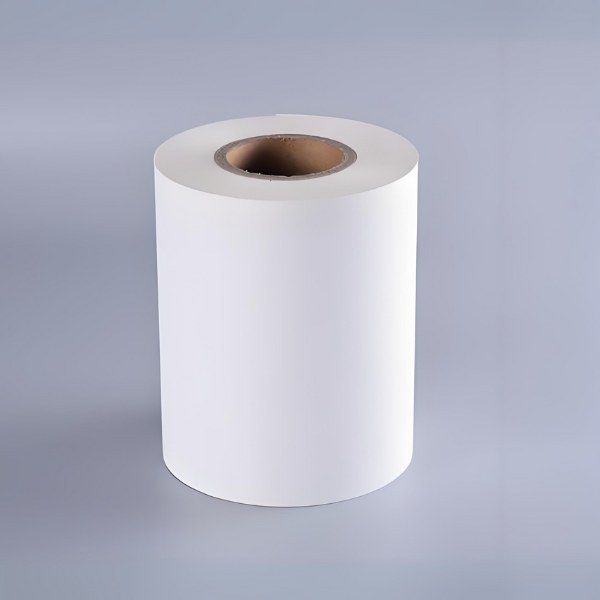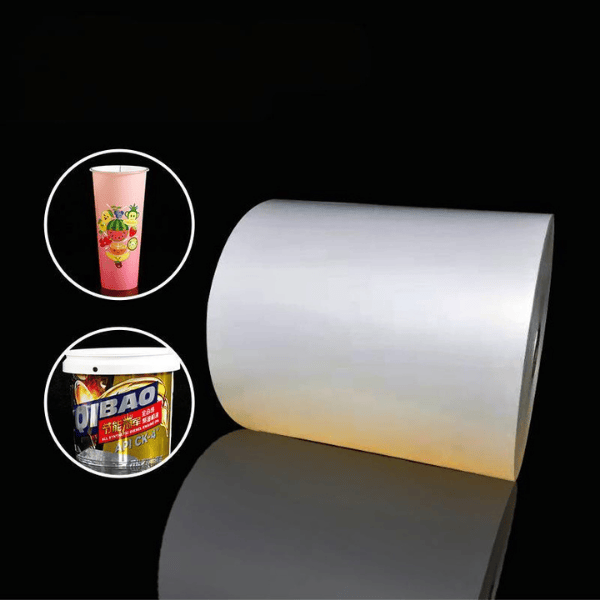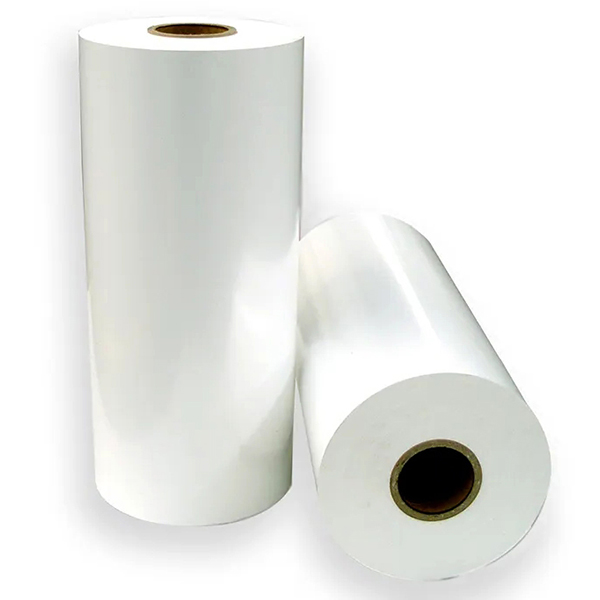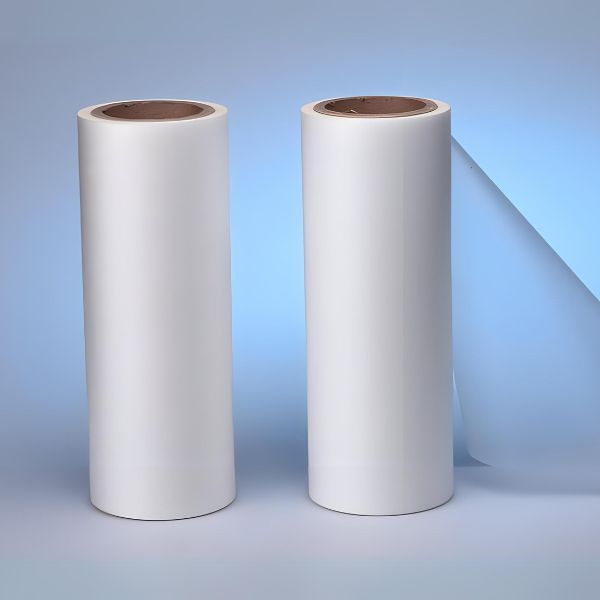
Synthetic paper looks and prints like paper, but it is made mainly from synthetic resin rather than wood pulp. It is selected when ordinary paper cannot provide enough resistance to water, tearing, oil, chemicals, repeated handling, or outdoor exposure. Depending on the grade, it may be used for durable labels, maps, menus, tags, manuals, packaging decoration, in-mold labels, and specialty printed products.
Quick answer: Synthetic paper is a paper-like printing substrate made primarily from polymers such as polypropylene or polyethylene. BOPP synthetic paper is one of the most common film-based grades. It combines a white, opaque, printable surface with the moisture resistance, strength, and dimensional stability associated with plastic film.
The term is broad, so buyers should not assume that every synthetic paper has the same structure or printing behavior. Some grades are biaxially oriented films with mineral fillers and microvoids. Others are microporous sheets or bonded polyethylene-fiber materials. The correct choice depends on the printing process, end-use environment, stiffness, surface finish, thickness, converting method, and regulatory requirements.
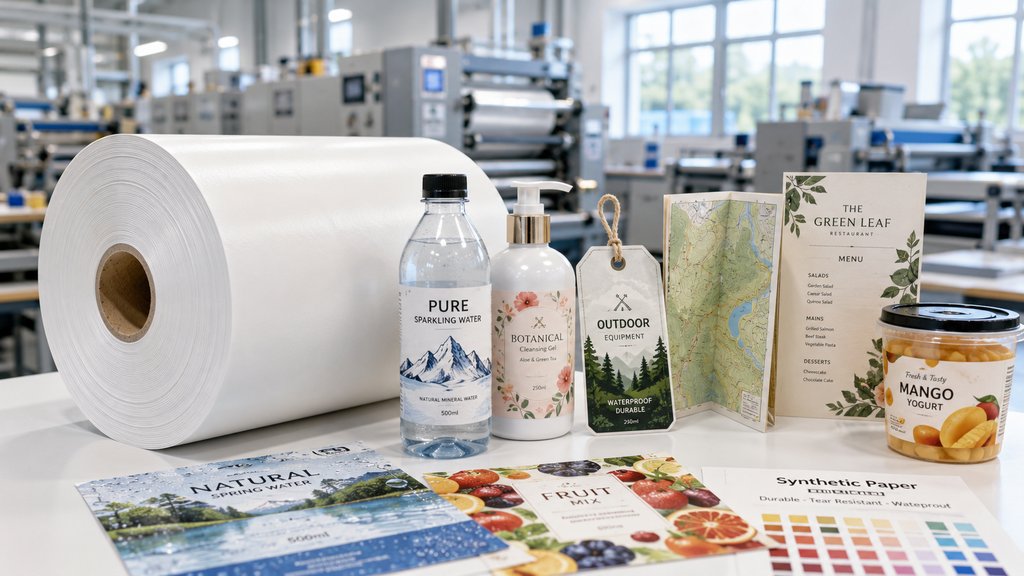
What Is Synthetic Paper?
Synthetic paper is a printable sheet or film engineered to provide a paper-like appearance and printing surface while retaining important performance characteristics of polymer materials. Most grades are based on polyolefin resins, especially polypropylene or polyethylene, although polyester and other specialty polymers may also be used for certain applications.
Is synthetic paper really paper? In commercial language, yes, because it is sold, printed, cut, folded, and converted in many paper-like ways. From a material-science perspective, however, it is usually a plastic-based substrate. That distinction matters for heat resistance, ink selection, static control, recycling, and converting conditions.
Ordinary paper relies on a network of cellulose fibers. Synthetic paper instead creates opacity, stiffness, ink receptivity, and a paper-like feel through resin selection, mineral fillers, microvoids, coatings, surface treatment, or fibrous sheet formation. A buyer therefore needs to evaluate the actual grade rather than relying only on the name “synthetic paper.”
For packaging and label projects, BOPP synthetic paper is especially important because the biaxial orientation process can deliver a useful balance of stiffness, strength, opacity, print quality, and moisture resistance.
How Is Synthetic Paper Made?
Manufacturing methods vary by product family. The following three routes explain most commercial synthetic papers encountered by printers, label converters, packaging buyers, and industrial users.
- Film-based synthetic paper
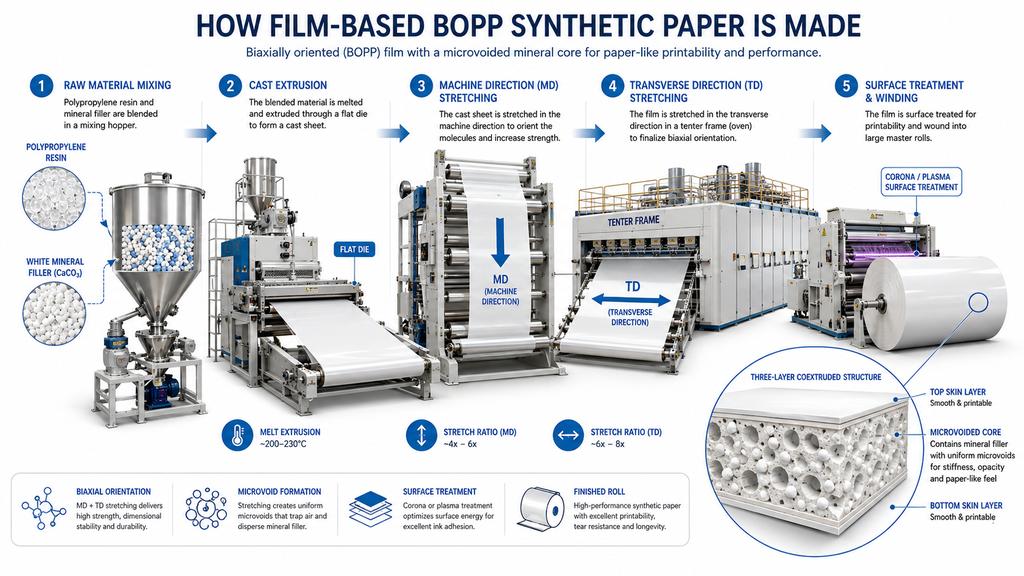
In a typical polypropylene route, resin is blended with inorganic fillers and performance additives, melted, and extruded into a sheet. The sheet is then stretched in the machine and transverse directions. This orientation improves mechanical strength and dimensional stability. During stretching, carefully controlled microvoids may form around filler particles, producing lower density, higher opacity, a softer paper-like appearance, and improved print behavior.
The surface may be corona treated or coated to raise surface energy and improve ink, adhesive, or coating anchorage. A multilayer coextruded structure can place different functions in the core and skin layers, allowing the manufacturer to control whiteness, stiffness, gloss, friction, antistatic performance, and print compatibility.
- Microporous synthetic sheet
A microporous polyolefin sheet contains a fine internal pore network. The pores can absorb or mechanically lock inks, adhesives, coatings, and laminating materials. Such grades may feel softer and more paper-like than a conventional film, but their printing and drying behavior should still be confirmed through a trial because pore structure and coating chemistry differ by supplier.
- Bonded synthetic-fiber sheet
Some synthetic sheets are formed from continuous polyethylene fibers that are bonded by heat and pressure. These materials can be lightweight, tough, breathable, and highly resistant to tearing and moisture. They are often chosen for tags, envelopes, protective uses, durable graphics, and technical applications rather than conventional flexible packaging laminates.
Main Types of Synthetic Paper
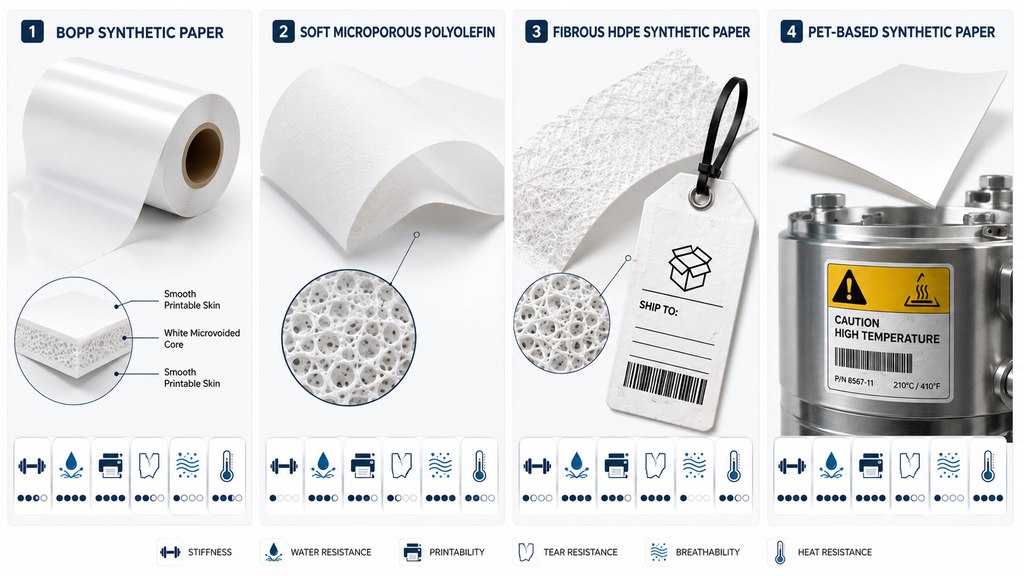
Synthetic paper should be classified by structure and intended use, not only by brand name or color. The most relevant categories are below.
BOPP synthetic paper
BOPP synthetic paper is made from biaxially oriented polypropylene. It is commonly white and opaque, although clear, translucent, pearlescent, glossy, or matte options can be developed. It is widely used for pressure-sensitive label face stock, wet-environment labels, maps, cards, menus, tags, posters, packaging inserts, and some in-mold label applications. Buyers who need a wider view of related grades can review the BOPP film product range.
PP-based non-oriented or specialty sheet
Not every polypropylene synthetic paper is biaxially oriented. Some cast or specialty PP sheets are selected for lower-temperature converting, special embossing, thermoforming, stationery, or industrial uses. The broader PP film range helps explain how BOPP and CPP-type polypropylene materials differ in stiffness, sealing behavior, and end-use performance.
HDPE fiber-based synthetic sheet
High-density polyethylene fiber sheets have a fibrous, paper-like appearance and very high resistance to tearing. They can be breathable while resisting liquid water. Common uses include durable tags, envelopes, protective packaging, wristbands, banners, and technical documents.
Microporous polyolefin synthetic paper
These sheets contain an engineered pore network that supports ink and adhesive anchorage. They are often used for identification cards, security print, labels, tags, durable commercial print, and laminated documents.
PET and other specialty synthetic papers
Polyester-based synthetic papers may be selected when higher heat resistance, stiffness, or dimensional stability is required. Specialty constructions can also include coated films, mineral-filled sheets, or multilayer materials designed for laser printing, thermal transfer, chemical resistance, or electrical insulation. Compatibility must be checked with the actual printing and converting temperatures.
Key Properties and Benefits
Performance varies by grade, but synthetic paper is usually selected for a combination of the following benefits.
- Water and moisture resistance:It does not absorb moisture in the same way as ordinary wood-pulp paper, helping labels and printed materials remain legible in wet, refrigerated, humid, or outdoor conditions.
- Tear and handling resistance:Polymer structure provides better resistance to tearing, edge damage, folding fatigue, and repeated handling than many ordinary papers of similar weight.
- Print appearance:White, opaque, smooth grades can reproduce sharp text, barcodes, fine graphics, and strong colors when the surface and ink system are correctly matched.
- Chemical and oil resistance:Selected grades can withstand oils, grease, cleaners, and mild chemicals better than unprotected paper. Resistance must still be tested against the exact chemical and contact time.
- Dimensional stability:Properly oriented or engineered sheets maintain more consistent dimensions during printing, die-cutting, labeling, and environmental changes.
- Low lint and clean converting:Film-based synthetic paper does not release cellulose dust, which can benefit clean printing, labeling, electronics, and precision converting environments.
- Design flexibility:Manufacturers can adjust opacity, density, whiteness, gloss, matte level, stiffness, surface energy, antistatic behavior, thickness, and roll dimensions for different applications.
These advantages do not mean that synthetic paper is automatically the best choice for every job. It may cost more than commodity paper, can require dedicated ink or drying adjustments, and may curl, build static, stretch, shrink, or distort if exposed to unsuitable temperatures or tensions.
Synthetic Paper vs Ordinary Paper vs Plastic Film
| Property | Synthetic Paper | Ordinary Paper | Conventional Plastic Film |
| Primary material | Mostly polymer resin, often with fillers or pores | Wood-pulp cellulose fibers | Polymer resin |
| Appearance | Paper-like, usually white and opaque | Natural paper surface | Often clear, glossy, or film-like |
| Water resistance | Generally high | Usually low unless coated | High |
| Tear resistance | Medium to very high, depending on structure | Low to medium | High, but may propagate from a notch |
| Printability | Good when treated or coated for the process | Naturally compatible with many print systems | Usually needs treatment or coating |
| Heat sensitivity | Depends strongly on resin and grade | Can tolerate many print conditions but may scorch | Depends on polymer and orientation |
| Recycling route | Depends on resin, coating, adhesive, and local collection | Paper stream when clean and accepted | Plastic stream when correctly identified and accepted |
| Typical use | Durable labels, tags, maps, menus, specialty packaging | Books, cartons, office print, dry labels | Flexible packaging, wraps, laminates, bags |
A practical decision should compare the complete converted product rather than only the base sheet. Adhesives, release liners, inks, coatings, laminates, varnishes, and the container material can all affect cost, performance, and end-of-life handling.
Common Applications of Synthetic Paper
Durable pressure-sensitive labels
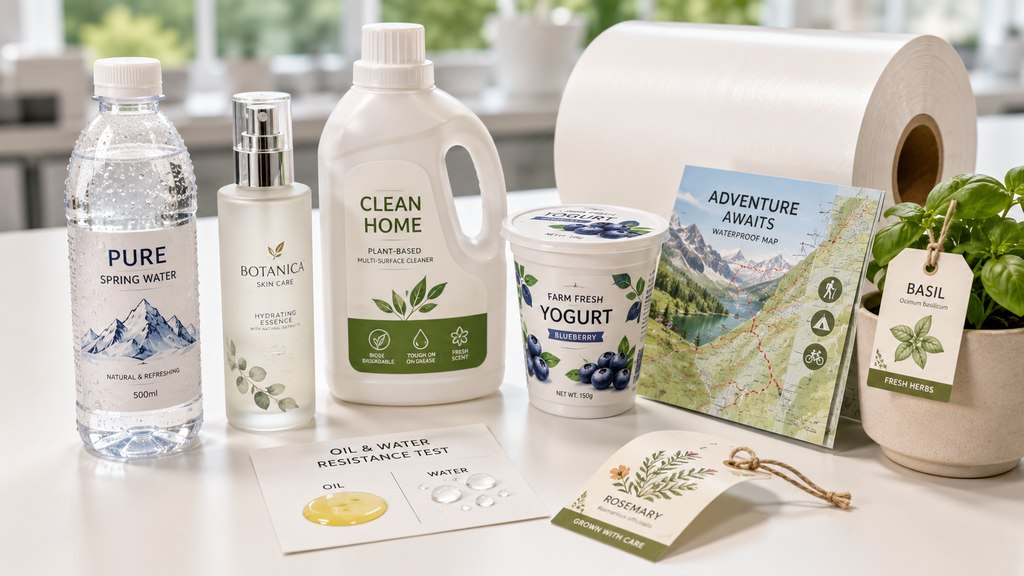
Synthetic paper is used as a label face stock for beverage bottles, cosmetics, shampoo, household cleaners, chilled food, lubricants, chemicals, and industrial products. It is valuable where condensation, oil, abrasion, or frequent handling could damage a paper label. For a broader comparison of clear, white, matte, metallized, and IML label materials, see the BOPP labels buying guide.
In-mold labeling
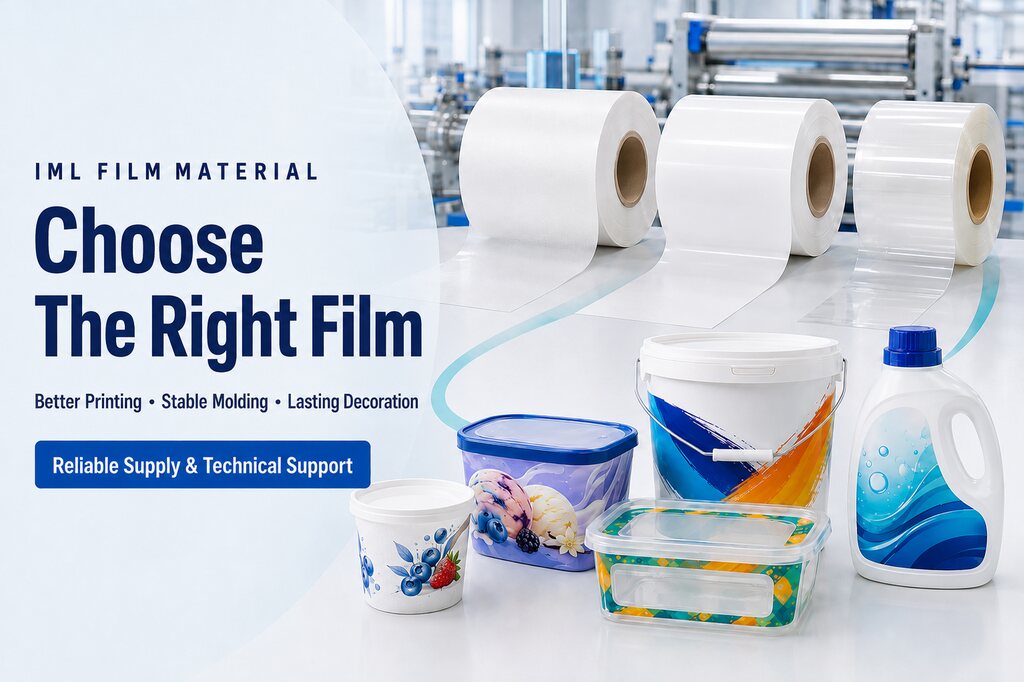
For injection-molded or blow-molded containers, a printed label can be placed in the mold before molding. The label becomes integrated with the plastic part, producing a durable decorative surface with no separate post-applied label. The film must have controlled stiffness, static behavior, die-cutting performance, printability, and compatibility with molding conditions. CloudFilm’s IML film page explains this specialized grade in more detail.
Packaging decoration and inserts
Synthetic paper can be used for waterproof packaging inserts, instruction cards, promotional tags, reusable bags, premium gift packaging, and labels that need a paper-like appearance with better durability. It may also serve as a printed outer layer or decorative component when the structure and sealing method are properly engineered.
Maps, menus, manuals, and outdoor graphics
Folded maps, restaurant menus, plant tags, safety instructions, equipment manuals, outdoor posters, and point-of-sale materials often experience moisture and repeated handling. Synthetic paper can extend service life and reduce the need for a separate protective lamination in some applications.
Cards, tags, and identification products
Luggage tags, event passes, wristbands, membership cards, shelf tags, horticultural labels, and industrial identification products benefit from tear resistance and stable print. Security, laser-printing, or personalization projects may require a specialized microporous or heat-resistant grade rather than standard BOPP synthetic paper.
Printing and Converting Synthetic Paper
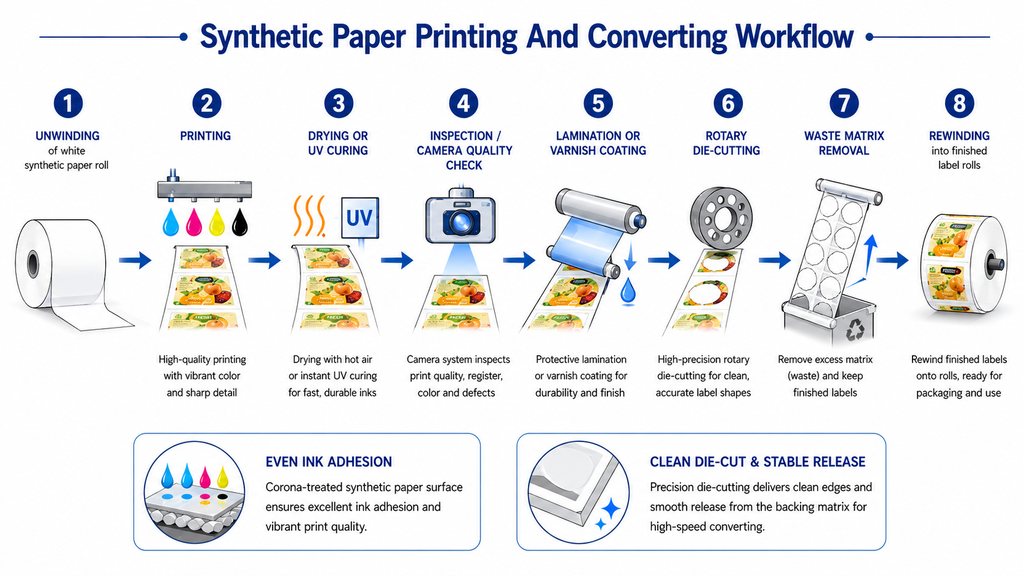
Successful printing begins with the exact grade, not the generic material name. Printers should confirm whether the surface is uncoated, corona treated, top-coated, microporous, glossy, matte, or designed for a specific digital process.
Compatible printing methods
Depending on the grade, synthetic paper may be printed by offset, flexographic, gravure, screen, UV inkjet, electrophotographic, thermal transfer, or other digital methods. A film described as “printable” is not necessarily compatible with every ink and drying system. The supplier should provide a technical recommendation, and the converter should run an adhesion, drying, rub, blocking, and color-density trial before mass production.
For flexible-packaging and label work, BOPP printing film illustrates how surface treatment, dyne level, slip, and dimensional stability influence print performance. The broader flexible packaging printing guide also explains the differences among gravure, flexographic, digital, and other processes.
Surface energy and ink adhesion
Polyolefin surfaces have relatively low surface energy, so corona treatment or a printable coating is commonly used. Treatment level can decay during storage, especially if rolls are exposed to heat, contamination, or long inventory periods. The receiving converter should confirm dyne level, treated side, storage conditions, and recommended shelf life.
Drying temperature and web tension
Synthetic paper can distort when excessive dryer temperature, web tension, or curing energy is applied. Oriented films may shrink if heated beyond the grade’s stable operating window. Printers should begin with conservative settings, confirm register stability, and increase speed only after ink curing and dimensional behavior are stable.
Die-cutting, folding, and finishing
The material may be die-cut, scored, folded, laminated, varnished, embossed, perforated, or converted into labels and tags. Blade geometry, matrix stripping, edge quality, fold direction, and static control are important. A synthetic sheet can spring back more strongly than paper, and a poorly designed crease may turn white, crack a coating, or resist folding.
Matte and premium finishes
When low glare and a premium tactile appearance are more important than a traditional paper feel, BOPP matte film may be an alternative. The buyer should compare opacity, hand feel, print method, scratch resistance, stiffness, and whether the material is used as a label face stock or as a laminating film.
How to Choose the Right Synthetic Paper
A useful specification begins with the application. Asking only for “white synthetic paper” or “80 gsm synthetic paper” leaves too many variables open. Buyers should define the following points before requesting a quotation or sample.
- End use:Pressure-sensitive label, IML, map, menu, tag, poster, packaging insert, card, outdoor graphic, or industrial document.
- Material family:BOPP, other PP, HDPE fiber sheet, microporous polyolefin, PET, or a supplier-recommended specialty grade.
- Thickness and basis weight:State microns and/or gsm, plus acceptable tolerance. Density differs among grades, so equal gsm does not always mean equal thickness.
- Appearance:White, transparent, translucent, pearlescent, glossy, satin, matte, or soft-touch.
- Opacity and whiteness:Important for barcode contrast, full-color printing, coverage over dark containers, and premium presentation.
- Printing method and ink:Gravure, flexo, offset, screen, UV inkjet, laser, thermal transfer, or another digital process.
- Surface requirement:Printable coating, corona treatment, single- or double-side treatment, adhesive-receptive side, or heat-sealable side.
- Mechanical performance:Stiffness, tensile strength, tear resistance, elongation, folding endurance, puncture resistance, and die-cutting behavior.
- Environmental exposure:Water, refrigeration, freezing, outdoor UV, oils, cleaners, chemicals, heat, humidity, or repeated abrasion.
- Roll and sheet format:Width, length, roll diameter, core size, winding direction, splice limit, sheet size, packing method, and pallet requirements.
- Compliance:Food-contact documents, restricted-substance declarations, migration testing, or market-specific regulatory requirements where applicable.
Thickness is especially important because it affects stiffness, yield, roll weight, printing stability, die-cutting, and label dispensing. The BOPP film thickness guide provides a useful framework for discussing micron ranges, but the final grade must still be validated in the intended process.
How to Evaluate a Synthetic Paper Manufacturer or Supplier
Commercial buyers often move directly from material comparison to sample requests, technical approval, and purchase specifications. A synthetic paper supplier should therefore be evaluated on both technical capability and commercial reliability, not only on a product name or a quoted price.
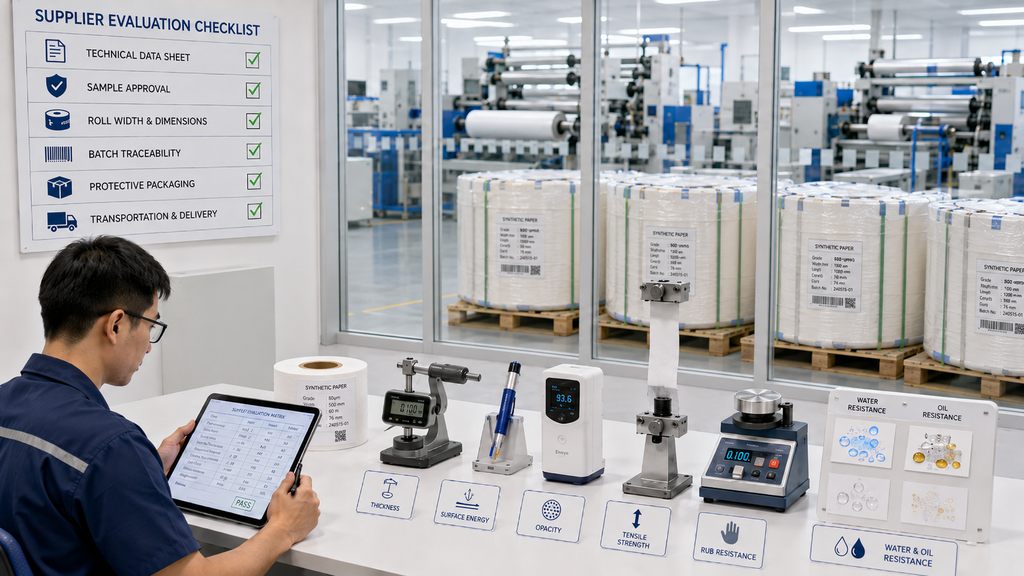
A reliable synthetic paper manufacturer or supplier should be able to connect material properties with the buyer’s printing and converting process. Price per kilogram is important, but unstable thickness, weak ink adhesion, poor winding, high static, or inconsistent surface treatment can create far greater losses during production.
Supplier qualification checklist
- Ask for a current technical data sheet with thickness, tolerance, density or basis weight, tensile properties, opacity, gloss, treatment level, and recommended printing methods.
- Confirm whether the supplier manufactures the base sheet, coats or converts purchased film, or combines several production partners. Each model can work, but responsibilities must be clear.
- Request representative samples from the same grade and surface specification proposed for the order. A generic white PP sample may not predict the performance of the quoted product.
- Evaluate roll quality: width tolerance, edge profile, telescoping, blocking, wrinkles, splices, winding tension, core condition, and protective packaging.
- Confirm traceability, batch identification, inspection records, certificate of analysis availability, and complaint-handling procedure.
- Discuss lead time, minimum order quantity, trial-roll options, slit-width flexibility, export packing, shipping terms, and technical support after delivery.
For a broader purchasing framework, the flexible packaging quality control guide explains how material, printing, slitting, packing, and documentation should be controlled. Buyers comparing sourcing regions may also review BOPP film manufacturers in China, while still conducting their own technical and commercial qualification.
Sustainability and Recycling Considerations
Synthetic paper should not be described as universally more sustainable than ordinary paper. Its environmental profile depends on resin source, filler content, manufacturing energy, product life, printing and adhesive systems, transport efficiency, reuse, and the actual collection and recycling infrastructure in the destination market.
A durable synthetic label or document may reduce replacement frequency and avoid protective lamination. A lightweight, lower-density microvoided grade may also reduce material use for a given area. On the other hand, a polymer-based sheet is not normally placed in the paper recycling stream, and a converted label may be difficult to separate from its container, adhesive, liner, ink, or coating.
For a responsible specification, identify the main resin, minimize unnecessary layers, avoid unsupported recycling claims, and confirm local acceptance. When the label and container are both polypropylene and designed for compatible processing, a mono-material concept may improve recyclability potential, but the complete package still requires local validation.
CloudFilm BOPP Synthetic Paper Supply
CloudFilm supports converters, printers, label producers, packaging companies, and brand owners that need BOPP-based synthetic paper in roll form. The material can be discussed around thickness, width, opacity, surface finish, corona treatment, printing process, roll diameter, core size, and end-use requirements.
The best starting point is a clear application description plus a reference sample or target data sheet. CloudFilm can then help compare standard BOPP synthetic paper with printing film, matte film, or IML film and recommend a practical trial path before a commercial order.
Request information for a quotation: end use, printing method, required thickness or gsm, width, roll length or diameter, core size, surface treatment, quantity, destination, compliance needs, and any existing sample or technical specification. This reduces quotation time and helps ensure that the sample represents the material you actually intend to purchase.
Frequently Asked Questions About Synthetic Paper
- What is synthetic paper made of?
Most synthetic paper is made primarily from polymer resin such as polypropylene or polyethylene. Depending on the grade, it may also contain inorganic fillers, pigments, coatings, pores, or bonded synthetic fibers.
- Is synthetic paper the same as BOPP film?
No. BOPP synthetic paper is a specialized BOPP grade designed to look and print more like paper. Standard transparent BOPP packaging film usually has different opacity, surface, density, thickness, and converting behavior.
- Is synthetic paper waterproof?
Most grades have very high resistance to water because the base material is polymer rather than cellulose. However, the printed ink, adhesive, coating, and converted construction must also be water resistant for the final product to be considered waterproof.
- Can synthetic paper be torn?
It is generally much harder to tear than ordinary paper, but no thin sheet is indestructible. Tear performance depends on resin, orientation, thickness, notches, die-cut edges, temperature, and whether the material is film-based or fiber-based.
- Can synthetic paper be printed in an ordinary printer?
Only when the grade is designed for that printer. Office laser printers generate heat, and inkjet printers require suitable ink reception. Always check the approved printing method and test the exact machine, ink or toner, drying conditions, and sheet feed.
- Which printing methods can be used?
Depending on the grade, options may include offset, flexographic, gravure, screen, UV inkjet, electrophotographic digital printing, and thermal transfer. Surface treatment and ink compatibility must be confirmed.
- Does synthetic paper need corona treatment?
Many polyolefin film grades need corona treatment or a printable top coating to improve surface energy and ink adhesion. Some microporous or pre-coated grades are supplied ready for specific printing processes.
- What is the difference between gsm and micron?
Gsm measures mass per square meter, while micron measures thickness. The conversion depends on density. Microvoided synthetic paper can have a lower density than solid film, so two products with the same thickness may have different gsm values.
- Can synthetic paper be used for food labels?
Yes, suitable grades can be used for food and beverage labels. The supplier should confirm the intended food-contact position, ink and adhesive system, migration requirements, and relevant documentation for the destination market.
- Can synthetic paper be heat sealed?
Some specialty structures may be heat sealable, but many synthetic papers are designed primarily for printing rather than sealing. If sealing is required, specify seal-to-self or seal-to-another-material, temperature window, dwell time, pressure, and required seal strength.
- Is synthetic paper suitable for outdoor use?
Many grades are suitable for wet and outdoor environments, but long-term outdoor performance also depends on UV stability, ink lightfastness, coating durability, temperature range, and exposure time. An accelerated-weathering or field test may be necessary.
- Is synthetic paper recyclable?
It may be recyclable as a plastic when the resin is identifiable and the local recycling system accepts that format. Coatings, adhesives, liners, inks, laminates, and mixed-material constructions can limit acceptance. It should not automatically be placed in paper recycling.
- Is synthetic paper biodegradable?
Conventional polypropylene, polyethylene, and polyester synthetic papers are not normally biodegradable. Biodegradability should never be claimed unless the exact material has appropriate testing and certification for the stated environment.
- What thickness is common for synthetic paper?
There is no universal thickness. Thin label grades, medium-gauge printing sheets, and heavy cards can differ widely. The correct choice depends on stiffness, printing, die-cutting, dispensing, folding, durability, and cost.
- What is the best synthetic paper for labels?
For wet, oil-resistant, and durable labels, white BOPP synthetic paper is often a strong starting point. IML, thermal-transfer, laser-printable, chemical-resistant, or security labels may require a specialized grade.
- How should synthetic paper be stored?
Keep rolls or sheets in clean, dry indoor conditions, protected from direct sunlight, excessive heat, dust, moisture condensation, and deformation. Allow the material to acclimatize to the printing room before use, and follow the supplier’s shelf-life guidance for treated surfaces.
- What problems can occur during printing?
Common issues include weak ink adhesion, slow drying, blocking, static, curl, register movement, shrinkage, scratches, poor rub resistance, and die-cutting difficulty. These problems are usually managed through correct grade selection and process trials.
- What should I send a supplier for an accurate quotation?
Provide the application, material preference, thickness or gsm, width, roll or sheet format, printing method, treated side, finish, mechanical requirements, compliance needs, annual or trial quantity, destination, and a reference sample or data sheet when available.
Conclusion
Synthetic paper is not one single material. It is a family of polymer-based printable sheets designed to combine paper-like appearance with improved resistance to water, tearing, chemicals, and handling. BOPP synthetic paper is particularly relevant for labels, packaging decoration, durable printed products, and selected IML applications, but other structures may be better for breathability, laser printing, security documents, or high-temperature use.
The most reliable selection process is application-first: define the environment, printing method, converting steps, thickness, surface, roll format, and compliance needs; then test a representative sample. A technically capable manufacturer or supplier should help translate those requirements into a stable specification rather than offering a generic white plastic sheet.