Cheese packaging is not only about wrapping a dairy product. It is a complete protection system that controls oxygen, moisture, aroma, seal strength, product appearance, shelf life, distribution risk, and consumer experience.
For cheese brands, dairy processors, food converters, and private-label buyers, the right packaging structure can help reduce leakage, slow oxidation, control mold risk, protect flavor, and improve shelf presentation. The wrong structure may lead to swollen packs, poor vacuum, seal failure, moisture loss, oil migration, color change, or short shelf life.
This guide explains how to choose cheese packaging materials, pouch types, lidding films, vacuum films, recyclable options, and supplier support. It is written for buyers who need practical packaging decisions, not only general material names.
Why Cheese Needs Special Packaging
Cheese is sensitive to oxygen, moisture, aroma transfer, fat migration, temperature change, and microbial growth. Different cheese products also behave differently. A hard cheese block, a soft cheese portion, a processed cheese slice, and shredded cheese do not always need the same packaging film.
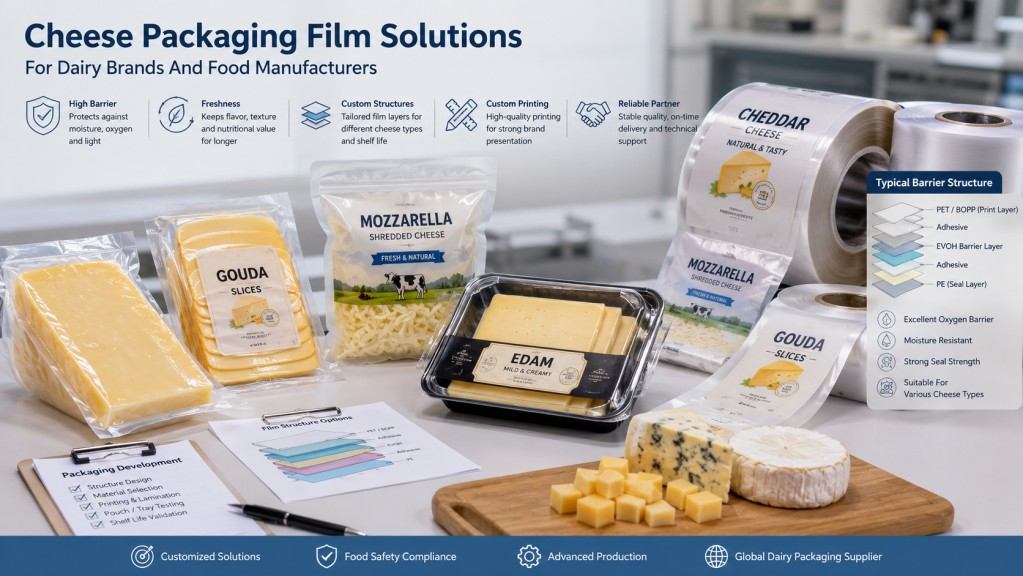
Some cheese products need a tight vacuum pack to reduce oxygen and hold the product firmly. Some need a thermoforming bottom web with a clear top film. Some need a tray and peelable lidding film for easy opening. Some need a printed pouch or flow-wrap film for retail branding. Some export products need a stronger high-barrier structure to survive long-distance shipping and cold-chain handling.
That is why a cheese packaging supplier should not only ask for the size and price target. A professional supplier should ask about cheese type, fat content, moisture level, storage temperature, filling method, target shelf life, package format, sealing machine, transport condition, and destination market.
For buyers still comparing basic material directions, CloudFilm’s food packaging film page can be used as a starting point for understanding flexible food packaging film options.
Main Cheese Packaging Formats
Cheese packaging can be designed in several common formats. The best choice depends on the product, shelf life, machinery, and retail positioning.
1. Vacuum Pouches For Cheese Blocks
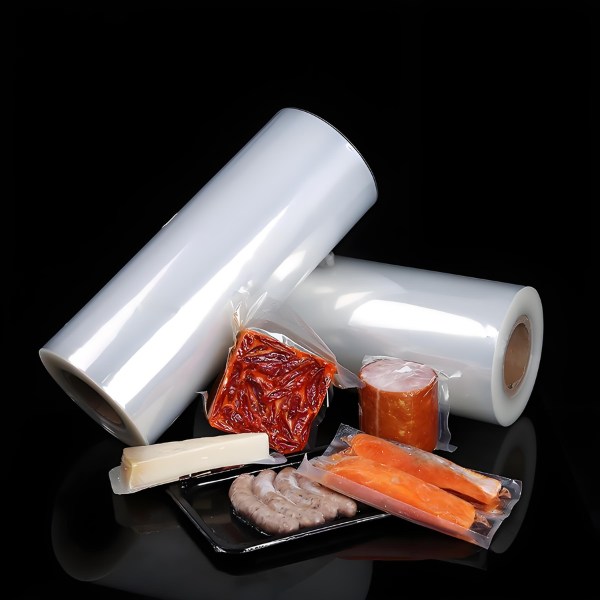
Vacuum pouches are widely used for cheese blocks, semi-hard cheese, processed cheese, and export dairy products. The air is removed before sealing, helping reduce oxygen exposure and keeping the pack tight around the product.
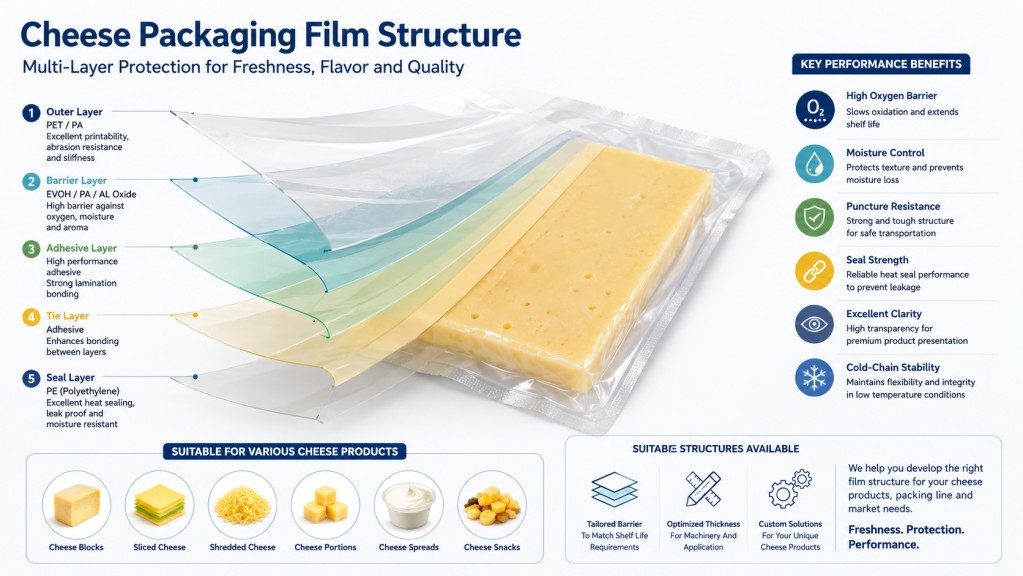
A common structure is PA/PE or PE/PA/PE. PA provides toughness, puncture resistance, and oxygen barrier. PE provides heat sealing and moisture resistance. For cheese with longer shelf-life requirements, EVOH or other high-barrier layers can be added.
For cheese blocks, vacuum packaging must have strong seal integrity. Even a small leak can destroy the vacuum effect and shorten shelf life. The film should also resist puncture from corners and edges, especially for block cheese.
For this type of pack, buyers can review PA/PE film because it is often used for vacuum-packed cheese, meat, seafood, and other high-barrier chilled foods.
2. Thermoforming Cheese Packaging
Thermoforming packaging is common for sliced cheese, block cheese portions, deli cheese, and processed cheese. The bottom film is formed into a cavity, the cheese is placed inside, and the top web is sealed over it.
Thermoforming cheese packs usually need bottom webs with good forming performance and top webs with reliable sealing. Structures may include PA/PE, PE/PA/PE, PA/EVOH/PE, or other multilayer films.
Important parameters include forming depth, corner thickness after forming, sealing temperature, film memory, puncture resistance, and clarity. If the forming web becomes too thin at the corners, the pack may leak or fail during transport.
Thermoforming is often preferred by larger cheese processors because it supports high-speed automatic packing, consistent pack shape, and clean retail presentation.
3. Cheese Trays With Lidding Film
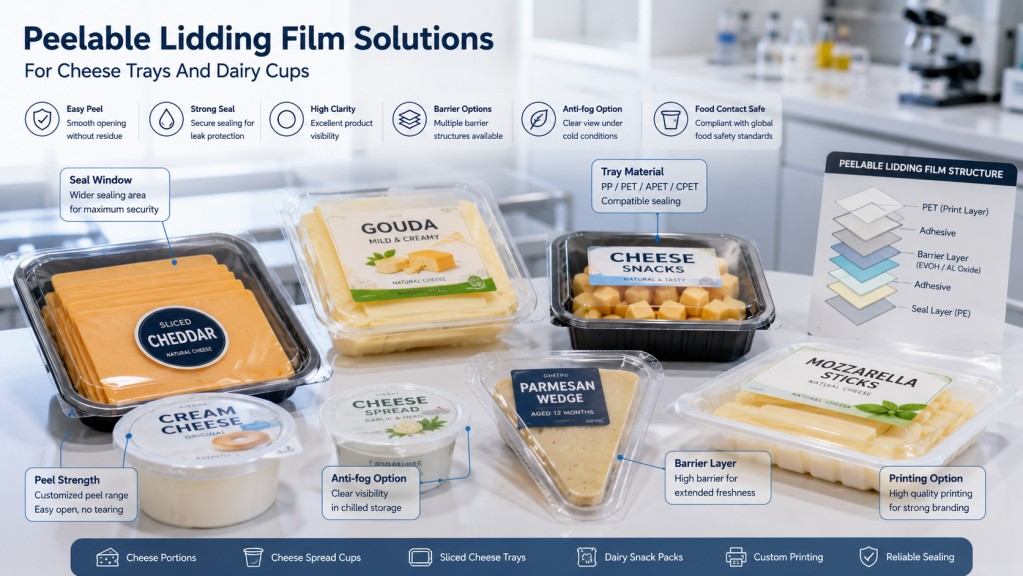
Cheese portions, cheese spreads, cheese snacks, fresh cheese, and deli cheese products are often packed in trays or cups with lidding film. The tray may be PP, PET, APET, CPET, PS, or aluminum, depending on the application.
The lidding film must match the tray material. A film that seals well to PP may not peel correctly from PET or aluminum. Seal strength is also important. If the seal is too weak, leakage may happen. If the seal is too strong, consumers may tear the film or spill the product when opening.
For tray-based dairy packaging, buyers can review food packaging tray options and combine them with a suitable lidding film. For easy opening, peelable lidding film is especially useful for cheese portions, dairy cups, dips, and chilled food trays.
4. Flow Wrap And Roll Stock For Sliced Cheese
Flow wrap and roll stock films are often used for individual cheese slices, cheese snacks, small cheese portions, and multipack formats. The film must run smoothly on high-speed horizontal or vertical packaging machines.
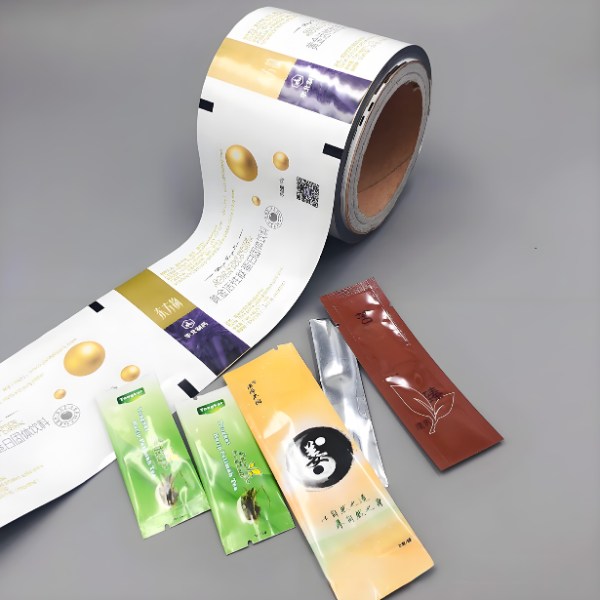
For printed cheese packaging, roll stock should have stable winding, correct COF, accurate thickness, proper corona treatment, and consistent sealing performance. Poor roll quality can cause tracking issues, film breakage, sealing defects, or print registration problems.
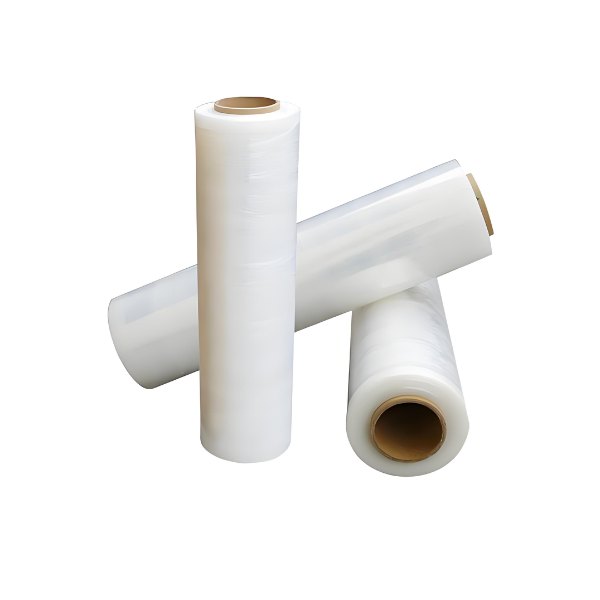
For buyers using automatic lines, packaging film roll is a useful internal reference because it covers custom roll width, thickness, core size, unwind direction, film structure, and machine runnability.
5. Stand-Up Pouches For Shredded Cheese
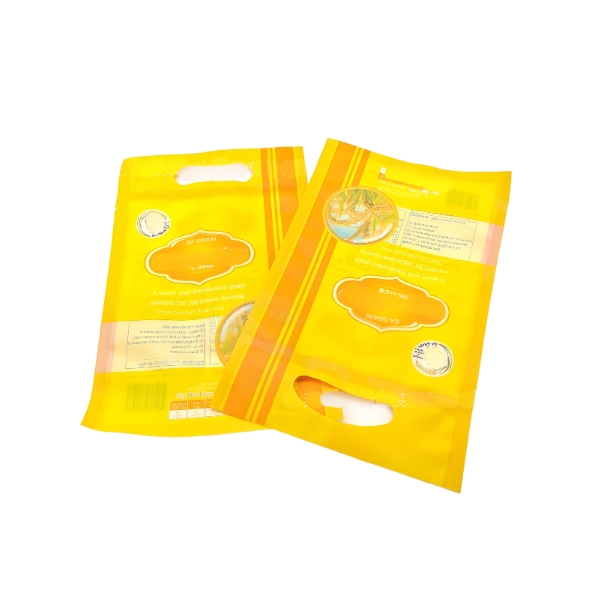
Shredded cheese and grated cheese often need reclosable packaging. Stand-up pouches, flat pouches, and zipper pouches are common choices. The package must protect the cheese from oxygen and moisture while allowing consumers to open and close the pack easily.
The structure may be PET/PE, PA/PE, PE/EVOH/PE, or recyclable mono-material options. If the cheese has high aroma or higher moisture sensitivity, barrier performance becomes more important.
A zipper can improve consumer convenience, but it also adds technical requirements. The zipper area must seal well. The pouch must stand properly. The top seal must not fail during filling, shipping, or retail handling.
For retail pouch formats, buyers can also review stand up pouches when developing shredded cheese, cheese snacks, or high-value dairy products.
Key Film Properties For Cheese Packaging
A good cheese packaging structure should be designed around the product, not only the film name. Below are the most important properties buyers should check.
Oxygen Barrier
Oxygen can affect cheese flavor, color, and microbial stability. Vacuum packaging and modified atmosphere packaging both rely on good oxygen control. PA, EVOH, coated PET, and other barrier layers may be used depending on shelf-life needs.
Hard cheese blocks may use PA/PE vacuum film. Sliced cheese or shredded cheese may need a different balance of oxygen barrier, sealability, clarity, and pouch stiffness.
Moisture Control
Cheese contains water and fat. If the packaging allows too much moisture loss, the product may dry out. If moisture is not managed properly, condensation, texture change, or microbial issues may appear.
PE sealing layers usually provide good moisture resistance. For some formats, anti-fog or controlled moisture performance may also be considered.
Seal Strength
Seal integrity is one of the most important factors in cheese packaging. The pack may look good, but if the seal fails, the product fails.
Buyers should check sealing temperature, pressure, dwell time, contamination in the seal area, hot tack, cold seal strength, and peel behavior. For vacuum pouches, the seal should be strong and leak-resistant. For lidding film, the seal should be secure but easy to peel when required.
Puncture Resistance
Cheese blocks, corners, hard edges, and frozen or chilled handling can stress the film. PA-based structures are often selected because they improve toughness and puncture resistance.
Puncture resistance is especially important for vacuum-packed cheese blocks and thermoformed packs. During distribution, cartons may be stacked, moved, and exposed to vibration. A weak film can lead to pinholes or micro-leaks.
Clarity And Shelf Appearance
For premium cheese, consumers often want to see the product. High clarity film helps show color, texture, and freshness. For printed packs, surface gloss, matte finish, and print quality also affect brand perception.
Clear top webs, transparent windows, and high-quality printed roll stock can help brands balance product visibility and brand communication.
Low-Temperature Performance
Most cheese products move through chilled storage and cold-chain logistics. The packaging film must remain flexible and stable at low temperatures. If the film becomes brittle, cracks or seal damage may occur.
This is one reason why a supplier should understand the full storage and transport environment before recommending a structure.
How To Choose Packaging For Different Cheese Types
Different cheese products require different packaging solutions. The following guide can help buyers make a first selection before discussing exact specifications with a supplier.
Hard Cheese Blocks
Recommended formats include vacuum pouches, shrink bags, and thermoforming packs. Common structures include PA/PE, PE/PA/PE, or PA/EVOH/PE for longer shelf life.
Key points: oxygen barrier, puncture resistance, strong vacuum seal, stable cold-chain performance, and tight pack appearance.
Sliced Cheese
Sliced cheese may be packed in thermoforming packs, flow-wrap packs, or reclosable pouches. The film should provide good clarity, reliable sealing, and easy opening.
Key points: anti-sticking performance, clean peel if needed, stable pack shape, and good product visibility.
Shredded Cheese
Shredded cheese often uses zipper pouches or pillow pouches. A reclosable zipper is helpful for retail packs because consumers usually use the product several times.
Key points: oxygen barrier, moisture control, zipper quality, pouch stiffness, and good sealing around powder or cheese particles.
Soft Cheese And Fresh Cheese
Soft cheese may need trays, cups, or high-barrier pouches. Depending on the product, the packaging may need peelable lidding film, anti-fog film, or stronger oxygen control.
Key points: clean opening, leakage prevention, aroma protection, and sealing performance on the chosen tray material.
Cheese Snacks And Portion Packs
Cheese snacks need convenient opening, strong branding, and good retail display. Flow wrap, small pouches, and tray-lid systems are common.
Key points: attractive printing, easy tear, portion control, good seal strength, and stable shelf appearance.
Recyclable Cheese Packaging: What Buyers Should Know
Many cheese brands are exploring recyclable flexible packaging. However, cheese is more demanding than many dry foods because it often needs strong oxygen barrier, moisture control, seal integrity, and cold-chain performance.
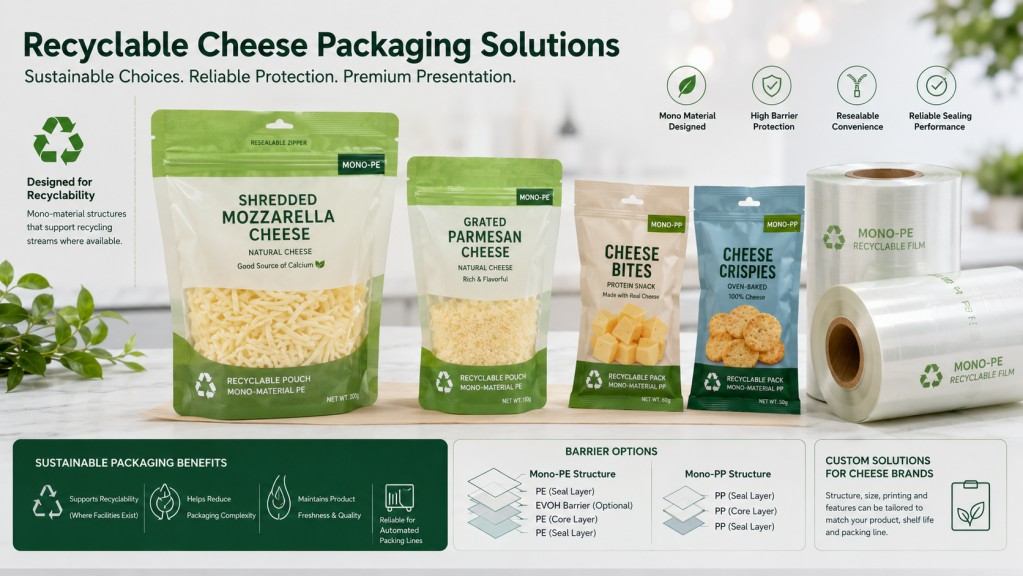
Mono-PE or mono-PP packaging may be suitable for some cheese products, especially when the shelf-life target is not too extreme and local recycling systems can accept the material. For higher barrier needs, recyclable-oriented structures may include EVOH or other barrier layers while still trying to stay within a more compatible material family.
Buyers should not choose recyclable packaging only by name. They should confirm local recycling rules, barrier needs, sealing performance, printing requirements, filling conditions, and shelf-life tests.
For brands developing recyclable dairy packs, CloudFilm’s recyclable pouches page can help buyers understand mono-material PE and PP pouch directions.
Printing And Branding For Cheese Packaging
Cheese packaging must protect the product, but it must also sell the product. Good printing can show brand story, flavor, origin, nutrition, storage instructions, and cooking use.
For roll stock and pouches, common printing options include gravure printing and flexographic printing. Finishes may include gloss, matte, registered matte, soft-touch feel, transparent window, metallic effect, or high-opacity white background.
For cheese, visual trust is very important. Clean design, readable text, and visible product windows can help consumers feel confident. However, the printing system must also be compatible with food packaging regulations, lamination, sealing, and cold-chain conditions.
A responsible cheese packaging manufacturer should review artwork, ink system, lamination structure, and sealing area before mass production. The printed design should not interfere with sealing performance or pouch forming.
Quality Testing For Cheese Packaging
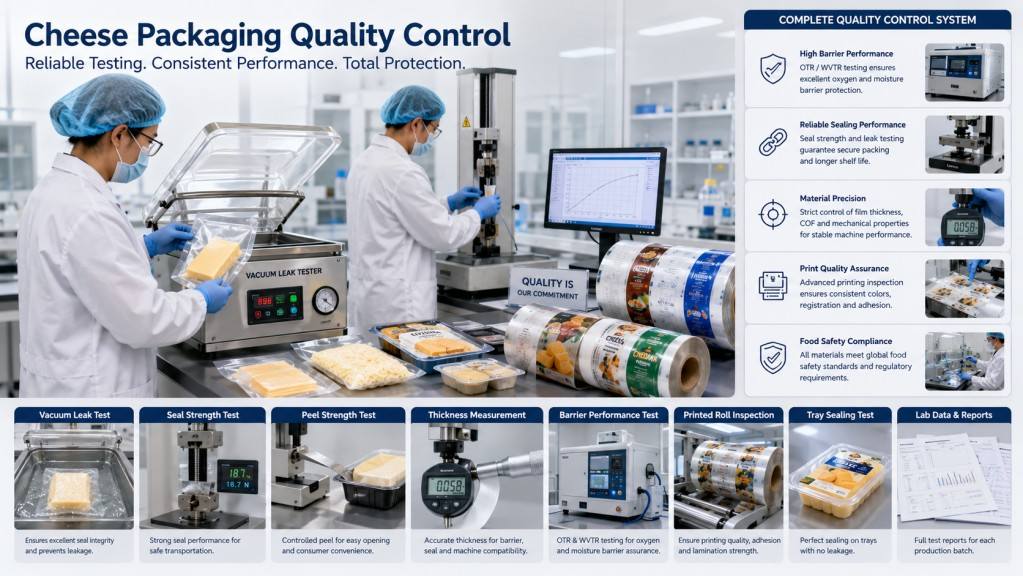
Before bulk production, buyers should test both the film and the finished package. Important tests may include:
Film thickness and width tolerance.
Seal strength and peel strength.
Vacuum leakage test.
Oxygen transmission rate.
Water vapor transmission rate.
Puncture resistance.
Coefficient of friction.
Printing adhesion.
Lamination bond strength.
Drop test and carton compression test.
Cold-chain storage trial.
Real product shelf-life test.
For cheese, line trials are especially important. A film that looks good in sample form may behave differently on a packing machine. Therefore, the supplier should support trial rolls, small batch testing, and technical adjustment before large orders.
How To Send A Clear RFQ To A Cheese Packaging Supplier
A clear RFQ helps the supplier recommend the correct structure and quote faster. When asking for cheese packaging film, prepare the following information:
Cheese type: hard cheese, soft cheese, sliced cheese, shredded cheese, processed cheese, cheese spread, or cheese snack.
Package format: vacuum pouch, thermoforming pack, tray with lidding film, flow wrap, stand-up pouch, flat pouch, or roll stock.
Product weight and pack size.
Target shelf life.
Storage temperature.
Filling temperature.
Packing machine type.
Required film width, thickness, and core size.
Current film structure if available.
Printing design and number of colors.
Need for zipper, easy tear, clear window, anti-fog, matte finish, or high barrier.
Monthly or annual quantity.
Destination country or port.
If you already have a current packaging sample, send photos, film structure, TDS, and sealing conditions. This helps the supplier match or improve the existing packaging more accurately.
Choosing A Reliable Cheese Packaging Manufacturer
A reliable cheese packaging manufacturer should do more than sell film rolls. The supplier should understand dairy packaging, barrier design, sealing behavior, pouch conversion, roll stock production, and export communication.
When evaluating a supplier, buyers should check these points:
Can the supplier recommend different structures for different cheese types?
Can the supplier provide vacuum film, lidding film, roll stock, and pouches?
Can the supplier support samples and trial rolls?
Can the supplier adjust barrier, thickness, seal layer, and printing finish?
Can the supplier explain MOQ, lead time, testing, and shipping clearly?
Can the supplier support food packaging documentation when needed?
Can the supplier help solve machine running problems?
Can the supplier communicate quickly during development?
Price matters, but the lowest price is not always the best value. Cheese packaging failure can cost much more than a small difference in film price. A better supplier helps reduce risk before mass production.
Why Work With CloudFilm For Cheese Packaging
CloudFilm supports dairy and food packaging buyers with flexible packaging films, laminated roll stock, vacuum packaging films, lidding films, food trays, and custom pouches.
For cheese packaging projects, CloudFilm can help you compare PA/PE vacuum film, PE/PA/PE thermoforming structures, peelable lidding films, printed roll stock, high-barrier laminates, and recyclable pouch options. The goal is to match the film structure with your cheese type, shelf-life target, packing machine, and market positioning.
Whether you need vacuum pouches for cheese blocks, lidding film for cheese trays, roll stock for sliced cheese, or reclosable pouches for shredded cheese, CloudFilm can help you move from material selection to sample testing and bulk production.
Send your cheese type, pack format, size, shelf-life target, machine information, and estimated quantity. CloudFilm will review your project and suggest a practical packaging solution.
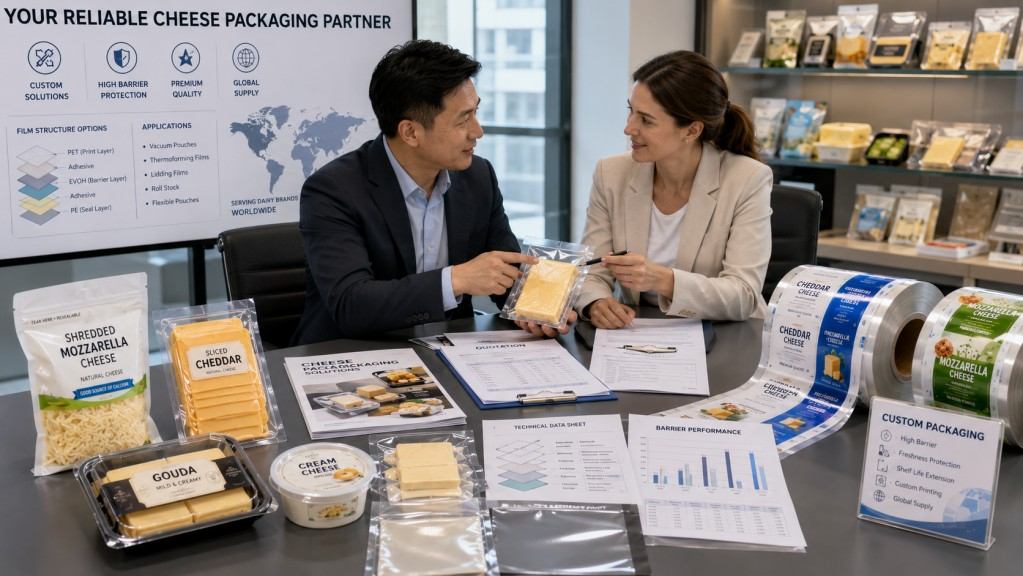
FAQ About Cheese Packaging
1. What is the best packaging for cheese?
The best packaging depends on the cheese type, shelf life, and filling method. Cheese blocks often use vacuum pouches or thermoforming packs. Sliced cheese may use thermoforming packs or flow-wrap film. Shredded cheese often uses zipper pouches. Cheese portions and spreads often use trays with peelable lidding film.
2. What film is commonly used for vacuum-packed cheese?
PA/PE film is commonly used because PA provides oxygen barrier and puncture resistance, while PE provides heat sealing and moisture resistance. For longer shelf life, EVOH or other high-barrier layers may be added.
3. Is PA/PE film suitable for cheese packaging?
Yes. PA/PE film is suitable for many vacuum-packed cheese products, especially cheese blocks, sliced cheese, and thermoforming packs that need oxygen barrier, toughness, and reliable seals.
4. Can cheese be packed in recyclable pouches?
Yes, some cheese products can use recyclable-oriented mono-PE or mono-PP pouches, depending on shelf-life target, barrier needs, and local recycling systems. The structure must be tested with the real product.
5. What is the difference between vacuum packaging and modified atmosphere packaging for cheese?
Vacuum packaging removes air and keeps the film tight around the cheese. Modified atmosphere packaging replaces the air inside the pack with a controlled gas mixture. The best choice depends on cheese type, shelf life, appearance, and packing equipment.
6. What causes cheese packaging to swell?
Swelling may come from microbial activity, gas generation, poor storage, incorrect packaging structure, leakage, or product-related issues. The packaging supplier and food producer should review the product, process, seal quality, and storage conditions together.
7. Why does vacuum-packed cheese lose vacuum?
Vacuum loss may be caused by pinholes, poor sealing, puncture damage, film defects, contamination in the seal area, or incorrect machine settings. Strong film and correct sealing parameters are both important.
8. Can lidding film be used for cheese trays?
Yes. Peelable lidding film is widely used for cheese trays, cheese portions, cheese spreads, dairy cups, and deli products. The film must be matched with the tray material and target peel strength.
9. What information is needed for a cheese packaging quotation?
A supplier usually needs cheese type, package format, size, weight, shelf-life target, storage temperature, machine type, film width, thickness, printing design, quantity, and destination country.
10. Does cheese packaging need high barrier film?
Many cheese products need good oxygen barrier, but not every product needs ultra-high barrier. Short-life chilled products may use a simpler structure, while export cheese, shredded cheese, and sensitive products may need stronger barrier.
11. Can cheese packaging film be printed?
Yes. Cheese packaging film can be printed for branding, nutrition facts, ingredients, barcodes, cooking instructions, and retail presentation. The printing must be designed so that it does not affect sealing performance.
12. What is the common thickness for cheese vacuum bags?
Thickness depends on cheese size, pack format, puncture risk, and machinery. Many PA/PE vacuum structures are in the medium-to-high thickness range, but the final specification should be confirmed by product testing.
13. Can cheese packaging include a zipper?
Yes. Zippers are common for shredded cheese and grated cheese pouches. The zipper must be compatible with the pouch structure and filling process.
14. Why is seal strength important for cheese packaging?
Seal strength protects the package from leakage, vacuum loss, contamination, and transport damage. For lidding film, controlled peel strength also affects consumer opening experience.
15. How can I test a new cheese packaging film?
Start with material samples, then run machine trials, seal tests, leakage tests, cold-chain storage tests, and real product shelf-life tests. Bulk orders should only be placed after the structure performs well in your own process.
Final Thoughts
Cheese packaging requires a careful balance of barrier, sealing, toughness, clarity, convenience, branding, and cost. A good structure protects flavor and texture, supports cold-chain distribution, and helps the product look attractive on the shelf.
For dairy processors, food brands, and packaging converters, working with a professional cheese packaging supplier can reduce development risk and improve packaging performance. The most effective approach is to share your product details, machine conditions, shelf-life target, and market requirements, then test the recommended structure before mass production.
CloudFilm can support cheese packaging projects with vacuum films, lidding films, roll stock, high-barrier laminates, recyclable pouches, and custom packaging solutions for global dairy brands.