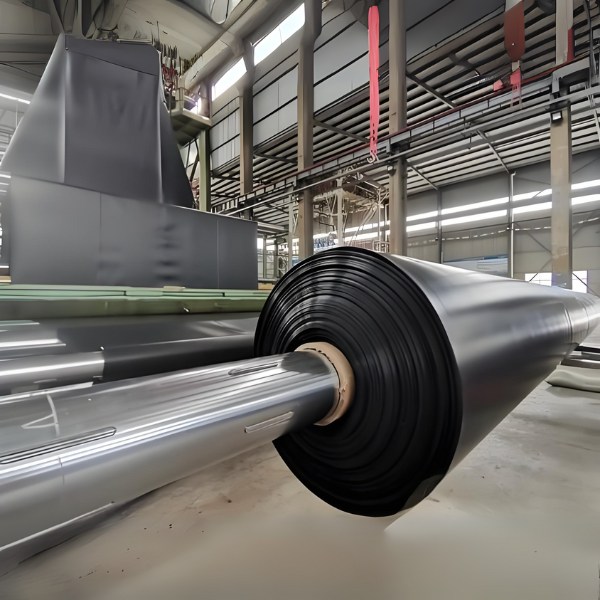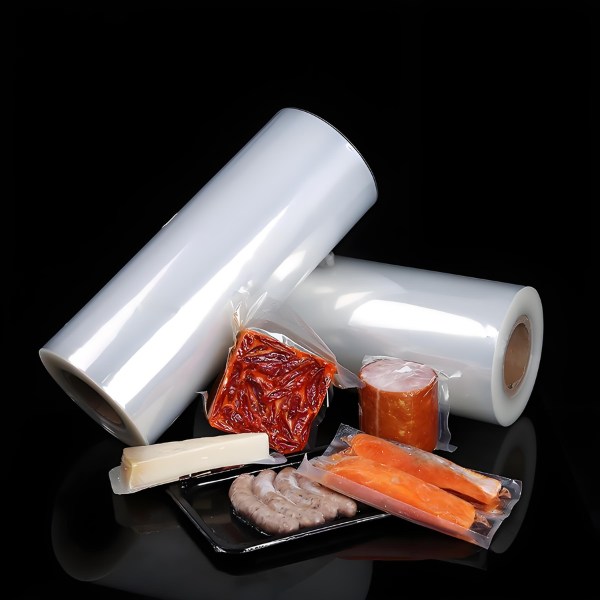
Choose LLDPE film for a heavy-duty bag or industrial liner from the real load and failure risk—not from thickness alone. Define the packed product, net weight, particle shape, bag or container geometry, filling temperature, sealing method, drop and stacking exposure, storage conditions and required cleanliness. Then select a monolayer, LDPE/LLDPE blend or coextruded PE structure and validate thickness profile, puncture or dart impact, tear behavior, tensile and elongation, seal strength, hot tack, coefficient of friction and filled-pack survival. There is no universal “heavy-duty” gauge that fits every bag and liner.
This application guide is written for packaging buyers, bag makers, industrial distributors, filling-line engineers and product manufacturers sourcing LLDPE film for sacks, box liners, drum liners, bin liners or FIBC liners. For a wider material and specification framework, first review the LLDPE film buyer’s guide. If your application and film format are already defined, go directly to CloudFilm’s custom LLDPE film product page to discuss a sample or quotation.
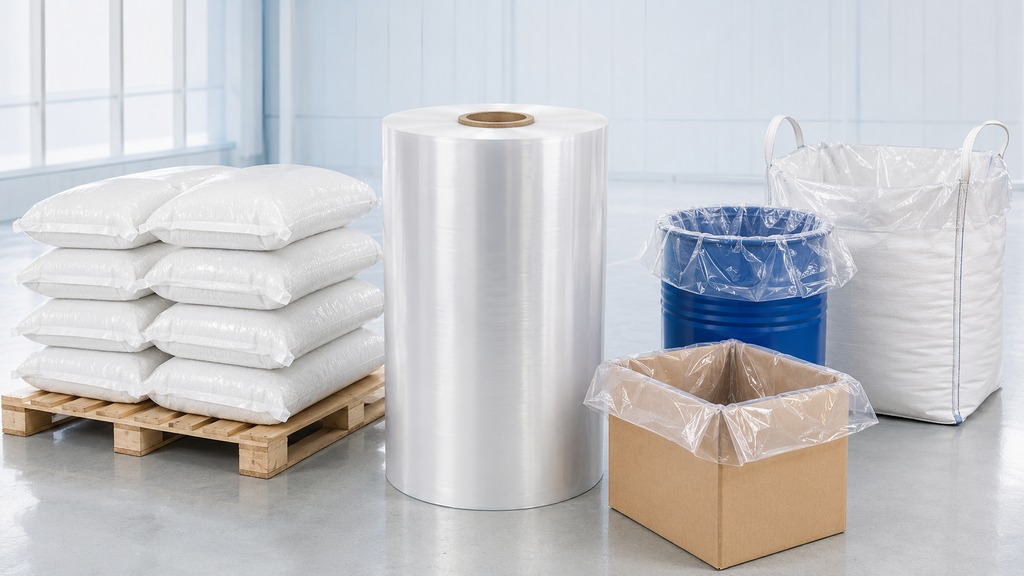
Heavy-Duty Bags and Industrial Liners Are Different Packaging Jobs
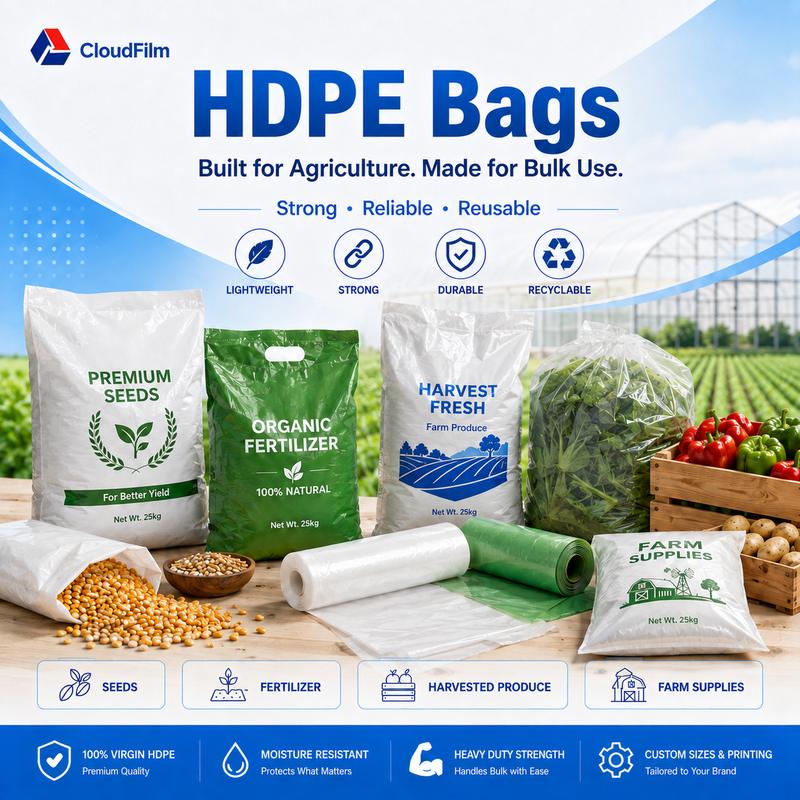
A heavy-duty bag normally carries the product as the primary package. The film and its seals must withstand filling impact, internal pressure, lifting, drops, stacking, pallet movement and transport vibration. Typical contents include polymer resin, fertilizer, seed, salt, grain, animal feed, mineral powder, construction materials and industrial components. The same film may also need printing, controlled friction for pallet stacking and stable running on a form-fill-seal line.
An industrial liner works with a rigid or flexible outer container. The carton, drum, crate, tote or FIBC carries most of the structural load, while the liner provides separation, cleanliness, moisture protection, product containment or easier discharge. Liner failures often begin at corners, folds, closure points, insertion damage or poor fit—not at the center of a flat film sample.
| Decision area | Heavy-duty bag or shipping sack | Industrial liner |
| Primary role | Contains and carries the filled product as a standalone package | Protects or separates the product inside another container |
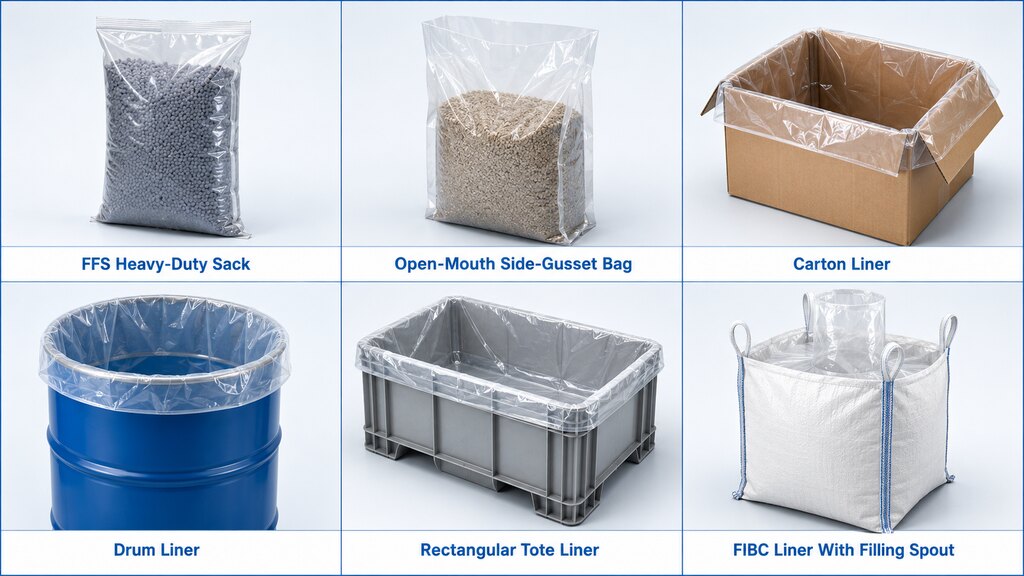
| Typical formats | FFS tube, open-mouth bag, flat bag, side-gusset bag or pre-made sack | Flat liner, gusseted liner, form-fit box liner, drum liner, tote liner or FIBC liner |
| Dominant hazards | Filling shock, drop impact, seal loading, puncture, creep, stacking and pallet friction | Corner puncture, folding stress, insertion damage, poor fit, closure leakage and extraction |
| Critical dimensions | Layflat width, gusset, cut length, seal geometry, valve/opening and filled-bag shape | Container internal dimensions, liner opening, bottom geometry, cuff, ties, spout or fitment |
| Best final proof | Filled-sack line trial followed by drop, stacking and distribution simulation | Installation and use trial in the actual container with the real product or justified simulant |
Do not use “industrial bag,” “liner” and “heavy-duty sack” as interchangeable terms in an RFQ. A clear drawing, current sample and photographs of the filled package prevent more errors than a long list of generic resin properties. For dimensional terminology and practical size references, use CloudFilm’s polyethylene bag sizes guide for buyers.
When LLDPE Is the Right Starting Point
LLDPE is a useful mechanical backbone when a bag or liner needs flexibility, elongation, impact resistance, puncture resistance and reliable heat sealing. Its ability to deform under load can help the film absorb energy around pellets, corners or irregular products instead of cracking immediately. These benefits explain why LLDPE is common in industrial bags, liners and heavy-duty shipping sacks.
However, “use LLDPE” is still only a material direction. Finished-film performance also depends on resin density, melt index, comonomer and catalyst system, LDPE or HDPE blending, layer distribution, additives, extrusion stability, thickness profile and sealing conditions. A stable LDPE/LLDPE blend can outperform a poorly converted nominally pure LLDPE film. A well-designed three-layer film can place toughness in the core while the skins manage sealing, printing, slip or antiblock.
LLDPE is a strong starting point when:
- The product creates impact, flexing or local puncture risks during filling and distribution.
- The package must remain flexible at normal or reduced handling temperatures.
- The seal must tolerate ordinary industrial handling and a realistic production window.
- A mono-PE bag or liner is preferred and the required protection can be achieved without a non-PE barrier layer.
- Downgauging is being evaluated through controlled package testing rather than by resin claims alone.
LLDPE alone may not be enough when:
- The product has severe sharp edges, metal burrs, bones or protrusions that require a nylon-containing puncture layer.
- The contents are highly oxygen- or aroma-sensitive and the required shelf life needs a validated barrier structure.
- The package requires unusually high stiffness, low creep or dimensional restraint that calls for an HDPE-rich layer or another design.
- The product is regulated as dangerous goods. Material selection does not replace package certification, closure qualification or applicable transport testing.
- High-temperature filling, sterilization or chemical compatibility is outside the demonstrated range of the proposed film.
When sharp products or higher barrier are the dominant risks, compare a PE-only construction with CloudFilm’s PE PA PE high-barrier and puncture-resistant film. Do not add nylon automatically: it can improve performance, but it changes structure, cost, processing and recyclability considerations.
Choose the Film Architecture by Failure Risk
| Film route | Where it can fit | Design value | What must be confirmed |
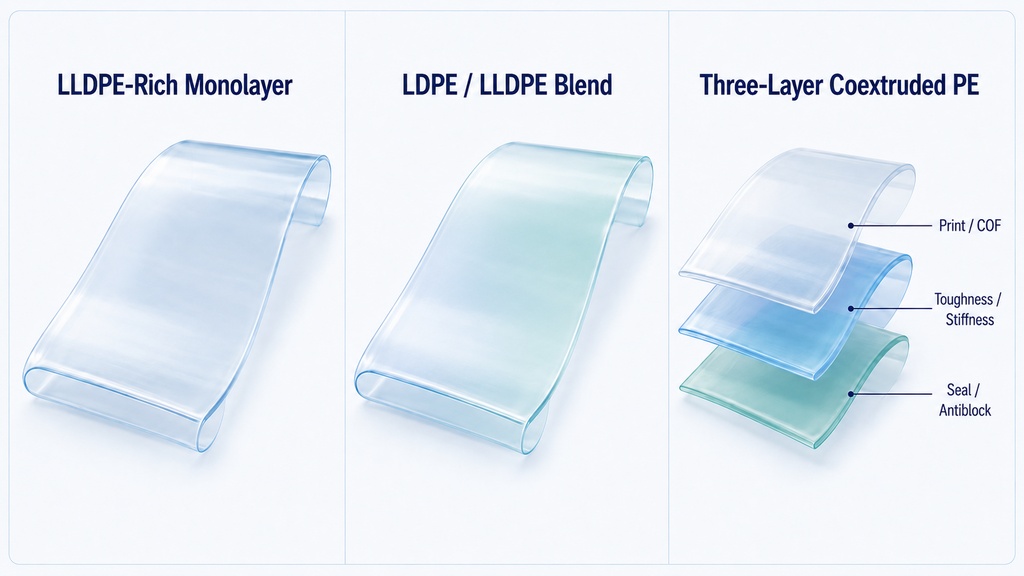
| LLDPE-rich monolayer | General heavy bags, liners and converting rollstock with moderate process complexity | Simple PE construction with useful toughness and sealing | Bubble or cast stability, thickness profile, blocking, COF, optics and seal window |
| LDPE/LLDPE blend | Blown-film bags and liners needing a balance of processability, melt strength, clarity and toughness | LDPE can support bubble stability and processing while LLDPE contributes mechanical performance | Blend purpose, consistency, seal behavior, finished-film tests and performance after aging |
| LLDPE/HDPE or PE stiffness blend | Sacks needing more stiffness, stacking stability or creep control | Balances extensibility with increased stiffness | Loss of flexibility, seal response, tear behavior and actual drop performance |
| Three-layer PE coextrusion | High-volume sacks, liners and FFS films with separate skin, core and seal-side needs | Functional layers can control printing, friction, blocking, stiffness, toughness and sealing independently | Layer functions, layer distribution, total gauge, edge trim, treatment side and lot consistency |
| mLLDPE-enhanced PE film | Projects seeking stronger seals, improved puncture or controlled downgauging | Can raise performance at a selected layer or blend level | Cost-benefit at the finished-pack level, sealing window, processing and formulation stability |
| PE/PA/PE or PA/PE structure | Sharp products, demanding industrial contents or barrier-sensitive applications | Nylon can add puncture resistance and oxygen barrier while PE supplies sealing | Actual barrier target, flex durability, seal layers, converting route and end-of-life claim |
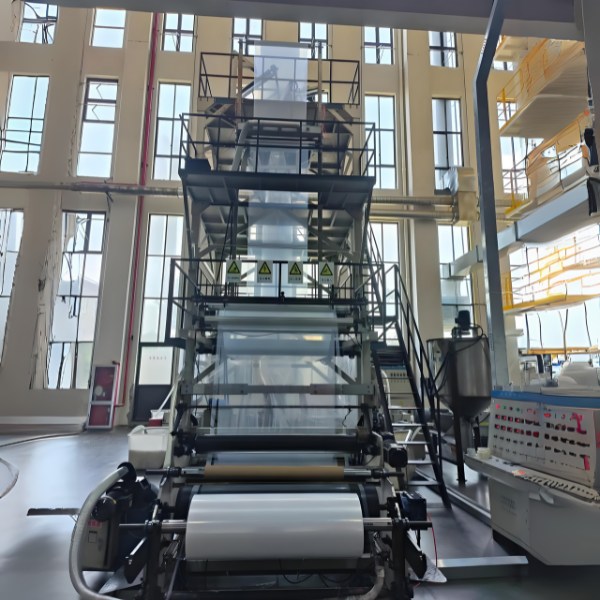
For a PE-only multilayer route, review CloudFilm’s three-layer coextruded film options. The correct architecture is not necessarily the most complex one. Select the simplest film that passes the defined filling, handling, storage and transport tests with a stable production window.
Match the Bag or Liner Format to the Filling Operation
Form-fill-seal and tubular sack film
FFS film is supplied as tubing or gusseted tubing and converted into a bag on the filling line. It needs stable layflat width, gusset geometry, web tracking, print registration where applicable, controlled friction and a seal window that works at production speed. Roll diameter, core, winding direction, splice rule and roll hardness are part of the application specification—not merely shipping details.
Pre-made open-mouth or side-gusset bags
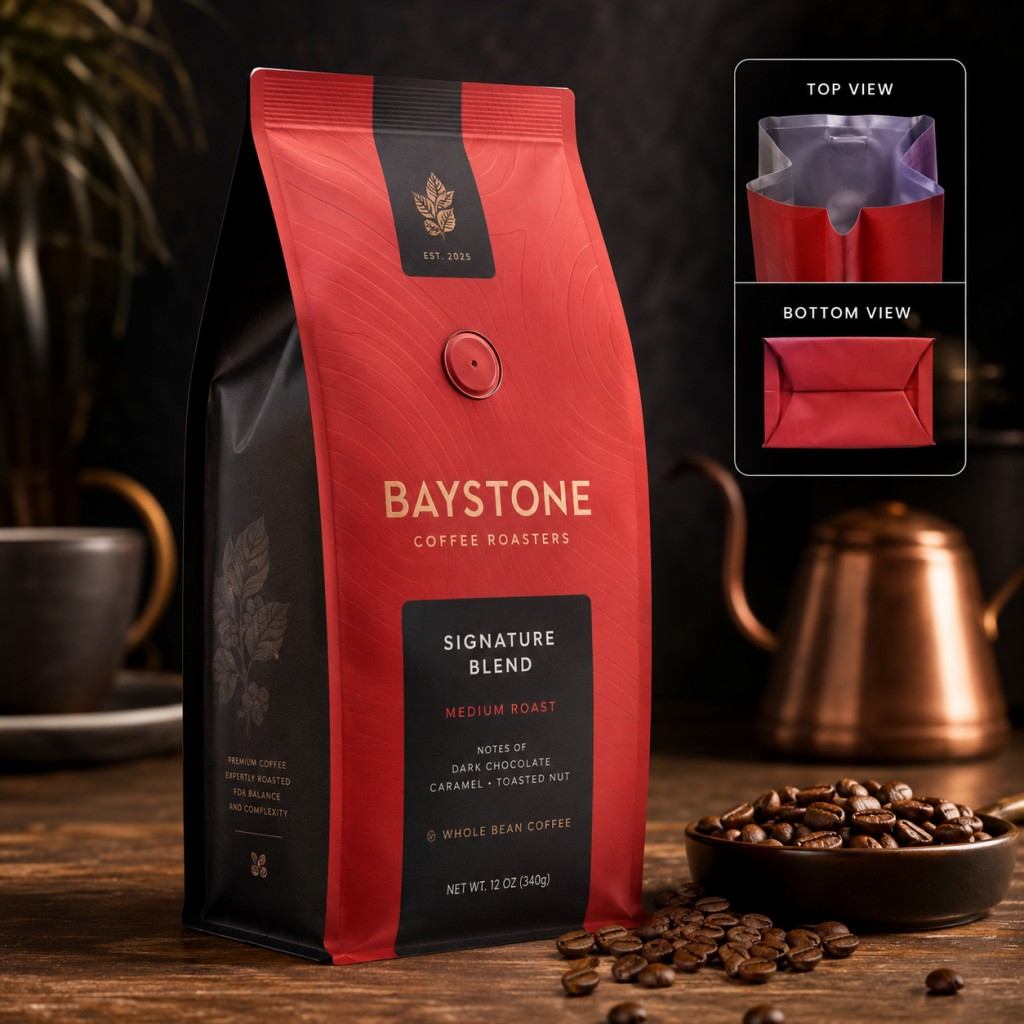
These formats separate bag making from filling. Buyers should define mouth opening, bottom seal, gusset depth, perforation or wicket requirements, valve or closure method, and how the bag is presented to the operator or automatic feeder. A gusset provides volume, but incorrect fold geometry can concentrate stress and create weak points. CloudFilm’s custom gusset bag page gives a broader view of expandable bag structures.
Box, carton and crate liners
The liner must fit the internal container without excessive tension or large loose folds. Confirm whether it is a simple flat bag, side-gusset liner, bottom-gusset liner or form-fit liner. State whether the top is folded over the carton, tied, clipped, heat sealed or left open. The closure method and product corners often determine the required film more than container volume alone.
Drum, tote and bin liners
Round and rectangular containers create different fold patterns. Define internal diameter or length/width, depth, opening circumference, cuff requirement and bottom construction. If the liner will be pulled out with product inside, describe the lifting method; a film designed only for static containment may not be safe or suitable for unsupported lifting.
FIBC and bulk-container liners
A liner inside a woven bulk bag may be loose, tabbed, form-fit, baffled or equipped with filling and discharge spouts. Static control, powder cleanliness, filling speed and discharge behavior may be more important than optical appearance. The outer FIBC specification and liner specification should be reviewed as one system, especially when the contents are fine powders or the package is used in a controlled industrial environment.
Set Dimensions Before Finalizing Thickness
A bag that is too tight may puncture even when the film is mechanically strong. A liner that is too large may fold unpredictably, trap product or interfere with sealing. Start with the actual product and container, then add controlled filling and closure allowance. Use a drawing that shows which dimension is layflat width, total gusset, cut length, cuff, spout or seal allowance.
| Dimension field | What to state | Common source of error |
| Width | Single-web width, layflat tube width or finished bag opening width | Confusing roll width with twice the finished bag width |
| Gusset | Side or bottom gusset and whether the quoted value is one fold or total added depth | Different markets use different gusset notation |
| Length | Cut length plus top and bottom seal/closure allowances | Ordering the product length with no room for filling and sealing |
| Thickness | Single-wall film thickness, not the combined double-wall bag reading | Measuring a folded bag and reporting twice the true film gauge |
| Liner fit | Container internal dimensions, corner radius, cuff, ties, spouts and installation method | Using only nominal container volume |
| Roll build | Core ID and length, maximum OD, roll weight, winding direction, print orientation and splice rule | A correct film arriving in a roll the equipment cannot load |
For new large-volume projects, send a physical container, CAD drawing or detailed measurement sheet when practical. Approve an empty-bag drawing first, then a filled-bag sample. Do not release mass production from an unfilled flat sample if the filled geometry controls pallet fit or seal stress.
Use Thickness as a Screening Range, Not a Performance Guarantee
CloudFilm’s current LLDPE product page publishes a general thickness range of 15–100 μm, width of 300–2000 mm, 3- or 6-inch cores, and a published MOQ of 1000 kg. Those values are useful for initial screening, but many heavy-duty sacks and liners require thicker or multilayer constructions. CloudFilm’s PE roll page shows a broader typical thickness range of 20–200 μm. Any requirement at the upper end or above the published LLDPE range needs a specific capability and structure review.
| Screening band | Possible application direction | Qualification warning |
| 40–80 μm | Selected carton liners, smooth products, secondary containment or lighter industrial protection | Not automatically suitable for heavy loads, sharp particles or unsupported lifting |
| 80–120 μm | Stronger liners, industrial parts, frozen or dense products and selected medium-to-heavy bags | Confirm local gauge minimum, puncture, seal and filled-pack drop behavior |
| 120–200 μm | Heavy-duty liners, agricultural or mineral products, pallet protection and demanding industrial bags | Confirm processing capability, fold behavior, sealing energy, roll weight and cost per bag |
| Above 200 μm | Special industrial covers, equipment protection or exceptionally demanding liner systems | May require another PE product route, multilayer design or alternative construction |
Important: These bands are discussion starting points, not CloudFilm guarantees and not global standards. A well-designed thinner coextruded film may outperform a thicker poor-quality film, while some sharp or high-risk products require more than thickness. Approve the exact formulation, gauge profile, bag geometry and filled-package test.
Thickness also changes yield and cost. At a given density, basis weight increases directly with gauge. Normalize competing quotations by finished bag area, film density, net film per bag, expected good-bag yield and packing-line efficiency. CloudFilm’s flexible film density and yield formulas can help convert microns and density into GSM and square meters per kilogram.
Control Seals, Gussets, Folds and Edges
Many “film failures” are actually package-design or sealing failures. A strong film can still fail if the bottom seal is narrow, overheated, contaminated, wrinkled or placed across a thick gusset transition. Ask for a seal curve rather than one temperature. The useful production window combines jaw temperature, dwell time, pressure, line speed and seal geometry.
Final seal strength and hot tack solve different problems
Final seal strength measures a cooled seal under defined conditions. Hot tack measures the seal while it is still hot and may carry product weight immediately after the jaws open. Vertical FFS sacks, powders and fast lines may need both. If contamination is expected at the seal, test with a controlled quantity of the actual product or a justified simulant.
Inspect the complete seal path
- Bottom and top seals, including seal width and edge distance.
- Gusset transitions where multiple film layers cross the jaw.
- Valve, spout, tie, clip, zipper or fitment areas.
- Print, slip or antiblock additives that may change sealing behavior.
- Wrinkles, trapped powder, fold memory and distorted areas after filling.
Use ASTM F88/F88M as a recognized method for seal strength and ASTM F1921/F1921M for hot tack where they fit the packaging system. The specification must still define specimen direction, seal-making conditions, conditioning, failure mode and acceptance rule. A method number without test conditions is incomplete.
Specify Friction, Additives, Printing and Roll Quality
Coefficient of friction affects several stages at once. The outer surface must move through guides and stack on pallets without uncontrolled sliding. The inner surface may need to open cleanly during bag making or liner installation. A single COF number is not enough: define which surfaces are tested together, whether the result is static or kinetic, conditioning time and the point in aging when the film must comply.
| Control | Why it matters | What to write in the specification |
| Slip / COF | Web transport, bag opening, filled-bag stacking and pallet stability | Inside/outside surface pair, static/kinetic method, target window and aging point |
| Antiblock | Tube opening and separation of film surfaces | Required opening behavior plus any optical or sealing constraint |
| Antistatic | Powder handling, dust attraction or electronics-related use | Required property, measurement method, humidity and service duration; do not use a vague label |
| UV stabilization | Outdoor storage or exposed liner/cover applications | Geography, exposure period, color and validation plan |
| Color / opacity | Product identification, light control, cleanliness inspection or brand requirement | Masterbatch, approved color standard, opacity and migration/contact constraints where relevant |
| Corona treatment | Ink, coating or lamination adhesion | Treated side, target surface energy, test method, winding map and acceptance time |
| Roll quality | Stable unwind and reduced downtime | Flatness, edge alignment, winding hardness, telescoping, wrinkles, gauge bands and splice limits |
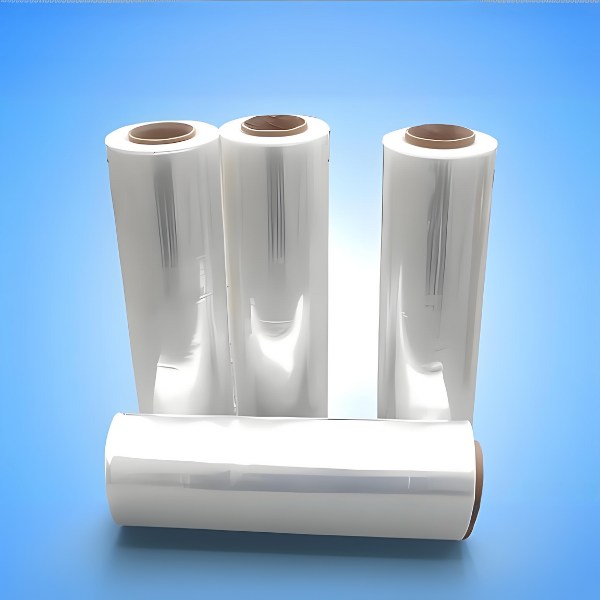
If a liner is supplied as plain rollstock or tubing for conversion, compare CloudFilm’s custom PE roll formats. For printed or treated film, store sample rolls under the agreed conditions and recheck surface treatment and COF after the intended aging period.
Use Tests That Reproduce the Real Failure
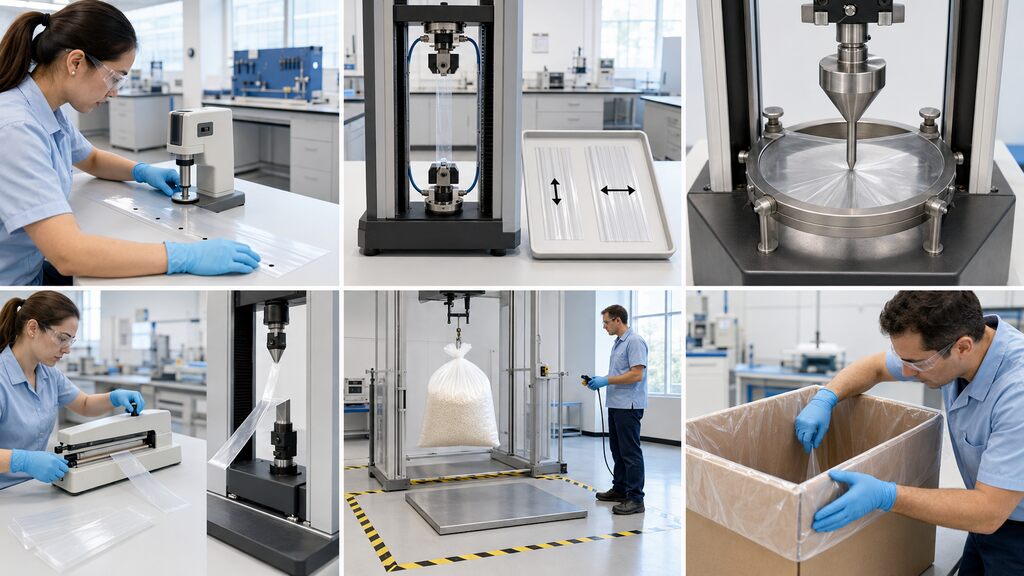
A complete test plan combines film-level data, seal-level data and package-level validation. Film tests screen materials and support process control. The filled bag or installed liner remains the final decision unit because geometry, seals, folds and product contact change the stress pattern.
| Risk or question | Useful test or evidence | Final application confirmation |
| Thin lanes or local weak areas | Average and cross-web thickness profile using an agreed film-thickness method | Inspect failures against the thickness map and production roll position |
| Filling or drop impact | Dart impact such as ASTM D1709, tensile/elongation and relevant puncture testing | Filled-sack vertical impact or drop sequence; ISO 7965-2 may be considered for thermoplastic film sacks |
| Tear starts at a notch, fold or edge | MD/TD tear initiation or propagation testing such as ASTM D1922 where appropriate | Inspect gussets, cut edges, perforations, spouts and closure transitions after use |
| Sharp product penetrates the film | Slow-rate penetration such as ASTM F1306 or an agreed product-specific puncture fixture | Actual product orientation, compression, vibration and handling trial |
| Seal opens or peels | ASTM F88/F88M seal strength and seal-failure mode | Full-width production seals after filling, conditioning, drops and stacking |
| Seal fails immediately after forming | ASTM F1921/F1921M hot-tack curve across the production window | Target FFS speed, product contamination and jaw geometry |
| Bags slide or film will not open | ASTM D1894 static and kinetic COF plus blocking/opening checks after aging | Actual web transport, bag feeding, filling and pallet stacking |
| Transport damage continues despite good lab data | Review lot profile, seals, bag geometry and conditioning | Distribution simulation using the actual pallet pattern and transport route |
Define every requirement as a minimum, maximum, range or reporting-only value. Record test method, method version where contractually required, specimen direction, conditioning, sample count and action on failure. CloudFilm’s packaging quality guide for film and pouches provides a broader framework for incoming inspection and supplier approval.
Run a Trial That Can Approve a Commercial Specification
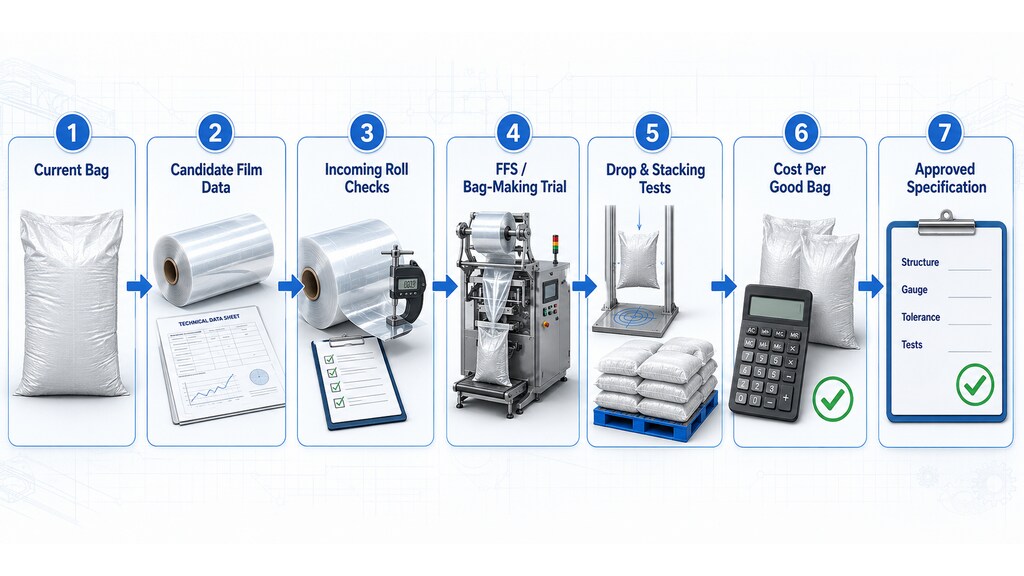
- Document the incumbent:Record current material, thickness profile, bag dimensions, filling rate, seal settings, failure frequency, pallet pattern and cost per accepted pack.
- Screen candidate film:Review TDS, structure, dimensions, additives, treatment, roll build and relevant compliance documents. Identify exactly how it differs from the incumbent.
- Check incoming samples:Verify labels, lot, width, thickness, gusset, roll OD, core, winding direction, treated side and obvious roll defects before running the machine.
- Run the intended process window:Evaluate unwind, tracking, printing, bag opening, gusset control, filling, sealing and discharge at safe baseline and target speed.
- Test the filled package:Use the real product or an agreed simulant. Include puncture, drops, stacking, storage, pallet movement and temperature conditions relevant to the route.
- Calculate total value:Compare net film per good bag, rejected bags, downtime, line speed, pallet damage, complaints and landed film cost.
- Freeze the approved specification:Record structure, nominal dimensions, tolerances, critical tests, sampling, roll format, labels and change-notification requirements.
Downgauging requires a control and a candidate
Keep bag dimensions, filling conditions, sealing setup, product, pallet pattern and distribution sequence consistent. Compare the existing film against one candidate at a time. A successful downgauging project reduces material per accepted pack without creating slower filling, more seal rejects, higher damage or unstable rolls. Do not release a thinner film from laboratory dart impact alone.
RFQ Checklist for Heavy-Duty Bags and Industrial Liners
| RFQ field | Buyer input required |
| Application | Heavy-duty sack, FFS bag, box liner, drum liner, tote liner, FIBC liner or other format |
| Packed product | Material name, particle shape, bulk density, net weight, temperature, moisture/oil and sharpness |
| Container / bag geometry | Drawing with width, gusset, length, cuff, spout, opening, seal and filled dimensions |
| Current film | Structure, thickness, density if known, supplier code, TDS, sample and current problem |
| Film route | Monolayer, blend, three-layer PE or supplier recommendation with required functions |
| Supply format | Single-wound sheet, layflat tube, gusseted tube, FFS roll or pre-made bags/liners |
| Roll specification | Width/layflat, core, maximum OD, roll weight, winding direction, splice rule and pallet packing |
| Converting / filling | Machine, line speed, print process, jaw type, temperature, dwell, pressure and contamination risk |
| Surface and additives | Inside/outside COF, antiblock, antistatic, UV, color, opacity and corona-treated side |
| Acceptance tests | Thickness profile, puncture/impact, tear, tensile, seal, hot tack, COF and filled-pack test |
| Compliance | Destination market, food/contact status if applicable, chemical compatibility and documents required |
| Commercial | Trial quantity, monthly/annual volume, destination, Incoterm, delivery schedule and quotation validity |
Common Purchasing Mistakes
Using one standard gauge for every industrial bag
Product shape, filled weight, bag dimensions, seal design, handling and pallet pattern change the stress. Treat thickness as one variable in a system, then confirm it through a controlled filled-pack trial.
Approving resin data instead of finished-film data
Resin properties help formulate a film but do not include gauge profile, layer distribution, additives, winding or bag-making quality. Approve the converted film and completed package.
Ignoring the difference between puncture and tear
A film can resist impact but propagate a tear from a nick, or show good tear data but fail under a concentrated product corner. Select tests from the observed failure mode.
Specifying low COF without a pallet-stability check
A slippery outer surface may run well through one machine and then allow filled sacks to shift. Define inside and outside surfaces separately and validate the full pallet.
Testing an empty bag only
Empty-bag seals and dimensions are necessary checks, but product weight, air, corners and filling contamination create the real stresses. The final decision needs a filled package.
Treating compliance as a generic certificate
State the exact product, contact condition, destination market and transport classification. Confirm that declarations and test reports cover the proposed grade and intended use.
Frequently Asked Questions
What thickness of LLDPE film is best for heavy-duty bags?
There is no universal thickness. Many industrial applications are screened within approximately 80–200 μm, but the correct gauge depends on load, product shape, bag dimensions, layer structure, seal design and drop exposure. CloudFilm’s current LLDPE product page publishes 15–100 μm; thicker requirements need a specific PE roll or multilayer capability review and filled-pack validation.
Is pure LLDPE better than an LDPE/LLDPE blend for industrial bags?
Not automatically. An LDPE/LLDPE blend can balance melt strength, process stability, optics, toughness and sealing. Compare finished films at the same gauge and on the actual bag-making or filling line.
When should I use a three-layer PE film for a heavy-duty sack?
Use a three-layer route when the skins and core need different functions, such as outside printing and pallet friction, core toughness or stiffness, and inside sealing or antiblock. Confirm layer functions and total-package performance instead of specifying layers only for marketing.
How can I reduce punctures in an industrial liner?
Inspect liner fit, container corners, insertion method, product orientation, local thickness and fold points before simply increasing gauge. Improve the structure or add corner protection where necessary, then repeat a container-level trial.
Which test is most important for an LLDPE shipping sack?
No single film test predicts every failure. Combine thickness profile, relevant puncture/impact and tear tests, seal or hot-tack data, COF and a filled-sack drop and distribution sequence based on the actual route.
Can LLDPE industrial bags be printed?
Yes, when the film, treatment level, treated side, ink system and storage period are qualified together. Define print orientation and winding direction so the converter uses the correct surface.
Can LLDPE liners provide oxygen barrier?
LLDPE provides useful moisture resistance for many industrial duties but is not normally selected as a high oxygen-barrier layer. Oxygen-sensitive products may need EVOH, PA, coated or laminated barrier structures validated at the full-package level.
What should I send CloudFilm for a heavy-duty bag film quotation?
Send the packed product, weight, sharpness, current bag or drawing, film structure and gauge, bag or roll dimensions, filling and sealing conditions, failure mode, required tests, trial quantity, annual demand, destination and Incoterm. A physical sample is especially useful when gussets, folds or seals are complex.
Request an LLDPE Film Recommendation
Send Your Bag, Liner or Current Film for a Technical Review
Share the packed product, net weight, sharpness, bag or container drawing, current structure and gauge, filling and sealing conditions, failure mode, required tests, trial quantity and destination. CloudFilm can review the application against its LLDPE film range and discuss an LLDPE-rich monolayer, PE blend, three-layer film or alternative puncture/barrier structure. Final performance, compliance, tolerances, MOQ and lead time will be confirmed against the approved specification.