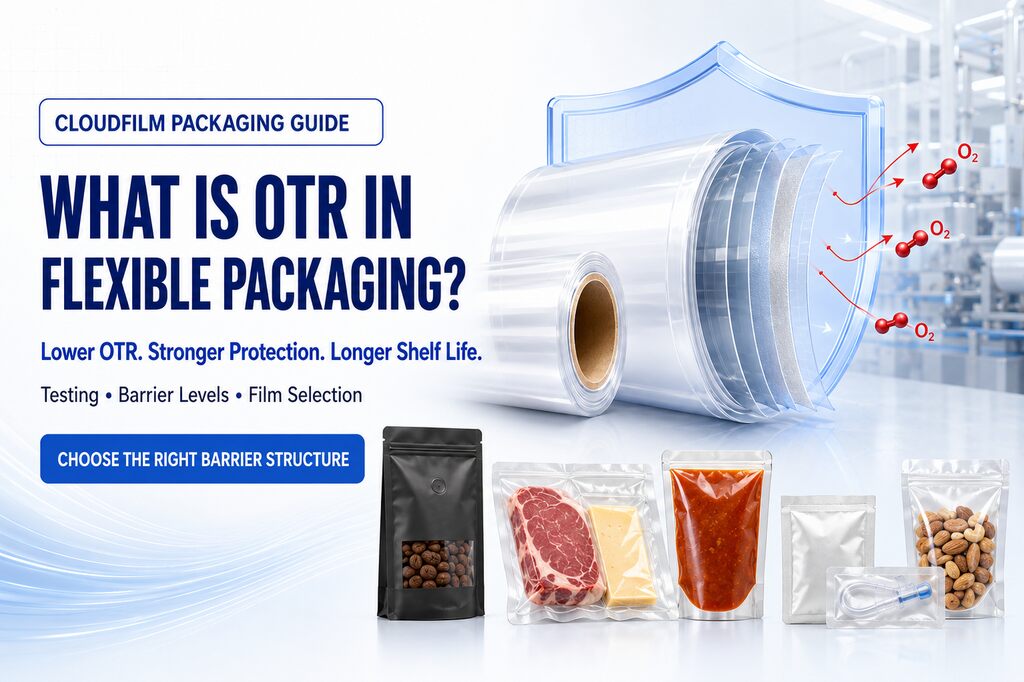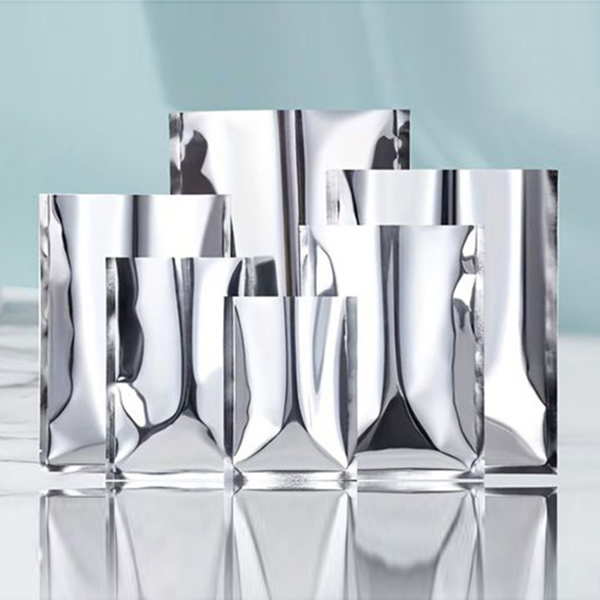
When buyers search for “VMPET meaning,” they are usually trying to understand a material name that appears in flexible packaging specifications, laminate structures, or supplier quotations. VMPET is common in food packaging, coffee bags, snack packs, pet food pouches, powder packaging, and many other applications where oxygen, moisture, aroma, and light protection are important.
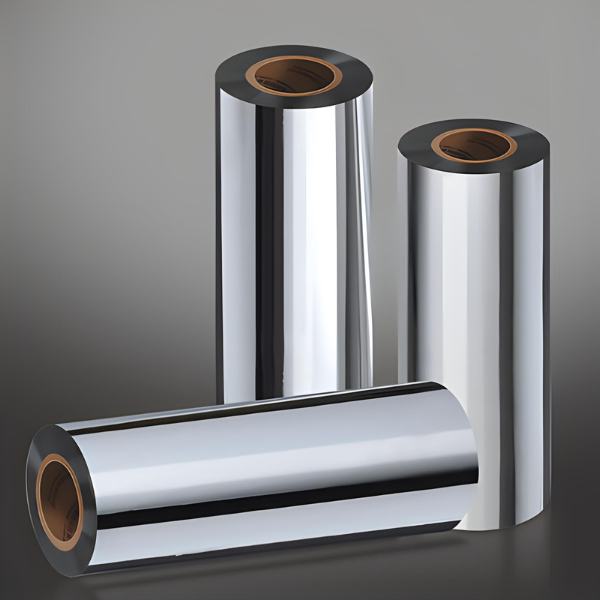
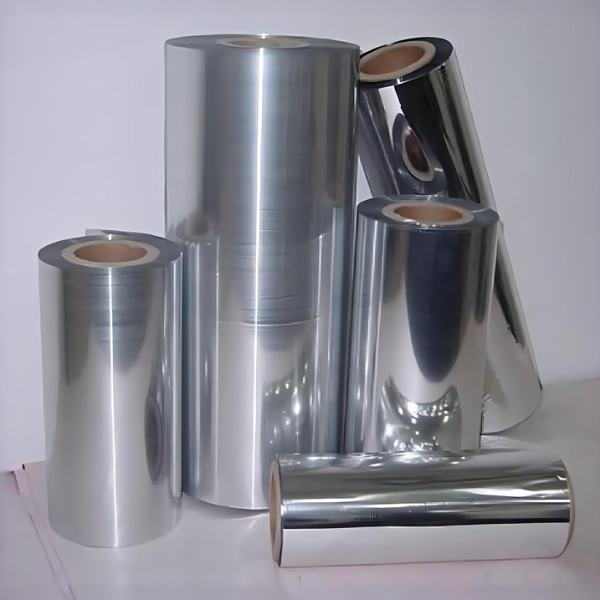
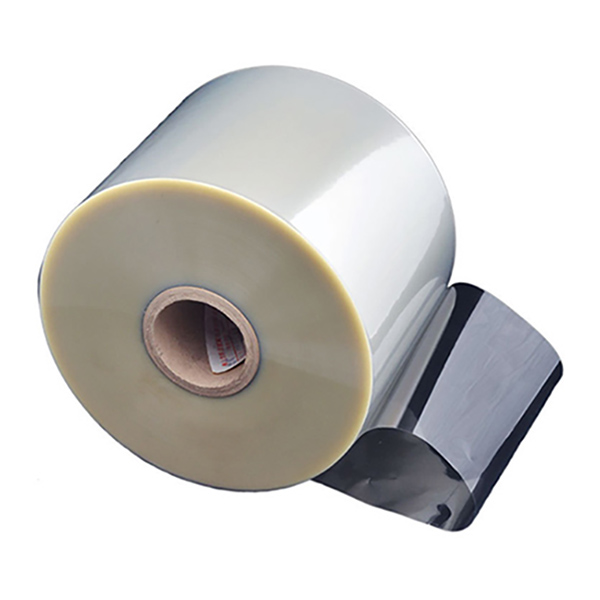
In simple terms, VMPET means vacuum metallized PET film. It is a PET film coated with an extremely thin layer of aluminum through a vacuum metallization process. This gives the film a bright metallic appearance and much better barrier performance than plain PET film.
VMPET is rarely used alone as a final package. More often, it works as the middle barrier layer in a laminated structure, such as PET/VMPET/PE, BOPP/VMPET/PE, or PET/VMPET/CPP. The outer layer provides printability and strength, the VMPET layer improves barrier performance, and the inner layer provides heat sealing.
For packaging buyers, understanding VMPET is useful because it helps you compare material structures, ask better questions to your film supplier, and choose the right packaging for your product’s shelf life, filling method, appearance, and cost target.
What Does VMPET Mean?
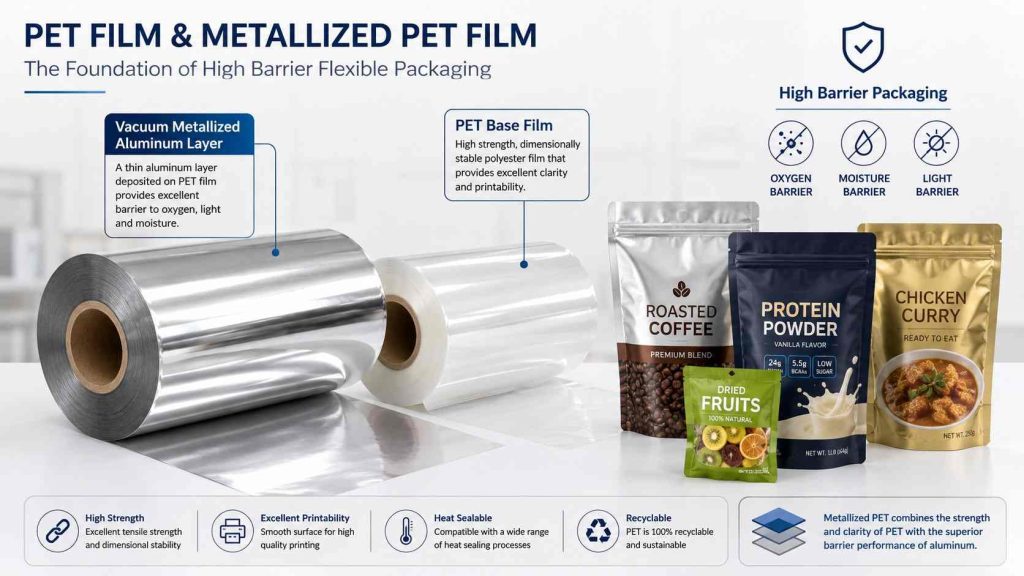
VMPET stands for Vacuum Metallized Polyethylene Terephthalate. PET is the base film, and “VM” means vacuum metallized. During production, aluminum is evaporated in a vacuum chamber and deposited onto the PET film surface as a very thin metal layer.
This aluminum layer is much thinner than aluminum foil, but it can still greatly improve the film’s resistance to oxygen, moisture vapor, aroma loss, and light. That is why VMPET is widely used in high barrier flexible packaging.
VMPET may also be called metallized PET film, metalized PET film, aluminized PET film, or metallised polyester film. In packaging quotations, it often appears as part of a laminate structure, such as PET/VMPET/PE.
If you are comparing different metallized materials, you can also review CloudFilm’s metallized films page for PET, BOPP, CPP, and PE-based metallized film options.
Is VMPET The Same As Aluminized PET Film?
Yes, in most flexible packaging discussions, VMPET and aluminized PET film refer to the same type of material. Both terms describe PET film with a vacuum-deposited aluminum layer.
The word “aluminized” emphasizes the aluminum coating. The word “VMPET” emphasizes the vacuum metallization process and PET base film. In international packaging communication, suppliers, converters, and buyers may use either term.
For example, when a buyer asks for “12 PET / VMPET / 70 PE,” the middle VMPET layer usually means metallized PET film. When a supplier says “aluminized PET film,” it usually refers to the same barrier layer.
For more product-level details, you can visit CloudFilm’s aluminized PET film page.
How Is VMPET Film Made?
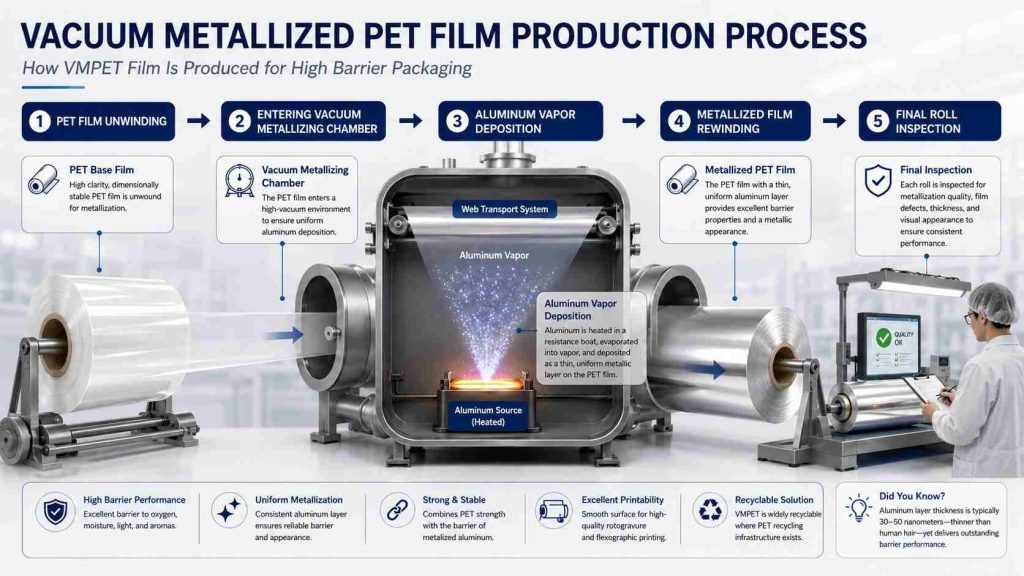
VMPET film is made by depositing aluminum onto PET film under high vacuum. The process usually includes several key steps.
First, PET film is selected as the base film. PET is commonly used because it has good dimensional stability, mechanical strength, heat resistance, and printability. It is suitable for high-speed converting and laminated packaging.
Second, the PET film is treated to improve surface energy. Good surface treatment helps the aluminum layer bond more evenly and supports better lamination performance later.
Third, aluminum is heated and evaporated inside a vacuum metallizing machine. The aluminum vapor condenses on the PET film surface and forms a thin, continuous metallic layer.
Finally, the metallized film is inspected, slit, and prepared for lamination or further conversion. In many packaging projects, VMPET is then laminated with PE, CPP, BOPP, PET, or other films to create a final packaging structure.
Common VMPET Laminate Structures
VMPET is usually not the only material in a package. It is normally combined with other layers to create a laminated film. Each layer has a different function.
A typical structure is PET/VMPET/PE. PET is the outer layer for printing, stiffness, and heat resistance. VMPET is the middle layer for barrier and metallic appearance. PE is the inner sealing layer for heat sealing and product contact.
Another common structure is BOPP/VMPET/PE. BOPP can provide good printability and a crisp packaging feel, while VMPET improves barrier performance. This type of structure may be used for dry snacks, confectionery, and light food packaging.
PET/VMPET/CPP is also used when CPP is preferred as the sealing layer. CPP can provide good seal strength, transparency in non-metallized structures, and stable performance on certain packing machines.
For buyers who need a practical explanation of PET/VMPET/PE packaging, CloudFilm’s PET VMPET PE high barrier packaging guide is a useful reference.
What Is VMPET Used For?
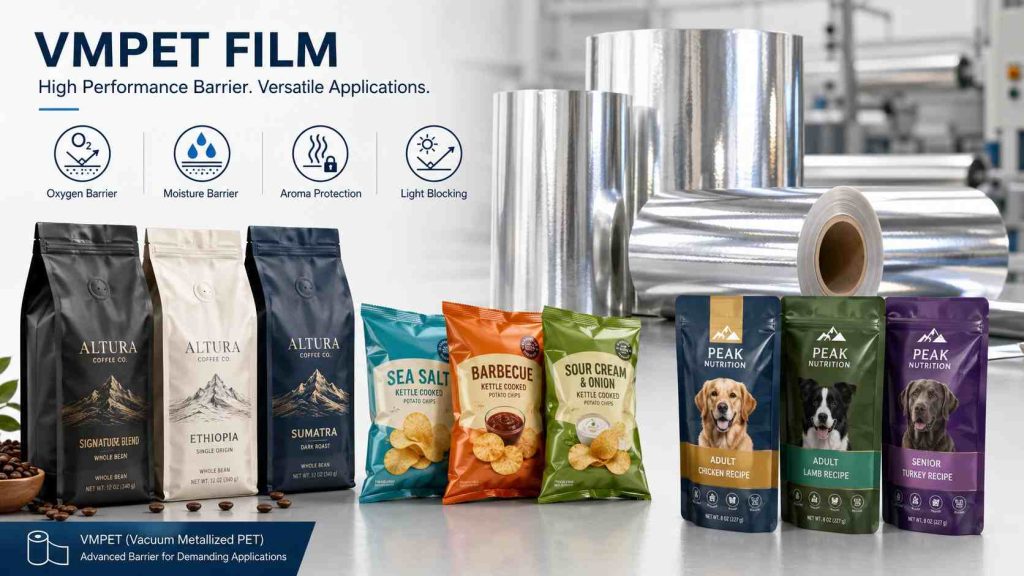
VMPET is used when a package needs better barrier protection than plain plastic film but does not necessarily require thick aluminum foil. It is especially common in dry food, coffee, tea, snacks, powder products, pet food, medical packaging, and technical packaging.
In food packaging, VMPET helps protect products from oxygen and moisture. This is important for chips, biscuits, crackers, nuts, cereal, milk powder, seasonings, and dehydrated foods.
In coffee packaging, VMPET helps reduce oxygen exposure, aroma loss, moisture ingress, and light damage. Coffee is sensitive to oxygen and aroma loss, so high barrier structures are often required for retail bags and pouches.
In pet food packaging, VMPET can help protect fats, flavors, and product freshness. It can also create a premium metallic look for retail shelves.
In industrial and technical packaging, VMPET may be used where moisture barrier, reflectivity, or light blocking is required.
If you are developing coffee packaging, you can review CloudFilm’s coffee packaging bags page to compare high-barrier bag formats, valves, and material structures.
Main Benefits Of VMPET Film
The first major benefit of VMPET is improved barrier performance. The metallized layer helps slow down oxygen and moisture transmission, which can support longer shelf life and better product protection.
The second benefit is light blocking. Many products are sensitive to light, especially products containing oils, aromas, colors, vitamins, or active ingredients. VMPET’s metallic layer can help reduce light exposure.
The third benefit is aroma protection. For coffee, tea, spices, pet food, and flavored snacks, aroma retention is important. A properly designed VMPET laminate can help keep aroma inside the package and reduce odor transfer from outside.
The fourth benefit is shelf appearance. VMPET gives packaging a metallic look, which can make products appear more premium. It can be used behind printed graphics or exposed in selected design areas to create shine and visual contrast.
The fifth benefit is cost efficiency compared with some foil structures. VMPET uses a very thin aluminum layer, so it can offer a balance between barrier, appearance, weight, and cost. However, for extremely high barrier requirements, aluminum foil may still be the better choice.
VMPET Vs PET Film
Plain PET film and VMPET film are not the same.
PET film is a transparent polyester film. It offers strength, heat resistance, printability, and dimensional stability. However, plain PET alone does not provide the same oxygen, moisture, aroma, or light barrier as metallized PET.
VMPET film starts with PET as the base film but adds a vacuum metallized aluminum layer. This changes both the appearance and the barrier performance. VMPET is not transparent; it has a metallic silver appearance and stronger barrier properties.
If your product only needs strength, printability, and clarity, plain PET or PET/PE may be enough. If your product needs stronger barrier protection and does not require a clear window, VMPET may be more suitable.
For clear laminated packaging options, you can review CloudFilm’s PET/PE film page.
VMPET Vs Aluminum Foil
VMPET and aluminum foil are both used for barrier packaging, but they are different materials.
Aluminum foil is a real metal foil layer. It provides excellent barrier against oxygen, moisture, light, and aroma when properly laminated. It is often used for high-protection applications such as pharmaceutical packaging, premium coffee, retort pouches, and sensitive food packaging.
VMPET is PET film with a very thin aluminum coating. It provides good barrier performance and a metallic appearance, but it is generally not equal to full aluminum foil in absolute barrier performance.
The advantage of VMPET is that it is lighter, often more flexible, and can be cost-effective for many dry food and pouch applications. The advantage of aluminum foil is stronger barrier protection for products with stricter shelf-life or storage requirements.
If your product requires very high barrier performance, CloudFilm’s flexible packaging aluminum foil page may be a better reference.
VMPET Vs ALOx PET
VMPET and ALOx PET are both PET-based barrier films, but their appearance and use cases are different.
VMPET has a metallic aluminum layer, so it is not transparent. It is suitable when a metallic look, light barrier, and strong shelf impact are desired.
ALOx PET is coated with aluminum oxide and remains transparent. It is suitable when brands want high barrier performance but still need product visibility or a clear packaging window.
For example, if a coffee bag does not need transparency and wants a premium metallic look, VMPET may be a good option. If a snack or medical product needs a clear high-barrier package, ALOx PET may be more suitable.
You can compare transparent barrier options on CloudFilm’s ALOx PET film page.
Can VMPET Be Heat Sealed?
VMPET itself is not normally used as the direct heat-sealing layer. In most flexible packaging structures, VMPET is laminated with PE, CPP, or another sealant film.
For example, in PET/VMPET/PE, the PE layer provides heat sealing. The VMPET layer provides barrier protection. The PET layer provides printability and strength.
This is why buyers should not only ask, “Can VMPET be heat sealed?” A better question is, “What is the full laminate structure, and what sealant layer will be used?”
The right sealant layer depends on the product, filling temperature, packing machine, seal strength target, and whether the package needs easy opening, strong sealing, or puncture resistance.
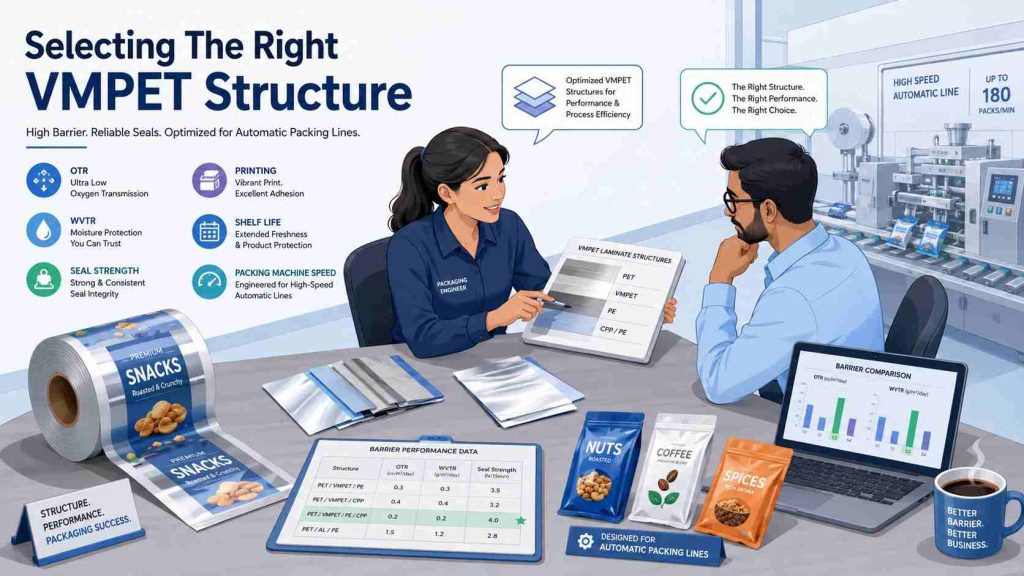
How To Choose The Right VMPET Packaging Structure
Choosing the right VMPET structure starts with the product.
For dry snacks, biscuits, and confectionery, the main requirements may be moisture barrier, crispness protection, good printing, and stable machine performance.
For coffee, the main requirements may be oxygen barrier, aroma retention, degassing valve compatibility, and strong sealing.
For powder products, the packaging may need moisture barrier, anti-leak sealing, good stiffness, and clean filling performance.
For pet food, the structure may need puncture resistance, aroma control, fat resistance, and larger bag strength.
For high-speed packing lines, the film must also match the VFFS, HFFS, flow-wrap, or pouch-making equipment. Film stiffness, COF, seal initiation temperature, hot tack, roll tension, and thickness tolerance all matter.
If you need printed film for automatic packaging machines, CloudFilm’s roll stock page is a relevant choice.
What Information Should You Give A VMPET Film Supplier?
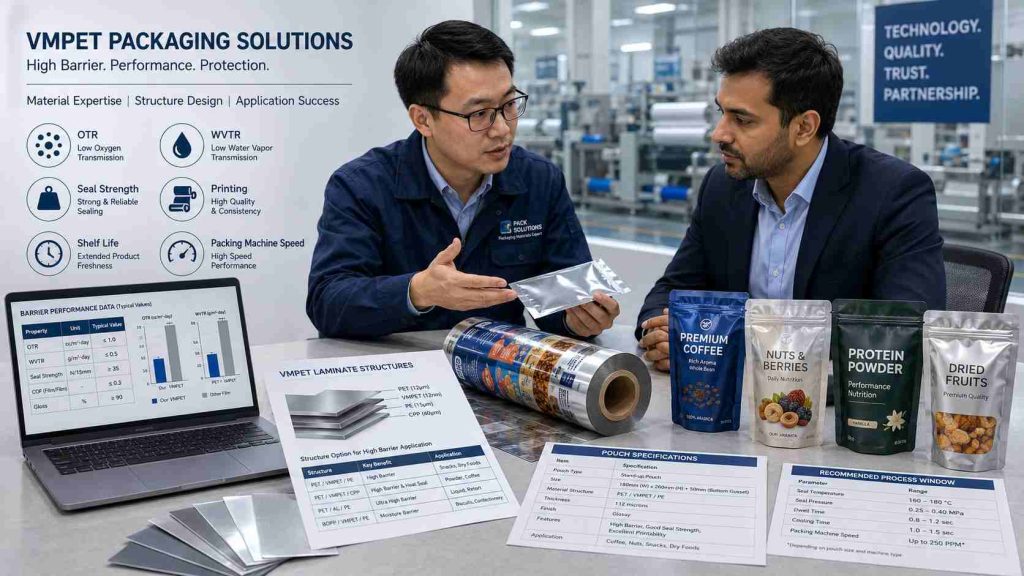
To get an accurate quotation and structure recommendation, buyers should provide clear packaging details.
Start with the product type. A supplier needs to know whether the package is for coffee, snacks, powder, pet food, medical products, or industrial items.
Then provide the packaging format. Is it roll stock, stand up pouch, flat bottom pouch, side gusset bag, pillow pack, sachet, or lidding film?
Next, provide the target shelf life and storage conditions. Room temperature, refrigeration, freezing, light exposure, and transport conditions can all affect material selection.
You should also provide the filling method and packing machine type. A structure that works well on one machine may need adjustment for another machine.
Artwork and printing requirements are also important. Matte finish, gloss finish, metallic effect, window design, and ink coverage can all influence the final structure.
Finally, provide order quantity, roll width, bag size, thickness preference, and destination port. These details help the supplier calculate MOQ, price, lead time, and shipping options.
For buyers who need finished bags instead of film rolls, CloudFilm’s stand up pouches page shows common high-barrier pouch options.
Is VMPET Packaging Recyclable?
This question depends on the full structure, local recycling rules, and the packaging format.
A traditional PET/VMPET/PE laminate is a multi-material flexible packaging structure. Because it combines PET, metallized PET, adhesive, and PE, it is usually more difficult to recycle through standard mono-material recycling streams.
However, VMPET can still help reduce material weight compared with some heavier packaging formats. In some projects, buyers may also compare VMPET with mono-material PE barrier structures, metallized PE-based films, or other recyclable alternatives.
If recyclability is a key requirement, it is important to tell your supplier at the beginning of the project. The supplier can then compare traditional high-barrier structures with recyclable or PE-rich options.
In practical packaging development, there is often a balance between barrier performance, recyclability, cost, machine performance, and shelf life. The best structure depends on your product and market requirements.
VMPET For Brand Owners, Converters, And Importers
VMPET is not only a material name. It is also a decision point in packaging design.
Brand owners choose VMPET when they need shelf impact, product protection, and a premium metallic look. Packaging converters choose VMPET when they need a reliable barrier layer for laminated roll stock or pouch production. Importers and distributors choose VMPET structures when they need stable quality, export-ready packaging, and consistent supply.
A professional VMPET film supplier or manufacturer should do more than quote a price. The supplier should help you confirm the correct structure, thickness, roll format, printing method, lamination design, and sealing layer.
For packaging projects, the cheapest film is not always the best option. A better choice is the structure that protects the product, runs well on your machine, supports your shelf-life target, and meets your commercial budget.
Conclusion: What VMPET Means For Packaging Buyers
VMPET means vacuum metallized PET film. It is a PET film coated with a thin aluminum layer under vacuum, giving it a metallic appearance and improved barrier performance.
For packaging buyers, the most important point is that VMPET is usually part of a laminated structure, not a complete package by itself. It is commonly used with PET, PE, CPP, BOPP, or other materials to create packaging that protects food, coffee, snacks, pet food, powders, and technical products.
VMPET is useful when you need better oxygen, moisture, aroma, and light protection than plain plastic film. It is also useful when you want a metallic visual effect without using full aluminum foil.
However, the right choice depends on your product, shelf life, storage condition, packing machine, and budget. A reliable supplier can help you compare VMPET, aluminum foil, ALOx PET, PET/PE, and recyclable alternatives before mass production.
If you are developing a custom VMPET packaging project, you can contact CloudFilm through the contact us page and share your product type, target shelf life, structure requirement, roll width or bag size, and estimated order quantity.
FAQ About VMPET Meaning And Packaging Use
1. What does VMPET stand for?
VMPET stands for vacuum metallized polyethylene terephthalate. It is PET film coated with a thin aluminum layer through vacuum metallization.
2. What is VMPET film used for?
VMPET film is used for high-barrier flexible packaging, including coffee bags, snack packaging, powder packaging, pet food pouches, dry food bags, and technical packaging.
3. Is VMPET the same as metallized PET?
Yes. VMPET is commonly called metallized PET film, metalized PET film, aluminized PET film, or metallized polyester film.
4. Is VMPET transparent?
No. VMPET has a metallic silver appearance because of the aluminum layer. If you need transparent high-barrier packaging, ALOx PET may be a better option.
5. Can VMPET be printed?
VMPET can be used in printed laminate structures, but printing is usually applied to the outer layer, such as PET or BOPP, rather than directly on the metallized surface.
6. Can VMPET be heat sealed?
VMPET itself is not usually the sealing layer. It is normally laminated with PE, CPP, or another heat-sealable film.
7. What is PET/VMPET/PE?
PET/VMPET/PE is a common laminated film structure. PET provides printability and strength, VMPET provides barrier performance, and PE provides heat sealing.
8. Is VMPET better than aluminum foil?
Not always. VMPET is lighter and often more cost-effective for many dry food applications. Aluminum foil usually provides stronger barrier performance for very sensitive products.
9. Is VMPET suitable for coffee packaging?
Yes. VMPET is commonly used in coffee packaging because it helps protect aroma, reduce oxygen exposure, block light, and improve shelf appearance.
10. Is VMPET suitable for frozen food?
It can be used in some frozen food structures, but the full laminate must be designed for freezing, sealing, puncture resistance, and storage conditions.
11. What thickness is VMPET film?
The PET base film is often around 12 microns in many flexible packaging structures, but thickness can vary depending on the project and supplier.
12. Does VMPET provide oxygen barrier?
Yes. The metallized aluminum layer improves oxygen barrier compared with plain PET film.
13. Does VMPET provide moisture barrier?
Yes. VMPET improves moisture barrier, especially when combined with suitable sealant layers such as PE or CPP.
14. Is VMPET food safe?
VMPET can be used in food packaging structures, but food-contact safety depends on the complete laminate, inner layer, inks, adhesives, and applicable regulations.
15. Can VMPET be used for stand up pouches?
Yes. VMPET is commonly used in high-barrier stand up pouches for coffee, snacks, pet food, powder products, and premium dry goods.
16. Can VMPET be used for roll stock?
Yes. VMPET laminated films can be supplied as roll stock for VFFS, HFFS, flow-wrap, and pouch-making lines.
17. What is the difference between VMPET and VMCPP?
VMPET uses PET as the base film, while VMCPP uses CPP as the base film. VMPET is often used as a middle barrier layer, while VMCPP may also provide heat sealing in some structures.
18. What is the difference between VMPET and VMBOPP?
VMPET is metallized PET film. VMBOPP is metallized BOPP film. PET generally offers better heat resistance and dimensional stability, while BOPP may be chosen for certain cost, stiffness, or snack packaging applications.
19. Is VMPET good for light blocking?
Yes. The metallic layer helps block light, making VMPET useful for light-sensitive foods, powders, coffee, tea, and some technical products.
20. How should I choose a VMPET film supplier?
Choose a supplier that can discuss your product, shelf life, structure, sealing layer, printing method, roll format, MOQ, lead time, and export requirements instead of only offering a generic film price.