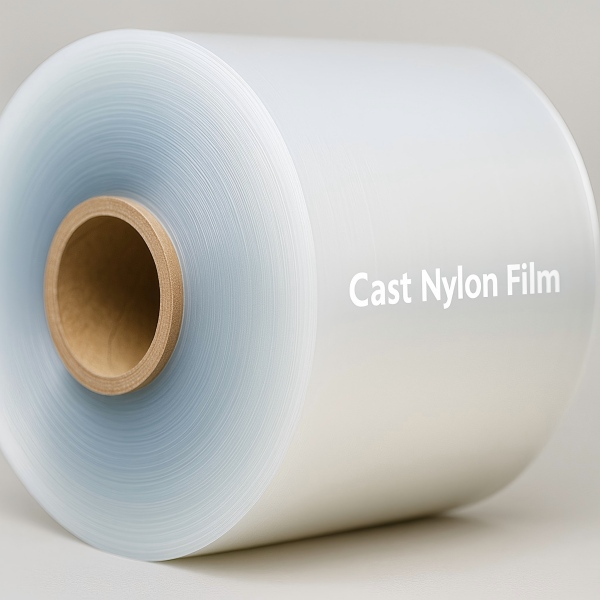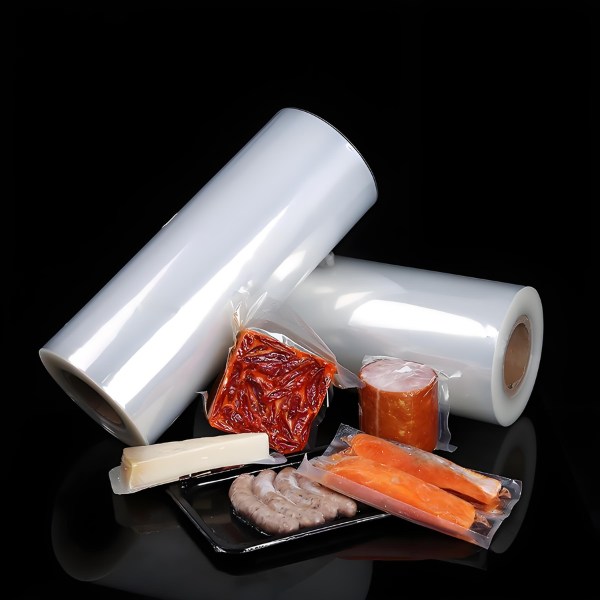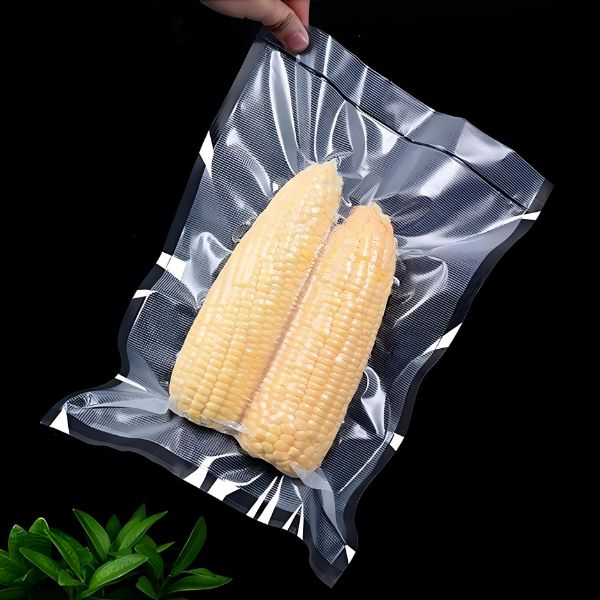
PE/PA/PE film is a multilayer coextruded nylon/polyethylene packaging film in which polyamide provides mechanical strength and gas-barrier support, while polyethylene surfaces provide moisture resistance, flexibility and heat sealing. It is a practical starting structure for vacuum pouches, thermoforming bottom webs and form-fill-seal packs that need transparency, puncture resistance and reliable seals. The name describes the main functional materials; it does not always mean that the finished web contains only three physical layers. Commercial constructions often include tie layers and may be built as five, seven or more physical layers.
The correct film is not selected by thickness alone. A buyer must define the product, package format, storage temperature, target shelf life, forming depth, sealing conditions, roll dimensions and test methods. Use this guide to prepare those decisions, then review the available PE/PA/PE film for vacuum and thermoforming packaging and request a structure recommendation based on an actual sample or line trial.
What Is PE/PA/PE Film?
PE/PA/PE combines polymers that perform different jobs. Polyethylene, or PE, is normally used at the surfaces because it is flexible, resists water-vapour transmission better than nylon and can form a heat seal. Polyamide, or PA, is placed inside the structure because it adds toughness, puncture resistance and improved oxygen and aroma barrier compared with a simple PE film. The result is a clear web that can perform as the sealant, structural support and moderate gas-barrier component of one package.
This balance is useful, but the material name is not a complete specification. Two films sold as 80 μm PE/PA/PE may contain different PE grades, different PA types, different layer ratios, different tie resins and different additives. They can therefore behave differently during deep drawing, sealing, freezing and distribution. A purchase order should identify the approved supplier grade or the agreed performance specification, not only the generic material name and total gauge.
Functional name versus physical layer count
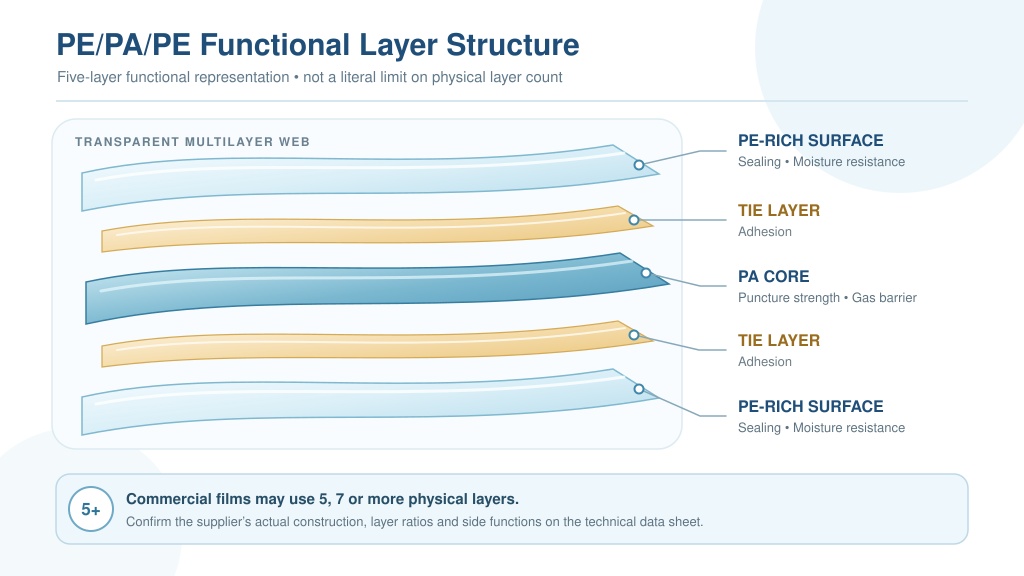
In buyer shorthand, PE/PA/PE describes a symmetrical functional arrangement: PE-rich material on both sides with PA inside. PE and PA do not naturally bond well to each other, so a real coextruded film normally uses adhesive tie resin between them. A simplified five-layer sequence may therefore be PE / tie / PA / tie / PE. Seven-layer and higher-layer designs can split the PA or PE functions into several thinner layers, include more than one PE grade, or improve process stability. Ask for the declared material family, physical layer concept and intended function of each side without assuming that “three-layer” language is a literal layer count.
Coextruded film versus a converted laminate
Coextrusion brings molten polymers together in one die and forms one multilayer web. A laminate joins previously made webs in a separate converting step, often with adhesive. Both routes can make useful nylon/PE packaging, but they are not interchangeable descriptions. Coextruded PE/PA/PE is attractive when both surfaces should behave like PE and when the package needs balanced toughness, sealability and forming performance. A laminated PA/PE or PET/PE structure may be chosen when printing, stiffness, outer-surface temperature resistance or a different directional balance is more important. Confirm the construction on the technical data sheet rather than inferring it from the letters alone.
Quick Application and Structure Selection Table
The following directions are screening points, not final specifications. Product geometry, shelf-life studies and packaging-line trials must confirm the grade.
| Product and pack | Main risk | Starting structure direction | Verify before approval |
| Boneless chilled or frozen food in a vacuum pouch | Seal contamination, handling puncture and oxygen exposure | Medium-gauge PE/PA/PE with a robust PE seal layer | Seal curve, vacuum retention, low-temperature drop and shelf life |
| Bone-in meat or sharp frozen product | Corner thinning, bone puncture and abrasion | Tougher or thicker PA-containing structure; protective bone guard may still be required | Loaded-pack puncture, distribution and freeze/thaw tests |
| Deep-draw thermoforming bottom web | Uneven forming and thin corners | Grade engineered for thermoforming with suitable layer balance and gauge | Forming depth, cavity geometry, preheat window and corner thickness |
| Industrial part or metal component | Sharp edges, oil contact and export handling | Heavy-gauge PE/PA/PE selected for toughness and chemical compatibility | Compatibility, abrasion, seal integrity and transport simulation |
| Highly oxygen-sensitive product with long ambient shelf life | Barrier target may exceed a PA-only design | Evaluate EVOH, coated, metallized or foil-containing alternatives | OTR/WVTR under stated conditions and a packaged-product shelf-life study |
How Each Layer Works
PE surface and seal layers
The PE-rich surfaces provide the heat-sealing interface and most of the water-vapour resistance. Resin density, comonomer, blend design, additives and layer thickness influence seal initiation, seal strength, hot tack, stiffness, clarity, blocking and low-temperature flexibility. The two outside layers may look identical but can be formulated differently. One side may be optimized for sealing and product contact, while the other may be adjusted for slip, winding, corona treatment, printing or lamination.
PA core or internal layers
PA contributes tensile strength, puncture resistance, thermoforming support and gas-barrier performance. It also absorbs moisture, and its oxygen barrier and mechanical response can change with humidity and conditioning. This is why an OTR value without test temperature, relative humidity, specimen thickness and conditioning history is not a reliable purchasing comparison. The grade and proportion of nylon also affect forming response and the balance between stiffness and flexibility. The nylon film properties guide explains these characteristics in more detail.
Tie layers
Tie resin bonds the otherwise incompatible PE and PA layers. Its adhesion must remain adequate after forming, flexing, freezing, heat sealing and storage. Weak interlayer adhesion may appear as bubbles, whitening, channel separation or delamination near a stressed corner. The tie layer is thin, but it is not optional from a performance perspective. Buyers should ask whether interlayer adhesion is checked and whether any resin or layer-ratio change is controlled through an approval process.
Balanced and unbalanced layer designs
A symmetrical concept can reduce curl and give PE functionality on both surfaces, but a supplier may adjust the two sides for the actual package. An unbalanced design is not automatically a defect; it can be intentional. What matters is that the side functions, treatment side, winding direction and use conditions are documented. If the web will be laminated or printed, identify the conversion side. If it will be used as a monoweb pouch or forming web, identify the product-contact and sealing surfaces.
| Component | Primary role | Questions for the supplier |
| Outer PE-rich layer | Sealability, moisture resistance, flexibility, slip and product contact | Which side seals? What are the COF, treatment and food-contact status of each side? |
| Tie resin | Interlayer adhesion between PE and PA | How is adhesion verified after forming, freezing and flexing? |
| PA layer or layers | Puncture resistance, strength, forming support and gas barrier | Which barrier test conditions and conditioning method apply? |
| Additives and surface treatment | Machinability, winding, print or lamination readiness | Are slip, antiblock and corona level controlled by side and over shelf time? |
Technical Properties That Matter in Purchasing
Oxygen transmission rate
OTR indicates how much oxygen passes through a defined film area over time under stated conditions. For PA-containing films, temperature and relative humidity are essential because moisture can plasticize nylon and change its barrier. Ask for the test standard, temperature, relative humidity, specimen thickness, test direction and whether the figure is typical or guaranteed. A flat-film OTR result is a material-control value; it does not by itself predict the shelf life of a formed pack with seals, corners and headspace.
Water-vapour transmission rate
WVTR is governed largely by the PE portions, total structure and test conditions. It matters for products that dry out, absorb moisture, lose weight or suffer texture changes. As with OTR, compare values only when units and conditions match. For chilled or frozen packs, consider condensation, freeze/thaw cycling and the performance of seals as well as the flat web.
Puncture, tear and flex-crack resistance
Puncture resistance is one of the main reasons to specify PA, but no single laboratory test reproduces every package hazard. Probe puncture, dart impact, tensile, tear and flex-crack tests describe different failure modes. A bone edge, machined metal corner or frozen product can concentrate force at a much smaller area than a standard probe. Use repeatable material tests for incoming control, then add loaded-package testing with the actual product or a representative hazard fixture.
Low-temperature toughness
A frozen-food film must remain tough after conditioning at the real storage temperature, not only at room temperature. Assess folds, corners, seals and any stretched thermoformed areas after freezing. Drop, vibration and abrasion tests should be performed on filled packs at the intended temperature. A film that feels strong as an unformed sheet may become vulnerable where it has thinned during forming or where the product creates a point load.
Seal initiation, seal window and hot tack
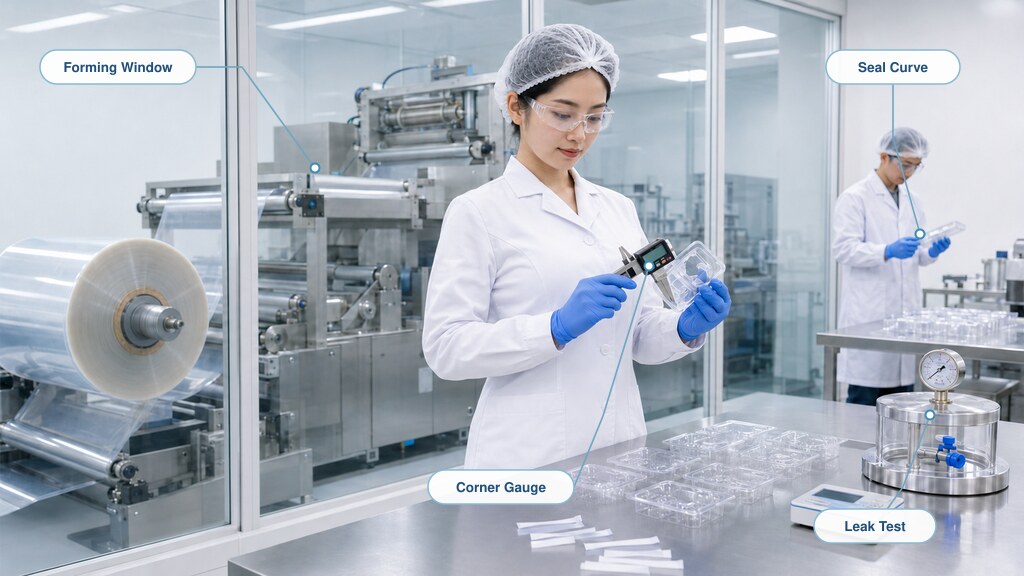
A useful seal specification is a curve, not one temperature. It records seal strength across several jaw settings at a stated pressure and dwell time. The operating window should be wide enough for machine variation without distortion, sticking or weak seals. Hot tack matters when a seal is loaded before it cools. For wet, oily, powdered or irregular products, test deliberate contamination levels because clean-laboratory seals can overstate production performance.
Thermoforming and draw uniformity
Formability is the ability to heat, stretch and retain the required cavity without web breaks, excessive whitening, spring-back or dangerous corner thinning. Total draw depth alone is incomplete; cavity length, width, corner radius, draw ratio, plug assistance, heating profile and cycle time all matter. Measure thickness at the flange, wall and deepest corners after forming. Barrier and puncture performance should be evaluated in the thinnest critical area, not assumed from the incoming roll gauge.
COF, blocking and surface treatment
Coefficient of friction affects unwinding, tracking, forming, bag opening and finished-pack handling. Too much friction can cause drag; too little can create unstable stacks or poor web control. State whether the value is film-to-film or film-to-metal and which surfaces were tested. Blocking, additive migration and corona-treatment decay can change over time, so define conditioning and test age when these properties are critical for printing, lamination or high-speed running.
| Property | Specify or test | Purchasing interpretation |
| OTR | Method, units, temperature, RH, thickness and conditioning | Compare like-for-like data; validate shelf life in the finished pack |
| WVTR | Method, units, temperature, RH and specimen orientation | Relate the result to moisture gain, loss or product texture |
| Puncture and impact | Named method plus actual-product challenge test | Use lab values for consistency and pack tests for real hazards |
| Seal performance | Seal-strength curve, pressure, dwell, peel speed and failure mode | Approve a stable operating window, not one nominal setting |
| Thermoforming | Cavity geometry, heating profile and post-form gauge map | Judge the thinnest corner and flange integrity |
| COF and treatment | Test pair, side, age and conditioning | Ensure the supplied roll matches machine and converting needs |
| Gauge and width | Average, tolerance, profile and measurement method | Control yield, forming balance, tracking and roll interchangeability |
Typical Specification Framework
CloudFilm’s current PE/PA/PE product range is listed at approximately 50–150 μm total thickness, 300–2000 mm width and 3-inch or 6-inch cores, with one- or two-side corona treatment available for relevant converting projects. These are supply ranges, not a universal recommendation. The quotation and approved specification should define the exact construction, tolerances and roll build for the application.
| Specification item | What to state on the RFQ or approval sheet | Why it matters |
| Product and pack | Contents, fill weight, dimensions, format and contact conditions | Sets the mechanical, barrier and seal challenge |
| Structure | Functional material sequence, supplier grade and side identification | Prevents substitution by generic name alone |
| Total thickness | Nominal gauge, tolerance and measurement method | Controls yield, toughness and forming response |
| Barrier | Target OTR/WVTR with method and environmental conditions | Makes supplier data comparable and auditable |
| Mechanical performance | Relevant puncture, tensile, impact, flex or low-temperature tests | Connects the film to the actual failure risk |
| Seal performance | Seal curve or minimum strength under stated jaw conditions | Defines a usable machine window |
| Surface properties | COF by side, treatment side and minimum treatment at delivery | Supports stable printing, lamination and web handling |
| Width and roll build | Width tolerance, core ID, OD, net weight, winding direction, splice limit and roll count | Ensures the roll fits equipment and logistics |
| Compliance | Market, food-contact declarations, traceability and requested test reports | Avoids document gaps after production |
| Change control | No resin, layer-ratio or process change without agreed notification | Protects the approved performance baseline |
Where PE/PA/PE Film Works Well
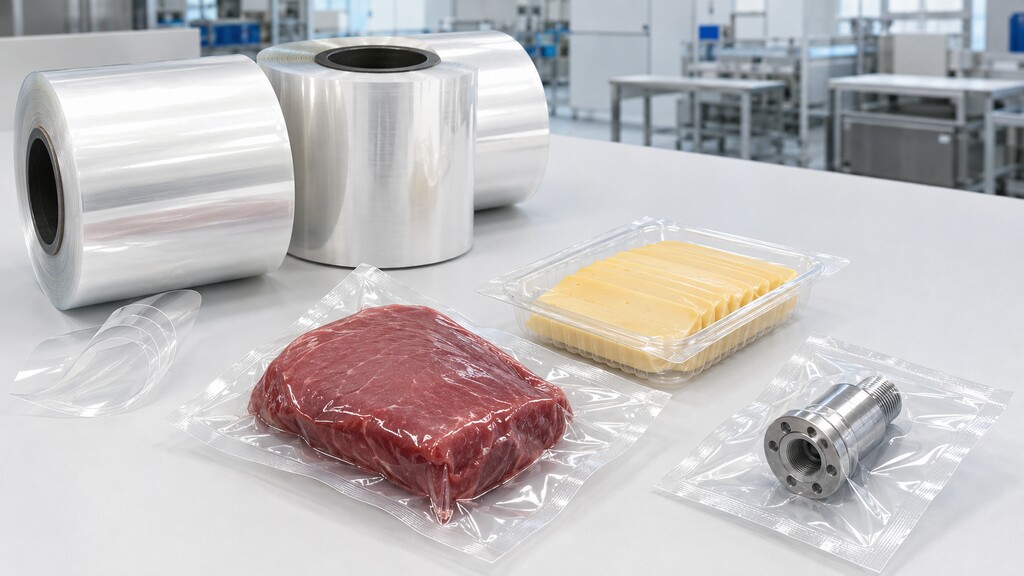
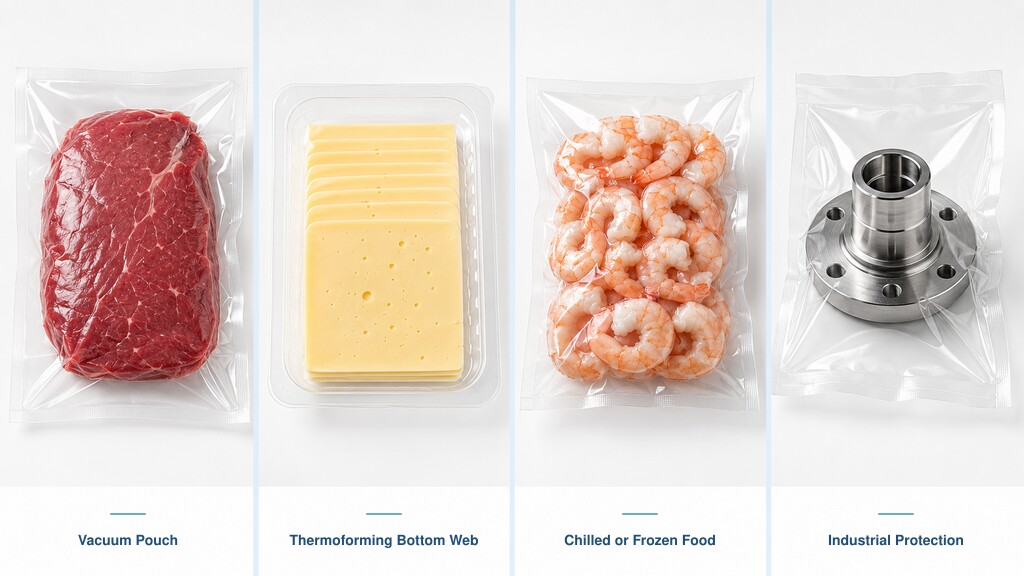
Vacuum pouches for chilled and frozen food
PE/PA/PE is commonly evaluated for clear vacuum pouches where a simple PE film lacks puncture resistance or gas barrier. Boneless meat, processed meat, seafood, cheese and some ready foods can benefit from its toughness and sealability. The package still needs correct evacuation, seal design, hygienic handling and cold-chain control. For bone-in products, sharp edges or demanding export distribution, increase protection only after testing; more gauge is not always the most efficient answer. The frozen meat packaging buyer guide provides a broader package-level selection process.
Thermoforming bottom webs
A forming-grade PE/PA/PE web can be heated and drawn into cavities, filled, evacuated or gas flushed, and sealed to a compatible top web. The PA supports toughness and drawing, while PE provides the seal interface. The bottom and top webs must be selected as one system. Confirm seal compatibility, flange flatness, forming depth, corner gauge, peel or permanent-seal requirement and the process temperature window. A good unformed film is not automatically a good deep-draw film.
Cheese and aroma-sensitive products
Clear nylon/PE structures can support vacuum-packed cheese and other products that need aroma retention, puncture resistance and close product conformity. The barrier target depends on cheese type, respiration, rind, maturation stage, storage temperature and intended shelf life. Gas generation or moisture management may require a different package design. Review the cheese packaging film and pouch guide before fixing one generic structure for every dairy product.
Industrial and heavy-duty protection
The same combination of toughness and sealing can protect machined parts, electronic components, powders or selected chemical products during storage and export. Industrial approval should include compatibility with oils, solvents, plasticizers or sharp surfaces. If corrosion control or very low moisture ingress is required, PE/PA/PE may be only one component of a larger system with desiccant, VCI, an aluminium barrier or a secondary container.
Where It Is Not Suitable or Requires Caution
Very high oxygen-barrier or long ambient shelf-life targets
PA improves oxygen barrier versus simple PE, but it is not the answer to every barrier target. Highly oxidation-sensitive foods, long ambient distribution, aggressive flavour protection or small packs with a high surface-area-to-volume ratio may need EVOH, a coating, metallization or foil. Compare structures using equivalent OTR conditions and a packaged-product shelf-life study. The nylon versus EVOH comparison helps define when the barrier layer should change.
Retort, hot fill and sterilization
Do not assume a standard PE/PA/PE grade is suitable for retort, hot fill, irradiation, steam or any medical sterilization cycle. Temperature, time, pressure, chemical exposure and regulatory validation can change the structure requirement. State the exact process before sampling, obtain the appropriate compliance documents and validate the finished package. A supplier statement about “medical use” or “high-temperature resistance” is not a substitute for process-specific qualification.
High-stiffness printed retail packs
PE/PA/PE is normally clear and relatively flexible. If the package needs reverse printing, high gloss, strong dead-fold, scuff resistance or display stiffness, a PET, BOPP or BOPA outer web may be more appropriate. The PE/PA/PE can sometimes be used as an inner functional web in a laminate, but the final construction then needs lamination-bond, curing, solvent-retention and seal compatibility control.
Projects requiring a mono-material recycling route
PE/PA/PE contains more than one polymer family. Its practical recyclability depends on local collection, sorting, design-for-recycling rules and the PA proportion. When a customer has a defined mono-PE target, investigate MDO PE film for mono-PE packaging or BOPE film with compatible PE sealants. Do not claim recyclability from a PE-rich structure without checking the destination market and the complete package, including inks, adhesives, closures and labels.
How to Choose Thickness
Thickness is selected from the packed product and process, not from a universal chart. CloudFilm lists 50–150 μm as its current customizable range. Within that window, a 60–90 μm direction may be screened for many medium-barrier vacuum pouches, 70–120 μm for deep-draw or heavier frozen packs, and 80–150 μm for demanding industrial protection. These are starting directions from the product range, not guaranteed application limits. Layer ratio, resin selection and forming geometry can matter as much as total gauge.
| Screening range | Possible starting use | Main reason to move thicker | Main reason not to over-specify |
| 50–70 μm | Smaller or lighter vacuum packs with moderate handling risk | Puncture, seal abuse or distribution failure | Lower yield, cost and unnecessary material use |
| 70–100 μm | Many general vacuum and thermoforming trials | Deeper draw, heavier product or sharp geometry | A better layer design may solve the issue without extra gauge |
| 100–150 μm | Deep draw, heavy frozen packs or industrial protection | Severe corner thinning or high mechanical load | Longer heating, reduced forming efficiency and higher cost |
To down-gauge safely, compare finished packs at equal performance. Record roll yield, scrap, corner thickness, leak rate, puncture failures and transport damage. A thinner, better-balanced film may outperform a thicker generic film, while an aggressive reduction can move failure to the seal or thinnest formed corner. Approve the lowest gauge that meets the complete test plan with a reasonable process margin.
Match the Film to the Packaging Process
Premade vacuum pouch conversion and filling
For pouch making, verify sealing-side orientation, gusset or folded-edge behaviour, bag opening, seal flatness and any edge curl. At filling, check that product juices, powder or wrinkles do not create channels. The chamber-vacuum cycle, evacuation level and seal-bar cooling affect the finished result. Test aged pouches as well as freshly converted bags because slip, blocking and treatment can change during storage.
Thermoforming form-fill-seal lines
Record the machine model, heating-zone settings, forming pressure or vacuum, plug design, cycle speed and cavity dimensions. Begin with a conservative window, then map defects as settings change. Whitening, web breaks, uneven corners, flange distortion and excessive shrink indicate different causes. Do not solve every issue by raising temperature or gauge. The resin balance, preheat uniformity, clamping and web tension may be more important.
Printing or lamination
If the film will be printed or laminated, identify the treated side, minimum surface energy at use, ink or adhesive system, curing time and final seal side. Corona treatment can decay, and additives can influence bond or print adhesion. Run bond-strength and migration-related compliance checks appropriate to the project. For a broader incoming, in-process and finished-pack control framework, use the flexible packaging quality control guide.
PE/PA/PE or Another Structure?
Choose the structure from the missing function. Adding materials without a defined reason increases cost and can complicate conversion, compliance and recycling. The tendencies below must be confirmed against supplier data and a trial.
| Structure direction | Typical strength | Main limitation or caution | Use it when |
| PE/PA/PE coextruded film | Balanced PE surfaces, toughness, transparency, sealing and thermoforming potential | Moderate rather than universal high barrier; multi-material | The pack needs clear, tough nylon/PE performance in one web |
| PA/PE structure | Widely used nylon/PE combination with flexible design options | Commercial name may describe coextrusion or lamination; confirm construction and side functions | A proven PA/PE grade already fits the pouch or forming process |
| PE/EVOH/PE or PA/EVOH/PE | Higher oxygen-barrier potential while retaining PE seal surfaces | Barrier depends on EVOH grade, humidity protection and forming; usually more complex | The shelf-life model requires lower OTR than PA-only structure can provide |
| PET/PE laminate | Print quality, stiffness, dimensional stability and PE sealing | Less suited to deep drawing; puncture response depends on total design | The package needs a strong printed outer web and moderate barrier |
| PET/VMPET/PE or foil laminate | Very high light and gas-barrier potential | Opaque, flex-crack sensitive by design and more complex to recycle | Long ambient shelf life or light protection is the priority |
| Mono-PE or oriented-PE design | Potential alignment with defined PE recycling streams | May require a different barrier and stiffness strategy | The project has an explicit design-for-recycling target |
For a direct nylon/PE option, review PA/PE film for vacuum packaging. If the barrier calculation points to EVOH, compare the PE/EVOH/PE film structure and CloudFilm’s broader multilayer coextruded film range. A comparison is useful only when each supplier reports the same test conditions and the package is evaluated after forming and sealing.
A Practical Seven-Step Selection Process
| Step | Decision | Evidence to collect |
| 1 | Define product risk | Oxygen and moisture sensitivity, sharpness, oil or chemical contact, fill temperature and pack weight |
| 2 | Define the package | Vacuum pouch, forming bottom web, top-web match, seal geometry, cavity dimensions and headspace |
| 3 | Define distribution | Chilled, frozen or ambient storage, shelf life, transport route, drops, vibration and altitude |
| 4 | Set measurable targets | OTR/WVTR conditions, puncture method, seal curve, corner gauge, leak criterion and visual standard |
| 5 | Screen structures | Supplier TDS, material sequence, layer function, thickness range, compliance and roll capability |
| 6 | Run samples and a trial roll | Flat-film tests, conversion, forming map, sealed-pack tests, aged performance and line efficiency |
| 7 | Freeze the approved specification | Grade code, tolerances, side and winding identification, COA items, golden sample and change-control rule |
The process should produce a decision record, not only a supplier quotation. Keep the test conditions, machine recipe, sample lot and failure photographs with the approval. When a later batch behaves differently, this record separates material variation from machine, product or storage changes.
Information to Send a Manufacturer or Supplier
A useful RFQ reduces vague back-and-forth and makes quotations comparable. Send as much of the following as you know:
- Product name, composition, fill weight, fat or oil content, moisture sensitivity and any sharp edges.
- Package format and dimensions: premade vacuum pouch, forming bottom web, top web, lidding web, liner or FFS bag.
- Storage and logistics: chilled, frozen or ambient temperature, destination climate, target shelf life and transport route.
- Current material structure, thickness and supplier grade, plus a sample or technical data sheet if replacement is required.
- Required OTR, WVTR, puncture, impact, seal or low-temperature performance with test methods and conditions.
- Thermoforming cavity dimensions, depth, corner radius, machine model, cycle speed and current heating recipe.
- Sealing jaw type, temperature range, pressure, dwell time, seal width and expected contamination conditions.
- Film width, tolerance, core ID, maximum roll OD or weight, winding direction, splice limit and pallet requirement.
- Printing, lamination, corona-treatment, COF, colour, transparency or special opening requirements.
- Destination-market compliance documents, audit needs, order volume, trial quantity, delivery port and target date.
If some data are unknown, start with the actual product, package photographs, machine nameplate and current roll label. A responsible supplier should identify the missing variables before promising performance.
How to Evaluate a PE/PA/PE Film Manufacturer and Supplier
Structure and process capability
Ask whether the proposed grade is blown or cast coextruded, how many physical layers are used, which resin families perform each function and what widths and roll builds can be controlled. The supplier does not need to disclose proprietary recipes, but it should be able to explain why the grade fits the stated pack and how side orientation is identified.
Test capability and data discipline
Review sample reports for thickness profile, OTR/WVTR, tensile or puncture, COF, treatment and seal performance as applicable. Confirm the methods, units and test conditions. A polished TDS with no conditions is weaker evidence than a modest report tied to a lot and repeatable method. Ask which properties appear on the certificate of analysis and which are periodic qualification tests.
Traceability and change control
Roll labels should connect finished film to production lot, date, line and quality records. The supplier should define how nonconforming rolls are segregated and how complaints are investigated. Agree in writing whether changes to major resin sources, functional layer ratios, additives or manufacturing route require notification or reapproval. This matters when a small formulation change can shift seal, COF or forming behaviour.
Export and technical support
For international supply, evaluate moisture-protected packing, core and pallet strength, container loading, labels, commercial documents, compliance declarations and response time across time zones. Technical support should continue through the trial roll and first production run. A supplier that asks detailed application questions before quoting is usually reducing risk, not delaying the sale.
Common Buying Mistakes
- Buying “80 μm PE/PA/PE” without an approved grade, layer concept or performance specification.
- Calling every PE/PA/PE structure “three-layer” and overlooking the tie layers required for reliable adhesion.
- Comparing OTR or WVTR values reported at different temperatures, humidity levels, thicknesses or units.
- Assuming more PA or more total thickness always creates a better film; it can change forming, cost and sealing balance.
- Approving flat sheets without testing the thinnest thermoformed corners and the complete sealed package.
- Using a room-temperature puncture result to approve a frozen, bone-in or sharp-edged product.
- Setting one jaw temperature instead of approving a seal window under production pressure and dwell time.
- Ignoring winding direction, treatment side, COF ageing, maximum roll OD or splice limits until the first delivery.
- Treating a standard grade as retort-, sterilization- or chemical-compatible without process-specific validation.
- Selecting only by price per kilogram instead of usable area, scrap, line speed, leak rate and product-loss risk.
Sample and Trial-Roll Test Checklist
- Confirm sample identity: supplier, grade, lot, nominal thickness, material concept, treatment side and winding direction.
- Condition samples under agreed temperature and humidity before comparative laboratory testing.
- Measure thickness at multiple positions across the web; record average, variation and any edge profile.
- Test OTR and WVTR only when the application needs quantified barrier, using stated methods and conditions.
- Measure the relevant mechanical properties and add a representative sharp-product or loaded-pack challenge.
- Build a seal-strength curve across several temperatures at the intended pressure and dwell; record failure mode.
- Convert or form the film on the actual line. Record settings, speed, tracking, blocking, curl, scrap and operator observations.
- Map post-form thickness at the flange, walls, base and deepest corners; inspect whitening or interlayer separation.
- Fill and seal representative packs, then run leak, vacuum-retention, burst or dye tests as appropriate after ageing and temperature cycling.
- Run distribution and shelf-life validation, compare results with the incumbent film, document approval limits and retain a golden sample.
A4 sheets can confirm appearance, basic sealing and some laboratory properties, but they cannot prove web tracking, roll blocking, forming stability or sustained production speed. Use a short trial roll before commercial approval whenever line behaviour is a critical requirement.
Frequently Asked Questions
Is PE/PA/PE film the same as PA/PE film?
They use the same main polymer families, but the commercial names do not guarantee the same construction. PE/PA/PE normally signals PE-rich surfaces on both sides with PA inside. PA/PE may describe an asymmetrical coextruded film or a laminate, depending on the supplier. Confirm the physical construction, side functions and grade data before substitution.
Does PE/PA/PE always contain only three physical layers?
No. The name is often a functional shorthand. Because PE and PA need compatible bonding layers, a practical construction may use five, seven or more physical layers. The supplier should state the functional structure and side use, even if the proprietary layer ratios remain confidential.
Is PE/PA/PE a high-barrier film?
It provides a useful oxygen-barrier improvement over simple PE and good moisture resistance from the PE layers, but “high barrier” is application-specific. PA barrier changes with humidity. Set an OTR/WVTR target under stated conditions and compare PA-only, EVOH, metallized or foil structures when the shelf-life requirement is demanding.
What thickness is commonly available?
CloudFilm currently lists a customizable 50–150 μm total-thickness range. A supplier recommendation should consider product weight and sharpness, package size, forming depth, sealing, distribution and layer balance. The same nominal gauge from two suppliers may not perform identically.
Can PE/PA/PE be used for frozen meat vacuum pouches?
Yes, suitable grades are commonly evaluated for chilled and frozen meat because PA adds toughness and PE provides sealing. Bone-in products and deep-freeze distribution require loaded-pack puncture, seal and drop testing. Protective pads or a different structure may still be necessary for severe bone hazards.
Can it be used as a thermoforming bottom web?
Yes, when the grade is designed for forming and validated on the intended cavity. Give the supplier the depth, dimensions, corner radius, machine and cycle conditions. Approve post-form corner thickness, appearance, barrier and seal compatibility with the top web.
Are both sides heat sealable?
PE surfaces can often seal, but the two sides may use different blends, treatment or additives and may not have identical seal curves. The data sheet should identify the intended sealing side, treatment side and winding direction. Test the actual side-to-side combination used in the pack.
Can PE/PA/PE film be printed?
It may be surface printed or laminated to a printed outer web when the grade, treatment and ink or adhesive system are compatible. Confirm surface energy at the time of conversion, additive effects, print adhesion, bond strength and regulatory requirements. PET or BOPP outer webs are often chosen when premium reverse printing and stiffness are priorities.
Is standard PE/PA/PE suitable for retort or sterilization?
Do not assume so. State the exact temperature, time, pressure, medium and sterilization method. The supplier must recommend a purpose-designed grade, and the converter or packer must validate the complete package and required compliance for that process.
Is PE/PA/PE recyclable?
It is a multi-material film, so acceptance depends on local recycling systems and design rules. Evaluate the complete package and destination market. If a verified mono-PE route is a project requirement, consider oriented-PE and PE sealant structures rather than relying on a general recyclability claim.
When should EVOH be added?
Consider EVOH when a shelf-life model or package test shows that the oxygen barrier of the PA-based structure is insufficient. The EVOH grade, thickness, humidity protection and post-form distribution all matter. Do not add EVOH only because it sounds more advanced; set the barrier target first.
Are A4 samples enough for approval?
They are useful for appearance, microscopy, basic barrier, puncture and laboratory sealing checks. They do not validate winding, tracking, blocking, deep-draw stability or production speed. Use a trial roll for machine-critical projects and retain its lot details with the results.
What is the typical MOQ and lead time?
MOQ and lead time depend on grade, width, gauge, resin availability, trial quantity and production scheduling. Ask for a project-specific answer. A narrow custom width or uncommon layer design may require a larger production batch than a standard construction.
What information is needed for an accurate quotation?
At minimum, provide the packed product, package format, storage temperature, target shelf life, current or target thickness, width, roll requirements, machine or forming depth, monthly volume and destination. Add barrier, puncture, sealing, treatment and compliance targets when known. A current sample or TDS makes replacement projects faster and more accurate.