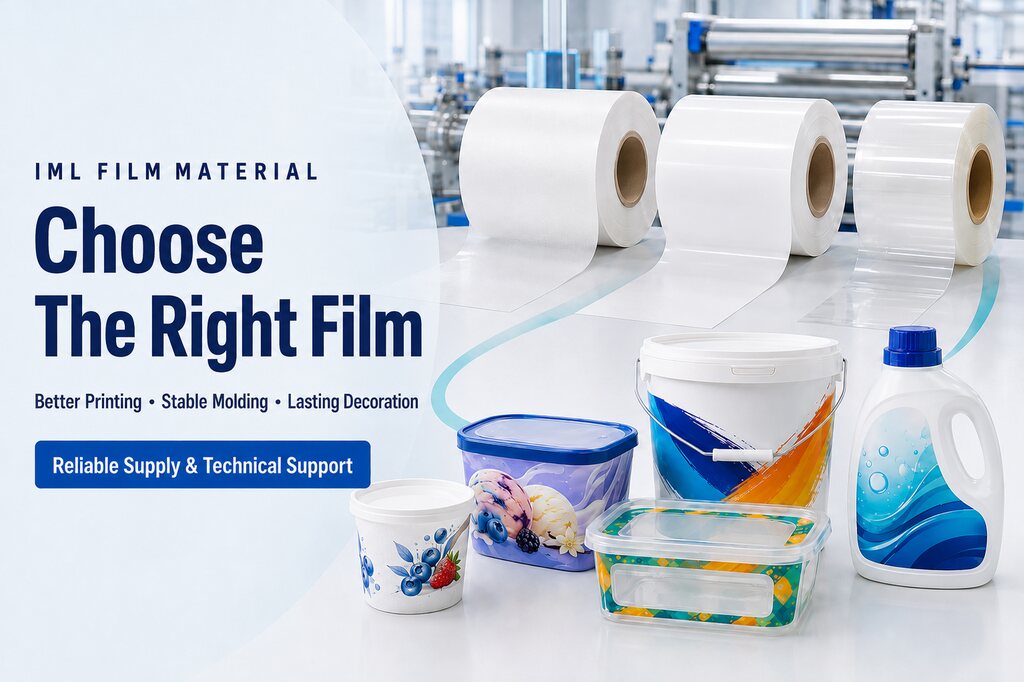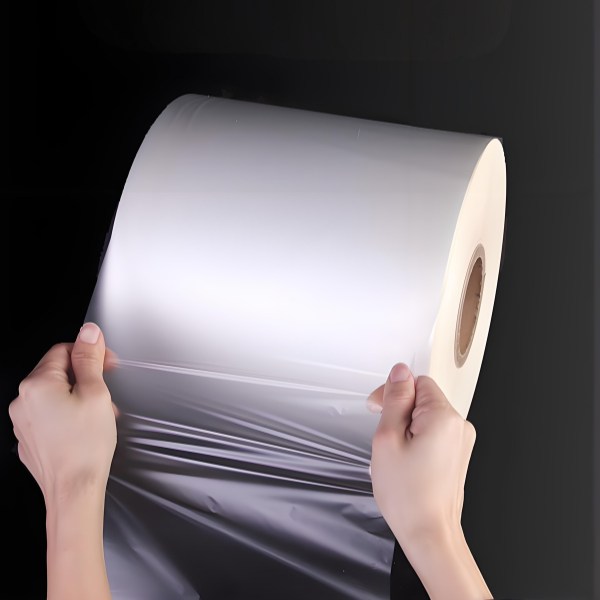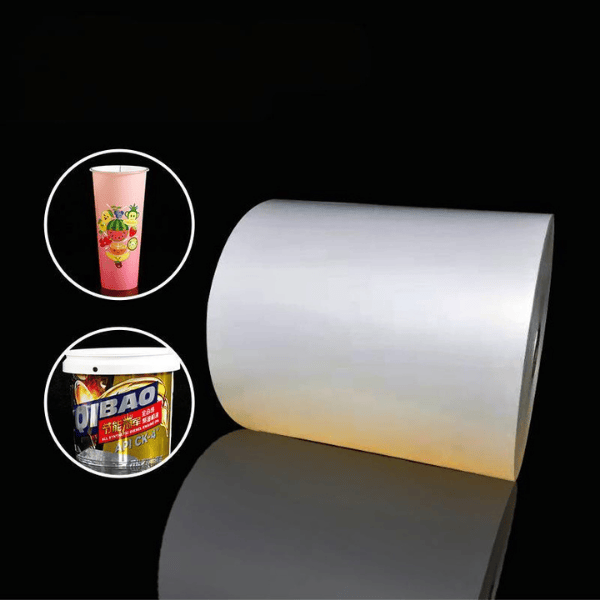
BOPP IML film is a practical label substrate for injection-molded yogurt cups, dessert cups, ice cream tubs, margarine containers, spread tubs, lids and other PP dairy packaging when the project needs integrated decoration, moisture resistance, strong print presentation and reliable label placement during molding. The correct grade must match the container resin, wall thickness, label geometry, printing and die-cutting process, robot or handling system, mold design, filling conditions and cold-chain requirements.
For many thin-wall PP containers, a white, opaque or transparent PP/BOPP-based IML film can provide the required stiffness and printing surface while becoming integrated with the container during injection molding. However, a film should not be approved only because it looks attractive or has the same nominal thickness as the current material. It must also print and die-cut cleanly, remain flat in the label stack, separate consistently, accept the required electrostatic charge or vacuum handling, stay correctly positioned in the mold and survive filling, lidding, refrigeration, condensation, freezing and distribution.
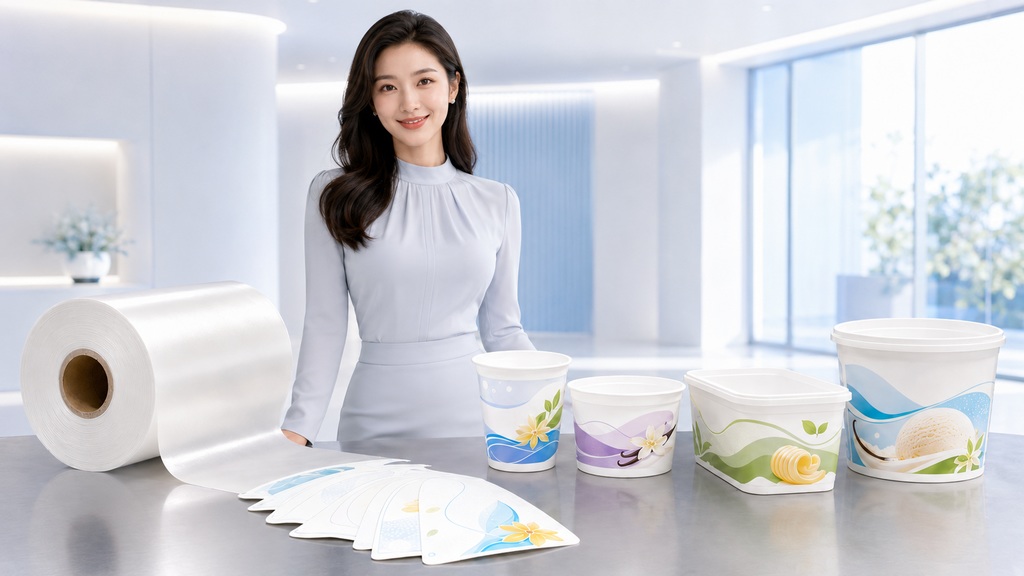
CloudFilm supplies BOPP IML film for yogurt cups and dairy containers in customized thicknesses, widths, roll formats, surface treatments and appearance options. This application guide explains how dairy brands, cup manufacturers, IML label converters, injection molders and packaging buyers can define a realistic specification and validate it before bulk purchasing.
Quick Answer: What Does Dairy-Container IML Film Need?
A suitable dairy-container IML film must do more than carry printed graphics. It must work as one part of a complete converting and molding system.
- Material compatibility:The label structure must be compatible with the container resin and the molding process. PP-based labels are commonly paired with PP containers, but the final combination still requires a molding trial.
- Stable converting:The film must print, cure, sheet, die-cut and stack without uncontrolled shrinkage, curl, blocking, dust or edge damage.
- Controlled handling:The label must separate from the stack, be picked by the robot or handling system, accept controlled static charging or vacuum placement and remain in the correct cavity position.
- Molding performance:The label must resist movement, wrinkles, bubbles, burn marks, ink distortion and incomplete bonding as molten resin fills the cavity.
- Cold-chain durability:The decorated container must remain visually acceptable through filling, lidding, refrigeration, condensation, freeze/thaw cycles when relevant, transport, stacking and consumer handling.
- Regulatory documentation:The supplier, label converter and molder must define which materials, inks, coatings and additives require declarations or migration evidence for the destination market.
The starting material cannot be selected from thickness alone. Two films at 60 μm can behave differently because of density, cavitation, layer design, stiffness, surface treatment, slip package, antistatic behavior and winding quality. Buyers who are new to the process can first review the in-mold labeling process and IML film guide and then use this page to build a dairy-specific specification.
Which Dairy Containers Commonly Use IML Film?
Yogurt and cultured-dairy cups
Single-serve and family-size yogurt cups need attractive graphics, accurate registration and a label that remains integrated with a thin container wall. The project may use a wraparound sidewall label, a partial label or a label shaped around ribs, windows, rims and base features. Cup taper, mold-cavity geometry, gate location and label overlap or gap must all be defined before the die line is frozen.
The cup may be filled cold and then closed with foil, lidding film or a snap-on lid. The IML label decorates the rigid cup; it does not replace the lid seal or automatically determine shelf life. The finished pack must therefore be evaluated as a system that includes the cup wall, IML label, product, headspace and closure.
Dessert, pudding and cream-cheese cups
Dessert cups often use premium graphics, metallic-looking effects, high opacity or areas of transparency. Small cups can be sensitive to label stiffness and stacking behavior because the labels are light and closely nested. Fine die-cut tolerances, clean edges and stable static behavior become particularly important when several cavities run at high speed.
Products containing fat, flavorings or strongly colored ingredients may also require odor, set-off and migration review for the ink and coating system. The label converter should confirm that the selected ink, varnish and curing method are suitable for the intended packaging construction and destination market.
Ice cream tubs and frozen-dessert containers
Ice cream packaging is exposed to low temperatures, moisture, condensation and repeated handling. IML avoids a separate pressure-sensitive adhesive layer, so there is no external adhesive label to lift simply because the package becomes wet. That does not mean every IML construction is automatically approved for freezing. The label, ink, varnish, container wall and bond area must survive the actual freezer temperature, storage time, impact, flexing and freeze/thaw pattern.
Larger tubs also place greater demands on label flatness, pick accuracy, stiffness and mold positioning. A large label that is slightly curled may still look acceptable on a table but fail during high-speed robotic placement.
Butter, margarine and spread tubs
These containers may be rectangular, oval or round and often include corners, ribs, handles or large decorated sidewalls. The IML film must conform to the intended geometry without creating wrinkles, trapped air or weak edge bonding. Grease exposure, filling temperature, stacking load and repeated opening should be included in the final pack test.
Dairy lids, overcaps and multi-component packs
Some projects use an IML-decorated lid or overcap in addition to the cup or tub. The resin, mold, label shape and placement system for the lid can differ from the body. A successful sidewall label does not automatically approve the same film for a lid, especially when the lid has living hinges, snap features, deep draws or a different resin formulation.
Why BOPP and PP-Based IML Films Work Well for Dairy Packaging
Integrated decoration without a separate adhesive label
In injection-molding IML, the printed label is placed inside the mold before resin is injected. The molten polymer forms the container and bonds with the label during the molding cycle. The decoration becomes part of the container surface rather than a label applied in a separate post-molding operation.
This integrated construction can resist moisture, scuffing and routine handling better than a poorly matched paper or pressure-sensitive label. Actual durability still depends on the film, ink, varnish, mold and bonding result.
Large printable area and consistent brand presentation
IML can decorate a broad sidewall area and can follow complex container shapes when the artwork and die line are properly prepared. White opaque films can support strong color density, clear grades can create product or container windows, and gloss or matte surfaces can support different brand positions. The final appearance should be approved with molded samples because the container color, label opacity, resin flow and mold texture can change the visual result.
Moisture and condensation resistance
PP/BOPP-based films do not absorb water in the way paper labels do. This makes them a useful starting material for refrigerated and frozen dairy packaging. Condensation can still expose defects in ink adhesion, varnish resistance, label bonding and container handling, so wet-rub, condensation and temperature-cycle testing remain necessary.
Stiffness for printing, die cutting and robotic handling
BOPP orientation can provide useful stiffness and dimensional stability at relatively low gauge. The correct balance helps the label remain flat, cut cleanly and move through magazines, pick heads and mold cavities. Too little stiffness can cause sagging or missed placement; excessive stiffness can reduce conformity around tight geometry or make a light label difficult to control.
Potential PP material compatibility
When a PP-based label is used on a PP container, the package may support a more compatible PP-focused material design than a paper label or a label made from a different polymer. This does not create a universal recyclability claim. Inks, coatings, additives, label percentage, container color and local collection and recycling systems must also be considered. For a broader view of label formats and buying factors, see the BOPP labels materials and buying guide.
Dairy Packaging Conditions and Their Main Failure Risks
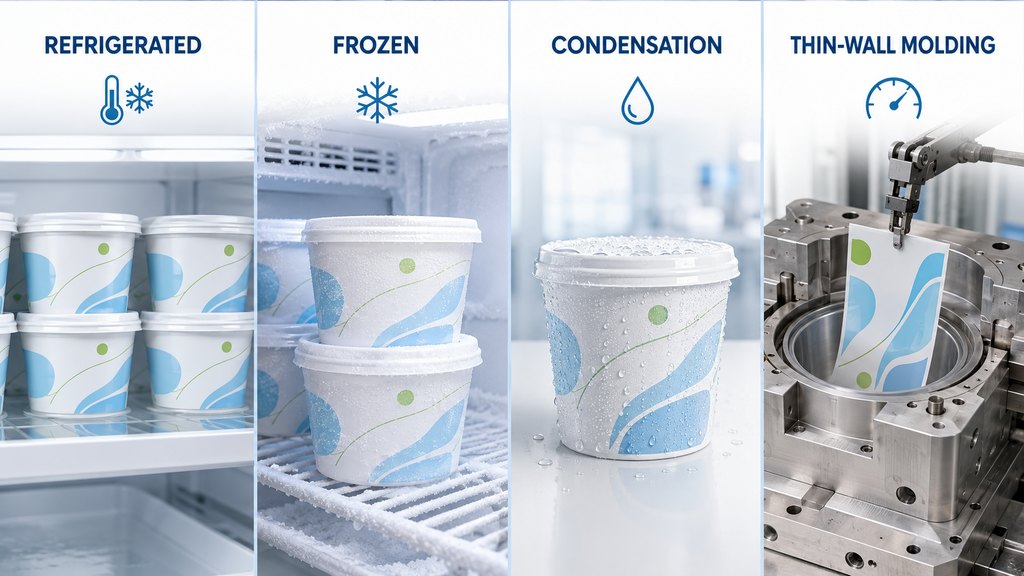
Refrigeration and surface condensation
A cold cup moved into warm humid air may quickly become covered with water. The label itself should not swell or peel, but condensation may reveal unbonded edges, ink weakness, poor coating cure or scuff sensitivity. Evaluate the pack immediately after removal from cold storage and again after repeated wet/dry cycles.
Frozen storage and freeze/thaw cycling
Freezing can change the impact behavior of the container and label system. Tubs may be dropped, squeezed, stacked or opened while cold. The test should use the actual product or a representative fill because an empty tub does not reproduce the same thermal mass, stress or impact load. Record freezer temperature, storage time, thaw conditions and number of cycles rather than reporting only that a sample “passed a freezer test.”
Thin-wall injection molding
Thin-wall cups are molded with fast resin flow, high injection pressure and short cycles. The label can move, wrinkle or trap gas if static placement, venting, gate position, film stiffness or cavity fit is wrong. Because the label also affects local heat transfer, the molder should evaluate wall balance, visual read-through, distortion and cycle stability with the final printed and die-cut label—not only with plain film.
Filling, lidding and sealing
The cup may face cold filling, warm filling, product splash, rim contamination, foil sealing pressure or lidding heat. The IML label usually sits away from the seal land, but label placement, container distortion and local wall thickness can still affect downstream closing. Confirm that the label does not enter the sealing rim, interfere with denesting or reduce the dimensional stability required by the lidding equipment.
Stacking, transport and retail handling
Nested empty cups experience compression and friction before filling. Finished tubs may be case-packed, palletized and stored under load. Labels should be inspected for scuffing, blocking, surface transfer, edge damage and color change after simulated distribution. Large decorated areas and matte finishes may need more deliberate rub and scratch evaluation than a small glossy label.
How to Select the IML Film Grade
Start with the container resin and molding method
State whether the container is injection-molded PP, another PP grade or a different polymer. Also provide the resin supplier and grade when possible, including filler or recycled-content information that may affect shrinkage, color, bonding or surface appearance. A film that works on one PP formulation should still be validated after a resin change.
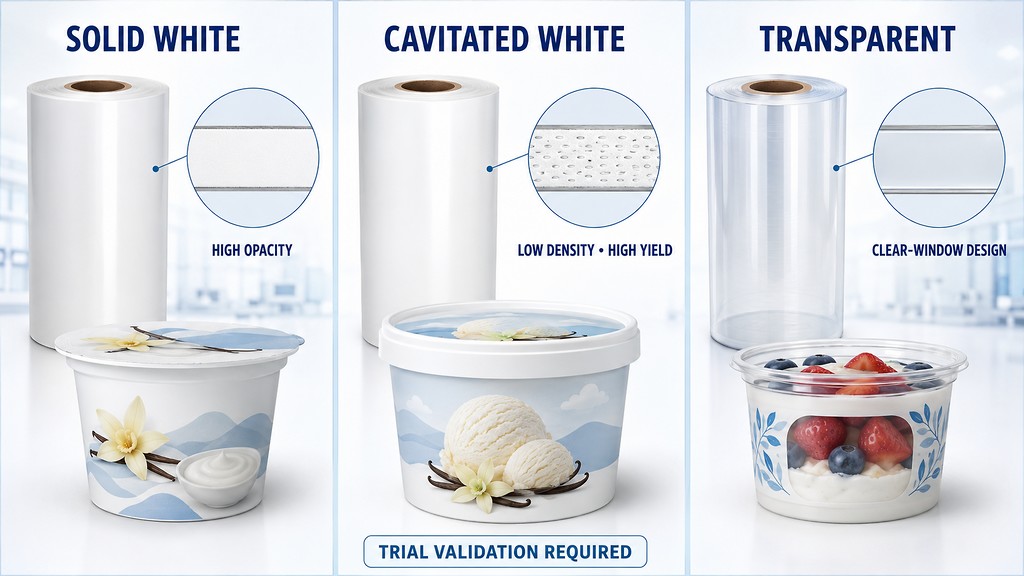
Choose solid white, cavitated white or transparent by function
A solid white grade can provide consistent opacity, smooth print presentation and a straightforward density profile. A cavitated or semi-cavitated grade uses microscopic voids to reduce density and create opacity; it may offer more label area per kilogram, but its compressibility, stiffness, die-cut behavior and mold performance must be checked. A transparent grade can create clear windows or a no-label appearance, but it makes ink coverage, container color, scratches, trapped air and flow marks more visible.
These are material families, not automatic performance rankings. A general pearlized packaging film is not automatically an IML grade. The grade must be designed and validated for printing, die cutting, static handling and molding. Buyers who need more structural background can review solid, cavitated and multilayer BOPP structures.
Select thickness together with density and stiffness
CloudFilm’s current product page presents a typical IML film supply range of 40–80 μm, with other gauges discussed case by case. The correct gauge depends on label size, shape, cavity count, robot speed, printing process, film density, die-cutting method and container geometry. Use the BOPP film thickness guide for packaging buyers to compare gauge, yield and handling, but approve the dairy project with a real converted label.
A thicker film may improve stiffness but increase weight and cost per square meter. A lower-density cavitated grade may deliver more square meters per kilogram but may not match the mechanical behavior of a solid film at the same thickness. Cost should therefore be compared per square meter, per thousand labels and per accepted molded container—not only per kilogram.
Define opacity, gloss and surface finish
Opacity influences color density and the visibility of the container resin behind the label. Gloss can create a bright retail appearance, while matte or semi-matte surfaces can reduce glare and support a premium look. The mold texture may reproduce through or around the label, and the label may alter local gloss. Approve the combination of film, ink, varnish, resin color and mold surface with final molded parts under retail lighting.
Control flatness and electrical behavior
IML labels need apparently opposite behaviors at different stages. They must separate cleanly from a stack, but they may also need to accept an electrostatic charge so that they stay against the mold wall. “More antistatic” is therefore not always better. The correct surface behavior must match printing, die cutting, storage, humidity, robot pick-up and the mold’s charging or vacuum system.
Specify the treated side and print system
The print surface may require controlled corona treatment, coating or primer. Treatment level can decline during storage, and inks and varnishes differ in their anchorage and heat resistance. Specify the treated side, winding direction, target dyne level, test method and expected time between film manufacture, printing and molding. The principles in the guide to corona treatment for plastic film are useful, but the final approval must use the exact IML ink and coating system.
| Grade Family | Main Advantages | Main Risks to Check | Practical Dairy Starting Use |
| Solid white PP/BOPP IML film | Smooth print surface, strong opacity options, stable reference for color approval | Higher density than cavitated grades; stiffness and yield depend on gauge | Yogurt cups, dessert cups, margarine tubs and lids requiring consistent white background |
| Cavitated or semi-cavitated IML film | Lower density, high opacity, potential area yield and useful stiffness design | Compression, die-cut edge, curl, static and molding response may differ from solid film | High-volume opaque cups and tubs after converter and molder validation |
| Transparent IML film | Clear window, no-label appearance, visibility of container or product | Ink coverage, scratches, trapped air, flow marks and resin color become more visible | Clear or tinted cups and premium designs with controlled transparent areas |
| Matte or specialty-finish IML film | Low glare and differentiated shelf appearance | Rub resistance, coefficient of friction, stack separation and mold-surface interaction | Premium dairy tubs and limited design zones after scuff and feeding trials |
Starting Specification by Dairy Container Type
The following table gives starting questions, not universal grade approvals.
| Container Type | Main Packaging Priority | Film Starting Point | Critical Trial Focus |
| Single-serve yogurt cup | Thin-wall molding, high cavity count, accurate decoration | White or opaque IML grade with controlled flatness, stiffness and static behavior | Multi-cavity pick consistency, label position, wall balance, denesting and lidding |
| Family-size yogurt or dessert tub | Large decorated area, stacking and retail appearance | Solid or cavitated white grade selected by label area, stiffness and opacity | Large-label curl, robot placement, trapped air, sidewall bond and stack rub |
| Ice cream tub | Freezing, condensation, impact and repeated handling | Validated PP/BOPP IML grade with suitable low-temperature finished-pack performance | Freeze/thaw, cold drop, flexing, wet rub, edge bond and lid fit |
| Margarine or spread tub | Grease exposure, corners and long sidewalls | Opaque grade with compatible ink/varnish and geometry-specific stiffness | Corner conformity, rub, product exposure, filling temperature and repeated opening |
| Dessert or cream-cheese cup | Premium graphics and small-label handling | White, matte or transparent grade according to artwork and mold | Fine registration, stack separation, small-label pick, ink set-off and visual defects |
| IML-decorated lid or overcap | Snap fit, flexing and different mold geometry | Separate label and film review from the cup body | Hinge/snap movement, label position, distortion, closure dimensions and cold use |
The label converter and molder should freeze a written specification only after the selected film has passed printing, die cutting, handling and molding at the intended production conditions.
Printing, Die-Cutting and Robotic Feeding Requirements
Printing method and surface compatibility
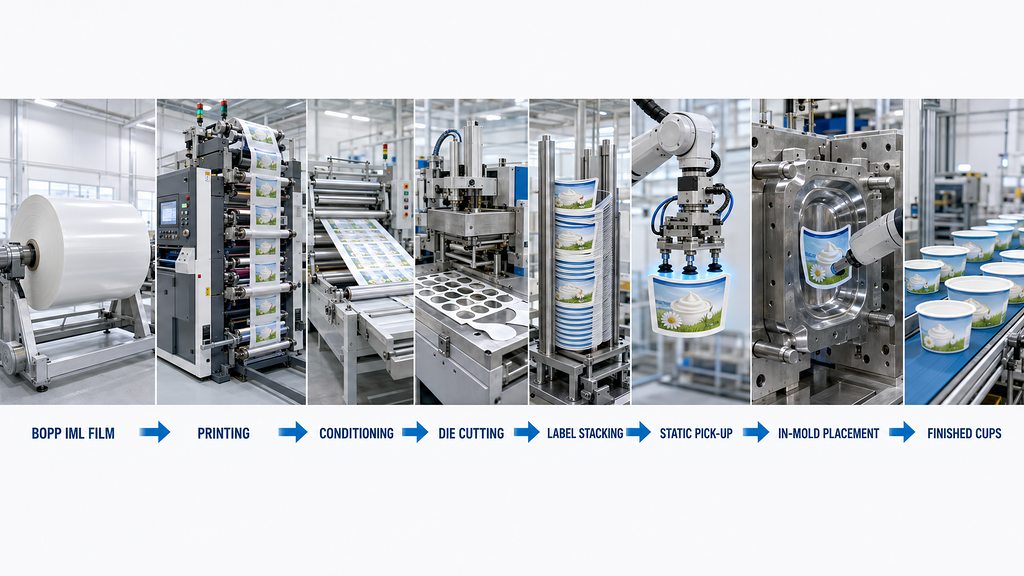
Offset, gravure and flexographic printing are used for different IML order sizes, label formats and converter setups. Digital printing may also be evaluated when the film, ink, primer and finishing process are compatible. The buyer should not approve a film from a generic statement such as “printable.” The converter should test ink adhesion, color density, dot quality, drying or curing, heat resistance, varnish performance and any risk of set-off in stacked labels.
Some converters use a dedicated BOPP printing film for other label or packaging work, but a general printing grade is not automatically suitable for IML. IML requires the combined performance of printability, dimensional stability, die cutting, stack separation, electrical behavior and mold bonding.
Ink, varnish and migration control
The ink and coating system must match the film surface and the final packaging use. Confirm whether the printed side faces the mold or the injected resin, whether the ink is protected by varnish or another layer, and whether the design includes heavy ink coverage, metallic effects or large unprinted windows. Record the curing conditions because excessive heat or unbalanced coating can contribute to label shrinkage and curl.
For food packaging, the responsibility is shared across the film supplier, ink supplier, printer, molder, filler and brand owner. Each party should provide the declarations and test evidence that apply to its material and process. Do not use a general “food grade” statement as a substitute for market-specific documentation and assessment of the finished package.
Sheeting and die cutting
The converted label must match the mold cavity, not only the artwork. Critical items include die-line dimensions, corner radius, gate clearance, overlap or gap, label orientation, cavity identification, cut-edge quality and burr direction. Dust, fused edges, nick points or damaged corners can cause double picks, poor placement and visible molding defects.
Printed sheets should be conditioned before die cutting, and label stacks should be checked for flatness after the full ink and varnish coverage has equilibrated. A plain-film die-cut test cannot reproduce the stresses created by the final printed design.
Stacking and label separation
Label stack height, count, nesting direction, slip, surface finish and humidity can change feeding behavior. The stack must remain aligned without blocking or uncontrolled sliding. Check the first, middle and last labels in the stack because compression and surface contact vary through the pile.
Robot pick-up and static charging
The robot may use vacuum, mechanical support, electrostatic charging or a combination. Record pick-head design, cycle time, acceleration, label magazine setup, charge voltage or controller settings where appropriate and the distance and orientation between the label and cavity. A label that feeds at low speed may fail when the machine reaches the intended production cycle.
Placement in the mold
The label must sit flat against the cavity without wrinkles, lifted edges or misalignment. The molder should inspect label movement relative to the gate and resin flow front. Venting, cavity cleanliness, mold texture and electrostatic grounding can all affect the result. If the label repeatedly moves in one direction, investigate the process and mold before assuming that a thicker film is the only solution.
Technical Properties to Specify
A useful technical data sheet should connect each property to a converting or molding requirement. Test methods and conditions must be stated; a number without a method is difficult to compare.
| Property | Why It Matters for Dairy IML | What the Buyer Should Request |
| Film material and structure | Influences resin compatibility, density, opacity, stiffness and bonding | Exact grade code, solid/cavitated/transparent description and layer or coating information relevant to use |
| Thickness and tolerance | Affects stiffness, die cutting, pick behavior, heat transfer, yield and cost | Nominal thickness, tolerance, measurement method, unit weight and change-control limit |
| Density or area yield | Changes square meters and labels obtained per kilogram | Density test method, typical value and calculated square meters per kilogram at nominal gauge |
| MD/TD stiffness | Influences flatness, stack handling, robotic pick and conformity | Test method, direction, conditioning and representative value or approved control sample |
| Dimensional stability and shrinkage | Printing, curing and molding heat can distort labels | MD/TD shrinkage or dimensional-change data under stated time and temperature |
| Surface treatment | Supports ink, varnish, primer or coating adhesion | Treated side, target dyne level, test method, treatment-retention guidance and production date |
| Static/antistatic behavior | Influences stack separation, charging and mold retention | Surface behavior description, conditioning, humidity sensitivity and compatibility with the handling system |
| Coefficient of friction | Affects sheeting, stacking, magazine feed and pick-up | Static/dynamic COF, tested surfaces, test method and aging conditions |
| Opacity, haze and gloss | Controls color density, clear windows and retail appearance | Test method, side measured and approved visual standard |
| Print and varnish compatibility | Prevents ink lift, set-off, cracking and wet-rub failure | Recommended pretreatment, ink/primer families, cure conditions and converter trial requirement |
| Winding and roll quality | Determines sheeting stability and downstream consistency | Width, diameter, core, edge quality, hardness, splices, telescoping and roll identification limits |
Recommended Roll and Purchase Specification
The correct film chemistry can still fail if the roll format or side identification is wrong. A purchase specification should include:
- Exact film grade and material family
- Nominal thickness and agreed tolerance
- Density or yield basis when relevant
- White, opaque, cavitated, transparent, gloss, semi-matte or matte appearance
- Treated side or sides and target treatment level
- Print side, mold side and resin-contact side identification
- Surface finish, slip and static/antistatic requirement
- Exact roll width and tolerance
- Core inner diameter, core material and core length
- Maximum roll diameter and maximum roll weight
- Winding direction and inside/outside surface orientation
- Roll hardness, edge quality and telescoping limits
- Maximum number, location and marking of splices
- Batch code, production date, COA and traceability requirements
- Moisture, dust, edge and pallet protection for export shipment
- Approved reference sample and change-control procedure
Do not rely on a purchase order that says only “IML film, 60 μm.” That description does not identify density, opacity, surface treatment, winding, print side, electrical behavior or mold compatibility.
Food-Contact and Cold-Chain Validation
Define the compliance scope
The destination country, food type, use temperature, storage time and position of each material determine which declarations and tests may be required. The rigid container and lid are usually the primary food-contact surfaces, but inks, coatings, additives and possible set-off or transfer pathways still require review. Ask each supplier for documents that apply to the exact grade and intended market.
Evaluate the complete decorated package
An IML label is not a substitute for a barrier or shelf-life study. Standard PP/BOPP labeling may add material to part of the container wall, but any oxygen, moisture, light or aroma improvement must be measured on the actual decorated package. Shelf life also depends on container-wall distribution, lid or foil, seal integrity, product formulation, filling hygiene and storage temperature. If the project requires a separate flexible lid or barrier component, the broader food packaging film range can be evaluated independently.
Build a written cold-chain protocol
Avoid a vague approval such as “freezer resistant.” Record the actual refrigerator or freezer temperature, exposure time, fill condition, number of temperature cycles, condensation period, impact method, rub method, sample quantity and acceptance criteria. Use both newly molded samples and aged samples because inks, coatings, static additives and molded stresses may change over time.
| Test Stage | Test Action | Main Acceptance Question |
| Incoming film | Verify grade, lot, thickness, side identification, treatment and roll condition | Is the tested material identical to the proposed supply specification? |
| Printed sheet | Check color, ink adhesion, cure, dimensional change, set-off and odor | Does the final artwork remain stable before die cutting? |
| Die-cut label | Measure dimensions, edge quality, curl, stack alignment and separation | Can labels be stacked and picked without damage or double feeds? |
| Molding trial | Run all cavities at low, normal and target cycle speed | Does the label stay positioned and bond without wrinkles, bubbles or distortion? |
| Filled-pack test | Fill and close the package under actual plant conditions | Do lidding, rim dimensions, denesting and container handling remain stable? |
| Refrigeration/condensation | Condition, remove to humid air and repeat wet/dry cycles | Do graphics, coating, edges and surface appearance remain acceptable? |
| Frozen storage | Freeze the filled pack and perform defined handling and impact checks | Does the decorated container survive cold use without cracking, delamination or severe scuffing? |
| Distribution | Perform stacking, compression, vibration or drop simulation as relevant | Does the pack remain saleable through expected transport and retail handling? |
| Shelf-life comparison | Compare decorated and control packs over the required period | Are product quality, closure integrity and package appearance maintained? |
Common Problems and Application-Specific Troubleshooting
Use a controlled sequence: identify the visible symptom, list likely film and process causes, measure the relevant conditions, change one variable at a time and decide whether the film grade, label conversion or molding setup must change.
| Problem | Possible Causes | How to Check | Corrective Actions | When to Change Film or Structure |
| Label curl after printing or die cutting | Unbalanced ink/varnish coverage, high drying heat, film shrinkage, tension, humidity or poor conditioning | Compare plain and printed labels; measure curl direction after each process stage | Balance coating, reduce unnecessary heat, condition sheets, correct tension and storage | Change grade if dimensional stability remains outside the converter’s workable window |
| Double picks or labels sticking together | Static imbalance, blocking, varnish tack, fused die-cut edges, high stack pressure or contamination | Inspect stack edges and surfaces; test different humidity and stack heights | Improve curing, edge quality, stack conditioning, air separation and pick settings | Change surface/film grade if clean labels still cannot separate at target speed |
| Missed picks or dropped labels | Low stiffness, curl, vacuum leak, pick-head mismatch, unstable static charge or incorrect magazine setup | Record failures by cavity, stack position and machine speed | Correct magazine alignment, vacuum, charge, humidity and pick acceleration | Test a different stiffness, surface or thickness when the handling window remains too narrow |
| Label moves inside the mold | Weak or uneven charge, poor cavity contact, wrong geometry, gate impact, dirty mold or lifted edges | Mark initial position and compare movement to resin flow and gate location | Improve placement, charging, grounding, cavity cleaning, venting and label design | Change film if flatness or stiffness prevents stable cavity contact after process correction |
| Wrinkles, bubbles or unbonded areas | Trapped gas, label lift, contamination, resin mismatch, low local pressure, poor venting or incorrect label orientation | Section and inspect defects; compare cavities, gate distance and process settings | Clean mold, improve venting and label fit, correct orientation and molding conditions | Change label structure if compatibility or surface design repeatedly prevents bonding |
| Ink scuffing, whitening or wet-rub failure | Inadequate ink/varnish cure, poor surface treatment, abrasion, condensation or low-temperature flexing | Run dry rub, wet rub, tape, freeze/thaw and filled-pack handling tests | Match ink and coating, improve cure, protect printed surface and reduce abrasive contact | Change film/coating system when adhesion remains weak on the approved process |
| Distorted graphics or gate read-through | Resin-flow stress, artwork compensation error, label movement, thin wall or excessive local heat | Compare distortion map with flow simulation, gate location and cavity measurements | Adjust artwork, label placement, gate/process balance and local wall design | Change stiffness or structure only after mold and artwork factors are separated |
This table is an application overview. A future dedicated troubleshooting page should expand the feeding problems into symptom-by-symptom tests without duplicating this entire application guide.
Laboratory and Production Trial Procedure
| Step | Trial Action | Acceptance Question |
| 1 | Confirm container resin, mold, cavity count, label drawing and proposed film grade | Is every test participant working from the same controlled specification? |
| 2 | Condition film and printed sheets at the agreed temperature and humidity | Have environmental differences been controlled before comparison? |
| 3 | Print the final artwork or a representative high-coverage design | Are adhesion, cure, color, dimensional stability, odor and set-off acceptable? |
| 4 | Die-cut at production settings and build normal label stacks | Are dimensions, edges, curl, dust, alignment and separation within limits? |
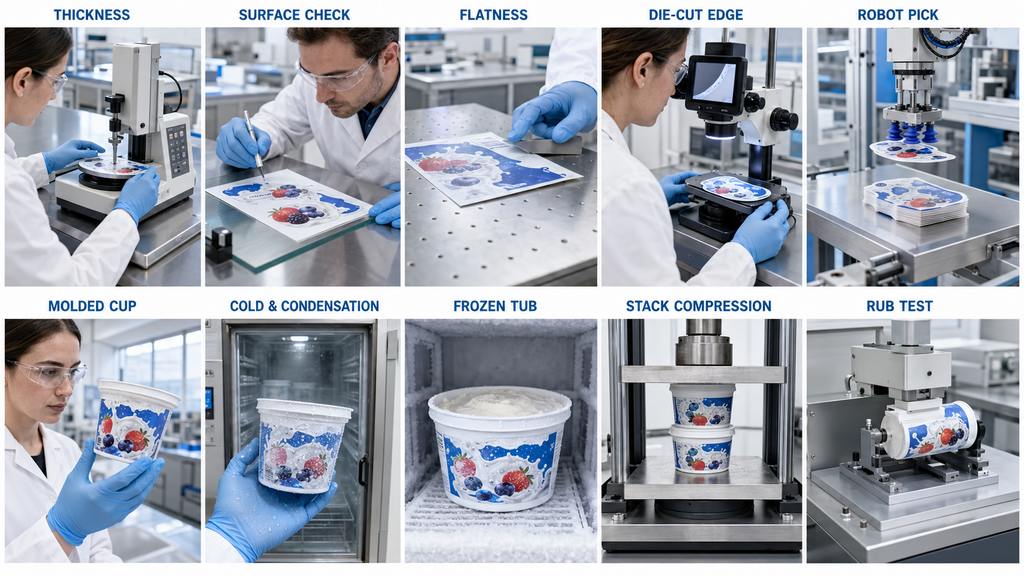
| 5 | Run robot pick and placement tests without resin at low and target speed | Are single-label pick, charge or vacuum control and cavity placement stable? |
| 6 | Mold empty containers across all cavities and planned cycle speeds | Are bonding, label position, graphics and container dimensions consistent? |
| 7 | Run normal production duration rather than a few isolated shots | Do waste, stoppages, static drift and operator adjustments remain acceptable? |
| 8 | Fill, close, stack and case-pack the containers under actual plant conditions | Does the decorated container work with filling, lidding, denesting and packing equipment? |
| 9 | Complete refrigeration, condensation, frozen-storage and distribution tests as applicable | Does the finished pack meet the written cold-chain and handling criteria? |
| 10 | Freeze the approved film, printing, label, mold and roll specification | Can future lots be checked against a retained standard and agreed change-control plan? |
An A4 film sheet can support initial appearance, treatment and print tests, but it cannot prove roll unwinding, production sheeting, stack consistency, robotic feeding or molding stability. A representative trial roll and final converted labels are required before a high-volume dairy project is approved.
Information to Send an IML Film Manufacturer or Supplier
A complete technical inquiry should include:
- Dairy product and container type
- Container drawing, photographs and final dimensions
- Injection-molding or other molding method
- Container resin supplier, resin grade, color, filler and recycled content when relevant
- Mold cavity count, gate position, mold texture and label placement method
- Current IML film grade, structure, thickness, density and supplier TDS
- White, opaque, cavitated, transparent, gloss or matte requirement
- Label drawing, dimensions, wrap angle, overlap/gap and orientation
- Printing method, number of colors, ink, primer, varnish and curing method
- Sheeting and die-cutting method
- Robot brand or general handling type, pick method and target cycle time
- Current defects with photographs or video
- Filling temperature, lidding or closure method and line conditions
- Refrigeration, freezer, condensation and shelf-life requirements
- Food-contact or other compliance documents required by the destination market
- Roll width, core, diameter, winding direction, surface orientation and splice rules
- Trial quantity, annual demand, delivery destination and preferred trade term
The more complete the inquiry, the easier it is to separate film selection from printer, label, robot, mold and filling-line issues. A quotation based only on thickness, width and tonnage is not enough for a new high-speed IML project.
How to Evaluate a Dairy-Container IML Film Supplier
Application-specific recommendation
A qualified supplier should ask about container resin, label size, printing, die cutting, robot handling, mold placement, filling and cold-chain conditions before recommending a grade. A generic statement that one film is suitable for “all cups and buckets” is not a technical recommendation.
Consistent film and roll control
Request a TDS, side identification, thickness profile, treatment information, roll specification and agreed visual standard. Confirm how the supplier controls winding, edge quality, telescoping, splices, contamination and lot traceability.
Representative sample and trial support
Small sheets are useful for early printing and appearance work. Trial rolls should use the intended thickness, width, core, winding and surface orientation. The supplier should support investigation across film, printing, die cutting and molding rather than assuming every defect is caused by one process.
Change control
The approved project should be linked to a grade code, retained sample, lot records and written specification. Changes to resin, cavitation, surface treatment, additives, coating, thickness, production line or manufacturing location may affect printing and molding and should be communicated before supply.
Food-packaging and export documentation
International buyers should confirm which declarations, certificates, COA details, packing marks, pallet protection and shipping documents will be supplied. Documentation must refer to the exact material and destination requirement rather than a generic company statement.
Frequently Asked Questions
- Can BOPP IML film be used for yogurt cups?
Yes. BOPP or PP-based IML film is widely used for injection-molded yogurt and dairy cups. The film must be matched to the cup resin, label shape, printing and die-cutting process, robotic handling, mold and filling conditions.
- Is IML film suitable for ice cream tubs?
Yes, provided the finished printed and molded package passes the defined freezer, condensation, impact, flexing and handling tests. “Freezer resistant” should be verified under the actual product and storage conditions.
- What thickness is commonly used for dairy-container IML film?
CloudFilm’s product page gives a typical supply range of 40–80 μm. The final thickness depends on density, stiffness, label size, mold geometry, robot speed, printing and die cutting. Thickness alone does not define performance.
- Should I choose solid or cavitated IML film?
Choose from the required opacity, density, yield, stiffness, die-cut behavior, stack separation and mold performance. Cavitated film can offer lower density and high opacity, while solid film can provide a stable print and mechanical reference. Both require a full trial.
- Can transparent IML film create a clear window?
Yes. Transparent IML film can support a clear-window or no-label look, but ink coverage, container color, scratches, trapped air and resin-flow marks become more visible. Approve the final molded appearance, not only the printed label.
- Does IML film need antistatic treatment?
It needs controlled electrical behavior. Labels must separate from the stack and may also need to accept electrostatic charging for mold placement. The correct balance depends on humidity, printing, varnish, robot and mold system.
- Which printing methods can be used?
Offset, gravure and flexographic printing are common, and digital printing may be evaluated. The exact film, ink, primer, varnish and cure conditions must be tested together.
- Is IML film automatically food-contact compliant?
No material should be described as universally compliant without scope. Confirm the exact grade, destination market, food type, use temperature, contact position, inks, coatings and required declarations or tests.
- Does an IML label improve the container’s oxygen or moisture barrier?
Not automatically. Any barrier improvement must be measured on the actual decorated container. Shelf life also depends on the container wall, lid or foil, sealing, product and storage conditions.
- Will condensation make an IML label peel off?
A correctly molded IML label is integrated with the container and does not rely on an external pressure-sensitive adhesive. Condensation can still reveal poor bonding, ink adhesion, coating cure or scuff resistance, so wet and temperature-cycle tests are required.
- Why do printed IML labels curl?
Possible causes include film dimensional instability, printing tension, unbalanced ink or varnish coverage, drying heat, humidity, conditioning and die-cut stress. Compare plain film, printed sheets and die-cut labels at each process stage.
- Are A4 samples enough to approve the film?
No. A4 sheets support initial print, appearance and laboratory checks. A trial roll and production-converted labels are needed to validate sheeting, die cutting, stack separation, robotic feeding and molding.
- Is a PP label on a PP cup recyclable?
It can support a more compatible PP-focused design, but recyclability depends on inks, coatings, additives, label percentage, container color and local collection and recycling rules. Avoid a universal recycling claim without market-specific assessment.
- What information is most important for an accurate quotation?
Provide film thickness, width, appearance, label drawing, annual volume, container resin, mold and robot details, printing and die-cutting methods, roll format, destination and required documents. Current film TDS and trial defects are especially useful.
- Should cost be compared per kilogram or per label?
Compare both, but purchasing decisions should include cost per square meter, per thousand labels and per accepted molded container. Density, thickness, print waste, die-cut yield, machine speed, downtime and rejected parts affect the real cost.
Request an IML Film Recommendation for Your Dairy Container
CloudFilm supports dairy brands, packaging converters, label printers, cup manufacturers and injection molders with white, opaque and transparent PP/BOPP-based IML film options, customized roll dimensions and technical communication for overseas projects.
Send us your cup or tub drawing, label dimensions, container resin, current film TDS, printing and die-cutting method, robot or molding details, cold-chain requirements, annual volume and destination. Our team can recommend a suitable starting specification, prepare sample sheets or discuss a trial roll, and provide a quotation for evaluation.