Dried fruit packaging is more than a printed bag around a sweet snack. It is a protection system that must control moisture, oxygen, aroma loss, light exposure, seal strength, machine performance, shelf display, and cost at the same time.
For dried mango, raisins, dates, banana chips, freeze-dried strawberries, dried cranberries, apple rings, and mixed fruit snacks, the wrong packaging material can quickly affect product quality. The fruit may become sticky, too dry, faded, soft, oxidized, or less attractive on the shelf.
This guide explains the best packaging materials for dried fruit, how different film structures work, when to choose transparent packaging, when to choose metallized or foil packaging, and how to work with a flexible packaging film supplier or manufacturer to build the right structure for your product.
Why Dried Fruit Needs Special Packaging
Dried fruit has lower water content than fresh fruit, but that does not mean it is easy to pack. In many cases, dried fruit is highly sensitive to moisture exchange. If the package allows too much moisture to enter, crispy products such as banana chips or freeze-dried fruit may lose their texture. If the package allows too much moisture to escape, soft dried fruit such as mango, dates, or raisins may become dry and hard.
Oxygen is another important factor. Oxygen can affect color, flavor, aroma, and oil stability, especially for fruit snacks that contain natural sugars, oils, or added ingredients. For products with a long distribution chain, a suitable oxygen barrier can help maintain better quality during storage, shipping, and retail display.
Light can also matter. Some dried fruits are color-sensitive. Clear packaging can improve product visibility, but it may not be the best choice for every product. When stronger protection is required, metallized film, aluminum foil laminate, or other high-barrier structures may be more suitable.
A good dried fruit packaging structure should balance protection, appearance, cost, runnability, and market positioning. The best material is not always the most expensive one. It is the material that matches the real product risk and the buyer’s commercial goal.
Key Packaging Requirements For Dried Fruit
Before choosing a material, buyers should define what the packaging needs to do. Most dried fruit packaging projects involve several key requirements.
First, the package should provide moisture barrier. This helps protect texture and reduces the risk of clumping, stickiness, or loss of crispness.
Second, the package should offer oxygen protection when the product is sensitive to oxidation, aroma loss, or color change. This is especially important for premium dried fruit, fruit snacks, and export packs with long shelf-life targets.
Third, the package must seal reliably. Even a good barrier film will fail if the sealing layer is not suitable for the packing machine, sealing temperature, filling speed, or product contamination risk around the seal area.
Fourth, the package should support shelf appeal. For retail products, the pouch format, printing surface, matte or glossy finish, window design, and brand color all affect how confidently the product sells.
Finally, the package should match the buyer’s production method. A brand using premade pouches has different requirements from a processor using VFFS, HFFS, flow-wrap, or other automatic packing lines.
PET/PE: A Clear And Versatile Choice For Many Dried Fruit Packs
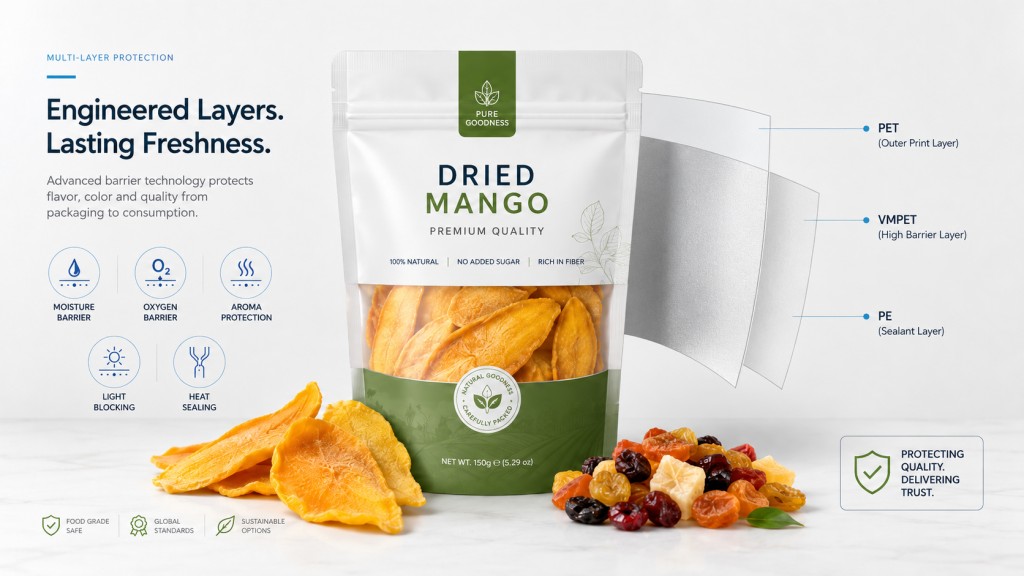
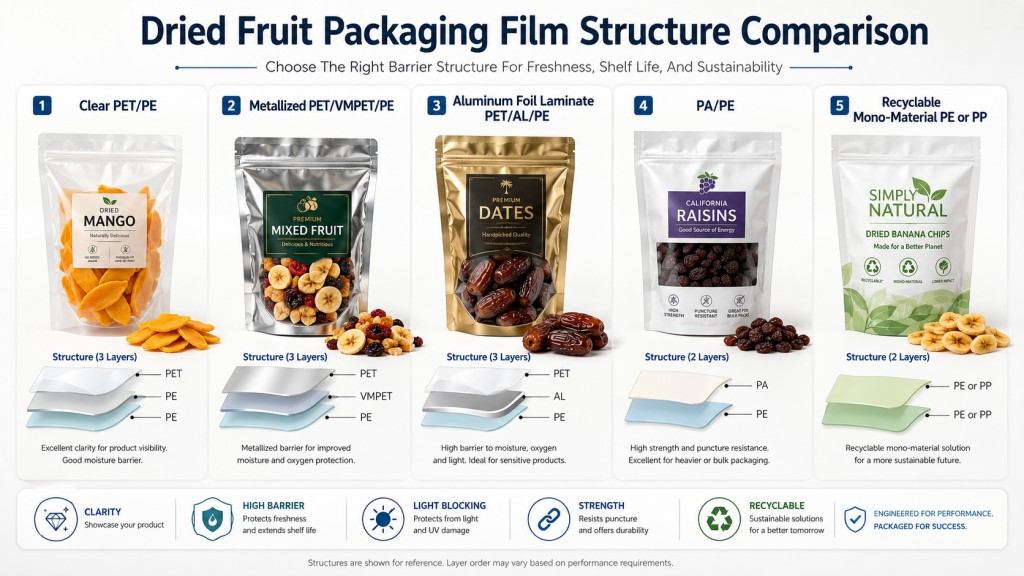
PET/PE is one of the most common flexible packaging structures for dried fruit. PET is usually used as the outer layer because it offers good clarity, stiffness, printability, and dimensional stability. PE is commonly used as the inner layer because it provides heat sealing performance.
For many standard dried fruit products, PET/PE Film can be a practical starting point. It is especially useful when the brand wants product visibility, clean printing, and reliable sealing in a pouch or roll film format.
PET/PE is often suitable for dried mango, raisins, mixed dried fruit, soft fruit snacks, and products where moderate barrier is enough. It is also a good option when the buyer wants a clear window or a transparent pouch design.
However, PET/PE may not be enough for every application. If the product needs stronger moisture, oxygen, aroma, or light protection, the structure may need a metallized layer, foil layer, coating layer, or additional barrier film.
BOPP/CPP And BOPP/PE: Cost-Effective Options For Snack-Style Packaging
BOPP-based laminates can be used for some dried fruit and snack-style applications. BOPP offers good clarity, gloss, stiffness, and printability. CPP or PE can provide sealing performance, depending on the structure and packing line.
BOPP/CPP or BOPP/PE may be considered for pillow bags, small packs, and lightweight dried fruit snacks where very high barrier is not required. These structures can work well for products that have shorter shelf-life targets or are sold through faster-moving retail channels.
For products that require stronger moisture barrier or oxygen protection, BOPP can also be combined with metallized films. For example, BOPP/VMPET/PE or BOPP/VMPET/CPP can improve barrier performance while keeping good printability and retail appearance.
When choosing BOPP-based structures, buyers should check seal strength, film stiffness, COF, machinability, and final shelf-life requirements. A packaging film is not only a material; it must also run smoothly on the customer’s equipment.
PET/VMPET/PE: A Strong Barrier Structure For Most Dry Fruit Applications
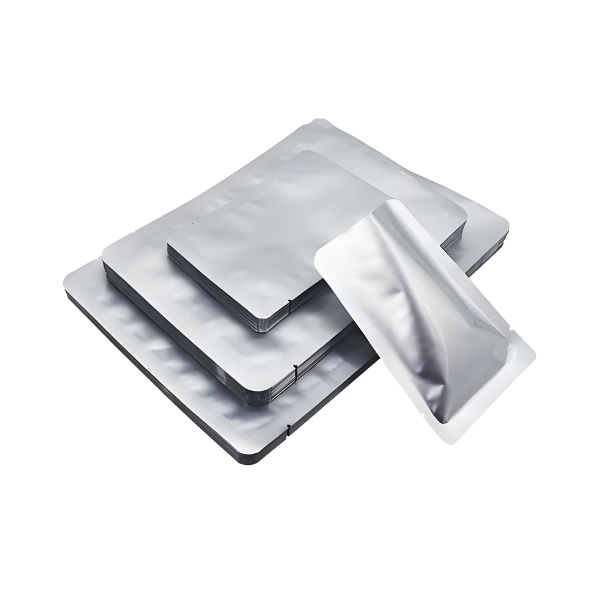
PET/VMPET/PE is one of the most popular high-barrier structures for dry food, snacks, coffee, tea, powders, and dried fruit. In this structure, PET supports printing and strength, VMPET improves barrier performance, and PE provides heat sealing.
If a buyer is comparing metallized packaging, it is useful to understand VMPET meaning before confirming the final structure. VMPET is often used as a middle barrier layer rather than as a standalone final package.
For dried fruit, PET/VMPET/PE can be suitable for banana chips, mixed fruit snacks, dried berries, dried mango, and export products that need better moisture and oxygen protection than clear PET/PE can provide.
The main trade-off is visibility. Metallized packaging usually blocks the product from view unless a special window is designed. For many brands, this is acceptable because the metallic look can also create a premium feeling and support stronger protection.
PET/AL/PE: High Barrier Protection For Sensitive Or Long Shelf-Life Products
When dried fruit needs very strong protection, PET/AL/PE can be a good choice. This structure uses aluminum foil as a high-barrier layer. It is commonly considered when the product requires stronger protection against moisture, oxygen, aroma loss, and light.
CloudFilm’s PET Foil Laminate page is relevant for buyers who need a high-barrier laminate based on PET, aluminum foil, and a heat-sealable inner layer such as PE or CPP.
PET/AL/PE may be suitable for premium dried fruit, export packs, oxygen-sensitive products, or products that require long shelf life under more demanding storage and transportation conditions.
However, foil laminate is not always necessary. It can be more expensive than metallized film and may be less flexible in some applications. For many dried fruit products, PET/VMPET/PE may provide enough protection at a better cost-performance balance.
ALOx PET: Transparent High Barrier For Premium Visibility
Some brands want both product visibility and stronger barrier protection. In these cases, ALOx PET can be considered. ALOx PET is a transparent barrier film that can improve oxygen and moisture protection while allowing consumers to see the product.
CloudFilm’s ALOx PET Film can be relevant for applications where clear packaging and high barrier are both important. It is normally used as part of a laminate structure, because it still needs an inner sealing layer such as PE or CPP.
For dried fruit, ALOx-based laminates may be useful when the brand wants a premium transparent pouch, clear product display, and better protection than a simple clear structure can provide.
This option is not always the lowest-cost choice, but it can be valuable for premium fruit snacks, natural food brands, and products where visible texture and color are important selling points.
PA/PE: Toughness And Puncture Resistance For Heavier Packs
PA/PE, also known as nylon/PE film, is often used when the package needs better toughness, puncture resistance, and oxygen barrier. PA offers strength and durability, while PE provides heat sealing.
For some dried fruit applications, PA/PE Film may be considered for heavier packs, larger pouches, vacuum-style bags, or products with harder edges and higher handling stress.
Dried dates, bulk dried fruit, mixed nut-and-fruit packs, and larger food-service packs may benefit from stronger structures. The package must survive filling, sealing, carton packing, shipping, stacking, and retail handling.
PA/PE is not required for every dried fruit product, but it is useful when durability is more important than simply choosing the lowest-cost film.
Recyclable Mono-Material Structures: A Growing Direction
Many dried fruit brands are now asking whether their packaging can be recyclable. In flexible packaging, recyclable structures often use mono-material PE or PP designs, such as PE/PE, MDOPE/PE, BOPE/PE, or PP/PP.
CloudFilm’s Recyclable Pouches page is useful for buyers exploring mono-material pouch options. These structures are designed to fit more easily into PE or PP recycling streams where local systems accept them.
For dried fruit, recyclable mono-material pouches may be suitable for certain snack packs, retail pouches, and private-label projects. However, the final decision depends on barrier needs, sealing performance, stiffness, printing requirements, and the recycling infrastructure in the target market.
Sustainability should not be treated as a label only. A recyclable package still needs to protect the product. If the package does not preserve the dried fruit properly, product waste may increase. The best solution balances material reduction, recyclability, product protection, and real market conditions.
Choosing Packaging By Product Type
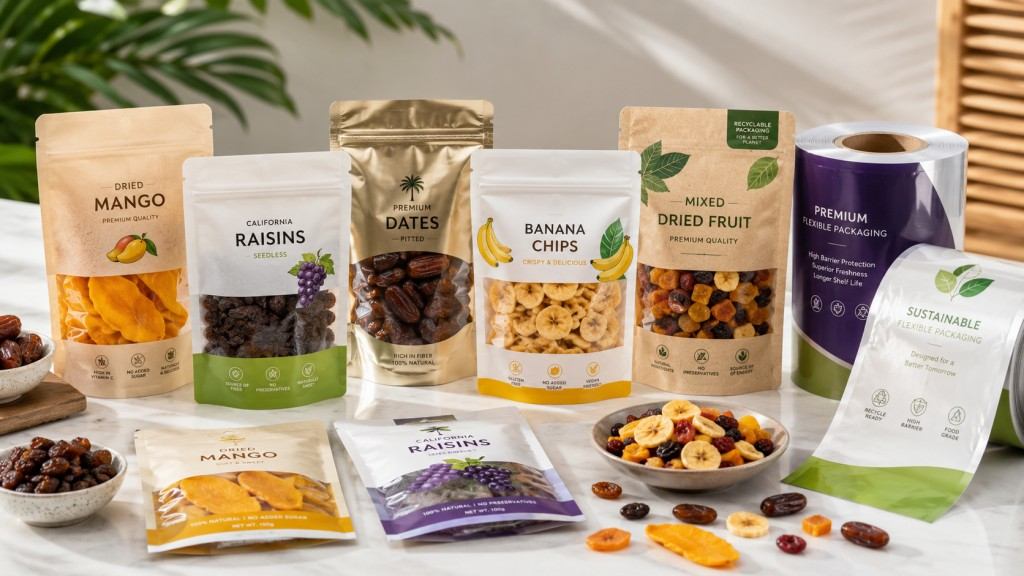
Different dried fruits need different packaging priorities. Dried mango is often soft and visually attractive, so many brands prefer clear windows or semi-transparent designs. Moisture control and seal reliability are important because texture and color affect consumer perception.
Raisins need packaging that prevents moisture imbalance and keeps the product from clumping or drying out. Clear or partially clear pouches can work well, but the final structure should match the target shelf life and storage condition.
Dates are often heavier and may require stronger pouch formats. For premium dates, flat-bottom pouches, quad-seal pouches, or heavier stand-up pouches can improve shelf stability and product presentation.
Freeze-dried fruit needs strong moisture protection because crisp texture is one of its main selling points. For these products, higher-barrier films are usually more important than simple visibility.
Banana chips and fruit snacks often need crispness protection, good seal integrity, and attractive retail graphics. Metallized or high-barrier laminates are common when the product needs longer shelf life or better protection from humidity.
Choosing Packaging By Format
Material selection is only one part of dried fruit packaging. The packaging format is equally important.
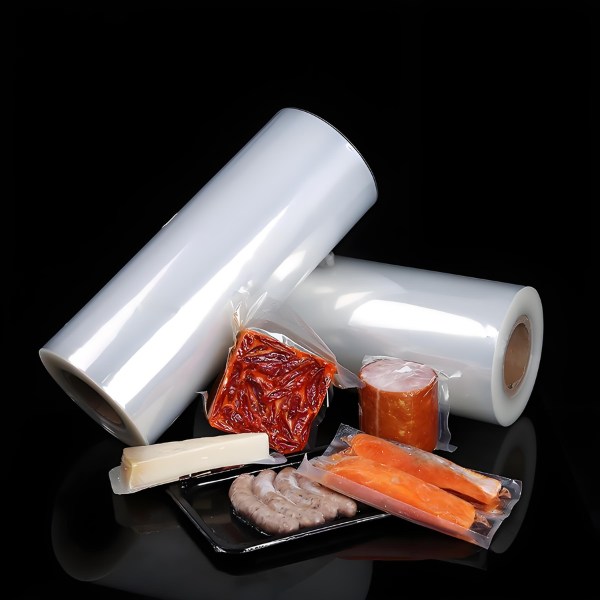
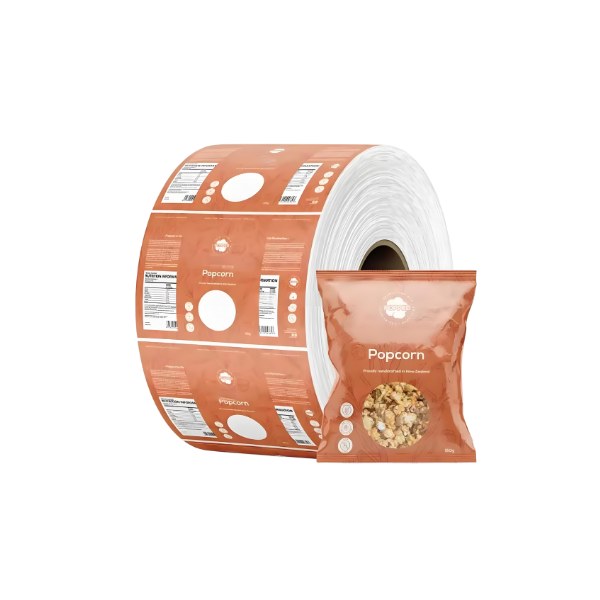
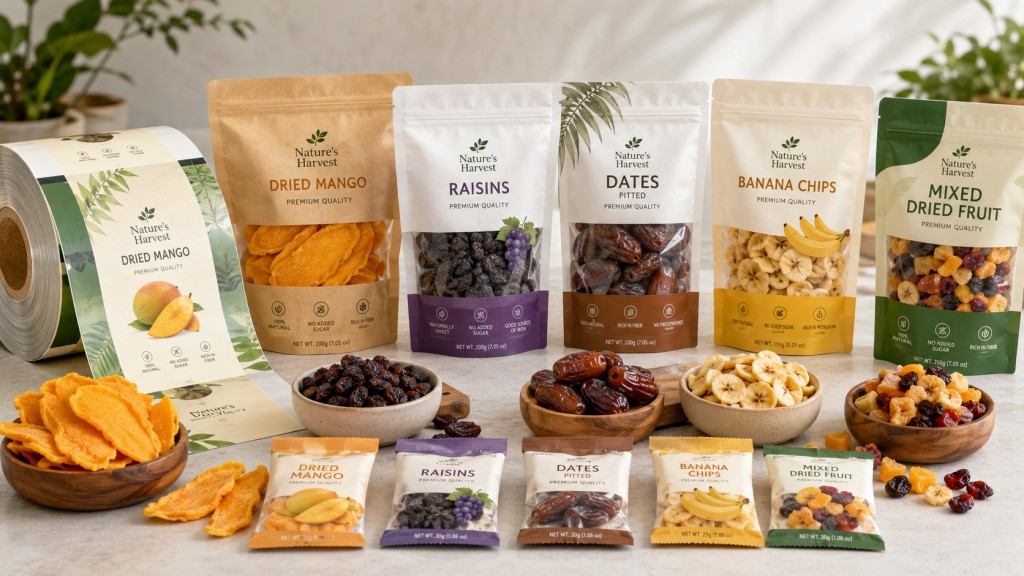
Roll stock is commonly used by factories with automatic packing lines. Custom Packaging Film Roll can be supplied according to thickness, width, core size, roll diameter, unwind direction, sealing layer, and packing machine requirements.
Printed Roll Stock is suitable for VFFS, HFFS, flow-wrap, and form-fill-seal systems. It helps processors pack dried fruit efficiently while keeping brand graphics consistent.
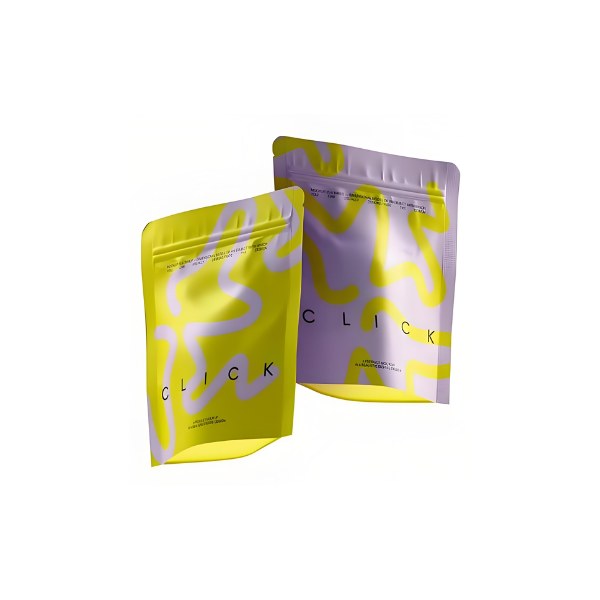
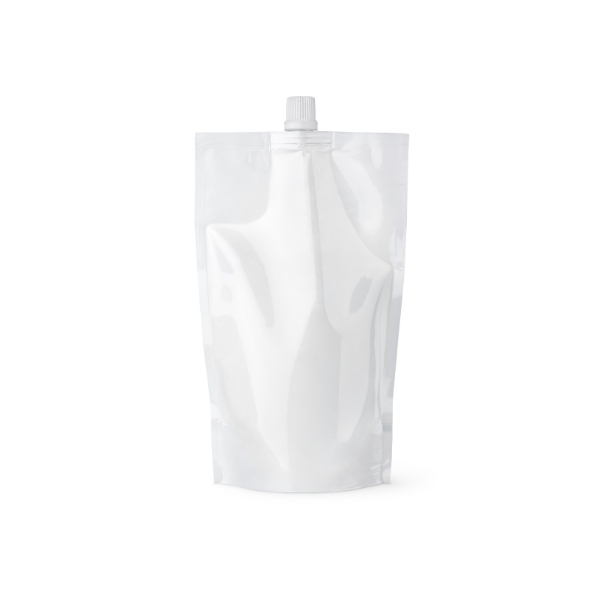
Premade pouches are useful for retail brands, importers, private-label projects, and lower-speed packing operations. Stand Up Pouches are especially popular because they display well on shelves and can include zippers, clear windows, tear notches, hang holes, matte finishes, and custom printing.
Flat-bottom pouches and quad-seal pouches can be better for premium or heavier dried fruit packs. Three-side-seal pouches are useful for sample packs, single-serve packs, and small retail bags.
How To Match Film Structure With Shelf-Life Target
Shelf life is one of the most important questions in dried fruit packaging. A product sold locally within a short time may not need the same material as a product exported by sea freight and stored for months before retail sale.
For short to medium shelf-life products, clear PET/PE or BOPP/PE may be enough, especially if the product is not extremely sensitive and distribution is controlled.
For medium to long shelf-life retail products, PET/VMPET/PE, BOPP/VMPET/PE, or other metallized laminates can improve moisture and oxygen protection.
For demanding export products, premium products, or products highly sensitive to oxygen and light, PET/AL/PE or other foil-based structures may be considered.
For brands that want clear display and better barrier, ALOx PET or other transparent barrier films can be evaluated. The final structure should be tested with real product, real sealing conditions, and expected storage conditions.
What Buyers Should Tell A Packaging Supplier
To receive a useful quotation, buyers should not only ask for “dried fruit packaging price.” A professional packaging supplier needs enough information to recommend the right structure.
Important details include product type, target shelf life, pack weight, bag size, current film structure, printing artwork, bag style, filling method, sealing method, packing machine type, monthly or annual quantity, and destination market.
If the buyer already has a sample pouch or current film specification, it is helpful to share photos, thickness, structure, and performance issues. The supplier can then recommend an equivalent structure or an improved alternative.
CloudFilm works with buyers on flexible packaging films, laminated roll stock, and custom pouches. For buyers comparing basic film properties, the guide on Understanding Packaging Film Parameters can help clarify thickness, width, barrier, COF, sealing window, and other key specifications.
How A Manufacturer Helps Beyond The Material Name
A good dried fruit packaging manufacturer does not simply sell PET/PE, VMPET, or foil laminate. The manufacturer should help the buyer connect material choice with product behavior, packing line performance, shelf-life target, and brand positioning.
For example, two bags may both be called PET/PE, but they may have different thicknesses, PE grades, sealing windows, stiffness, COF, printing methods, and lamination quality. These details can affect machine speed, seal strength, leakage risk, and final appearance.
A reliable supplier should also understand export packing, roll winding, pallet protection, documentation, and sample preparation. For international buyers, these practical details matter because packaging problems can delay filling lines and product launches.
For dried fruit brands, the best partner is not only a film supplier but also a packaging solution provider that can discuss structure, printing, format, function, MOQ, sample testing, and logistics together.
Final Recommendation
The best packaging material for dried fruit depends on the product type, shelf-life target, display requirement, packing machine, and sustainability goal.
For many standard products, PET/PE offers clarity, printability, and reliable sealing. For stronger barrier needs, PET/VMPET/PE is a practical high-barrier option. For very sensitive or long shelf-life products, PET/AL/PE can provide stronger protection. For premium transparent barrier packs, ALOx PET may be considered. For heavier or tougher applications, PA/PE can improve durability. For brands moving toward sustainability, mono-material PE or PP structures may be evaluated.
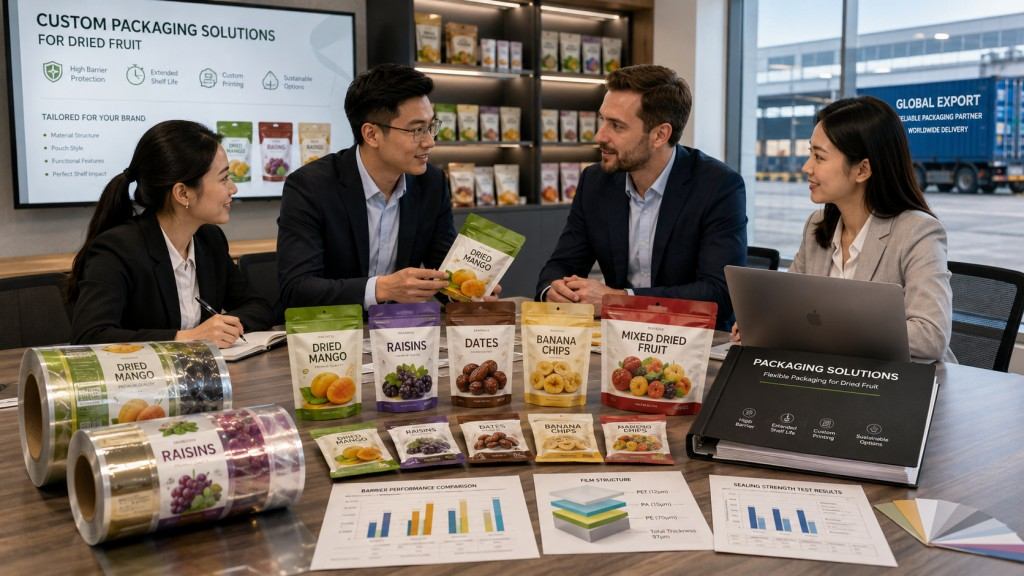
The right dried fruit packaging should protect flavor, texture, color, and shelf appeal while also matching real production and market needs. If you are developing a new dried fruit product or improving your current packaging, share your product details with CloudFilm. Our team can help compare structures, prepare samples, and recommend a practical packaging solution for your brand, packing line, and target market.
FAQs About Dried Fruit Packaging Materials
1. What Is The Best Packaging Material For Dried Fruit?
The best material depends on the product and shelf-life target. Common options include PET/PE, BOPP/PE, PET/VMPET/PE, PET/AL/PE, PA/PE, ALOx PET laminates, and recyclable mono-material PE or PP structures.
2. Does Dried Fruit Need Moisture Barrier Packaging?
Yes. Moisture barrier is very important because dried fruit can absorb moisture from the environment or lose its own moisture balance. This may cause stickiness, clumping, softness, dryness, or shorter shelf life.
3. Is PET/PE Good For Dried Fruit Packaging?
PET/PE is a good option for many dried fruit products that need clarity, printability, and reliable sealing. It is often used for dried mango, raisins, mixed fruit, and other products with moderate barrier needs.
4. When Should I Use PET/VMPET/PE For Dried Fruit?
PET/VMPET/PE is useful when dried fruit needs stronger moisture, oxygen, aroma, and light protection than clear PET/PE can provide. It is often used for snack packs, banana chips, dried berries, and longer shelf-life retail packs.
5. Is Aluminum Foil Packaging Necessary For Dried Fruit?
Not always. Aluminum foil laminate offers very strong barrier protection, but many dried fruit products can use metallized film structures instead. Foil is more suitable for highly sensitive products, premium packs, or demanding long shelf-life applications.
6. Can Dried Fruit Packaging Have A Clear Window?
Yes. Clear windows are common in dried fruit packaging because consumers often want to see color, texture, and fill level. However, the window size and material should be balanced with barrier requirements.
7. What Is The Best Packaging For Freeze-Dried Fruit?
Freeze-dried fruit usually needs strong moisture barrier because crisp texture is very sensitive to humidity. Metallized laminates, foil laminates, or transparent high-barrier structures may be considered depending on shelf-life and display needs.
8. What Pouch Type Is Best For Dried Fruit?
Stand-up pouches are popular for retail dried fruit because they display well and can include zippers. Flat-bottom pouches are good for premium or heavier packs. Three-side-seal pouches are suitable for small packs and sample packs.
9. Can Dried Fruit Packaging Be Recyclable?
Yes, some dried fruit packaging can use mono-material PE or PP structures. However, recyclability depends on the final structure, barrier requirement, printing system, and local recycling infrastructure.
10. Can CloudFilm Supply Printed Roll Stock For Dried Fruit?
Yes. CloudFilm can supply printed roll stock for automatic packing lines such as VFFS, HFFS, flow-wrap, and form-fill-seal machines. Roll width, thickness, core size, unwind direction, and sealing layer can be customized.
11. What Information Is Needed For A Dried Fruit Packaging Quote?
Useful information includes product type, bag size, pack weight, target shelf life, current structure, printing requirement, pouch format, packing machine, order quantity, and destination country or port.
12. Can I Test Samples Before Placing A Bulk Order?
Yes. Testing samples is strongly recommended. It allows buyers to check appearance, seal strength, product compatibility, machine performance, and basic barrier suitability before confirming mass production.