Flexible packaging quality control is not only a factory procedure. For brand owners, food companies, converters, importers, and packaging buyers, it is a practical way to reduce leakage, printing defects, shipment claims, machine downtime, and product returns.
A good flexible packaging supplier should control quality from raw film selection to printing, lamination, slitting, pouch making, packing, and shipment. If quality is only checked at the final stage, many hidden risks may already be built into the roll or pouch.
This guide explains how flexible packaging quality control works, what buyers should check before placing an order, and how to work with a professional manufacturer to build stable packaging performance.
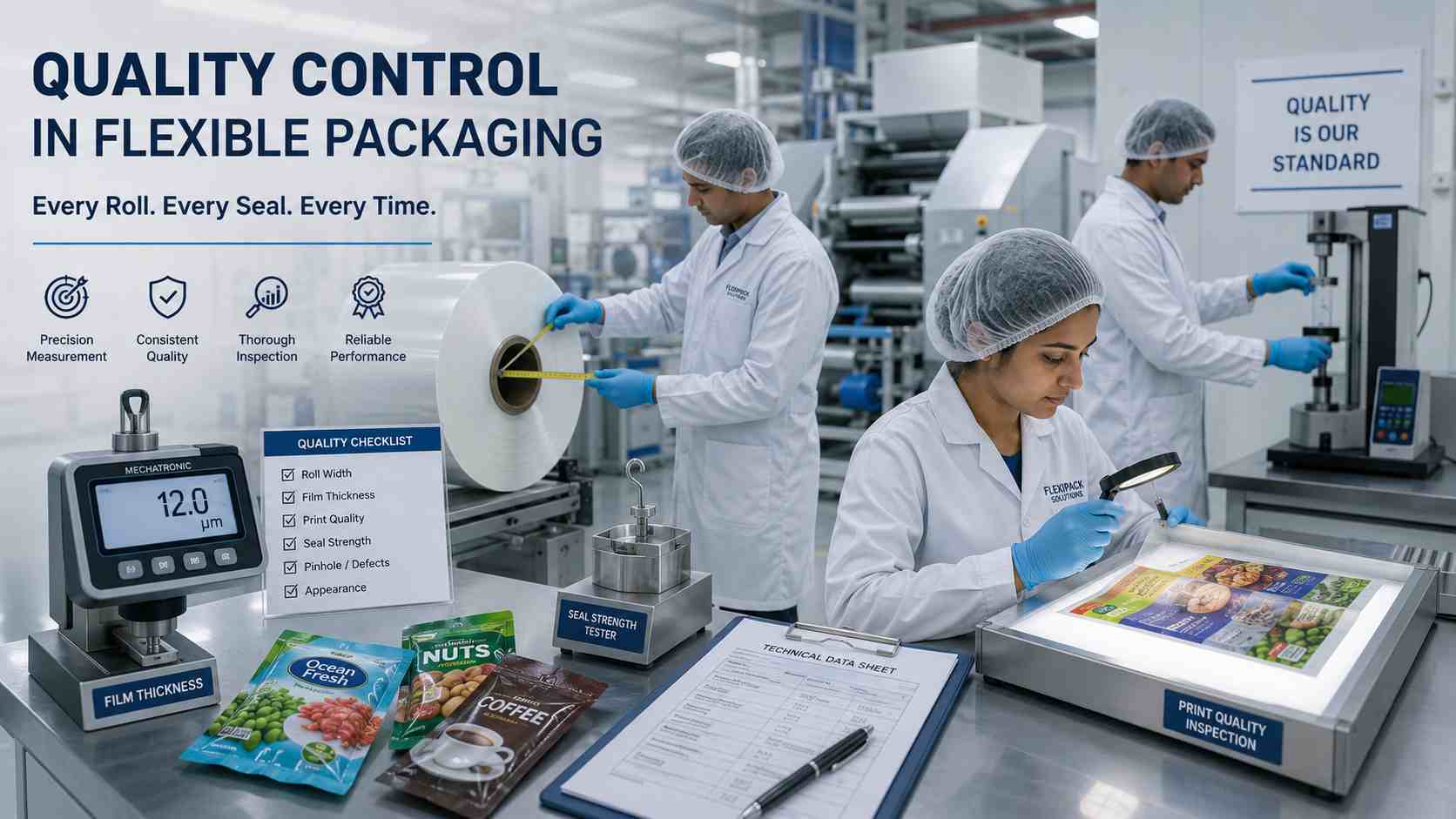
What Is Flexible Packaging Quality Control?
Flexible packaging quality control is the full process of checking whether films, laminates, roll stock, and finished pouches meet the agreed specification. It covers material properties, appearance, printing, lamination strength, barrier performance, sealing, dimensions, roll winding, pouch shape, packing, and documentation.
For buyers who are still learning the category, it is helpful to first understand what flexible packaging means and how different materials are used in bags, pouches, wraps, lidding films, and roll stock.
In real production, flexible packaging is not a single material. It may include BOPP, PET, BOPA, CPP, PE, aluminum foil, metallized film, EVOH, coated film, or mono-material recyclable structures. Each material has its own role. Some layers provide stiffness and printing quality. Some provide oxygen barrier. Some provide moisture resistance. Some provide heat seal strength.
Because each layer affects the final package, quality control must be built into every production step.
Why Quality Control Matters For Packaging Buyers
Poor packaging quality can create many problems after shipment. A small sealing defect may cause leakage. A weak lamination bond may lead to delamination. Poor COF control may cause film slipping or jamming on packing machines. Inconsistent thickness may affect forming, sealing, or pouch strength.
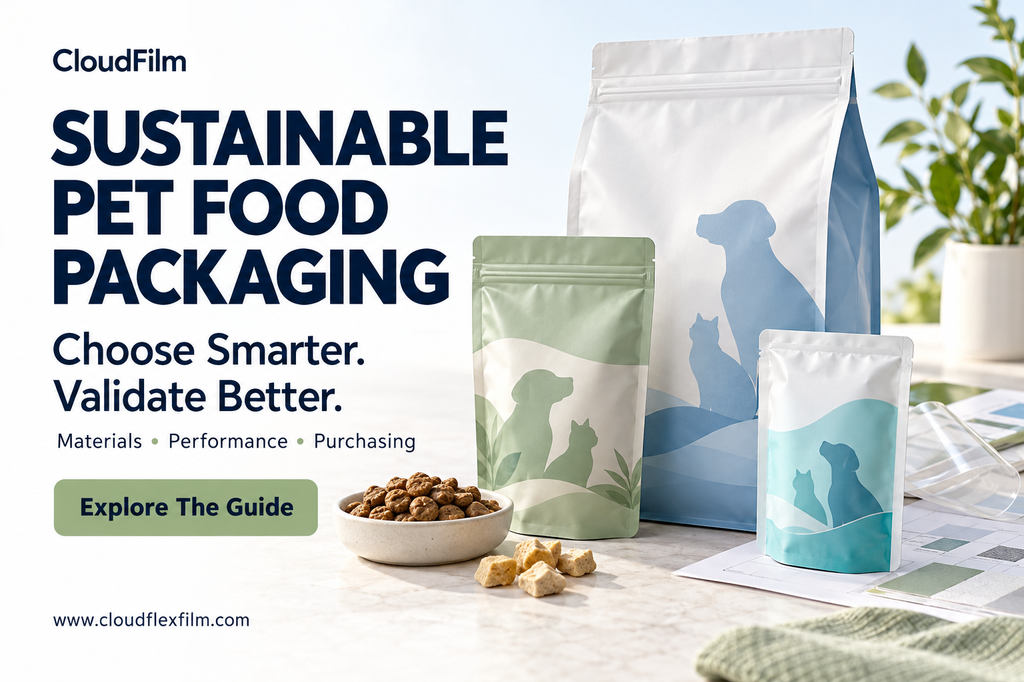
For food packaging, quality issues can also affect shelf life, aroma protection, freshness, and consumer trust. For liquid pouches, leakage is a direct commercial risk. For coffee bags, poor valve sealing or low barrier performance may damage flavor. For pet food bags, insufficient puncture resistance may cause breakage during transport.
This is why buyers should not only ask for a low price. They should also evaluate whether the flexible packaging manufacturer has a complete quality control system, clear technical communication, and experience with the final application.
A practical starting point is to define the application and structure clearly. CloudFilm’s flexible packaging solutions page gives buyers a broader view of films, pouches, lidding structures, and custom packaging formats.
Quality Control Starts Before Production
Good quality control starts before mass production. At the quotation and sample stage, the buyer and supplier should confirm all important details in writing.
These details normally include material structure, thickness, width, roll length, core size, printing colors, surface treatment, sealing layer, barrier target, packing method, quantity tolerance, and final application. If the packaging will run on automatic equipment, the buyer should also provide machine type, packing speed, sealing temperature range, filling weight, and forming direction.
For printed packaging, artwork confirmation is also critical. The buyer should check dielines, barcode position, text, color standards, varnish area, window area, zipper position, tear notch position, and bag dimensions.
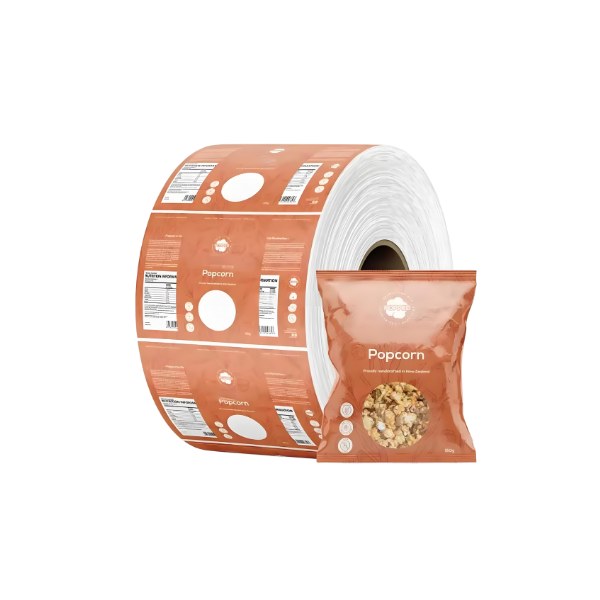
For roll stock used on VFFS, HFFS, or flow-wrap machines, roll direction and winding tension are especially important. A reliable supplier should provide technical support for custom printed roll stock film so the film can run smoothly on the buyer’s packing line.
Raw Material Inspection
Raw material quality affects the whole packaging structure. Before production, the manufacturer should inspect incoming film rolls, resins, inks, adhesives, aluminum foil, coated films, and auxiliary materials.
Common checks include thickness, width, appearance, corona treatment level, surface smoothness, haze, clarity, shrinkage, COF, tensile strength, and roll condition. For food packaging, suppliers should also control food-contact materials and keep proper documents when required.
If the base film has unstable thickness or poor surface treatment, printing and lamination may become unstable. If the PE sealing layer has poor sealing performance, the finished pouch may leak even if the printing and lamination look good.
This is why raw material inspection should never be ignored. It is the first barrier against production risk.
Film Thickness And Width Control
Thickness and width are basic but critical quality points. Film that is too thin may reduce puncture resistance, sealing strength, or barrier performance. Film that is too thick may increase cost and affect machine forming. Width variation may cause tracking problems, poor pouch shape, or sealing misalignment.
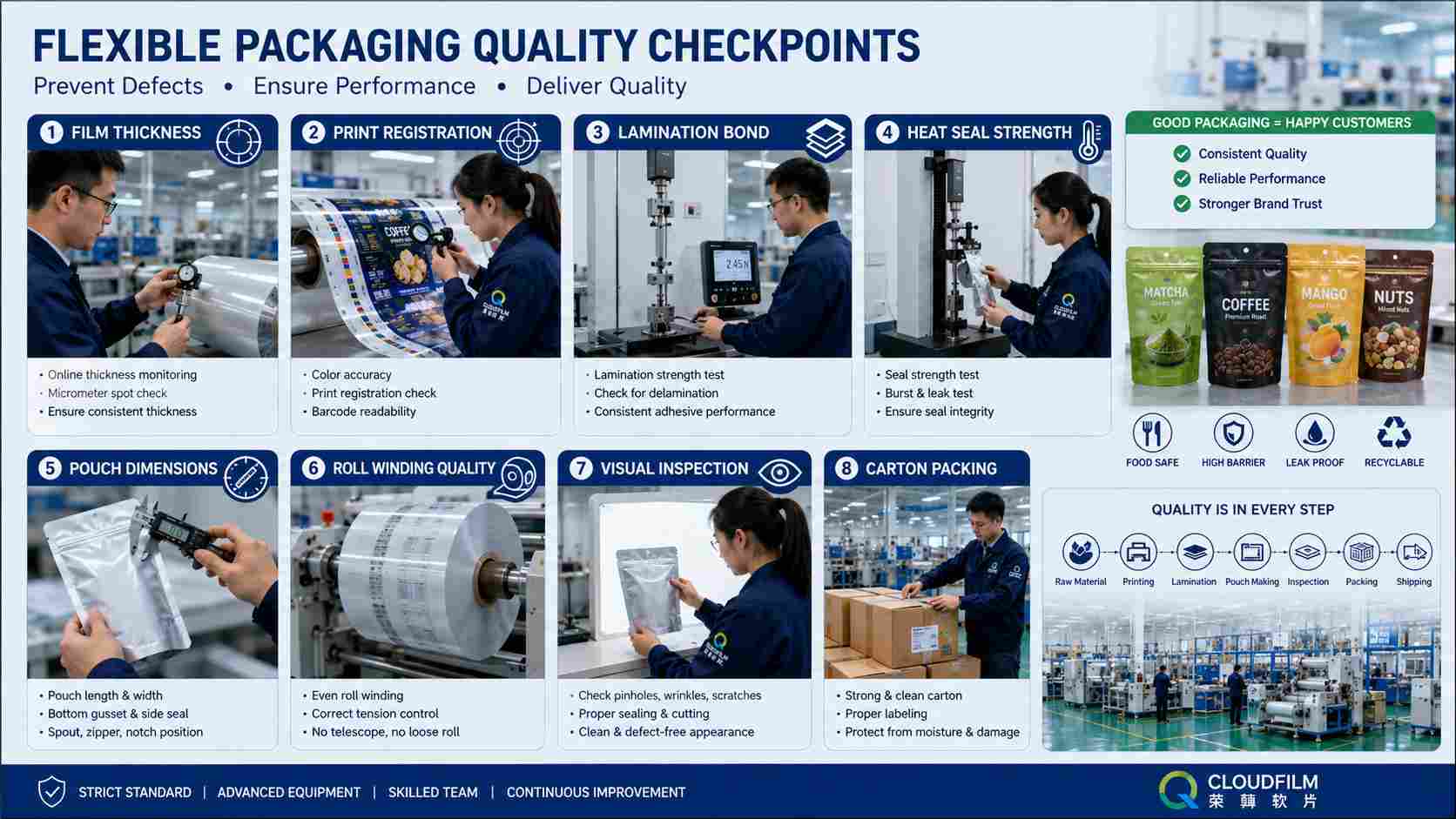
Quality control teams normally use micrometers, online gauges, width measuring tools, and sampling plans to check film consistency. For high-speed packaging lines, stable thickness and width are not only technical requirements; they are also production efficiency requirements.
For food brands and converters, food packaging film should be selected according to product type, storage condition, target shelf life, and packing machine requirements.
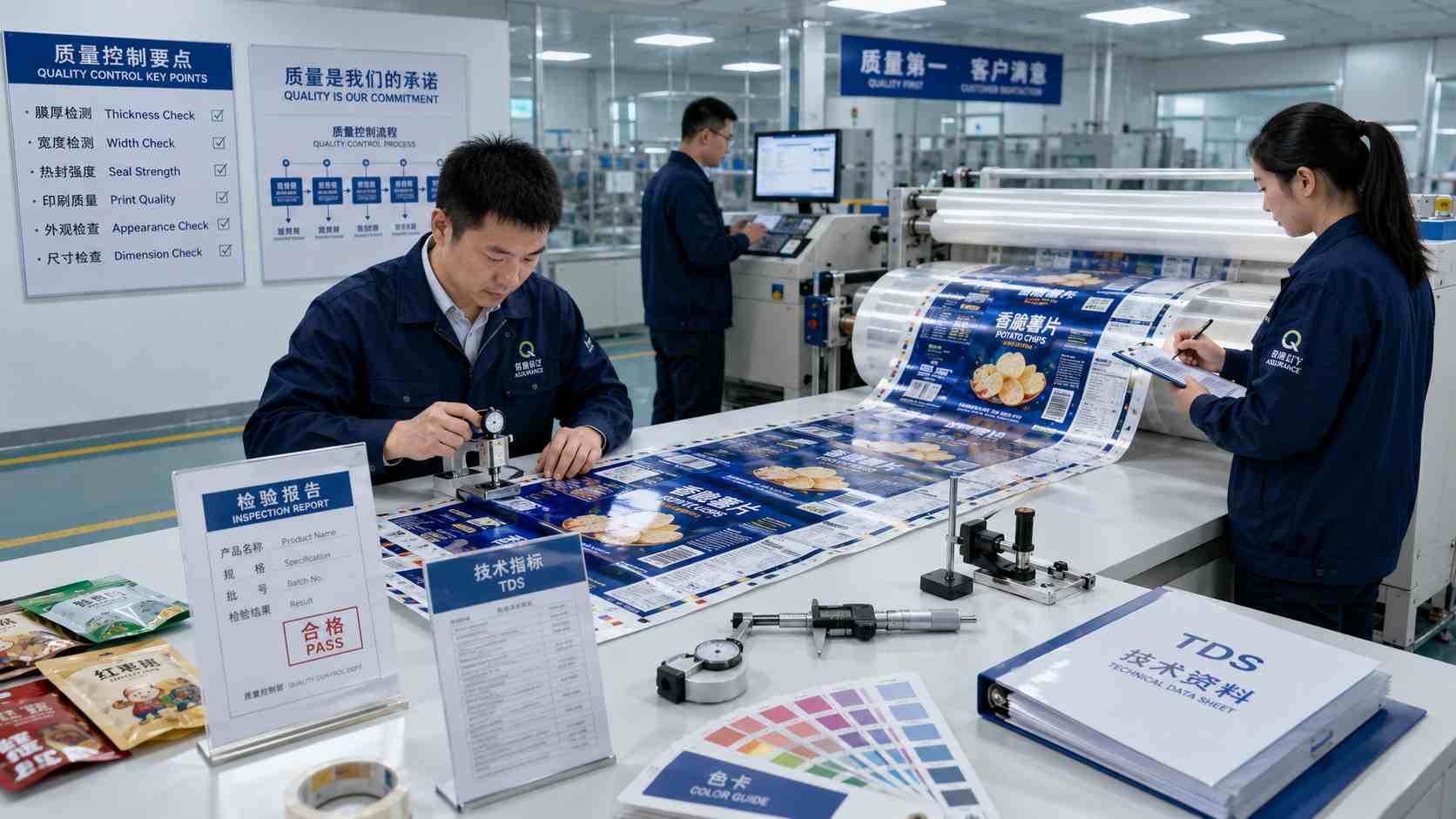
Printing Quality Control
Printing is one of the most visible quality points in flexible packaging. Even when the film structure is correct, poor printing may damage brand image and retail shelf appearance.
Printing quality control usually includes color matching, registration accuracy, ink adhesion, dot quality, text clarity, barcode readability, solvent residue control, and surface defects such as streaks, scratches, spots, blocking, and color deviation.
For repeat orders, color consistency between batches is very important. A professional packaging supplier should keep approved samples, color standards, production records, and inspection reports. If the buyer has strict brand color requirements, color measurement tools and clear tolerance standards should be used.
For a deeper understanding of printing methods and common printing checks, buyers can refer to this flexible packaging printing guide.
Lamination Quality Control
Many flexible packages use laminated structures. Lamination combines two or more layers to achieve printing protection, barrier performance, sealing strength, puncture resistance, and better shelf appearance.
Common laminate structures include PET/PE, PET/CPP, BOPA/PE, PET/AL/PE, PET/VMPET/PE, and mono-material PE or PP structures. Each structure has a different purpose.
Lamination quality control normally checks bond strength, adhesive coating, curing condition, appearance, wrinkles, bubbles, tunnels, delamination, odor, and roll winding quality. If adhesive is not properly cured, the laminate may have odor, weak bonding, or poor heat resistance.
Buyers who need high-barrier packaging should understand how different laminates in flexible packaging work before confirming a structure.
Barrier Performance Control
Barrier performance is one of the key reasons to use flexible packaging. Depending on the product, the package may need oxygen barrier, moisture barrier, aroma barrier, grease resistance, light barrier, or chemical resistance.
For dry snacks, moisture protection may be the key point. For coffee, aroma and oxygen protection are important. For meat, cheese, seafood, and ready meals, oxygen barrier and seal integrity are critical. For sensitive powders or pharmaceuticals, both moisture and contamination control may be required.
Barrier quality can be checked through OTR, WVTR, pinhole testing, vacuum testing, dye penetration testing, or shelf-life trials. Not every project needs every test, but the supplier should know which test is relevant to the product.
For buyers comparing film and foil options, this film and foil in flexible packaging buyer guide can help explain how different barrier layers are selected.
Heat Seal Strength And Seal Integrity
A package may look perfect, but if the seal is weak, it can still fail during filling, shipping, or storage. Heat seal quality is one of the most important points in flexible packaging quality control.
Seal performance depends on sealing layer material, film thickness, sealing temperature, pressure, dwell time, contamination in the seal area, and packing machine condition. For liquid, frozen, greasy, powder, or heavy products, seal strength requirements are usually higher.
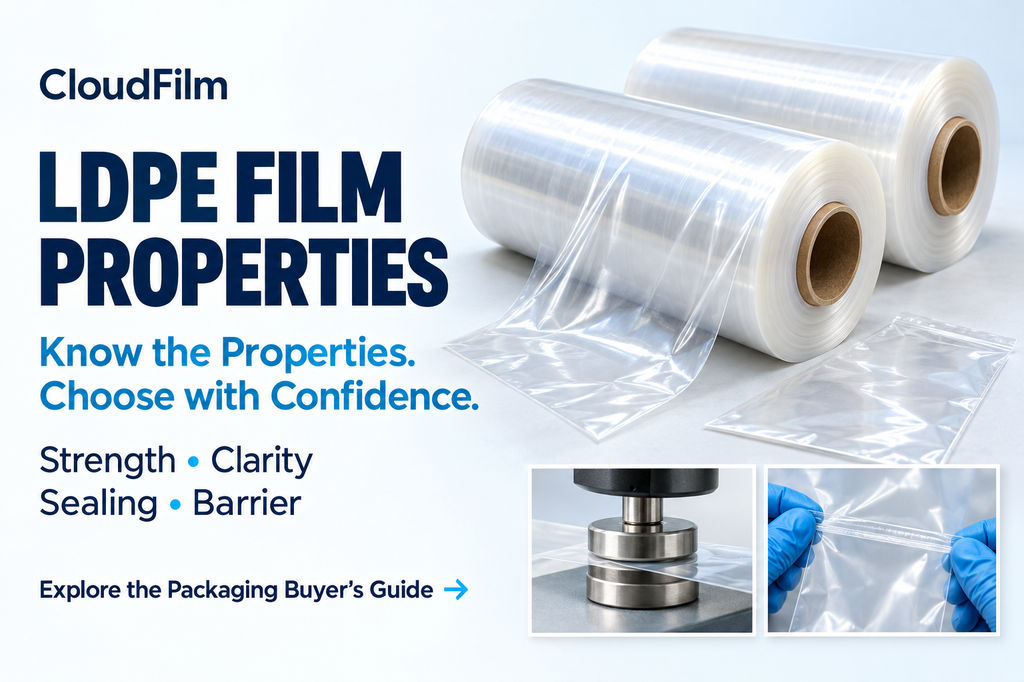
Common tests include seal strength testing, hot tack testing, burst testing, leak testing, drop testing, and visual inspection. For easy-open packaging, the balance between seal strength and peelability must be carefully controlled.
For structures such as PET/PE laminated film, the PET layer provides printability and stiffness, while the PE layer provides heat sealing. The quality of both layers must work together.
Pouch-Making Quality Control
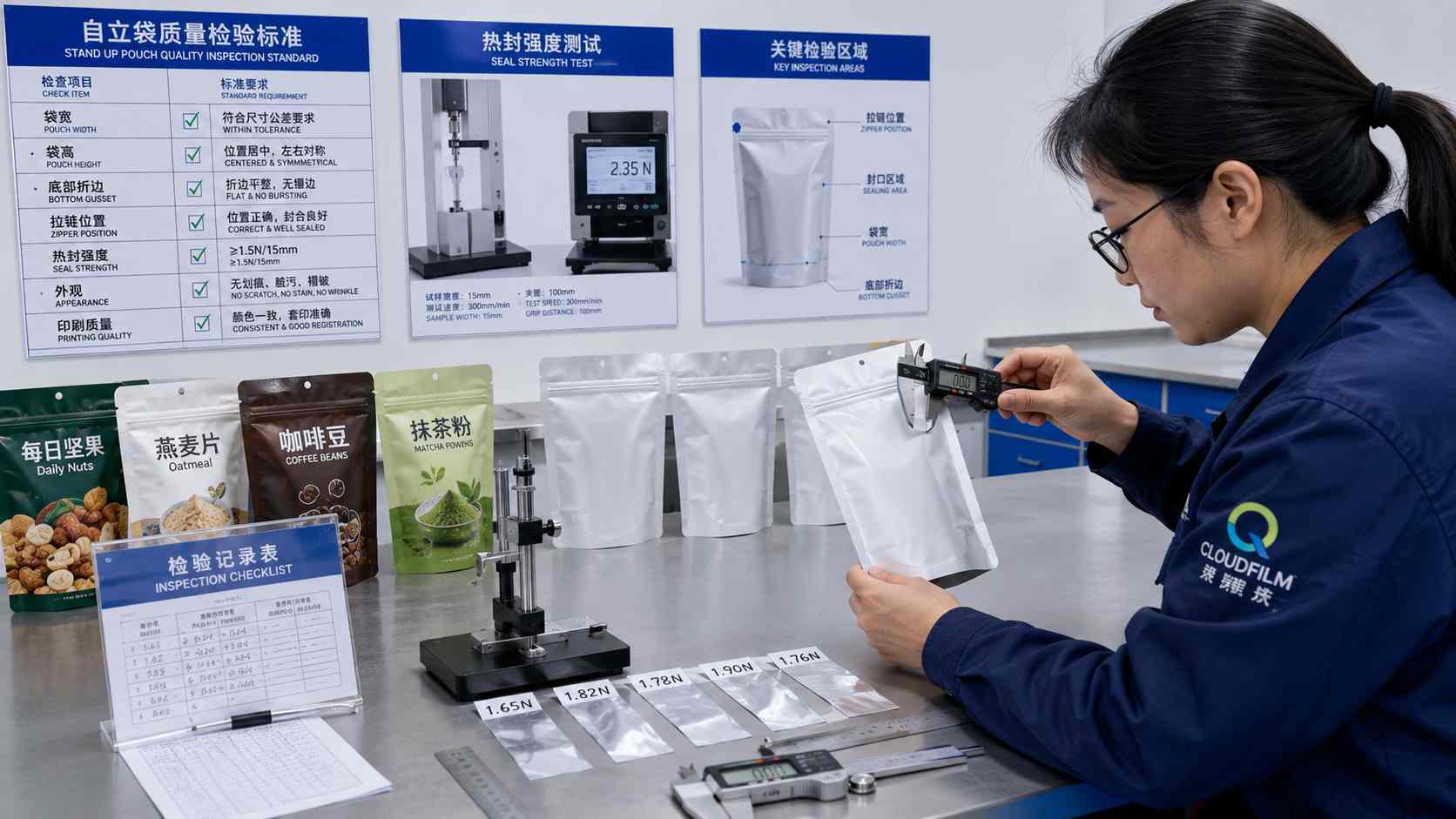
For finished pouches, quality control becomes more detailed because every pouch has a fixed shape and functional parts. The manufacturer should check pouch length, width, gusset size, bottom shape, zipper position, spout position, tear notch, handle hole, seal width, corner sealing, and appearance.
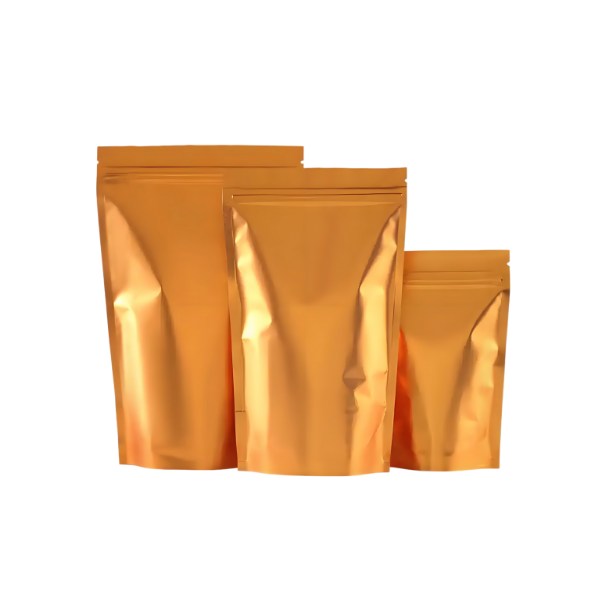
For custom stand up pouches, the bottom gusset and side seals must be stable enough to support shelf display and filling. For flat bottom pouches, the bottom and side panels must be aligned. For spout pouches, spout sealing is one of the most important leakage-control points.
Finished pouches should also be checked for contamination, wrinkles, scratches, poor sealing, uneven cutting, foreign matter, color deviation, and packing quantity.
Quality Control For Recyclable Flexible Packaging
Recyclable flexible packaging has become more important for many brands, but it also brings new quality control requirements. Mono-material structures may need to replace traditional PET/PE, PA/PE, or aluminum foil laminates while still keeping stiffness, printability, barrier, and sealing performance.
For recyclable pouches, the supplier must control not only appearance and seal strength, but also structure compatibility, material selection, and practical performance on the packing line.
Materials such as MDO PE film can help improve stiffness and printability in PE-based recyclable laminates. However, recyclable structures should always be tested with the real product and real packing machine before mass production.
The goal is not only to make the package recyclable in theory. The package must also protect the product, run on the machine, seal well, and survive transport.
Quality Control For High-Barrier Packaging
High-barrier packaging is used when the product is sensitive to oxygen, moisture, aroma loss, light, or external contamination. Typical applications include meat, cheese, seafood, coffee, pet food, sauces, medical products, and some industrial materials.
For EVOH high-barrier bags, the key quality points include oxygen barrier, layer distribution, sealing strength, puncture resistance, bag size, and vacuum performance. If the product needs long shelf life or export distribution, the buyer should also consider storage temperature, cold-chain condition, and carton packing strength.
High-barrier packaging should be selected based on the real risk of the product. Over-design increases cost. Under-design increases the risk of spoilage, leakage, odor loss, or customer complaints.
Slitting, Rewinding, And Roll Packing Control
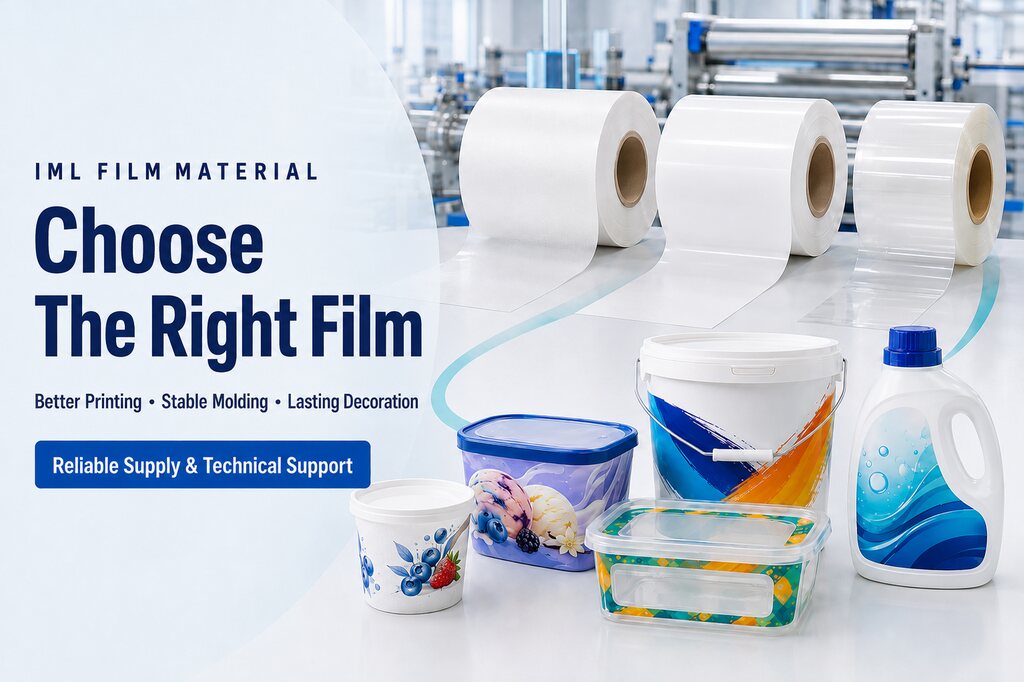
For roll stock, slitting and rewinding quality directly affects the buyer’s packing machine. Common issues include poor edge quality, telescoping rolls, loose winding, tight winding, wrong core size, roll direction error, and roll joint problems.
A good supplier should label each roll clearly with product name, structure, size, batch number, roll length or weight, production date, and inspection status. Roll packing should protect the film from dust, moisture, deformation, and transport damage.
If buyers use automatic packaging lines, they should confirm maximum roll diameter, core size, winding direction, film width tolerance, and roll weight limits before production.
Documentation And Traceability
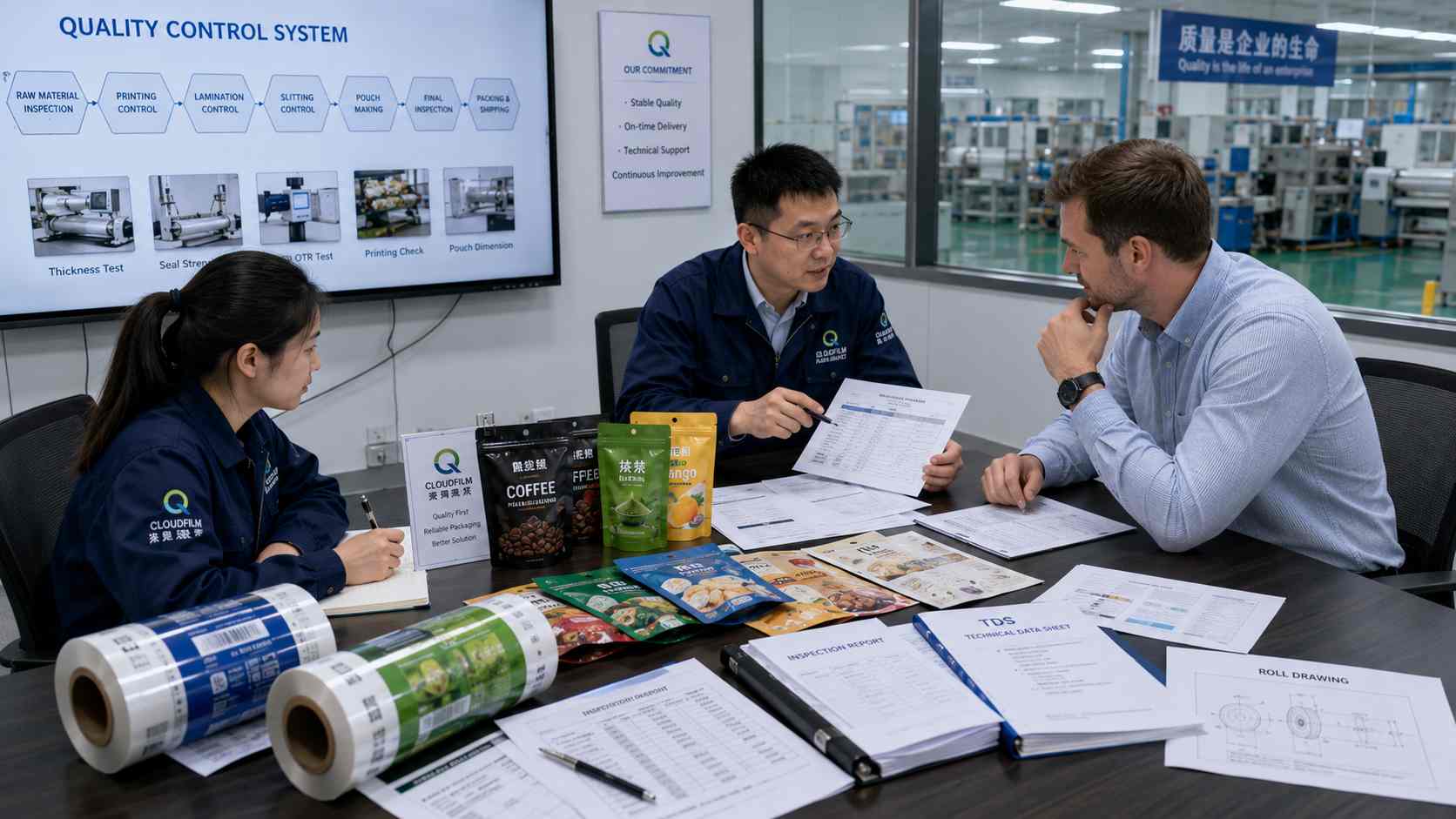
Quality control is not complete without documentation. For export orders, professional packaging suppliers should keep records for raw materials, production batches, inspection results, approved samples, packing details, and shipment information.
Depending on the application and market, buyers may request TDS, COA, MSDS, food-contact documents, migration test reports, compliance statements, or third-party test reports. These documents help buyers control risk and communicate with their own customers.
Traceability is also important when a problem occurs. If each batch is clearly recorded, the supplier can investigate the cause faster and offer a practical solution.
How Buyers Can Evaluate A Flexible Packaging Supplier
When choosing a flexible packaging supplier or manufacturer, buyers should not only compare price per kilogram or price per thousand pouches. They should also evaluate the supplier’s ability to understand applications, recommend structures, control production, and support testing.
A strong supplier should be able to answer these questions clearly:
Can they explain why a structure is suitable for your product?
Can they provide samples for testing?
Can they support printing, lamination, pouch making, and roll stock?
Can they control color, sealing, barrier, and dimensions?
Can they provide technical documents when needed?
Can they handle both trial orders and stable repeat orders?
This is especially important for buyers who need long-term supply instead of one-time purchasing.
Common Quality Problems And How To Prevent Them
Many quality problems can be prevented when the buyer and supplier confirm the specification clearly before production.
Printing color deviation can be reduced through approved color standards and stable ink control. Delamination can be reduced through correct adhesive selection, coating weight, and curing time. Leakage can be reduced through proper sealing layer selection and seal strength testing. Wrinkles and bubbles can be reduced through machine tension control and lamination process control.
Roll running problems can often be prevented by confirming roll direction, width tolerance, COF, winding tension, and core size. Pouch shape problems can be reduced through accurate tooling, stable film tension, and regular dimension checks.
In other words, quality control is not only inspection. It is also prevention.
What Information Should Buyers Provide?
To get a more accurate recommendation from a flexible packaging manufacturer, buyers should provide as much practical information as possible.
Useful information includes product type, filling weight, storage temperature, shelf-life target, packing machine type, required structure, current packaging problem, roll or pouch size, printing artwork, order quantity, destination market, and special requirements such as recyclability, high barrier, easy peel, anti-fog, retort resistance, or freezer resistance.
If the buyer is not sure which structure to use, a good supplier can recommend options based on the application. For example, dry snacks, coffee, frozen meat, liquid food, and pet food usually require different film structures and different quality control focus points.
Final Thoughts
Flexible packaging quality control is a complete system. It starts with material selection and continues through printing, lamination, slitting, pouch making, packing, and shipment.
For buyers, the best result comes from working with a supplier that understands both film technology and real packaging applications. A professional manufacturer should not only produce film or pouches, but also help buyers reduce risk, improve packaging performance, and build stable supply.
If you are developing a new flexible packaging project, it is useful to prepare your product information, target shelf life, packaging format, and machine details before requesting a quotation. This allows the supplier to recommend a suitable structure and quality control plan from the beginning.
FAQs About Flexible Packaging Quality Control
1. What is the most important quality test for flexible packaging?
There is no single test for all products. For dry food, moisture barrier and seal strength may be most important. For liquids, leakage and seal integrity are critical. For meat and cheese, oxygen barrier, puncture resistance, and vacuum performance are usually key points.
2. How can I know if a flexible packaging supplier has good quality control?
Ask for technical documents, inspection methods, approved samples, production records, and sample testing support. A good supplier should be able to explain the quality control process clearly, not only say that quality is good.
3. Why does flexible packaging sometimes leak?
Leakage may come from weak heat seals, contamination in the seal area, poor sealing layer selection, incorrect sealing temperature, sharp product edges, pouch-making defects, or transport damage. The cause should be checked through seal strength testing, leak testing, and production record review.
4. What causes delamination in flexible packaging?
Delamination may be caused by poor adhesive selection, insufficient adhesive coating, incomplete curing, wrong lamination conditions, high-temperature processing, chemical attack from the product, or poor surface treatment of the film.
5. Why is film thickness tolerance important?
Thickness affects cost, strength, barrier, sealing, stiffness, and machine performance. Large thickness variation may cause unstable packaging performance and machine running problems.
6. What should I check before approving printed packaging?
Check artwork, text, barcode, color, registration, logo position, bag direction, dieline, varnish area, window position, and legal information. Once printing starts, changes can be costly.
7. How do I reduce color difference between repeat orders?
Use approved color samples, standard lighting, color measurement tools, stable ink formulas, and clear tolerance limits. It is also helpful to keep production records from previous batches.
8. What is the difference between quality control for roll stock and finished pouches?
Roll stock quality focuses on film structure, width, roll direction, winding, COF, printing, lamination, and machine running performance. Finished pouch quality also includes pouch size, seals, zipper, spout, gusset, tear notch, and bag appearance.
9. Can recyclable flexible packaging have the same quality as traditional laminates?
In many applications, recyclable structures can achieve good practical performance, but they should be tested carefully. Recyclable packaging must balance recyclability, stiffness, sealing, barrier, printing, and machine compatibility.
10. What documents should a packaging supplier provide?
Depending on the application, buyers may request TDS, COA, MSDS, food-contact documents, migration reports, compliance statements, and inspection reports. Not every project needs all documents, but the supplier should support reasonable documentation requests.
11. How can I test packaging samples before mass production?
You can test samples on your packing machine, check sealing temperature, filling performance, leakage, drop resistance, appearance, shelf life, and transport performance. For food products, shelf-life testing under real storage conditions is especially useful.
12. Why should I share my packing machine details with the supplier?
Machine type, speed, sealing temperature, roll direction, and forming method affect film selection. Without machine details, the supplier may recommend a structure that looks correct but does not run smoothly on your line.