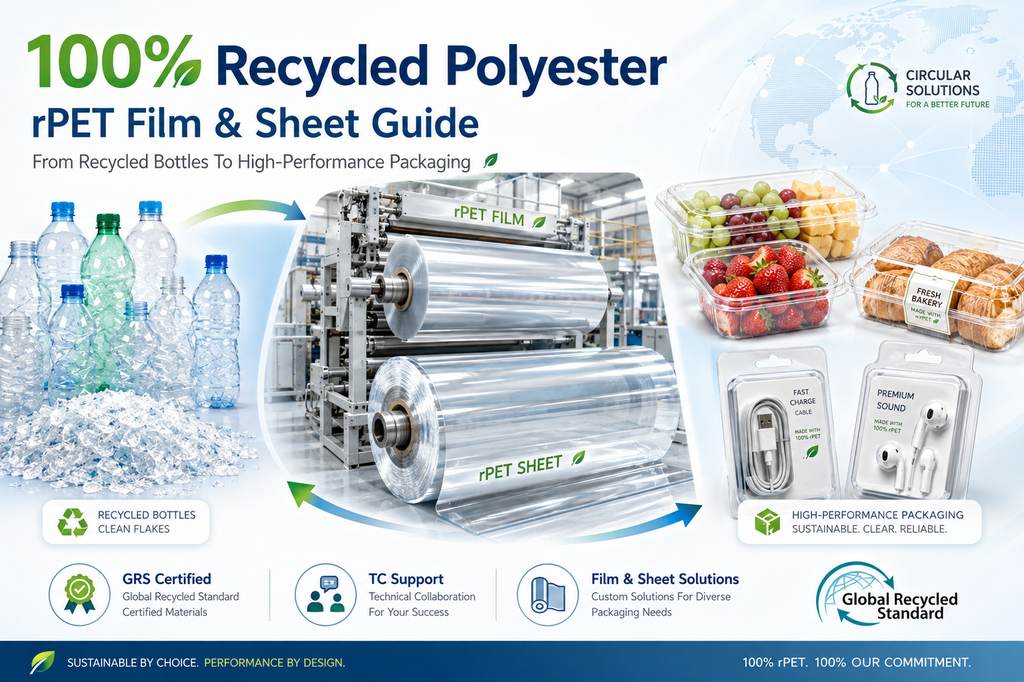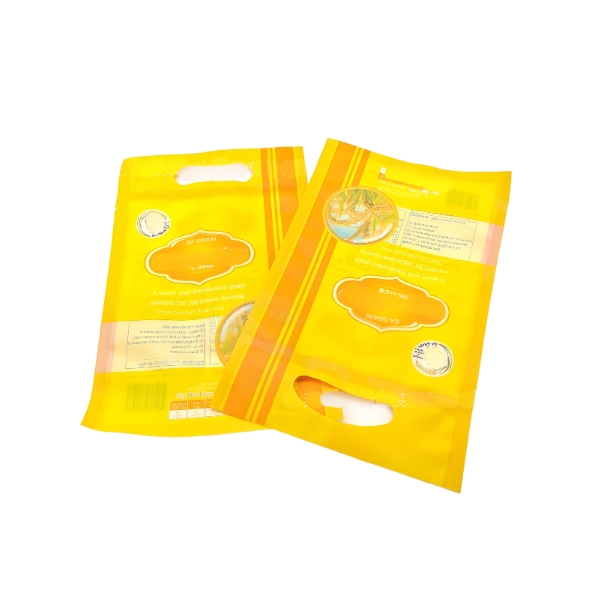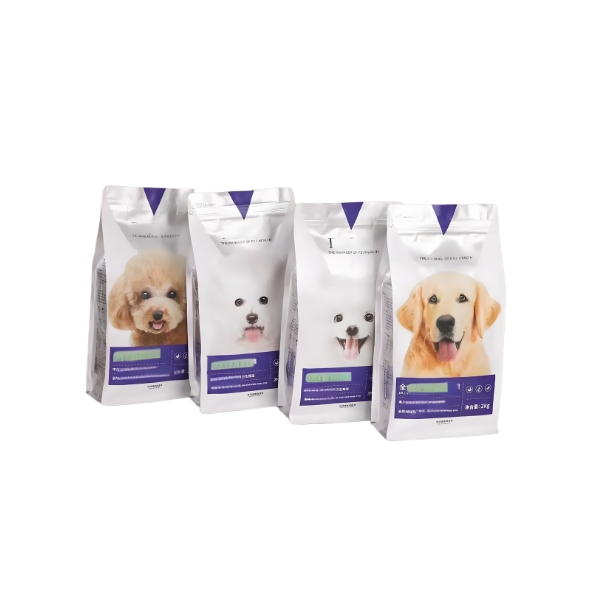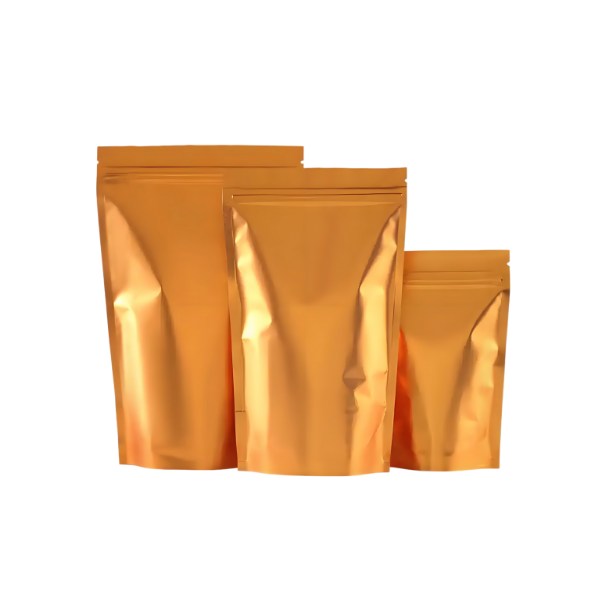
What Does Flexible Packaging Mean?
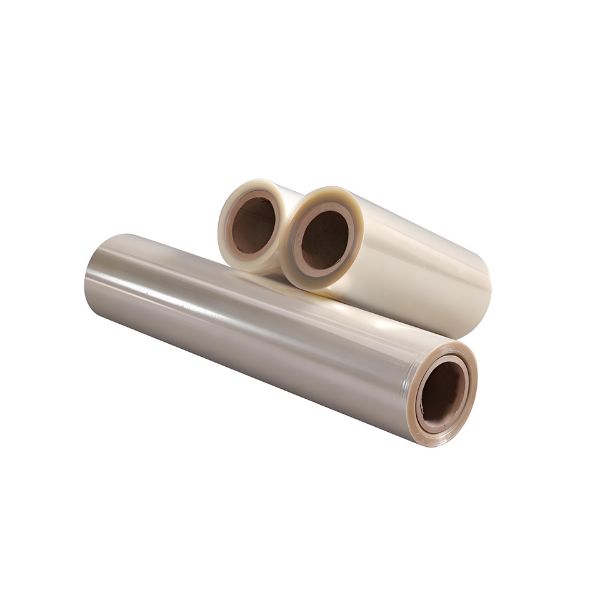
Flexible packaging means packaging made from flexible or easily yielding materials that can change shape when filled, sealed, handled, or transported. Unlike rigid packaging such as glass bottles, metal cans, plastic jars, or paperboard boxes, flexible packaging can bend, fold, wrap, seal, and conform to the product inside.
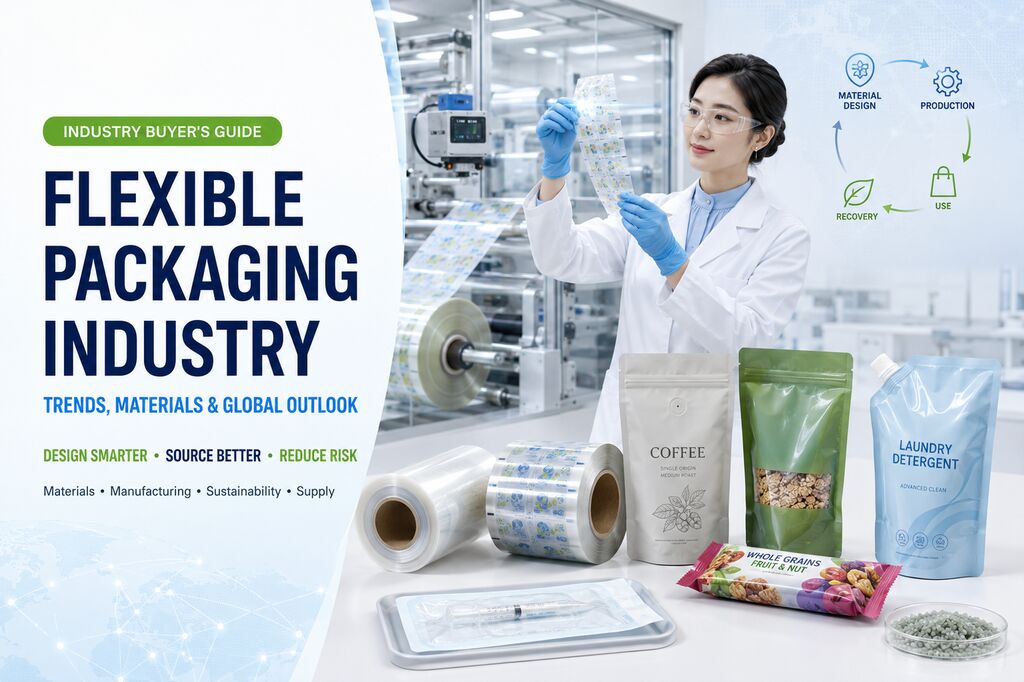
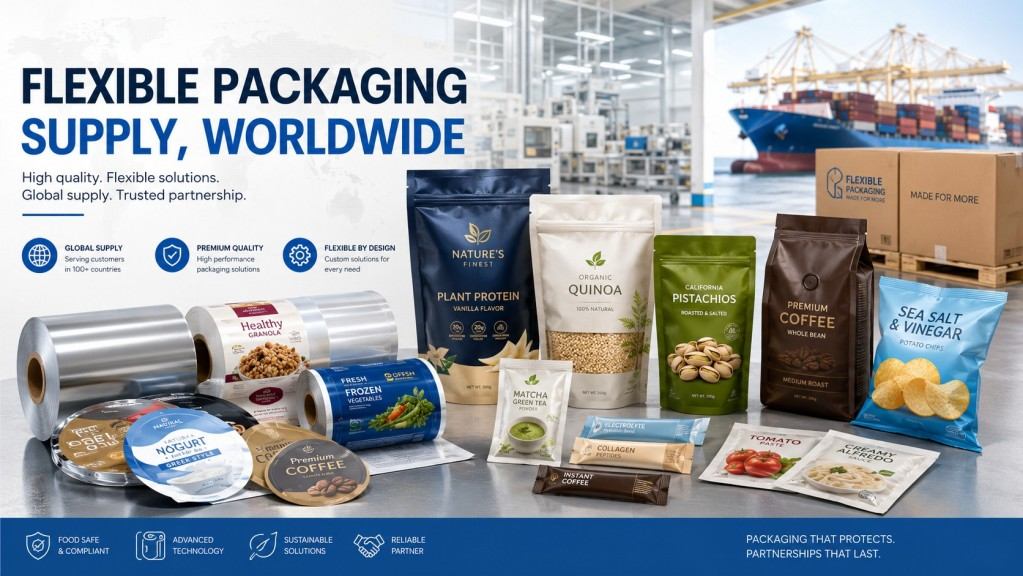
In simple words, flexible packaging includes packaging formats such as film rolls, pouches, bags, sachets, wraps, liners, lidding films, overwraps, and laminated roll stock. It can be made from plastic film, paper, aluminum foil, metallized film, biodegradable film, or a combination of several layers.
For buyers, flexible packaging is not only a “bag.” It is a complete material system designed to protect the product, support printing, run smoothly on packing machines, improve shelf appearance, reduce logistics weight, and match market requirements for safety, barrier performance, and sustainability.
At CloudFilm Packaging, flexible packaging usually refers to flexible packaging films and custom pouches used for food, pet food, coffee, snacks, powder, liquids, medical products, household goods, industrial parts, and many other applications.
Why Flexible Packaging Is Important
Flexible packaging is widely used because it solves several problems at the same time. A good flexible package protects the product from oxygen, moisture, aroma loss, light, grease, puncture, leakage, and contamination. It also provides a printable surface for branding and product information.
Compared with many rigid packaging formats, flexible packaging is often lighter, easier to store, and more efficient to ship. Empty pouches and roll stock take less space than bottles, jars, tubs, or cans. This helps reduce storage volume and transportation cost, especially for international buyers who need stable bulk supply.
Flexible packaging is also highly customizable. A buyer can adjust film thickness, material structure, roll width, seal layer, barrier level, surface finish, printing method, pouch format, zipper, spout, valve, handle, hang hole, easy-tear notch, or laser scoring according to the product and packing line.
For brand owners and converters, this flexibility is the real value. One product may need high oxygen barrier. Another may need strong puncture resistance. A third may need low-temperature sealing for high-speed packing. A reliable flexible packaging manufacturer can help match the structure to the real application instead of offering only one standard material.
Common Materials Used In Flexible Packaging
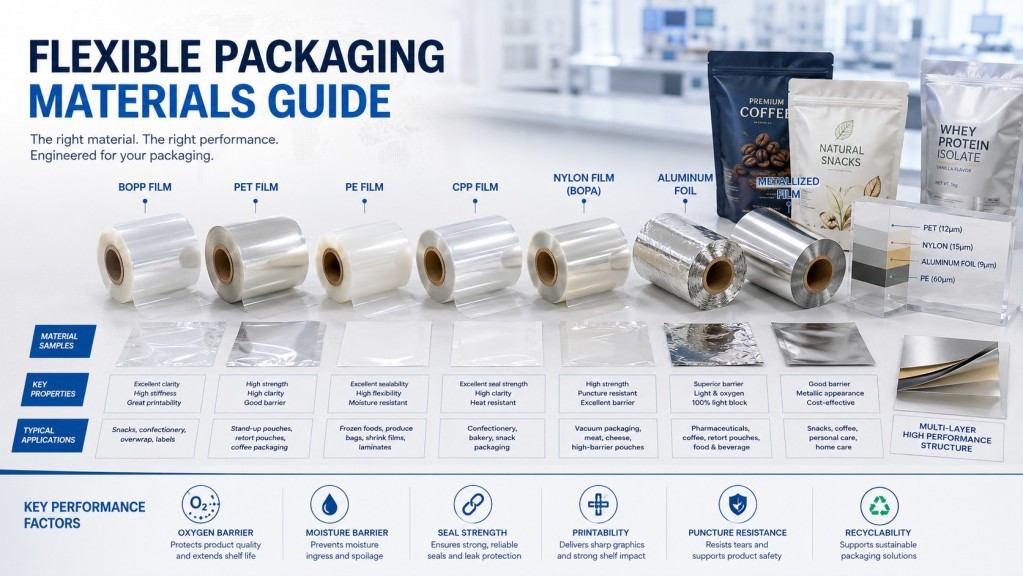
Flexible packaging can be made from many different materials. Each material has its own strengths, limits, and typical role inside a packaging structure.
BOPP Film
BOPP film is a biaxially oriented polypropylene film. It is widely used for snack packaging, candy packaging, label film, overwrap film, matte film, anti-fog film, and lamination structures. BOPP usually offers good clarity, stiffness, printability, and moisture resistance.
If your product needs good shelf appearance, smooth printing, and cost-effective performance, BOPP film is often a practical option.
BOPET Film
BOPET film, also known as polyester film or PET film, provides excellent strength, dimensional stability, heat resistance, clarity, and print quality. It is commonly used as the outer printing layer in laminated flexible packaging.
For high-quality printing, premium appearance, and strong mechanical performance, BOPET film is one of the most important substrates in modern packaging.
BOPA Film
BOPA film, also called nylon film or polyamide film, is known for toughness, puncture resistance, and gas barrier performance. It is often used for vacuum packaging, frozen food packaging, retort packaging, meat packaging, seafood packaging, cheese packaging, and medical packaging.
When the product has sharp edges, bones, heavy weight, or strict oxygen barrier requirements, BOPA film can improve packaging reliability.
PE Film
PE film is widely used as a sealing layer, mono-material packaging layer, shrink film, liner, bag film, and protective film. It offers flexibility, toughness, moisture resistance, and heat sealability.
For buyers who need heat sealing, recyclable mono-PE structures, or soft and durable packaging, PE film is a key material family.
CPP Film
CPP film is cast polypropylene film. It is softer and more heat-sealable than many oriented films. CPP is often used as the inner sealing layer in structures such as BOPP/CPP and PET/CPP.
For snack bags, dry food packaging, retort pouches, textile packaging, and daily consumer goods packaging, CPP film can provide a stable seal layer and good moisture resistance.
Aluminum Foil And Metallized Films
Aluminum foil and metallized films are used when the product needs stronger protection against oxygen, moisture, light, and aroma loss. Metallized PET, also called VMPET or aluminized PET, is common in coffee, tea, snacks, milk powder, pet food, and high-barrier dry food packaging.
For packaging that needs metallic appearance and high barrier performance, aluminized PET film is a common choice.
Flexible Packaging Structures: Single-Layer, Co-Extruded, And Laminated
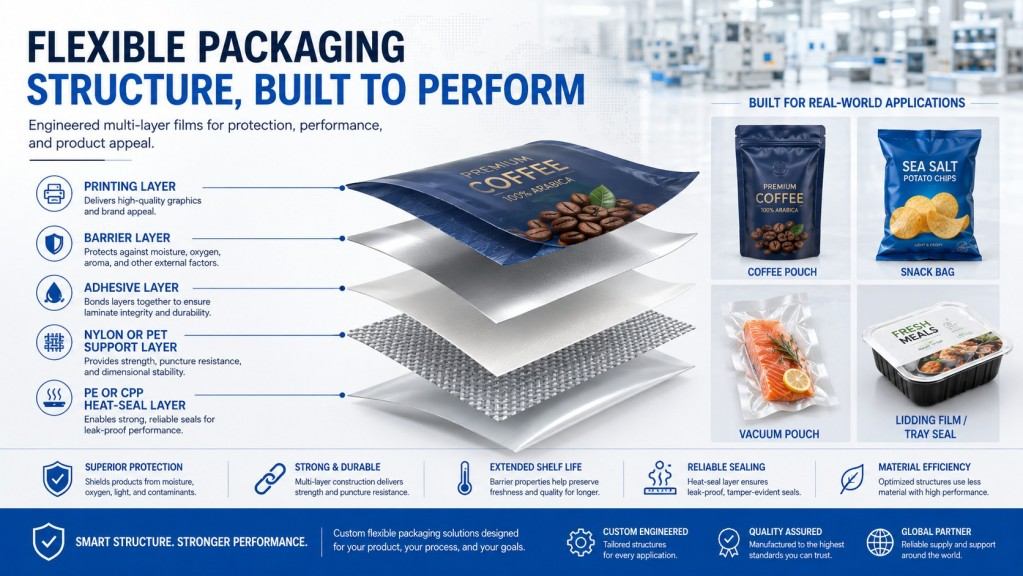
Flexible packaging can be simple or highly engineered. The structure depends on the product, shelf-life target, storage condition, packing machine, printing requirement, and cost target.
Single-Layer Films
Single-layer films are made from one main material, such as PE, PP, PET, or CPP. They are often used for simple bags, wraps, liners, surface protection, shrink film, or non-barrier packaging.
Single-layer films are easier to produce and can be cost-effective, but they may not provide enough barrier, stiffness, or print performance for demanding food or medical products.
Co-Extruded Films
Co-extruded films are made by combining different polymer layers during film production. For example, PE/Tie/EVOH/Tie/PE structures can add oxygen barrier while keeping PE sealing performance. Co-extrusion can create functional layers without a separate lamination process.
This type of structure is often used for meat, cheese, seafood, vacuum packaging, thermoforming webs, and recyclable barrier packaging.
Laminated Films
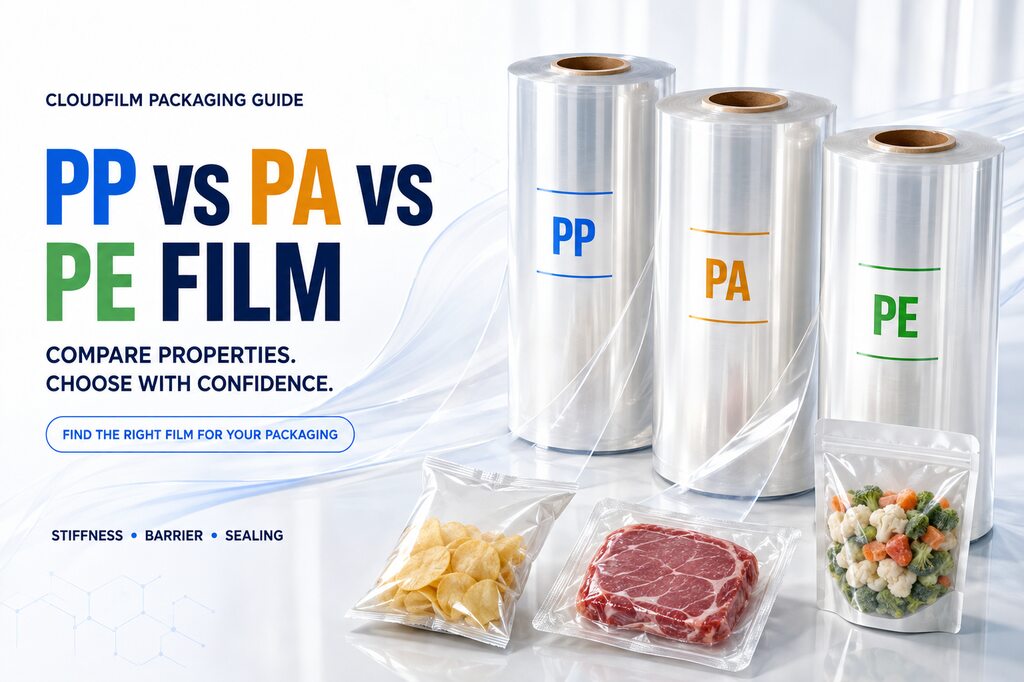
Laminated films bond two or more films together with adhesive or extrusion lamination. Common structures include BOPP/CPP, PET/PE, PET/CPP, PA/PE, PET/AL/PE, PET/VMPET/PE, and paper/PE.
Laminated structures are popular because each layer can perform a different function. One layer may provide printing. Another may provide barrier. Another may provide puncture resistance. Another may provide heat sealing.
For many food, pet food, pharmaceutical, and consumer goods projects, packaging film roll is supplied as laminated roll stock for automatic VFFS, HFFS, or flow-wrap machines.
Common Flexible Packaging Formats
Flexible packaging is not limited to one shape. The same material structure can often be converted into several formats.
Roll Stock Film
Roll stock is supplied in rolls and used on automatic packing machines. It is common for snacks, biscuits, coffee, powder, frozen food, medical products, sachets, and flow-wrap packs.
Custom roll stock can be printed, laminated, slit, and wound according to the buyer’s machine direction, roll width, core size, and sealing requirements.
Stand Up Pouches
Stand up pouches have a bottom gusset that allows the package to stand upright on the shelf. They are widely used for coffee, nuts, dried fruit, pet food, powder, supplements, cosmetics, detergents, and refill products.
For brands that want shelf impact and convenience, stand up pouches can include zipper, spout, valve, tear notch, transparent window, matte finish, gloss finish, or soft-touch finish.
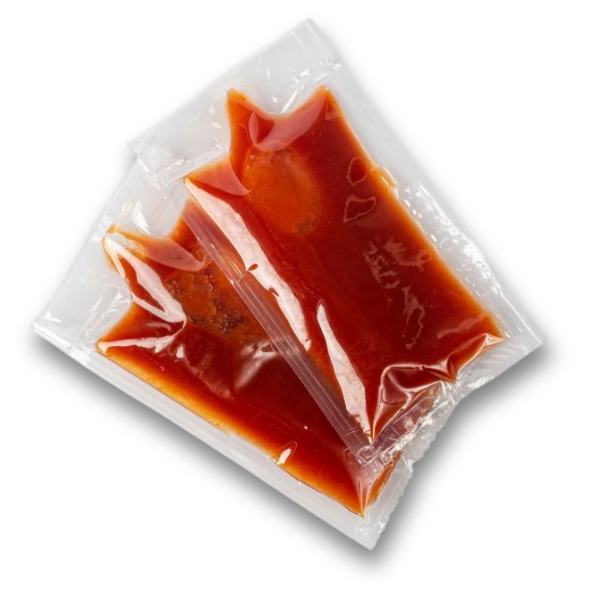
Flat Pouches And Sachets
Flat pouches are simple, compact, and cost-effective. They are often used for samples, spices, sauces, masks, tablets, medical items, powder, and single-use portions.
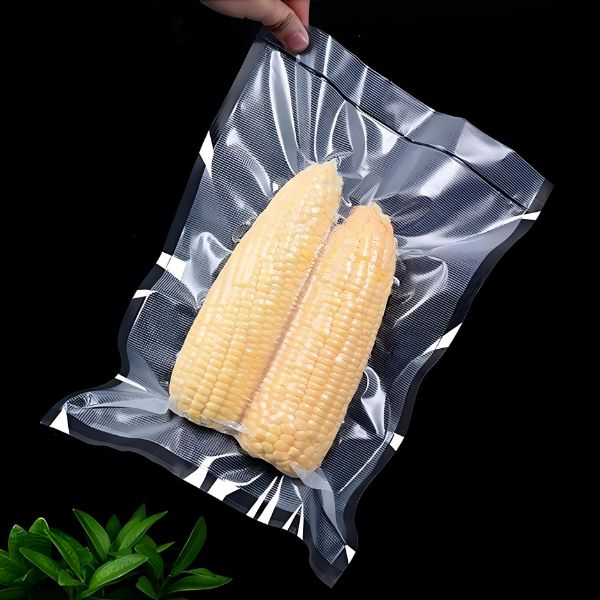
Vacuum Pouches
Vacuum pouches need strong sealing and puncture resistance. They are widely used for meat, seafood, cheese, frozen food, and ready meals. PA/PE and PE/PA/PE structures are common because nylon improves toughness and oxygen barrier.
For vacuum and frozen applications, PA/PE film is often used as a reliable high-barrier structure.
Lidding Films
Lidding films are used to seal trays, cups, containers, and blister packs. They may need easy peel, anti-fog, freezer resistance, retort resistance, or strong sealing to PET, PP, PE, CPET, or aluminum trays.
High-Barrier Pouches
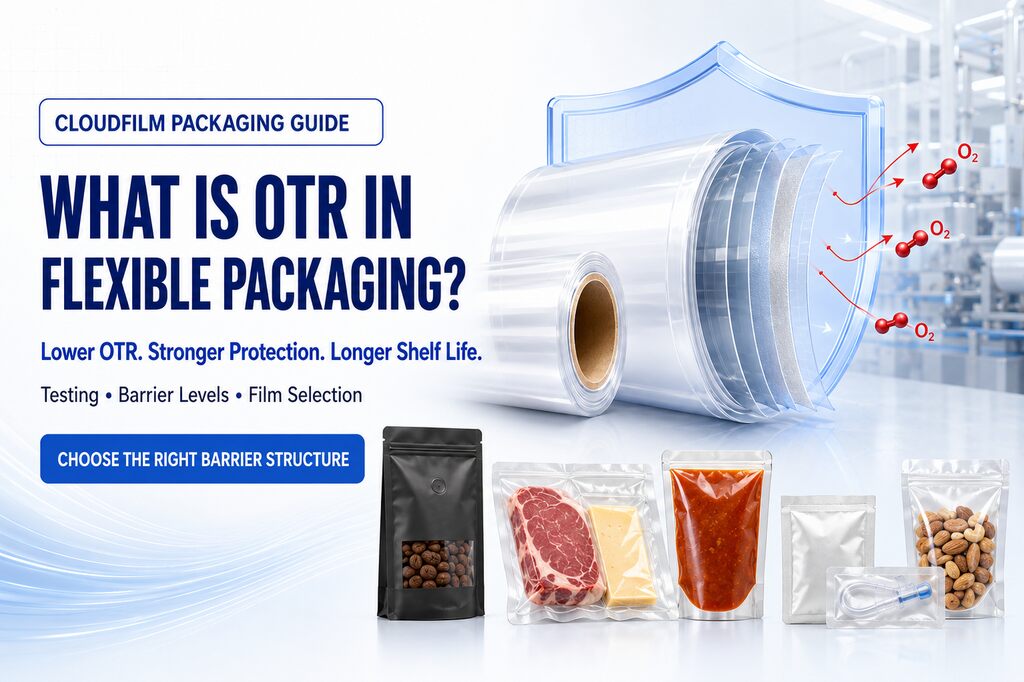
High-barrier pouches are designed to protect sensitive products from oxygen, water vapor, light, and aroma loss. Coffee, tea, nuts, pet food, milk powder, pharmaceuticals, and electronics often need stronger barrier structures.
CloudFilm’s high barrier films can be used when the product requires longer shelf life and stronger protection.
Flexible Packaging Applications By Industry
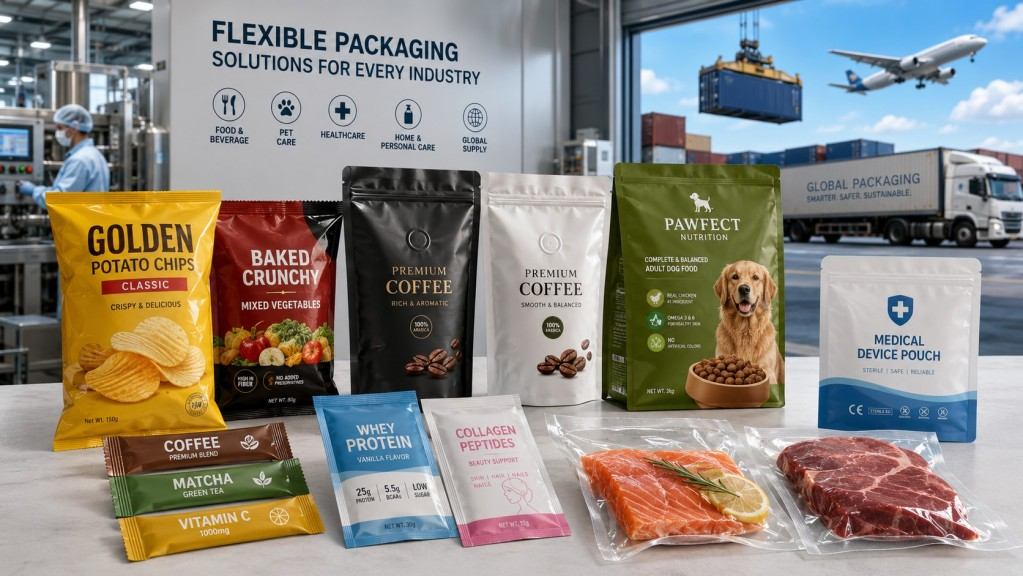
Flexible packaging is used across many industries because it can be engineered for different protection and display requirements.
Food And Beverage
Food packaging is one of the largest application areas. Snacks need moisture barrier and good shelf appearance. Coffee needs aroma barrier and oxygen protection. Frozen food needs cold resistance and seal strength. Sauces and ready meals may need retort resistance or strong puncture resistance.
Typical structures include BOPP/CPP, PET/PE, PET/CPP, PET/VMPET/PE, PET/AL/PE, PA/PE, and mono-PE recyclable structures.
Pet Food
Pet food packaging often needs grease resistance, aroma barrier, puncture resistance, and strong pouch stability. Flat bottom pouches, quad seal pouches, stand up pouches, and roll stock are common formats.
Coffee And Tea
Coffee and tea require protection against oxygen, moisture, and aroma loss. Metallized PET, aluminum foil, high-barrier PET, and valve-equipped pouches are common choices.
Powder And Dry Food
Protein powder, flour, spices, milk powder, instant drink mixes, and dry ingredients need moisture resistance, clean sealing, and good powder containment. PET/PE, PET/CPP, and high-barrier laminates are often used.
Medical And Pharmaceutical
Medical packaging requires cleanliness, stable sealing, puncture resistance, and suitable barrier. PET/PE, PA/PE, aluminum foil laminates, and high-barrier films are common depending on the product.
Household And Personal Care
Detergent refill pouches, cosmetic masks, shampoo pouches, wipes, and personal care samples often require strong seals, chemical resistance, and attractive printing.
Industrial Packaging
Industrial components, electronic parts, chemicals, hardware, and logistics materials may need puncture resistance, moisture protection, anti-static function, or heavy-duty PE films.
Main Benefits Of Flexible Packaging
Flexible packaging brings practical benefits for both brands and manufacturers.
First, it can protect product quality. By selecting the right structure, flexible packaging can reduce oxygen entry, moisture absorption, aroma loss, grease migration, contamination, and leakage.
Second, it supports brand presentation. High-quality printing, gloss, matte, metallic, transparent window, soft-touch, and registered matte effects can help products stand out on crowded shelves.
Third, it improves logistics efficiency. Flexible packs and roll stock are light and compact before filling, which can reduce storage space and transport volume.
Fourth, it supports many filling systems. Flexible packaging can be designed for VFFS, HFFS, flow-wrap, premade pouch filling, vacuum packing, thermoforming, tray sealing, and retort processing.
Fifth, it can help brands move toward recyclable packaging. Mono-material PE and PP structures are increasingly used where local recycling systems can handle them.
For companies developing recyclable pouch projects, recyclable pouches can help balance packaging performance with recycling goals.
How To Choose The Right Flexible Packaging Structure
Choosing flexible packaging should start with the product, not with the film name. A professional supplier or manufacturer should ask about the product first and then recommend a suitable structure.
1. What Product Will Be Packed?
Dry snacks, coffee beans, fresh meat, frozen seafood, powder, liquid detergent, medical devices, and pet food all need different protection. The same PET/PE film may work for one product but fail for another if the barrier or seal layer is not suitable.
2. What Barrier Is Required?
Some products only need moisture resistance. Others need oxygen barrier, aroma barrier, light barrier, oil resistance, or all of these together. Barrier requirements should be matched to shelf life and storage conditions.
3. What Packing Machine Will Be Used?
Roll width, coefficient of friction, sealing temperature, sealing speed, film stiffness, winding direction, and roll diameter must match the packing machine. A film that looks good in the sample may still fail if it does not run smoothly on the machine.
4. What Seal Performance Is Needed?
Seal strength, hot tack, low-temperature sealing, contamination resistance, and anti-leak performance are critical. Powder, liquid, oil, and frozen products usually require more careful seal layer selection.
5. What Appearance Is Needed?
A premium product may require matte PET, soft-touch film, metallic film, transparent window, registered matte printing, or high-gloss finish. Shelf appearance should be designed together with material performance.
6. Is Recyclability A Key Requirement?
If the market requires recyclable packaging, mono-material structures such as PE/PE, MDOPE/PE, BOPE/PE, or PP/PP may be considered. However, recyclability must be balanced with barrier, sealing, printing, stiffness, and local recycling conditions.
For a broader background, buyers can also review this recyclable flexible packaging guide before starting a new project.
Flexible Packaging Supplier And Manufacturer Selection Guide
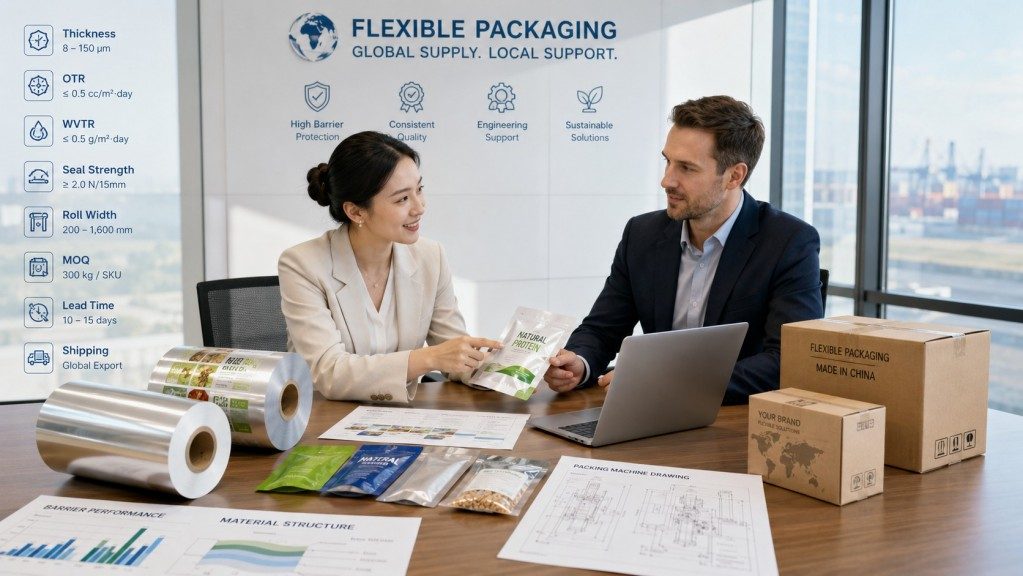
A reliable flexible packaging supplier should not only quote a price. The supplier should understand materials, structures, machinery, applications, printing, lamination, pouch conversion, quality control, and export logistics.
When choosing a flexible packaging manufacturer, buyers should check whether the supplier can support the following points:
The supplier should be able to recommend materials based on product needs, not only sell standard film. It should understand BOPP, BOPET, BOPA, PE, CPP, aluminum foil, metallized film, EVOH, PVDC, and mono-material structures.
The supplier should ask for clear technical information, including product type, shelf life, filling temperature, sterilization condition, roll width, thickness, sealing layer, printing design, packing machine type, and order quantity.
The supplier should provide samples or trial rolls before mass production when possible. Testing is especially important for new structures, new machines, recyclable packaging, high-barrier applications, and export packaging.
The supplier should have stable quality control. Important tests may include thickness, width, roll appearance, corona treatment, coefficient of friction, seal strength, bond strength, barrier data, print registration, leakage resistance, and pouch strength.
The supplier should also understand export packaging and logistics. For international buyers, safe palletizing, moisture protection, clear labels, documents, shipping schedule, and stable communication are all important.
Information To Send When Requesting A Quotation
To receive an accurate quotation, buyers should prepare basic information before contacting a flexible packaging film supplier or pouch manufacturer.
Useful information includes product name, packed weight, application, current structure, target thickness, roll width, pouch size, packing machine type, printing requirement, barrier requirement, storage condition, sample photos, annual quantity, first trial order quantity, destination port, and preferred trade term.
If the current structure is unknown, buyers can send an existing sample. A professional supplier can check the film, discuss the application, and recommend an equivalent or improved structure.
For example, if you need clear laminated film with strong printing and sealing performance, PET/PE film may be a practical starting point. If you need vacuum packaging for meat or seafood, PA/PE or PE/PA/PE may be more suitable.
Conclusion
Flexible packaging is a lightweight, customizable, and high-performance packaging solution made from flexible materials such as plastic films, paper, foil, metallized films, and multi-layer laminates. It can be supplied as roll stock, pouches, bags, wraps, lidding films, liners, sachets, or high-barrier structures.
For buyers, the most important point is not only the definition. The real value is choosing the right material structure for the product, machine, shelf life, market, and brand positioning.
As a flexible packaging film supplier and manufacturer, CloudFilm Packaging helps global buyers select suitable films and pouches for food, pet food, coffee, powder, liquid, medical, household, and industrial packaging projects. Share your product, current structure, target size, and application requirements, and our team can help recommend a practical packaging solution for testing and mass production.
FAQ About Flexible Packaging
1. What is flexible packaging?
Flexible packaging is packaging made from flexible materials that can bend, fold, wrap, seal, or change shape. Common examples include film rolls, pouches, bags, wraps, liners, sachets, and lidding films.
2. What materials are used in flexible packaging?
Common materials include BOPP, BOPET, BOPA, PE, CPP, aluminum foil, metallized PET, paper, biodegradable film, EVOH barrier film, and laminated structures.
3. Is a pouch considered flexible packaging?
Yes. Stand up pouches, flat pouches, spout pouches, vacuum pouches, retort pouches, and flat bottom pouches are all common types of flexible packaging.
4. What is the difference between flexible packaging and rigid packaging?
Flexible packaging can change shape and is usually made from films, foil, paper, or laminates. Rigid packaging keeps a fixed shape and includes bottles, jars, cans, trays, tubs, and boxes.
5. What is flexible packaging film?
Flexible packaging film is a thin material used to wrap, protect, seal, or form packages. It may be used alone or laminated with other films to improve barrier, strength, printability, or sealing.
6. What is laminated flexible packaging?
Laminated flexible packaging is made by bonding two or more layers together. Each layer has a different function, such as printing, barrier, strength, or heat sealing.
7. What is roll stock packaging?
Roll stock packaging is flexible film supplied in rolls for automatic packing machines. It is commonly used for snacks, coffee, powder, frozen food, medical items, sachets, and flow-wrap packaging.
8. What is high-barrier flexible packaging?
High-barrier flexible packaging protects products from oxygen, moisture, light, aroma loss, or grease. It is often used for coffee, tea, snacks, meat, pet food, pharmaceuticals, and sensitive dry foods.
9. Which flexible packaging structure is best for food?
There is no single best structure for all food. Snacks may use BOPP/CPP, coffee may use PET/VMPET/PE or PET/AL/PE, meat may use PA/PE, and recyclable packs may use mono-PE or mono-PP structures.
10. Can flexible packaging be recyclable?
Yes, some flexible packaging can be designed as recyclable mono-material PE or PP structures. Actual recyclability depends on material design, inks, additives, local collection systems, and recycling facilities.
11. What is the role of PE in flexible packaging?
PE is commonly used as a heat-seal layer. It provides flexibility, toughness, moisture resistance, and sealing performance. It is also important for mono-PE recyclable packaging.
12. What is the role of PET in flexible packaging?
PET is commonly used as an outer printing layer. It provides strength, stiffness, clarity, heat resistance, and premium print appearance.
13. What is the role of BOPA or nylon in flexible packaging?
BOPA or nylon improves puncture resistance, toughness, and oxygen barrier. It is useful for vacuum packaging, frozen food, meat, seafood, retort packaging, and medical packaging.
14. How do I choose a flexible packaging supplier?
Choose a supplier that understands materials, structures, barrier requirements, sealing performance, packing machines, printing, quality control, and export logistics. A good supplier should recommend the right structure based on your product, not only quote a price.
15. What information should I send for a flexible packaging quotation?
You should send product type, package size, target thickness, structure if known, roll width or pouch size, printing requirement, barrier requirement, packing machine type, quantity, destination port, and sample photos if available.