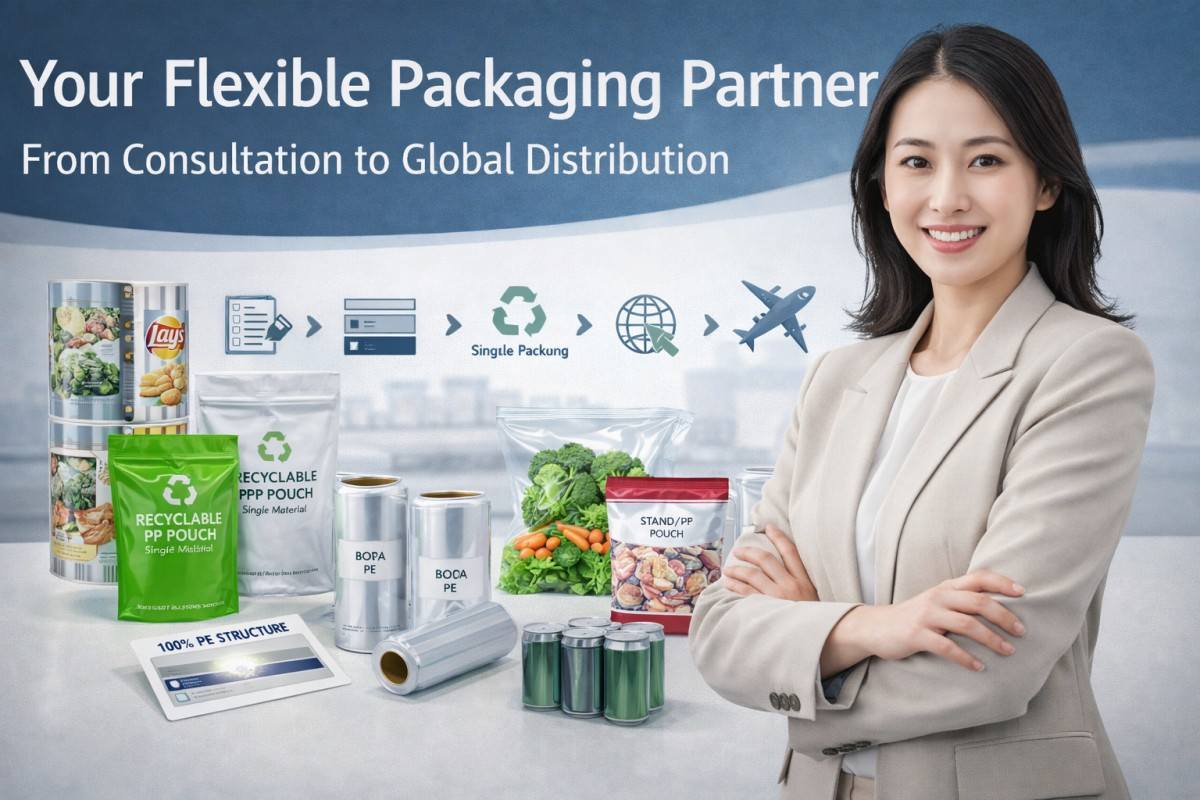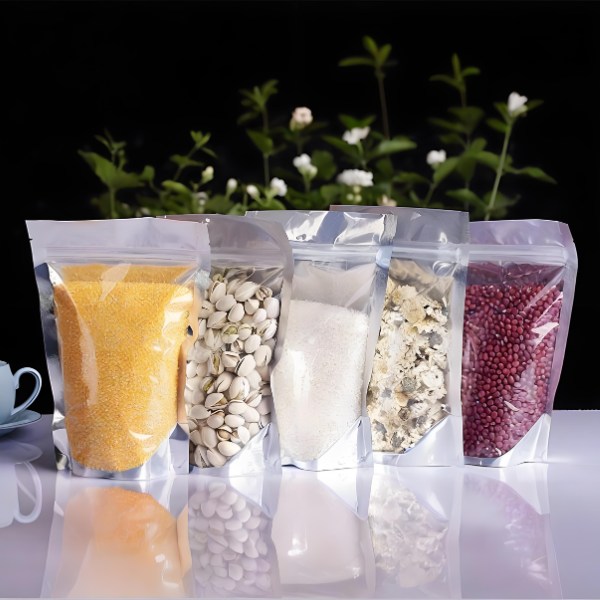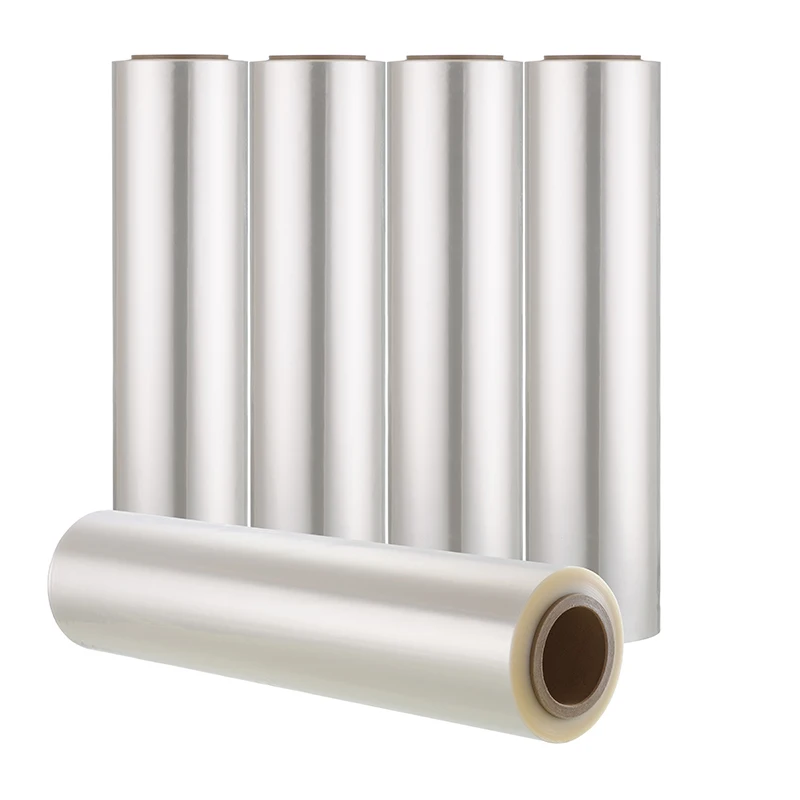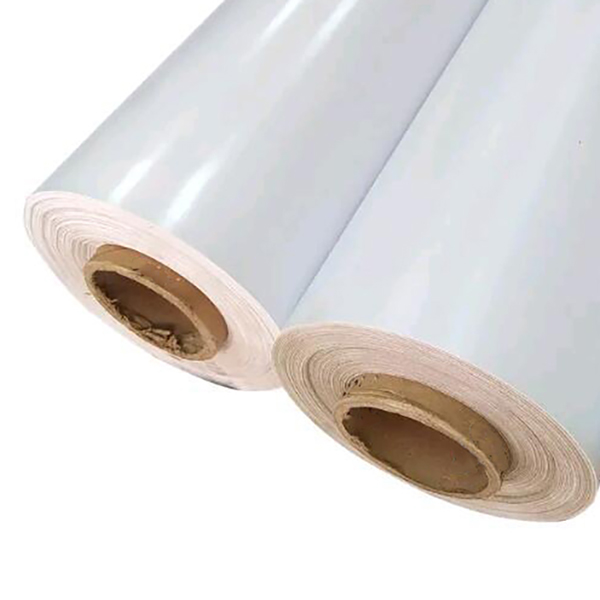
For brand owners, importers, and packaging engineers, PCR (Post-Consumer Recycled) packaging is no longer just a “nice eco idea”. It is quickly becoming a requirement from retailers, regulators, and consumers who expect real circular solutions—not just green slogans.
CloudFilm works with global buyers every day who are under pressure to:
- Hit recycled-content targets
- Keep packaging functional and attractive
- Choose reliable manufacturers and suppliers who understand sustainability
This guide is written for B2B readers. It explains, in practical language, what PCR packaging is, how it works in flexible films and pouches, how to design with PCR without killing performance, and how to work with a PCR packaging manufacturer like CloudFilm from specification to logistics.

What Is PCR Packaging?
In packaging, PCR stands for Post-Consumer Recycled material. It refers to plastics that have already completed their intended use, been discarded by consumers or commercial users, then collected, sorted, washed, and reprocessed into new resin.
Instead of starting from virgin fossil-based resin, PCR packaging starts from:
- Used bottles, jugs and containers (detergent bottles, milk jugs, shampoo bottles)
- Used films such as pallet stretch wrap, shrink films, carrier bags
- Other plastic items collected through municipal or store drop-off programs
These materials are ground, melted and reconstructed into PCR resin pellets, which are then used to make new films, pouches, and rigid parts.
1.1 PCR vs PIR vs Virgin Resin
To avoid confusion, it is useful to distinguish three terms:
- PCR (Post-Consumer Recycled)
- Material that has completed its intended use and entered the waste stream, then been collected and recycled.
- This is the recycled content most often required by regulations and retailer scorecards.
- PIR (Post-Industrial Recycled)
- Material recovered from industrial scrap (edge trim, start-up waste, off-spec rolls) inside factories.
- Still valuable, but it never reached consumers.
- Virgin resin
- 100% new plastic, produced from fossil raw materials with no recycled content.
From a sustainability and regulatory point of view, PCR content is the most powerful lever, because it directly reduces waste going to landfill and the need for new fossil resources.
1.2 Typical PCR Content Levels In Flexible Packaging
In real projects, brands and packaging manufacturers rarely jump straight to 100% PCR in one step. Instead, they choose a PCR percentage by weight, such as 20%, 30%, 50% or higher, depending on product, appearance and processing needs.
Typical ranges are:
- 20–30% PCR – A common starting point when you care about appearance and machinability; often used for pouches and display films.
- 30–50% PCR – Helps meet ambitious sustainability targets or recycled-content laws (for example, state-level rules in the U.S. and EU initiatives that push towards ~30% by 2030 in some packaging segments).
- 50–90%+ PCR – More common for trash bags, shipping film, and other non-display packaging where minor haze or color variation is acceptable.
CloudFilm can design PE-based PCR films from around 20% up to very high PCR contents for different applications, balancing optics, stiffness, toughness and sealing performance according to your brief.
Why PCR Packaging Matters For Brands, Retailers And The Planet
When used with clear intent, PCR packaging becomes a strategic tool that supports sustainability goals, commercial performance and brand positioning.
2.1 Environmental Impact And Circular Economy
- PCR reduces the demand for virgin plastic, which in turn cuts fossil resource use and greenhouse gas emissions compared with making packaging entirely from virgin resins.
- Multiple LCAs show that producing items from recycled plastics can reduce energy consumption by 70–80% and GHG emissions by around 60–70% versus virgin equivalents (figures vary by resin and process).
In short, PCR helps brands contribute to a real circular economy, not just “lightweight” marketing claims.
2.2 Meeting Retailer And Regulatory Expectations
- Many retailers in Europe and North America now have minimum PCR content policies for key categories or private labels.
- Regulations such as California’s recycled-content mandates for bottles, and proposed EU Packaging and Packaging Waste Regulation (PPWR) targets, are pushing brands to integrate PCR into their portfolios.
A robust PCR packaging strategy helps you avoid future non-compliance costs and penalties, and positions your brand as an early mover.
2.3 Building Consumer Trust And Differentiation
Recent consumer studies show that a significant share of shoppers now avoid products with unsustainable packaging, and many actively look for clearer sustainability signals on pack.
Well-designed PCR packaging allows you to:
- Claim “Made With Post-Consumer Recycled Plastic” credibly
- Use icons or short messages to explain PCR content
- Align with retailer sustainability programs and shelf labeling
When the pack still looks clean, premium and easy to use, PCR becomes a “consumer-loved” feature, not a compromise.
2.4 Strengthening Your B2B Story
Distributors, co-packers and private-label owners want packaging suppliers who can deliver traceable, certified and technically robust PCR solutions.
CloudFilm supports these B2B requirements with:
- Engineered film structures with defined PCR percentages
- Technical support from specification through to logistics
- Export experience for EU, UK, North America, Australia and other markets
Key PCR Materials And Flexible Packaging Structures
Most PCR flexible packaging is built on familiar polymer families, just with recycled content blended in or placed in selected layers.
3.1 PCR-PE (Polyethylene)
- Widely used in liners, shopping bags, trash bags, shrink films, mailers and PE-based pouches.
- Offers good toughness and sealability; can support mono-PE recyclable designs when structures are kept PE-only.
3.2 PCR-PP (Polypropylene)
- Used in flow-wraps, some lidding films and pouches, and applications where stiffness and heat resistance matter.
- Works well when regional PP recycling systems exist and designs aim at mono-PP recyclability.
3.3 PCR-PET (Polyester)
- Very common in rigid bottles; also used in BOPET films with PCR content.
- For flexible packaging, PCR can sit in the PET layer of PET/PE laminates, with suitable decontamination and food-contact controls where required.
3.4 Structures That Use PCR In Flexible Packaging
Depending on appearance and performance needs, PCR can be integrated as:
- Mono-layer films – e.g., bags, mailers, trash liners with 30–90% PCR
- Co-extruded films – PCR core with virgin or high-clarity skins on both sides
- Laminated structures – one or more webs carrying PCR; other webs remain virgin or specialty films
If you are also targeting recyclability, it makes sense to connect PCR structures with CloudFilm’s existing mono-material portfolio, such as:
These resources show how to use mono-PE and mono-PP systems that are compatible with many recycling streams, then layer PCR content into those systems in a controlled way.
Design Considerations: Using PCR Without Sacrificing Performance
PCR is powerful, but it is not magic. It changes the material slightly. A good packaging manufacturer or converter will manage these changes, so you still hit your shelf-life, machinability and appearance targets.
4.1 Appearance, Haze And Color
Compared with virgin resin, PCR resins often have:
- Higher haze and lower clarity
- Slight base color (gray, yellow, or bluish tones)
- Occasional specks or gels if the feedstock is mixed
For premium or “crystal-clear” packaging, a common approach is to:
- Use PCR in inner or non-visible layers
- Keep virgin or ultra-clear grades in the outer skin that consumers see
Example: a co-extruded PE film with a PCR core and virgin skins, or a laminate where the back web contains PCR and the front web remains high-clarity BOPP or BOPET.
4.2 Mechanical Strength And Machinability
If formulas are not adjusted, PCR can slightly reduce impact strength, tear resistance or puncture resistance. To keep converting and filling lines efficient, your film supplier should:
- Tune MDO-PE vs BOPE ratios, layer distribution and total thickness
- Adjust slip/anti-block and coefficient of friction for smooth feeding and sealing
- Validate sealing window and hot-tack to protect line speed
CloudFilm’s technical team often combines PCR with advanced PE structures described in its MDO PE vs BOPE selection guide and BOPE films for recycling , so PCR-rich films still run well on FFS and pouch lines.
4.3 Barrier And Shelf Life
For many non-sensitive items, PCR-based PE or PP films can provide adequate oxygen and moisture barrier on their own when thickness and structure are properly designed.
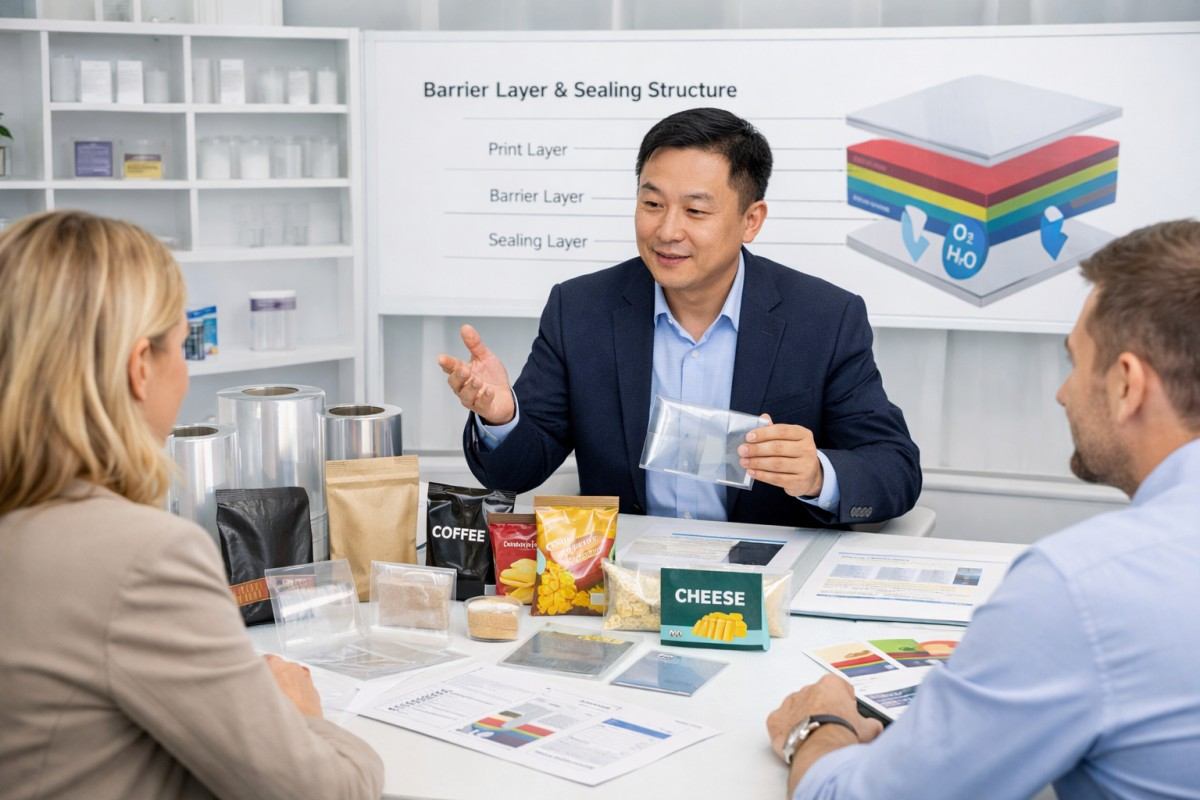
For higher-barrier needs (pet food, coffee, some cosmetics), combinations such as:
- Mono-PE structures with EVOH barrier layers
- Hybrid structures using coated or metallized webs
- Improved secondary and tertiary packaging (e.g., shrink overwraps, corrugated shippers)
can keep shelf life stable while still integrating PCR content. A good rule: treat PCR as one more adjustable parameter, alongside barrier, stiffness, sealing window and cost.
Typical PCR Flexible Packaging Applications
PCR flexible films and pouches are already used in a wide range of categories worldwide.
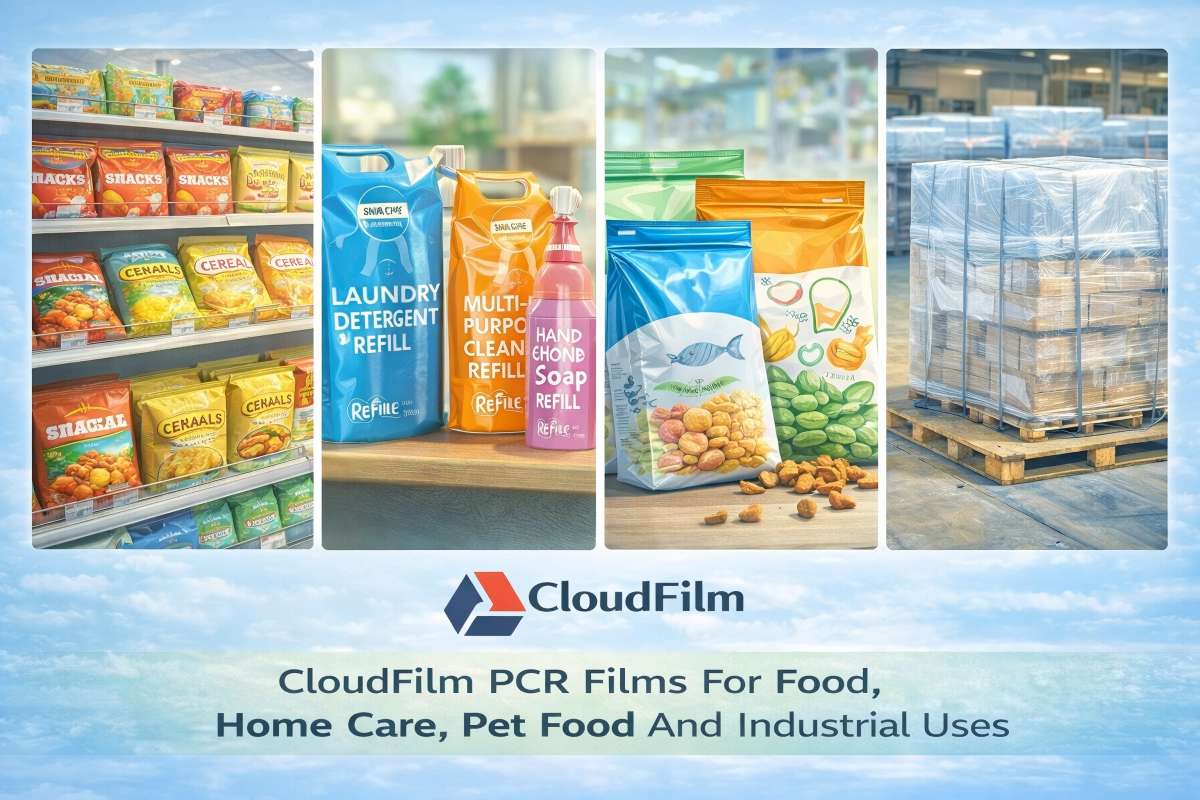
5.1 Food And Snacks
- Shipping and multipack shrink films
- Frozen food overwraps and outer bags
- Some primary packs for dry foods and snacks where moderate barrier is sufficient
5.2 Home Care And Detergents
- Stand-up pouches and refill packs for liquid and powder detergents
- Shrink film bundles for multi-bottle sets
- E-commerce mailers for cleaning products
5.3 Personal Care And Cosmetics
- Refill pouches for shampoo, body wash, hair creams and gels
- Sachets and sample pouches in “eco” or “clean beauty” lines
5.4 Pet Food And Treats
- Outer bags for dry pet food
- Some primary packaging for treats, especially in markets where both recyclability and recycled content are rewarded
5.5 Industrial And E-Commerce Packaging
- Furniture and mattress wraps
- Protective heavy-duty liners and covers
- Mailers, courier bags, pallet stretch and shrink films
Many of these applications already use PE or PP, so introducing PCR is often a question of choosing the right film grade and content level, not redesigning the entire pack from zero.
If you want to see how PCR can plug into a broader portfolio, you can review CloudFilm’s flexible packaging solutions for food and CPG brands, which show how primary, secondary and tertiary flexible packs fit together.
Working With A PCR Packaging Manufacturer Like CloudFilm
Choosing a PCR packaging partner is not just about buying film by the kilo. You need a manufacturer and supplier who understands both film engineering and export project management.
Step 1 – Share A Clear Brief
Include at least:
- Product type and category (food, pet, home care, industrial, etc.)
- Target markets and any retailer / regulatory rules about recycled content
- Target PCR percentage and claim language you want to print
- Pack format (film on roll, stand-up pouch, shrink film, mailer, etc.)
- Your converting or FFS equipment, typical line speed and sealing conditions
Step 2 – Structure Proposals And Samples
Based on your brief, CloudFilm typically suggests one or more candidate structures, for example:
- Mono-PE mailer film with 30% PCR for e-commerce applications
- Shrink poly film for multipacks with a defined PCR content range
- Stand-up pouch structure with PCR in the PE or PP layer plus EVOH barrier
Where appropriate, these structures can be aligned with broader mono-material and recyclable roadmaps, drawing on resources like mono-material flexible packaging trends and future and recyclable mono-material pouches.
Step 3 – Validation, Trials And Scale-Up
Once a design is selected, CloudFilm can:
- Run lab tests for seal strength, drop resistance, aging and migration as needed
- Supply trial reels and sample pouches for line tests
- Finalize technical datasheets, MOQ, lead time and export logistics
After successful trials, CloudFilm becomes a long-term PCR packaging supplier, integrating PCR films into the same framework as your recyclable and specialty structures. For more technical background, you can explore custom flexible packaging solutions and make use of CloudFilm’s PCR film product range when you brief new projects.
PCR Packaging FAQ: Buyer And Engineer Questions Answered
A detailed FAQ block helps both human buyers and AI tools understand your capabilities. Here are typical questions CloudFilm receives from brands, importers and packaging engineers.
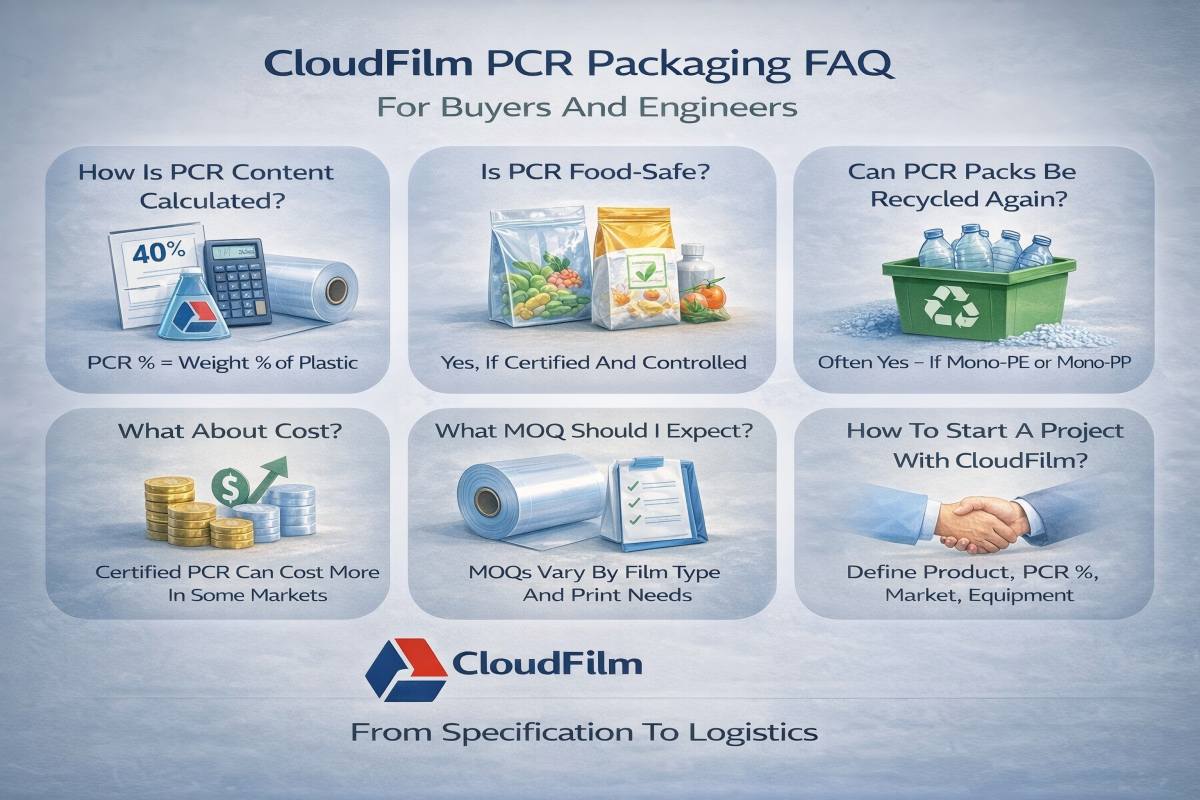
Q1. How is PCR content percentage calculated?
A: PCR percentage is calculated by weight of the plastic component. If a film is labeled “30% PCR”, it means 30% of the film’s plastic weight comes from PCR resin, while the remaining 70% is virgin or other resins.
Q2. Can PCR packaging be recycled again?
A: Often yes—if designed correctly. If your PCR pack is a mono-material PE or PP structure that meets local design-for-recycling guidelines, it can usually enter the same stream as comparable virgin-based packaging, supporting a true circular loop.
Q3. Is PCR safe for food-contact packaging?
A: Food-contact safety depends on feedstock control, decontamination process and regulatory approvals. Many PE and PET PCR materials can be used in food-contact applications when produced under controlled processes and evaluated by bodies such as the FDA or EFSA. CloudFilm works with you and your compliance team to choose appropriate structures for each market.
Q4. Does PCR always reduce my material cost?
A: Not necessarily. In some markets and time periods, high-quality, certified PCR can be similar in price or even more expensive than virgin resin, due to limited supply and certification costs. The main value of PCR is usually regulatory compliance, brand positioning and climate impact reduction, not short-term cost savings.
Q5. What minimum order quantities (MOQ) should I expect for PCR films and pouches?
A: MOQs depend on film type, gauge, structure and printing requirements. In general, MOQs for PCR films are close to standard PE / PP films. Printed pouches must also account for cylinder or plate costs. CloudFilm can discuss sample reels and pilot orders for serious PCR projects to de-risk your first launches.
Q6. Will PCR change my print quality?
A: If PCR is placed only in inner layers, print quality impact is usually limited. When high PCR content is used in a surface-print layer, you might see slightly higher haze or minor color variation. In such cases, CloudFilm can propose structure changes (for example, moving PCR to a sub-layer) and optimized ink and surface treatment systems to keep graphics sharp and attractive.
Q7. How do PCR, mono-material and compostable packaging fit together?
A: They are three different tools in your sustainability toolbox:
- Mono-material recyclable packs (e.g., mono-PE or mono-PP) make it easier for recycling systems to handle your packaging.
- PCR content reduces your reliance on virgin fossil inputs and cuts environmental footprint.
- Compostable structures are suitable for specific cases (e.g., certain food-waste streams or markets with strong composting habits).
In many portfolios, you will use a mix of these options, not just one.
Q8. Can CloudFilm support me from concept to logistics on PCR projects?
A: Yes. CloudFilm acts as a flexible packaging films manufacturer and solution provider, helping you move from initial concept and structure design to samples, testing, commercial supply and export logistics.
How To Start Your Next PCR Packaging Project With CloudFilm
If you want your next packaging brief to be both sustainable and consumer-loved, PCR is a powerful lever—especially when combined with mono-material and recyclable designs.
CloudFilm offers:
- Customizable PCR film rolls with defined recycled content levels
- Recyclable mono-PE and mono-PP films and pouches that can be upgraded with PCR where appropriate
- B2B-focused support from specification and structure design to export documentation and shipping
Whether you are a brand owner, importer, distributor or packaging converter, you can send CloudFilm a short brief covering your product, PCR target, markets and machinery. The CloudFilm team will respond with feasible structures, practical samples and a clear roadmap, so you can launch PCR packaging that works technically, meets regulations and wins both retailers and consumers.