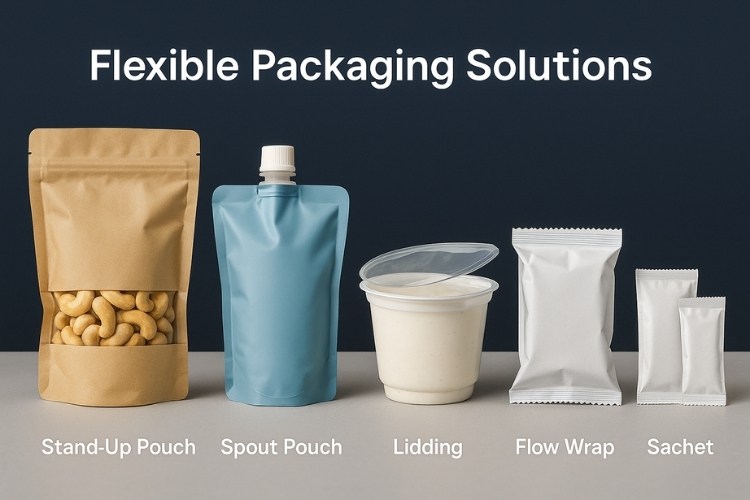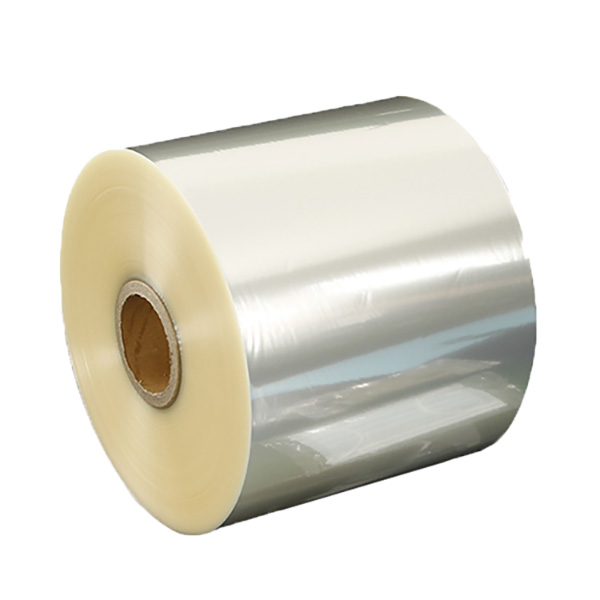
Biaxially Oriented Polypropylene (BOPP) film is one of the workhorse materials behind modern flexible packaging. Thanks to its clarity, stiffness and moisture barrier, BOPP film is used across snacks, confectionery, bakery, fresh produce, labels, tapes, personal care items and many other categories.
CloudFilm is a Qingdao-based manufacturer and exporter of flexible packaging films, including BOPP, BOPET, BOPA, PE and CPP films. Since 2002, we have supported converters and brand owners in many countries with film solutions for food and non-food packaging. Our BOPP range covers transparent and glossy films, matte and soft touch grades, metallized barrier films, synthetic paper, tape film and more. You can explore the full BOPP portfolio on the BOPP Film category page .
This article explains what BOPP film is, summarizes its advantages, and gives a practical overview of the main BOPP film uses in the packaging industry. At the same time, it points you to the right CloudFilm product pages so you can move quickly from concept to confirmed film structure.
What Is BOPP Film?
BOPP film is a biaxially oriented polypropylene film produced by extruding polypropylene into a sheet and then stretching it in both machine direction (MD) and transverse direction (TD). This biaxial orientation process improves the film’s:
- Clarity and gloss
- Tensile strength and stiffness
- Moisture barrier
- Dimensional stability during printing and lamination
Because of this combination of properties, BOPP film has become a standard material for:
- Food packaging (snacks, candy, nuts, bakery, fresh produce, frozen food)
- Labels for bottles and containers
- Pressure-sensitive tapes and industrial wraps
- Book covers and print lamination
Key Advantages of BOPP Film for Packaging
Product protection and quality
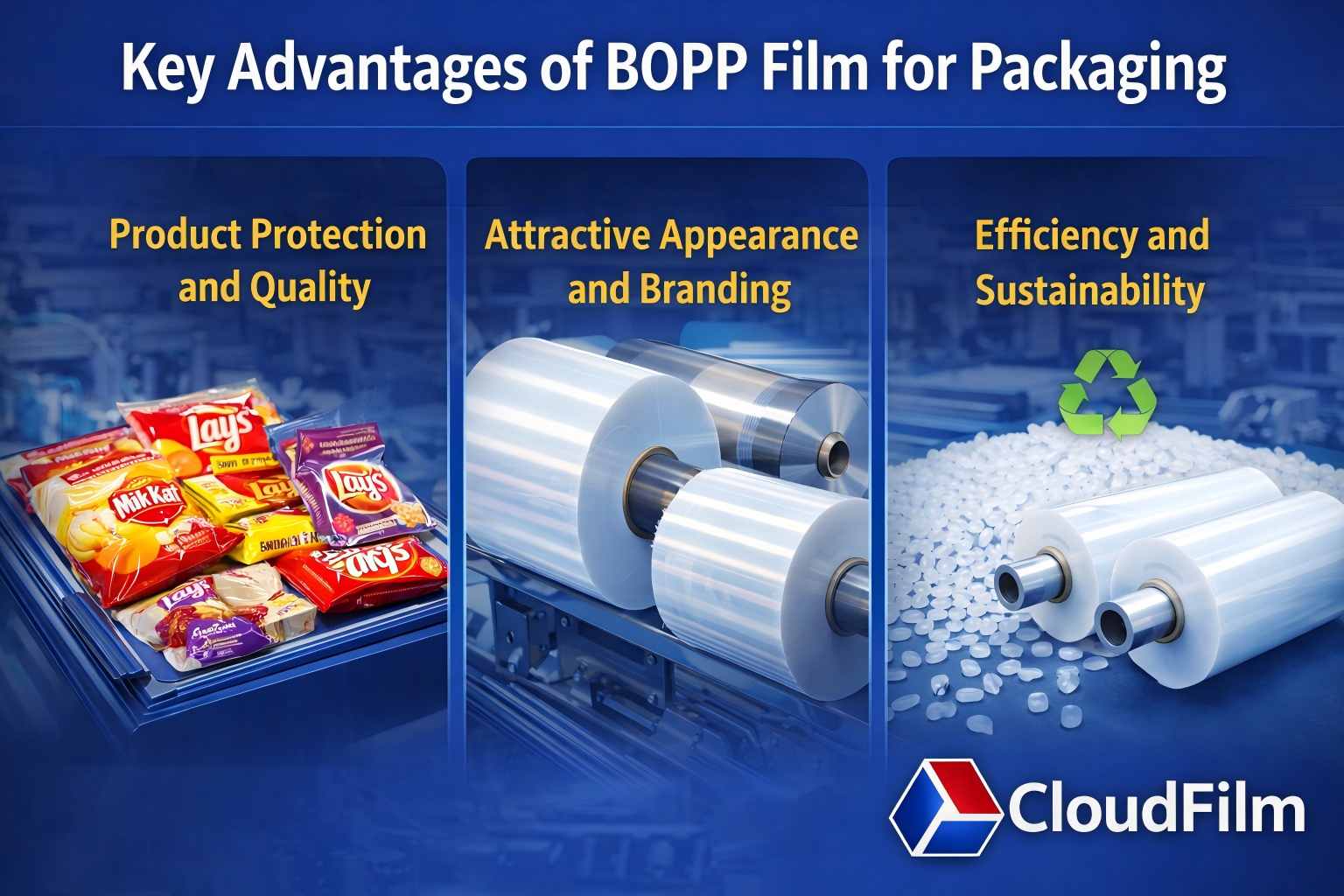
BOPP film combines good moisture barrier with strong mechanical properties. For dry foods such as chips, crackers and biscuits, BOPP helps keep the product crunchy by limiting moisture uptake. In pillow bags and stand-up pouches, BOPP films protect against tearing and pinholes during filling, shipping and display.
CloudFilm’s 12 Micron BOPP Film is a typical outer web for snack and confectionery packs, balancing yield, stiffness and shelf impact.
Attractive appearance and branding
BOPP film offers a very smooth surface and high clarity. This is ideal for gravure, flexo and digital printing, allowing brands to present vivid colors and sharp small text. For premium packs and labels, matte or soft touch BOPP films can create low-gloss or velvet-like surfaces that stand out on the shelf.
If you want a high-gloss look, you can consider BOPP Gloss Film. For low-gloss and premium effects, CloudFilm offers BOPP Matte Film and Soft Touch BOPP Film.
Efficiency and sustainability
BOPP has a relatively low density compared with many other plastics. That means you can get more square meters of film per kilogram of resin. This helps reduce packaging weight and shipping costs.
Another important point is recyclability. In many markets, BOPP-based mono-material structures (for example BOPP/CPP or all-PP pouches) fit into polypropylene recycling streams. Combined with downgauging to thinner films, this helps brand owners progress toward lighter, more recyclable packaging solutions.
How Is BOPP Film Made?
Although converters and brand owners do not run BOPP lines themselves, understanding the basic process helps you communicate better with your film supplier.
- Raw material feeding
Isotactic polypropylene pellets are dried and fed into an extruder. - Extrusion and casting
The molten polymer is extruded through a flat die and cast onto a chill roll to form a thick sheet. - Machine direction orientation (MDO)
The sheet is heated and stretched in the machine direction, increasing strength and stiffness along the running direction. - Transverse direction orientation (TDO)
The film enters a tenter frame and is stretched sideways. After this step, the film has balanced properties in both directions. - Surface treatment and coating
Corona or flame treatment increases surface energy for better ink and adhesive adhesion. Some BOPP films are also coated (for example acrylic coated BOPP for better printability or heat seal). - Slitting and packing
Finally, the large mother rolls are slit into customer widths and packed as jumbo rolls or smaller rolls for export.
CloudFilm controls each step of this process to supply consistent BOPP jumbo rolls and finished rolls for converters worldwide.
Common BOPP Film Types and Matching CloudFilm Products
Different BOPP film types are optimized for specific roles in your packaging structure. Below are some common examples and the corresponding CloudFilm products:
- Transparent printing film for outer webs
Use high-clarity BOPP printing film in 12 µm or similar gauges as the outer printed layer for snacks, candy and dry food. Recommended products:
CloudFilm 12 Micron BOPP Film and BOPP Printing Film. - Heat-sealable BOPP film
For mono-BOPP bags or as an inner layer in laminates, heat-sealable BOPP provides good seal strength and hot-tack. Recommended product:
Heat Sealable BOPP Film. - Anti-fog BOPP film
For fresh produce and chilled ready meals, anti-fog BOPP prevents condensation from blocking the view of the product. Recommended product:
BOPP Anti Fog Film. - Metallized BOPP film
When you need higher oxygen, aroma or light barrier (for example coffee, nuts and sensitive snacks), metallized BOPP can be used as a barrier layer. Recommended product:
Metallized BOPP Film. - Matte and soft touch BOPP film
For premium pouches, boxes and labels, matte and soft touch BOPP films provide a low-gloss or velvet surface. Recommended products:
BOPP Matte Film and Soft Touch BOPP Film. - BOPP tape film
For pressure-sensitive packaging tapes and carton sealing, tape-grade BOPP offers high tensile strength and controlled shrinkage. Recommended product:
BOPP Tape Film for Carton Sealing & Packaging Tapes. - BOPP synthetic paper
For durable labels and outdoor graphics that must be waterproof and tear-resistant, BOPP synthetic paper is a strong alternative to paper. Recommended product:
BOPP Synthetic Paper. - PP film for technical laminates
In some technical films and electrical applications, PP-based films such as BOPP and CPP are combined with other dielectric layers. Recommended product:
PP Film.
Main BOPP Film Uses in the Packaging Industry
Food and beverage packaging
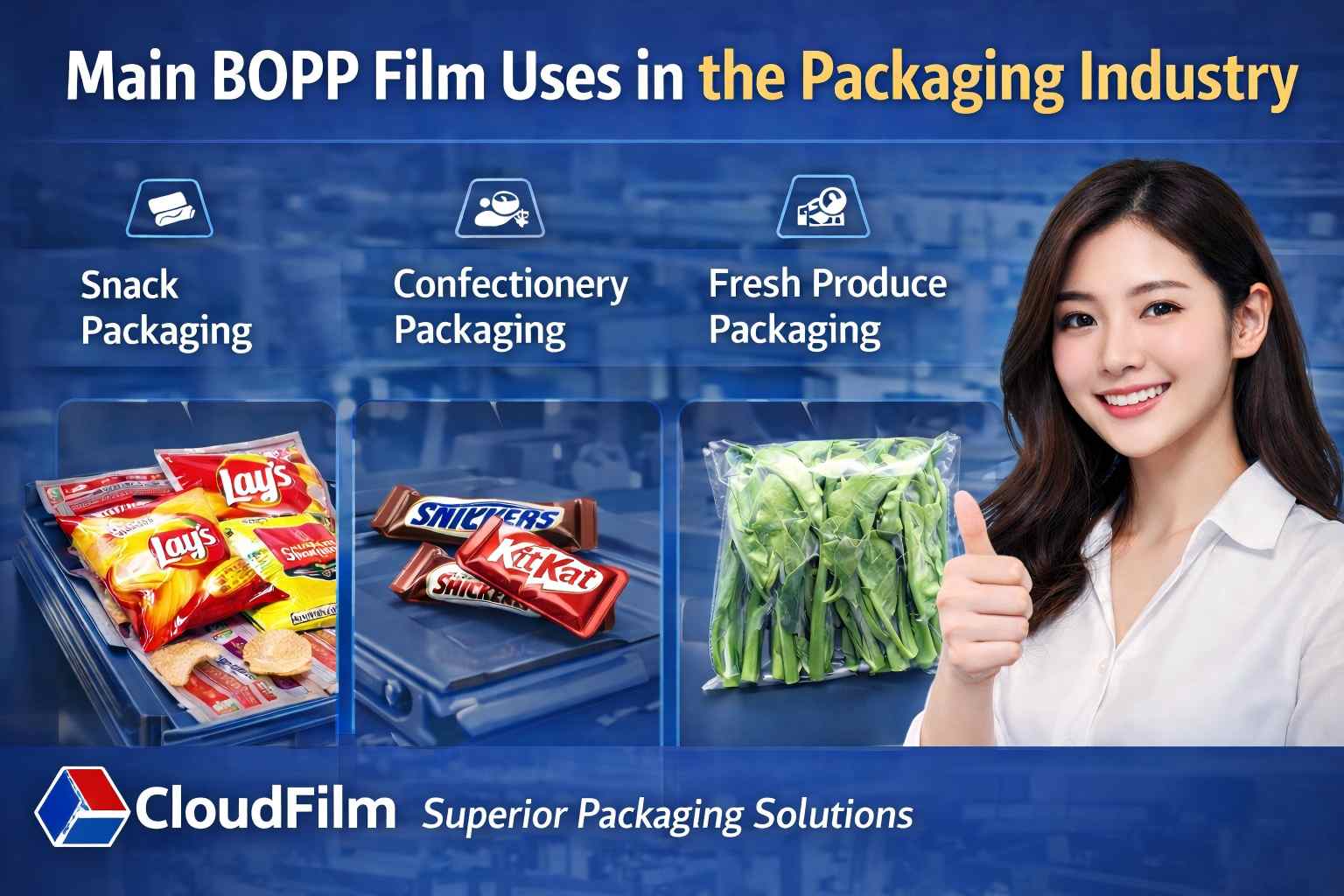
BOPP film is widely used in food and beverage packaging because it helps maintain product freshness while keeping packs attractive and easy to run on high-speed lines.
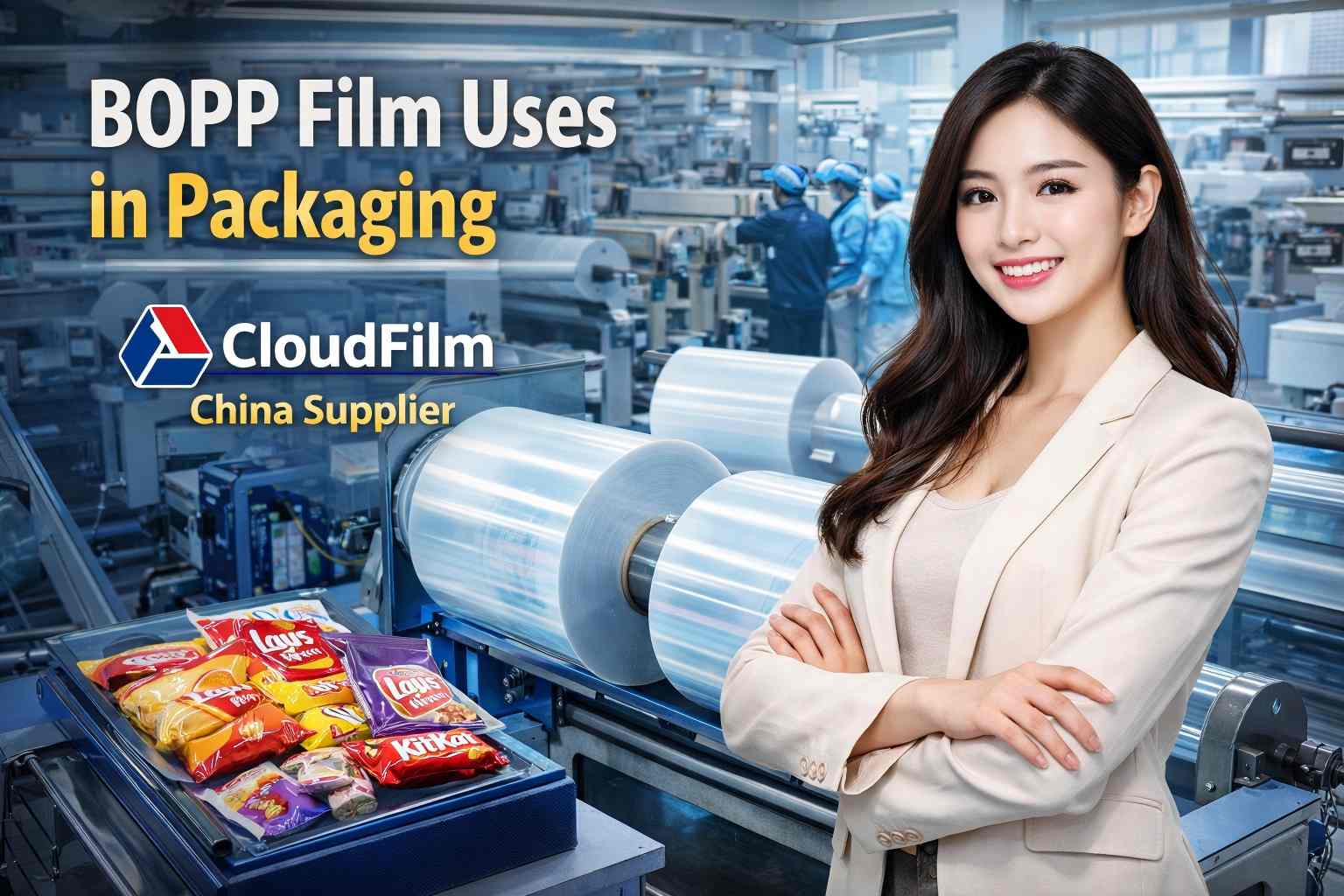
For dry foods such as chips, candy and baked snacks, a typical structure is BOPP printing film / metallized BOPP / PE or CPP.
For fresh produce and salad, anti-fog BOPP is used as lid film or flow-wrap film so that condensation does not hide the product.
In many snack pillow packs, converters combine CloudFilm’s 12 Micron BOPP Film as the printed outer web with Heat Sealable BOPP Filmor CPP/PE sealant layers to balance clarity, seal strength and shelf life.
Labeling and branding
In a competitive retail environment, labels carry most of the brand message. BOPP label films support high-quality printing and resist water, oil and scuffing better than paper.
For pressure-sensitive and wrap-around labels, many customers choose CloudFilm’s BOPP Printing Film or BOPP Synthetic Paper as the label face stock. These options combine high print quality with good dimensional stability and durability in cold, wet or refrigerated conditions.
Tamper-evident packaging and security
BOPP film is also used in tamper-evident structures and security seals. It can be printed with warning messages or security patterns and then laminated or applied over closures and carton flaps. When someone tries to open the pack, the BOPP layer tears or leaves visible damage, signaling tampering.
If you produce security tapes or carton sealing tapes with printed messages or logos, CloudFilm’s BOPP Tape Film for Carton Sealing & Packaging Tapes provides a stable base for adhesive coating and printing.
Medical and diagnostic packaging
For medical devices, diagnostic test kits and healthcare consumables, BOPP film is often part of laminate structures. It offers clarity for visual inspection and good resistance to tears and punctures. While BOPP alone is not a high barrier film, it can be combined with high-barrier layers such as metallized films, EVOH co-extruded films or aluminum foil to reach the required protection against moisture and oxygen.
A common approach is to use BOPP Printing Film as the print layer and then laminate it to Heat Sealable BOPP Film or to PE/CPP sealant layers.
Personal care and cosmetics packaging
In personal care applications, packaging must both protect the product and communicate brand values. BOPP film supports vivid graphics, metallic effects and tactile finishes.
Brands that want a more premium, low-gloss appearance for cosmetics or personal care items can laminate CloudFilm’s BOPP Matte Film or Soft Touch BOPP Film onto printed paperboard or flexible packaging structures. This creates a “soft luxury” surface that consumers can feel when they pick up the pack.
Printing and lamination
BOPP film is widely used as a laminating film to protect printed paper and board, such as book covers, catalogs, posters and gift boxes. Gloss BOPP lamination film enhances color intensity, while matte or soft touch BOPP adds a finer, premium look.
For these uses, you can consider BOPP Thermal Lamination Film or BOPP Adhesive-Free Lamination Film. These grades help printers and finishers improve lamination efficiency and achieve reliable bonding.
Electrical and technical applications
Because of its dielectric properties, BOPP film is used as an insulating material in some capacitors and technical laminates. In such structures, PP-based films (including BOPP and CPP in the PP Film range) can be combined with other layers while keeping the structure PP-rich for better recyclability.
Flower packing and gift wrapping
BOPP film is widely used in flower sleeves, bouquets and gift wrapping. Its high clarity shows the natural beauty of the flowers or gift inside, while its stiffness and crease retention create attractive shapes.
Converters often use clear BOPP Folia or Clear Plastic Film for flower sleeves and high-transparency gift wrap. When condensation control is needed for refrigerated bouquets, Anti Fog BOPP Film helps keep the view clear.
Adhesive tapes
BOPP film is the backbone of many packaging and office tapes. It provides a smooth surface for adhesive coating, resists stretching during unwinding and application, and offers good clarity so barcodes and print remain easy to scan.
If you are evaluating new or backup suppliers for tape film, you can refer directly to CloudFilm’s BOPP Tape Film for Carton Sealing & Packaging Tapes product page for technical data, sample rolls and quotations.
How to Choose the Right BOPP Film for Your Packaging Project
When you move from general BOPP film knowledge to a real project, three questions usually matter most:
- What do you pack?
- How is it packed?
- What performance targets do you have?
CloudFilm uses these questions to recommend a suitable BOPP structure and film grade.
Key factors to define before talking to your BOPP film supplier
- Product and shelf-life
Is it snacks, confectionery, frozen food, fresh produce, coffee, pet food, personal care or medical? Do you need short shelf life or long-term, high barrier? - Pack format
Pillow bag, gusseted bag, stand-up pouch, flow-wrap, overwrap, label, tape or lid film. - Required appearance
High-gloss “crystal” look, low-gloss matte, soft touch or special effects such as holographic or pearlized surfaces. - Barrier level
Standard moisture barrier only, or higher oxygen, aroma and light barrier for sensitive products. - Line conditions
Horizontal or vertical FFS, thermoform–fill–seal, packing speed, typical sealing temperature and dwell time. - Sustainability goals
Mono-PP structures, recyclable pouches, downgauging to thinner films or replacing mixed-material laminates.
What information should you send to CloudFilm?
To get a fast and precise BOPP film recommendation, you can include the following details in your inquiry:
- Your product and target market (country, retail channel).
- Existing or planned structure (for example BOPP/CPP, PET/PE, BOPP/VMPET/PE), thickness and web width.
- Planned print method (gravure, flexo, digital) and number of colors.
- Special requirements such as anti fog, easy-tear, matte finish, soft touch or high scratch resistance.
Once we receive this information, CloudFilm will propose one or two candidate structures, advise which BOPP film grades from the BOPP Film category to use, and prepare trial rolls when needed so that your team can run tests on your own lines.
Partner with CloudFilm for Your BOPP Film Projects
BOPP film underpins a large share of modern flexible packaging, from simple snack overwraps and transparent fruit packs to premium matte pouches, tapes and labels. Understanding the main BOPP film uses and matching them with the right film type helps you improve shelf appeal, protect your product and reduce total packaging cost.
As Qingdao Cloud Film Packaging Materials Co., Ltd., CloudFilm has focused on flexible packaging films since 2002. We supply BOPP, BOPET, BOPA, PE and CPP films to converters and brand owners in more than 30 countries, and have supported hundreds of packaging projects in food, beverage, personal care, industrial and technical markets.
If you are planning a new packaging structure, looking for backup BOPP film suppliers or simply want to optimize an existing film, share your requirements with CloudFilm. We will recommend suitable BOPP film grades, provide technical data sheets and arrange trial rolls so that you can validate performance on your own machines.
Ready to discuss your next BOPP film project? Contact CloudFilm today via the Contact Us page Our team will respond with a tailored proposal and help you move from initial concept to stable, repeat orders.
BOPP Film Technical & Application FAQ
Q1. What BOPP film thickness is most common for snack packaging?
For many pillow packs and flow-wraps used for chips, candy and bakery products, 12 μm BOPP film is a very common outer printing web. It offers a good balance between stiffness, optical properties and cost. In some structures, converters may also use 15–20 μm depending on line conditions and pack size.
Q2. Can BOPP film alone provide high oxygen and aroma barrier?
Standard transparent BOPP film mainly provides moisture barrier and mechanical strength. On its own, it does not offer very high oxygen or aroma barrier. For coffee, nuts, spices and other sensitive products, BOPP is usually combined with metallized films or high-barrier co-extruded layers. A common option is to use Metallized BOPP Film from CloudFilm as the barrier layer inside a laminate.
Q3. What is the difference between normal BOPP and anti-fog BOPP?
Normal BOPP film tends to show water droplets when condensation forms on the inside of the pack, which can block the view of the product. Anti-fog BOPP film has a special surface treatment or coating that spreads the water into a thin, transparent layer. This keeps the pack clear in refrigerated conditions and improves shelf appearance for fresh produce and salads.
Q4. Is BOPP film suitable for mono-material recyclable packaging?
Yes, BOPP film is one of the key materials for mono-PP structures. By combining BOPP with other PP-based films such as CPP or certain co-extruded PP sealant films, you can design pouches and wraps that remain within the polypropylene family. In markets where PP recycling streams exist, these mono-PP structures are easier to sort and recycle compared with mixed-material laminates.
Q5. When should I choose matte or soft touch BOPP film instead of glossy film?
Glossy BOPP works well when you want strong color vibrancy and a “crystal clear” look. Matte BOPP is better if you want a low-gloss, paper-like appearance that reduces reflections, for example on premium food or cosmetic packs. Soft touch BOPP goes one step further – it adds a velvet feel that consumers notice when they pick up the product.
Q6. Can BOPP film be used for both labels and flexible packaging?
Yes. Many converters use BOPP printing film and BOPP synthetic paper for pressure-sensitive and wrap-around labels, while using other BOPP grades for bags, pouches and overwraps. Label applications usually need good printability, dimensional stability and resistance to water and chemicals.
Working with CloudFilm – Purchasing FAQ
Q7. What information should I prepare before asking CloudFilm for a BOPP film quotation?
To receive a fast and accurate recommendation, it is helpful to prepare the following information:
- Your product type and target market (country, retail channel).
- Planned pack format (pillow bag, stand-up pouch, label, tape, flower sleeve, etc.).
- Existing or planned structure (for example BOPP/CPP, BOPP/VMPET/PE) and target thickness.
- Printing method (gravure, flexo or digital) and number of colors.
- Special requirements such as anti fog, easy-tear, matte or soft touch.
Q8. Can CloudFilm provide trial rolls for machine tests?
In many cases, CloudFilm can arrange trial rolls or smaller test quantities so that you can run new films on your own packaging lines before placing larger orders. Please describe your test plan, required width, thickness and estimated running meters, and our team will suggest a practical trial roll solution.
Q9. Does CloudFilm only supply BOPP film, or also other packaging films?
CloudFilm focuses on flexible packaging films and supplies a full range of BOPP, BOPET, BOPA, PE and CPP films. For many customers, we recommend BOPP film grades together with suitable PET, PA or PE/CPP films to build complete laminate structures.
Q10. How do I start a long-term cooperation with CloudFilm as my BOPP film supplier?
The typical steps are:
- Share your current projects and basic film specifications with our team.
- Receive technical suggestions, film samples or trial rolls from CloudFilm.
- Run tests on your machines and give feedback on performance.
- Confirm final film grades, purchasing terms and delivery schedules.
Once your structures are confirmed, CloudFilm can support you with stable supply, technical follow-up and, when needed, new film developments for future projects.