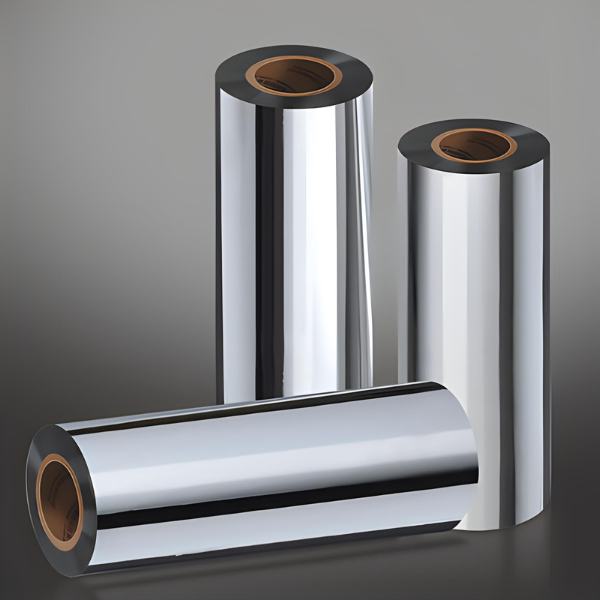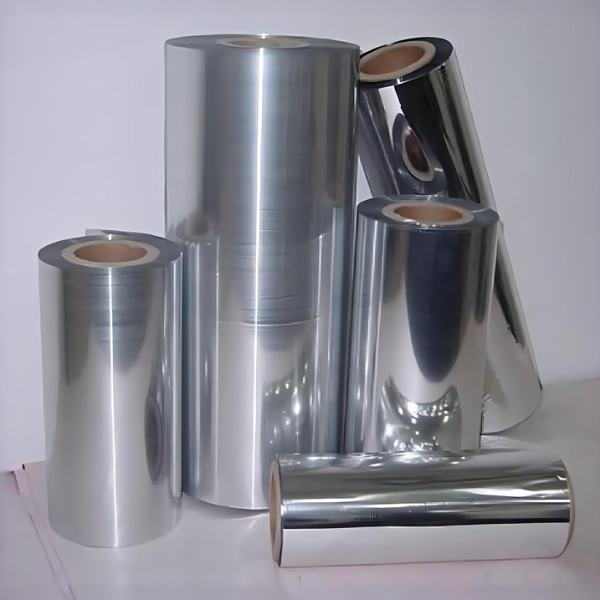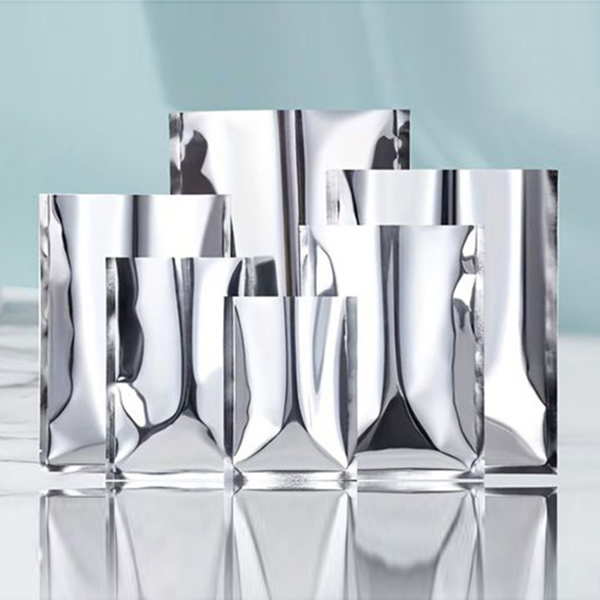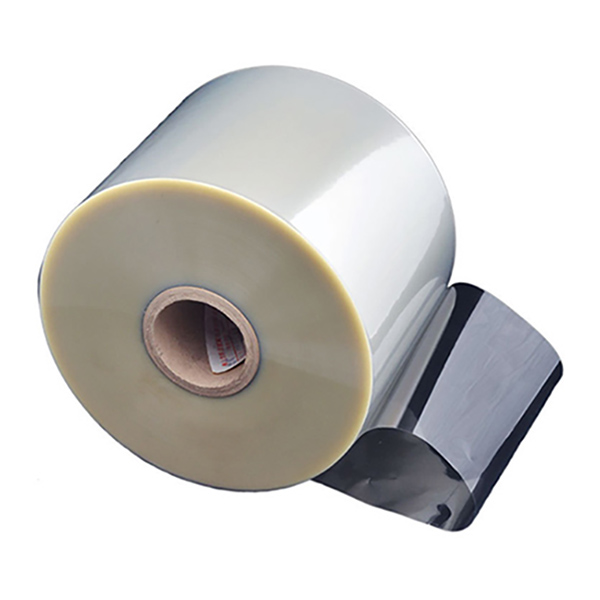
MET PET film, also known as metallized PET film or VMPET film, is one of the most widely used high-barrier materials in flexible packaging. For packaging buyers, converters, brand owners, and procurement teams, understanding the density of MET PET film is more than a technical detail. It directly affects roll weight, square-meter yield, freight cost, quotation comparison, laminate design, and final packaging cost.
In many sourcing projects, buyers compare MET PET film only by price per kilogram. This can be misleading. A film with the same thickness but different density, coating level, or real measured gram weight may give a different usable area per kilogram. For flexible packaging, what finally matters is not only “how much one kilogram costs,” but also “how many square meters one kilogram can cover” and “whether the film can meet the required barrier, lamination, printing, and sealing performance.”
This guide explains the typical density of MET PET film, how to calculate roll weight and yield, why density matters in purchasing, and how to choose a reliable MET PET film manufacturer or supplier for packaging applications.
What Is MET PET Film?
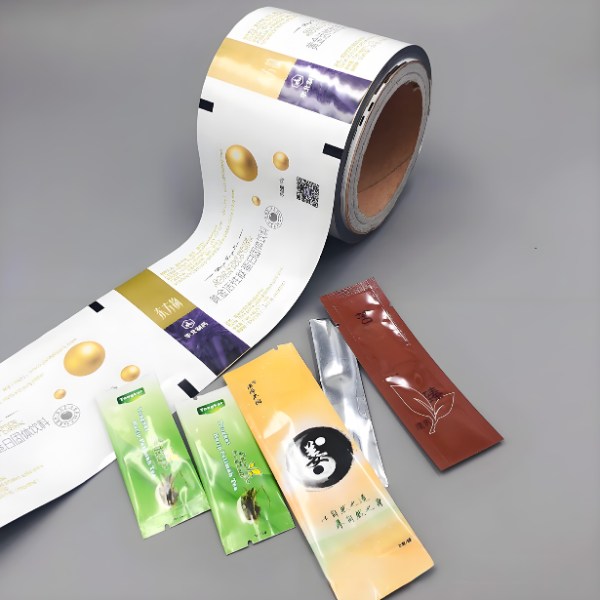
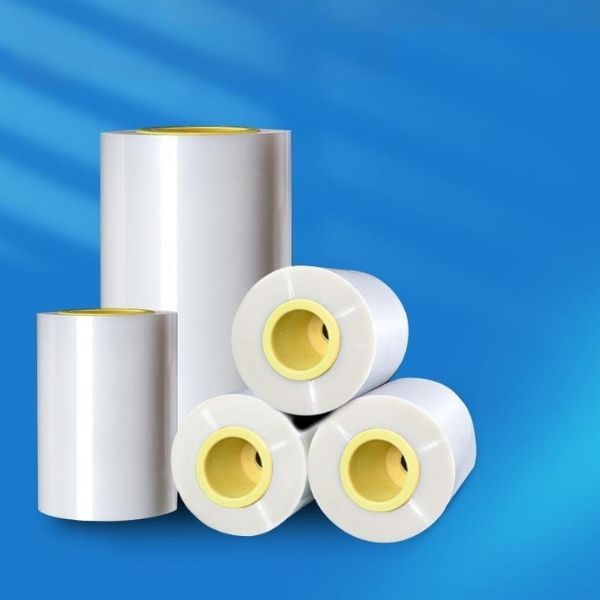
MET PET film is a PET-based film with a very thin vacuum-deposited metal layer, usually aluminum. The PET base film provides strength, stiffness, dimensional stability, heat resistance, and a good surface for converting. The metallized layer improves barrier performance against oxygen, moisture, aroma loss, and light transmission.
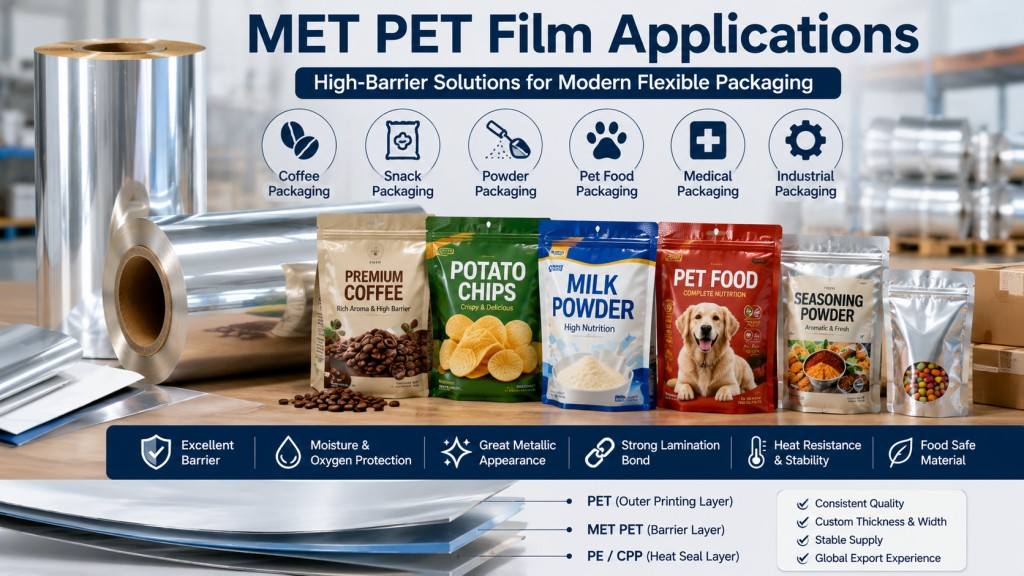
In flexible packaging, MET PET is commonly used as a middle barrier layer in laminated structures such as PET/MET PET/PE, PET/MET PET/CPP, BOPP/MET PET/PE, and paper/MET PET/PE. These structures are widely used for coffee, tea, snacks, biscuits, milk powder, seasoning, dry food, pet food, personal care products, medical packaging, and technical packaging.
If you are comparing metallized materials for food or industrial packaging, you can also review CloudFilm’s Metallized Films page, which covers metallized PET, metallized BOPP, metallized CPP, and related packaging applications.
Typical Density of MET PET Film
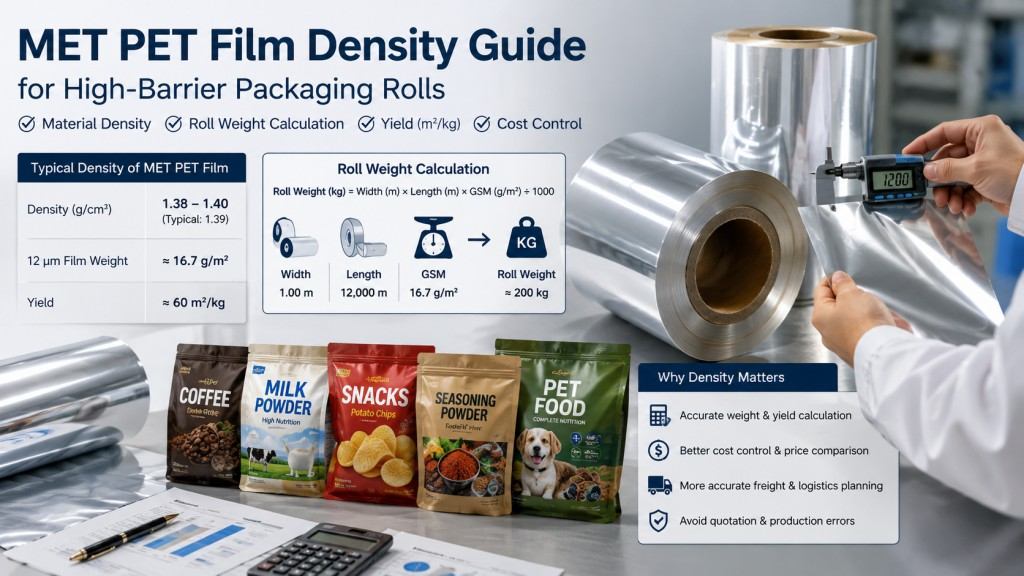
For most packaging-grade MET PET film, the practical density is close to standard BOPET film because the aluminum layer is extremely thin. A commonly used calculation value is about 1.39 g/cm³. In real projects, the density may usually be considered in the range of 1.38–1.40 g/cm³, depending on the base film, formulation, coating, treatment, and supplier datasheet.
This means that a 12 micron MET PET film is usually much heavier per square meter than a 12 micron BOPP film or a 12 micron PE film. PET-based materials have higher density than polyolefin films, so buyers should not compare different materials only by kilogram price.
For example, if 12 micron MET PET and 12 micron BOPP are both quoted per kilogram, MET PET will normally provide fewer square meters per kilogram because PET density is higher. However, MET PET may offer stronger barrier, better thermal stability, and better dimensional stability for high-barrier laminated packaging.
For buyers who want a broader comparison between common packaging films, CloudFilm’s BOPP vs BOPET vs CPP vs PE packaging film guide can help explain how different films perform in flexible packaging structures.
MET PET Film Density vs Optical Density
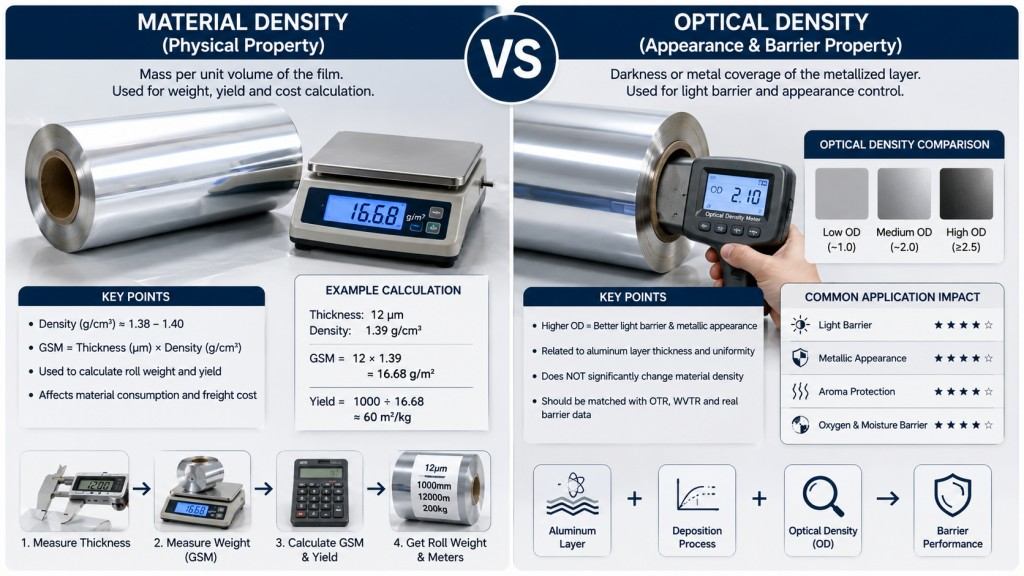
Many buyers confuse “density” with “optical density.” They are not the same.
Material density describes the mass per unit volume of the film. It is used for calculating weight, yield, and material consumption. The common unit is g/cm³.
Optical density describes the darkness or metal coverage of the metallized layer. It is related to light blocking, appearance, and barrier performance. A higher optical density usually means stronger metallized appearance and better light barrier, but it does not mean the film has much higher material density.
For most packaging calculations, you need material density. For barrier and appearance control, you need optical density, oxygen transmission rate, moisture vapor transmission rate, metal adhesion, and lamination bond strength.
How to Calculate MET PET Film Weight
The most practical formula for film buyers is:
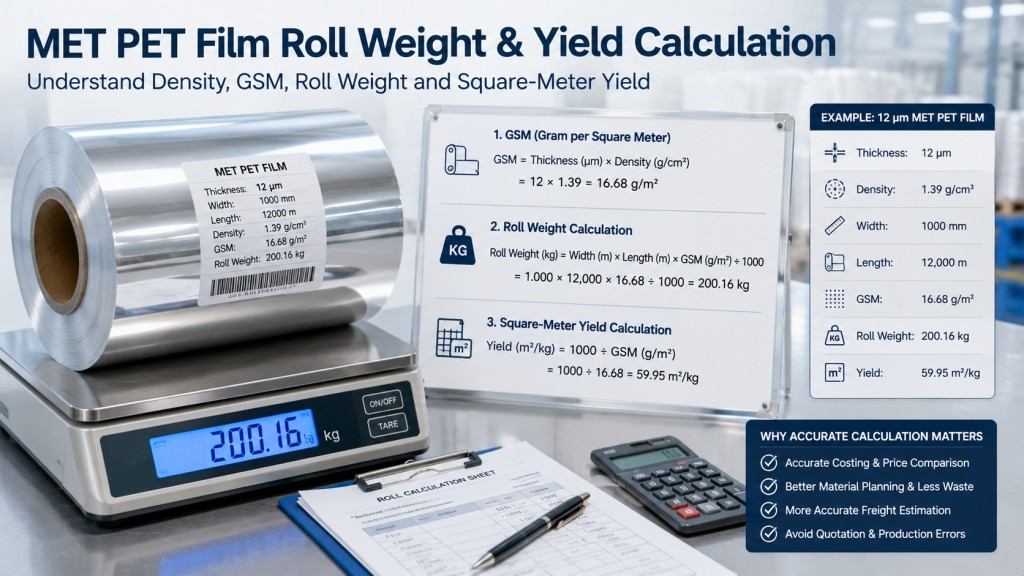
GSM = Thickness × Density
For plastic film calculation:
GSM = Film Thickness in Microns × Density in g/cm³
If the MET PET film thickness is 12 microns and the density is 1.39 g/cm³:
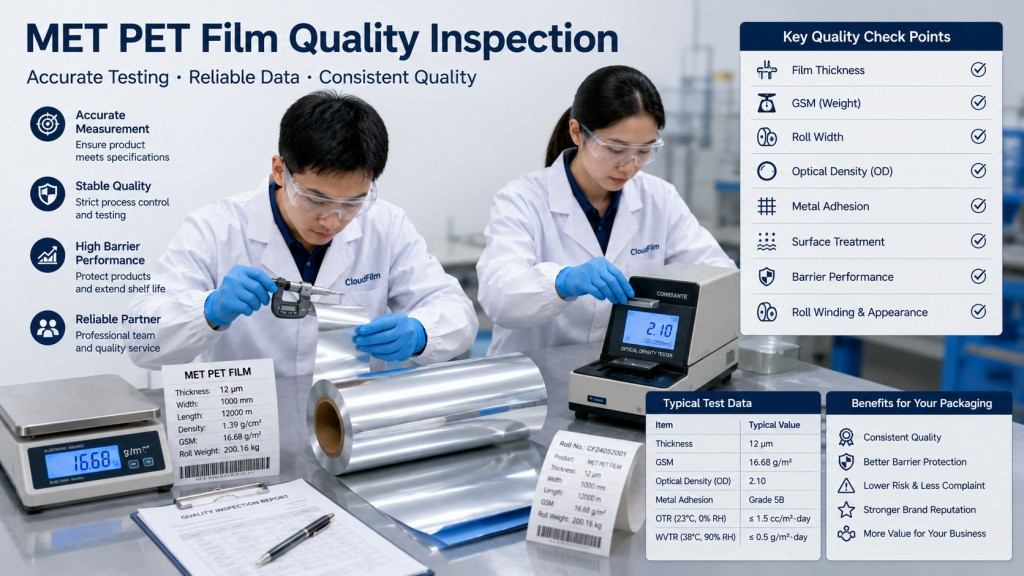
12 × 1.39 = 16.68 g/m²
This means one square meter of 12 micron MET PET film weighs about 16.68 grams.
To calculate roll weight:
Roll Weight = Width × Length × GSM ÷ 1000
Width should be in meters. Length should be in meters. GSM means grams per square meter.
For example:
Film thickness: 12 microns
Density: 1.39 g/cm³
Width: 1.000 meter
Length: 12,000 meters
GSM: 16.68 g/m²
Roll weight:
1.000 × 12,000 × 16.68 ÷ 1000 = 200.16 kg
So, a 1,000 mm wide roll with 12,000 meters length will weigh about 200 kg before adding core, packaging, pallet, and tolerance.
How to Calculate MET PET Film Yield
Yield means how many square meters you can get from one kilogram of film. It is very useful when comparing quotations.
The formula is:
Yield = 1000 ÷ GSM
For 12 micron MET PET film:
1000 ÷ 16.68 = 59.95 m²/kg
So, 1 kg of 12 micron MET PET film gives about 60 square meters.
Here is a simple reference table:
| MET PET Thickness | Density Used | Approx. GSM | Approx. Yield |
|---|---|---|---|
| 8 micron | 1.39 g/cm³ | 11.12 g/m² | 89.9 m²/kg |
| 10 micron | 1.39 g/cm³ | 13.90 g/m² | 71.9 m²/kg |
| 12 micron | 1.39 g/cm³ | 16.68 g/m² | 60.0 m²/kg |
| 15 micron | 1.39 g/cm³ | 20.85 g/m² | 48.0 m²/kg |
| 23 micron | 1.39 g/cm³ | 31.97 g/m² | 31.3 m²/kg |
These values are practical estimates. For final purchasing, always confirm the actual thickness tolerance, measured GSM, roll width, roll length, and core weight with your supplier.
Why Density Matters in MET PET Film Purchasing
Density affects cost in several ways.
First, it affects square-meter price. Many international film quotations are based on USD/kg, but many packaging designs are consumed by square meters. If two materials have different density, the lower kg price may not mean lower packaging cost per pouch.
Second, density affects roll weight and handling. Higher density means a roll reaches a certain weight with fewer meters. This may affect roll length, roll diameter, machine changeover frequency, pallet loading, and warehouse planning.
Third, density affects freight calculation. Ocean freight is often container-based, but air freight, courier samples, and LCL shipments may be affected by gross weight, volume weight, and packing design. Accurate density and GSM help buyers estimate landed cost more clearly.
Fourth, density helps prevent quotation mistakes. If a buyer requests 12 micron MET PET film but receives an offer calculated using the density of PP or PE, the roll weight and usable area will be wrong. This can create price disputes, production shortages, and delivery delays.
MET PET Film in Laminated Packaging Structures
MET PET film is rarely used alone as the final package. It is usually laminated with other materials to create a complete packaging structure.
A common structure is PET/MET PET/PE. PET is usually the outer layer for printing and strength. MET PET is the middle barrier layer. PE is the inner heat-sealing layer. This structure is widely used for dry food, coffee, powder, and pet food packaging.
Another option is PET/MET PET/CPP. CPP can provide good heat sealability and is often used in snack packaging, retort-related projects, or packaging formats where CPP is preferred as the sealant layer.
For products requiring stronger puncture resistance, buyers may consider PA-based structures. For extremely high barrier requirements, aluminum foil laminates may be considered. However, MET PET often provides a good balance between barrier, appearance, cost, and converting performance.
For buyers developing high-barrier laminated pouches or roll stock, CloudFilm’s PET/VMPET/PE high barrier packaging guide explains how PET, metallized PET, and PE work together in a flexible packaging structure.
Common Applications of MET PET Film
MET PET film is used in many packaging markets because it combines metallic appearance with practical barrier performance.
In coffee packaging, MET PET helps reduce oxygen and aroma transmission. It can be used in coffee bags, drip coffee sachets, ground coffee pouches, and instant coffee packaging.
In snack packaging, MET PET helps improve moisture and light barrier. It is suitable for chips, biscuits, nuts, candy, chocolate, and dry food products.
In powder packaging, MET PET is used for milk powder, protein powder, seasoning powder, and powdered drinks. These products are often sensitive to moisture, odor, and shelf-life changes.
In pet food packaging, MET PET can help protect aroma and reduce oxygen exposure. It is often used in laminated pet food bags, treat pouches, and dry food packaging.
In industrial packaging, MET PET may be used for electronic components, insulation materials, decorative laminates, labels, and technical wrapping.
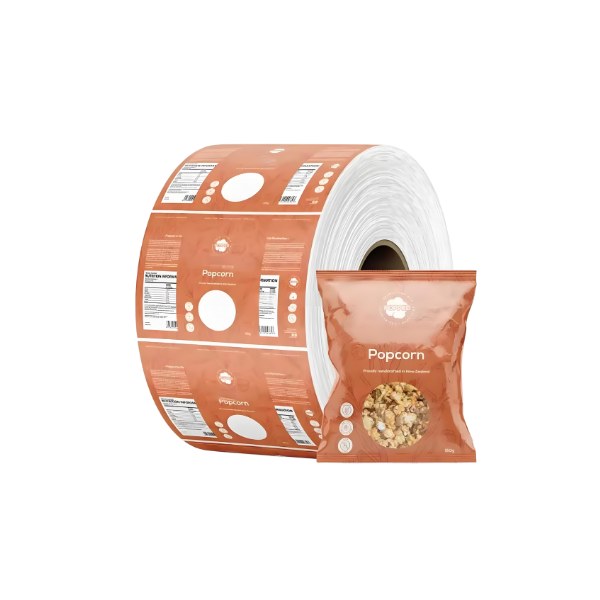
If your project requires high-barrier roll materials for automated filling lines, CloudFilm’s Packaging Film Roll page may help you compare roll structure, width, thickness, core size, and machine compatibility.
How to Choose the Right MET PET Film Supplier
A good MET PET film supplier should not only quote a price. The supplier should help you confirm thickness, density, GSM, optical density, metal adhesion, surface treatment, roll width, roll length, core size, and laminate compatibility.
For printed laminated packaging, surface treatment is important. If the film will be laminated, metal adhesion and bonding performance are critical. If the film will be used in high-speed machines, roll winding quality, flatness, COF, and splice control should also be checked.
A professional MET PET film manufacturer should also understand the final packaging application. Coffee packaging, snack packaging, powder packaging, and pet food packaging may require different barrier levels, sealant layers, pouch formats, and testing standards.
When sending an inquiry, buyers should provide:
- Product application
- Target structure
- Film thickness
- Roll width and length
- Core inner diameter
- Required optical density or barrier target
- Printing or lamination method
- Monthly or annual quantity
- Destination port or delivery terms
- Sample or technical datasheet from current supplier, if available
CloudFilm can support buyers with metallized PET film, high-barrier films, laminated roll stock, and customized flexible packaging solutions. For broader barrier material selection, you can also review CloudFilm’s High Barrier Film category.
MET PET Film vs Aluminum Foil
MET PET film and aluminum foil are both used for barrier packaging, but they are not the same.
Aluminum foil usually provides stronger total barrier against light, oxygen, and moisture. It is often selected for demanding applications such as pharmaceutical packaging, retort packaging, sensitive powders, and long shelf-life products.
MET PET film is lighter, more flexible, and often more economical than foil-based structures. It provides metallic appearance and good barrier performance, but it may not replace foil in every application.
The right choice depends on shelf life, product sensitivity, filling process, packaging machine, budget, and market requirements. For many dry food and consumer packaging projects, MET PET can be a practical high-barrier option. For more demanding projects, foil laminates may be safer.
CloudFilm’s Film and Foil in Flexible Packaging guide can help buyers compare film-based and foil-based structures.
MET PET Film vs PET/PE Film
PET/PE film is a common clear laminated packaging structure. PET provides strength and printability, while PE provides heat sealability. It is suitable for many general packaging applications where a metallic barrier layer is not required.
MET PET-based structures are selected when the package needs stronger barrier, metallic appearance, or better light protection. For example, PET/PE may be suitable for a clear flow-wrap pack, while PET/MET PET/PE may be better for coffee, powder, or aroma-sensitive products.
For clear laminated packaging structures, you can review CloudFilm’s PET/PE Film page.
Practical Buyer Tips
Do not compare MET PET film only by kilogram price. Always convert price into square-meter cost when possible.
Confirm whether the quoted thickness is nominal thickness or measured average thickness.
Ask for actual GSM if the project is cost-sensitive.
Check whether the supplier includes core weight in roll weight.
Confirm roll diameter and roll length because high-density films may reach target roll weight earlier than low-density films.
If the film will be laminated, test bond strength, metal adhesion, and appearance after lamination.
If the product is sensitive to moisture or oxygen, ask for barrier data from the final laminate, not only from the single film.
If you are changing suppliers, send your current sample or datasheet so the new supplier can match the structure more accurately.
MET PET Film Density FAQ
1. What is the typical density of MET PET film?
The typical density used for MET PET film calculation is about 1.39 g/cm³. In practical purchasing, many packaging-grade PET films are considered around 1.38–1.40 g/cm³. The exact value should be confirmed by the supplier’s technical datasheet.
2. Does the metallized layer greatly increase MET PET film density?
Usually no. The metallized layer is extremely thin, so the practical density is still close to the PET base film. However, actual GSM may vary slightly due to coating, treatment, and production tolerance.
3. How do I calculate the GSM of MET PET film?
Use this formula: GSM = thickness in microns × density in g/cm³. For example, 12 micron × 1.39 = 16.68 g/m².
4. How many square meters are in 1 kg of 12 micron MET PET film?
Using 1.39 g/cm³ density, 12 micron MET PET film is about 16.68 g/m². The yield is 1000 ÷ 16.68, which is about 60 m²/kg.
5. Why is MET PET heavier than BOPP at the same thickness?
PET has higher density than polypropylene. Therefore, at the same thickness, PET-based film usually weighs more per square meter than BOPP, CPP, or PE film.
6. Is MET PET film suitable for coffee packaging?
Yes. MET PET film is widely used in coffee packaging because it helps improve oxygen, moisture, aroma, and light barrier when laminated with suitable outer and inner layers.
7. Can MET PET film be used as a sealing layer?
Usually no. MET PET is normally used as a middle barrier layer. A heat-sealable inner layer such as PE or CPP is usually required.
8. What structure is commonly used with MET PET film?
Common structures include PET/MET PET/PE, PET/MET PET/CPP, BOPP/MET PET/PE, and paper/MET PET/PE. The right structure depends on the product, filling process, shelf-life target, and packaging machine.
9. Should I buy MET PET film by kg or by square meter?
International film trading is often quoted by kg, but buyers should also calculate square-meter cost. This gives a clearer view of real packaging cost.
10. What information should I send to a MET PET film supplier?
You should provide film thickness, width, roll length, core size, application, target structure, barrier requirement, optical density requirement, quantity, and destination. A current sample or datasheet is also very helpful.
11. Can MET PET film replace aluminum foil?
In some dry food and consumer packaging applications, MET PET can be a cost-effective alternative. But for very high barrier, pharmaceutical, retort, or highly sensitive products, aluminum foil may still be required.
12. Can CloudFilm supply customized MET PET film rolls?
Yes. CloudFilm can support customized metallized PET film rolls and related laminated packaging structures based on thickness, width, roll size, barrier target, and application requirements. Buyers can send project details for technical review and quotation.
Conclusion
The density of MET PET film is a key factor in packaging cost calculation, roll design, quotation comparison, and material selection. For most packaging-grade MET PET films, buyers commonly use about 1.39 g/cm³ for quick calculation, while the exact value should always be confirmed by the technical datasheet.
A correct density calculation helps you estimate GSM, roll weight, square-meter yield, freight cost, and real packaging cost. It also helps avoid mistakes when comparing MET PET with BOPP, CPP, PE, PET/PE, or aluminum foil structures.
If you are sourcing MET PET film for coffee, snacks, powder, pet food, or other high-barrier flexible packaging, work with a supplier who can support both technical calculation and real production requirements. CloudFilm can help you review your current structure, calculate roll weight and yield, prepare samples, and recommend suitable metallized PET or laminated packaging film solutions for your market.