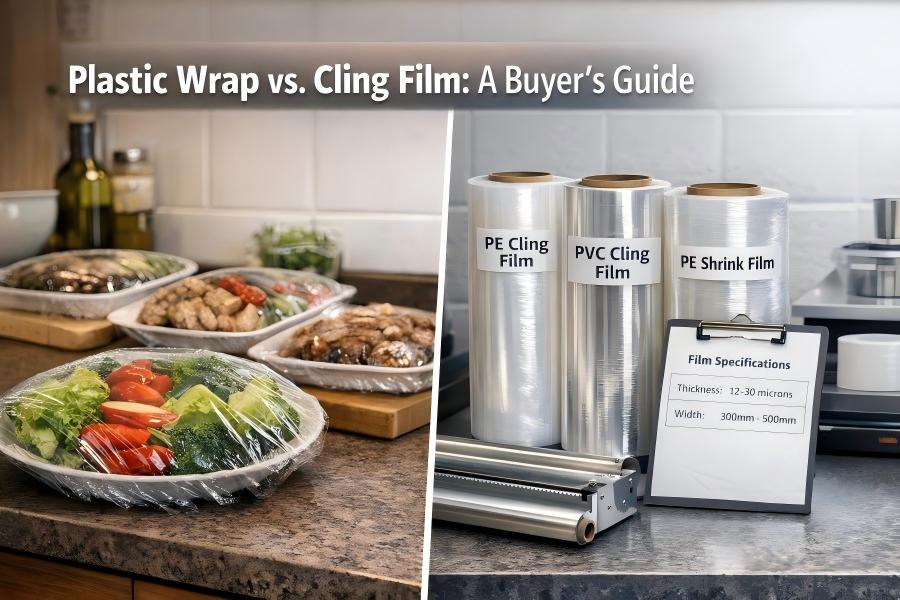
Plastic Wrap Vs Cling Film – Everyday Language Vs Packaging Terminology
When consumers talk about “plastic wrap” or “cling film”, they usually mean the same everyday product: a thin, transparent film used to cover food in kitchens, supermarkets, and restaurants. In many markets, “plastic wrap”, “cling film”, “food wrap”, “cling wrap”, “fresh-keeping film” and even brand names like “Saran wrap” are used almost interchangeably in daily conversation.
However, once you step into the world of flexible packaging and B2B sourcing, “plastic wrap” and “cling film” can point to more specific materials, structures and applications. For example, some buyers use “cling film” only for food-contact wrap with self-clinging properties, while “plastic wrap” may be used more broadly for any thin film wrapped around products, including shrink film or pallet stretch wrap.
From a technical perspective, what most people call “kitchen plastic wrap” or “cling film” is usually a very thin PE or PVC film designed to:
- cling lightly to trays, bowls and plates without adhesive
- provide a moisture barrier to reduce drying out
- keep aromas in and external odors out
- remain soft and clear at refrigerator temperatures
To avoid confusion in this article:
- “Cling film” / “food wrap” → thin, soft film that clings around food (primary or near-primary packaging).
- “Plastic wrap” → can mean the same thing as cling film, but many people also use it loosely for shrink film or stretch film.
- “Shrink film” / “shrink wrap” → film that tightens around the product when heated.
- “Stretch film” / “pallet wrap” → film stretched around pallets and boxes for transport.
What Actually Makes A Cling Film? Materials And Properties
If we move beyond names and look at what defines a cling film technically, three core aspects matter:
- Material family (PVC, PE, PVDC, etc.)
- Self-cling behavior – the film gently sticks to smooth surfaces
- Food-contact safety and regulations
Common Material Types For Cling Film
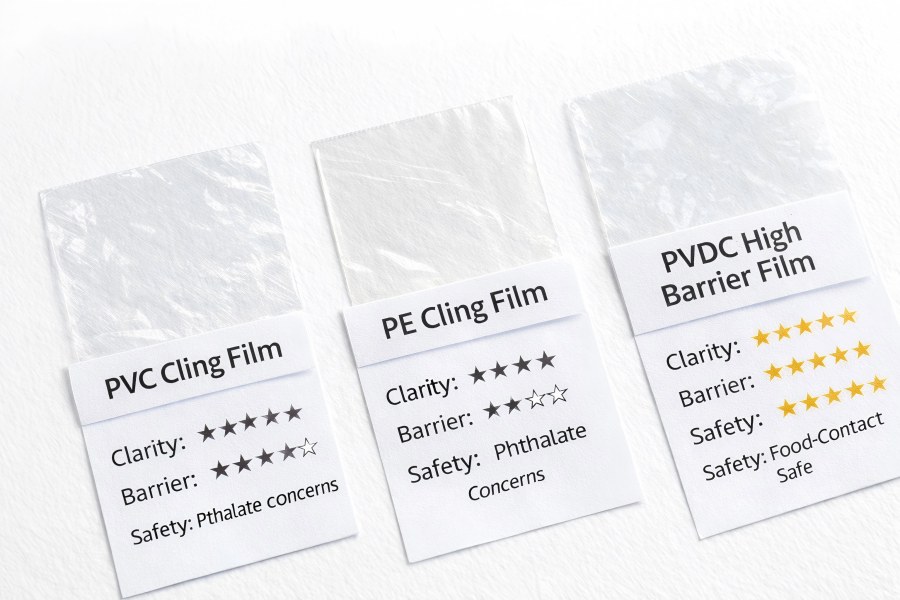
Most commercial cling films on the market fall into three material groups:
- PVC (Polyvinyl Chloride)
- Historically dominant in many regions due to strong cling and high clarity.
- Often contains plasticizers, which are a concern for high-temperature or fatty-food applications.
- Many retailers and regulators are gradually limiting PVC for sensitive food-contact uses.
- PE (Polyethylene), mainly LDPE / LLDPE
- Chemically simpler, without the same plasticizer concerns.
- Slightly lower natural cling but can be tuned by formulation and surface treatment.
- Widely used for bread bags, produce bags and “softer-feel” food wraps.
- PVDC (Polyvinylidene Chloride)
- Outstanding barrier to oxygen and moisture.
- More expensive and used in specific high-barrier projects rather than everyday household wraps.
In many modern food projects, buyers are moving from PVC-based cling films toward PE-based wraps to improve regulatory comfort and brand image. CloudFilm’s articles on cling film categories and packaging PE film explain how LDPE and LLDPE grades are tuned for cling, clarity and machinability in real production.
Why Many Buyers Prefer PE Cling Films Today
From a B2B perspective, PE cling films offer several advantages:
- Better perception of safety – no traditional phthalate plasticizers.
- Flexible structures – can be used as mono-layer PE wrap, or as part of laminates like PET/PE or PE/PE.
- Recyclability potential – PE is the backbone of most mono-material flexible packaging concepts.
This is why you will often see specifications such as “PE cling film 10–15 μm, food grade, suitable for direct contact”, especially in projects that also consider mono-material all-PE packaging for recyclability. For deeper technical background, CloudFilm’s packaging PE film selection guide gives real ranges for thickness, width and structure that you can use directly in RFQs.
For buyers who want to understand how LDPE and LLDPE behave in real projects, our packaging PE film selection guide explains typical thickness ranges, structures and applications.
So… Is Plastic Wrap The Same As Cling Film?
Now we can answer the core question in a more precise way:
In everyday language – yes, plastic wrap and cling film are usually the same thing.
In technical and B2B language – “cling film” tends to mean thin, self-clinging food wrap, often PE-based, while “plastic wrap” can be a vague term that also includes shrink film or stretch film in some markets.
When Plastic Wrap And Cling Film Are Effectively The Same
For home kitchens, small restaurants, bakeries and many supermarket counters, buyers will often send RFQs saying “plastic wrap” or “cling film” interchangeably, but their specification looks like this:
- material: LDPE / LLDPE or PVC
- thickness: about 8–15 μm
- width: 250–450 mm
- use: hand wrapping of trays, plates, bowls and food pans
In these cases, plastic wrap = cling film = food wrap, and the only thing that really changes is material choice, thickness and brand. CloudFilm’s cling film buying guide goes deeper into how PVC, PE and PVDC cling films compare in safety, barrier and price.
For a deeper material comparison, you can also read our guide to choosing the right cling film, which explains PVC, PE and PVDC options with tables and FAQs.
When “Plastic Wrap” Might Mean Something Else
Confusion usually appears when:
- a logistics buyer uses “plastic wrap” to mean pallet stretch film
- a food brand uses “plastic wrap” to mean heat shrink film used for retail bundles
- an end user simply doesn’t know whether their current wrap shrinks or stretches
That is why, when you contact a manufacturer or supplier, it is important to clarify:
- Is the film self-clinging at room temperature, or activated by heat?
- Is it used for direct food contact, or only as an outer bundle?
- Do you wrap by hand, on a dispenser, or on an automatic line?
The clearer your description, the faster a packaging film manufacturer like CloudFilm can tell whether you need cling film, shrink film, stretch film or a laminated food packaging film.
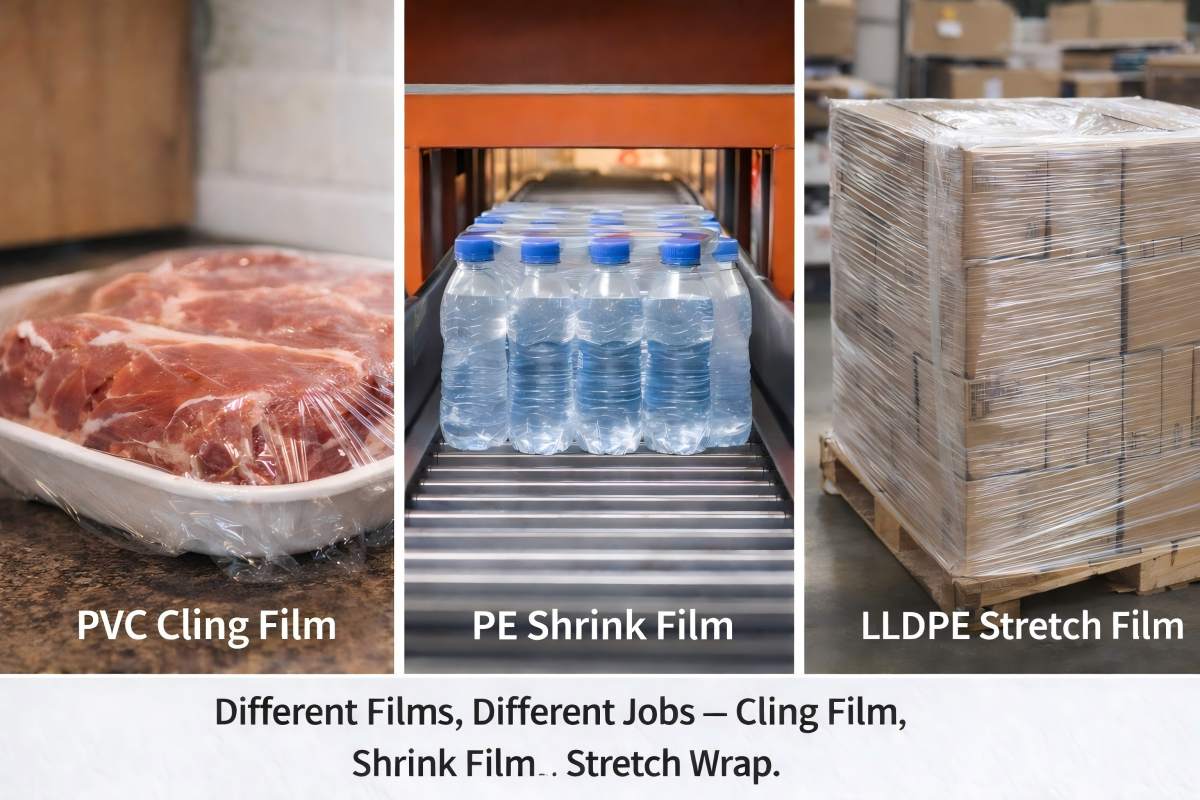
Don’t Confuse Cling Film With Shrink Film And Stretch Wrap
Because all of them can look like “transparent plastic film”, many people mix up:
- Cling film – thin, soft, self-clinging
- Shrink film – shrinks under heat
- Stretch film / pallet wrap – stretches around loads for transport
From an engineering and cost perspective, these are very different products.
Cling Film Vs Shrink Film
- Cling film
- Very thin (often 8–15 μm)
- Used at room or fridge temperature
- Mainly for short-term freshness and presentation of food trays, leftovers, deli items
- No shrink tunnel; only manual or light mechanical dispensing
- Shrink film
- Thicker and stronger (POF shrink film ~12–25 μm; PE shrink film often 40–80 μm)
- Requires a heat source (shrink tunnel, heat gun) to shrink tightly around the product
- Used for retail multipacks, boxed goods, beverage trays and industrial bundles
A buyer who writes “plastic wrap for beverage packs” but actually needs heat shrink film will end up with the wrong product if the supplier assumes kitchen cling film. To avoid this, CloudFilm has a dedicated heat shrink film packaging guide and a full shrink film collection that explain PVC, POF, PE and PETG shrink films, their applications and selection logic.
For a structured overview of shrink materials, see our heat shrink film packaging guide.
You can also browse our shrink film collection to compare PVC, POF, PE and PETG shrink films in one place.
Cling Film Vs Stretch Film (Pallet Wrap)
- Stretch film / pallet wrap is typically LLDPE-based, 12–35 μm thick, and designed to be stretched around pallets or boxes while under tension.
- It does not have the same soft cling or clarity requirements as food wrap, but must deliver load stability, puncture resistance and cling between layers.
In short:
- If your keyword is “plastic wrap for pallets”, you are looking for stretch film.
- If your keyword is “plastic wrap for food trays”, you are looking for cling film or food packaging film.
How To Choose The Right Wrap For Your Application (EN)
Instead of arguing about words, it is more useful to start from your application and work backwards to the right film:
Household And Catering Use
If you are sourcing cling film for home use, catering, bakeries or small restaurants, key questions are:
- Will the film be used in microwave or oven?
- Will it mainly cover cold food, or also hot, oily dishes?
- Do you need ready-made rolls with cutter box, or larger jumbo rolls for dispensers?
In many markets, PE-based cling film is preferred for higher safety perception and simpler recycling streams, while PVC-based films may still be found where regulations are looser and cost is the main driver.
Supermarkets And Food Processors
For supermarkets, central kitchens and food processors, requirements move closer to what a professional food packaging film manufacturer can provide:
- precise thickness and tensile strength to avoid tears
- consistent width and roll length for automatic dispensers
- compliance documentation (FDA, EU, GB, etc.)
- potential migration tests for fatty or high-temperature products
In some projects, cling film is combined with trays, lidding films and vacuum pouches as part of a broader packaging system. Here, it is more accurate to talk about “food packaging film” rather than only “plastic wrap”.
If you need not only cling film but also lidding films and pouches, our food packaging film manufacturer page shows how we combine BOPP, PET, PE and high-barrier webs into complete food packaging structures.
Converters, Brands And Importers Sourcing Film Rolls
If you are a converter, brand owner or importer, you probably don’t buy small finished rolls; you buy film rollstock for slitting, printing and converting. In that case, your decision is less about “Is it called plastic wrap or cling film?” and more about:
- mono-layer PE cling film vs PE-based laminates (e.g. PET/PE, PE/PE)
- fully transparent crystal flexible packaging vs slightly hazy PE-only wraps
- mono-material all-PE solutions vs traditional PET/PE or PET/AL/PE structures
For high-clarity shelf presentation, many brands choose BOPP or PET outer webs + PE sealant layers, as described in CloudFilm’s guide to crystal flexible packaging. For recyclable projects, the trend is toward mono-material films based on PE or PP.
If you are exploring premium clear packaging, our crystal flexible packaging solutions article explains how to design glass-like clarity with flexible film.
For sustainability projects, see our overview of mono-material films in packaging and how all-PE or all-PP structures support recyclability goals.
In short, start with your product and process, then choose structure and film type, and only then worry about names like “plastic wrap” vs “cling film”.
Working With CloudFilm As Your Cling Film / Food Wrap Manufacturer And Supplier
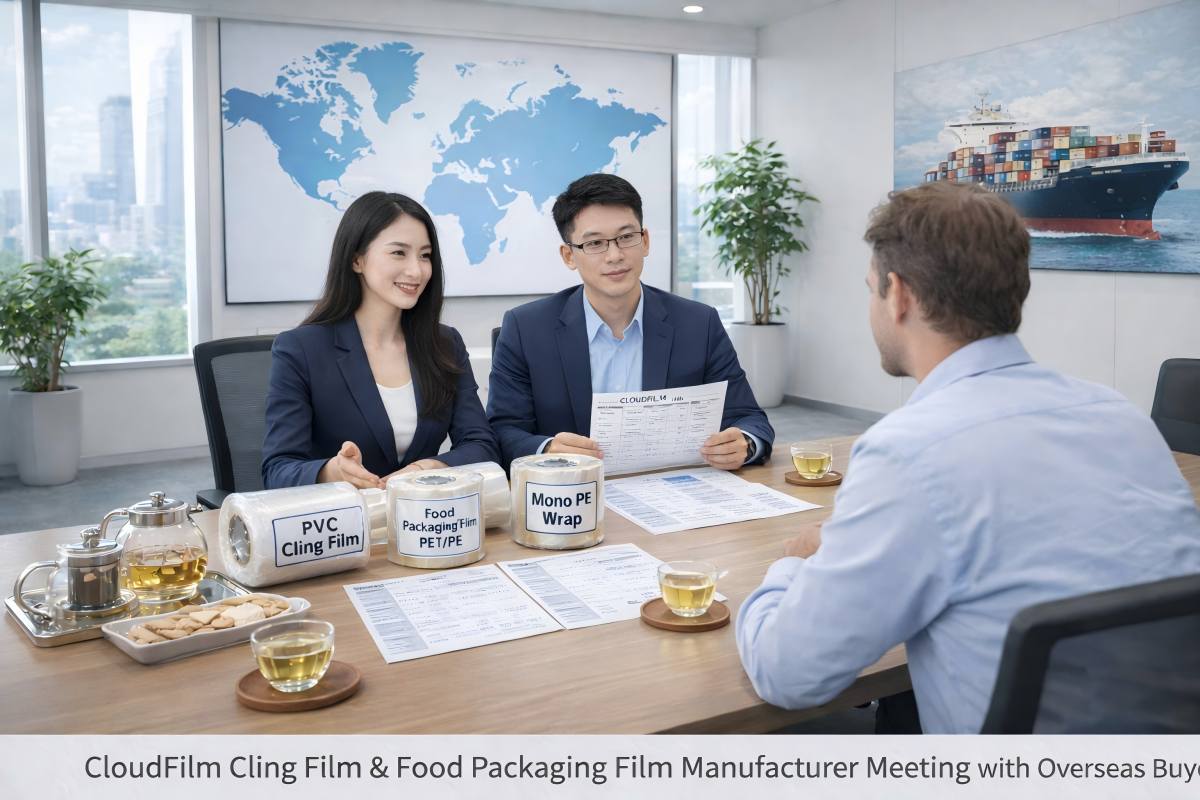
For overseas buyers, converters and brand owners, the real challenge is not the terminology—it is finding a reliable manufacturer and supplier who understands both material science and export logistics.
CloudFilm is a flexible packaging film manufacturer based in Qingdao, China, focused on BOPP, BOPET, BOPA, PE, CPP, high-barrier and speciality films, as well as custom pouches. For projects involving cling film, food wrap or related structures, we typically support buyers in three ways:
- PE-based cling and food wrap films – LDPE / LLDPE films designed for soft feel, clarity and stable sealing.
- High-clarity outer webs and laminates – BOPP, PET and crystal-clear structures when you need premium on-shelf appearance.
- Mono-material and recyclable solutions – MDOPE, BOPE and mono-PE laminates for brands moving toward all-PE packaging.
When you contact a manufacturer, including CloudFilm, try to share:
- your product (e.g. fresh meat tray, bakery items, vegetables, frozen food)
- current or target structure and thickness
- whether the film is for direct food contact or as outer wrap
- roll width, roll length and estimated monthly or annual volume
The more specific your brief, the easier it is for the manufacturer to quickly move from generic “plastic wrap” to a precise cling film or food packaging film proposal.
To learn more about our capabilities as a China-based producer, you can visit the CloudFilm flexible packaging manufacturer page, which summarizes our product portfolio, capacity and export experience.
FAQs – Key Questions About Plastic Wrap, Cling Film And Shrink Film
Q1. Is plastic wrap the same as cling film?
In everyday life, yes—most people use the two terms for the same kitchen wrap. Technically, “cling film” usually means a thin, self-clinging food wrap, while “plastic wrap” can also refer to shrink film or stretch film depending on context.
Q2. Is PVC cling film safe for food?
High-quality PVC cling film produced by reputable manufacturers can meet specific food-contact regulations, but it relies on plasticizers and is increasingly restricted in many markets, especially for high-temperature or fatty foods. Many brands therefore prefer PE-based cling films for a simpler safety profile.
Q3. Which material is better for my cling film, PE or PVC?
- Choose PE cling film if you prioritize regulatory comfort, sustainability and potential recyclability.
- Choose PVC cling film only if regulations allow it and cost is the overriding factor, and avoid high-heat or high-fat direct contact.
Q4. Can cling film be used in the microwave?
Always follow local regulations and the manufacturer’s instructions. In general, not all cling films are suitable for microwave heating—especially PVC-based films or films without explicit high-heat approval. When in doubt, avoid direct contact with hot food and use microwave-safe lids instead.
Q5. Is shrink film a type of plastic wrap?
Shrink film is a different product: it requires heat to shrink tightly around items and is commonly used for retail multipacks, beverage trays and industrial bundles. It is not designed for short-term cling around open food trays.
Q6. What information should I send to a cling film or plastic wrap supplier?
To get a precise quotation, include at least:
- product type and whether it is direct food contact
- target material (PVC, PE or open to suggestions)
- thickness range (e.g. 8–15 μm) and roll width
- packaging form (small rolls for retail, jumbo rolls for converting)
- monthly or annual volume and destination market
Q7. Can cling film be part of a mono-material recyclable solution?
Yes. Many brands are exploring mono-PE structures, where PE cling film, PE lidding film and mono-PE pouches form a consistent, all-PE system that is easier to recycle than mixed-material laminates. CloudFilm’s work on mono-material films in packaging and packaging PE film gives several real-world examples.
Q8. I search “plastic wrap supplier” or “cling film manufacturer in China”. How should I shortlist partners?
Look for suppliers who can:
- explain material choices (PVC vs PE vs PVDC) clearly
- provide technical data sheets and food-contact documentation
- offer trial rolls and support line trials
- also supply related films like shrink film, stretch film or high-barrier laminates if you need a full packaging solution
As a flexible packaging film manufacturer and exporter, CloudFilm regularly works with overseas buyers who start with a simple search like “cling film supplier” and then refine their requirements together with our technical team.