When people hear news about the Middle East, crude oil, or geopolitical risk, many assume it is something far away from everyday life. It sounds like a topic for governments, traders, or large energy companies. But in reality, oil price volatility reaches much further.
It can influence transport costs, food prices, packaging costs, factory operations, and even what ordinary families pay for daily essentials.
As of early April 2026, oil markets were already reacting sharply to the latest Middle East conflict, with Brent settling at $109.03 per barrel and WTI at $111.54, while the IMF warned that the conflict was leading toward higher prices and slower growth for many economies.
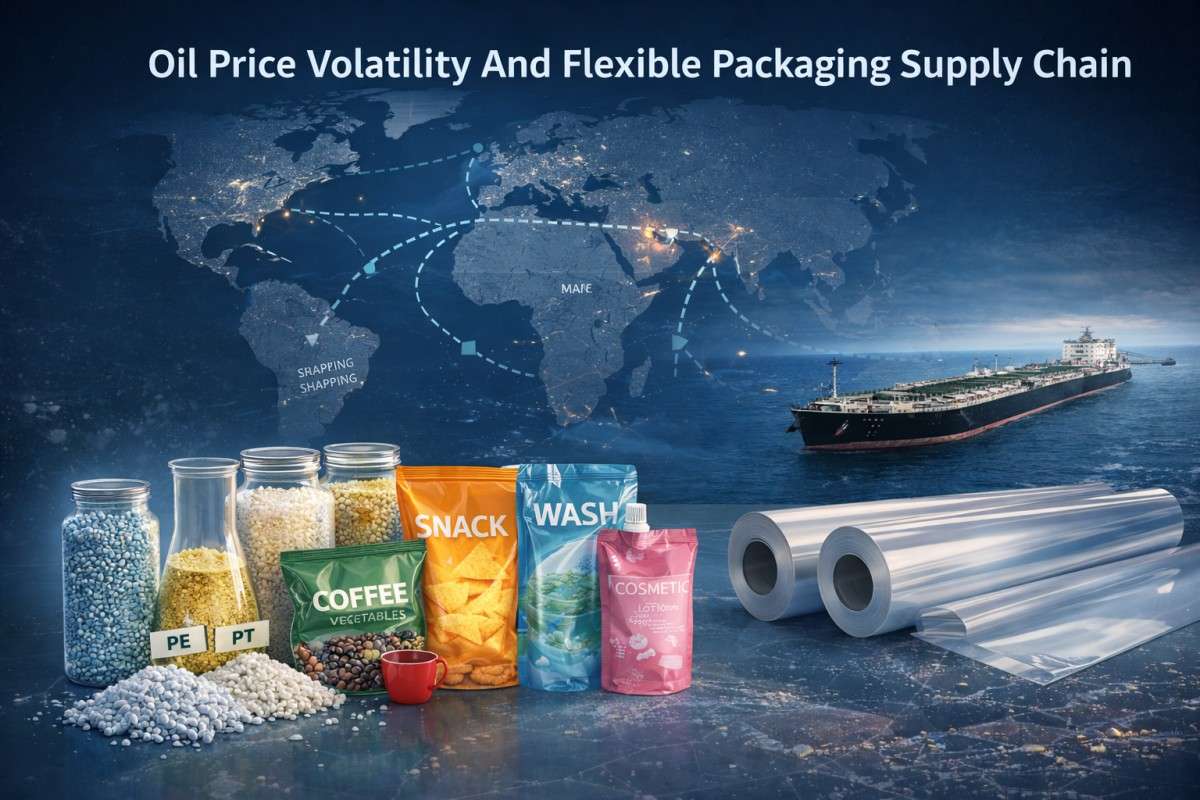
For flexible packaging suppliers, this connection is especially clear. Oil does not only matter because of fuel. It matters because the modern packaging industry is built on an energy-intensive, petrochemical-based supply chain.
When oil prices become unstable, the effects move step by step through resin, film production, logistics, and final product pricing. In the end, even people who never think about crude oil may still pay more for snacks, frozen food, shampoo refills, coffee packs, delivery services, or other packaged goods.
Why the Middle East Has Such a Big Effect on Oil Prices
The first question many readers ask is simple: why does unrest in one region move prices around the world?
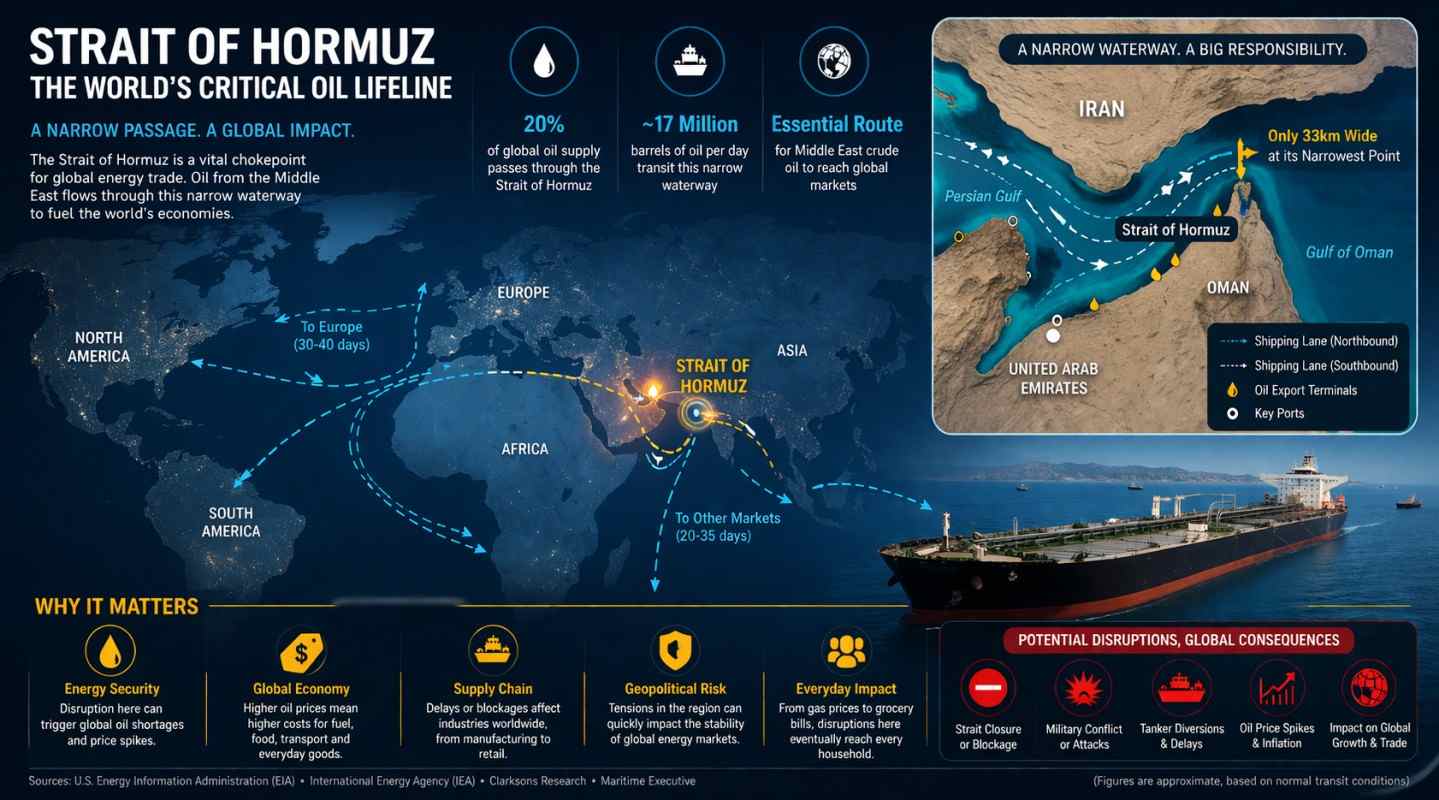
The answer is that the Middle East remains one of the most important regions in the global energy system. It is not only a major production area. It also includes key export routes and shipping lanes. When conflict threatens production, infrastructure, or maritime traffic,
the market responds immediately because global oil supply cannot be adjusted quickly in the short term. That is why prices often jump before a full physical shortage appears. The market is reacting not only to actual disruption, but also to the fear of future disruption.
This is also why headlines about the Strait of Hormuz matter so much. It is a critical route for global oil and gas flows, so any threat there can change freight expectations, insurance costs, delivery timing, and pricing psychology across the world. Even if supply is not fully cut off, uncertainty alone can create a risk premium in energy markets.
Oil Does Not Stop at the Gas Station
Many people think oil affects only gasoline and diesel. That is only one part of the story.
According to the U.S. Energy Information Administration, petroleum products are used to move vehicles, heat buildings, produce electricity, and serve as feedstock for the petrochemical industry. In other words, oil is both a fuel and an industrial raw material.
The petrochemical sector uses petroleum to make plastics, polyurethane, solvents, and many other intermediate goods that later appear in packaging, construction materials, textiles, electronics, and household products.
That is why oil price volatility can spread much more widely than people expect. It can affect transportation, factory operating costs, raw material prices, and the cost structure of many consumer products at the same time.
The World Bank notes that over the past five decades, oil price shocks were the single largest driver of variation in global inflation, contributing more than 38 percent. This helps explain why oil market stress is often felt well beyond the energy sector.
How Crude Oil Becomes Plastic and Then Becomes Film
To understand why flexible packaging film prices move with oil, it helps to follow the chain more closely.
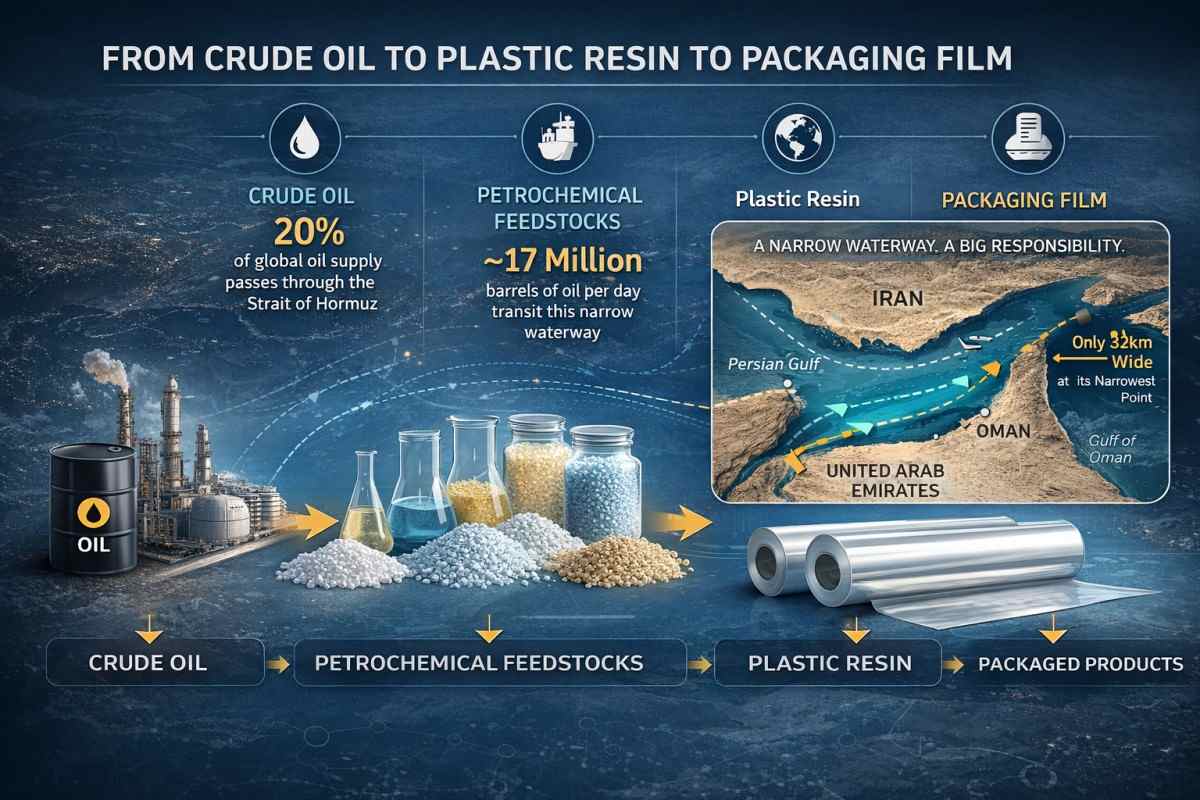
Crude oil is refined into many products, including petrochemical feedstocks such as naphtha. Those feedstocks are then used in crackers and chemical plants to produce basic building blocks for plastics.
The EIA explains that naphtha and other oil-derived feedstocks are used to make the basic materials needed for plastic production. This is the upstream foundation for many packaging resins.
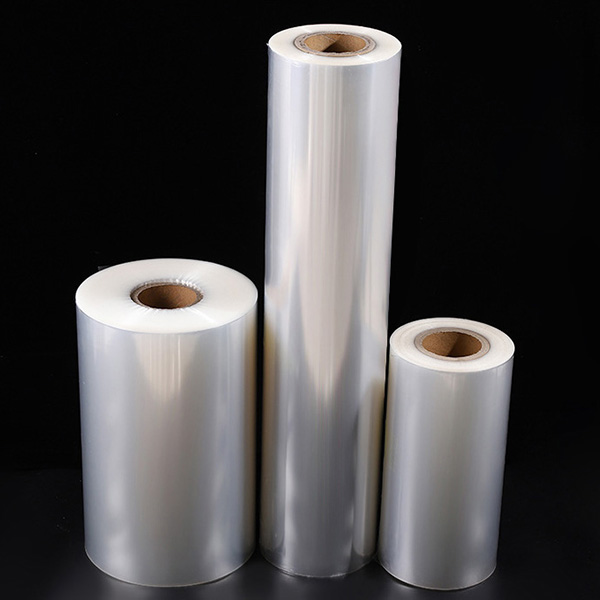
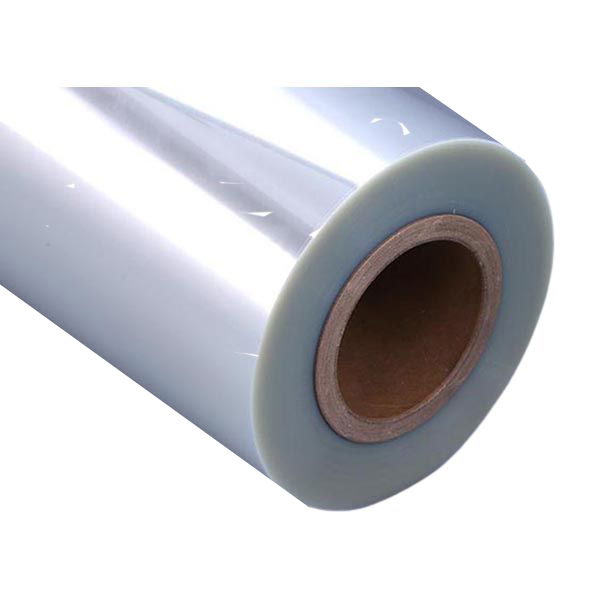
From there, the chain continues into resins and finished materials. Polyethylene, polypropylene, BOPP, CPP, and many other flexible packaging materials are closely connected to the broader petrochemical chain.
PET follows a different but still energy-linked petrochemical route. So when oil prices rise sharply, or when the market becomes nervous about energy supply, packaging producers often face cost pressure on more than one front at the same time.
Why Flexible Packaging Film Prices Rise for More Than One Reason
When film prices go up, many buyers assume it is only because raw materials became more expensive. In reality, that is only part of the picture.
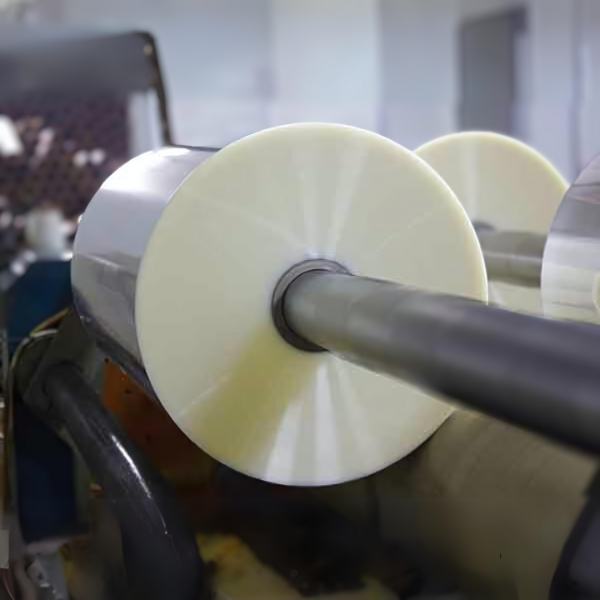
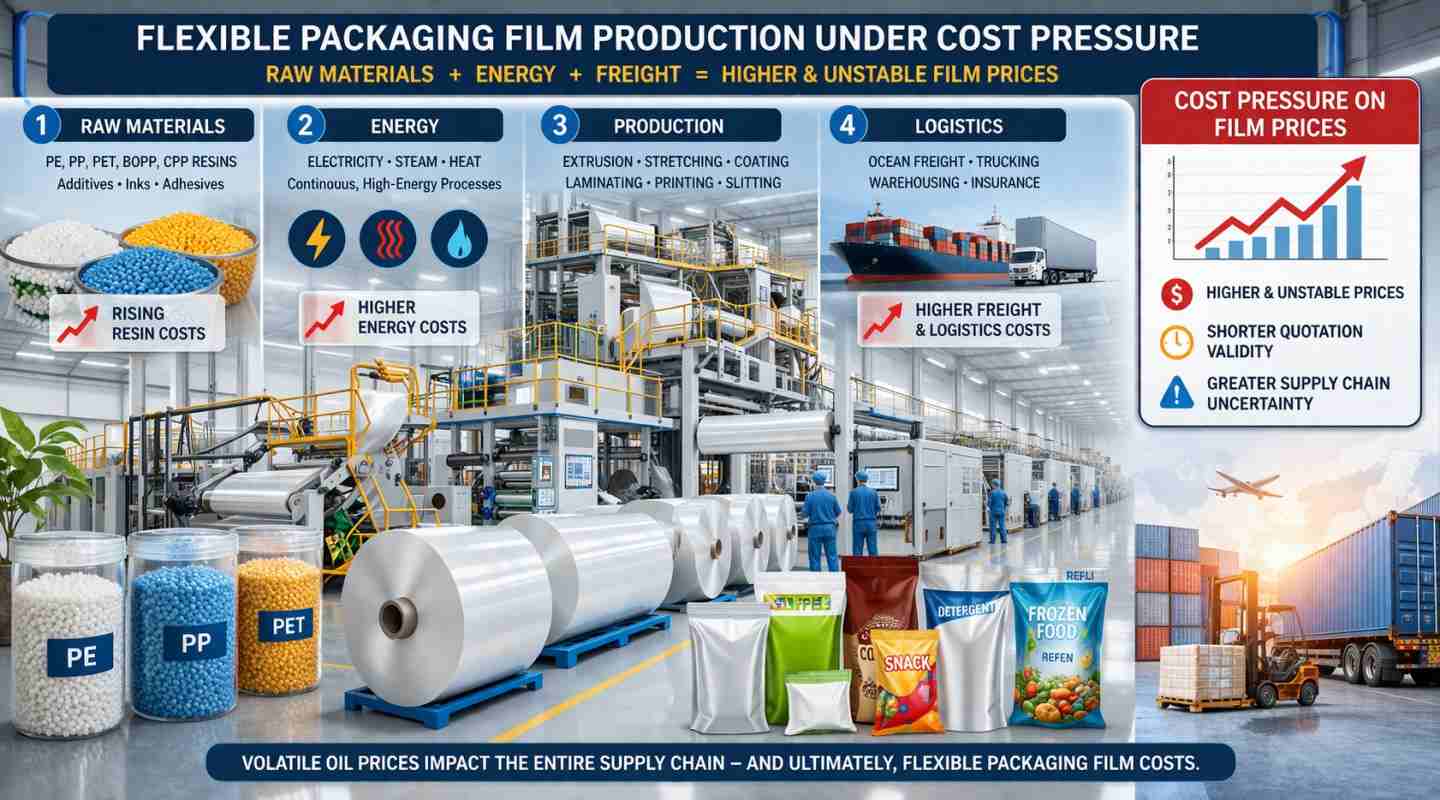
The first cost pressure comes from resin and chemical inputs. If upstream feedstocks become more expensive or less stable, resin producers and converters will feel it. But after that comes the second layer: energy. Film production depends on extrusion, stretching, heating, treating, laminating, printing, and slitting.
These are industrial processes that consume electricity and thermal energy. So even if resin prices were unchanged, higher energy prices could still push conversion costs upward.
Then there is the third layer: logistics. When oil prices move higher, transportation becomes more expensive. Ocean freight, inland trucking, warehousing, and delivery all face pressure.
In periods of geopolitical tension, insurance costs, risk surcharges, and scheduling uncertainty may also rise. That means a flexible packaging supplier may face higher costs not only in making the film, but also in moving it.
The fourth layer is quotation stability. In a calm market, suppliers can often hold prices for longer periods. In a volatile market, that becomes much harder. If oil, freight, and input prices are changing quickly, suppliers may shorten quotation validity or revise prices more often. This is not simply a negotiation tactic. It is often a direct response to unstable upstream conditions.
How Oil Price Volatility Reaches Ordinary People
This is where the topic becomes personal.
When oil prices rise, the most visible effect is often at the fuel pump. But that is only the first layer. Transportation costs can affect retail distribution, e-commerce delivery, commuting, agricultural operations, and public transport.
Reuters reported that U.S. gasoline prices moved above $4 per gallon again as the oil shock intensified, showing how quickly energy market stress can reach consumers.
Food is another major channel. The FAO said in early April 2026 that global food prices rose in March to the highest level since September 2025, driven mainly by higher energy prices linked to the Middle East conflict.
It also warned that if the conflict continued, higher input costs could lead farmers to reduce fertilizer use, cut planting, or shift crops, which could continue affecting supply and prices later on.
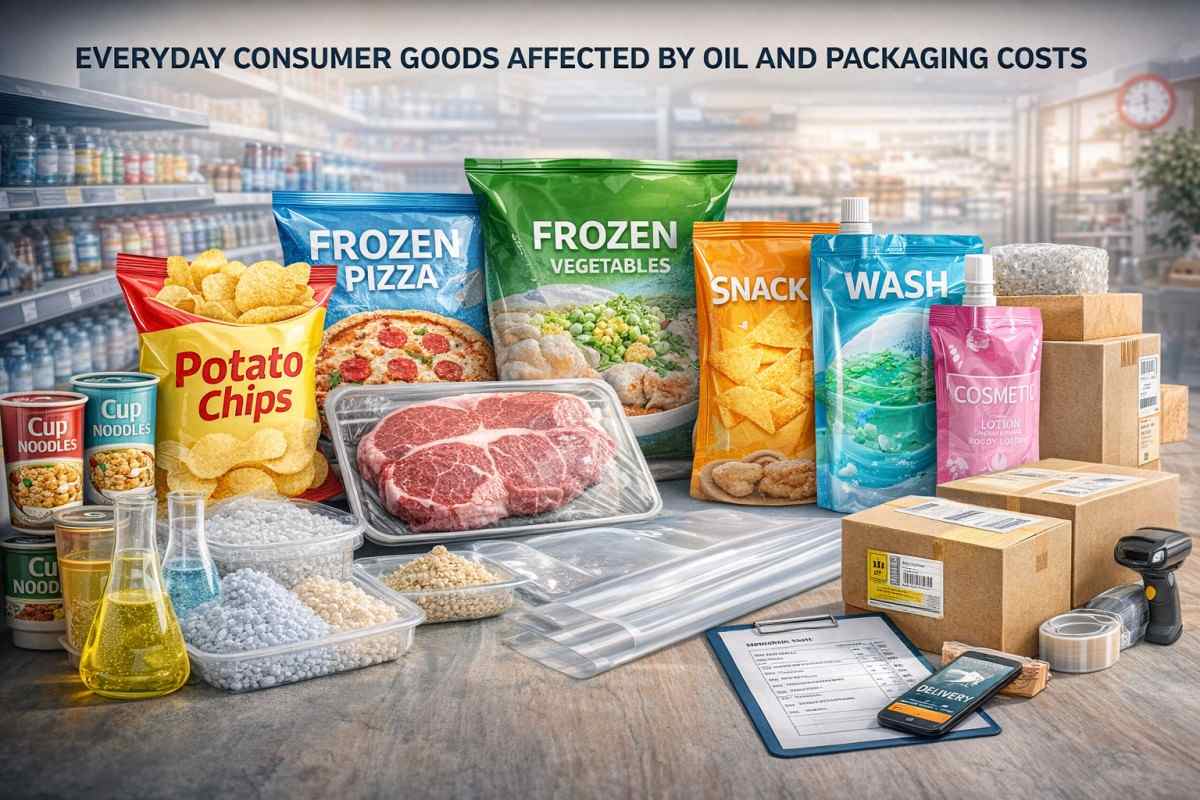
Packaging also matters more than many consumers realize. Modern food, beverages, personal care products, household items, and e-commerce shipments all depend on packaging. If film, pouch, label, or logistics costs increase, that pressure can move into final selling prices.
Sometimes the impact is small on one item, but across many items and many months, households feel it as a broader increase in the cost of living. The World Bank’s research on inflation helps explain why this pattern appears again and again when oil shocks hit the global economy.
Why Prices Often Rise Fast but Fall Slowly
Another common question is this: if oil prices later decline, why do product prices not come down immediately?
The reason is that supply chains move more slowly than markets. A crude oil chart can change in minutes, but manufacturers and retailers usually work with inventories, purchase contracts, production schedules, and shipping lead times.
Companies may still be using higher-cost raw materials purchased earlier. Freight contracts may take time to reset. Some businesses also absorb part of the cost increase first and pass it on only later. Because of this lag, consumer prices often react more slowly and less smoothly than the oil market itself.
This is one reason ordinary people sometimes feel frustrated. They can see headlines saying that oil has eased, but the prices of food, transport, and packaged goods do not fall at the same speed. That is not always because companies are acting unfairly. Often, it is because cost transmission across a supply chain is uneven, delayed, and affected by many contracts and operating realities.
Why This Matters So Much for Flexible Packaging Buyers
For buyers in packaging, food, consumer goods, and industrial products, understanding this chain is important.
A film supplier is not reacting only to one number on an oil chart. The supplier is watching resin costs, energy bills, freight conditions, lead times, availability, and market sentiment all at once.
In an export business, those pressures can be even stronger because international shipping and currency conditions add more uncertainty. This is why packaging quotations may become less stable during periods of oil and geopolitical volatility.
For a flexible packaging film exporter such as CloudFilm, this chain is visible in real business decisions. Oil volatility can affect upstream materials, production costs, logistics planning, and quotation validity at the same time.
For buyers, understanding this does not remove the challenge, but it does make the pricing logic easier to understand. It also shows why communication, lead-time planning, and timely procurement become more important in unstable markets.

Final Thoughts: Oil Volatility Is Really Cost-of-Living Volatility
Oil price volatility is not just an energy story. It is a cost story. It is a supply chain story. And for ordinary people, it is often a daily life story.
When geopolitical tensions rise, oil can become more expensive and more unstable. That instability can spread into energy, transport, chemicals, agriculture, packaging, retail pricing, and household budgets.
For businesses, it can create difficult decisions about sourcing, pricing, and planning. For consumers, it can quietly raise the cost of living through many small changes across many products.
The IMF’s recent warning about higher prices and slower growth, together with the FAO’s warning about food costs and the World Bank’s longer-term inflation research, all point in the same direction: oil volatility does not stay in the oil market for long.
That is why understanding oil price volatility matters even for people who never trade oil, never work in energy, and never think much about global politics. In a connected economy, a shock at the top of the supply chain can eventually reach almost every shopping basket, every delivery route, and every factory floor.
For the flexible packaging industry, that connection is especially direct. But in the end, the impact reaches far beyond film and far beyond industry. It reaches everyday life.