Chemical Treated PET vs Corona Treated PET
This section helps buyers compare two common PET surface-treatment approaches and understand when each one may be appropriate for printing, lamination, coating, and metallizing processes.
| Comparison | Chemical Treated PET | Corona Treated PET |
| Main Purpose | Improve compatibility and adhesion with selected inks, adhesives and coatings | Increase surface energy for better wetting and adhesion |
| Surface Modification | Functional chemical treatment or adhesion-promoting surface | Electrical discharge surface treatment |
| Printing | Suitable for demanding printing applications | Widely used for standard printing |
| Lamination | Useful when stronger or more controlled adhesion is required | Suitable for many conventional lamination processes |
| Metallizing | Selected grades can be designed for metallizing applications | Corona-treated surfaces are also widely used for metallizing |
| Selection Basis | Ink, adhesive, coating and final bond requirement | Required surface energy and converting process |
Which One Should You Choose?
Chemical treated PET and corona treated PET are not simply “better” or “worse” versions of each other. Selection should be based on the actual downstream process.
If standard corona-treated PET already provides stable printing and lamination, changing the material may not be necessary. If the converter has demanding ink, adhesive, coating or metal adhesion requirements, a chemical treated grade may provide a more targeted solution.
How to Choose Chemical Treated PET Film
The correct grade should be selected around the actual converting process, the material that contacts the treated surface, and the required performance in commercial production.
1. Define the Converting Process
First determine whether the PET film will be:
- Printed
- Adhesive laminated
- Metallized
- Functionally coated
- Used through several converting processes
The treatment requirement should always follow the process rather than simply choosing a “treated PET film” specification.
2. Identify the Contact Material
Tell the supplier what will contact the treated PET surface:
- Solvent-based ink
- Water-based ink
- UV ink
- Polyurethane adhesive
- Other laminating adhesives
- Metal deposition
- Functional coating
Different systems may interact differently with the treated surface.
3. Confirm Which Side Requires Treatment
Clearly identify:
- Chemical treated side
- Printing side
- Lamination side
- Metallizing side
- Required treatment on the opposite side
This is particularly important when winding direction determines which surface enters the next process.
4. Confirm Roll Specifications
Provide:
- Film thickness
- Roll width
- Roll length or roll weight
- Paper core size
- Maximum roll diameter
- Winding direction
- Required quantity
5. Test Before Commercial Production
Whenever possible, test the selected PET film with the actual ink, adhesive, coating and converting line before commercial production.
A successful film specification should be based on the entire converting system rather than the PET film alone.

Typical Chemical Treated PET Film Configurations
Chemical treated PET film can be designed around different converting requirements. The final configuration should be confirmed according to the customer’s process rather than selected only by thickness.
Chemical Treated / Untreated
One functional surface is intended for the target printing, lamination or coating process, while the opposite surface remains untreated where additional surface functionality is unnecessary.
Chemical Treated / Corona Treated
This configuration can be considered when one side requires a specialized chemically treated surface while the opposite side also needs controlled surface treatment for another converting step.
Chemical Treated PET for Printing
The treated side is selected according to the intended ink system and required print adhesion.
Chemical Treated PET for Lamination
Designed for projects where PET is laminated with another flexible substrate and reliable adhesive bonding is a key requirement.
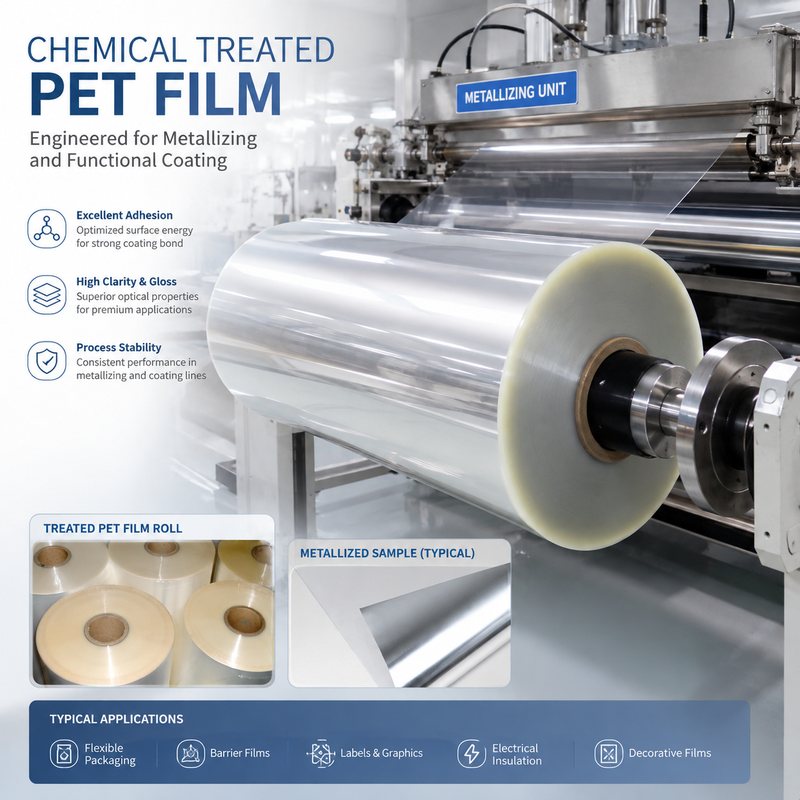
Chemical Treated PET for Metallizing
Selected grades can be evaluated when PET is used as a substrate for vacuum metallization and metal adhesion is particularly important.