Introduction – Why Are PET and CPP Always Compared?
Imagine this scenario: You are a product manager designing packaging for a new snack product. You need a material that can protect the product’s crispiness, perfectly showcase the printed graphics, and be compatible with high-speed automated packaging lines. You are handed two technical data sheets—one labeled “PET” and the other “CPP.”
They both look like transparent plastic films, yet their prices and performance metrics are very different. How do you choose between them? This is a dilemma that nearly everyone in the packaging, printing and composite materials industry has faced at some point.
Worry no more. The purpose of this article is to end that dilemma for you once and for all. We will walk through PET film and CPP film from their “origins” (chemical composition) to their “personalities” (physical properties), and their “specialties” (application areas).
This will be a comprehensive, multi-dimensional showdown. After reading this, you will not only be able to clearly distinguish between PET and CPP, but also confidently select the most suitable “outfit” for your product like a true expert.
Based on real questions from international buyers, CloudFilm’s packaging engineers have structured this guide to help you quickly match PET or CPP film structures to your own projects and reduce trial-and-error costs.
Meet the Contenders – Getting to Know PET and CPP Individually
Contender One: PET Film – The Tough “Hardman”
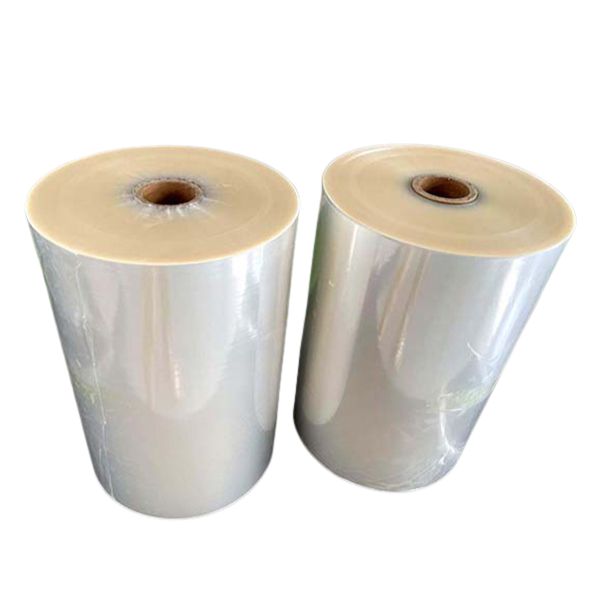
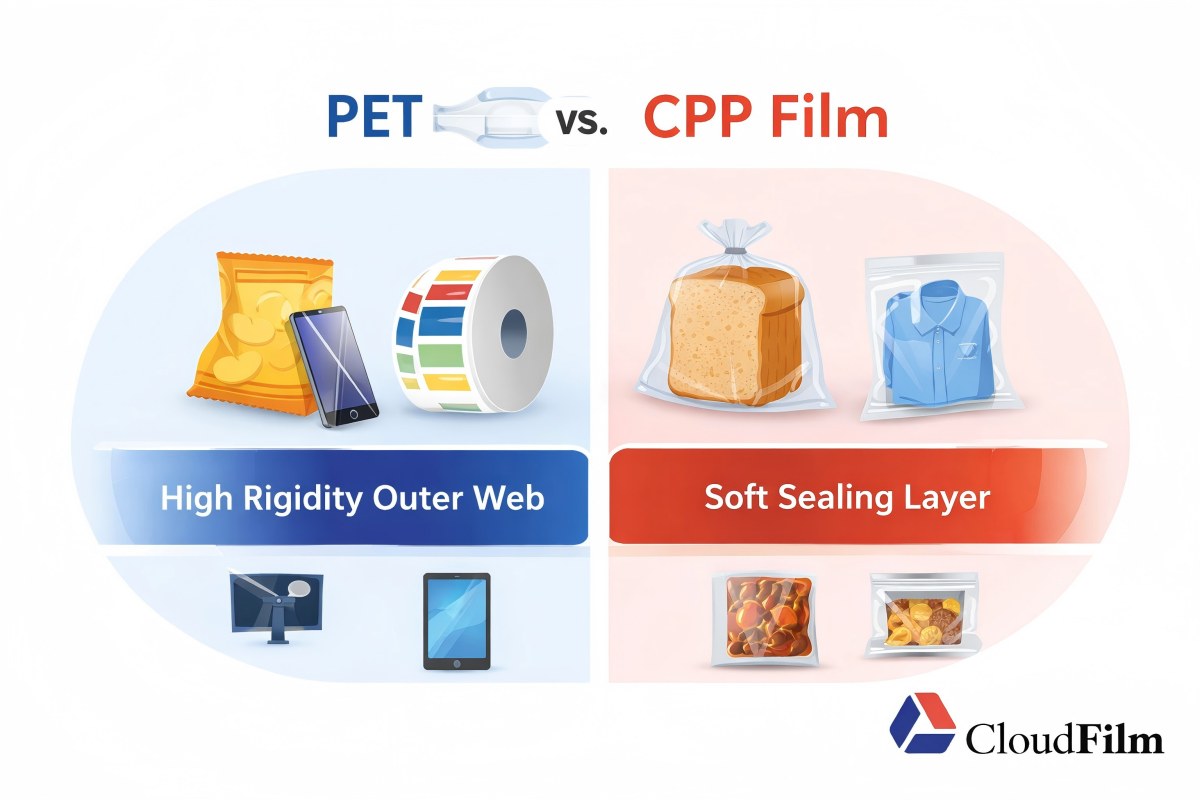
PET, or Polyethylene Terephthalate, is a name you might recognize from polyester fabrics. In the world of plastic films, PET is an undisputed “hardman.”
- Chemical Composition and Background: It belongs to the polyester family. Its rigid molecular chain structure gives it inherent hardness and stability.
- Key Personality Traits:
- High Rigidity, High Strength: It’s incredibly tough, with high tensile strength, making it resistant to tearing and puncturing. To the touch, it feels stiff and “has a backbone.”
- Excellent Heat Resistance: It maintains dimensional stability at both high temperatures (over 120°C) and low temperatures without deforming.
- Superior Barrier Properties: It offers an excellent barrier against oxygen and odors, effectively extending the shelf life of food products.
- High Transparency and Gloss: As clear as crystal, it perfectly renders printed colors and details.
- Where Does It Excel?: You’ll find it in applications demanding high strength, clarity, and aroma retention, such as:
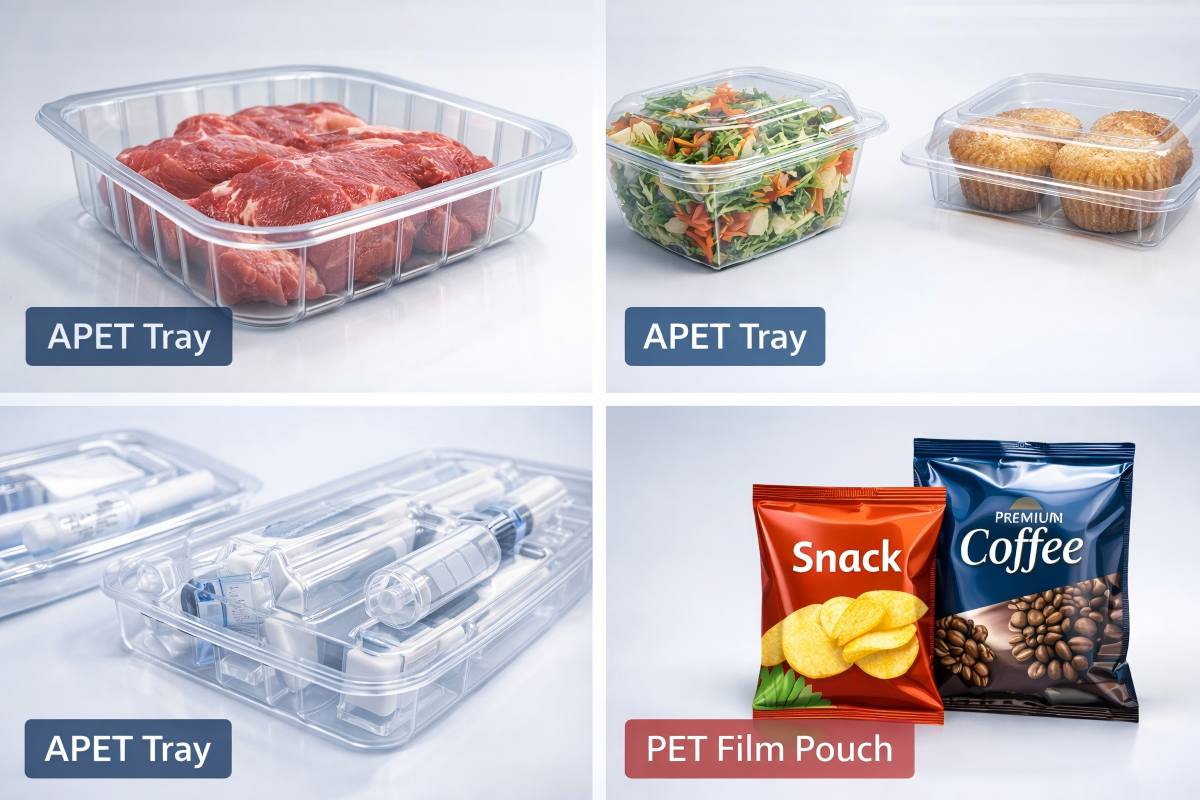
- The outer layer of food packaging (e.g., potato chip bags, transparent windows on biscuit boxes).
- Protective films for electronic device screens.
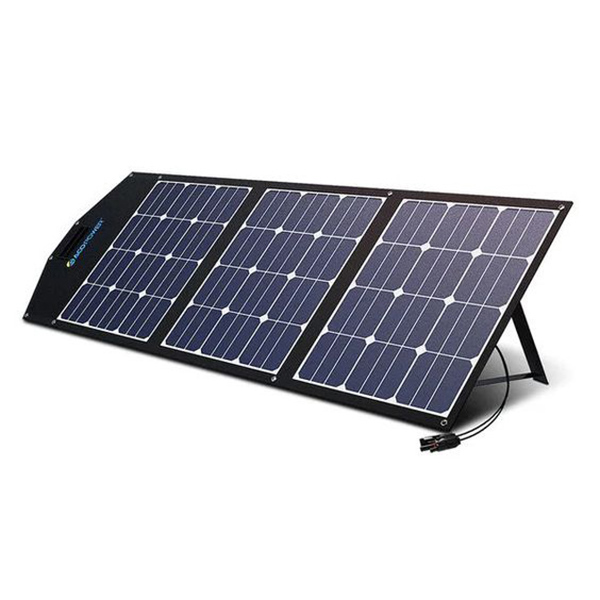
- Backsheet films for solar panels.
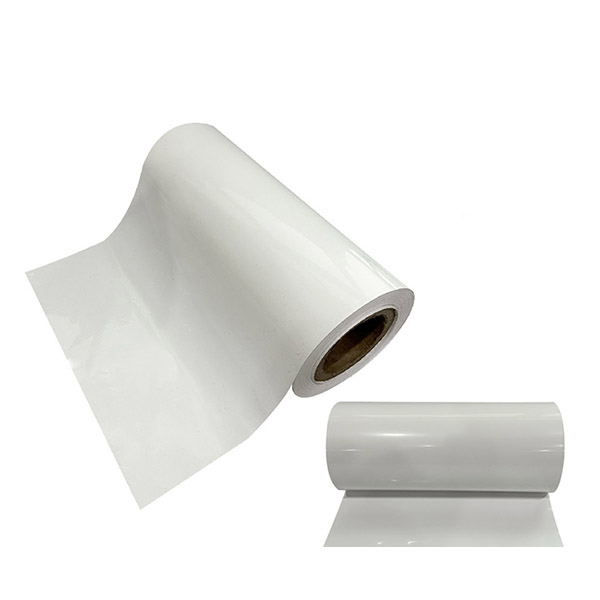
- High-end labels and printed materials.
Contender Two: CPP Film – The Gentle “Soft Touch”
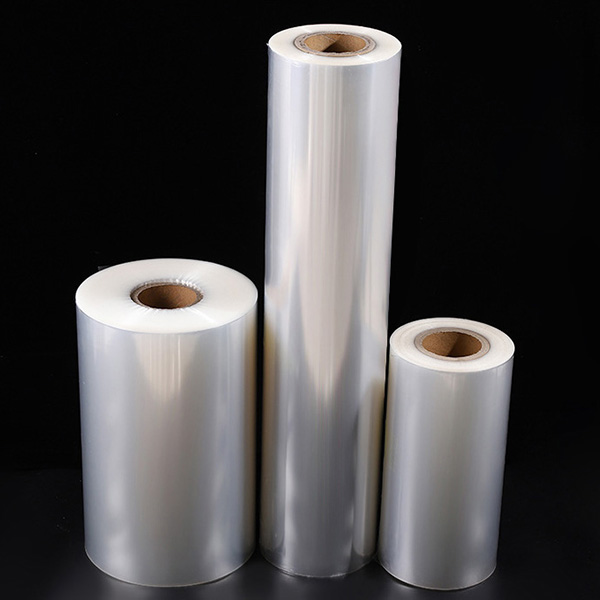
CPP, or Cast Polypropylene, is the “gentle soft touch” to PET’s hardman.
- Chemical Composition and Background: Hailing from the polypropylene family, its flexible molecular chains and the cast (non-stretched) production process grant it exceptional flexibility.
- Key Personality Traits:
- Excellent Flexibility and Crease Resistance: It’s very soft and can be repeatedly folded and crumpled without breaking or retaining permanent creases.
- Outstanding Heat Sealability: This is CPP’s “ace in the hole.” It achieves a strong, reliable seal at relatively low temperatures, making it ideal for high-speed automated packaging lines.
- Good Moisture Barrier: It has a strong resistance to water vapor, effectively preventing products from getting damp.
- Good Oil and Chemical Resistance: It can withstand exposure to oils and many chemical substances.
- Where Does It Excel?: It is often used as an inner layer that requires direct product contact or heat sealing, for example:
- The inner layer of food packaging (e.g., retort pouches, bread bags).
- Flower wrapping paper.
- Garment bags.
- Medical packaging.
For buyers who need a reliable CPP supplier in China, CloudFilm provides a complete CPP film series including clear CPP, anti-fog CPP, anti-static CPP, tissue CPP and retort CPP grades, so you can match each machine speed and application with the right film.
The Head-to-Head Showdown – A Comprehensive Comparison of PET vs. CPP
All the theory in the world can’t beat a clear, side-by-side comparison. The table below lays out the core differences between PET and CPP in a definitive showdown.
| Comparison Dimension | PET Film (Polyethylene Terephthalate) | CPP Film (Cast Polypropylene) | In a Nutshell |
|---|---|---|---|
| Mechanical Properties | High rigidity, high strength. Stiff, resistant to stretching and puncture. | High flexibility, crease-resistant. Soft, easy to fold. | PET is the “skeleton,” CPP is the “flesh.” |
| Thermal Properties | Heat-resistant (approx. 120-150°C), excellent dimensional stability. | Not heat-resistant (deforms above ~120°C), but has excellent heat sealability. | PET withstands heat, CPP seals easily. |
| Barrier Properties | Excellent oxygen and gas barrier, great for aroma retention. | Excellent moisture barrier (water vapor), moderate oxygen barrier. | PET blocks “gas,” CPP blocks “water.” |
| Optical Properties | High clarity, high gloss, superb for printing. | Good clarity, but gloss is typically slightly lower than PET. | PET is “shinier,” CPP is more “matte.” |
| Chemical Stability | Resistant to weak acids and alkalis, but not strong alkalis. | Excellent oil and chemical resistance (acids, alkalis, solvents). | CPP is more “corrosion-resistant.” |
| Cost & Processing | Relatively higher raw material and processing costs. | Relatively lower raw material and processing costs. | CPP offers better “cost-effectiveness.” |
When you compare quotations from different suppliers, this PET vs CPP checklist helps you verify whether the material being offered really matches the required mechanical, thermal and barrier performance for your project, instead of only comparing price per kilogram.

The Power Couple – When Do You Need PET/CPP Laminate?
Since PET and CPP each have their unique strengths, is there a way to combine them for the best of both worlds? Absolutely. This brings us to the original search term, “PET CPP”—the PET/CPP laminate.
The Synergistic Effect of 1+1 > 2
A laminate is created by bonding two or more films together using adhesive lamination or extrusion lamination. The goal is to combine the strengths of each material and compensate for their weaknesses, so that the final structure achieves a performance level no single layer can reach.
PET/CPP is one of the classic laminate combinations:
- Role of the PET Layer (Outer Layer):
- Provides mechanical strength, stiffness and puncture resistance.
- Offers heat resistance and dimensional stability.
- Acts as an excellent printing surface for high-quality graphics.
- Protects the entire packaging structure and enhances shelf appearance.
- Role of the CPP Layer (Inner Layer):
- Provides excellent heat sealability and a wide sealing window.
- Offers good moisture barrier to keep products dry and fresh.
- Directly contacts the food or product, ensuring reliable sealing and a soft, consumer-friendly feel.
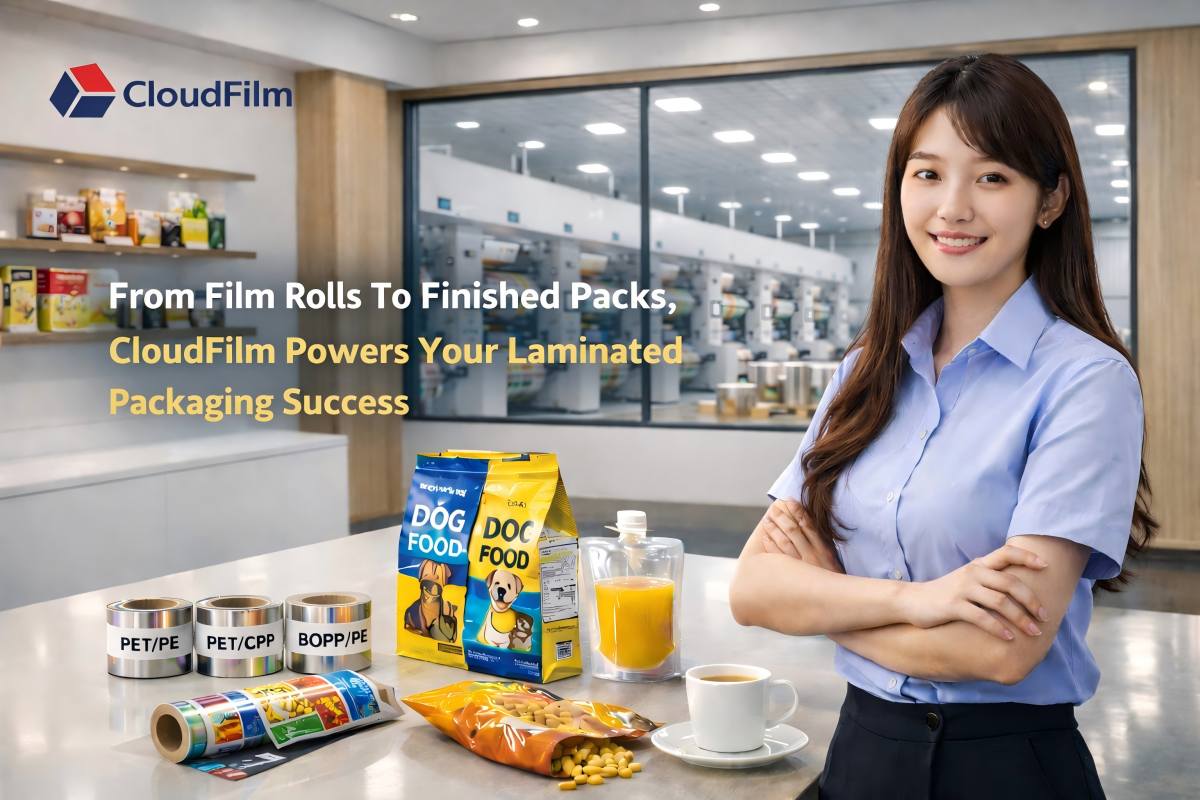
CloudFilm supplies standard and customized PET CPP laminated film structures, so you can cover dry foods, sauces, pet food, daily chemicals and technical products with one trusted manufacturing partner rather than multiple suppliers.
For demanding retort applications above 121°C, CloudFilm can also combine PET films with specialized Retort CPP Film or aluminum foil layers according to your sterilization temperature, time and filling conditions.
Typical Applications for PET/CPP Laminate
PET/CPP laminates are tailor-made for high-performance packaging, including but not limited to:
- Puffed Snacks & Nuts: PET’s high oxygen barrier helps prevent nuts and snacks from oxidizing and going stale, while CPP’s sealability ensures tight seals and moisture resistance to keep them crispy.
- Retort Pouches (High-Temperature Sterilization): PET withstands high retort temperatures, while CPP provides reliable sealing and moisture protection.
- Daily Necessity Packaging with High-Quality Printing: For example, laundry pod pouches or daily chemical packaging where the PET layer presents vivid graphics, and the CPP layer offers secure seals and inner protection.
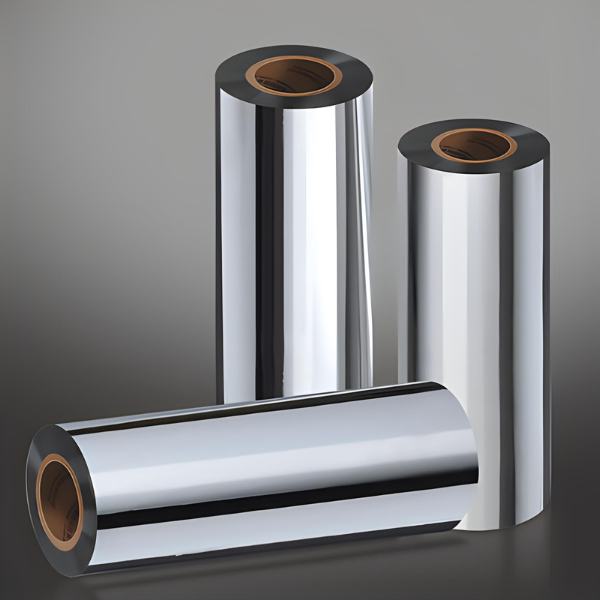
If you want to further enhance barrier performance while controlling cost and weight, CloudFilm also offers Metallized CPP Film and other PET-based high-barrier structures (such as PET/VMPET/CPP or PET/AL/CPP) to meet shelf-life targets for coffee, tea, snacks and pet food.
Practical Guide – How Should I Choose?
With all this knowledge, let’s circle back to the ultimate question: Which material is right for my product?
A Decision-Making Flowchart (In Text Form)
Ask yourself the following questions to quickly narrow down your choice:
- Step 1: What is the single most important requirement for my packaging?
- A. Strength, appearance, aroma retention (e.g., chips, premium gifts) -> Prioritize PET.
- B. Softness, moisture resistance, direct heat sealing (e.g., bread, garments) -> Prioritize CPP.
- Step 2: Does my packaging need to withstand high temperatures?
- A. Yes (e.g., for high-temperature sterilization or filling with hot liquids) -> You must choose PET or a laminate containing PET.
- B. No -> Both PET and CPP are still in the running.
- Step 3: Am I on a tight budget?
- A. Yes -> CPP is typically the more economical choice.
- B. No, performance is the priority -> Consider PET or a PET/CPP laminate.
- Step 4: Do I need the benefits of both an inner and an outer layer?
- A. Yes (i.e., you need a strong, beautiful outer layer and an easy-to-seal, moisture-resistant inner layer) -> Without hesitation, choose a PET/CPP laminate!
- B. No, a single layer will suffice -> Make your choice based on the conclusions from the previous three steps.
If you are not completely sure after walking through these four steps, you can simply send your product picture, filling method, target shelf life and packaging machine type to CloudFilm. Our team will recommend a suitable PET, CPP or PET/CPP structure and suggest a starting thickness range for quick line trials.
For deeper technical understanding of parameters like density, yield, OTR and WVTR, you can also read our in-depth guides on CPP film properties, PET film density and PET VMPET PE high-barrier structures.
Common Pitfalls and How to Avoid Them
- Myth 1: “The more expensive the material, the better.”
- Reality: The most suitable material is the best. Using expensive PET for a simple inner liner that only needs moisture resistance is a huge waste.
- Myth 2: “PET and CPP look similar, so they can be used interchangeably.”
- Reality: This is a disastrous thought. Using CPP as the outer layer will result in a limp, unattractive package. Using PET as the inner layer might make it impossible to heat seal, leading to packaging failure.
- Myth 3: “As long as I know the material name, the supplier doesn’t matter.”
- Reality: Even for the same material type, additives, thickness, and process control can vary significantly between suppliers, leading to performance differences. Choosing a reliable, professional supplier is crucial.
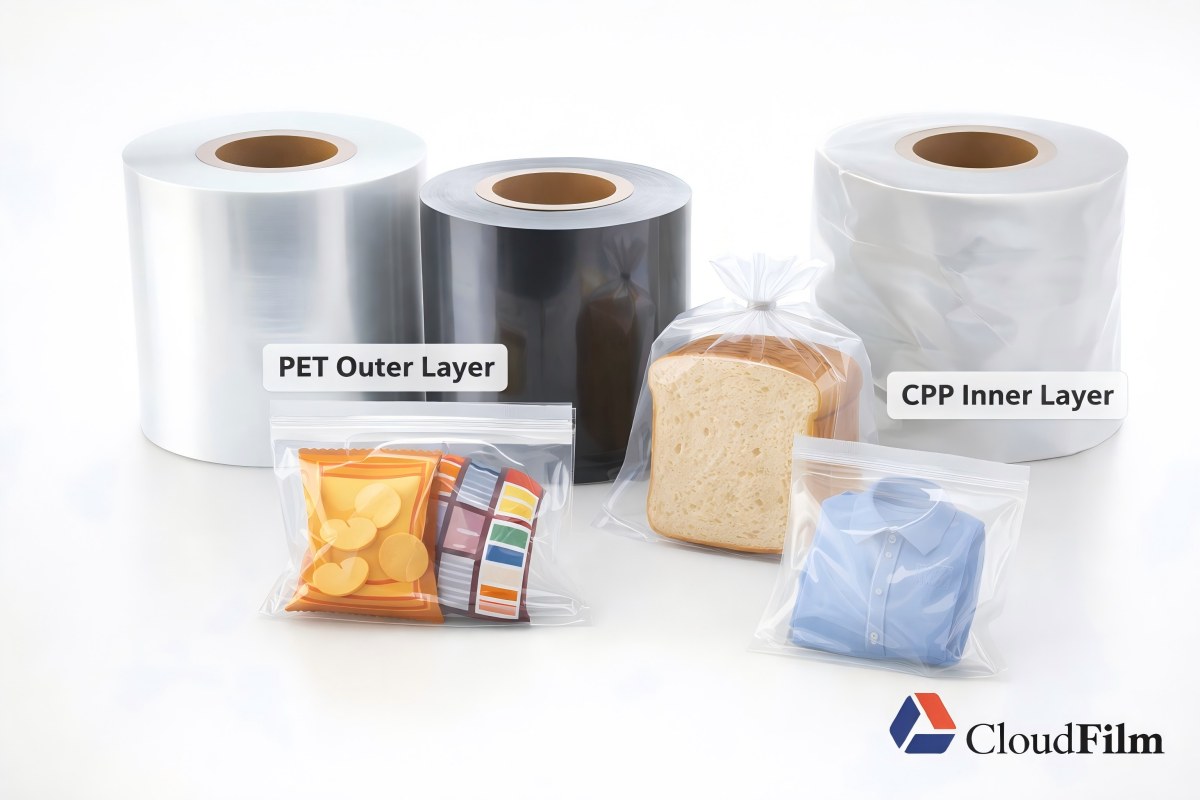
CloudFilm PET, CPP And PET/CPP Solutions For Different Packaging Scenarios
CloudFilm offers a complete portfolio of PET film, CPP film and PET/CPP laminated film so that most common flexible packaging structures can be sourced from one experienced manufacturer.
Below are some typical buyer scenarios and suggested starting points:
- Scenario 1 – Standard Dry Food Packaging (Snacks, Biscuits, Nuts)
- Recommended structure: PET (outer printing layer) + CPP (inner sealing layer).
- Practical starting point: Use PET film roll as the stiff outer web and clear CPP film as the sealing web, then fine-tune thickness and sealing temperature based on your VFFS/HFFS line.
- Scenario 2 – High-Barrier Snacks, Coffee, Tea Or Pet Food
- Recommended structure: PET / VMPET / CPP or PET / Metallized CPP.
- Practical starting point: Combine PET films with Metallized CPP Film or other high-barrier films to hit your target shelf life, while keeping weight and cost under control.
- Scenario 3 – Retort Pouches And Hot-Fill Packaging
- Recommended structure: PET / AL / Retort CPP, PET / PA / Retort CPP or PET / CPP for non-retort hot-fill.
- Practical starting point: Use PET CPP laminated film together with specialized Retort CPP Film, and adjust structure according to your sterilization temperature (e.g. 121–135°C) and product type.
No matter which scenario you are in, CloudFilm can provide samples, data sheets, and small trial rolls so you can verify machinability and sealing performance on your own lines before placing volume orders.
Conclusion and Looking Forward

PET and CPP are like two partners with very different personalities in the material world. PET is the tough, reliable “hardman”, while CPP is the gentle, accommodating “soft touch”. There is no absolute “better” or “worse” between them—only what is most suitable for your specific application.
Understanding their fundamental differences is the first step towards making an informed material selection, and it is also a key factor in improving your product’s competitiveness in the market.
After this in-depth comparison, you should have a clearer understanding of PET and CPP and a more solid direction for material selection. If you are still unsure or need a customized packaging solution, you are welcome to contact the material expert team at CloudFilm for one-on-one support.
CloudFilm’s technical and sales team can help you benchmark competing PET and CPP offers, design PET/CPP laminate structures, and optimize cost-performance according to your packaging line speed, sealing temperature and shelf-life requirements.
FAQ – PET Film vs CPP Film For Real-World Projects
Q1. Is PET or CPP film more expensive?
In most cases, PET film has higher raw material and processing costs than CPP film. PET is usually used as the outer printing and strength layer, while CPP is chosen as the inner sealing layer to keep overall cost under control.
Q2. Which film is better for high-temperature retort packaging?
For retort applications (for example 121–135°C), PET is essential as the outer layer because of its dimensional stability and heat resistance. The inner sealing layer is usually a special retort-grade CPP. A typical structure would be PET/AL/Retort CPP or PET/PA/Retort CPP.
Q3. Can CPP film replace PET in all applications to reduce cost?
No. If you use CPP as the outer layer in applications that require high stiffness, transparency and print quality, the package will look soft and cheap. PET’s rigidity and optical properties are crucial for premium shelf appearance. CPP works best as the soft, sealing inner layer.
Q4. Which material is safer for direct food contact, PET or CPP?
Both PET and CPP films can be made food-contact compliant when they are produced with suitable resins and follow relevant regulations. The key is to work with a supplier who can provide compliance documents and batch traceability, rather than only focusing on the material name. CloudFilm can provide this documentation for PET, CPP and PET/CPP laminates.
Q5. How do PET and CPP affect machinability on VFFS/HFFS packaging lines?
PET, as a stiffer film, helps maintain good film tracking and stable forming on vertical and horizontal form-fill-seal lines. CPP, as the inner layer, provides a wide sealing window and good hot-tack strength. Together, PET/CPP laminates usually offer the most stable performance for high-speed packaging.
Q6. Can CloudFilm customize thickness, width and roll length for PET and CPP film?
Yes. CloudFilm can tailor film thickness, width, roll diameter and core size based on your packaging machine and finished pouch dimensions. We can also advise you on starting thickness ranges for different products, so you can optimize cost without sacrificing performance.