Introduction: Why Lidding Packaging is Crucial in Today’s Market
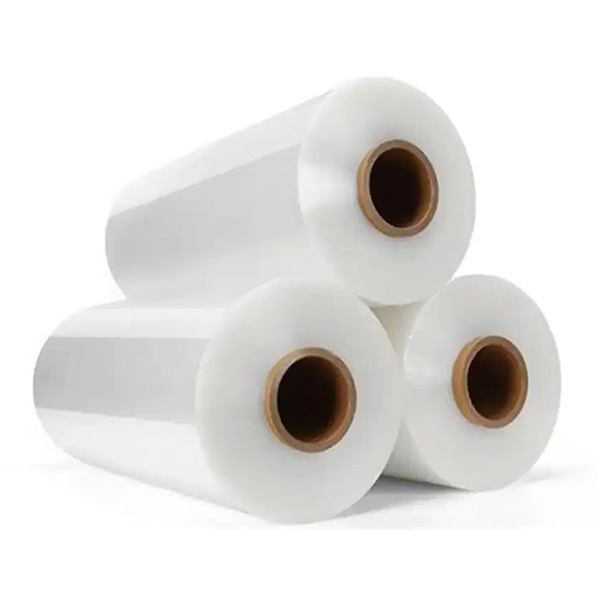
Lidding packaging, also known as lid film or heat-seal lidding, is a specialized form of flexible packaging that provides secure, tamper-evident sealing for containers across various industries. From dairy products to medical devices, this technology ensures product safety, extends shelf life, and enhances consumer convenience.
With the growing global demand for efficient, sustainable, and visually appealing packaging, lidding packaging has become a cornerstone of the modern packaging industry.
According to market research data, the global lidding packaging market is projected to reach approximately $30 billion by 2027, with a compound annual growth rate (CAGR) of around 5.8%. This growth is primarily driven by the food and beverage industry, which accounts for over 60% of total demand. Increasing consumer preference for convenience foods and ready-to-eat products further fuels the demand for innovative lidding solutions.
As a China-based flexible packaging film manufacturer and exporter, CloudFilm focuses on helping overseas buyers match lidding films with APET/CPET/PP trays, cups and tubs, so that seal strength, shelf life and sustainability targets can all be met in a single solution.
If you are new to lid film terminology, you can also review CloudFilm’s more basic lidding film guide and then use this page as a deeper technical reference when you are ready to specify structures and sealing conditions.
Understanding Lidding Packaging: The Basics
1.1 What is Lidding Packaging?
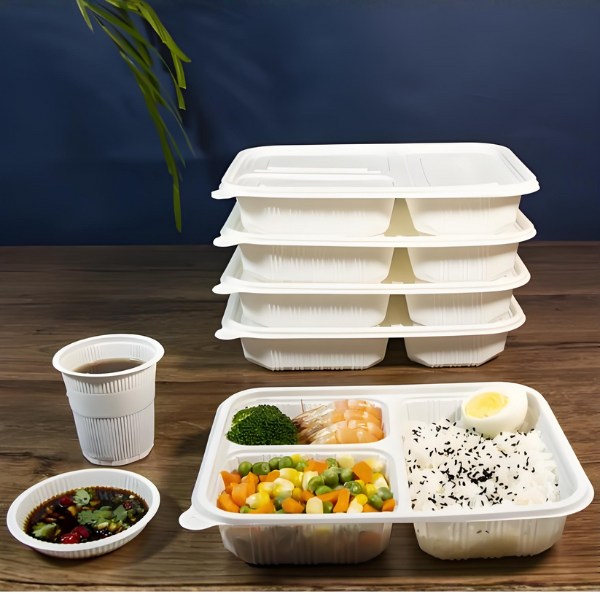
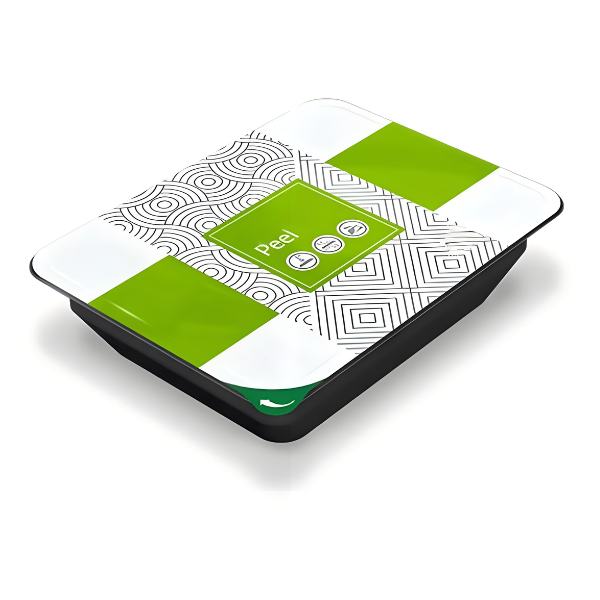
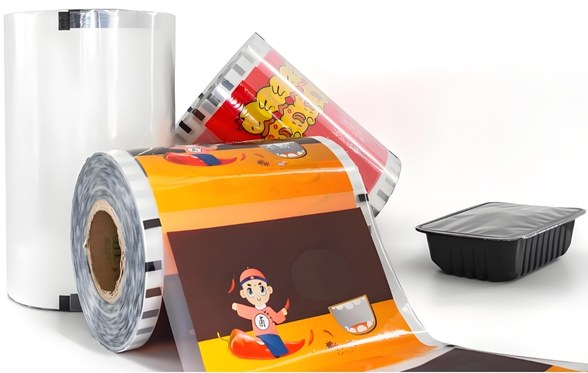
Lidding packaging is a heat-sealable film used to seal various containers, including trays, cups, and tubs. It bonds to the rim of the container through a heat-sealing process, creating an airtight seal that protects the contents from contamination, extends shelf life, and provides tamper evidence.
This type of packaging is especially suitable for products that require freshness preservation, leakage prevention, or product integrity.
Lidding films are typically composed of multiple layers, each serving a specific function:
- Outer layer: Provides a printable surface and mechanical strength
- Middle layer: Offers barrier properties (against oxygen, moisture, light)
- Sealing layer: Ensures reliable heat-sealing to the container
In real projects, these layers are often combined into structures such as PET/PE, PET/CPP, PVDC PET/PE or mono-PE lidding films, allowing CloudFilm engineers to tune stiffness, clarity, barrier and peel strength for each application instead of relying on a single “one-size-fits-all” film.
1.2 How Does Lidding Packaging Work?
Lidding packaging operates based on heat-sealing technology. During the packaging process, the film is placed over the filled container, and heat and pressure are applied to fuse the film to the container’s rim, forming a seal. This process can be performed on various packaging lines, from semi-manual operations to fully automated high-speed systems.
Key parameters of the heat-sealing process include:
- Temperature: Typically between 120°C and 200°C, depending on the material
- Pressure: Ensures proper contact between the film and container
- Time: Sufficient to form a strong seal without damaging the product
Modern lidding packaging systems integrate advanced control technologies to precisely monitor and adjust these parameters, ensuring consistent quality and performance.
1.3 Comparison of Lidding Packaging vs. Traditional Packaging Method
| Feature | Lidding Packaging | Traditional Packaging (e.g., Lids, Caps) |
|---|---|---|
| Seal Integrity | Excellent, provides airtight seal | Good, but potential leak points |
| Material Usage | 30–50% less material | Typically requires more material |
| Opening Convenience | Designed for easy or peelable opening | Varies; sometimes difficult to open |
| Tamper Evidence | High, seal break is clearly visible | Moderate, depends on design |
| Sustainability | Generally lighter, less material | Usually heavier, more material usage |
| Cost Efficiency | Often more economical, especially in bulk | Varies, can be more expensive |
| Adaptability | High, customizable for various needs | Limited, constrained by standard designs |
For brands moving from rigid lids or snap-on caps, switching to lidding films can therefore reduce plastic usage, logistics cost and consumer complaints about hard-to-open packs, while keeping or even improving barrier performance.
1.4 Typical Lidding Film Structures
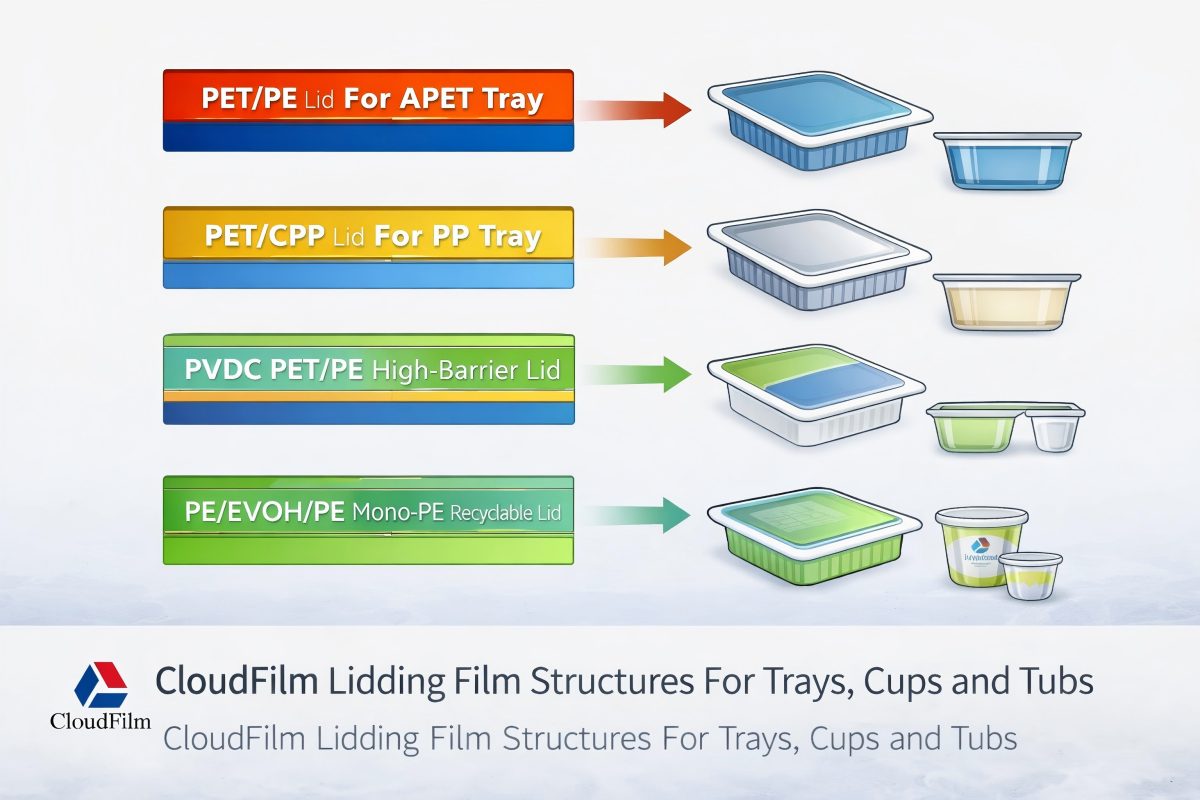
To make this guide more practical for buyers and engineers, it is useful to look at some typical lidding film structures used with trays, cups and tubs:
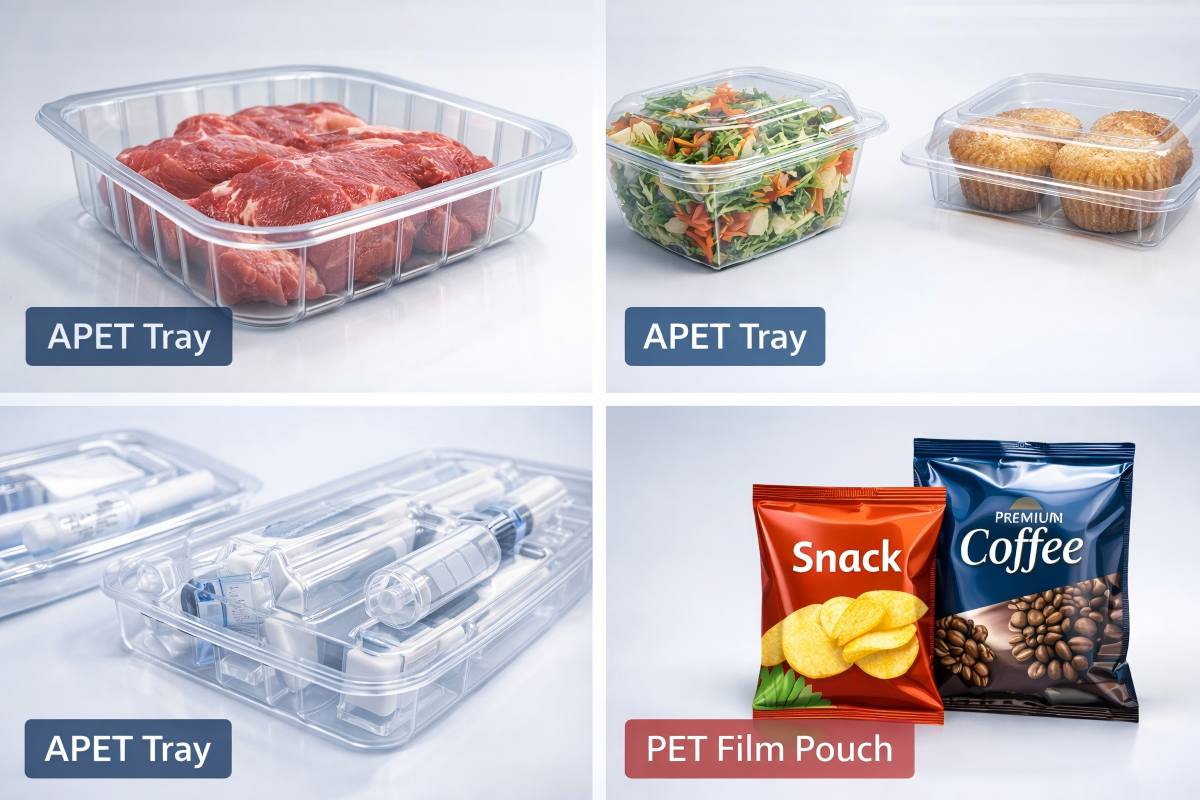
- PET/PE or PET/CPP lidding films for APET, CPET and PP trays used in chilled ready meals and meat packaging
- High-barrier PVDC PET/PE or PET/AL/CPP lids for coffee, tea, sauces and long-shelf-life MAP trays
- Mono-PE or PE/EVOH/PE lidding films for recyclable mono-PE packaging systems
- Specialty anti-fog or easy-peel lidding films where opening comfort and shelf appearance are critical
When you share your current laminate and tray material with CloudFilm, our technical team can map your requirements onto one of these structures and then adjust thickness, peel strength and barrier to reach a stable specification.
Industries Using Lidding Packaging
2.1 Food and Beverage Industry
The food and beverage industry is the largest user of lidding packaging, accounting for over 60% of the market. From dairy products to ready meals, lidding packaging provides essential solutions to maintain freshness, safety, and convenience.
Key Applications Include:
- Dairy products: yogurt, pudding, cheese
- Ready meals: pre-cooked foods, microwaveable meal trays
- Beverages: coffee capsules, ready-to-drink teas and juices
- Fresh produce: pre-cut fruits, vegetable salads
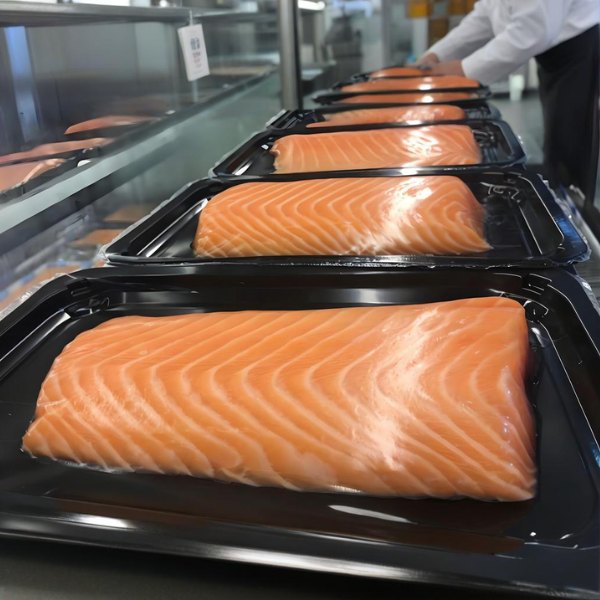
- Meat and seafood: fresh and processed meats, seafood products
Industry Data:
- The global food packaging market is projected to reach $405 billion by 2027, with lidding packaging among the fastest-growing segments.
- The convenience food market is growing at approximately 7.5% annually, driving demand for innovative lidding solutions.
- Consumer surveys show that 85% of consumers consider packaging convenience an important factor in their purchasing decisions.
In chilled and fresh food projects, CloudFilm can provide thermoformed food packaging trays matched with roll-stock food packaging film, so that your lidding films, trays and flow-wrap films share a coordinated look on shelf and run smoothly on your existing tray sealers and FFS lines.
2.2 Medical and Pharmaceutical Industry
In the medical and pharmaceutical sectors, lidding packaging provides critical protection to ensure the safety and sterility of medical devices and medications. These applications have stringent requirements and must comply with strict regulatory standards.
Key Applications Include:
- Medical devices: surgical tool kits, diagnostic equipment
- Pharmaceuticals: tablets, capsules, powders
- Diagnostic reagents: test strips, sample containers
- Disposable medical supplies: syringes, catheters
Industry Data:
- The global medical packaging market is expected to reach approximately $210 billion by 2026, with a CAGR of 6.2%.
- Sterile medical packaging accounts for over 40% of the medical packaging market, with lidding packaging as a key technology.
- Increasing regulatory requirements are driving demand for high-quality, compliant packaging solutions.
For medical kits and blister lidding, CloudFilm can combine high-barrier PET-based films, peelable seal layers and clean-room slitting processes to help converters meet regional medical packaging standards.
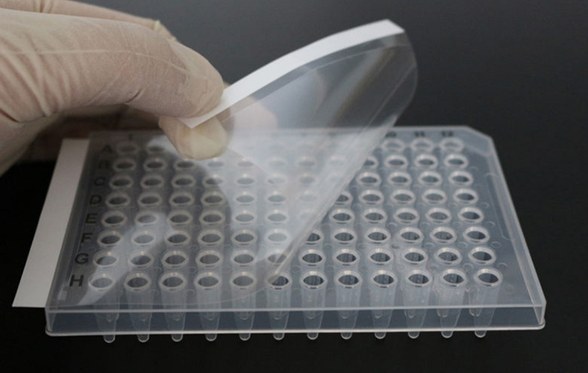
2.3 Personal Care and Cosmetics
The personal care and cosmetics industry uses lidding packaging to protect products, enhance brand image, and provide a consumer-friendly experience. From creams to shampoos, lidding packaging combines functionality with aesthetic appeal.
Key Applications Include:
- Skincare: creams, serums, facial masks
- Hair care: shampoos, conditioners, hair masks
- Color cosmetics: foundations, eyeshadows, lipsticks
- Fragrances: samples, travel sizes
Industry Data:
- The global cosmetics packaging market is projected to reach about $33 billion by 2025, with a CAGR of 4.8%.
- The premium cosmetics segment is driving demand for innovative packaging solutions, growing at approximately 6.5% annually.
- Consumer surveys indicate that 70% of consumers believe packaging design influences their purchasing decisions.
For personal care brands, CloudFilm can print high-definition graphics on the lidding web and combine easy-peel or reclose features so that unboxing feels premium while still protecting the formula inside.
Material Types in Lidding Packaging and Their Applications
3.1 Peelable Lidding Films
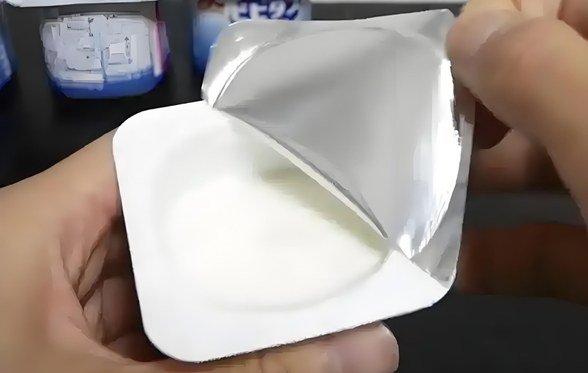
Peelable lidding films are designed to be easily peeled away from the container, offering a consumer-friendly opening experience while maintaining seal integrity until use. This type is widely used in dairy, ready meals, and medical products.
Key Features:
- Controlled peel strength for easy opening without accidental opening
- Maintains seal integrity until consumer access
- Can be designed for full or partial peel
- Suitable for various container shapes and sizes
Application Examples:
- Yogurt and pudding containers
- Ready-meal trays
- Medical device packaging
- Cosmetic samples
For these projects, many buyers choose CloudFilm’s Easy Peel Film as the dedicated peelable lidding web, tuning peel force to work on APET, CPET, PP or PS trays while still running efficiently on high-speed sealing lines.
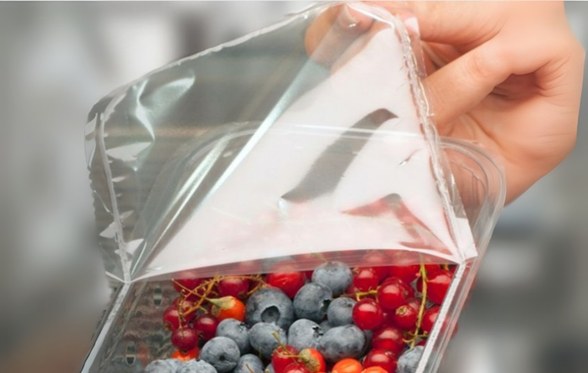
3.2 Breathable Lidding Films
Breathable lidding films allow gases (such as oxygen and carbon dioxide) to pass in a controlled manner while maintaining a barrier against liquids and microorganisms. This technology is especially useful for fresh produce and products that need to “breathe.”
Key Features:
- Precisely controlled gas transmission rates
- Maintains product freshness and shelf life
- Reduces condensation and spoilage
- Customizable to specific product respiration needs
Application Examples:
- Fresh-cut fruits and vegetables
- Bread and baked goods
- Certain types of cheese
- Active packaging applications
By adjusting micro-perforation patterns or inherent gas transmission, CloudFilm can design lidding webs that match the respiration curve of your produce instead of using an overly generic breathable film.
3.3 Anti-Fog Lidding Films
Anti-fog lidding films are designed to prevent condensation from forming inside the package, maintaining product visibility and appeal. This technology is particularly important for refrigerated products and those requiring visual presentation.
Key Features:
- Special coatings or additives prevent water droplet formation
- Maintains product visibility and shelf appeal
- Reduces risk of microbial growth
- Suitable for refrigerated and temperature-variable environments
Application Examples:
- Fresh produce packaging
- Refrigerated ready meals
- Meat and seafood
- Pre-made salads
For salad bowls, fruit trays and refrigerated meat packs where visibility is critical, CloudFilm often uses structures based on CPP Anti Fog Film as the sealing layer, so that the lidding film stays clear even in cold cabinets and during temperature fluctuations.
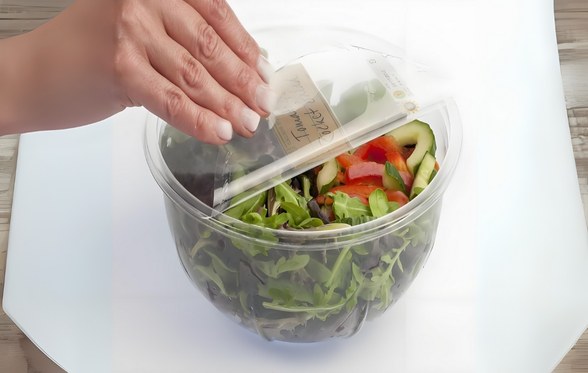
3.4 High-Barrier Lidding Films
High-barrier lidding films provide exceptional protection against oxygen, moisture, light, and other environmental factors, significantly extending product shelf life. This technology is critical for sensitive products such as coffee, pharmaceuticals, and certain foods.
Key Features:
- Extremely low oxygen and moisture transmission rates
- Light protection (including UV)
- Excellent seal integrity
- Can be combined with other functional properties
Application Examples:
- Coffee and tea
- Pharmaceuticals and medical products
- Sensitive food ingredients
- Premium food products
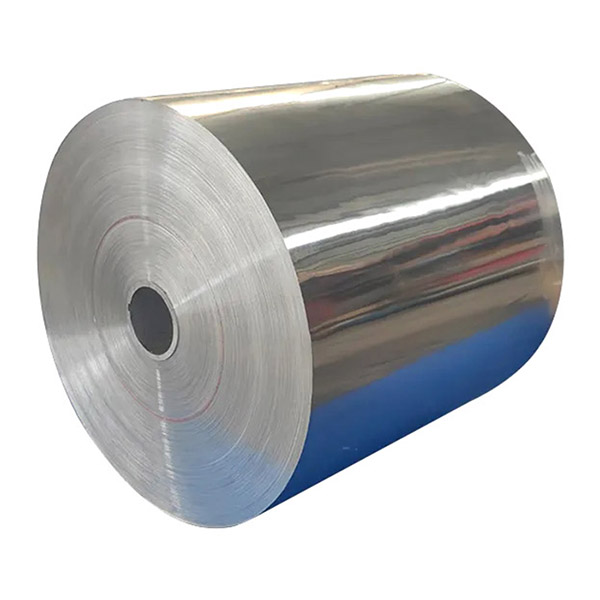
In high-barrier trays and cups, CloudFilm often uses transparent PVDC PET high barrier film laminated with PE or CPP, or combines lidding films with Food Grade Aluminum Foil when full light barrier and very long shelf life are required. To compare different barrier stacks in more detail, buyers can also refer to CloudFilm’s high barrier films guide, which covers ALOx PET, PVDC PET, EVOH films and foil laminates.
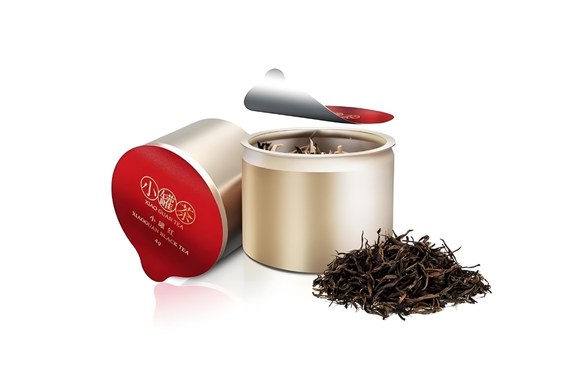
Benefits of Lidding Packaging
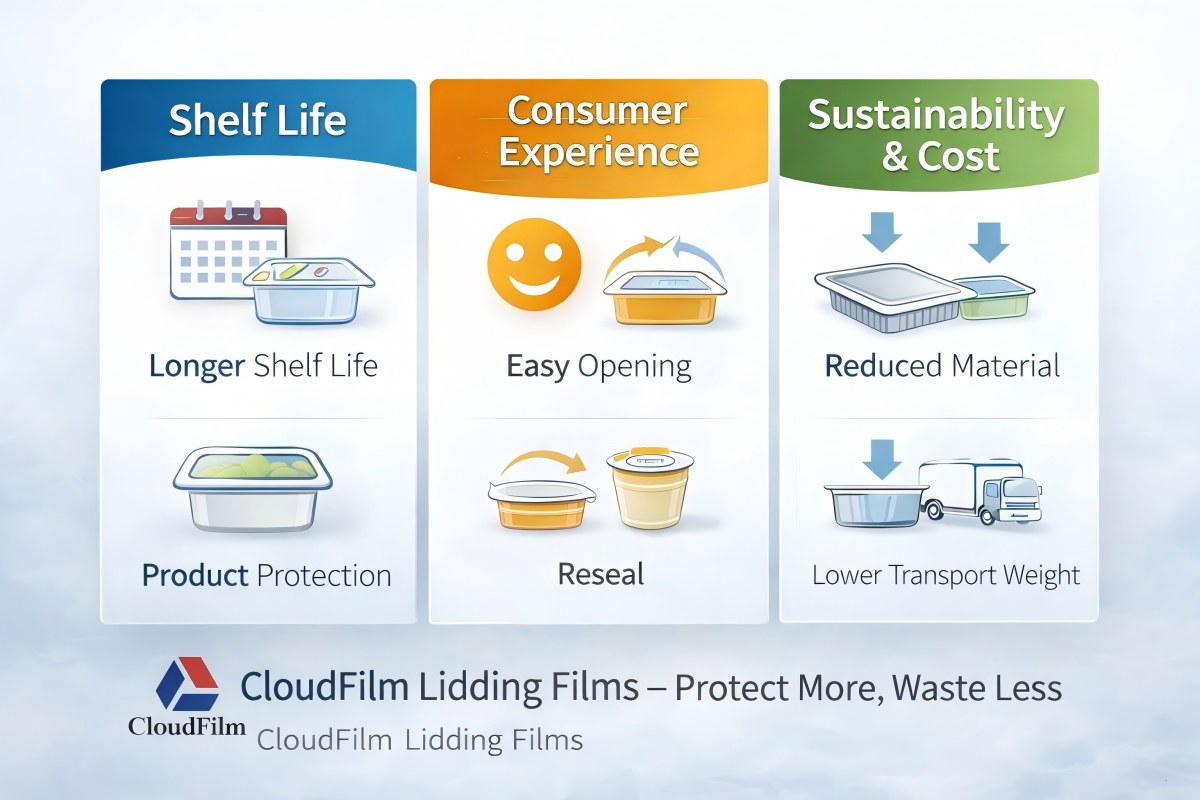
4.1 Enhanced Product Protection and Shelf Life
Lidding packaging offers superior product protection, significantly extending shelf life and reducing food waste. By providing effective barriers against oxygen, moisture, light, and microorganisms, lidding packaging ensures products remain in optimal condition from production to consumption.
Key Benefits:
- Extends shelf life by 30–100%, depending on product type
- Reduces oxidation and spoilage
- Prevents microbial contamination
- Maintains product flavor, texture, and nutritional value
Industry Data:
- Studies show that improved packaging technologies can reduce global food waste by approximately 20%.
- Consumer surveys indicate that 78% of consumers are willing to pay more for packaging that extends shelf life.
- Retailers report a reduction in return rates of about 15% for products using high-barrier lidding films.
By combining barrier data from PET, PVDC PET, EVOH films and foils, CloudFilm can help you choose lidding structures that deliver the shelf life you need without over-specifying thickness or barrier level, thereby controlling cost while still protecting the product.
4.2 Enhanced Consumer Experience
Lidding packaging is designed with consumer convenience in mind, offering easy-to-open, resealable, and visually appealing solutions. These features enhance consumer satisfaction and can influence purchasing decisions.
Key Benefits:
- Easy opening without tools
- Resealable options to extend product usability after opening
- Clear product visibility
- Convenient to use and dispense
Industry Data:
- Consumer surveys show that 85% of consumers consider packaging convenience an important factor in their purchasing decisions.
- Easy-to-open packaging can increase consumer satisfaction scores by about 25%.
- Resealable packaging can reduce product waste and improve consumer loyalty.
Peelable lids, laser-scored easy-tear features and reclose labels can all be integrated into the lidding web, so that your brand delivers both convenience and a premium unboxing feel.
4.3 Sustainability and Environmental Benefits
Modern lidding packaging solutions increasingly focus on sustainability, using less material, offering recyclable options, and reducing carbon footprints. These features align with growing consumer and regulatory demands for eco-friendly packaging.
Key Benefits:
- 30–50% reduction in material usage
- Recyclable and compostable options
- Lighter weight reduces transportation emissions
- Indirect environmental benefits from reduced food waste
Industry Data:
- The global sustainable packaging market is projected to reach approximately $500 billion by 2027, with a CAGR of 7.7%.
- Consumer surveys indicate that 74% of consumers are willing to pay more for sustainable packaging.
- Regulatory trends show increasing restrictions on single-use plastics globally.
For mono-PE recyclable systems, CloudFilm’s MDO and BOPE ranges can be used both as tray or pouch materials and as the basis for mono-PE lidding films, while our dedicated mono-material packaging articles explain how to design structures that fit real recycling guidelines instead of only theoretical claims.
4.4 Cost Efficiency and Operational Efficiency
Lidding packaging offers significant cost efficiency and operational advantages, reducing material usage, increasing production line speeds, and lowering overall packaging costs. These benefits make lidding packaging an economical choice for manufacturers and brand owners.
Key Benefits:
- Reduced material costs
- Increased production line speed and efficiency
- Lower storage and transportation costs
- Reduced product waste and return rates
Industry Data:
- Manufacturers report that switching to lidding packaging can reduce packaging costs by 15–30%.
- Production line speeds can increase by 20–40%, depending on the application.
- Storage space requirements can be reduced by about 25% due to more compact packaging forms.
Many CloudFilm customers upgrade to optimized lidding films and report fewer sealing issues, less downtime and lower waste on tray-sealing and form-fill-seal lines, which often has more impact on total cost than the price per kilogram of film alone.
Future Trends and Innovations in Lidding Packaging
5.1 Sustainable Material Innovations
Sustainable material innovation is a major trend in the lidding packaging industry, including bio-based materials, recyclable structures, and compostable options. These innovations aim to reduce environmental impact while maintaining packaging performance and protection.
Key Development Directions:
- Bio-based polymers such as PLA and PHA
- Mono-material structures for easier recycling
- Compostable materials compliant with industrial and home composting standards
- Use of recycled content to reduce virgin material demand
Industry Data:
- The bio-based packaging market is projected to reach approximately $150 billion by 2026, with a CAGR of 15.1%.
- Consumer surveys show that 83% of consumers consider sustainable packaging an important part of brand responsibility.
- Regulatory trends indicate increasing global requirements for recyclable packaging.
In lidding applications, this often means moving from mixed PET/Al/PE stacks to mono-PE or mono-PET designs, or combining high-barrier layers with recyclable sealant films such as CloudFilm’s co-extruded EVOH films, so that performance and recyclability can be balanced instead of sacrificing one for the other.
5.2 Smart Packaging Technologies
Smart packaging technologies are transforming the functionality of lidding packaging, offering advanced features such as freshness monitoring, temperature control, anti-counterfeiting, and consumer interaction. These innovations enhance product safety, provide value-added services, and create brand differentiation opportunities.
Key Development Directions:
- Freshness indicators showing product status
- Time-temperature indicators monitoring cold chain integrity
- NFC and RFID technologies providing product information and anti-counterfeiting
- Interactive packaging enhancing consumer experience
Industry Data:
- The smart packaging market is projected to reach approximately $40 billion by 2025, with a CAGR of 8.1%.
- Retailers report that using smart packaging technologies can reduce product waste by about 10–15%.
- Consumer surveys indicate that 67% of consumers are willing to pay more for smart packaging that provides additional information.
5.3 Customization and Brand Differentiation
Customization and brand differentiation are important trends in lidding packaging, including advanced printing effects, unique opening mechanisms, and custom shapes. These innovations help brands stand out in a competitive market and create memorable consumer experiences.
Key Development Directions:
- Advanced printing technologies such as digital printing and embossing effects
- Custom opening mechanisms such as pull tabs and easy-tear features
- Unique shapes and design elements
- Brand integration and storytelling
Industry Data:
- Brands report that customized packaging can increase brand recognition by about 30%.
- Consumer surveys show that 72% of consumers believe packaging design influences their purchasing decisions.
- Market research indicates that unique packaging can increase product premium capability by about 15–20%.
CloudFilm supports these trends by offering small-batch trial rolls, digital-print-ready films and lidding webs with registered embossing or matte/gloss effects, so that even mid-sized brands can test differentiated lidding designs before full-scale rollout.
How to Choose the Right Lidding Packaging Solution for Your Product
6.1 Assessing Product Needs
The first step in choosing the right lidding packaging solution is to thoroughly assess product needs, including product characteristics, shelf life requirements, target market, and brand positioning. These factors will guide material selection, functional features, and design decisions.
Key Considerations:
- Product composition and sensitivity (oxygen, moisture, light)
- Required shelf life and storage conditions
- Target consumers and their preferences
- Brand positioning and differentiation needs
- Regulatory requirements and industry standards
Assessment Steps:
- Conduct product characteristic analysis
- Identify key protection needs
- Evaluate target market expectations
- Consider brand positioning and differentiation opportunities
- Determine regulatory and standard requirements
For tray-based packs, CloudFilm will usually start by matching the tray material with suitable lids – for example combining APET film for thermoformed trays with PET/PE laminated film lidding – then adjust thickness, stiffness and sealing temperature so that both product protection and line efficiency are optimized.
6.2 Material and Functionality Testing
Material and functionality testing are critical steps to ensure the lidding packaging solution meets product needs. These tests evaluate material performance, seal integrity, shelf life extension effects, and consumer experience.
Key Test Types:
- Material performance testing (barrier properties, mechanical strength)
- Seal integrity testing
- Processing and production line compatibility testing
- Storage and shelf life testing
- Consumer experience testing
Testing Process:
- Preliminary material screening
- Laboratory performance testing
- Small-scale production testing
- Processing condition optimization
- Final validation and confirmation
During these tests, buyers often start with CloudFilm’s heat sealable PET film or easy-peel grades, then fine-tune peel strength, anti-fog performance and barrier level until the chosen lidding film passes both laboratory checks and real transport simulations.
6.3 Partnering with a Specialist Supplier
Partnering with a specialist supplier is key to ensuring the best lidding packaging solution. Experienced suppliers can provide technical expertise, material innovation, custom design, and comprehensive support to help you achieve your packaging goals.
Key Factors in Choosing a Supplier:
- Technical expertise and experience
- Material innovation and R&D capabilities
- Quality control and certifications
- Customer service and support
- Sustainability commitment
CloudFilm’s Advantages:
- 20+ years of industry experience
- Advanced material R&D capabilities
- Comprehensive quality management system
- Global technical support network
- Strong sustainability commitment
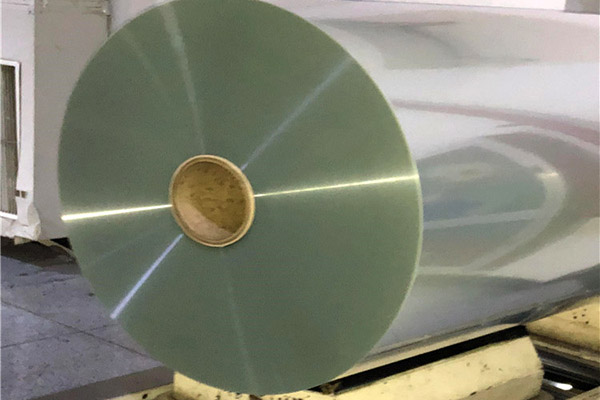
When you work with CloudFilm, you gain access not only to individual films but to a complete lidding toolbox – from PET, CPP, PE and EVOH films to high-barrier PVDC PET and aluminum foil – plus engineering support that translates your product brief into a stable, repeatable lidding specification.
Frequently Asked Questions (FAQs)
Q1: What is lidding packaging?
A1: Lidding packaging is a heat-sealable film used to seal containers, providing tamper evidence while allowing easy consumer opening. It is widely used in the food, beverage, medical, and cosmetics industries.
Q2: What are the main types of lidding packaging?
A2: Main types include peelable lidding films, breathable lidding films, anti-fog lidding films, and high-barrier lidding films, each designed for specific product needs and applications.
Q3: How does lidding packaging extend product shelf life?
A3: By providing high barriers against oxygen, moisture, and light, lidding packaging significantly slows down product deterioration, extends shelf life, and reduces food waste.
Q4: What is sustainable lidding packaging?
A4: Sustainable lidding packaging uses recyclable, compostable, or bio-based materials, aiming to reduce environmental impact while maintaining packaging performance and protective functions.
Q5: How do I choose the right lidding for my product?
A6: Consider factors such as product composition, shelf life requirements, processing conditions, and sustainability goals. Our technical team can help you select the optimal solution.
Q6: What is the difference between “lidding film” and “top web” on thermoforming lines?
A6: In most cases, they refer to the same concept: the upper web that seals the tray or formed pocket. “Lidding film” is a general term used across many packaging formats, while “top web” is often used on thermoforming lines where a lower web is formed into pockets and the top web seals over it.
CloudFilm can supply both top webs and matching forming webs so that forming depth, sealing window and peel strength are all compatible.
Q7: Which lidding films are suitable for high-barrier MAP meat and cheese trays?
A7: For MAP meat and cheese, buyers usually combine high-barrier lidding films such as PVDC PET/PE or PET/AL/CPP with high-barrier tray materials. CloudFilm can also incorporate EVOH or PVDC coatings to reach very low OTR/WVTR targets and recommend sealing layers that run well on your existing tray sealers.
Q8: Can CloudFilm provide both lidding film roll-stock and finished pouches or trays?
A8: Yes. CloudFilm’s core business is flexible film roll-stock, but we also cooperate with downstream converters to offer finished pouches and trays where required. If you share your product type, filling method and annual volume, we can propose whether it is better to buy lidding film only, or a combination of film plus partially converted packaging.
Q9: How can I make my lidding packaging more recyclable or mono-material?
A9: The main approach is to minimize incompatible layers and align both tray and lid with the same recycling stream – for example by using mono-PE trays and mono-PE lidding films based on MDO PE or BOPE, or mono-PET systems where tray and lidding are both PET-based.
CloudFilm can review your current structure, local recycling guidelines and line conditions, then suggest realistic mono-material upgrade paths instead of purely theoretical designs.
Q10: What information should I send to CloudFilm to get a fast and accurate lidding film quotation?
A10: To speed up quotation and structure design, please share at least:
- product type and whether it is fresh, chilled, frozen or hot-filled;
- tray material and size;
- target shelf life and market;
- filling and sealing temperatures and speeds; and
- any specific requirements such as peelable, anti-fog, high barrier or mono-material.
With this information, CloudFilm’s engineers can quickly shortlist suitable lidding structures and provide pricing plus trial-roll recommendations.