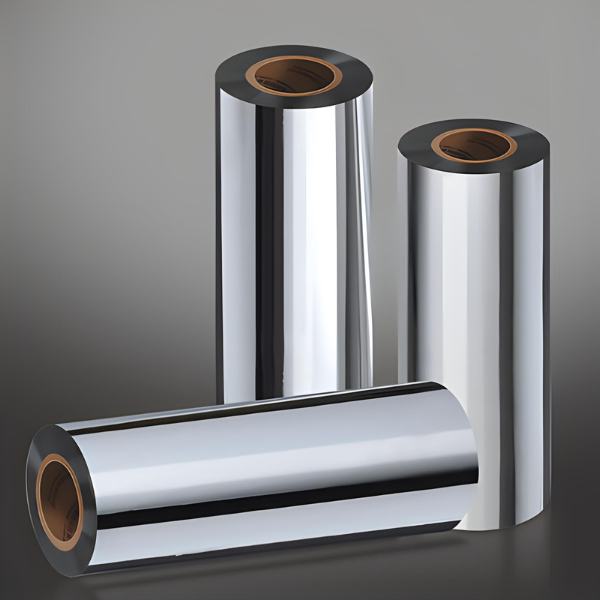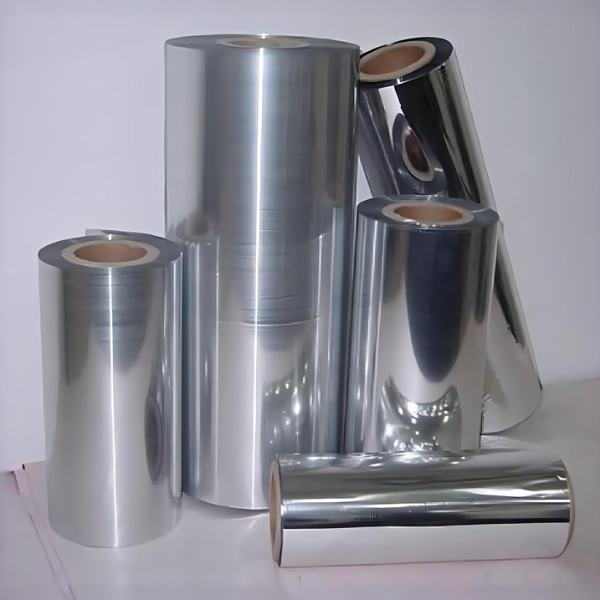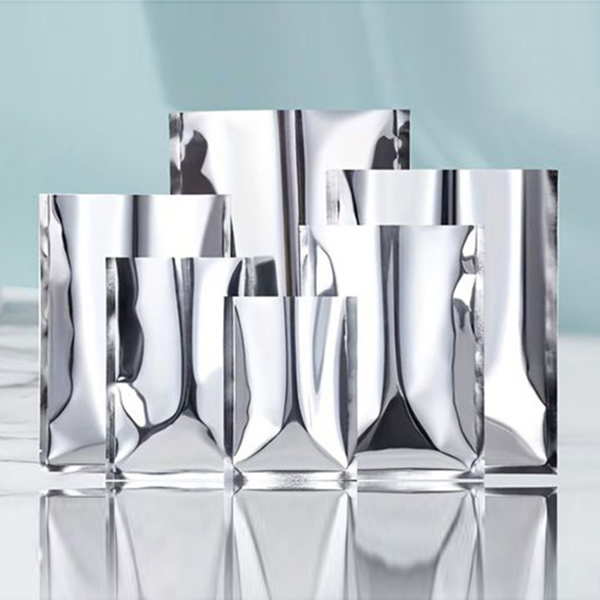
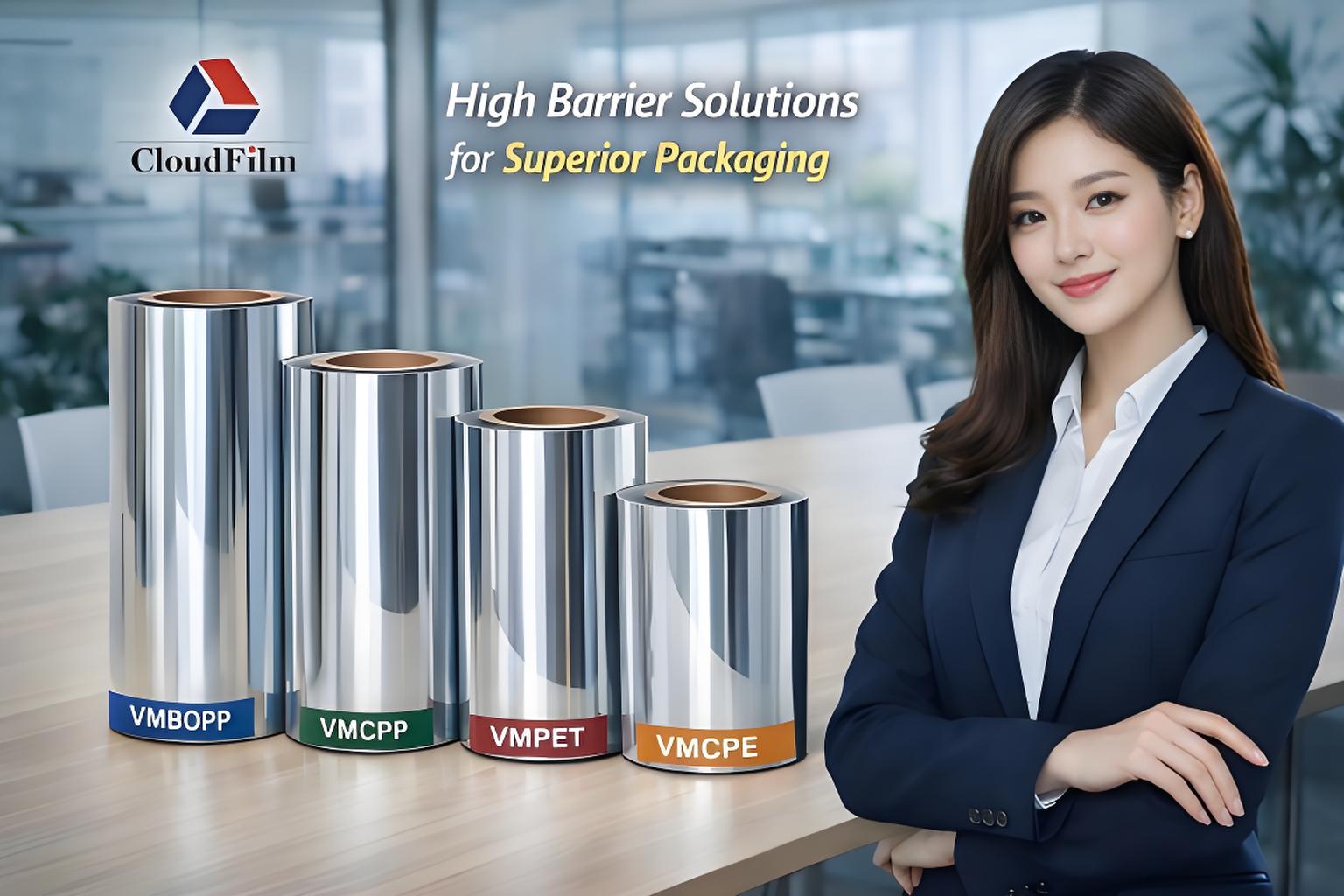
Aluminized film – also called metallized film, VMPET, VMBOPP or VMCPP – is a plastic film coated with a very thin vacuum-deposited aluminum layer. It combines the metallic gloss and barrier of foil with the flexibility, printability and processing efficiency of modern plastic films, which makes it one of the most widely used high-barrier materials in flexible packaging.
At CloudFilm, we supply a complete metallized portfolio, including aluminized PET film (VMPET), metallized BOPP film and metallized CPP film, so that each layer of your laminate – outer, middle and seal layer – can be optimized for appearance, barrier and sealing.
This guide explains how aluminized films are manufactured, the main types (VMPET, VMBOPP, VMCPP), key benefits compared with conventional materials and practical tips on choosing the right structure for your food, pharmaceutical or industrial packaging project.
Aluminum Introduction
Aluminum is the core metal behind aluminized films. It offers a unique combination of light weight, high reflectivity and excellent barrier properties, which is why it is widely used in packaging, construction, transportation and many other industries.
Key characteristics of aluminum include:
- Versatility – Aluminum is lightweight, flexible, ductile and mechanically strong. When converted into a vacuum-deposited layer on plastic films, it adds barrier and metallic gloss without making the packaging rigid or bulky.
- Abundance – After oxygen and silicon, aluminum is one of the most abundant elements in the earth’s crust, which helps keep raw material supply relatively stable.
- Energy efficiency and recycling – Recycling aluminum typically uses up to 95% less energy than primary production. Once produced, aluminum can be recycled many times without losing its basic structure and properties, supporting circular-economy goals in packaging.
Because of these attributes, a very thin aluminum layer on BOPP, PET, CPP or CPE films can provide a strong barrier against oxygen, moisture and light with minimal material usage. This is the foundation of aluminized film technology described in the next section.
How Is Aluminized Film Manufactured?
Aluminized films are produced by vacuum metallization. In this process, a very thin layer of aluminum is deposited onto the surface of a plastic substrate such as PET, BOPP, CPP or CPE.
In simplified terms, the workflow looks like this:
- Substrate preparation – The base film (for example PET, BOPP or CPP) is corona-treated and cleaned to reach sufficient surface energy for good aluminum adhesion.
- Vacuum metallization – Inside a high-vacuum chamber, aluminum wire is heated until it evaporates. The aluminum vapor condenses onto the moving film web and forms a uniform metallic layer with controlled optical density (OD) and thickness.
- Protective coating (optional) – For some applications, a primer or protective coating is applied to improve abrasion resistance, printability or lamination strength.
- Rewinding and slitting – The metallized jumbo roll is rewound and slit into the final widths required by printers, laminators or form-fill-seal (FFS) lines.
If you want a deeper technical explanation of each control point (vacuum level, web speed, aluminum thickness, optical density and so on), you can also refer to CloudFilm’s dedicated article on the metalized film manufacturing process.
Types of Aluminized Films
Based on substrate type and barrier performance, the most common aluminized films used in packaging are:
Polyester Aluminized Film (VMPET)
VMPET is usually used as the middle high-barrier layer in laminates such as PET/VMPET/PE or PET/VMPET/CPP. It offers:
- Excellent oxygen and moisture barrier
- High stiffness and dimensional stability
- Strong metallic gloss for premium brands
Typical applications include coffee, tea, milk powder, snacks, instant beverages and high-value dry foods.
CPP Aluminized Film (VMCPP)
VMCPP is a cast-polypropylene film that is often used as the inner heat-seal layer in laminates such as BOPP/VMCPP or PET/VMCPP. It provides:
- Good hot-tack and heat-seal strength
- Soft hand-feel and better drop resistance compared with rigid structures
- Sufficient barrier for many snack and biscuit applications
VMCPP is widely used for packaging biscuits, confectionery, dry snacks and everyday grocery items that require reliable sealing and moderate barrier.
BOPP Aluminized Film (VMBOPP)
VMBOPP is typically used as the outer decorative and barrier layer in laminates such as VMBOPP/PE or VMBOPP/CPP. It offers:
- High gloss and printability
- Good moisture barrier
- Good stiffness and machinability on high-speed packing lines
It is ideal for snack packaging, candy wraps, instant noodles and other dry foods that benefit from a shiny, metallic appearance.
Metallized CPE Film (VMCPE)
For heavier or bulkier products, metallized CPE film can serve as a tough, impact-resistant layer in laminates that require higher puncture strength, such as frozen food, industrial products or heavy-duty bags.
Together, these metallized films allow CloudFilm to design complete structures from outer layer to seal layer, optimizing barrier, appearance and sealing performance for each application.
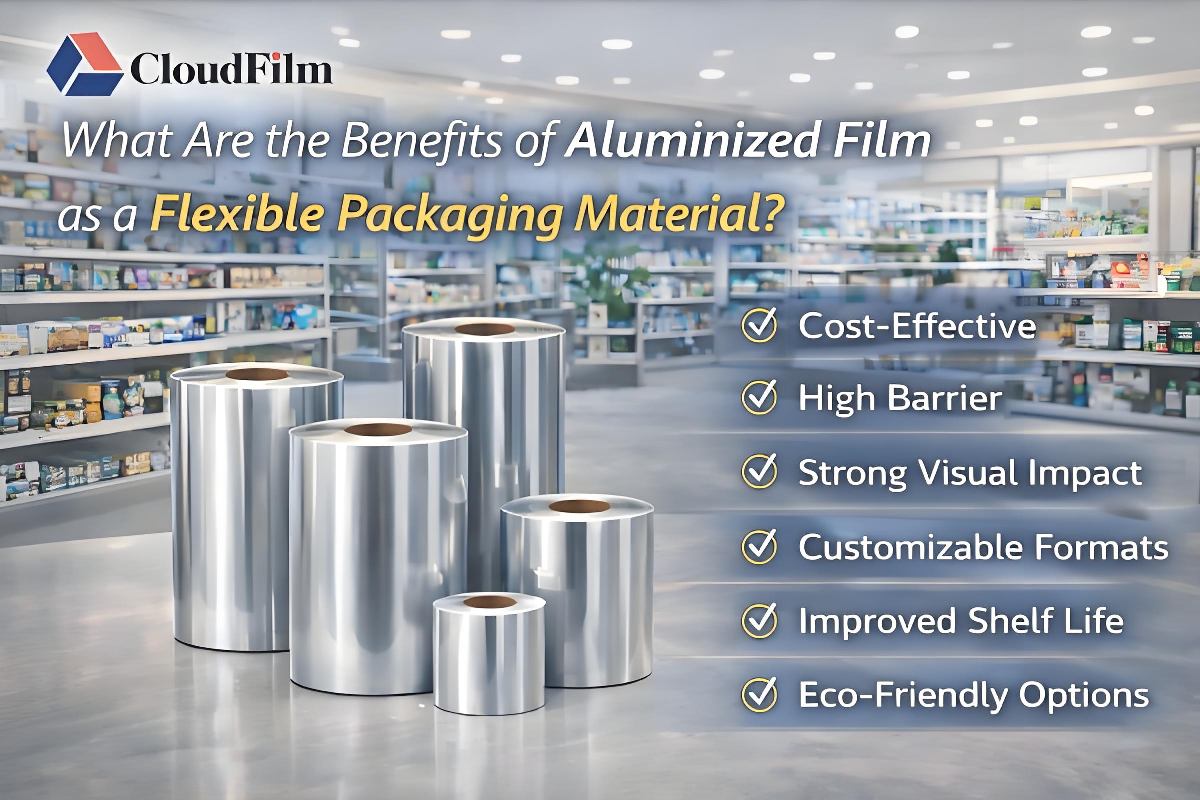
What Are the Benefits of Aluminized Film as a Flexible Packaging Material?
Cost-Efficient High-Barrier Performance
Because the aluminum layer is extremely thin, aluminized films achieve strong oxygen, moisture and light barrier with much less material than rigid containers or thick foil laminates. This helps brand owners reduce packaging weight, transport volume and overall material cost while still protecting the product effectively.
Flexible Formats and Sizes
Aluminized films can be converted into many formats – from form-fill-seal roll stock to premade pouches. Whether you are packing small sachets or family-size bags, the same material family can be used in different sizes and shapes. When combined with CloudFilm’s stand up pouches and roll stock, you can cover both automatic FFS lines and premade bag formats under one coordinated structure.
Better Product Safety and Shelf Life
Aluminum’s barrier effect protects the packed goods from moisture, oxygen, UV light, dust and other external factors. By choosing the right metallized film type and optical density, many food and pharmaceutical products can significantly extend their shelf life and reduce spoilage or returns.
Strong Branding and Customization
Aluminized films offer a luxurious metallic appearance and excellent printability. With high-quality gravure or flexographic printing, you can create eye-catching metallic effects, matte–gloss contrasts or holographic accents that help your packaging stand out on the shelf. CloudFilm can further customize film thickness, slip, coefficient of friction (COF) and corona treatment to match your printing and laminating process.
Environmentally Minded Material Usage
By using a very thin aluminum layer on a plastic substrate, aluminized films reduce the overall consumption of metal compared with full-gauge aluminum foil. In addition, aluminum is infinitely recyclable, and the metallized portfolio can be combined with other high-barrier solutions such as ALOx PET or co-extruded films to align with your sustainability roadmap.
Good Sealing and Machinability
When combined with suitable seal-layer films (such as VMCPP or PE), aluminized structures offer reliable heat-sealing, good hot-tack and excellent machinability on vertical and horizontal form-fill-seal equipment. This minimizes leakage, especially for powders and fine particles, and keeps your packing lines running efficiently.
Sorts of Aluminized Film Packaging Materials to Choose From
When aluminized films are converted into finished packaging, some of the most common formats include:
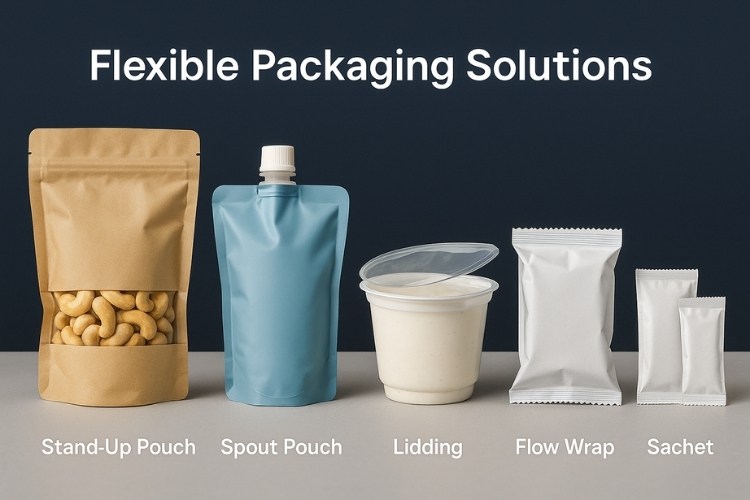
- Stand Up Pouches (Doypacks) – Used for coffee, tea, spices, dried fruits, jerky, nuts and pet food. Structures like PET/VMPET/PE or BOPP/VMBOPP/PE combine metallic appearance with strong barrier and shelf impact.
- Spout Pouches – Add a spout and cap to a stand-up pouch, making them ideal for juices, sauces, baby food, energy gels and household liquids. Aluminized structures help protect flavor and sensitive ingredients. Refer to our spout pouches for more details.
- Three-Side Seal Sachets – Flat 3-side seal pouches are perfect for single-serve samples, seasoning sachets, instant beverage powders and small medical or cosmetic doses. For these, VMPET-based laminates can deliver excellent barrier in a very compact format; see 3 side seal pouches.
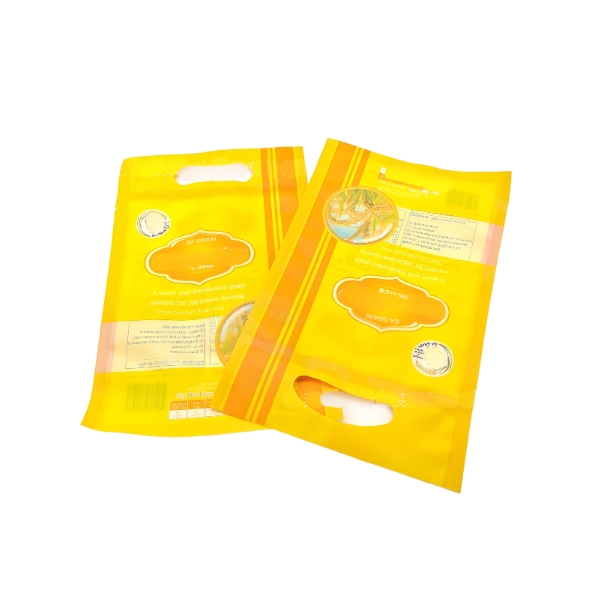
- Quad Seal and Flat-Bottom Pouches – For heavier fills such as coffee beans, pet food, milk powder or rice, aluminized structures can be used in quad seal or flat-bottom pouches to provide better stability and shelf impact. Learn more on our quad seal pouches page.
By matching the right pouch format with a suitable aluminized structure, CloudFilm can help you balance product protection, shelf impact and cost.
Aluminized Film Applications: A Versatile Packaging Material
Food and Beverage Packaging
Aluminized films are widely used in bags and roll stock for snacks, biscuits, confectionery, instant noodles, coffee and tea. By adjusting the aluminum layer thickness (optical density), structures such as PET/VMPET/PE, BOPP/VMBOPP/PE or PET/VMBOPP/CPP can deliver high oxygen and moisture barrier while maintaining attractive metallic graphics. For coffee or premium foods, CloudFilm often recommends VMPET-based laminates or metallized BOPP film to balance cost and shelf life.
Pharmaceutical Packaging
In pharmaceuticals, aluminized PET films are used for light- and moisture-sensitive products such as tablets, capsules, diagnostic reagents and medical devices. They can be made into sachets or pouches where the film structure ensures product stability throughout its shelf life. For finished bag solutions, see CloudFilm’s pharmaceutical pouches.
Ornamentation and Decorative Uses
Beyond functional packaging, aluminized PET and metallized films are often used for decorative wraps, gift packaging, festival products and labels. By combining metallized layers with special finishes or holographic patterns (for example with PET holographic film ), brand owners can achieve strong shelf impact and promotional effects.
Air Conditioning and Insulation
Thanks to their high reflectivity and heat-insulation properties, aluminized PET films are used in building and HVAC applications, such as roof insulation, air-duct liners and reflective barriers. The aluminum layer reflects radiant heat, helping improve energy efficiency and indoor comfort while keeping the structure lightweight.
Dry Lamination
Aluminized films are also excellent substrates for dry lamination. When selecting adhesives, drying conditions and curing parameters correctly, converters can laminate VMPET, VMBOPP or VMCPP to PE, CPP or paper to create multi-layer structures tailored to specific products.
FAQs: Key Questions About Aluminized Films
What is the difference between aluminized film and aluminum foil?
Aluminized film is a plastic film with a very thin vacuum-deposited aluminum layer, while aluminum foil is solid metal. Aluminized films are lighter, more flexible and easier to run on high-speed packaging lines, whereas foil offers very high barrier but is stiffer and more prone to pinholes when folded sharply.
How do I choose between VMPET, VMBOPP and VMCPP?
As a rule of thumb, VMPET is used as a stiff, high-barrier middle layer, VMBOPP is used as a glossy outer layer and VMCPP is used as a heat-seal inner layer. The final choice depends on your product type, filling temperature, shelf-life target and desired appearance – CloudFilm can recommend a suitable combination based on your project brief.
Can aluminized films be used in recyclable packaging?
In many markets, traditional metallized laminates are still classified as “difficult to recycle” because they combine different polymers and a metal layer. However, by minimizing aluminum thickness and pairing metallized films with mono-material structures or alternative high-barrier layers (such as ALOx PET and high-barrier PE), we can design “recycle-ready” or downgauged solutions aligned with your local recycling streams.
What information should I prepare before asking CloudFilm for a quotation?
It is helpful to prepare basic information such as product type, target market, required shelf life, planned filling and storage conditions, preferred pouch format (or roll stock), and any priorities like high barrier, matte or gloss appearance, or recyclability. With these details, CloudFilm can quickly propose a structure, suggest a suitable aluminized grade and provide a quotation with lead times.
Expert Opinion: When Should You Consider Aluminized Film?
From a packaging engineer’s perspective, aluminized films are an excellent choice when you need:
- High oxygen and moisture barrier for dry or semi-dry products
- Strong metallic shelf appeal without using full-gauge aluminum foil
- Good machinability on high-speed VFFS/HFFS lines or premade-bag filling lines
- Reasonable cost compared with alternative high-barrier structures
Typical “good fit” applications include snacks, biscuits, coffee, tea, powdered beverages, milk powder, pet food, nutraceuticals and many non-corrosive industrial products.
However, aluminized films are not a universal solution. In cases where:
- Full transparency is required for product visibility
- Extremely high barrier and pinhole-free performance are needed (for example some pharma or long-term military rations)
- The product requires very high-temperature processing beyond the film’s tolerance
you may need alternative structures such as ALOx films, co-extruded high-barrier films or aluminum foil.
If you are unsure which structure fits your project, CloudFilm’s technical team can help. We can recommend suitable VMPET, VMBOPP or VMCPP grades, propose complete laminate designs and arrange trial rolls or premade pouches for testing. You can contact us via the Contact Us page or start from our Metallized Films overview.
Conclusion
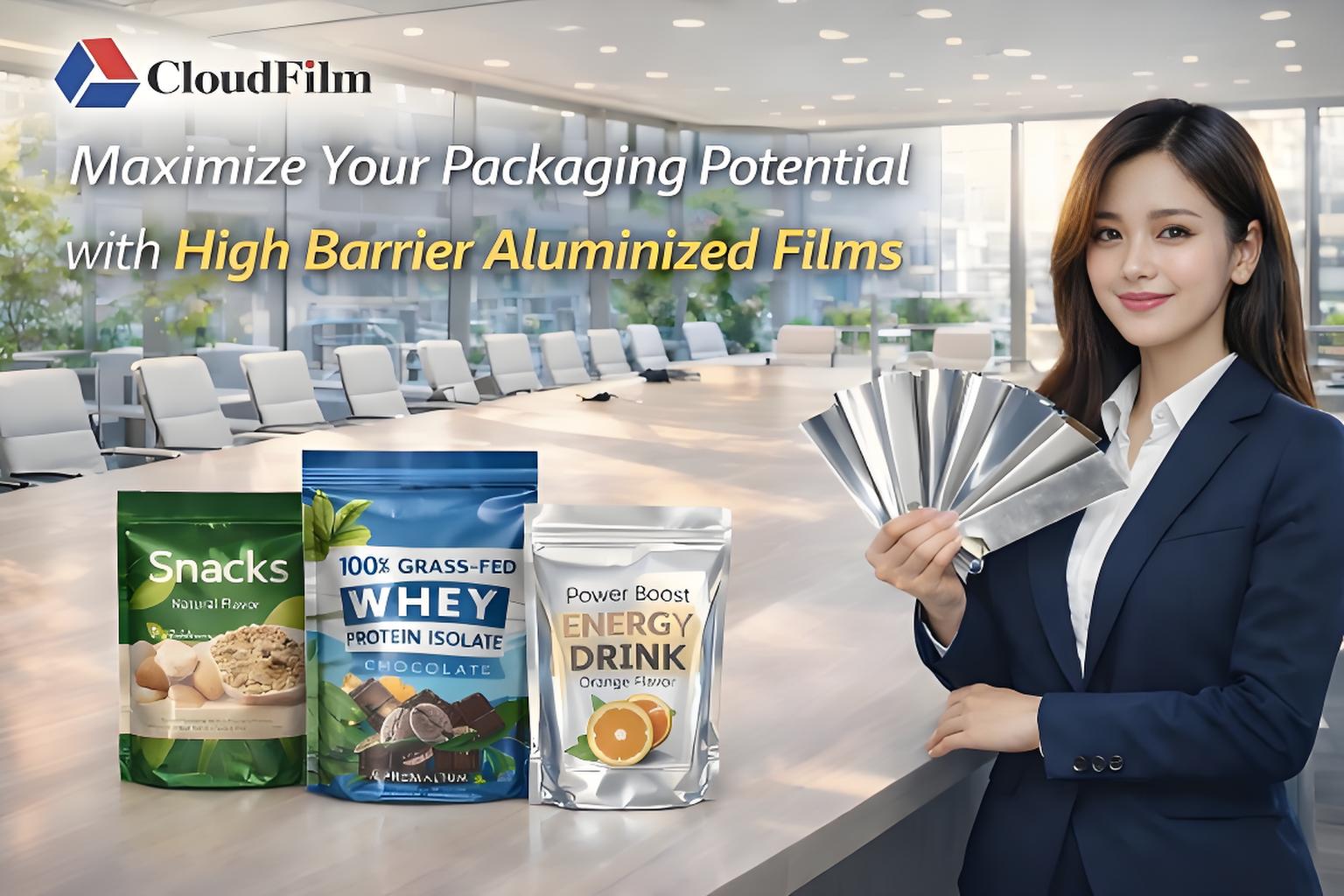
The growing use of aluminized films in flexible packaging is driven by their unique combination of high barrier performance, metallic shelf appeal, processing efficiency and cost effectiveness. When correctly specified, structures based on VMPET, VMBOPP and VMCPP can protect food, pharmaceuticals and industrial products against moisture, oxygen and light, while also enhancing brand image.
By working with an experienced supplier like CloudFilm, you can choose the right metallized film type, laminate structure and pouch format for your project. Whether you are upgrading from paper or plain plastic bags, or looking to optimize an existing high-barrier laminate, our team can support you from material selection to trial rolls and mass production.
If you are planning a new packaging project or benchmarking your current structure, feel free to contact CloudFilm for a free consultation and samples.