As brands, converters, and retailers rethink their packaging strategies, one core question keeps coming up: how do we move from difficult-to-recycle laminates to truly circular, recycling-ready films—without sacrificing performance or product safety?
This is where BOPE film (Biaxially Oriented Polyethylene film) has quickly become a strategic material. By enabling mono-PE recyclable structures, BOPE helps you simplify recycling, reduce plastic use, and support the shift toward a circular packaging economy. At the same time, it offers high strength, clarity, and printability that brand and operations teams still need.
CloudFilm, as a specialized flexible packaging film manufacturer and supplier in Qingdao, China, engineers BOPE films and related PE structures for converters and brand owners worldwide.
This guide explains how BOPE film supports recycling and environmental sustainability—and how to turn that into a clear, practical specification for your next project.
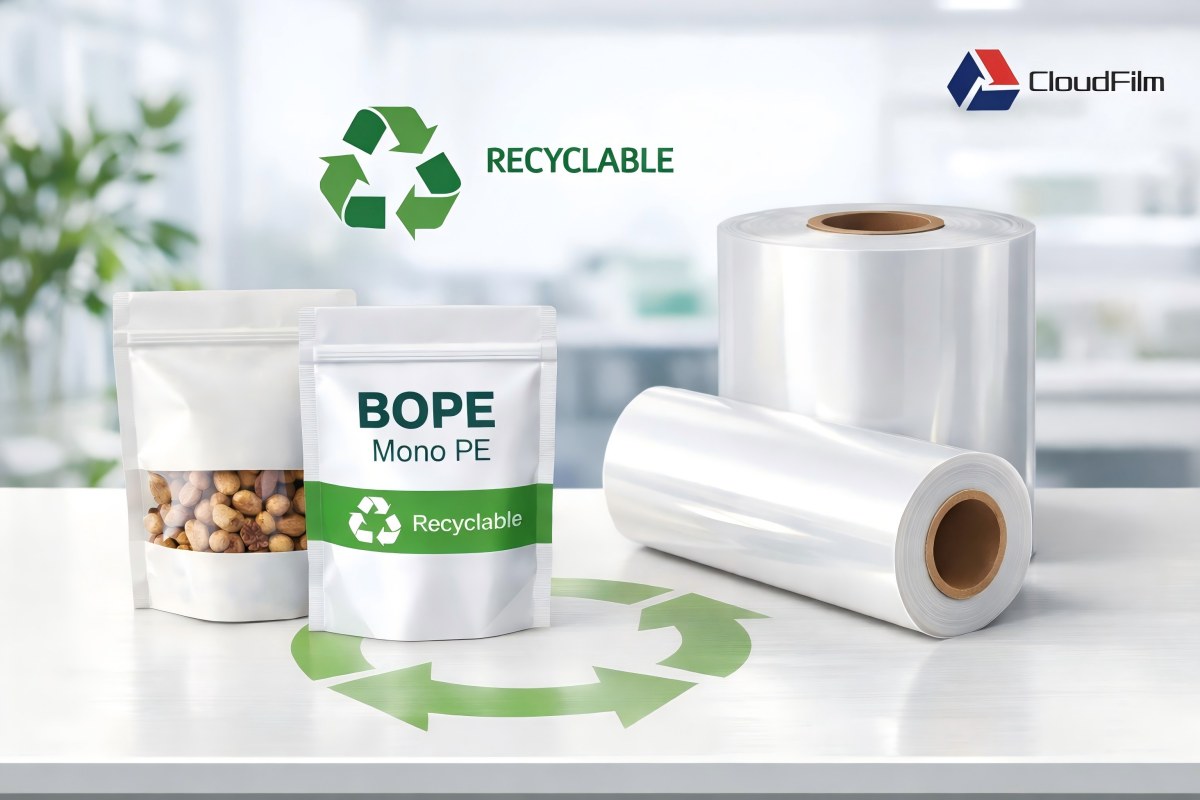
What Is BOPE Film and Why It Matters for Recycling
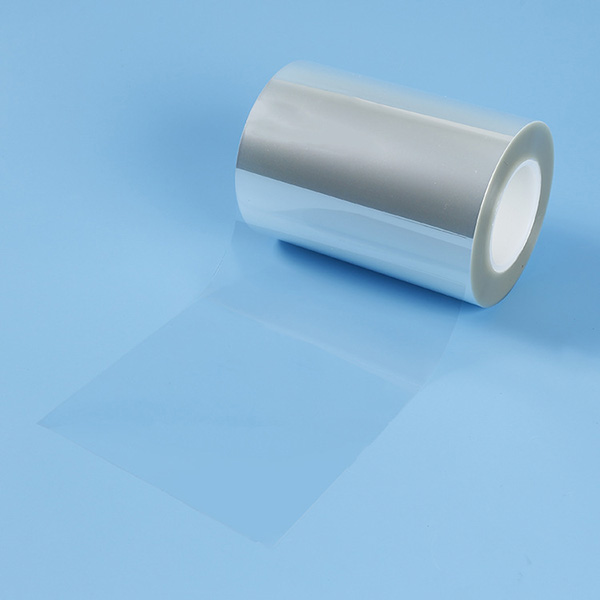
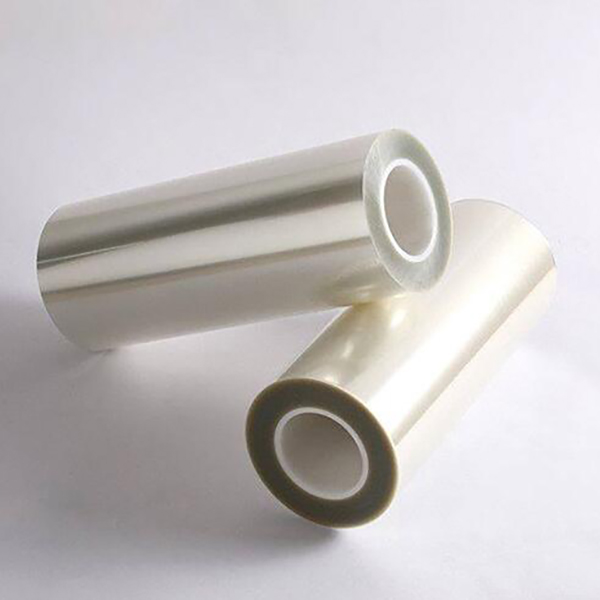
BOPE film is a biaxially oriented polyethylene film produced by stretching PE in both machine and transverse directions. This biaxial orientation transforms standard PE into a much stronger, stiffer, and clearer film, while still keeping it in the polyethylene family.
Key features include:
- Higher tensile strength and stiffness than conventional blown PE film
- Improved puncture resistance and tear resistance
- Low haze and high gloss for shelf impact
- Stable thickness and flatness, suitable for high-quality printing
- Full compatibility with PE recycling streams
Because BOPE is still fundamentally PE, it allows packaging engineers to design all-PE structures—for example, BOPE as the oriented print web combined with PE sealing layers—so that the entire pack can be collected and recycled in existing polyethylene waste streams.
Compared to other orientation technologies such as MDO PE (Machine Direction Oriented PE), BOPE offers biaxial orientation, giving more balanced mechanical properties and better performance in demanding pouch formats. For technical buyers who need a deeper comparison, see CloudFilm’s dedicated guide on MDO PE vs BOPE.
How BOPE Film Supports Recycling and Circular Packaging
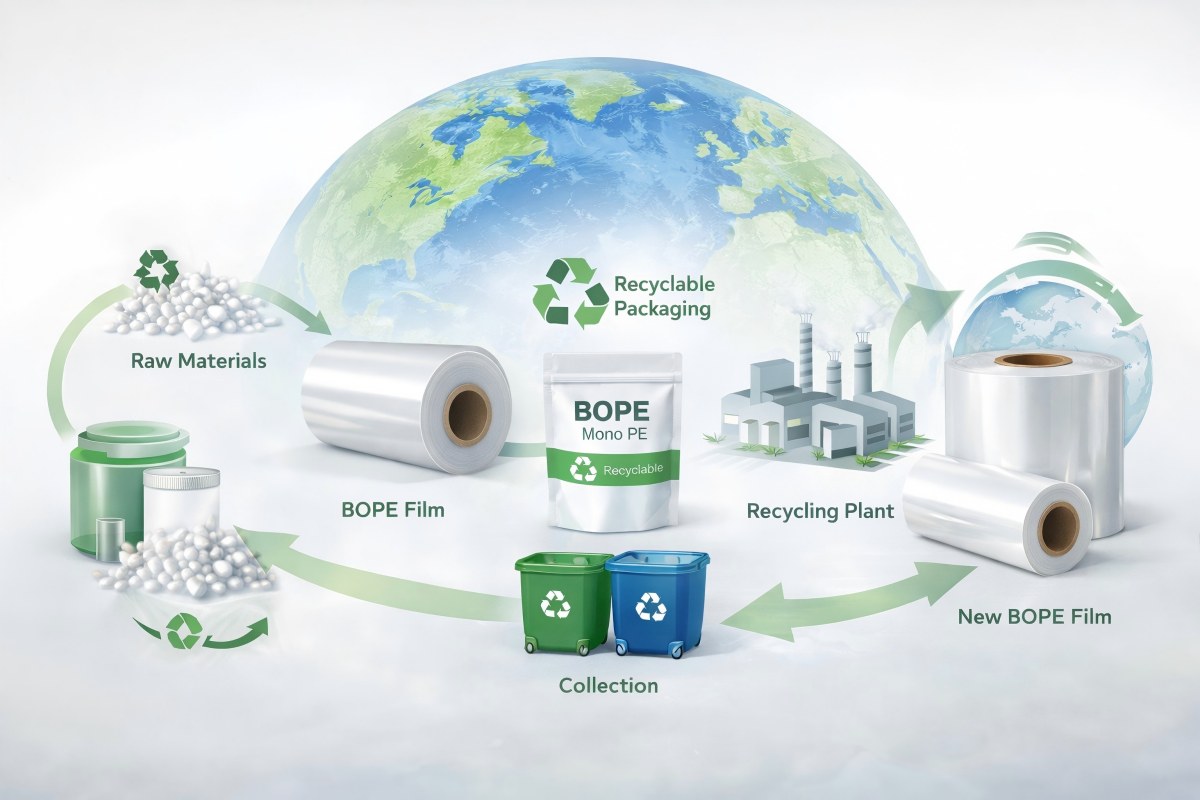
From a sustainability point of view, BOPE is valuable because it helps close the loop between design, recycling, and re-use.
Enabling Mono-PE Recyclable Structures
Traditional laminates such as PET/AL/PE or PET/PE/PA are difficult to recycle because different polymers must be separated. In contrast, BOPE allows you to use:
- BOPE / PE
- BOPE / BOPE
- BOPE / PE with PE zipper, spout, or valve
These structures are mono-material (all PE) and can be directed into PE recycling streams, which simplifies collection, sorting, and reprocessing. This aligns with the mono-material packaging trend that many brand owners use to meet their recyclability targets and retailer guidelines.
Reducing Plastic Usage and Carbon Footprint
Thanks to its higher strength and stiffness, BOPE film can often:
- Use thinner gauges while maintaining or improving pack integrity
- Replace rigid components in some applications
- Reduce product damage and associated waste by improving puncture resistance
These improvements can translate into less plastic per pack and fewer damaged products, helping to lower the total carbon footprint of the packaging system.
Working with Existing Recycling Infrastructure
Because BOPE is based on polyethylene, it is compatible with many existing PE recycling streams and equipment. When designed correctly, BOPE-based mono-PE packs can be:
- Collected and sorted with other PE films
- Washed and regranulated using standard PE recycling processes
- Reused in film-to-film or film-to-moulding applications, depending on local regulations and quality requirements
For markets that are tightening EPR (Extended Producer Responsibility) rules and retailer recyclability guidelines, this compatibility is a strong advantage.
Key Applications of BOPE Film in Sustainable Packaging
BOPE is not just a “concept material.” It is already used in a wide range of real-world applications where recyclability and performance must coexist.
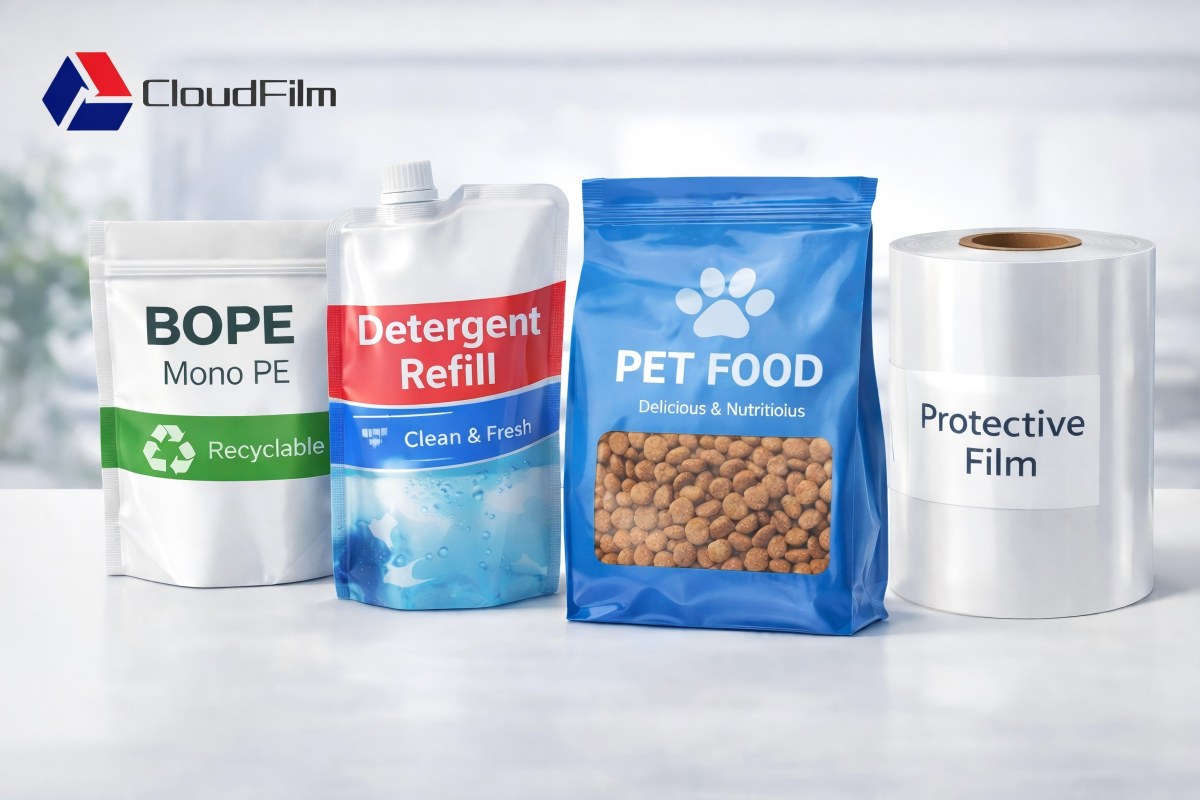
Food Packaging
For food brands, BOPE supports:
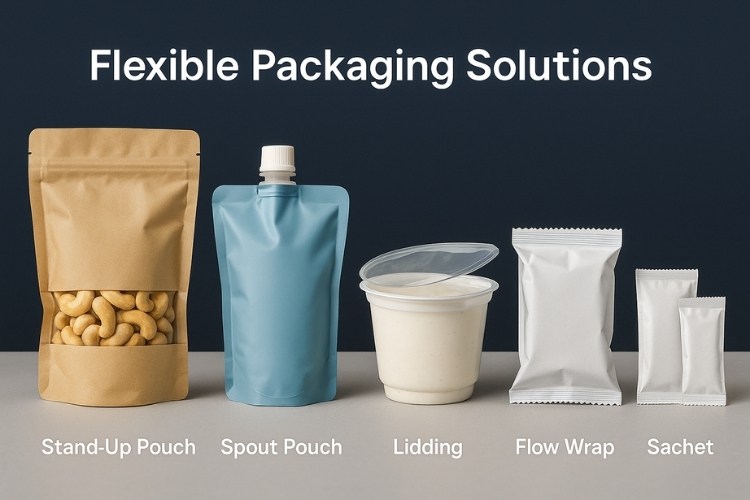
- Recyclable stand-up pouches for snacks, cereals, rice, and grains
- Frozen food pouches that require toughness and low-temperature performance
- Flow-wraps for noodles, confectionery, and bakery items
With BOPE as the oriented outer layer and PE as the inner sealing layer, brand owners can replace traditional PET/PE or PA/PE films with all-PE structures that still offer good optics, printability, and mechanical strength.
Home & Personal Care
BOPE is also suitable for:
- Detergent and household cleaner pouches
- Shampoo, body wash, and refill packs
- Refill bags for dishwashing liquids and fabric softeners
In these applications, BOPE’s stiffness and toughness help packs remain stable on shelves and during transport, while mono-PE design helps global and regional brands meet their corporate sustainable packaging roadmaps.
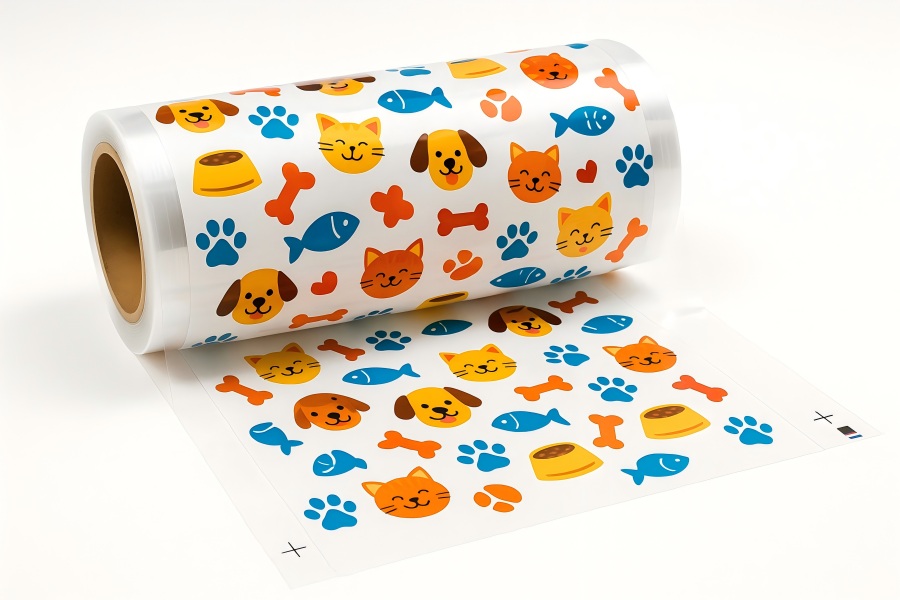
Pet Food and Treats
Pet food and treats traditionally rely on high-barrier, multi-material laminates that are hard to recycle. BOPE-based structures can, in many cases, be engineered as mono-PE with:
- Sufficient mechanical strength for heavier pack sizes
- Good printability for premium branding
- Compatibility with zippers, tear notches, and degassing valves (where technically appropriate)
When barrier requirements are moderate to high, BOPE can be combined with barrier PE (e.g., PE/EVOH/PE) layers inside an all-PE structure, keeping the pack recyclable in PE-focused systems where such structures are accepted.
Industrial and Protective Films
BOPE’s mechanical strength and dimensional stability also make it useful for:
- Surface protection films for appliances, panels, and profiles
- Secondary packaging and protective overwraps
- Other industrial wraps where recyclability and robustness are both required
By replacing mixed-material or metallized structures with BOPE-based mono-PE films, converters can simplify their product families and help their customers reduce waste.
Design Guidelines: Building a Recycling-Ready BOPE Structure
To capture the full environmental benefits of BOPE, packaging engineers and buyers should look beyond the film itself and consider the complete structure and pack design.
Define the Performance Window
Start with basic questions:
- What is the product? (dry food, liquids, pet food, tablets, etc.)
- Required shelf life and barrier (oxygen, moisture, aroma, light)
- Pack format (pillow pack, stand-up pouch, quad-seal, spouted pouch, lidding film, etc.)
- Filling process (VFFS, HFFS, pre-made pouch filling, etc.)
- Regional recycling guidelines or retailer requirements
This information allows your BOPE film manufacturer or supplier to propose the right structure—for example BOPE 25 μm / PE 60–80 μm or more specialized high-barrier all-PE structures.
Keep Components Within the PE Family
For maximum recyclability:
- Use BOPE as the oriented print web
- Use PE-based sealing films, zippers, and spouts
- Choose inks, coatings, and adhesives designed for recycling-ready laminates
- Avoid incompatible materials (e.g., PVC valves, non-PE fitments) whenever possible
CloudFilm’s BOPE product page provides typical thicknesses, mechanical properties, and processing parameters that can be used as a starting point for structure design.
You can explore these details on the BOPE Film product page.
Validate on Real Production Lines
Before a full-scale roll-out:
- Run printing and lamination trials to validate tension control and registration
- Test sealing windows across actual filling speeds and jaw temperatures
- Check pack appearance, stiffness, and drop resistance at real pack sizes
- Confirm recyclability alignment with local or retailer guidelines
Working with an experienced BOPE film supplier can significantly shorten this trial phase and reduce total project risk.
Business Perspective: Why Work with a Specialized BOPE Film Manufacturer
For converters, importers, and brand owners, BOPE is not just a material choice—it is a strategic sourcing decision. Choosing the right BOPE film manufacturer and supplier is key.
What a BOPE Supplier Should Offer
An experienced BOPE partner like CloudFilm should provide:
- Stable, export-ready quality with documented testing and certificates
- Tailor-made BOPE specifications for different applications (food, home care, pet food, industrial, etc.)
- Engineering support to convert existing PET/PA structures into mono-PE designs
- Reasonable MOQs (for example, CloudFilm’s BOPE film is typically supplied from 1000 kg upwards)
Cloud Film - Competitive lead times and logistics support for global shipments
CloudFilm acts as the international trading and solution arm of a group with a broad portfolio of BOPP/BOPET/BOPA/CPP/PE films and recyclable mono-material solutions, supplying more than 500 customers worldwide.
This experience is especially valuable when you are redesigning multiple SKUs at once.
How BOPE Fits Your Sustainability Roadmap
For brands and converters, switching to BOPE-based mono-PE structures helps to:
- Meet internal sustainable packaging targets
- Comply with retailer “recyclable packaging” guidelines
- Support EPR and plastic tax reduction strategies
- Improve brand perception among eco-conscious consumers
If you are considering a migration from traditional laminates to recyclable mono-PE, you can combine this article with CloudFilm’s broader guide on recyclable flexible packaging to build a multi-material roadmap.
FAQ – BOPE Film, Recycling and Sourcing
Below is a focused FAQ section designed to match the way buyers and engineers typically ask questions on AI platforms and search engines.
Q1. Is BOPE film really recyclable?
Yes—when BOPE is used within mono-PE structures (BOPE/PE or BOPE/BOPE/PE) and combined with PE-compatible fitments, it can generally be recycled with other polyethylene films where such streams exist. Local regulations differ, so always check regional guidelines, but structurally BOPE is designed for PE-to-PE recycling.
Q2. How is BOPE different from regular PE film?
Conventional PE film is usually produced by blown or cast processes without biaxial orientation. BOPE, by contrast, is stretched in both directions, giving:
- Higher tensile strength and modulus
- Better puncture resistance
- Improved flatness and printability
This allows thinner films and higher performance in demanding pouch formats.
Q3. BOPE vs MDO PE – which is better for sustainable packaging?
Both BOPE and MDO PE aim to improve PE’s mechanical properties, but:
- MDO PE is oriented mainly in the machine direction
- BOPE is oriented in both machine and transverse directions
For many pouches and bags that require balanced strength and stiffness, BOPE can be more suitable. The best choice depends on your structure, line, and target markets, which is why CloudFilm provides both options and a detailed MDO PE vs BOPE comparison.
Q4. What packaging formats are most suitable for BOPE?
Typical BOPE applications include:
- Pillow packs and flow-wraps
- Stand-up pouches (with or without zipper)
- Frozen food and liquid refill packs
- Medium to large pet food bags
- Industrial overwraps and protection films
If your project involves PE-rich packaging and you want recyclability, BOPE is a strong candidate.
Q5. Can BOPE-based packs achieve high barrier?
Yes, but usually with support from barrier PE layers. Common strategies include:
- Laminating BOPE to EVOH-based PE films
- Using coatings and structures that remain within the PE family
CloudFilm’s PE and high-barrier film portfolio includes options that can be combined into recycling-friendly mono-material structures for many foods and personal care products.
Q6. What should I prepare before contacting a BOPE film manufacturer?
To get a fast and accurate recommendation, prepare:
- Product type(s) and pack sizes
- Current or target structure (e.g., PET/PE, PA/PE, etc.)
- Barrier requirements (O₂, WVTR, aroma, light)
- Packaging line type and speed
- Target markets and recyclability claims you want to achieve
Sharing this information allows suppliers like CloudFilm to quickly propose BOPE film specs, thicknesses, and trial plans.
Q7. What are the typical MOQs and lead times for BOPE film from CloudFilm?
As a reference, CloudFilm’s BOPE films are typically supplied from around 1000 kg per spec with roll widths tailored to your converting equipment.
Lead times depend on structure complexity and volume but are generally competitive for both trial and commercial orders. For urgent projects, you can discuss stocking or phased delivery solutions.
Q8. Can BOPE film run on my existing converting and packing equipment?
In most cases, yes. BOPE is designed to be compatible with:
- Standard rotogravure or flexographic printing
- Solvent or solvent-free lamination
- VFFS / HFFS lines and pouch-making equipment
You may need to fine-tune tension settings, sealing parameters, and knife design, but with supplier technical support, most converters can integrate BOPE with limited modification.
Q9. How does BOPE support my brand’s sustainability storytelling?
Because BOPE enables recyclable mono-PE packaging, you can communicate:
- “Designed for recycling” or “mono-material PE packaging” where regulations allow
- Verified material reductions compared with previous structures
- Alignment with retailer and NGO sustainable packaging frameworks
CloudFilm can provide basic technical documentation to support your internal sustainability and marketing teams.
Conclusion: Turn BOPE Sustainability into a Clear Specification
BOPE film sits at the intersection of performance, recyclability, and business reality. It allows you to:
- Replace hard-to-recycle multi-material laminates with mono-PE structures
- Reduce plastic usage while maintaining product protection
- Align with global recycling and circular economy targets
- Work with a specialized BOPE film manufacturer and supplier to manage risk and speed up projects
If you are evaluating BOPE for your next packaging upgrade, you can begin with a single pilot project—such as a snack pouch, detergent refill, or pet food bag—and then scale across your portfolio once the results are validated.
CloudFilm’s engineering team is ready to help you translate sustainability goals into real film specifications, trials, and long-term supply programs.