Introduction: Why MDO PE and BOPE Matter for Mono-PE Packaging
In today’s flexible packaging market, brand owners and converters are under pressure to move from mixed-material laminates to recyclable mono-PE structures that can enter existing PE recycling streams. Within this transition, MDO PE (Machine Direction Oriented PE) and BOPE (Biaxially Oriented PE) have become two of the most important oriented PE films.
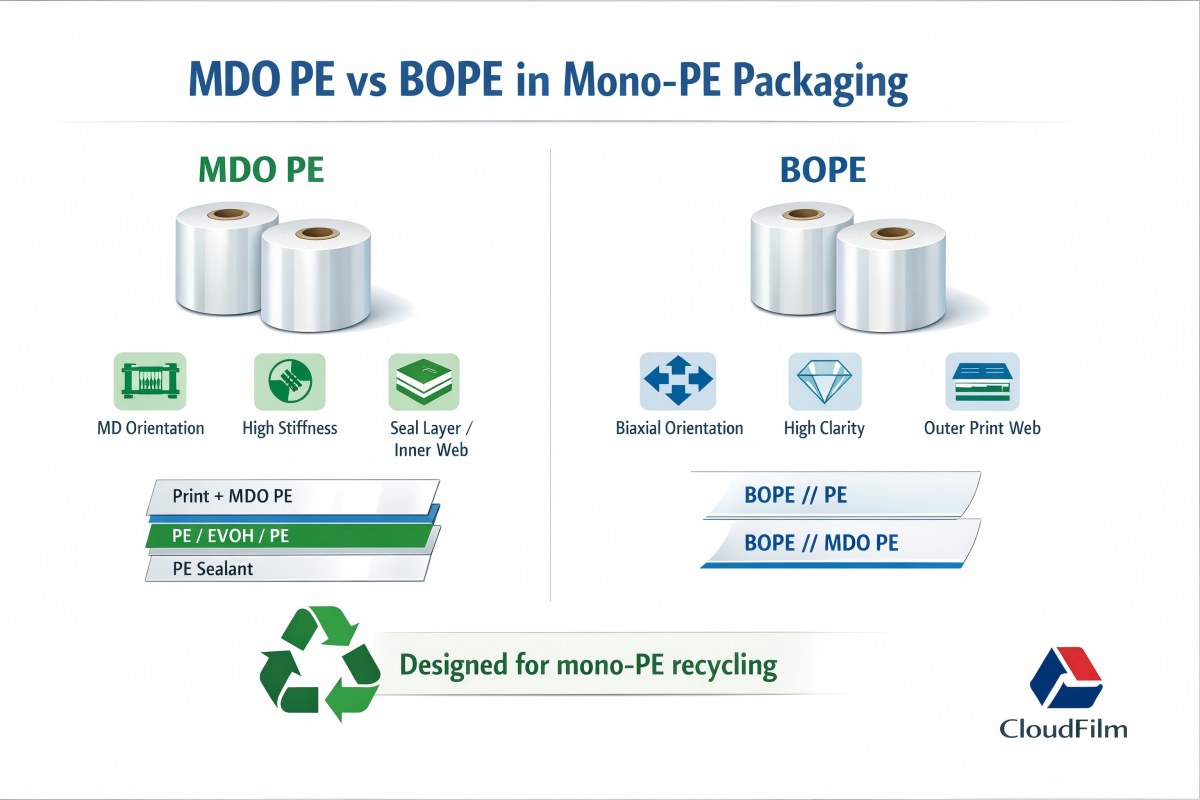
MDO PE is produced by stretching polyethylene mainly in the machine direction (MD). This uni-axial orientation delivers higher stiffness, improved tensile strength and better clarity compared with conventional blown PE, while retaining very good sealing performance. It is widely used as a stiff inner web or sealing web in PE-based laminates.
BOPE is stretched in both MD and TD (transverse direction) on a tenter line. This biaxial orientation creates a film with balanced strength, excellent flatness and very high transparency, making it ideal as an outer printable web in many mono-PE laminates that replace PET or PA.
For buyers who want 100% PE recyclable pouches, PE-PE laminates or PE-based roll stock, understanding MDO PE vs BOPE is critical. Choosing the right PE film combination helps improve shelf impact, machinability and recyclability, while controlling total packaging cost.
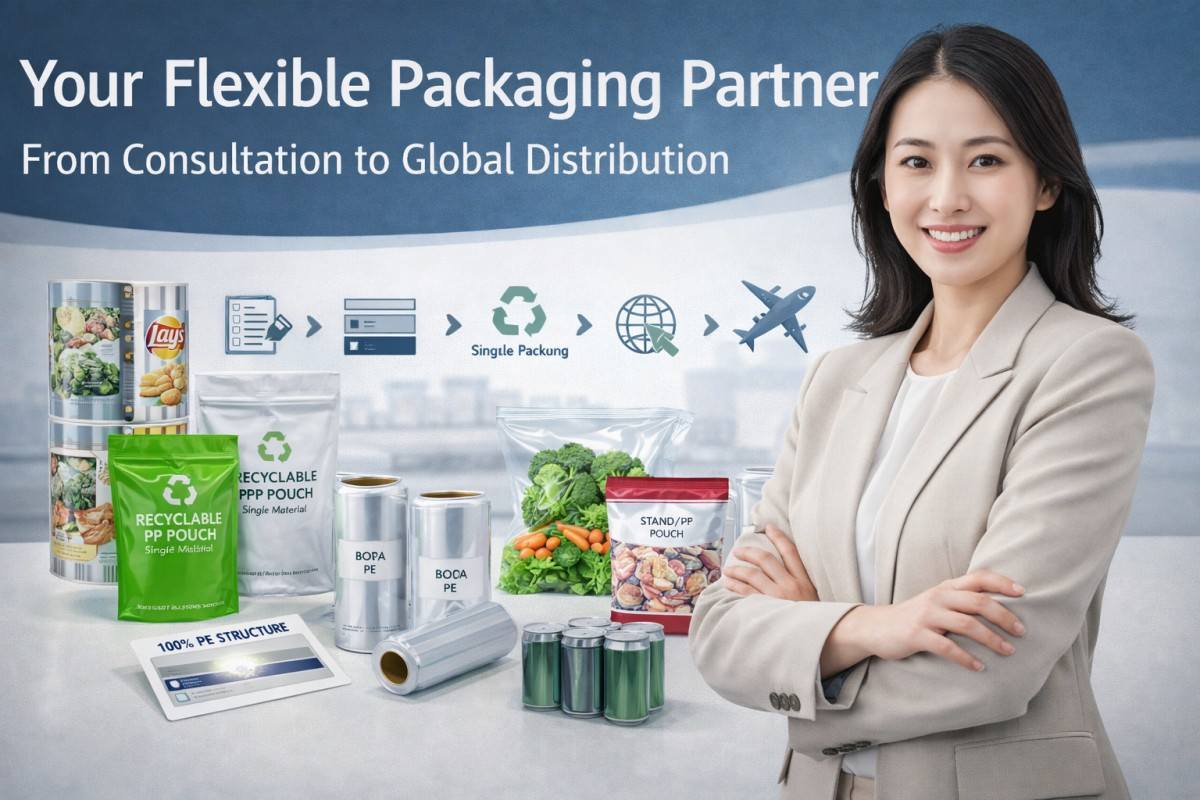
CloudFilm is not only a PE film producer but also a solution provider for mono-PE flexible packaging, supplying both MDO PE film and BOPE film, as well as finished PE pouches used in food, pet food, personal care and industrial markets.

Comparison of Production Processes
MDO PE uses a mono – axial orientation process, focusing on stretching the film in the machine direction. This process makes the molecular chains in the length direction of the film more regular, effectively improving its physical properties such as strength and transparency.
Generally, the films produced by this process are thinner and have high toughness, which is very suitable for applications that require specific film thickness and toughness.
BOPE uses a biaxial orientation process, first in the machine direction and then in the transverse direction. Under this process, the film can be uniformly stretched in both directions, and the molecular chains are more orderly arranged in both directions. This process significantly improves the strength, transparency, and uniformity of the film, enabling it to better meet the requirements of high – precision printing and complex packaging.
For example, in the packaging of some products that require exquisite printed patterns and precise packaging dimensions, BOPE shows its unique advantages.
Production Process Comparison: MDO PE vs BOPE
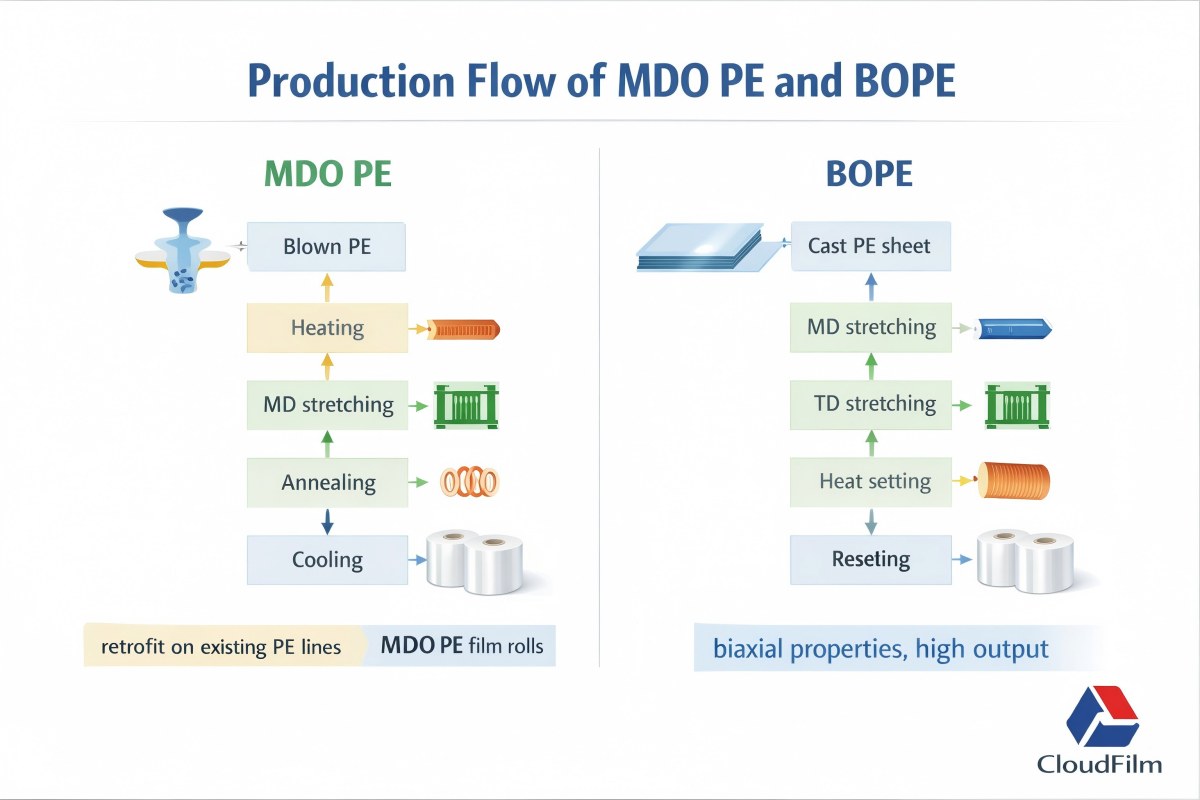
MDO PE production
- A PE base film (blown or cast) is first extruded and cooled.
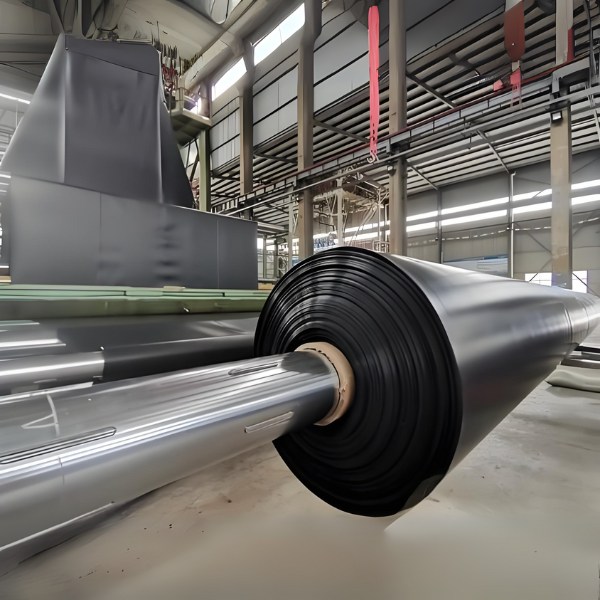
- The film then passes through an inline MDO unit, where it is heated and stretched mainly in the machine direction.
- Controlled temperature zones and draw ratios align the molecules along the running direction, creating higher stiffness, tensile strength and better optical performance than standard PE.
- Because MDO units can often be retrofitted on existing PE lines, investment cost is relatively moderate and changeover is flexible.
BOPE production
- BOPE is produced on tenter-frame lines, similar to BOPP or BOPET.
- The PE base sheet is heated and stretched first in MD, then in TD, followed by heat setting.
- This biaxial orientation gives BOPE very high and balanced strength, excellent flatness and low gauge variation.
- BOPE lines usually require higher CAPEX and dedicated resins but provide very high output for large-volume markets such as snacks and frozen food.
In simple terms: MDO PE is “mainly MD-oriented” and ideal as an inner or sealing web, while BOPE is “MD+TD-oriented” and ideal as an outer, high-clarity print web.
Performance Comparison: Strength, Optics and Downgauging
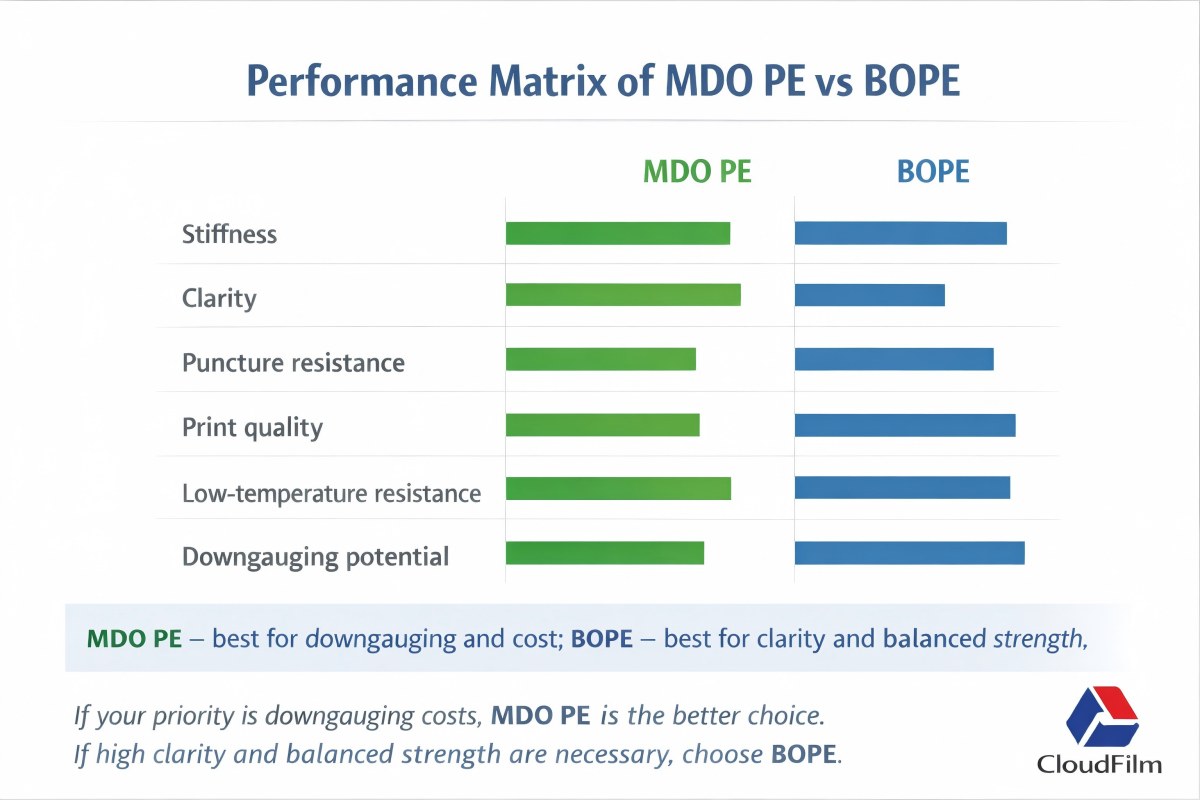
Key performance features of MDO PE
- High stiffness and tensile strength in MD, enabling downgauging versus conventional LDPE/LLDPE.
- Good clarity and gloss, sufficient for most food, hygiene and household packaging where ultra-high transparency is not mandatory.
- Improved puncture and tear resistance (especially in MD) compared with standard PE films.
- Wide sealing window when used as an inner web or sealing web in mono-PE structures.
CloudFilm’s MDO PE film grades are designed for:
- Recyclable mono-PE pouches and PE-based laminates, often combined with barrier cores like PE-EVOH-PE.
- Lidding films and flow-wrap films for frozen food and snacks.
- Hygiene backsheet films and industrial liners where stiffness and downgauging are important.
Key performance features of BOPE
- Very high tensile strength and stiffness, with MD/TD balance better than uni-oriented films.
- Outstanding transparency and low haze, delivering PET-like shelf appearance.
- Excellent gauge uniformity and flatness, improving print registration and lamination stability.
- Good low-temperature impact resistance, suitable for cold-chain and frozen food applications.
CloudFilm’s BOPE film is widely used where you need PET-like optics in a mono-PE structure, especially in high-end snack packs, candy packaging bags, coffee packaging bags and frozen food pouches.
Application Scenarios and Mono-PE Structures
Typical MDO PE applications
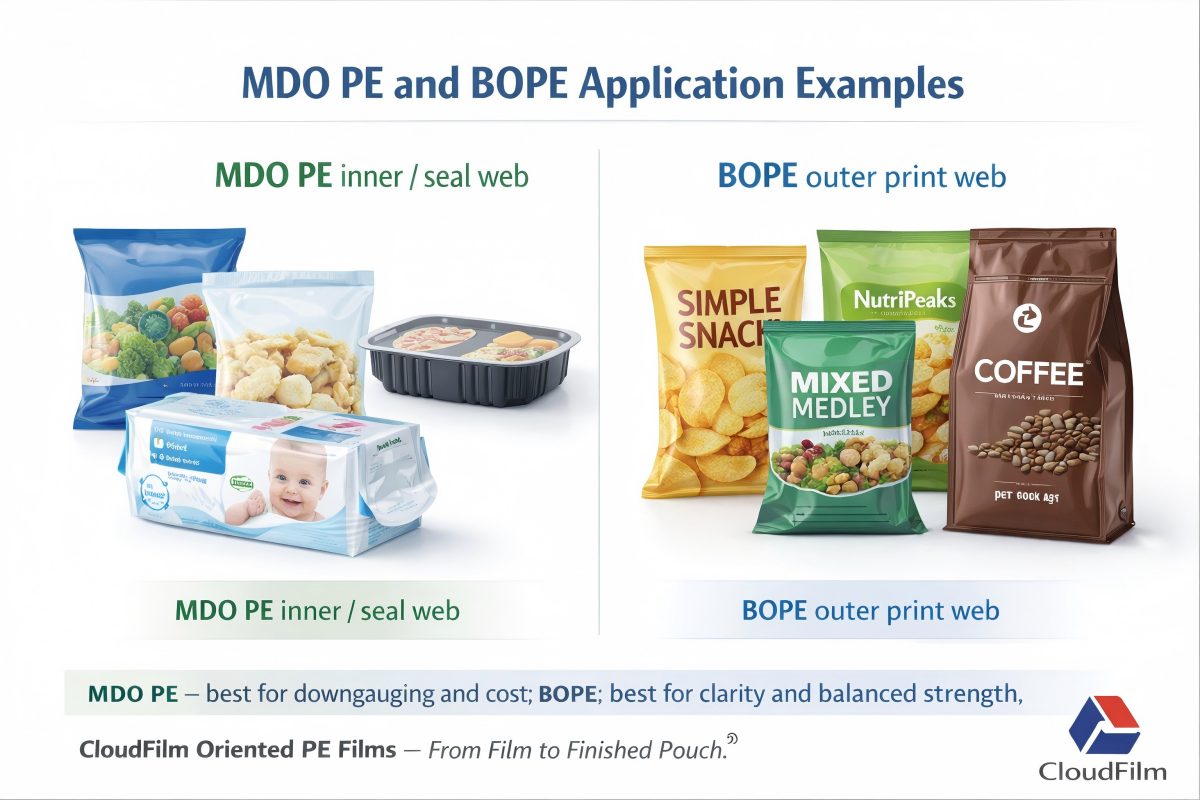
MDO PE is preferred where stiffness, downgauging and good sealability are critical:
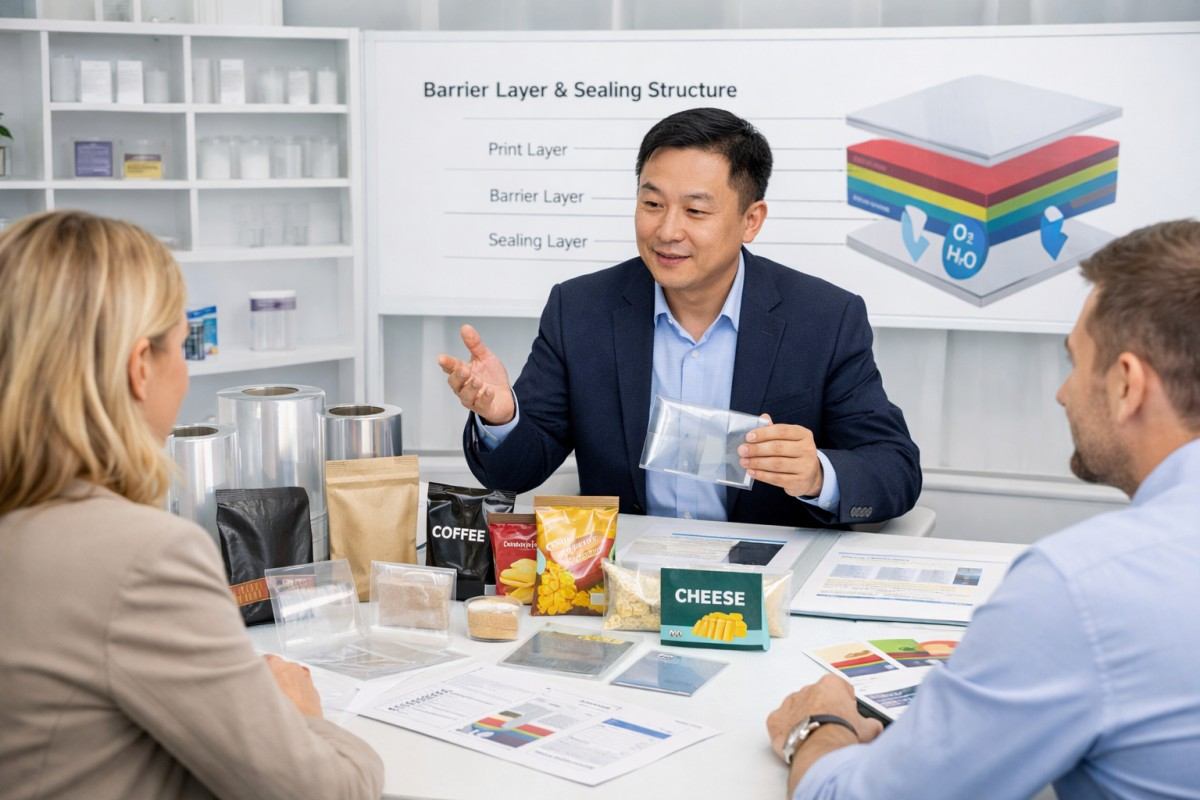
- Inner webs or sealing webs in mono-PE pouches such as MDO PE // PE-EVOH-PE // PE.
- Lidding films and pillow bags for frozen food and snacks.
- Hygiene backsheet films where softness and mechanical strength must be balanced.
- Industrial liners and heavy-duty sacks needing better stacking and handling.
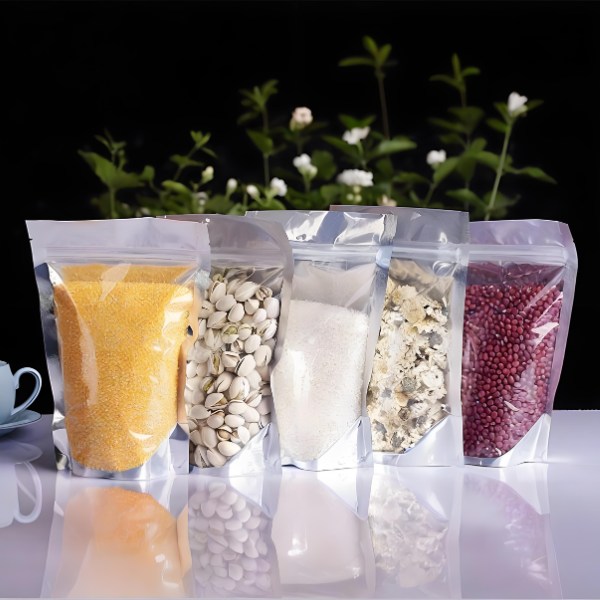
You can see how MDO PE is integrated into complete solutions through CloudFilm’s food packaging film , PE pouches and recyclable pouches.
Typical BOPE applications
BOPE is chosen where premium appearance, print quality and toughness are required:
- Outer print webs for high-impact snack and candy packaging bags – see CloudFilm’s candy packaging bags.
- Premium coffee packaging bags where PET replacement and mono-PE design are important – see coffee packaging bags.
- Pharmaceutical pouches where clarity is needed for visual inspection – see pharmaceutical pouches.
- Frozen food and cold-chain bags that need strong, tear-resistant films.
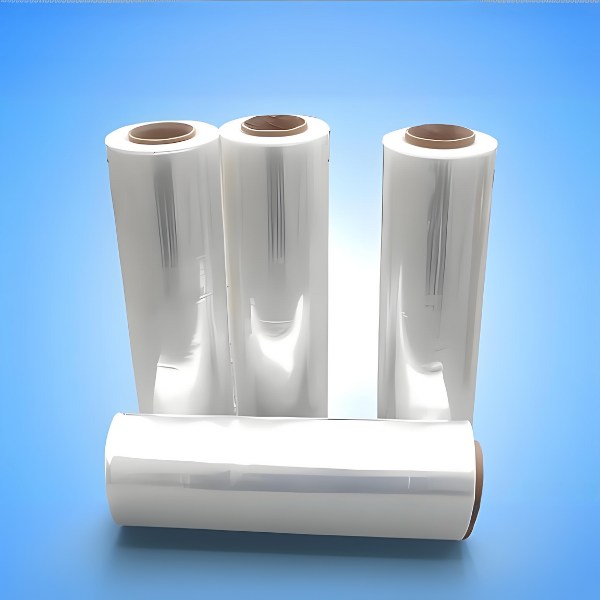
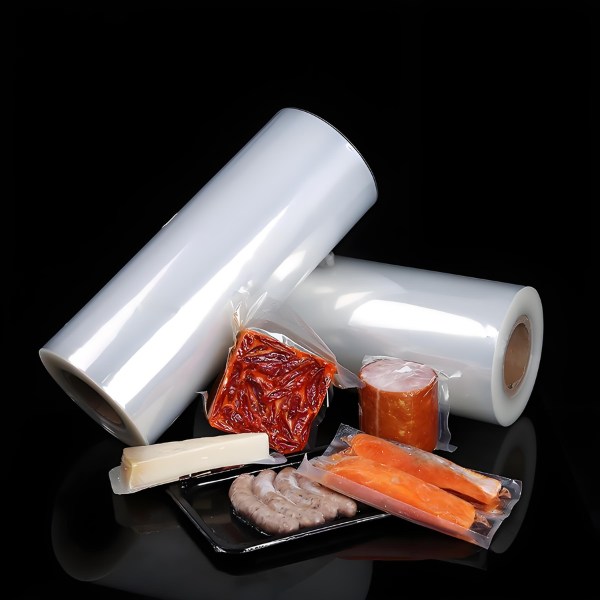
CloudFilm also supports customers who need transparent roll stock for automatic FFS lines through clear plastic film and clear poly film, which can be tailored with MDO PE and BOPE grades.
Environmental Performance and Full-PE Systems
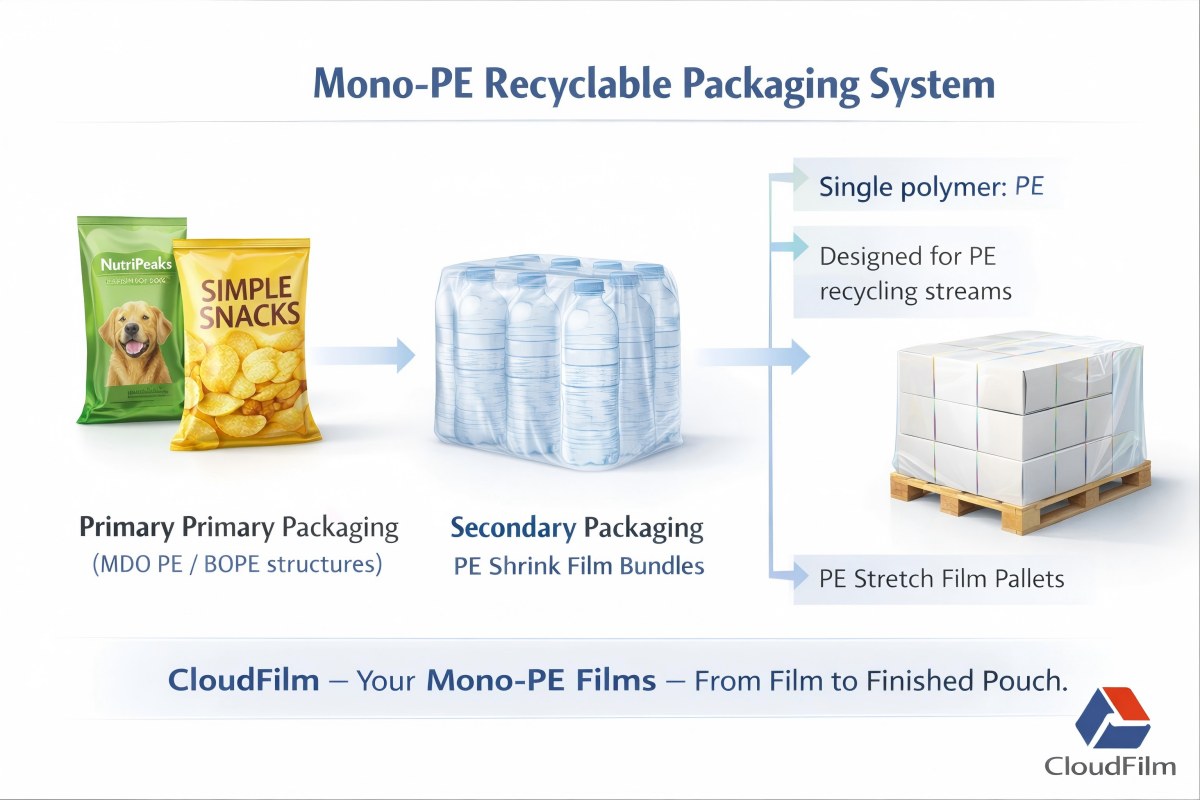
Because both MDO PE and BOPE are polyethylene, they are ideal building blocks for mono-PE recyclable structures:
- MDO PE-based laminates (for example MDO PE // PE-EVOH-PE // PE) can replace many PET/PE structures while staying within “PE-only” material families.
- BOPE-based laminates offer PET-like optics and balanced mechanical properties in mono-PE pouches such as BOPE // PE or BOPE // MDO PE.
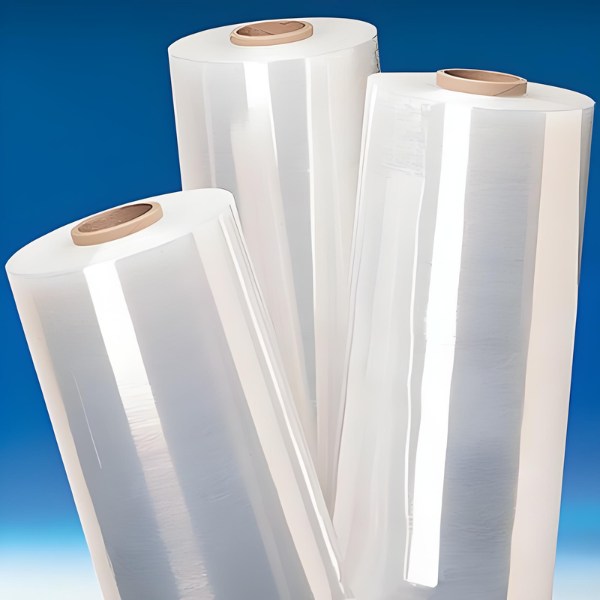
To extend sustainability beyond primary packaging, CloudFilm also offers PE-based films for secondary and tertiary packaging: PE shrink film for bundling and PE stretch film for pallet wrapping. This allows customers to move step-by-step toward a full-PE packaging system.
How to Choose Between MDO PE and BOPE & How CloudFilm Helps
When planning a new mono-PE packaging project, consider:
- Role in the laminate
- Choose MDO PE when you need a stiff inner or sealing web with good seal integrity and downgauging potential.
- Choose BOPE when you need a high-clarity, stiff outer print web to replace PET or PA.
- End-use category
- Snacks, confectionery, premium coffee and pet food often benefit from BOPE outer + MDO PE or PE inner.
- Hygiene backsheet, lidding and some industrial sacks may work well with MDO PE + PE structures only.
- Recyclability targets
- For strict recycling guidelines, prioritize simple mono-PE structures such as BOPE/PE, BOPE/MDO PE or MDO PE/PE, and avoid unnecessary non-PE layers.
- Existing equipment
- BOPE’s high flatness helps high-speed printing and lamination; MDO PE’s sealability helps form-fill-seal performance. Trial reels from CloudFilm are the safest way to confirm.
CloudFilm supports you through:
- Film selection and structure design for each project.
- Sample reels of MDO PE film and BOPE film for line trials.
- Trial pouches based on PE pouches and recyclable pouches.
- Application-specific solutions for food packaging film, candy packaging bags, coffee packaging bags and pharmaceutical pouches.
FAQ – MDO PE vs BOPE
Q1. What is the main technical difference between MDO PE and BOPE?
MDO PE is uni-axially oriented in the machine direction, giving high stiffness and strength mainly in MD. BOPE is biaxially oriented in MD and TD, resulting in more balanced strength, better flatness and very high clarity.
Q2. When should I choose MDO PE instead of BOPE?
Choose MDO PE when your priority is stiffness + downgauging + sealability and when ultra-high clarity is not required, for example in lidding films, pillow bags, hygiene backsheet and some industrial liners.
Q3. When is BOPE the better option?
BOPE is usually better when you need PET-like optics and balanced strength, especially for high-end snack, candy, coffee and frozen food packaging that must look premium on the shelf while still aiming for mono-PE recyclability.
Q4. Can I combine MDO PE and BOPE in one pouch?
Yes. Many successful mono-PE pouches use BOPE as the outer print web and MDO PE (or PE-EVOH-PE) as the inner web, balancing appearance, mechanical performance and recyclability.
Q5. Are these structures really recyclable in practice?
From a material standpoint, mono-PE structures designed with MDO PE and BOPE are compatible with PE recycling streams. Actual recyclability depends on local collection and sorting infrastructure, and on the overall pack design (inks, closures, non-PE components).
Q6. How can CloudFilm support my trials?
CloudFilm can supply sample reels of MDO PE film and BOPE film, plus trial packs based on PE pouches and recyclable pouches, and help you fine-tune thickness, width and structure.